



TIM ANGLADE PROUDLY PRESENTS PART TWO 
OF THE TOTALLY UNKOWN “FUN & PROFIT” 
SERIES. A TALE OF TECH, INTRIGUE 
&! FORBIDDEN LOVE. A WHIRLWIND OF 
ADVENTURERS, PRODUCTION SYSTEMS 
&!TROLLS. A STORY SO BIG, ITS TITLE HAD TO 
HAVE ITS OWN INTRODUCTION TEXT. HERE IS… 
NOSQL Profit!& forFun
@TIMANGLADE 
Hit me up. I don’t bite… too hard.
AN ANNOUNCEMENT
NØSQL rope!Eu 
LONDON, APRIL 20TH & 21ST 
WORKSHOPS AND TRAINING ON THE 22ND 
FOLLOW @NOSQLEU FOR DETAILS
A WARNING 
This is Tech for Managers. Don’t Blame Me.
40 YEARS 
IN THE DESERT
Information Retrieval P. BAXENDALE, Editor 
A Relational Model of Data for 
Large Shared Data Banks 
E. F. CODD 
IBM Research Laboratory, San Jose, California 
Future users of large data banks must be protected from 
having to know how the data is organized in the machine (the 
internal representation). A prompting service which supplies 
such information is not a satisfactory solution. Activities of users 
at terminals and most application programs should remain 
unaffected when the internal representation of data is changed 
and even when some aspects of the external representation 
are changed. Changes in data representation will often be 
needed as a result of changes in query, update, and report 
traffic and natural growth in the types of stored information. 
Existing noninferential, formatted data systems provide users 
with tree-structured files or slightly more general network 
models of the data. In Section 1, inadequacies of these models 
are discussed. A model based on n-ary relations, a normal 
form for data base relations, and the concept of a universal 
data sublanguage are introduced. In Section 2, certain opera-tions 
on relations (other than logical inference) are discussed 

and applied to the problems of redundancy and consistency 
in the user’s model. 
KEY WORDS AND PHRASES: data bank, data base, data structure, data 
organization, hierarchies of data, networks of data, relations, derivability, 
redundancy, consistency, composition, join, retrieval language, predicate 
calculus, security, data integrity 
CR CATEGORIES: 3.70, 3.73, 3.75, 4.20, 4.22, 4.29 
1. Relational Model and Normal Form 
1 .I. INTR~xJ~TI~N 
This paper is concerned with the application of ele-mentary 
relation theory to systems which provide shared 
access to large banks of formatted data. Except for a paper 
by Childs [l], the principal application of relations to data 
systems has been to deductive question-answering systems. 
Levein and Maron [2] provide numerous references to work 
in this area. 
In contrast, the problems treated here are those of data 
independence-the independence of application programs 
and terminal activities from growth in data types and 
changes in data representation-and certain kinds of data 
inconsistency which are expected to become troublesome 
even in nondeductive systems. 
Volume 13 / Number 6 / June, 1970 
The relational view (or model) of data described in 
Section 1 appears to be superior in several respects to the 
graph or network model [3,4] presently in vogue for non-inferential 
systems. It provides a means of describing data 
with its natural structure only-that is, without superim-posing 
any additional structure for machine representation 
purposes. Accordingly, it provides a basis for a high level 
data language which will yield maximal independence be-tween 
programs on the one hand and machine representa-tion 
and organization of data on the other. 
A further advantage of the relational view is that it 
forms a sound basis for treating derivability, redundancy, 
and consistency of relations-these are discussed in Section 
2. The network model, on the other hand, has spawned a 
number of confusions, not the least of which is mistaking 
the derivation of connections for the derivation of rela-tions 
(see remarks in Section 2 on the “connection trap”). 
Finally, the relational view permits a clearer evaluation 
of the scope and logical limitations of present formatted 
data systems, and also the relative merits (from a logical 
standpoint) of competing representations of data within a 
single system. Examples of this clearer perspective are 
cited in various parts of this paper. Implementations of 
systems to support the relational model are not discussed. 
1.2. DATA DEPENDENCIESIN PRESENTS YSTEMS 
The provision of data description tables in recently de-veloped 
information systems represents a major advance 
toward the goal of data independence [5,6,7]. Such tables 
facilitate changing certain characteristics of the data repre-sentation 
stored in a data bank. However, the variety of 
data representation characteristics which can be changed 
without logically impairing some application programs is 
still quite limited. Further, the model of data with which 
users interact is still cluttered with representational prop-erties, 
particularly in regard to the representation of col-lections 
of data (as opposed to individual items). Three of 
the principal kinds of data dependencies which still need 
to be removed are: ordering dependence, indexing depend-ence, 
and access path dependence. In some systems these 
dependencies are not clearly separable from one another. 
1.2.1. Ordering Dependence. Elements of data in a 
data bank may be stored in a variety of ways, some involv-ing 
no concern for ordering, some permitting each element 
to participate in one ordering only, others permitting each 
element to participate in several orderings. Let us consider 
those existing systems which either require or permit data 
elements to be stored in at least one total ordering which is 
closely associated with the hardware-determined ordering 
of addresses. For example, the records of a file concerning 
parts might be stored in ascending order by part serial 
number. Such systems normally permit application pro-grams 
to assume that the order of presentation of records 
from such a file is identical to (or is a subordering of) the 
Communications of the ACM 377
form for data base relations, and the concept of a universal 
data sublanguage are introduced. In Section 2, certain opera-tions 
on relations (other than logical inference) are discussed 
and applied to the problems of redundancy and consistency 
in the user’s model. 
KEY WORDS AND PHRASES: data bank, data base, data structure, data 
organization, hierarchies of data, networks of data, relations, derivability, 
redundancy, consistency, composition, join, retrieval language, predicate 
calculus, security, data integrity 
CR CATEGORIES: 3.70, 3.73, 3.75, 4.20, 4.22, 4.29 
1. Relational Model and Normal Form 
1 .I. INTR~xJ~TI~N 
This paper is concerned with the application of ele-mentary 
relation theory to systems which provide shared 
access to large banks of formatted data. Except for a paper 
by Childs [l], the principal application of relations to data 
systems has been to deductive question-answering systems. 
Levein and Maron [2] provide numerous references to work 
in this area. 
In contrast, the problems treated here are those of data 
independence-the independence of application programs 
and terminal activities from growth in data types and 
changes in data representation-and certain kinds of data 
inconsistency which are expected to become troublesome 
even in nondeductive systems. 
Volume 13 / Number 6 / June, 1970 
systems to support the relational model are not discussed. 
1.2. DATA DEPENDENCIESIN PRESENTS YSTEMS 
The provision of data description tables in recently de-veloped 
information systems represents a major advance 
toward the goal of data independence [5,6,7]. Such tables 
facilitate changing certain characteristics of the data repre-sentation 
stored in a data bank. However, the variety of 
data representation characteristics which can be changed 
without logically impairing some application programs is 
still quite limited. Further, the model of data with which 
users interact is still cluttered with representational prop-erties, 
particularly in regard to the representation of col-lections 
of data (as opposed to individual items). Three of 
the principal kinds of data dependencies which still need 
to be removed are: ordering dependence, indexing depend-ence, 
and access path dependence. In some systems these 
dependencies are not clearly separable from one another. 
1.2.1. Ordering Dependence. Elements of data in a 
data bank may be stored in a variety of ways, some involv-ing 
no concern for ordering, some permitting each element 
to participate in one ordering only, others permitting each 
element to participate in several orderings. Let us consider 
those existing systems which either require or permit data 
elements to be stored in at least one total ordering which is 
closely associated with the hardware-determined ordering 
of addresses. For example, the records of a file concerning 
parts might be stored in ascending order by part serial 
number. Such systems normally permit application pro-grams 
to assume that the order of presentation of records 
from such a file is identical to (or is a subordering of) the 
Communications of the ACM 377
WHAT DO YOU MEAN 
BY “THE DESERT”?
THE GOOD 
A strong ecosystem.
THE BAD 
Databases on ACID.
THE UGLY 
Paradigm Puzzlement.
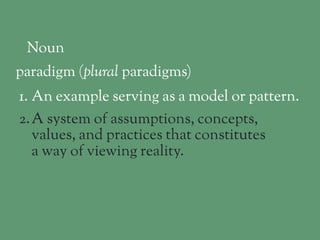
Noun 
paradigm (plural!paradigms) 
1. An example serving as a model or pattern. 
2.A system of assumptions, concepts, 
values, and practices that constitutes 
a way of viewing reality.
S!Just L 
say no
A NOT-SO-NOVEL 
IDEA
Information Retrieval P. BAXENDALE, Editor 
A Relational Model of Data for 
Large Shared Data Banks 
E. F. CODD 
IBM Research Laboratory, San Jose, California 
Future users of large data banks must be protected from 
having to know how the data is organized in the machine (the 
internal representation). A prompting service which supplies 
such information is not a satisfactory solution. Activities of users 
at terminals and most application programs should remain 
unaffected when the internal representation of data is changed 
and even when some aspects of the external representation 
are changed. Changes in data representation will often be 
needed as a result of changes in query, update, and report 
traffic and natural growth in the types of stored information. 
Existing noninferential, formatted data systems provide users 
with tree-structured files or slightly more general network 
models of the data. In Section 1, inadequacies of these models 
are discussed. A model based on n-ary relations, a normal 
form for data base relations, and the concept of a universal 
data sublanguage are introduced. In Section 2, certain opera-tions 
on relations (other than logical inference) are discussed 
and applied to the problems of redundancy and consistency 
in the user’s model. 
KEY WORDS AND PHRASES: data bank, data base, data structure, data 
organization, hierarchies of data, networks of data, relations, derivability, 
redundancy, consistency, composition, join, retrieval language, predicate 
calculus, security, data integrity 
CR CATEGORIES: 3.70, 3.73, 3.75, 4.20, 4.22, 4.29 
1. Relational Model and Normal Form 
1 .I. INTR~xJ~TI~N 
This paper is concerned with the application of ele-mentary 
relation theory to systems which provide shared 
access to large banks of formatted data. Except for a paper 
by Childs [l], the principal application of relations to data 
systems has been to deductive question-answering systems. 
Levein and Maron [2] provide numerous references to work 
in this area. 
In contrast, the problems treated here are those of data 
independence-the independence of application programs 
and terminal activities from growth in data types and 
changes in data representation-and certain kinds of data 
inconsistency which are expected to become troublesome 
even in nondeductive systems. 
Volume 13 / Number 6 / June, 1970 
The relational view (or model) of data described in 
Section 1 appears to be superior in several respects to the 
graph or network model [3,4] presently in vogue for non-inferential 
systems. It provides a means of describing data 
with its natural structure only-that is, without superim-posing 
any additional structure for machine representation 
purposes. Accordingly, it provides a basis for a high level 
data language which will yield maximal independence be-tween 
programs on the one hand and machine representa-tion 
and organization of data on the other. 
A further advantage of the relational view is that it 
forms a sound basis for treating derivability, redundancy, 
and consistency of relations-these are discussed in Section 
2. The network model, on the other hand, has spawned a 
number of confusions, not the least of which is mistaking 
the derivation of connections for the derivation of rela-tions 
(see remarks in Section 2 on the “connection trap”). 
Finally, the relational view permits a clearer evaluation 
of the scope and logical limitations of present formatted 
data systems, and also the relative merits (from a logical 
standpoint) of competing representations of data within a 
single system. Examples of this clearer perspective are 
cited in various parts of this paper. Implementations of 
systems to support the relational model are not discussed. 
1.2. DATA DEPENDENCIESIN PRESENTS YSTEMS 
The provision of data description tables in recently de-veloped 
information systems represents a major advance 
toward the goal of data independence [5,6,7]. Such tables 
facilitate changing certain characteristics of the data repre-sentation 
stored in a data bank. However, the variety of 
data representation characteristics which can be changed 
without logically impairing some application programs is 
still quite limited. Further, the model of data with which 
users interact is still cluttered with representational prop-erties, 
particularly in regard to the representation of col-lections 
of data (as opposed to individual items). Three of 
the principal kinds of data dependencies which still need 
to be removed are: ordering dependence, indexing depend-ence, 
and access path dependence. In some systems these 
dependencies are not clearly separable from one another. 
1.2.1. Ordering Dependence. Elements of data in a 
data bank may be stored in a variety of ways, some involv-ing 
no concern for ordering, some permitting each element 
to participate in one ordering only, others permitting each 
element to participate in several orderings. Let us consider 
those existing systems which either require or permit data 
elements to be stored in at least one total ordering which is 
closely associated with the hardware-determined ordering 
of addresses. For example, the records of a file concerning 
parts might be stored in ascending order by part serial 
number. Such systems normally permit application pro-grams 
to assume that the order of presentation of records 
from such a file is identical to (or is a subordering of) the 
Communications of the ACM 377
P. BAXENDALE, Editor 
Data for 
California 
protected from 
the machine (the 
which supplies 
Activities of users 
should remain 
data is changed 
representation 
will often be 
update, and report 
stored information. 
The relational view (or model) of data described in 
Section 1 appears to be superior in several respects to the 
graph or network model [3,4] presently in vogue for non-inferential 
systems. It provides a means of describing data 
with its natural structure only-that is, without superim-posing 
any additional structure for machine representation 
purposes. Accordingly, it provides a basis for a high level 
data language which will yield maximal independence be-tween 
programs on the one hand and machine representa-tion 
and organization of data on the other. 
A further advantage of the relational view is that it 
forms a sound basis for treating derivability, redundancy, 
and consistency of relations-these are discussed in Section 
2. The network model, on the other hand, has spawned a 
number of confusions, not the least of which is mistaking 
the derivation of connections for the derivation of rela-tions 
(see remarks in Section 2 on the “connection trap”). 
Finally, the relational view permits a clearer evaluation 
of the scope and logical limitations of present formatted
TWO WORDS 
data warehousing.
THE ODD COUPLE 
FAMILY
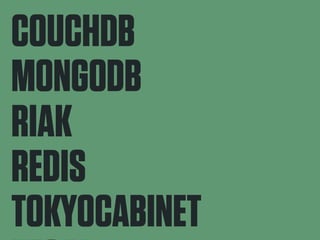
COUCHDB 
MONGODB 
RIAK 
REDIS 
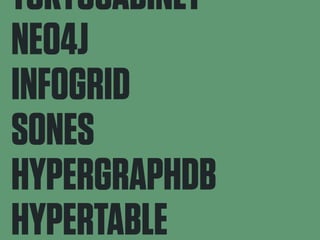
TOKYOCABINET 
NEO4J
TOKYOCABINET 
NEO4J 
INFOGRID 
SONES 
HYPERGRAPHDB 
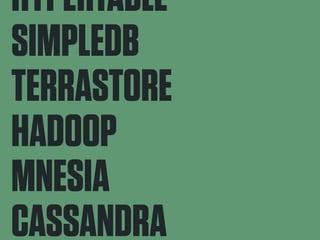
HYPERTABLE 
SIMPLEDB
HYPERTABLE 
SIMPLEDB 
TERRASTORE 
HADOOP 
MNESIA 
CASSANDRA 
HBASE
CASSANDRA 
HBASE 
JACKRABBIT 
VOLDEMORT 
GT.M 
DYNOMITE 
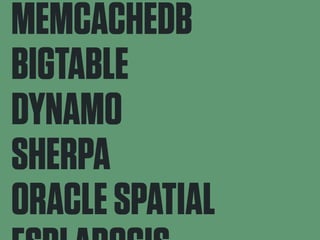
MEMCACHEDB
DYNOMITE 
MEMCACHEDB 
BIGTABLE 
DYNAMO 
SHERPA 
ORACLE SPATIAL 
ESRI ARCGIS
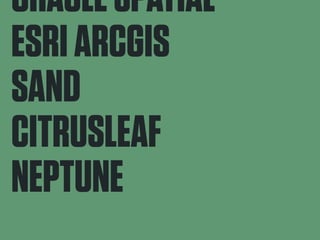
ORACLE SPATIAL 
ESRI ARCGIS 
SAND 
CITRUSLEAF 
NEPTUNE
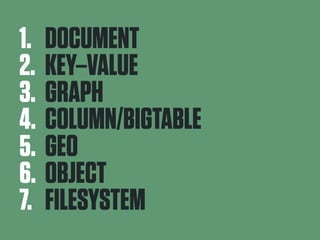
DOCUMENT 
KEY–VALUE 
GRAPH 
COLUMN/BIGTABLE 
GEO 
OBJECT 
FILESYSTEM 
1. 
2. 
3. 
4. 
5. 
6. 
7.
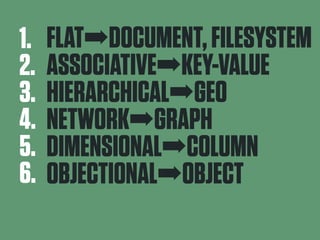
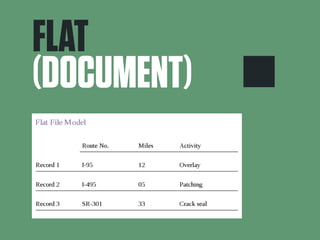
FLAT!DOCUMENT, FILESYSTEM 
ASSOCIATIVE!KEY-VALUE 
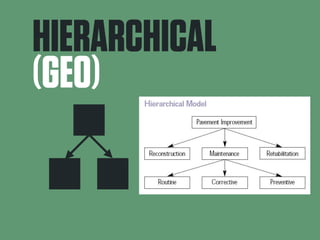
HIERARCHICAL!GEO 
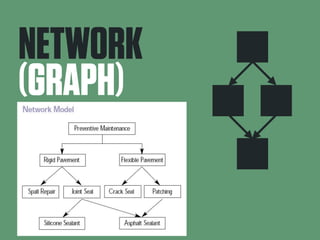
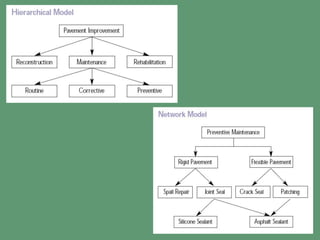
NETWORK!GRAPH 
DIMENSIONAL!COLUMN 
OBJECTIONAL!OBJECT 
1. 
2. 
3. 
4. 
5. 
6.
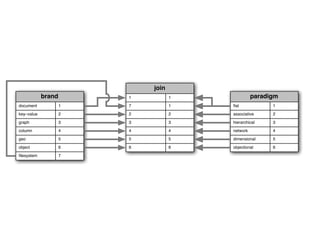
FOR THE SQL-ERS 
I made a relational version of that.
brand 
document 1 
key–value 2 
graph 3 
column 4 
geo 5 
object 6 
filesystem 7 
paradigm 
1 
2 
4 
flat 
hierarchical 
network 
dimensional 
3 
associative 
5 
objectional 6 
join 
1 1 
7 1 
2 2 
3 3 
4 4 
5 5 
6 6
FLAT 
(DOCUMENT)
ASSOCIATIVE 
(KEY–VALUE)
HIERARCHICAL 
(GEO)
NETWORK 
(GRAPH)
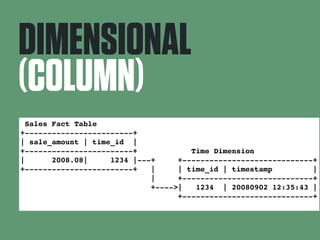
DIMENSIONAL 
(COLUMN) 
Sales Fact Table 
+------------------------+ 
| sale_amount | time_id | 
+------------------------+ Time Dimension 
| 2008.08| 1234 |---+ +-----------------------------+ 
+------------------------+ | | time_id | timestamp | 
| +-----------------------------+ 
+---->| 1234 | 20080902 12:35:43 | 
+-----------------------------+
OBJECTIONAL 
(OBJECT)
WHAT’S IN 
A NAME?
ANTI-SQL?
ANTI-DATABASES?
A NEW STANDARD?
A NEW LANGUAGE?
NOT ONLY SQL?
WHAT IS NOSQL ABOUT?
SQL VS. NOSQL 
VS. NOSQL
1. NOSQL SUCKS 
No, really.
2. IT’S NOT ABOUT 
THE SIZE. IT’S 
ABOUT HOW YOU 
USE IT.
3. IT’S NOT ROCKET 
SCIENCE.
IT’S… 
ALIVE !!!
THANK YOU! 
NOSQL Profit!& forFun
SpeakerRate.com/timanglade
?

Asif nosql

  • 1.
    TIM ANGLADE PROUDLYPRESENTS PART TWO OF THE TOTALLY UNKOWN “FUN & PROFIT” SERIES. A TALE OF TECH, INTRIGUE &! FORBIDDEN LOVE. A WHIRLWIND OF ADVENTURERS, PRODUCTION SYSTEMS &!TROLLS. A STORY SO BIG, ITS TITLE HAD TO HAVE ITS OWN INTRODUCTION TEXT. HERE IS… NOSQL Profit!& forFun
  • 2.
    @TIMANGLADE Hit meup. I don’t bite… too hard.
  • 3.
  • 4.
    NØSQL rope!Eu LONDON,APRIL 20TH & 21ST WORKSHOPS AND TRAINING ON THE 22ND FOLLOW @NOSQLEU FOR DETAILS
  • 5.
    A WARNING Thisis Tech for Managers. Don’t Blame Me.
  • 6.
    40 YEARS INTHE DESERT
  • 7.
    Information Retrieval P.BAXENDALE, Editor A Relational Model of Data for Large Shared Data Banks E. F. CODD IBM Research Laboratory, San Jose, California Future users of large data banks must be protected from having to know how the data is organized in the machine (the internal representation). A prompting service which supplies such information is not a satisfactory solution. Activities of users at terminals and most application programs should remain unaffected when the internal representation of data is changed and even when some aspects of the external representation are changed. Changes in data representation will often be needed as a result of changes in query, update, and report traffic and natural growth in the types of stored information. Existing noninferential, formatted data systems provide users with tree-structured files or slightly more general network models of the data. In Section 1, inadequacies of these models are discussed. A model based on n-ary relations, a normal form for data base relations, and the concept of a universal data sublanguage are introduced. In Section 2, certain opera-tions on relations (other than logical inference) are discussed and applied to the problems of redundancy and consistency in the user’s model. KEY WORDS AND PHRASES: data bank, data base, data structure, data organization, hierarchies of data, networks of data, relations, derivability, redundancy, consistency, composition, join, retrieval language, predicate calculus, security, data integrity CR CATEGORIES: 3.70, 3.73, 3.75, 4.20, 4.22, 4.29 1. Relational Model and Normal Form 1 .I. INTR~xJ~TI~N This paper is concerned with the application of ele-mentary relation theory to systems which provide shared access to large banks of formatted data. Except for a paper by Childs [l], the principal application of relations to data systems has been to deductive question-answering systems. Levein and Maron [2] provide numerous references to work in this area. In contrast, the problems treated here are those of data independence-the independence of application programs and terminal activities from growth in data types and changes in data representation-and certain kinds of data inconsistency which are expected to become troublesome even in nondeductive systems. Volume 13 / Number 6 / June, 1970 The relational view (or model) of data described in Section 1 appears to be superior in several respects to the graph or network model [3,4] presently in vogue for non-inferential systems. It provides a means of describing data with its natural structure only-that is, without superim-posing any additional structure for machine representation purposes. Accordingly, it provides a basis for a high level data language which will yield maximal independence be-tween programs on the one hand and machine representa-tion and organization of data on the other. A further advantage of the relational view is that it forms a sound basis for treating derivability, redundancy, and consistency of relations-these are discussed in Section 2. The network model, on the other hand, has spawned a number of confusions, not the least of which is mistaking the derivation of connections for the derivation of rela-tions (see remarks in Section 2 on the “connection trap”). Finally, the relational view permits a clearer evaluation of the scope and logical limitations of present formatted data systems, and also the relative merits (from a logical standpoint) of competing representations of data within a single system. Examples of this clearer perspective are cited in various parts of this paper. Implementations of systems to support the relational model are not discussed. 1.2. DATA DEPENDENCIESIN PRESENTS YSTEMS The provision of data description tables in recently de-veloped information systems represents a major advance toward the goal of data independence [5,6,7]. Such tables facilitate changing certain characteristics of the data repre-sentation stored in a data bank. However, the variety of data representation characteristics which can be changed without logically impairing some application programs is still quite limited. Further, the model of data with which users interact is still cluttered with representational prop-erties, particularly in regard to the representation of col-lections of data (as opposed to individual items). Three of the principal kinds of data dependencies which still need to be removed are: ordering dependence, indexing depend-ence, and access path dependence. In some systems these dependencies are not clearly separable from one another. 1.2.1. Ordering Dependence. Elements of data in a data bank may be stored in a variety of ways, some involv-ing no concern for ordering, some permitting each element to participate in one ordering only, others permitting each element to participate in several orderings. Let us consider those existing systems which either require or permit data elements to be stored in at least one total ordering which is closely associated with the hardware-determined ordering of addresses. For example, the records of a file concerning parts might be stored in ascending order by part serial number. Such systems normally permit application pro-grams to assume that the order of presentation of records from such a file is identical to (or is a subordering of) the Communications of the ACM 377
  • 8.
    form for database relations, and the concept of a universal data sublanguage are introduced. In Section 2, certain opera-tions on relations (other than logical inference) are discussed and applied to the problems of redundancy and consistency in the user’s model. KEY WORDS AND PHRASES: data bank, data base, data structure, data organization, hierarchies of data, networks of data, relations, derivability, redundancy, consistency, composition, join, retrieval language, predicate calculus, security, data integrity CR CATEGORIES: 3.70, 3.73, 3.75, 4.20, 4.22, 4.29 1. Relational Model and Normal Form 1 .I. INTR~xJ~TI~N This paper is concerned with the application of ele-mentary relation theory to systems which provide shared access to large banks of formatted data. Except for a paper by Childs [l], the principal application of relations to data systems has been to deductive question-answering systems. Levein and Maron [2] provide numerous references to work in this area. In contrast, the problems treated here are those of data independence-the independence of application programs and terminal activities from growth in data types and changes in data representation-and certain kinds of data inconsistency which are expected to become troublesome even in nondeductive systems. Volume 13 / Number 6 / June, 1970 systems to support the relational model are not discussed. 1.2. DATA DEPENDENCIESIN PRESENTS YSTEMS The provision of data description tables in recently de-veloped information systems represents a major advance toward the goal of data independence [5,6,7]. Such tables facilitate changing certain characteristics of the data repre-sentation stored in a data bank. However, the variety of data representation characteristics which can be changed without logically impairing some application programs is still quite limited. Further, the model of data with which users interact is still cluttered with representational prop-erties, particularly in regard to the representation of col-lections of data (as opposed to individual items). Three of the principal kinds of data dependencies which still need to be removed are: ordering dependence, indexing depend-ence, and access path dependence. In some systems these dependencies are not clearly separable from one another. 1.2.1. Ordering Dependence. Elements of data in a data bank may be stored in a variety of ways, some involv-ing no concern for ordering, some permitting each element to participate in one ordering only, others permitting each element to participate in several orderings. Let us consider those existing systems which either require or permit data elements to be stored in at least one total ordering which is closely associated with the hardware-determined ordering of addresses. For example, the records of a file concerning parts might be stored in ascending order by part serial number. Such systems normally permit application pro-grams to assume that the order of presentation of records from such a file is identical to (or is a subordering of) the Communications of the ACM 377
  • 9.
    WHAT DO YOUMEAN BY “THE DESERT”?
  • 10.
    THE GOOD Astrong ecosystem.
  • 11.
  • 12.
    THE UGLY ParadigmPuzzlement.
  • 13.
    Noun paradigm (plural!paradigms) 1. An example serving as a model or pattern. 2.A system of assumptions, concepts, values, and practices that constitutes a way of viewing reality.
  • 14.
  • 15.
  • 16.
    Information Retrieval P.BAXENDALE, Editor A Relational Model of Data for Large Shared Data Banks E. F. CODD IBM Research Laboratory, San Jose, California Future users of large data banks must be protected from having to know how the data is organized in the machine (the internal representation). A prompting service which supplies such information is not a satisfactory solution. Activities of users at terminals and most application programs should remain unaffected when the internal representation of data is changed and even when some aspects of the external representation are changed. Changes in data representation will often be needed as a result of changes in query, update, and report traffic and natural growth in the types of stored information. Existing noninferential, formatted data systems provide users with tree-structured files or slightly more general network models of the data. In Section 1, inadequacies of these models are discussed. A model based on n-ary relations, a normal form for data base relations, and the concept of a universal data sublanguage are introduced. In Section 2, certain opera-tions on relations (other than logical inference) are discussed and applied to the problems of redundancy and consistency in the user’s model. KEY WORDS AND PHRASES: data bank, data base, data structure, data organization, hierarchies of data, networks of data, relations, derivability, redundancy, consistency, composition, join, retrieval language, predicate calculus, security, data integrity CR CATEGORIES: 3.70, 3.73, 3.75, 4.20, 4.22, 4.29 1. Relational Model and Normal Form 1 .I. INTR~xJ~TI~N This paper is concerned with the application of ele-mentary relation theory to systems which provide shared access to large banks of formatted data. Except for a paper by Childs [l], the principal application of relations to data systems has been to deductive question-answering systems. Levein and Maron [2] provide numerous references to work in this area. In contrast, the problems treated here are those of data independence-the independence of application programs and terminal activities from growth in data types and changes in data representation-and certain kinds of data inconsistency which are expected to become troublesome even in nondeductive systems. Volume 13 / Number 6 / June, 1970 The relational view (or model) of data described in Section 1 appears to be superior in several respects to the graph or network model [3,4] presently in vogue for non-inferential systems. It provides a means of describing data with its natural structure only-that is, without superim-posing any additional structure for machine representation purposes. Accordingly, it provides a basis for a high level data language which will yield maximal independence be-tween programs on the one hand and machine representa-tion and organization of data on the other. A further advantage of the relational view is that it forms a sound basis for treating derivability, redundancy, and consistency of relations-these are discussed in Section 2. The network model, on the other hand, has spawned a number of confusions, not the least of which is mistaking the derivation of connections for the derivation of rela-tions (see remarks in Section 2 on the “connection trap”). Finally, the relational view permits a clearer evaluation of the scope and logical limitations of present formatted data systems, and also the relative merits (from a logical standpoint) of competing representations of data within a single system. Examples of this clearer perspective are cited in various parts of this paper. Implementations of systems to support the relational model are not discussed. 1.2. DATA DEPENDENCIESIN PRESENTS YSTEMS The provision of data description tables in recently de-veloped information systems represents a major advance toward the goal of data independence [5,6,7]. Such tables facilitate changing certain characteristics of the data repre-sentation stored in a data bank. However, the variety of data representation characteristics which can be changed without logically impairing some application programs is still quite limited. Further, the model of data with which users interact is still cluttered with representational prop-erties, particularly in regard to the representation of col-lections of data (as opposed to individual items). Three of the principal kinds of data dependencies which still need to be removed are: ordering dependence, indexing depend-ence, and access path dependence. In some systems these dependencies are not clearly separable from one another. 1.2.1. Ordering Dependence. Elements of data in a data bank may be stored in a variety of ways, some involv-ing no concern for ordering, some permitting each element to participate in one ordering only, others permitting each element to participate in several orderings. Let us consider those existing systems which either require or permit data elements to be stored in at least one total ordering which is closely associated with the hardware-determined ordering of addresses. For example, the records of a file concerning parts might be stored in ascending order by part serial number. Such systems normally permit application pro-grams to assume that the order of presentation of records from such a file is identical to (or is a subordering of) the Communications of the ACM 377
  • 17.
    P. BAXENDALE, Editor Data for California protected from the machine (the which supplies Activities of users should remain data is changed representation will often be update, and report stored information. The relational view (or model) of data described in Section 1 appears to be superior in several respects to the graph or network model [3,4] presently in vogue for non-inferential systems. It provides a means of describing data with its natural structure only-that is, without superim-posing any additional structure for machine representation purposes. Accordingly, it provides a basis for a high level data language which will yield maximal independence be-tween programs on the one hand and machine representa-tion and organization of data on the other. A further advantage of the relational view is that it forms a sound basis for treating derivability, redundancy, and consistency of relations-these are discussed in Section 2. The network model, on the other hand, has spawned a number of confusions, not the least of which is mistaking the derivation of connections for the derivation of rela-tions (see remarks in Section 2 on the “connection trap”). Finally, the relational view permits a clearer evaluation of the scope and logical limitations of present formatted
  • 18.
    TWO WORDS datawarehousing.
  • 19.
  • 20.
    COUCHDB MONGODB RIAK REDIS TOKYOCABINET NEO4J
  • 21.
    TOKYOCABINET NEO4J INFOGRID SONES HYPERGRAPHDB HYPERTABLE SIMPLEDB
  • 22.
    HYPERTABLE SIMPLEDB TERRASTORE HADOOP MNESIA CASSANDRA HBASE
  • 23.
    CASSANDRA HBASE JACKRABBIT VOLDEMORT GT.M DYNOMITE MEMCACHEDB
  • 24.
    DYNOMITE MEMCACHEDB BIGTABLE DYNAMO SHERPA ORACLE SPATIAL ESRI ARCGIS
  • 25.
    ORACLE SPATIAL ESRIARCGIS SAND CITRUSLEAF NEPTUNE
  • 26.
    DOCUMENT KEY–VALUE GRAPH COLUMN/BIGTABLE GEO OBJECT FILESYSTEM 1. 2. 3. 4. 5. 6. 7.
  • 27.
    FLAT!DOCUMENT, FILESYSTEM ASSOCIATIVE!KEY-VALUE HIERARCHICAL!GEO NETWORK!GRAPH DIMENSIONAL!COLUMN OBJECTIONAL!OBJECT 1. 2. 3. 4. 5. 6.
  • 28.
    FOR THE SQL-ERS I made a relational version of that.
  • 29.
    brand document 1 key–value 2 graph 3 column 4 geo 5 object 6 filesystem 7 paradigm 1 2 4 flat hierarchical network dimensional 3 associative 5 objectional 6 join 1 1 7 1 2 2 3 3 4 4 5 5 6 6
  • 30.
  • 31.
  • 32.
  • 33.
  • 35.
    DIMENSIONAL (COLUMN) SalesFact Table +------------------------+ | sale_amount | time_id | +------------------------+ Time Dimension | 2008.08| 1234 |---+ +-----------------------------+ +------------------------+ | | time_id | timestamp | | +-----------------------------+ +---->| 1234 | 20080902 12:35:43 | +-----------------------------+
  • 36.
  • 37.
  • 38.
  • 39.
  • 40.
  • 41.
  • 42.
  • 44.
  • 45.
    SQL VS. NOSQL VS. NOSQL
  • 46.
    1. NOSQL SUCKS No, really.
  • 47.
    2. IT’S NOTABOUT THE SIZE. IT’S ABOUT HOW YOU USE IT.
  • 48.
    3. IT’S NOTROCKET SCIENCE.
  • 53.
  • 54.
    THANK YOU! NOSQLProfit!& forFun
  • 55.
  • 56.