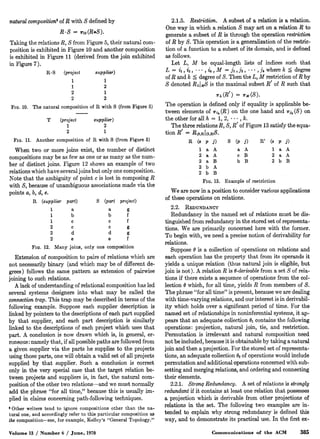
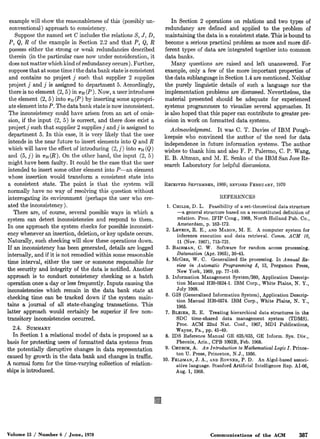
1. The paper introduces a relational model of data as a superior alternative to existing network and tree models for large shared databases. It allows data to be described in its natural form without imposing additional structure.
2. The relational model provides a basis for treating issues like redundancy, derivability, and consistency of data relations. It also allows clearer evaluation of existing data systems and representations.
3. Existing systems still impose dependencies between data representation and user interaction models related to ordering, indexing, and access paths that limit changes without impacting applications. The relational model aims to reduce these dependencies.
![Information Retrieval P. BAXENDALE, Editor
A Relational Model of Data for The relational view (or model) of data described in
Section 1 appears to be superior in several respects to the
Large Shared Data Banks graph or network model [3,4] presently in vogue for non-
inferential systems. It provides a means of describing data
with its natural structure only-that is, without superim-
E. F. CODD posing any additional structure for machine representation
IBM Research Laboratory, San Jose, California purposes. Accordingly, it provides a basis for a high level
data language which will yield maximal independence be-
tween programs on the one hand and machine representa-
Future users of large data banks must be protected from tion and organization of data on the other.
having to know how the data is organized in the machine (the A further advantage of the relational view is that it
internal representation). A prompting service which supplies forms a sound basis for treating derivability, redundancy,
such information is not a satisfactory solution. Activities of users and consistency of relations-these are discussedin Section
at terminals and most application programs should remain 2. The network model, on the other hand, has spawned a
unaffected when the internal representation of data is changed number of confusions, not the least of which is mistaking
and even when some aspects of the external representation the derivation of connections for the derivation of rela-
are changed. Changes in data representation will often be tions (seeremarks in Section 2 on the “connection trap”).
needed as a result of changes in query, update, and report Finally, the relational view permits a clearer evaluation
traffic and natural growth in the types of stored information. of the scope and logical limitations of present formatted
Existing noninferential, formatted data systems provide users data systems, and also the relative merits (from a logical
with tree-structured files or slightly more general network standpoint) of competing representations of data within a
models of the data. In Section 1, inadequacies of these models single system. Examples of this clearer perspective are
are discussed. A model based on n-ary relations, a normal cited in various parts of this paper. Implementations of
form for data base relations, and the concept of a universal systems to support the relational model are not discussed.
data sublanguage are introduced. In Section 2, certain opera-
1.2. DATA DEPENDENCIES PRESENTSYSTEMS
IN
tions on relations (other than logical inference) are discussed
The provision of data description tables in recently de-
and applied to the problems of redundancy and consistency
veloped information systems represents a major advance
in the user’s model.
toward the goal of data independence [5,6,7]. Such tables
KEY WORDS AND PHRASES: data bank, data base, data structure, data facilitate changing certain characteristics of the data repre-
organization, hierarchies of data, networks of data, relations, derivability, sentation stored in a data bank. However, the variety of
redundancy, consistency, composition, join, retrieval language, predicate
calculus, security, data integrity
data representation characteristics which can be changed
CR CATEGORIES: 3.70, 3.73, 3.75, 4.20, 4.22, 4.29 without logically impairing some application programs is
still quite limited. Further, the model of data with which
users interact is still cluttered with representational prop-
erties, particularly in regard to the representation of col-
lections of data (as opposed to individual items). Three of
the principal kinds of data dependencies which still need
1. Relational Model and Normal Form to be removed are: ordering dependence, indexing depend-
ence, and accesspath dependence. In some systems these
1.I. INTR~xJ~TI~N dependencies are not clearly separable from one another.
This paper is concerned with the application of ele- 1.2.1. Ordering Dependence. Elements of data in a
mentary relation theory to systems which provide shared data bank may be stored in a variety of ways, someinvolv-
access large banks of formatted data. Except for a paper
to ing no concern for ordering, some permitting each element
by Childs [l], the principal application of relations to data to participate in one ordering only, others permitting each
systems has been to deductive question-answering systems. element to participate in several orderings. Let us consider
Levein and Maron [2] provide numerous referencesto work those existing systems which either require or permit data
in this area. elements to be stored in at least one total ordering which is
In contrast, the problems treated here are those of data closely associated with the hardware-determined ordering
independence-the independence of application programs of addresses.For example, the records of a file concerning
and terminal activities from growth in data types and parts might be stored in ascending order by part serial
changesin data representation-and certain kinds of data number. Such systems normally permit application pro-
inconsistency which are expected to become troublesome grams to assumethat the order of presentation of records
even in nondeductive systems. from such a file is identical to (or is a subordering of) the
Volume 13 / Number 6 / June, 1970 Communications of the ACM 377](https://image.slidesharecdn.com/codd-111125184734-phpapp01/85/A-Relational-Model-of-Data-for-Large-Shared-Data-Banks-1-320.jpg)
![Information Retrieval P. BAXENDALE, Editor
A Relational Model of Data for The relational view (or model) of data described in
Section 1 appears to be superior in several respects to the
Large Shared Data Banks graph or network model [3,4] presently in vogue for non-
inferential systems. It provides a means of describing data
with its natural structure only-that is, without superim-
E. F. CODD posing any additional structure for machine representation
IBM Research Laboratory, San Jose, California purposes. Accordingly, it provides a basis for a high level
data language which will yield maximal independence be-
tween programs on the one hand and machine representa-
Future users of large data banks must be protected from tion and organization of data on the other.
having to know how the data is organized in the machine (the A further advantage of the relational view is that it
internal representation). A prompting service which supplies forms a sound basis for treating derivability, redundancy,
such information is not a satisfactory solution. Activities of users and consistency of relations-these are discussedin Section
at terminals and most application programs should remain 2. The network model, on the other hand, has spawned a
unaffected when the internal representation of data is changed number of confusions, not the least of which is mistaking
and even when some aspects of the external representation the derivation of connections for the derivation of rela-
are changed. Changes in data representation will often be tions (seeremarks in Section 2 on the “connection trap”).
needed as a result of changes in query, update, and report Finally, the relational view permits a clearer evaluation
traffic and natural growth in the types of stored information. of the scope and logical limitations of present formatted
Existing noninferential, formatted data systems provide users data systems, and also the relative merits (from a logical
with tree-structured files or slightly more general network standpoint) of competing representations of data within a
models of the data. In Section 1, inadequacies of these models single system. Examples of this clearer perspective are
are discussed. A model based on n-ary relations, a normal cited in various parts of this paper. Implementations of
form for data base relations, and the concept of a universal systems to support the relational model are not discussed.
data sublanguage are introduced. In Section 2, certain opera-
1.2. DATA DEPENDENCIES PRESENTSYSTEMS
IN
tions on relations (other than logical inference) are discussed
The provision of data description tables in recently de-
and applied to the problems of redundancy and consistency
veloped information systems represents a major advance
in the user’s model.
toward the goal of data independence [5,6,7]. Such tables
KEY WORDS AND PHRASES: data bank, data base, data structure, data facilitate changing certain characteristics of the data repre-
organization, hierarchies of data, networks of data, relations, derivability, sentation stored in a data bank. However, the variety of
redundancy, consistency, composition, join, retrieval language, predicate
calculus, security, data integrity
data representation characteristics which can be changed
CR CATEGORIES: 3.70, 3.73, 3.75, 4.20, 4.22, 4.29 without logically impairing some application programs is
still quite limited. Further, the model of data with which
users interact is still cluttered with representational prop-
erties, particularly in regard to the representation of col-
lections of data (as opposed to individual items). Three of
the principal kinds of data dependencies which still need
1. Relational Model and Normal Form to be removed are: ordering dependence, indexing depend-
ence, and accesspath dependence. In some systems these
1.I. INTR~xJ~TI~N dependencies are not clearly separable from one another.
This paper is concerned with the application of ele- 1.2.1. Ordering Dependence. Elements of data in a
mentary relation theory to systems which provide shared data bank may be stored in a variety of ways, someinvolv-
access large banks of formatted data. Except for a paper
to ing no concern for ordering, some permitting each element
by Childs [l], the principal application of relations to data to participate in one ordering only, others permitting each
systems has been to deductive question-answering systems. element to participate in several orderings. Let us consider
Levein and Maron [2] provide numerous referencesto work those existing systems which either require or permit data
in this area. elements to be stored in at least one total ordering which is
In contrast, the problems treated here are those of data closely associated with the hardware-determined ordering
independence-the independence of application programs of addresses.For example, the records of a file concerning
and terminal activities from growth in data types and parts might be stored in ascending order by part serial
changesin data representation-and certain kinds of data number. Such systems normally permit application pro-
inconsistency which are expected to become troublesome grams to assumethat the order of presentation of records
even in nondeductive systems. from such a file is identical to (or is a subordering of) the
Volume 13 / Number 6 / June, 1970 Communications of the ACM 377](https://image.slidesharecdn.com/codd-111125184734-phpapp01/75/A-Relational-Model-of-Data-for-Large-Shared-Data-Banks-1-2048.jpg)
![stored ordering. Those application programs which take Structure 1. Projects Subordinate to Parts
advantage of the stored ordering of a file are likely to fail File Segment Fields
to operate correctly if for some reason it becomes necessary F PART part #
to replace that ordering by a different one. Similar remarks part name
part description
hold for a stored ordering implemented by means of quantity-on-hand
pointers. quantity-on-order
It is unnecessary to single out any system as an example, PROJECT project #
because all the well-known information systems that are project name
marketed today fail to make a clear distinction between project description
quantity committed
order of presentation on the one hand and stored ordering
on the other. Significant implementation problems must be
solved to provide this kind of independence. Structure 2. Parts Subordinate to Projects
1.2.2. Indexing Dependence. In the context of for- File Sqmeut Fields
matted data, an index is usually thought of as a purely F PROJECT project #
performance-oriented component of the data representa- project name
tion. It tends to improve response to queries and updates project description
PART part #
and, at the same time, slow down response to insertions part name
and deletions. From an informational standpoint, an index part description
is a redundant component of the data representation. If a quantity-on-hand
system uses indices at all and if it is to perform well in an quantity-on-order
environment with changing patterns of activity on the data quantity committed
bank, an ability to create and destroy indices from time to
time will probably be necessary. The question then arises: Structure 3. Parts and Projects as Peers
Can application programs and terminal activities remain Commitment Relationship Subordinate to Projects
invariant as indices come and go? File Segment Fields
Present formatted data systems take widely different F PART part #
approaches to indexing. TDMS [7] unconditionally pro- part name
part description
vides indexing on all attributes. The presently released quantity-on-hand
version of IMS [5] provides the user with a choice for each quantity-on-order
file: a choice between no indexing at all (the hierarchic se- G PROJECT project #
quential organization) or indexing on the primary key project name
only (the hierarchic indexed sequent,ial organization). In project description
PART part #
neither case is the user’s application logic dependent on the quantity committed
existence of the unconditionally provided indices. IDS
[8], however, permits the fle designers to select attributes Structure 4. Parts and Projects as Peers
to be indexed and to incorporate indices into the file struc- Commitment Relationship Subordinate to Parts
ture by means of additional chains. Application programs File Segnren1 Fields
taking advantage of the performance benefit of these in- F PART part #
dexing chains must refer to those chains by name. Such pro- part description
grams do not operate correctly if these chains are later quantity-on-hand
removed. quantity-on-order
PROJECT project #
1.2.3. Access Path Dependence. Many of the existing quantity committed
formatted data systems provide users with tree-structured G PROJECT project #
files or slightly more general network models of the data. project name
Application programs developed to work with these sys- project description
tems tend to be logically impaired if the trees or networks
are changed in structure. A simple example follows. Structure 5. Parts, Projects, and
Suppose the data bank contains information about parts Commitment Relationship as Peers
FCZC .%&-,,ZC,,t Ficlds
and projects. For each part, the part number, part name,
part description, quantity-on-hand, and quantity-on-order F PART part #
part name
are recorded. For each project, the project number, project part description
name, project description are recorded. Whenever a project quantity-on-hand
makes use of a certain part, the quantity of that part com- quantity-on-order
mitted to the given project is also recorded. Suppose that G PROJECT project #
the system requires the user or file designer to declare or project name
project description
define the data in terms of tree structures. Then, any one H COMMIT part #
of the hierarchical structures may be adopted for the infor- project #
mation mentioned above (see Structures l-5). quantity committed
378 Communications of the ACM Volume 13 / Number 6 / June, 1970](https://image.slidesharecdn.com/codd-111125184734-phpapp01/85/A-Relational-Model-of-Data-for-Large-Shared-Data-Banks-2-320.jpg)
![Now, consider the problem of printing out the part ray which represents an n-ary relation R has the following
number, part name, and quantity committed for every part properties :
used in the project whose project name is “alpha.” The (1) Each row represents an n-tuple of R.
following observations may be made regardless of which (2) The ordering of rows is immaterial.
available tree-oriented information system is selected to (3) All rows are distinct.
tackle this problem. If a program P is developed for this (4) The ordering of columns is significant-it corre-
problem assuming one of the five structures above-that sponds to the ordering S1, Sz , . . . , S, of the do-
is, P makes no test to determine which structure is in ef- mains on which R is defined (see, however, remarks
fect-then P will fail on at least three of the remaining below on domain-ordered and domain-unordered
structures. More specifically, if P succeeds with structure 5, relations ) .
it will fail with all the others; if P succeeds with structure 3 (5) The significance of each column is partially con-
or 4, it will fail with at least 1,2, and 5; if P succeeds with veyed by labeling it with the name of the corre-
1 or 2, it will fail with at least 3, 4, and 5. The reason is sponding domain.
simple in each case. In the absence of a test to determine The example in Figure 1 illustrates a relation of degree
which structure is in effect, P fails because an attempt is 4, called supply, which reflects the shipments-in-progress
made to exceute a reference to a nonexistent file (available of parts from specified suppliers to specified projects in
systems treat this as an error) or no attempt is made to specified quantities.
execute a reference to a file containing needed information.
supply (supplier part project quantity)
The reader who is not convinced should develop sample
programs for this simple problem. 1 2 5 17
1 3 5 23
Since, in general, it is not practical to develop applica-
2 3 7 9
tion programs which test for all tree structurings permitted 2 7 5 4
by the system, these programs fail when a change in 4 1 1 12
&ructure becomes necessary. FIG. 1. A relation of degree 4
Systems which provide users with a network model of
the data run into similar difficulties. In both the tree and One might ask: If the columns are labeled by the name
network cases, the user (or his program) is required to of corresponding domains, why should the ordering of col-
exploit a collection of user access paths to the data. It does umns matter? As the example in Figure 2 shows, two col-
not matter whether these paths are in close correspondence umns may have identical headings (indicating identical
with pointer-defined paths in the stored representation-in domains) but possess distinct meanings with respect to the
IDS the correspondence is extremely simple, in TDMS it is relation. The relation depicted is called component. It is a
just the opposite. The consequence, regardless of the stored ternary relation, whose first two domains are called part
representation, is that terminal activities and programs be- and third domain is called quantity. The meaning of com-
come dependent on the continued existence of the user ponent (2, y, z) is that part x is an immediate component
access paths. (or subassembly) of part y, and z units of part 5 are needed
One solution to this is to adopt the policy that once a to assembleone unit of part y. It is a relation which plays
user access path is defined it will not be made obsolete un- a critical role in the parts explosion problem.
til all application programs using that path have become
obsolete. Such a policy is not practical, because the number component (part part quantity)
of access paths in the total model for the community of 1 5 9
users of a data bank would eventually become excessively 2 5 7
3 5 2
large.
2 6 12
1.3. A RELATIONAL VIEW OF DATA 3 6 3
The term relation is used here in its accepted mathe- 4 7 1
6 7 1
matical sense.Given sets X1, S, , . . . , S, (not necessarily
distinct), R is a relation on these n sets if it is a set of n- FIG. 2. A relation with-two identical domains
tuples each of which has its first element from S1, its
second element from Sz , and so on.’ We shall refer to Si as It is a remarkable fact that several existing information
the jth domain of R. As defined above, R is said to have systems (chiefly those based on tree-structured files) fail
degreen. Relations of degree 1 are often called unary, de- to provide data representations for relations which have
gree 2 binary, degree 3 ternary, and degree n n-ary. two or more identical domains. The present version of
For expository reasons, we shall frequently make use of IMS/360 [5] is an example of such a system.
an array representation of relations, but it must be re- The totality of data in a data bank may be viewed as a
membered that this particular representation is not an es- collection of time-varying relations. These relations are of
sential part of the relational view being expounded. An ar- assorted degrees. As time progresses,each n-ary relation
may be subject to insertion of additional n-tuples, deletion
1 More concisely, R is a subset of the Cartesian product 81 X of existing ones, and alteration of components of any of its
sz x *.* x 87%. existing n-tuples.
Volume 13 / Number 6 / June, 1970 Communications of the ACM 379](https://image.slidesharecdn.com/codd-111125184734-phpapp01/85/A-Relational-Model-of-Data-for-Large-Shared-Data-Banks-3-320.jpg)

![age. R permits the specification for retrieval of any subset 4-ary relation supply of Figure 1, which entails 5 names in
of data from the data bank. Action on such a retrieval re- n-ary notation, would be represented in the form
quest is subject to security constraints.
P (supplier, & (part, R (project, quantity)))
The universality of the data sublanguage lies in its
descriptive ability (not its computing ability). In a large in nested binary notation and, thus, employ 7 names.
data bank each subset of the data has a very large number -4 further disadvantage of this kind of expression is its
of possible (and sensible) descriptions, even when we as- asymmetry. Although this asymmetry does not prohibit
sume (as we do) that there is only a finite set of function symmetric exploitation, it certainly makes some basesof
subroutines to which the system has access for use in interrogation very awkward for the user to express (con-
qualifying data for retrieval. Thus, the class of qualification sider, for example, a query for those parts and quantities
expressions which can be used in a set specification must related to certain given projects via & and R).
have the descriptive power of the class of well-formed 1.6. EXPRESSIBLE, NAMED, AND STORED RELATIONS
formulas of an applied predicate calculus. It is well known Associated with a data bank are two collections of rela-
that to preserve this descriptive power it is unnecessary to tions: the named set and the expressibleset. The named set
express (in whatever syntax is chosen) every formula of is the collection of all those relations that the community of
the selected predicate calculus. For example, just those in userscan identify by means of a simple name (or identifier).
prenex normal form are adequate [9]. A relation R acquires membership in the named set when a
Arithmetic functions may be needed in the qualification suitably authorized user declares R; it loses membership
or other parts of retrieval statements. Such functions can when a suitably authorized user cancels the declaration of
be defined in H and invoked in R. R.
A set so specified may be fetched for query purposes The expressible set is the total collection of relations that
only, or it may be held for possible changes. Insertions t,ake can be designated by expressionsin the data language. Such
the form of adding new elements to declared relations with- expressionsare constructed from simple names of relations
out regard to any ordering that may be present in their in the named set; names of generations, roles and domains;
machine representation. Deletions which are effective for logical connectives; the quantifiers of the predicate calcu-
the community (as opposed to the individual user or sub- 1~s;~and certain constant relation symbols such as = , > .
communities) take the form of removing elements from de- The named set is a subset of the expressible set-usually a
clared relations. Some deletions and updates may be trig- very small subset.
gered by others, if deletion and update dependencies be- Since some relations in the named set may be time-inde-
tween specified relations are declared in R. pendent combinations of others in that set, it is useful to
One important effect that the view adopted toward data consider associating with the named set a collection of
has on the language used to retrieve it is in the naming of statements that define these time-independent constraints.
data elements and sets. Some aspects of this have been dis- We shall postpone further discussion of this until we have
cussed in the previous section. With the usual network introduced several operations on relations (seeSection 2).
view, users will often be burdened with coining and using One of the major problems confronting the designer of a
more relat,ion names than are absolutely necessary, since data system which is to support a relational model for its
names are associated with paths (or path types) rather users is that of determining the class of stored representa-
than with relations. tions to be supported. Ideally, the variety of permitted
Once a user is aware that a certain relation is stored, he data representations should be just adequate to cover the
will expect to be able to exploit5 it using any combination spectrum of performance requirements of the total col-
of its arguments as “knowns” and the remaining argu- lection of installations. Too great a variety leads to un-
ments as “unknowns,” because the information (like necessary overhead in storage and continual reinterpreta-
Everest) is there. This is a system feature (missing from tion of descriptions for the structures currently in effect.
many current informat.ion systems) which we shall call For any selected class of stored representations the data
(logically) symmetric expZoitation of relations. Naturally, system must provide a means of translating user requests
symmetry in performance is not to be expected. expressedin the data language of the relational model into
To support symmetric exploitation of a single binary re- corresponding-and elhcient-actions on the current
lation, two directed paths are needed. For a relation of de- stored representation. For a high level data language this
gree n, the number of paths to be named and controlled is presents a challenging design problem. Nevertheless, it is a
n factorial. problem which must be solved-as more users obtain con-
Again, if a relational view is adopted in which every n- current accessto a large data bank, responsibility for pro-
ary relation (n > 2) has to be expressed by the user as a viding efficient response and throughput shifts from the
nested expression involving only binary relations (see individual user to the data system.
Feldman’s LEAP System [lo], for example) then 2n - 1
names have to be coined instead of only n + 1 with direct 6 Because each relation in a practical data bank is a finite set at
every instant of time, the existential and universal quantifiers
n-ary notation as described in Section 1.2. For example, the can be expressed in terms of a function that counts the number of
6 Exploiting a relation includes query, update, and delete. elements in any finite set.
382 Communications of the ACM Volume 13 / Number 6 / June, 1970](https://image.slidesharecdn.com/codd-111125184734-phpapp01/85/A-Relational-Model-of-Data-for-Large-Shared-Data-Banks-6-320.jpg)