Chemical Safety in
Histopathology laboratory
Dr. KANWALPREET KAUR
Occupational hazards in Pathology Lab
• The hazards that workers in pathology laboratories face
include
1. specific risks from toxic chemicals which are used in
investigative procedures
2. pathogenic microorganisms in patient's samples
3. general risks from mechanical, electrical and fire hazards
Aggravated by ignorance of the hazards, lack of knowledge on safety measures
and inadequate safety measures adopted by laboratories
IDENTIFY AND EVALUATE HAZARDS
FOUNDATION OF WORKSPACE CHEMICAL
SAFETY PROGRAMMES
• Occupational Safety and Health Act of 1970, Congress created
the Occupational Safety and Health Administration (OSHA) to
ensure safe and healthful working conditions for working men
and women by setting and enforcing standards and by
providing training, outreach, education and assistance
• In 2003 the United Nations established the Globally
Harmonized System (GHS) for the classification and labeling of
chemicals
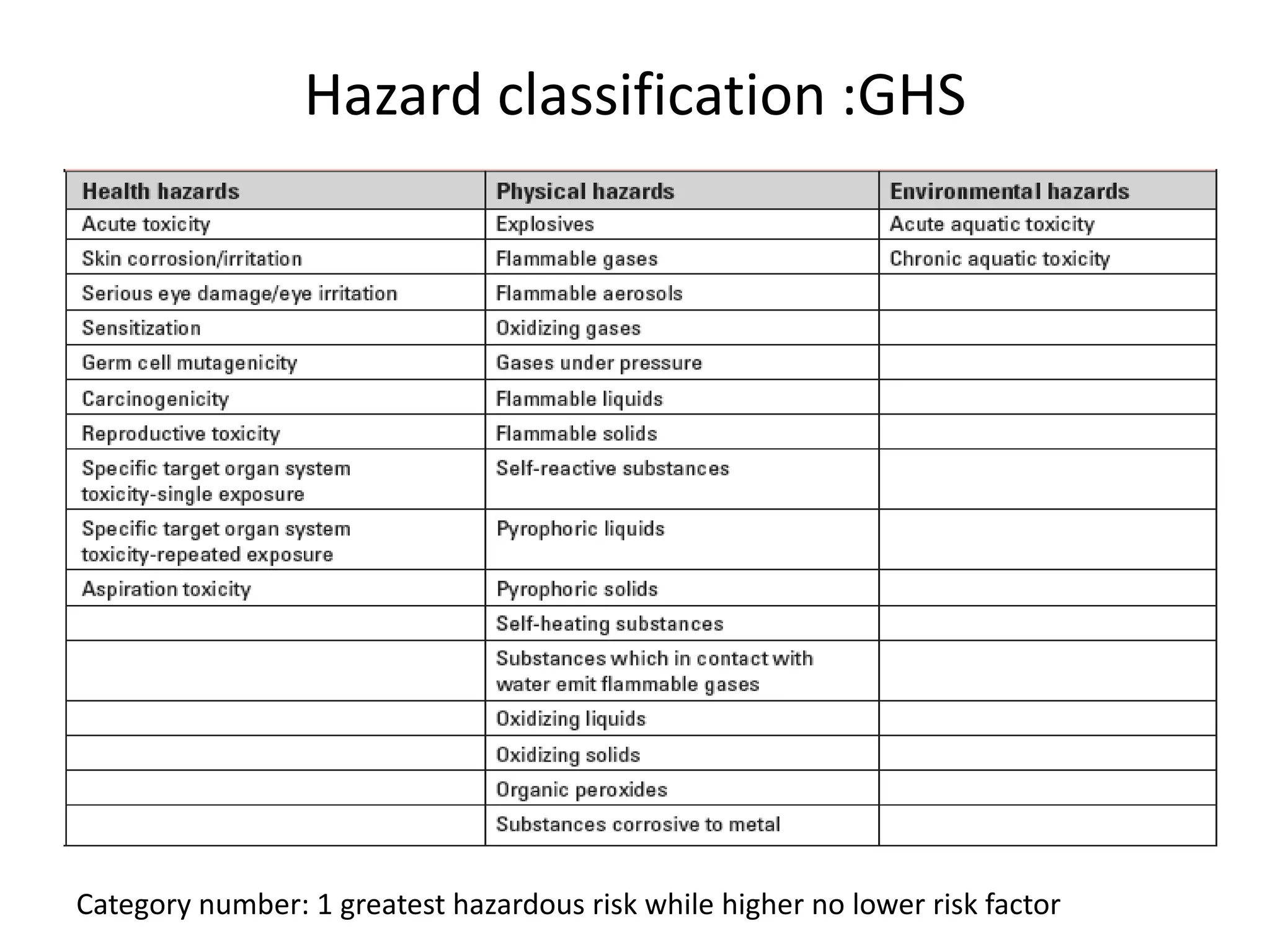
Hazard classification :GHS
Category number: 1 greatest hazardous risk while higher no lower risk factor
Biohazards can be infectious
agents themselves or items
(solutions, specimens or objects)
contaminated with them
Irritants are chemicals that cause
reversible inflammatory effects
at the site of contact with living
tissue
Corrosive chemicals present both
physical and health hazards. When
exposed to living tissue,
destruction or irreversible
alteration occurs. Inanimate
surfaces, they destroy the material
Carcinogens : chloroform, chromic
acid,formaldehyde, nickel chloride,
and potassium dichromate.
dyes : auramine O , basic fuchsin
any dye derived from benzidine
(including Congo red)
GHS HAZARD CLASSIFICATION ANS ASSIGNED PICTOGRAMS
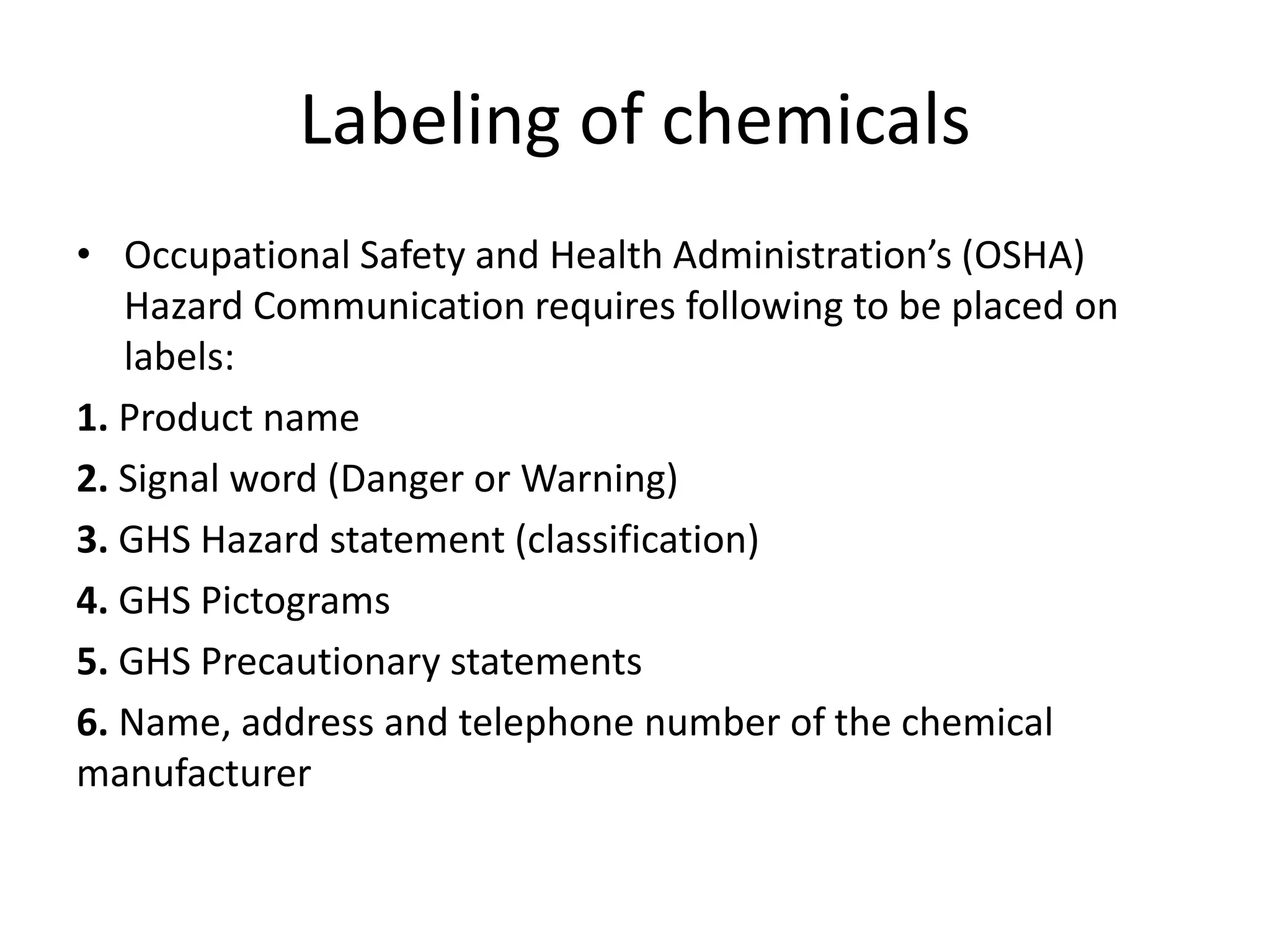
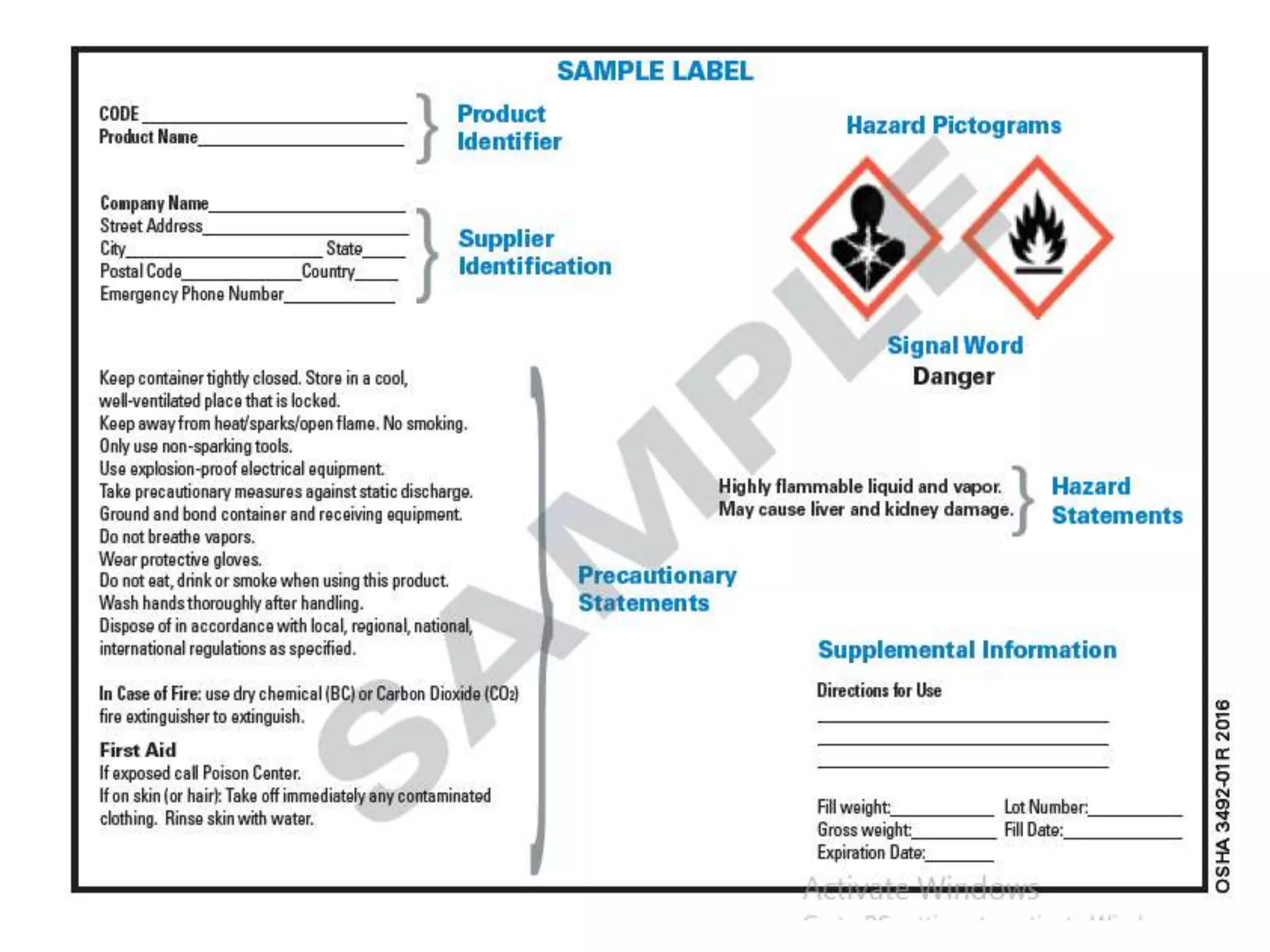
Labeling of chemicals
• Occupational Safety and Health Administration’s (OSHA)
Hazard Communication requires following to be placed on
labels:
1. Product name
2. Signal word (Danger or Warning)
3. GHS Hazard statement (classification)
4. GHS Pictograms
5. GHS Precautionary statements
6. Name, address and telephone number of the chemical
manufacturer
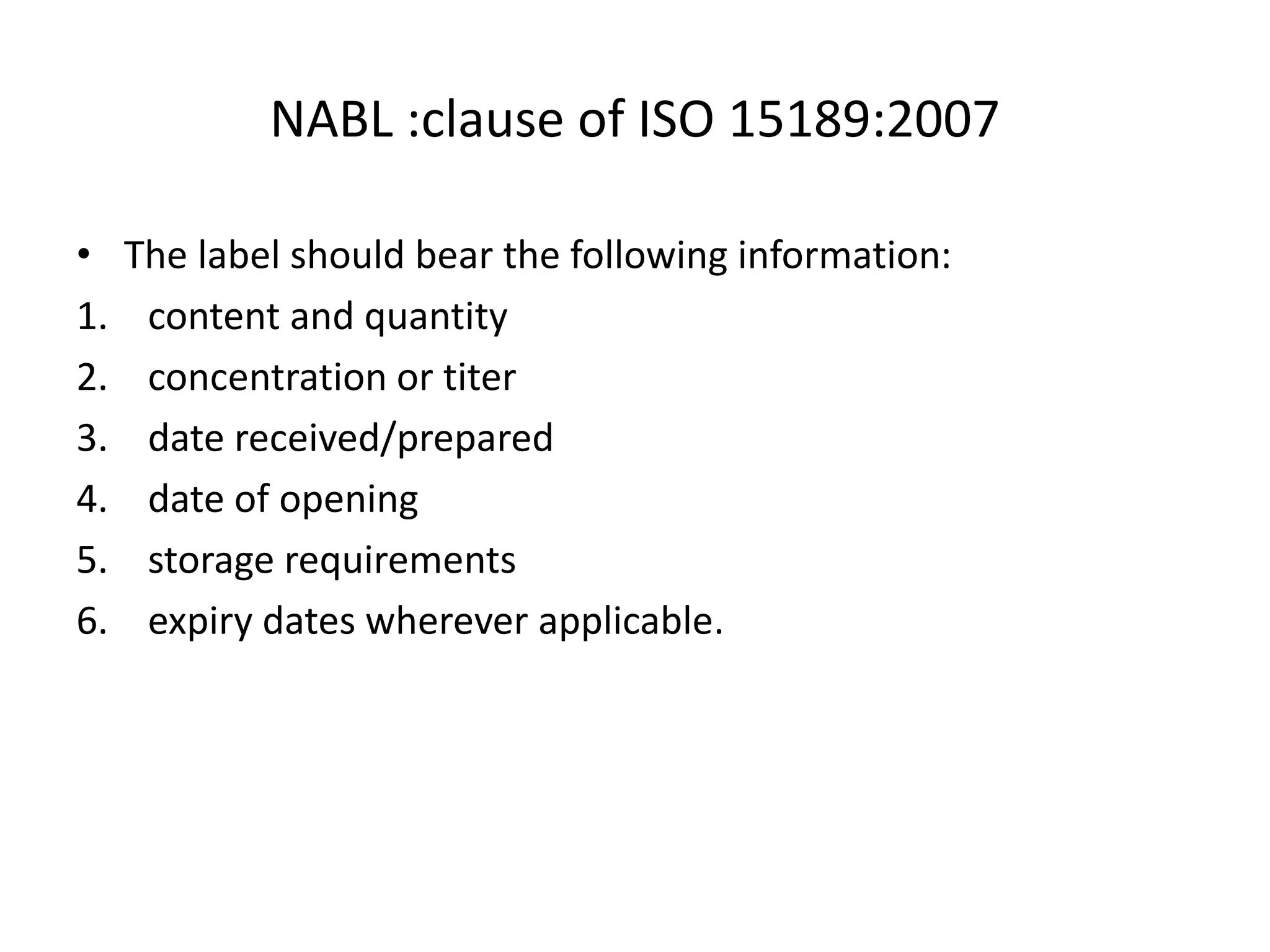
NABL :clause of ISO 15189:2007
• The label should bear the following information:
1. content and quantity
2. concentration or titer
3. date received/prepared
4. date of opening
5. storage requirements
6. expiry dates wherever applicable.
NABL requirements
Safety data sheet (SDS)
• Primary source for identifying the hazards and proper
handling requirements of a chemical
• Manufacturers are required to send SDS with the initial
shipment of a chemical and whenever a change has been
made in the SDS
GHS SAFETY DATA SHEET FORMAT
General information
any information
needed quickly in an
emergency (e.g.
first-aid, spill, fire).
Basis of
classification
Regulatory
information
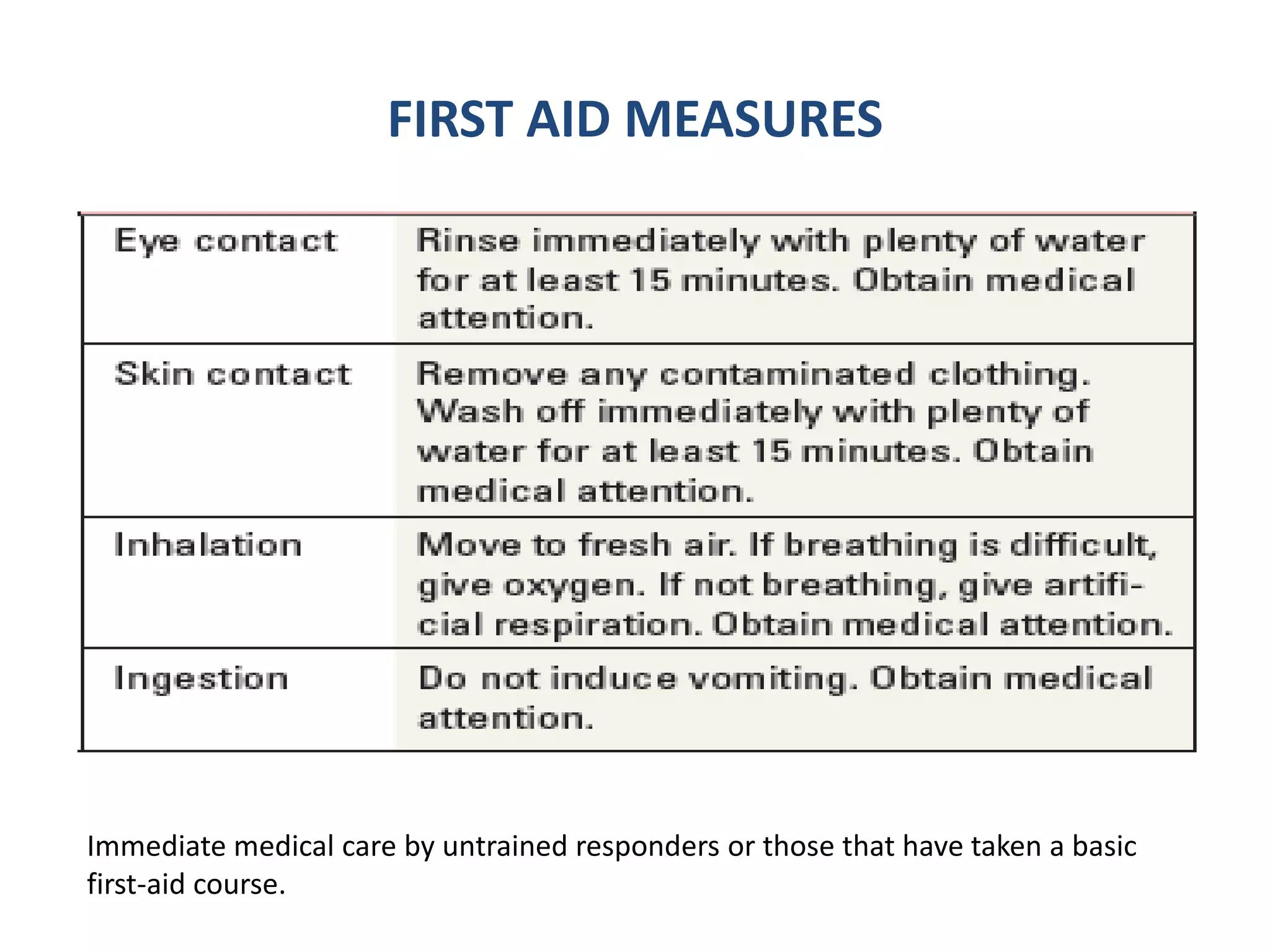
FIRST AID MEASURES
Immediate medical care by untrained responders or those that have taken a basic
first-aid course.
EVERY WORK AREA SHOULD HAVE A BASIC FIRST-AID KIT
CONTAINING AT LEAST ADHESIVE BANDAGES, STERILE
GAUZE PADS AND ADHESIVE TAPES TO DRESS A WOUND
PRIOR TO OBTAINING ADVANCED MEDICAL ATTENTION
In the USA, the Formaldehyde Standard requires a laboratory to have eyewash
stations within the immediate work area (29 CFR 1910.1048(i)(3))
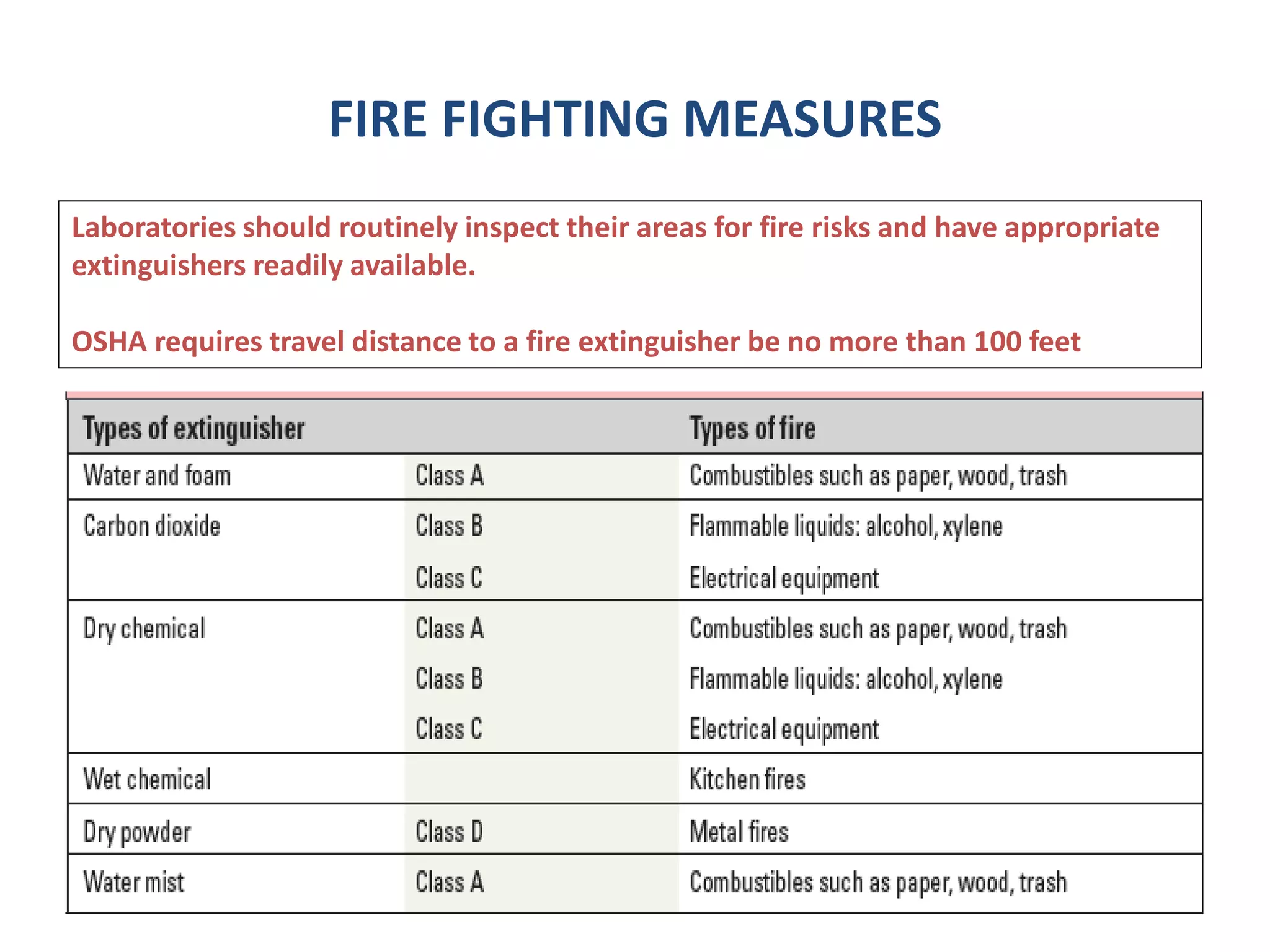
Laboratories should routinely inspect their areas for fire risks and have appropriate
extinguishers readily available.
OSHA requires travel distance to a fire extinguisher be no more than 100 feet
FIRE FIGHTING MEASURES
ACCIDENTAL RELEASE MEASURES
• Laboratory must be prepared with all the specific spill cleanup
supplies (personal protective equipment [PPE], absorbents,
neutralizers)
• Size of a spill that will determine the cleanup procedure
• Characteristics of the chemical and ventilation play a major
role
• Spill response procedure must be developed to cover every
chemical used in the laboratory
• The written procedure must document evacuation routes and
alarms in case they are needed.
• In a well ventilated area, a
few hundred milliliters of
spilled alcohol might be
considered a small spill and
only require absorbent
materials to contain and
remove it
• A few hundred milliliters of
formaldehyde in a poorly
ventilated room could
exceed exposure limits and
produce a higher health
risk requiring a different
mode of cleanup involving
respirators
General Procedures For A Spill Cleanup
• Evaluate the risk to determine if outside assistance is needed
• Evacuate people from the area if required
• All individuals performing any cleanup must wear appropriate
Personal Protective Equipment (PPE): goggles, gloves, shoe
covers, aprons, and respirators.
For any spill response, always
wear the required PPE
General Procedures For A Spill Cleanup
• Prevent the spread of any vapors by increasing ventilation
• Turn off all ignition sources if cleaning up a flammable liquid
• Control the spread of a liquid by using absorbent materials
Absorbent socks, booms, pillows and pads are convenient
General Procedures For A Spill Cleanup
• Neutralize if possible.
• Acids are easily neutralized with sodium bicarbonate; bases
with citric acid.
• The neutralizing procedure is exothermic and a bubbling
reaction is normal
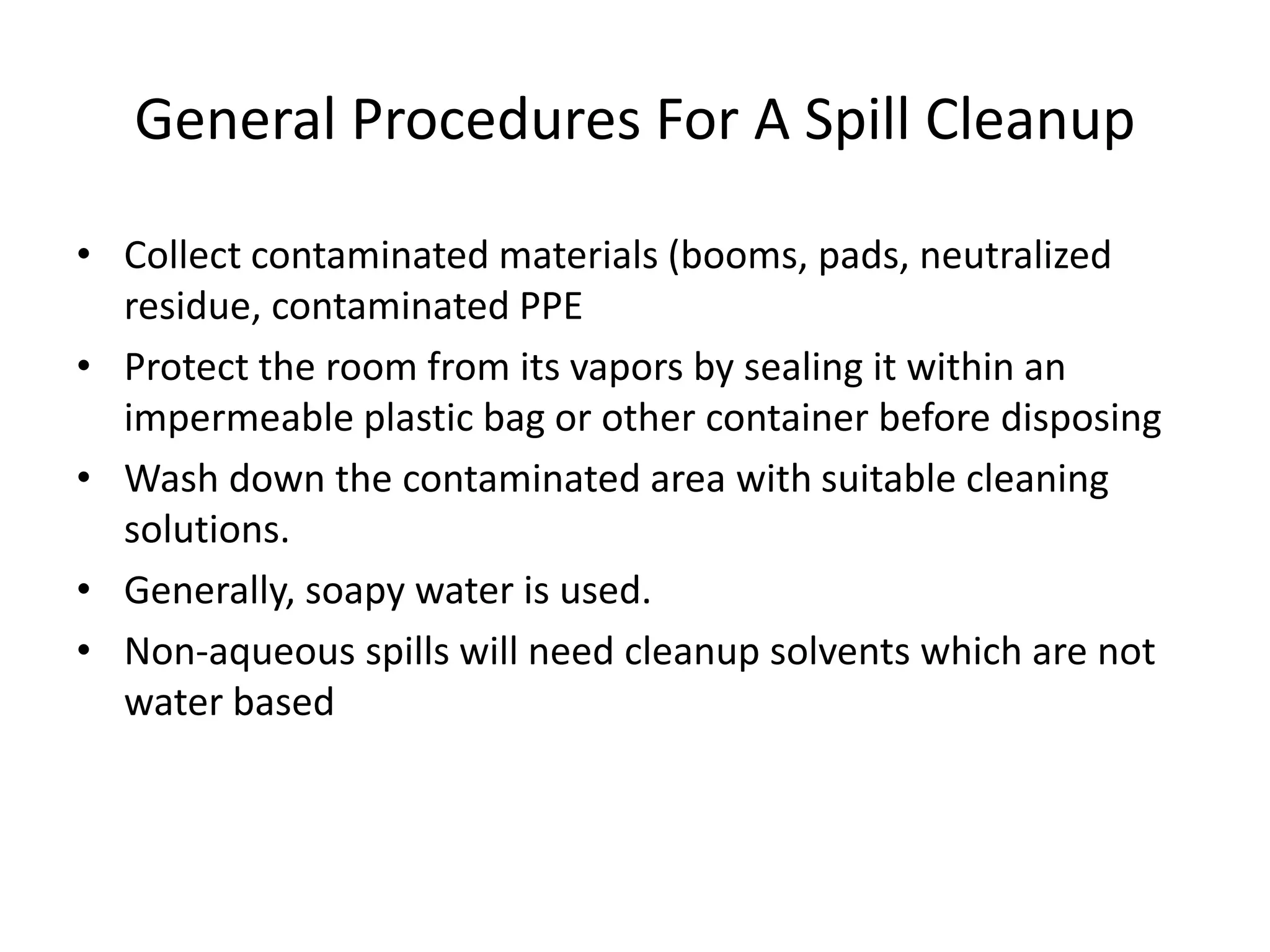
General Procedures For A Spill Cleanup
• Collect contaminated materials (booms, pads, neutralized
residue, contaminated PPE
• Protect the room from its vapors by sealing it within an
impermeable plastic bag or other container before disposing
• Wash down the contaminated area with suitable cleaning
solutions.
• Generally, soapy water is used.
• Non-aqueous spills will need cleanup solvents which are not
water based
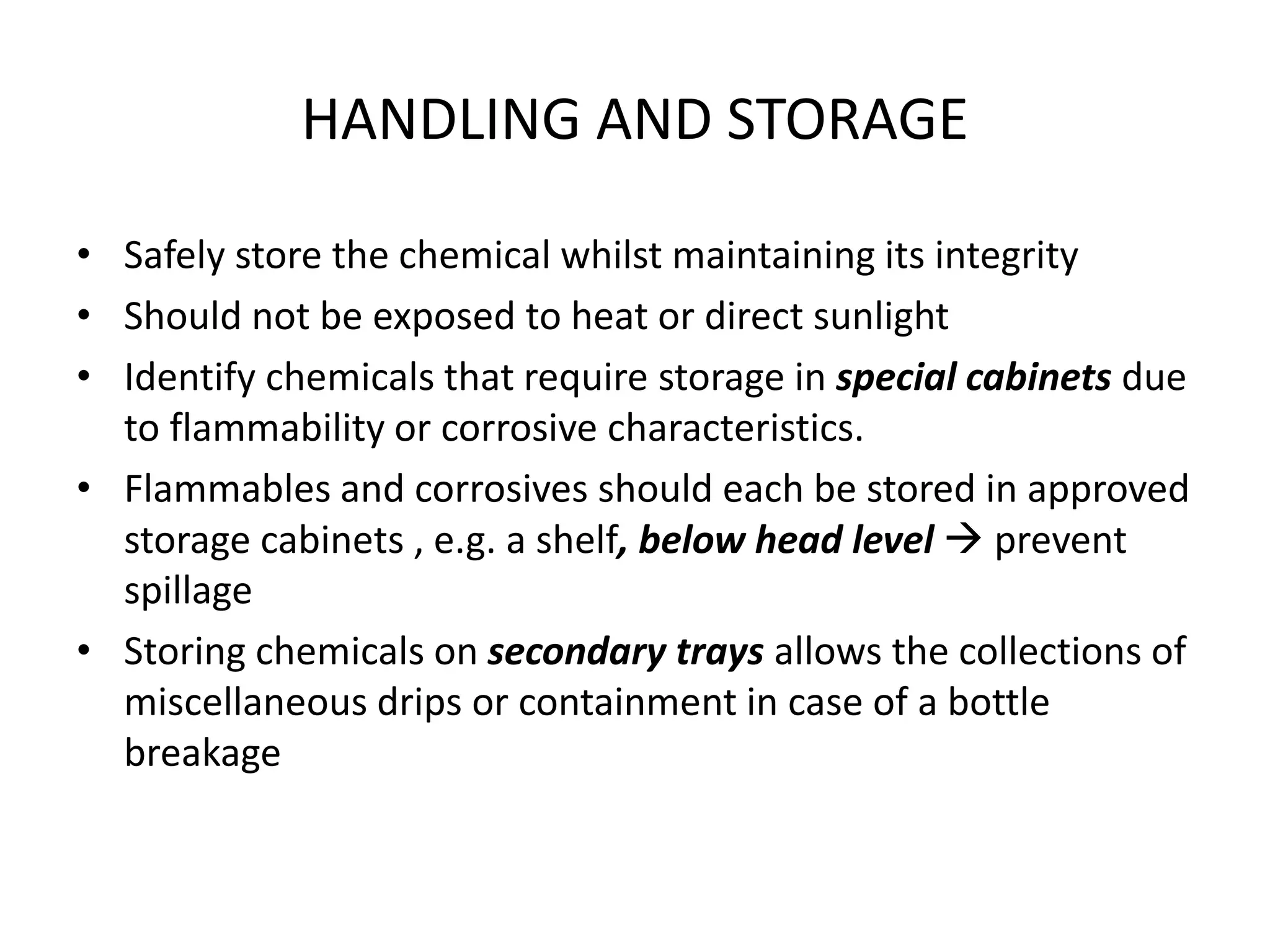
HANDLING AND STORAGE
• Safely store the chemical whilst maintaining its integrity
• Should not be exposed to heat or direct sunlight
• Identify chemicals that require storage in special cabinets due
to flammability or corrosive characteristics.
• Flammables and corrosives should each be stored in approved
storage cabinets , e.g. a shelf, below head level  prevent
spillage
• Storing chemicals on secondary trays allows the collections of
miscellaneous drips or containment in case of a bottle
breakage
HANDLING AND STORAGE
• Volume stored therein should also be limited
• OSHA limits 60 gallons inside a safety cabinet for Class I & II
flammables (Ethyl alcohol, isopropyl alcohol and xylene)
• Explosion-proof laboratory refrigerators should be used when
flammables need to be refrigerated.
• A household refrigerator/freezer should never be used to
store flammable materials
• Vapors should be controlled carefully to prevent buildup
around electrical devices that spark
EXPOSURE CONTROLS/PERSONAL PROTECTION
• Time weighted average (TWA)
represents the exposure limit
averaged over an eight-hour time
period
• not practical in a laboratory
environment where there could
be a high exposure for a very
short time period and none for
the rest of the day
• Short term exposure limit (STEL)
measures the exposure for a 15-
minute time frame.
Permissible exposure limits (PELs) are issued by OSHA
Represent the amount a worker may be exposed to during a time period
without any adverse health effects
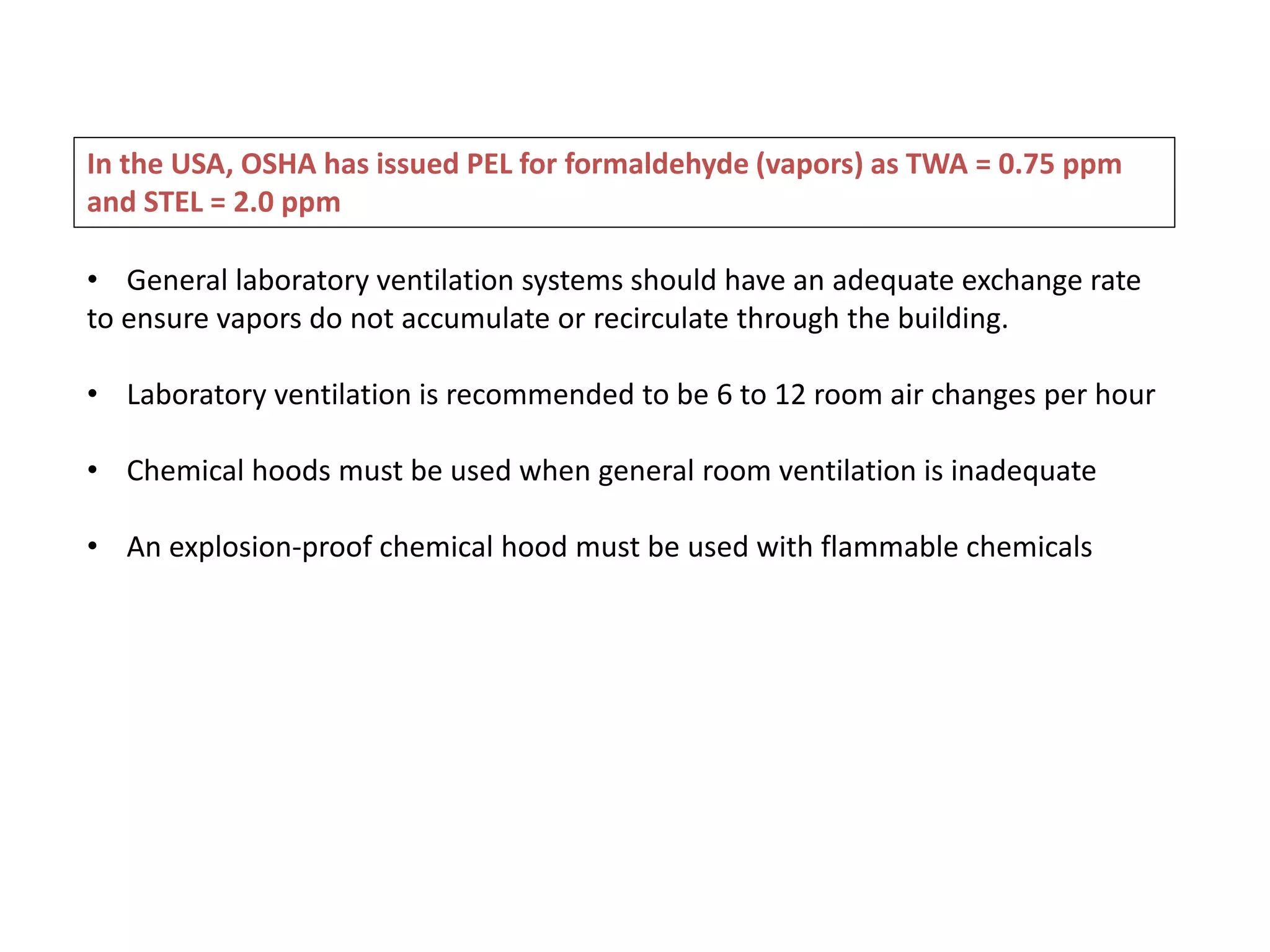
In the USA, OSHA has issued PEL for formaldehyde (vapors) as TWA = 0.75 ppm
and STEL = 2.0 ppm
• General laboratory ventilation systems should have an adequate exchange rate
to ensure vapors do not accumulate or recirculate through the building.
• Laboratory ventilation is recommended to be 6 to 12 room air changes per hour
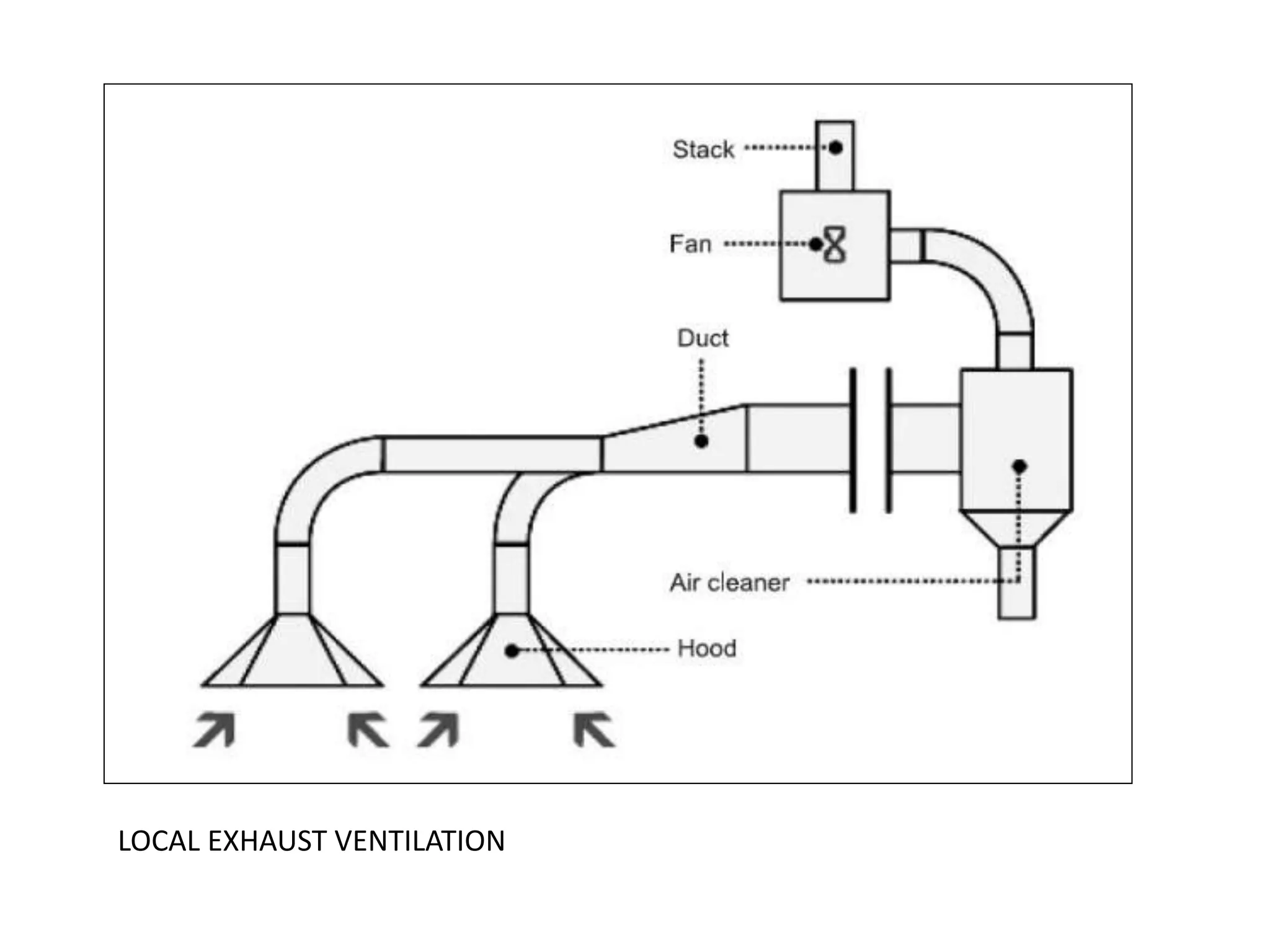
• Chemical hoods must be used when general room ventilation is inadequate
• An explosion-proof chemical hood must be used with flammable chemicals
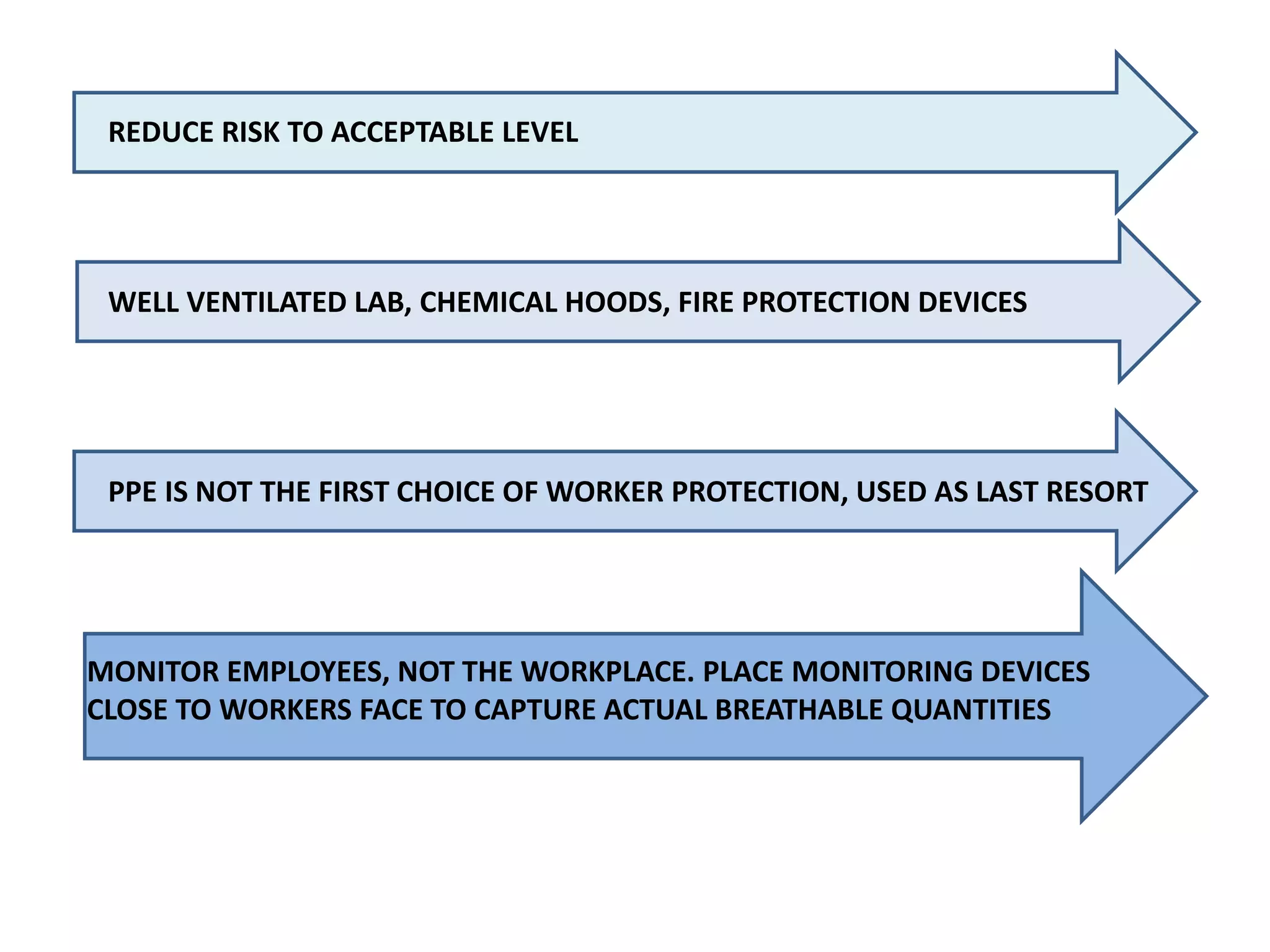
REDUCE RISK TO ACCEPTABLE LEVEL
WELL VENTILATED LAB, CHEMICAL HOODS, FIRE PROTECTION DEVICES
PPE IS NOT THE FIRST CHOICE OF WORKER PROTECTION, USED AS LAST RESORT
MONITOR EMPLOYEES, NOT THE WORKPLACE. PLACE MONITORING DEVICES
CLOSE TO WORKERS FACE TO CAPTURE ACTUAL BREATHABLE QUANTITIES
LOCAL EXHAUST VENTILATION
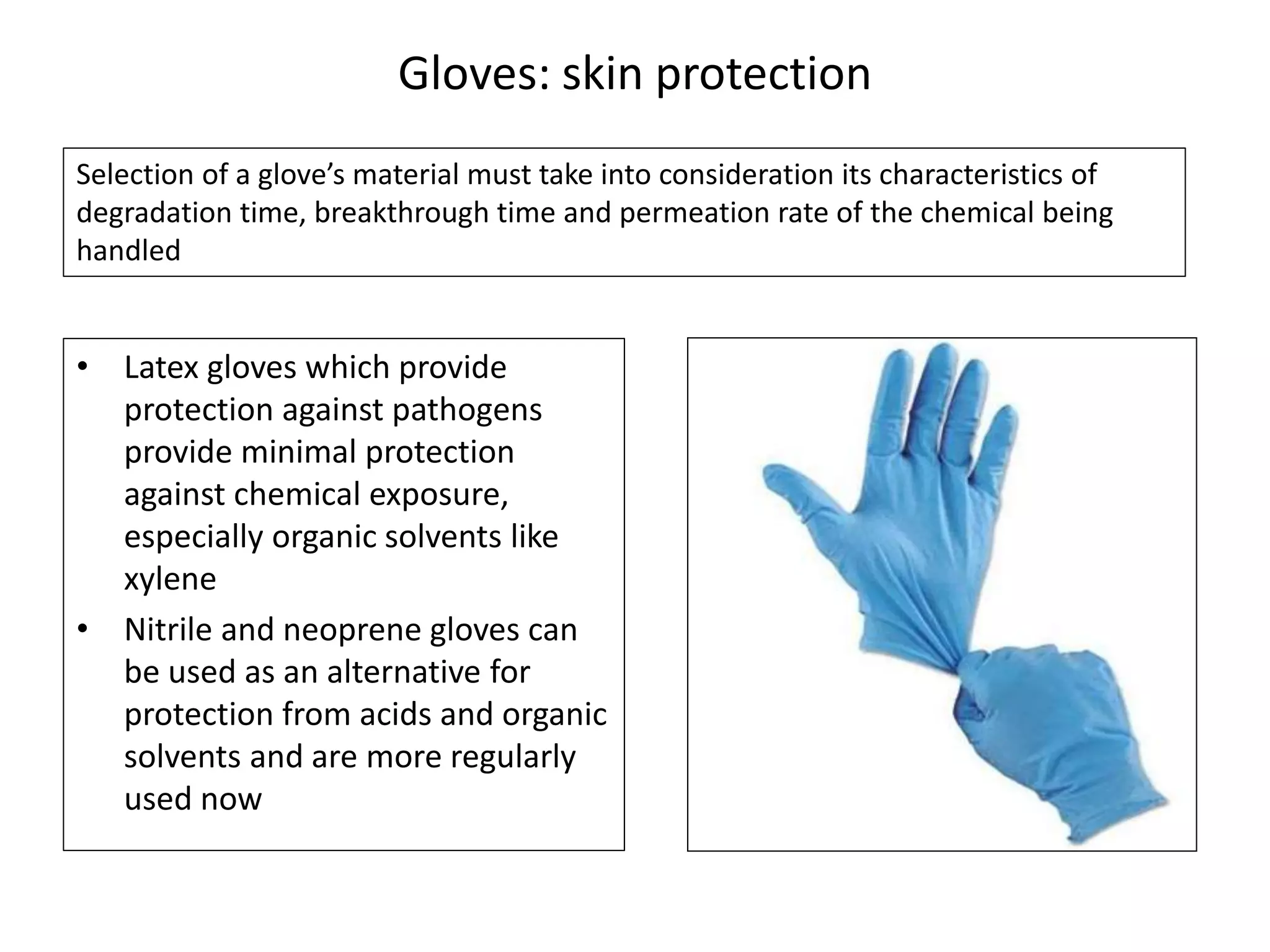
Gloves: skin protection
• Latex gloves which provide
protection against pathogens
provide minimal protection
against chemical exposure,
especially organic solvents like
xylene
• Nitrile and neoprene gloves can
be used as an alternative for
protection from acids and organic
solvents and are more regularly
used now
Selection of a glove’s material must take into consideration its characteristics of
degradation time, breakthrough time and permeation rate of the chemical being
handled
Respiratory Protection
• Respiratory protection against chemical vapors should rarely if
ever be needed except in emergencies
• Regulatory agencies stress that respirators are the protective
equipment of last resort
• Surgical masks are unacceptable because they fit poorly and
have too large a pore size to filter out aerosols
NO ONE IN HISTOLOGY SHOULD BE IN A WORKPLACE WHOSE VAPOR LEVELS
ARE EVEN TRANSIENTLY HIGHER THAN THE PELS
Respiratory Protection
• Particle (dust) masks
• Respirators
• All particle masks are not suitable for use
with chemical vapors
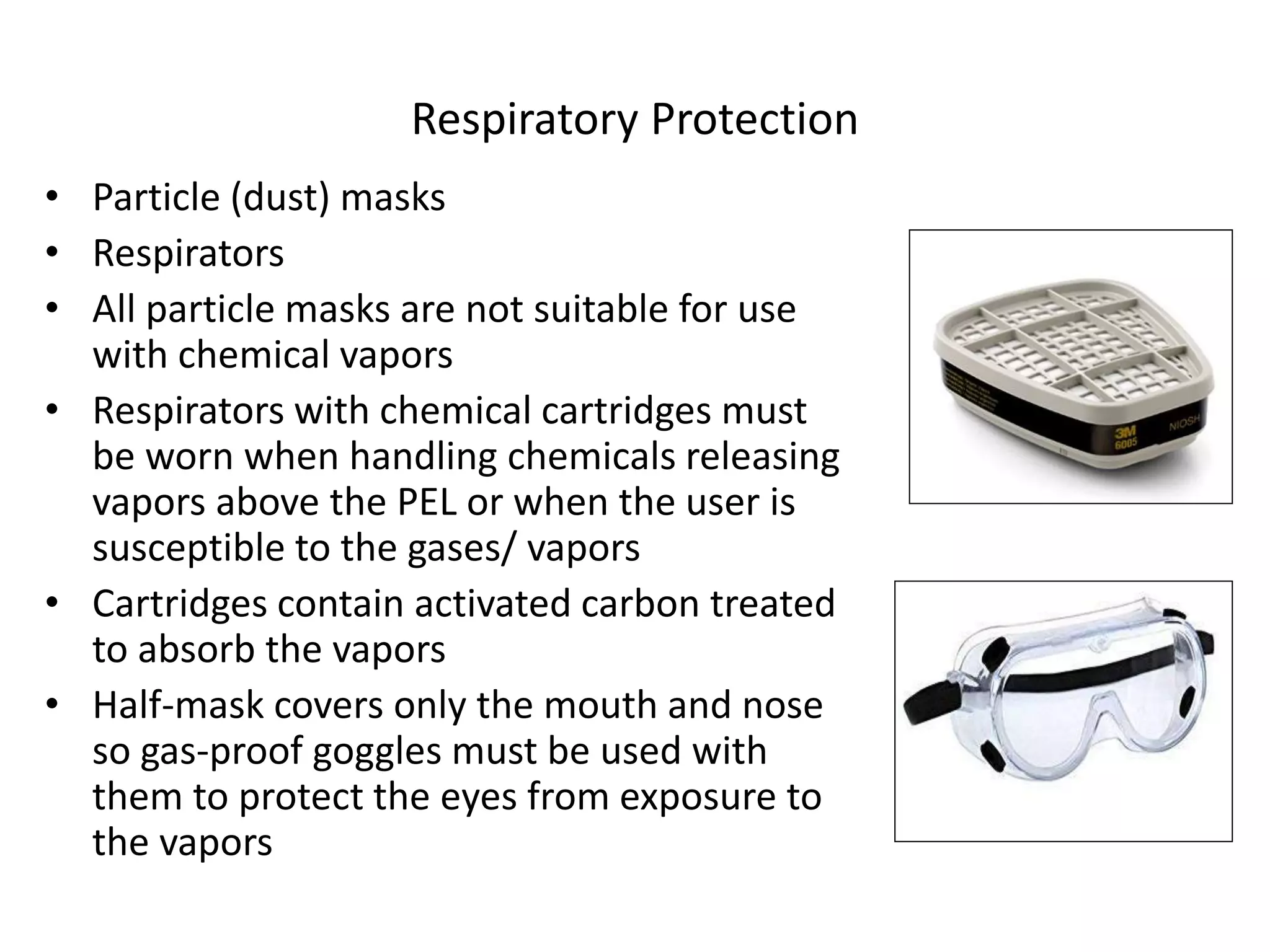
• Respirators with chemical cartridges must
be worn when handling chemicals releasing
vapors above the PEL or when the user is
susceptible to the gases/ vapors
• Cartridges contain activated carbon treated
to absorb the vapors
• Half-mask covers only the mouth and nose
so gas-proof goggles must be used with
them to protect the eyes from exposure to
the vapors
Ingestion Protection
• Written policy which prohibits eating, drinking, smoking,
application of cosmetics, and mouth pipetting in the
laboratory
• Washing your hands and face after handling chemicals and
after removing gloves is essential in a medical laboratory
Disposal
• Drain disposal is the easiest disposal option
• One must get permission from their public-owned wastewater
treatment plant to assure that drain disposal will not affect
the functions of the facility
• Drain-disposed chemical must not be toxic to the bacteria
• It is beneficial when the chemical being disposed is water
soluble, since the toxic effect is reduced through standard
water dilution whilst traveling through the pipe systems
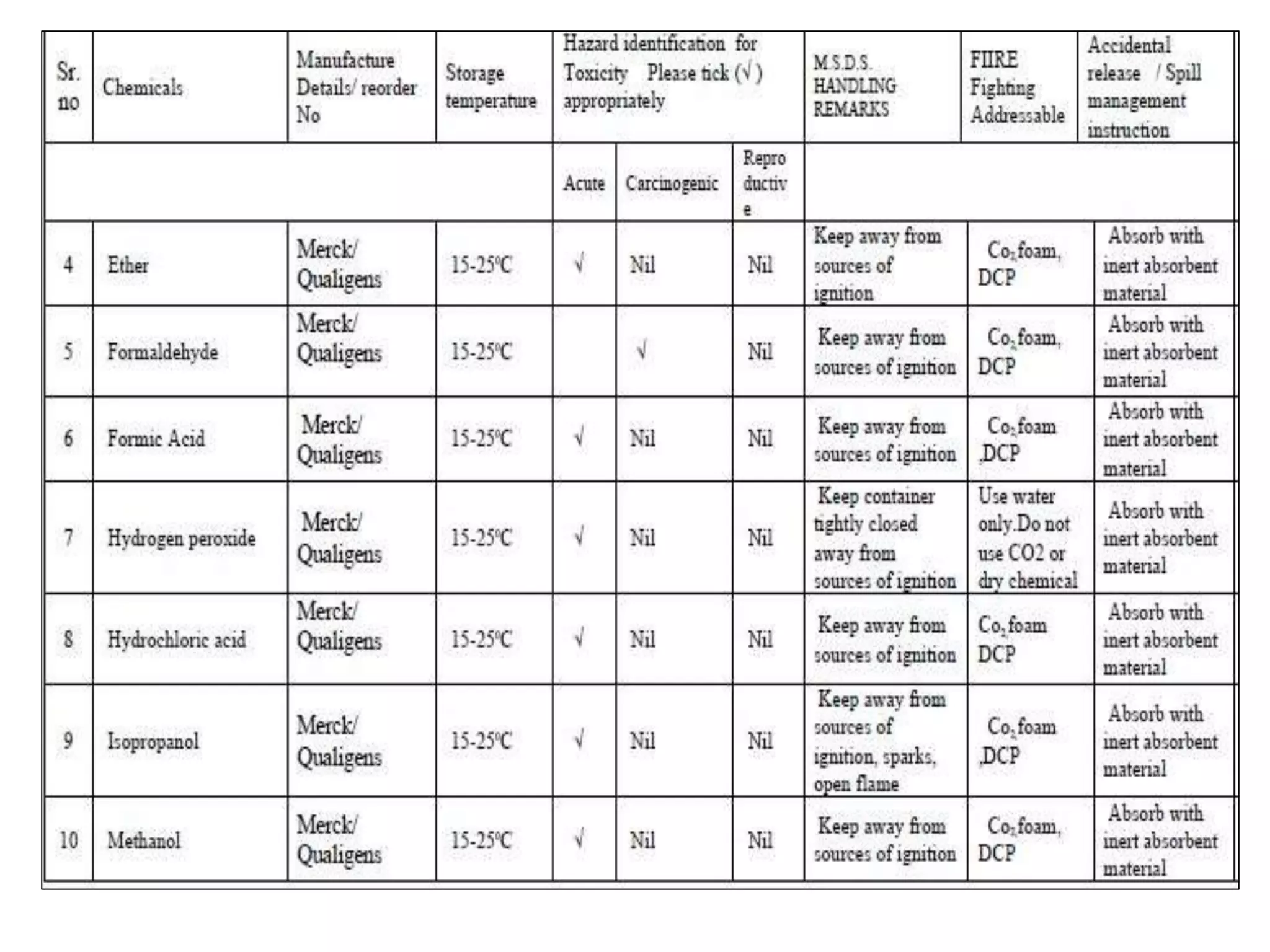
HAZARDS AND HANDLING OF
COMMON HISTOLOGICAL CHEMICALS
FORMALDEHYDE
• Formalin is typically 37% formaldehyde by weight (40% by
volume) and 6-13% methanol by volume in water
• The permissible exposure limit (PEL) for formaldehyde in the
workplace is 0.75 parts formaldehyde per million parts of air
(0.75 ppm) measured as an 8-hour time-weighted average
(TWA)
• The standard includes a second PEL in the form of a short-
term exposure limit (STEL) of 2 ppm which is the maximum
exposure allowed during a 15-minute period
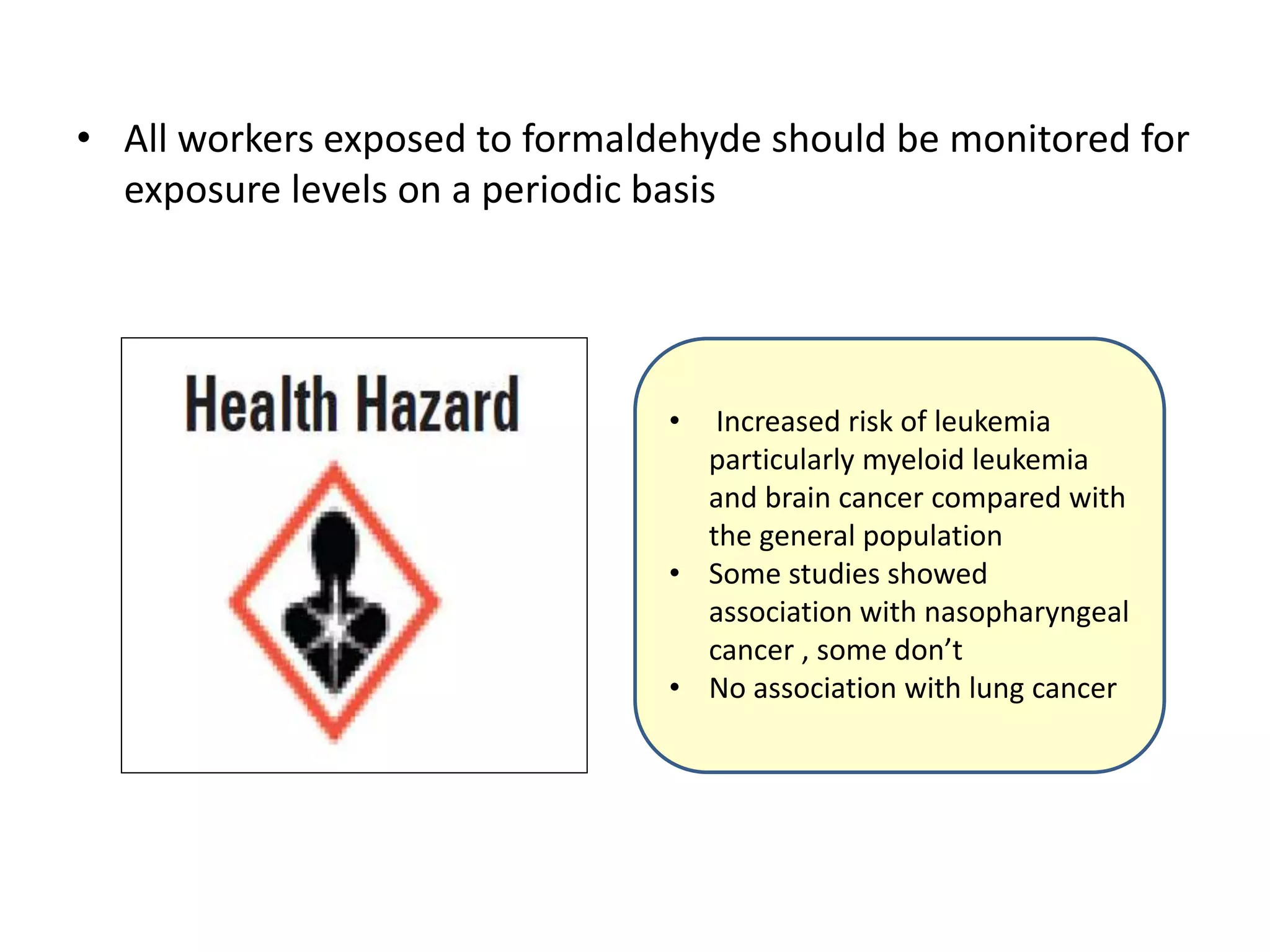
• All workers exposed to formaldehyde should be monitored for
exposure levels on a periodic basis
• Increased risk of leukemia
particularly myeloid leukemia
and brain cancer compared with
the general population
• Some studies showed
association with nasopharyngeal
cancer , some don’t
• No association with lung cancer
• Drain disposal of limited quantities of formaldehyde may be
permitted in some communities
• Recycle as much waste as possible by distillation and have the
remainder taken away by a licensed waste hauler or
detoxified by a commercial product.
Sodium phosphate, monobasic and dibasic. Harmless to workers.
May pose an environmental problem from eutrophication
(over-enrichment of aquatic systems).
• Formaldehyde is readily biodegradable. Nearly all organisms
have an enzyme, formaldehyde dehydrogenase, which
decomposes this chemical
• The trick is to feed it into the system slowly enough so that it is
diluted below toxic concentrations by the normal flow of water.
• NEVER DILUTE TOXIC MATERIAL BEFORE POURING IT DOWN
THE DRAIN, OR FOLLOW DISPOSAL BY FLUSHING WITH
‘COPIOUS AMOUNTS OF WATER’; this practice increases the
volume passing through the treatment plant, which shortens
the residence time and may impair biodegradation.
• For small/minor formaldehyde spills, clean surfaces with cold water at least two
times.
• If absorbents are used, place them into a plastic bag and seal the bag.
• Complete a waste tag so the material is disposed of as hazardous waste.
pending transfer to the institution's central facility or satellite site for chemical
waste handling or pickup by commercial disposal firm.
Making formaldehyde containing solutions:
• Potential over-exposures can occur when preparing
paraformaldehyde and 35% formaldehyde solutions
• Prepared in chemical fume hood to prevent exposures and to
contain spills
• If a spill occurs within the fume hood, the spill can be
considered minor and can be cleaned up using paper towels.
• Clean any contaminated surface with cold water at least two
times
• Place the aldehyde contaminated paper towels into a sealable
bag for disposal as hazardous waste
ISOPROPANOL
• TWA = 400 ppm STEL = 400 ppm
• Mild skin and moderate eye irritant. Toxic by ingestion.
• Flammable liquid (flash point = 12°C).
• Practically harmless except for flammability
ACETONE
• TWA = 1000 ppm (500 ppm ACGIH®, 250 ppm NIOSH); STEL
750 ppm;
• Not a serious health hazard under most conditions of use
Inhalation may cause dizziness, headache and irritation to
respiratory passages
• Skin contact can cause excessive drying and dermatitis
ACETONE
• Highly flammable (flash point = −16°C) and very volatile
• Great risk of fire from heavy vapors traveling along counters
or floors to a distant ignition source
• STORE tight-fitting lid and store in a space where there are no
electrical outlets, stoves, or heat-producing sources.
XYLENE
• Laboratory-grade xylene is composed of m-xylene (40–65%),
p-xylene (20%), o-xylene (20%) and ethyl benzene (6-20%)
and traces of toluene, trimethyl benzene, phenol, thiophene,
pyridine and hydrogen sulfide
• Flash point is 25°C
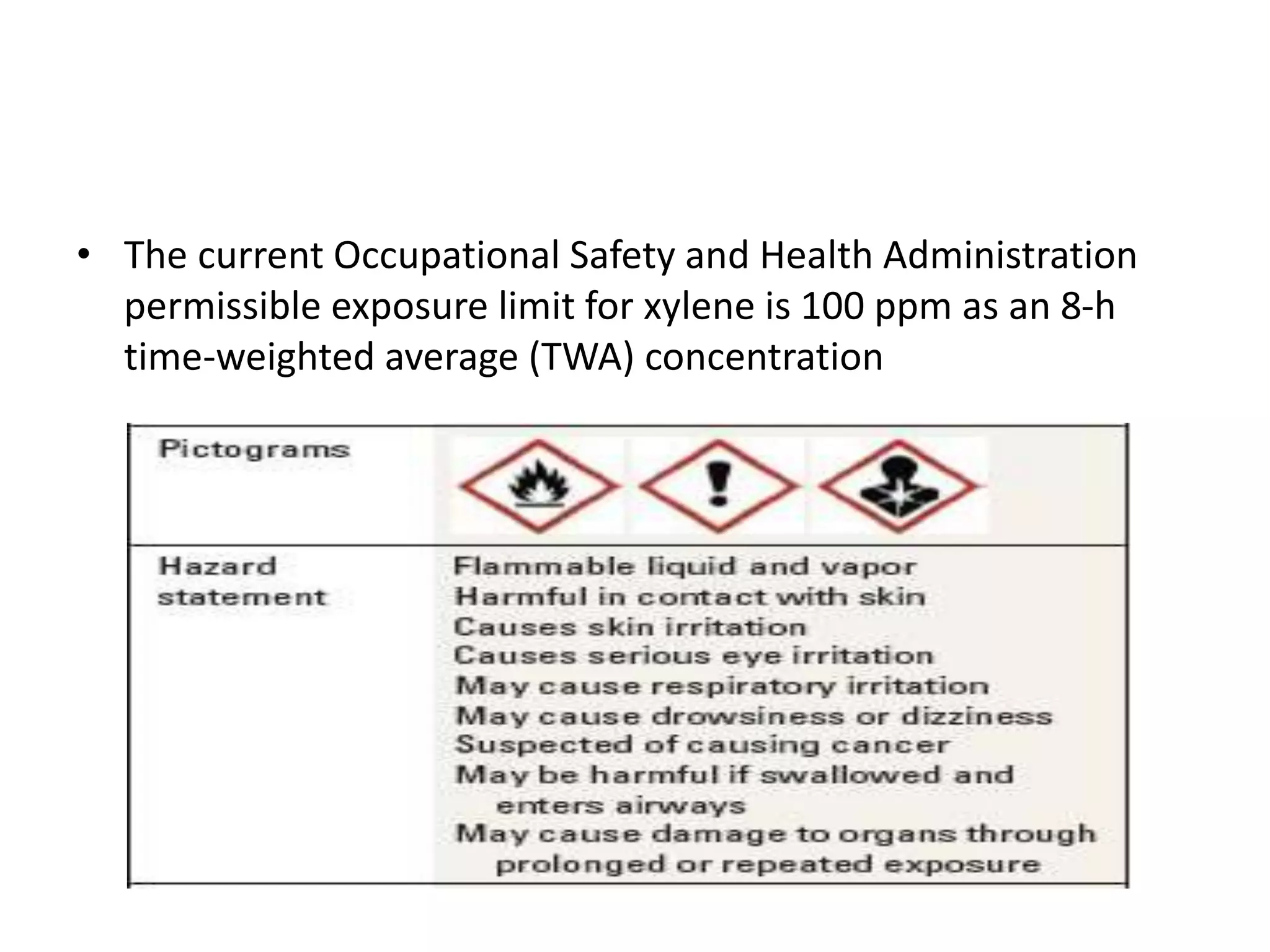
• The current Occupational Safety and Health Administration
permissible exposure limit for xylene is 100 ppm as an 8-h
time-weighted average (TWA) concentration
NITRIC ACID
• TWA = 2 ppm; STEL = 4
• Corrosive to skin, mucous membranes and most metals.
• Toxic by inhalation.
• Target organ effects on reproductive and fetal systems after
ingestion.
• Oxidizer.
• Concentrated acid is very hazardous.
• Use Neoprene gloves for extensive use; nitrile, butyl and latex
are not effective except to protect against minor splashes.
• Wear apron and goggles for handling any quantity.
Always add acid to water, never water to acid, to avoid
severe splattering.
SILVER SALTS AND SOLUTIONS
• TWA = 0.01 mg silver/cubic meter
• Skin and eye irritants.
• Ingestion will cause violent gastrointestinal discomfort.
• Little risk to workers when fresh, but SOME AGED SOLUTIONS
BECOME EXPLOSIVE. Never store after use. Explosions may
occur even with shaking.
Serious environmental hazard. Do not discard solutions or rinse
fluids down the drain
THANK YOU

Chemical safety in histopathology lab

  • 1.
    Chemical Safety in Histopathologylaboratory Dr. KANWALPREET KAUR
  • 2.
    Occupational hazards inPathology Lab • The hazards that workers in pathology laboratories face include 1. specific risks from toxic chemicals which are used in investigative procedures 2. pathogenic microorganisms in patient's samples 3. general risks from mechanical, electrical and fire hazards Aggravated by ignorance of the hazards, lack of knowledge on safety measures and inadequate safety measures adopted by laboratories IDENTIFY AND EVALUATE HAZARDS
  • 3.
    FOUNDATION OF WORKSPACECHEMICAL SAFETY PROGRAMMES • Occupational Safety and Health Act of 1970, Congress created the Occupational Safety and Health Administration (OSHA) to ensure safe and healthful working conditions for working men and women by setting and enforcing standards and by providing training, outreach, education and assistance • In 2003 the United Nations established the Globally Harmonized System (GHS) for the classification and labeling of chemicals
  • 5.
    Hazard classification :GHS Categorynumber: 1 greatest hazardous risk while higher no lower risk factor
  • 6.
    Biohazards can beinfectious agents themselves or items (solutions, specimens or objects) contaminated with them Irritants are chemicals that cause reversible inflammatory effects at the site of contact with living tissue Corrosive chemicals present both physical and health hazards. When exposed to living tissue, destruction or irreversible alteration occurs. Inanimate surfaces, they destroy the material Carcinogens : chloroform, chromic acid,formaldehyde, nickel chloride, and potassium dichromate. dyes : auramine O , basic fuchsin any dye derived from benzidine (including Congo red)
  • 7.
    GHS HAZARD CLASSIFICATIONANS ASSIGNED PICTOGRAMS
  • 8.
    Labeling of chemicals •Occupational Safety and Health Administration’s (OSHA) Hazard Communication requires following to be placed on labels: 1. Product name 2. Signal word (Danger or Warning) 3. GHS Hazard statement (classification) 4. GHS Pictograms 5. GHS Precautionary statements 6. Name, address and telephone number of the chemical manufacturer
  • 10.
    NABL :clause ofISO 15189:2007 • The label should bear the following information: 1. content and quantity 2. concentration or titer 3. date received/prepared 4. date of opening 5. storage requirements 6. expiry dates wherever applicable.
  • 11.
  • 12.
    Safety data sheet(SDS) • Primary source for identifying the hazards and proper handling requirements of a chemical • Manufacturers are required to send SDS with the initial shipment of a chemical and whenever a change has been made in the SDS
  • 13.
    GHS SAFETY DATASHEET FORMAT General information any information needed quickly in an emergency (e.g. first-aid, spill, fire). Basis of classification Regulatory information
  • 14.
    FIRST AID MEASURES Immediatemedical care by untrained responders or those that have taken a basic first-aid course.
  • 15.
    EVERY WORK AREASHOULD HAVE A BASIC FIRST-AID KIT CONTAINING AT LEAST ADHESIVE BANDAGES, STERILE GAUZE PADS AND ADHESIVE TAPES TO DRESS A WOUND PRIOR TO OBTAINING ADVANCED MEDICAL ATTENTION In the USA, the Formaldehyde Standard requires a laboratory to have eyewash stations within the immediate work area (29 CFR 1910.1048(i)(3))
  • 16.
    Laboratories should routinelyinspect their areas for fire risks and have appropriate extinguishers readily available. OSHA requires travel distance to a fire extinguisher be no more than 100 feet FIRE FIGHTING MEASURES
  • 17.
    ACCIDENTAL RELEASE MEASURES •Laboratory must be prepared with all the specific spill cleanup supplies (personal protective equipment [PPE], absorbents, neutralizers) • Size of a spill that will determine the cleanup procedure • Characteristics of the chemical and ventilation play a major role • Spill response procedure must be developed to cover every chemical used in the laboratory • The written procedure must document evacuation routes and alarms in case they are needed.
  • 18.
    • In awell ventilated area, a few hundred milliliters of spilled alcohol might be considered a small spill and only require absorbent materials to contain and remove it • A few hundred milliliters of formaldehyde in a poorly ventilated room could exceed exposure limits and produce a higher health risk requiring a different mode of cleanup involving respirators
  • 19.
    General Procedures ForA Spill Cleanup • Evaluate the risk to determine if outside assistance is needed • Evacuate people from the area if required • All individuals performing any cleanup must wear appropriate Personal Protective Equipment (PPE): goggles, gloves, shoe covers, aprons, and respirators. For any spill response, always wear the required PPE
  • 20.
    General Procedures ForA Spill Cleanup • Prevent the spread of any vapors by increasing ventilation • Turn off all ignition sources if cleaning up a flammable liquid • Control the spread of a liquid by using absorbent materials Absorbent socks, booms, pillows and pads are convenient
  • 21.
    General Procedures ForA Spill Cleanup • Neutralize if possible. • Acids are easily neutralized with sodium bicarbonate; bases with citric acid. • The neutralizing procedure is exothermic and a bubbling reaction is normal
  • 22.
    General Procedures ForA Spill Cleanup • Collect contaminated materials (booms, pads, neutralized residue, contaminated PPE • Protect the room from its vapors by sealing it within an impermeable plastic bag or other container before disposing • Wash down the contaminated area with suitable cleaning solutions. • Generally, soapy water is used. • Non-aqueous spills will need cleanup solvents which are not water based
  • 26.
    HANDLING AND STORAGE •Safely store the chemical whilst maintaining its integrity • Should not be exposed to heat or direct sunlight • Identify chemicals that require storage in special cabinets due to flammability or corrosive characteristics. • Flammables and corrosives should each be stored in approved storage cabinets , e.g. a shelf, below head level  prevent spillage • Storing chemicals on secondary trays allows the collections of miscellaneous drips or containment in case of a bottle breakage
  • 27.
    HANDLING AND STORAGE •Volume stored therein should also be limited • OSHA limits 60 gallons inside a safety cabinet for Class I & II flammables (Ethyl alcohol, isopropyl alcohol and xylene) • Explosion-proof laboratory refrigerators should be used when flammables need to be refrigerated. • A household refrigerator/freezer should never be used to store flammable materials • Vapors should be controlled carefully to prevent buildup around electrical devices that spark
  • 28.
    EXPOSURE CONTROLS/PERSONAL PROTECTION •Time weighted average (TWA) represents the exposure limit averaged over an eight-hour time period • not practical in a laboratory environment where there could be a high exposure for a very short time period and none for the rest of the day • Short term exposure limit (STEL) measures the exposure for a 15- minute time frame. Permissible exposure limits (PELs) are issued by OSHA Represent the amount a worker may be exposed to during a time period without any adverse health effects
  • 29.
    In the USA,OSHA has issued PEL for formaldehyde (vapors) as TWA = 0.75 ppm and STEL = 2.0 ppm • General laboratory ventilation systems should have an adequate exchange rate to ensure vapors do not accumulate or recirculate through the building. • Laboratory ventilation is recommended to be 6 to 12 room air changes per hour • Chemical hoods must be used when general room ventilation is inadequate • An explosion-proof chemical hood must be used with flammable chemicals
  • 30.
    REDUCE RISK TOACCEPTABLE LEVEL WELL VENTILATED LAB, CHEMICAL HOODS, FIRE PROTECTION DEVICES PPE IS NOT THE FIRST CHOICE OF WORKER PROTECTION, USED AS LAST RESORT MONITOR EMPLOYEES, NOT THE WORKPLACE. PLACE MONITORING DEVICES CLOSE TO WORKERS FACE TO CAPTURE ACTUAL BREATHABLE QUANTITIES
  • 31.
  • 32.
    Gloves: skin protection •Latex gloves which provide protection against pathogens provide minimal protection against chemical exposure, especially organic solvents like xylene • Nitrile and neoprene gloves can be used as an alternative for protection from acids and organic solvents and are more regularly used now Selection of a glove’s material must take into consideration its characteristics of degradation time, breakthrough time and permeation rate of the chemical being handled
  • 33.
    Respiratory Protection • Respiratoryprotection against chemical vapors should rarely if ever be needed except in emergencies • Regulatory agencies stress that respirators are the protective equipment of last resort • Surgical masks are unacceptable because they fit poorly and have too large a pore size to filter out aerosols NO ONE IN HISTOLOGY SHOULD BE IN A WORKPLACE WHOSE VAPOR LEVELS ARE EVEN TRANSIENTLY HIGHER THAN THE PELS
  • 34.
    Respiratory Protection • Particle(dust) masks • Respirators • All particle masks are not suitable for use with chemical vapors • Respirators with chemical cartridges must be worn when handling chemicals releasing vapors above the PEL or when the user is susceptible to the gases/ vapors • Cartridges contain activated carbon treated to absorb the vapors • Half-mask covers only the mouth and nose so gas-proof goggles must be used with them to protect the eyes from exposure to the vapors
  • 35.
    Ingestion Protection • Writtenpolicy which prohibits eating, drinking, smoking, application of cosmetics, and mouth pipetting in the laboratory • Washing your hands and face after handling chemicals and after removing gloves is essential in a medical laboratory
  • 36.
    Disposal • Drain disposalis the easiest disposal option • One must get permission from their public-owned wastewater treatment plant to assure that drain disposal will not affect the functions of the facility • Drain-disposed chemical must not be toxic to the bacteria • It is beneficial when the chemical being disposed is water soluble, since the toxic effect is reduced through standard water dilution whilst traveling through the pipe systems
  • 37.
    HAZARDS AND HANDLINGOF COMMON HISTOLOGICAL CHEMICALS
  • 38.
    FORMALDEHYDE • Formalin istypically 37% formaldehyde by weight (40% by volume) and 6-13% methanol by volume in water • The permissible exposure limit (PEL) for formaldehyde in the workplace is 0.75 parts formaldehyde per million parts of air (0.75 ppm) measured as an 8-hour time-weighted average (TWA) • The standard includes a second PEL in the form of a short- term exposure limit (STEL) of 2 ppm which is the maximum exposure allowed during a 15-minute period
  • 39.
    • All workersexposed to formaldehyde should be monitored for exposure levels on a periodic basis • Increased risk of leukemia particularly myeloid leukemia and brain cancer compared with the general population • Some studies showed association with nasopharyngeal cancer , some don’t • No association with lung cancer
  • 40.
    • Drain disposalof limited quantities of formaldehyde may be permitted in some communities • Recycle as much waste as possible by distillation and have the remainder taken away by a licensed waste hauler or detoxified by a commercial product. Sodium phosphate, monobasic and dibasic. Harmless to workers. May pose an environmental problem from eutrophication (over-enrichment of aquatic systems).
  • 41.
    • Formaldehyde isreadily biodegradable. Nearly all organisms have an enzyme, formaldehyde dehydrogenase, which decomposes this chemical • The trick is to feed it into the system slowly enough so that it is diluted below toxic concentrations by the normal flow of water. • NEVER DILUTE TOXIC MATERIAL BEFORE POURING IT DOWN THE DRAIN, OR FOLLOW DISPOSAL BY FLUSHING WITH ‘COPIOUS AMOUNTS OF WATER’; this practice increases the volume passing through the treatment plant, which shortens the residence time and may impair biodegradation.
  • 42.
    • For small/minorformaldehyde spills, clean surfaces with cold water at least two times. • If absorbents are used, place them into a plastic bag and seal the bag. • Complete a waste tag so the material is disposed of as hazardous waste. pending transfer to the institution's central facility or satellite site for chemical waste handling or pickup by commercial disposal firm.
  • 43.
    Making formaldehyde containingsolutions: • Potential over-exposures can occur when preparing paraformaldehyde and 35% formaldehyde solutions • Prepared in chemical fume hood to prevent exposures and to contain spills • If a spill occurs within the fume hood, the spill can be considered minor and can be cleaned up using paper towels. • Clean any contaminated surface with cold water at least two times • Place the aldehyde contaminated paper towels into a sealable bag for disposal as hazardous waste
  • 44.
    ISOPROPANOL • TWA =400 ppm STEL = 400 ppm • Mild skin and moderate eye irritant. Toxic by ingestion. • Flammable liquid (flash point = 12°C). • Practically harmless except for flammability
  • 45.
    ACETONE • TWA =1000 ppm (500 ppm ACGIH®, 250 ppm NIOSH); STEL 750 ppm; • Not a serious health hazard under most conditions of use Inhalation may cause dizziness, headache and irritation to respiratory passages • Skin contact can cause excessive drying and dermatitis
  • 46.
    ACETONE • Highly flammable(flash point = −16°C) and very volatile • Great risk of fire from heavy vapors traveling along counters or floors to a distant ignition source • STORE tight-fitting lid and store in a space where there are no electrical outlets, stoves, or heat-producing sources.
  • 47.
    XYLENE • Laboratory-grade xyleneis composed of m-xylene (40–65%), p-xylene (20%), o-xylene (20%) and ethyl benzene (6-20%) and traces of toluene, trimethyl benzene, phenol, thiophene, pyridine and hydrogen sulfide • Flash point is 25°C
  • 48.
    • The currentOccupational Safety and Health Administration permissible exposure limit for xylene is 100 ppm as an 8-h time-weighted average (TWA) concentration
  • 49.
    NITRIC ACID • TWA= 2 ppm; STEL = 4 • Corrosive to skin, mucous membranes and most metals. • Toxic by inhalation. • Target organ effects on reproductive and fetal systems after ingestion. • Oxidizer. • Concentrated acid is very hazardous. • Use Neoprene gloves for extensive use; nitrile, butyl and latex are not effective except to protect against minor splashes. • Wear apron and goggles for handling any quantity.
  • 50.
    Always add acidto water, never water to acid, to avoid severe splattering.
  • 51.
    SILVER SALTS ANDSOLUTIONS • TWA = 0.01 mg silver/cubic meter • Skin and eye irritants. • Ingestion will cause violent gastrointestinal discomfort. • Little risk to workers when fresh, but SOME AGED SOLUTIONS BECOME EXPLOSIVE. Never store after use. Explosions may occur even with shaking. Serious environmental hazard. Do not discard solutions or rinse fluids down the drain
  • 52.

Editor's Notes

  • #4 Criteria : classification of health, physical and environmental hazards Specifies what information should be included on labels of hazardous chemicals as well as safety data sheets.
  • #19 specifics of the procedure for a spillage cleanup
  • #30 STEL does take a laboratory environment into consideration
  • #32 exposure limits are properties of the worker and the workplace combined. They are not simply the maximum limits of vapor, fume or dust in the workplace; they are the maximum limits of exposure. This is especially important to consider when monitoring exposure levels. Monitor employees, not the workplace… airborne levels of formaldehyde vapor a few inches above a grossing station’s cutting board may be much higher than concentrations at nose level, especially with well-designed ventilation.
  • #41 In 1987, OSHA established a Federal standard that reduced the amount of formaldehyde to which workers can be exposed over an 8-hour workday from 3 ppm to 1 ppm
  • #42 In . In 1980, laboratory studies showed that exposure to formaldehyde could cause nasal cancer in rats. This finding raised the question of whether formaldehyde exposure could also cause cancer in humans. 2011, the National Toxicology Program, an interagency program of the Department of Health and Human Services, named formaldehyde as a known human carcinogen in its 12 Report on Carcinogens