PRESENTED BY: VINAY .R
1ST YEAR
M.PHARM
DEPT. OF PHARMACHEMISTRY
INDUSTRIAL SAFETY
Contents :
 Introduction to Industrial Safety.
 Objectives of Industrial Safety.
 MSDS.
 NEPA Chemical Hazard Label.
 PPE.
Industrial Safety
Industrial safety is primarily a management activity
which is concerned with
 Reducing the hazards
Controlling the hazards
Eliminating hazards from the industries or industrial
units.
Objectives
 To prevent accidents in the plant by reducing the
hazard to minimum.
 To eliminate accident caused work stoppage and
lost production.
 To evaluate employee's moral by promoting safe
work place and good working condition.
MSDS ( Material Safety Data Sheet )
 A MSDS is a document which discusses all the
information of the material related to its
identification, Hazards, Handling/Storage
requirement, First Aid measures, Disposal
information.
Material Safety Data Sheet
 STANDARDIZED FORMAT, ( ANSI ).
ANSI Standardized MDSD consist of 16
sections with standard titles.
 NON-STANDARDIZED FORMAT.
This format varies from company to company.
Material Safety Data Sheet
16 SECTION STANDARD MSDS
1. Chemical product and Company Identification.
2. Composition, Information or Ingredients.
3. Hazard Identification.
4. First Aid Measures.
5. Fire-Fighting Measures.
6. Accidental Release Measures.
7. Handling and Storage.
8. Exposure Controls and Personal Protection.
Material Safety Data Sheet
9. Physical and Chemical Properties.
10. Stability and Reactivity.
11. Toxicological Information.
12. Ecological Information.
13. Disposal Considerations.
14. Transport Information.
15. Regulatory Information.
16. Other Information.
Material Safety Data Sheet
1. Chemical product and Company Identification.
This section links the chemical name on the
label to the MSDS. The MSDS also lists the name,
address and the phone number of the company,
manufacturer or distributer who provides the
chemical.
Material Safety Data Sheet
2. Composition, Information or Ingredients.
This section identify all the hazardous
ingredients of the material. This section may also
include OSHA ( occupational safety and health
administration).
Material Safety Data Sheet
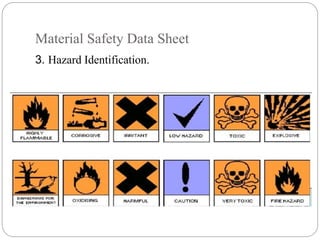
3. Hazard Identification.
Material Safety Data Sheet
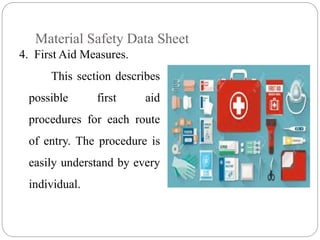
4. First Aid Measures.
This section describes
possible first aid
procedures for each route
of entry. The procedure is
easily understand by every
individual.
Material Safety Data Sheet
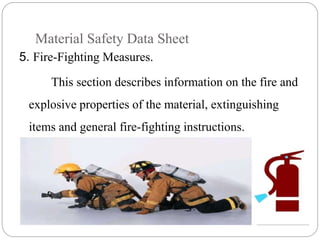
5. Fire-Fighting Measures.
This section describes information on the fire and
explosive properties of the material, extinguishing
items and general fire-fighting instructions.
Material Safety Data Sheet
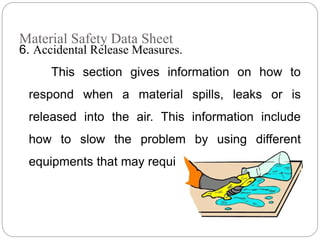
6. Accidental Release Measures.
This section gives information on how to
respond when a material spills, leaks or is
released into the air. This information include
how to slow the problem by using different
equipments that may required for protection.
Material Safety Data Sheet
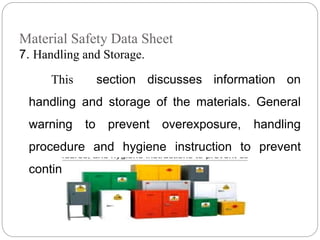
7. Handling and Storage.
This section discusses information on
handling and storage of the materials. General
warning to prevent overexposure, handling
procedure and hygiene instruction to prevent
continued exposure.
Material Safety Data Sheet
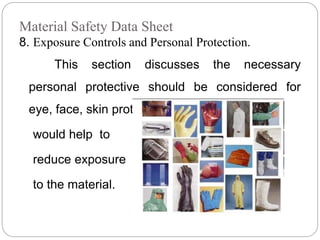
8. Exposure Controls and Personal Protection.
This section discusses the necessary
personal protective should be considered for
eye, face, skin protection that
would help to
reduce exposure
to the material.
Material Safety Data Sheet
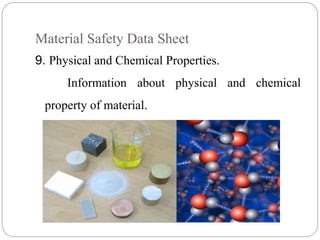
9. Physical and Chemical Properties.
Information about physical and chemical
property of material.
Material Safety Data Sheet
10. Stability and Reactivity.
This section discuss chemical stability,
conditions to avoid, incompatibility with other
materials.
Material Safety Data Sheet
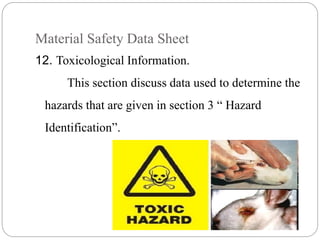
12. Toxicological Information.
This section discuss data used to determine the
hazards that are given in section 3 “ Hazard
Identification”.
Material Safety Data Sheet
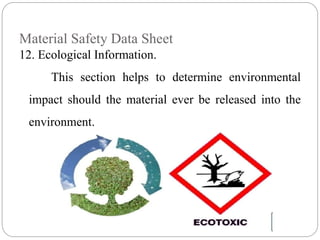
12. Ecological Information.
This section helps to determine environmental
impact should the material ever be released into the
environment.
Material Safety Data Sheet
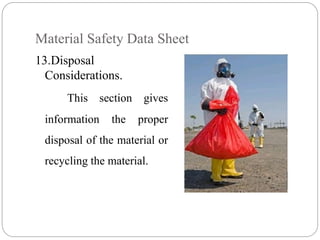
13.Disposal
Considerations.
This section gives
information the proper
disposal of the material or
recycling the material.
Material Safety Data Sheet
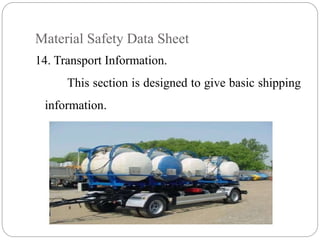
14. Transport Information.
This section is designed to give basic shipping
information.
Material Safety Data Sheet
15. Regulatory Information.
This section discusses information on the
regulations under the materials falls.
Example: OSHA (Occupational Safety and Health
Administration)
TSCA (Toxic Substance Control Act.)
Material Safety Data Sheet
16. Other Information.
This section include any other important
information concerning the material like Risk
factor, Safety factor.
Material Safety Data Sheet
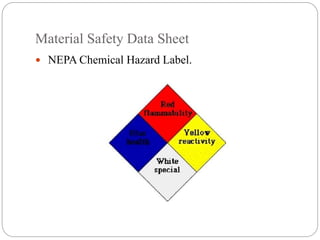
 NEPA Chemical Hazard Label.
Material Safety Data Sheet
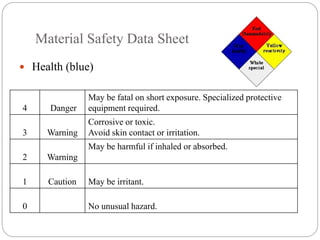
 Health (blue)
4 Danger
May be fatal on short exposure. Specialized protective
equipment required.
3 Warning
Corrosive or toxic.
Avoid skin contact or irritation.
2 Warning
May be harmful if inhaled or absorbed.
1 Caution May be irritant.
0 No unusual hazard.
Material Safety Data Sheet
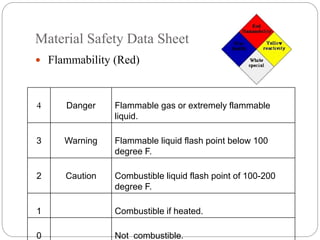
 Flammability (Red)
4 Danger Flammable gas or extremely flammable
liquid.
3 Warning Flammable liquid flash point below 100
degree F.
2 Caution Combustible liquid flash point of 100-200
degree F.
1 Combustible if heated.
0 Not combustible.
Material Safety Data Sheet
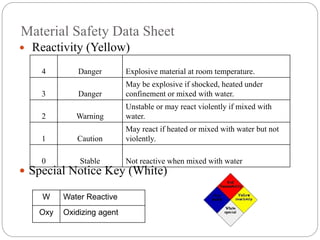
 Reactivity (Yellow)
 Special Notice Key (White)
4 Danger Explosive material at room temperature.
3 Danger
May be explosive if shocked, heated under
confinement or mixed with water.
2 Warning
Unstable or may react violently if mixed with
water.
1 Caution
May react if heated or mixed with water but not
violently.
0 Stable Not reactive when mixed with water
W Water Reactive
Oxy Oxidizing agent
Personal Protective Equipment
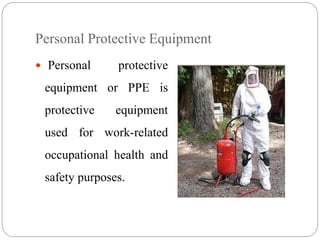
 Personal protective
equipment or PPE is
protective equipment
used for work-related
occupational health and
safety purposes.
Personal Protective Equipment
 Why is PPE important?
PPE is designed to protect the worker’s body
from hazards and injuries such as blunt impacts,
electrical hazards, heat, chemicals, and infection, etc.
 What Do I Wear ?
 All employees, depending on their jobs, are required to
co-operate in the strict observance of safety legislation,
regulations, guideline policies and procedures at all time.
 This includes wearing safety shoes, hearing protection, goggles,
gloves, helmets, etc.
 Depending on their jobs, employees are required to wear all
PPE while they are in the manufacturing plant.
What does Personal Protective Equipment
Include ?
 Eye & Face Protection
 Head Protection
 Hand/Skin Protection
 Body Protection
 Hearing Protection
 Foot Protection
 Respiratory Protection
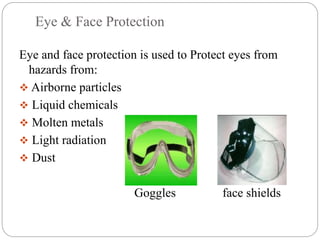
Eye & Face Protection
Eye and face protection is used to Protect eyes from
hazards from:
 Airborne particles
 Liquid chemicals
 Molten metals
 Light radiation
 Dust
Goggles face shields
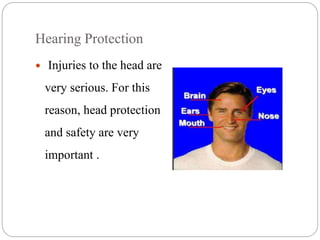
Hearing Protection
 Injuries to the head are
very serious. For this
reason, head protection
and safety are very
important .
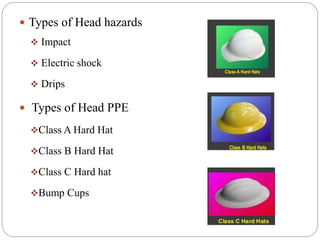
 Types of Head hazards
 Impact
 Electric shock
 Drips
 Types of Head PPE
Class A Hard Hat
Class B Hard Hat
Class C Hard hat
Bump Cups
Hand/Skin Protection
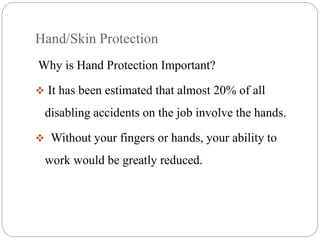
Why is Hand Protection Important?
 It has been estimated that almost 20% of all
disabling accidents on the job involve the hands.
 Without your fingers or hands, your ability to
work would be greatly reduced.
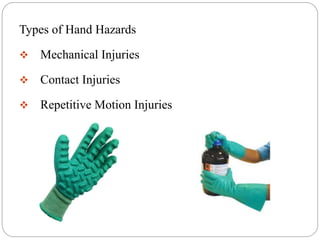
Types of Hand Hazards
 Mechanical Injuries
 Contact Injuries
 Repetitive Motion Injuries
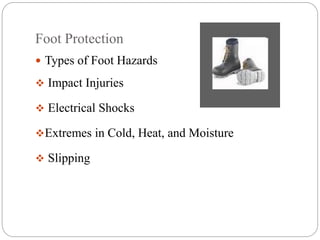
Foot Protection
 Types of Foot Hazards
 Impact Injuries
 Electrical Shocks
Extremes in Cold, Heat, and Moisture
 Slipping
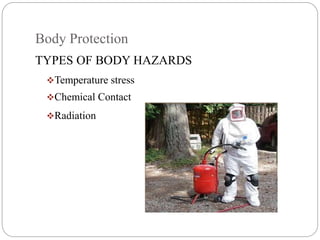
Body Protection
TYPES OF BODY HAZARDS
Temperature stress
Chemical Contact
Radiation
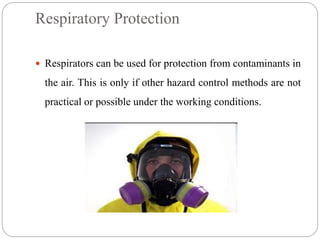
Respiratory Protection
 Respirators can be used for protection from contaminants in
the air. This is only if other hazard control methods are not
practical or possible under the working conditions.
Reference
 http:/ /ae.linkedin.com/pub/nadeem-
baig/14/68a/515
 http:/ /www.ccohs.ca/oshanswers/prevention/
 http:/ /www.flickr.com/
 http:/ /www.slideshere.net/

Industrial safty

  • 1.
    PRESENTED BY: VINAY.R 1ST YEAR M.PHARM DEPT. OF PHARMACHEMISTRY INDUSTRIAL SAFETY
  • 2.
    Contents :  Introductionto Industrial Safety.  Objectives of Industrial Safety.  MSDS.  NEPA Chemical Hazard Label.  PPE.
  • 3.
    Industrial Safety Industrial safetyis primarily a management activity which is concerned with  Reducing the hazards Controlling the hazards Eliminating hazards from the industries or industrial units.
  • 4.
    Objectives  To preventaccidents in the plant by reducing the hazard to minimum.  To eliminate accident caused work stoppage and lost production.  To evaluate employee's moral by promoting safe work place and good working condition.
  • 5.
    MSDS ( MaterialSafety Data Sheet )  A MSDS is a document which discusses all the information of the material related to its identification, Hazards, Handling/Storage requirement, First Aid measures, Disposal information.
  • 6.
    Material Safety DataSheet  STANDARDIZED FORMAT, ( ANSI ). ANSI Standardized MDSD consist of 16 sections with standard titles.  NON-STANDARDIZED FORMAT. This format varies from company to company.
  • 7.
    Material Safety DataSheet 16 SECTION STANDARD MSDS 1. Chemical product and Company Identification. 2. Composition, Information or Ingredients. 3. Hazard Identification. 4. First Aid Measures. 5. Fire-Fighting Measures. 6. Accidental Release Measures. 7. Handling and Storage. 8. Exposure Controls and Personal Protection.
  • 8.
    Material Safety DataSheet 9. Physical and Chemical Properties. 10. Stability and Reactivity. 11. Toxicological Information. 12. Ecological Information. 13. Disposal Considerations. 14. Transport Information. 15. Regulatory Information. 16. Other Information.
  • 9.
    Material Safety DataSheet 1. Chemical product and Company Identification. This section links the chemical name on the label to the MSDS. The MSDS also lists the name, address and the phone number of the company, manufacturer or distributer who provides the chemical.
  • 10.
    Material Safety DataSheet 2. Composition, Information or Ingredients. This section identify all the hazardous ingredients of the material. This section may also include OSHA ( occupational safety and health administration).
  • 11.
    Material Safety DataSheet 3. Hazard Identification.
  • 12.
    Material Safety DataSheet 4. First Aid Measures. This section describes possible first aid procedures for each route of entry. The procedure is easily understand by every individual.
  • 13.
    Material Safety DataSheet 5. Fire-Fighting Measures. This section describes information on the fire and explosive properties of the material, extinguishing items and general fire-fighting instructions.
  • 14.
    Material Safety DataSheet 6. Accidental Release Measures. This section gives information on how to respond when a material spills, leaks or is released into the air. This information include how to slow the problem by using different equipments that may required for protection.
  • 15.
    Material Safety DataSheet 7. Handling and Storage. This section discusses information on handling and storage of the materials. General warning to prevent overexposure, handling procedure and hygiene instruction to prevent continued exposure.
  • 16.
    Material Safety DataSheet 8. Exposure Controls and Personal Protection. This section discusses the necessary personal protective should be considered for eye, face, skin protection that would help to reduce exposure to the material.
  • 17.
    Material Safety DataSheet 9. Physical and Chemical Properties. Information about physical and chemical property of material.
  • 18.
    Material Safety DataSheet 10. Stability and Reactivity. This section discuss chemical stability, conditions to avoid, incompatibility with other materials.
  • 19.
    Material Safety DataSheet 12. Toxicological Information. This section discuss data used to determine the hazards that are given in section 3 “ Hazard Identification”.
  • 20.
    Material Safety DataSheet 12. Ecological Information. This section helps to determine environmental impact should the material ever be released into the environment.
  • 21.
    Material Safety DataSheet 13.Disposal Considerations. This section gives information the proper disposal of the material or recycling the material.
  • 22.
    Material Safety DataSheet 14. Transport Information. This section is designed to give basic shipping information.
  • 23.
    Material Safety DataSheet 15. Regulatory Information. This section discusses information on the regulations under the materials falls. Example: OSHA (Occupational Safety and Health Administration) TSCA (Toxic Substance Control Act.)
  • 24.
    Material Safety DataSheet 16. Other Information. This section include any other important information concerning the material like Risk factor, Safety factor.
  • 25.
    Material Safety DataSheet  NEPA Chemical Hazard Label.
  • 26.
    Material Safety DataSheet  Health (blue) 4 Danger May be fatal on short exposure. Specialized protective equipment required. 3 Warning Corrosive or toxic. Avoid skin contact or irritation. 2 Warning May be harmful if inhaled or absorbed. 1 Caution May be irritant. 0 No unusual hazard.
  • 27.
    Material Safety DataSheet  Flammability (Red) 4 Danger Flammable gas or extremely flammable liquid. 3 Warning Flammable liquid flash point below 100 degree F. 2 Caution Combustible liquid flash point of 100-200 degree F. 1 Combustible if heated. 0 Not combustible.
  • 28.
    Material Safety DataSheet  Reactivity (Yellow)  Special Notice Key (White) 4 Danger Explosive material at room temperature. 3 Danger May be explosive if shocked, heated under confinement or mixed with water. 2 Warning Unstable or may react violently if mixed with water. 1 Caution May react if heated or mixed with water but not violently. 0 Stable Not reactive when mixed with water W Water Reactive Oxy Oxidizing agent
  • 29.
    Personal Protective Equipment Personal protective equipment or PPE is protective equipment used for work-related occupational health and safety purposes.
  • 30.
    Personal Protective Equipment Why is PPE important? PPE is designed to protect the worker’s body from hazards and injuries such as blunt impacts, electrical hazards, heat, chemicals, and infection, etc.
  • 31.
     What DoI Wear ?  All employees, depending on their jobs, are required to co-operate in the strict observance of safety legislation, regulations, guideline policies and procedures at all time.  This includes wearing safety shoes, hearing protection, goggles, gloves, helmets, etc.  Depending on their jobs, employees are required to wear all PPE while they are in the manufacturing plant.
  • 32.
    What does PersonalProtective Equipment Include ?  Eye & Face Protection  Head Protection  Hand/Skin Protection  Body Protection  Hearing Protection  Foot Protection  Respiratory Protection
  • 33.
    Eye & FaceProtection Eye and face protection is used to Protect eyes from hazards from:  Airborne particles  Liquid chemicals  Molten metals  Light radiation  Dust Goggles face shields
  • 34.
    Hearing Protection  Injuriesto the head are very serious. For this reason, head protection and safety are very important .
  • 35.
     Types ofHead hazards  Impact  Electric shock  Drips  Types of Head PPE Class A Hard Hat Class B Hard Hat Class C Hard hat Bump Cups
  • 36.
    Hand/Skin Protection Why isHand Protection Important?  It has been estimated that almost 20% of all disabling accidents on the job involve the hands.  Without your fingers or hands, your ability to work would be greatly reduced.
  • 37.
    Types of HandHazards  Mechanical Injuries  Contact Injuries  Repetitive Motion Injuries
  • 38.
    Foot Protection  Typesof Foot Hazards  Impact Injuries  Electrical Shocks Extremes in Cold, Heat, and Moisture  Slipping
  • 39.
    Body Protection TYPES OFBODY HAZARDS Temperature stress Chemical Contact Radiation
  • 40.
    Respiratory Protection  Respiratorscan be used for protection from contaminants in the air. This is only if other hazard control methods are not practical or possible under the working conditions.
  • 41.
    Reference  http:/ /ae.linkedin.com/pub/nadeem- baig/14/68a/515 http:/ /www.ccohs.ca/oshanswers/prevention/  http:/ /www.flickr.com/  http:/ /www.slideshere.net/