ASTHI DHATU
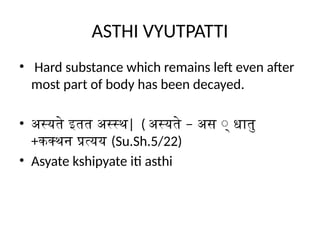
ASTHI VYUTPATTI
• Hard substance which remains left even after
most part of body has been decayed.
• अस्यते इतत अस्स्थ| ( –
अस्यते अस ् धातु
+कक्थन प्रत्यय (Su.Sh.5/22)
• Asyate kshipyate iti asthi
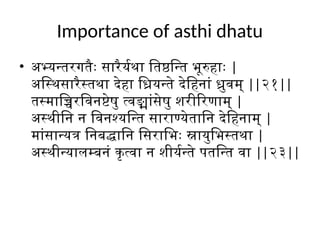
Importance of asthi dhatu
• अभ्यन्तरगतैः सारैर्यथा तिष्ठन्ति भूरुहाः |
अस्थिसारैस्तथा देहा ध्रियन्ते देहिनां ध्रुवम् ||२१||
तस्माच्चिरविनष्टेषु त्वङ्मांसेषु शरीरिणाम् |
अस्थीनि न विनश्यन्ति साराण्येतानि देहिनाम् |
मांसान्यत्र निबद्धानि सिराभिः स्नायुभिस्तथा |
अस्थीन्यालम्बनं कृत्वा न शीर्यन्ते पतन्ति वा ||२३||
• Asthi is compared to a strong hard wood of a tree.Like
how a strong hard wood supports the tree,asthi dhatu
helps in mainting errect posture
• According to Susruta it is substance which remains
even after else very part like flesh, muscles etc. are
shattered even after burying the body after death. It
remains as last identity of person even after demise
• Asthi helps in the proper attachment of masa ,sira and
snayu without falling.
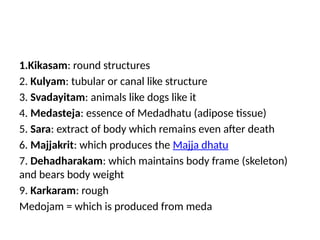
1.Kikasam: round structures
2. Kulyam: tubular or canal like structure
3. Svadayitam: animals like dogs like it
4. Medasteja: essence of Medadhatu (adipose tissue)
5. Sara: extract of body which remains even after death
6. Majjakrit: which produces the Majja dhatu
7. Dehadharakam: which maintains body frame (skeleton)
and bears body weight
9. Karkaram: rough
Medojam = which is produced from meda
PANCHABHAUTIKACONSTITUTION
• Asthi has predominance of Prithivi and Vayu
Mahabhuta.
• qualities of Prithvi Mahabhuta, Asthi is strong
and heavy and as per qualities of Vayu
Mahabhuta,Asthi is dry and rough.
ASTHI KARMA
• Deha Dharana.
• Majja Pushti.
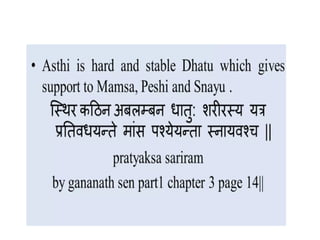
• Asthi supports the Mamsa, Sira and Snayu
TYPES
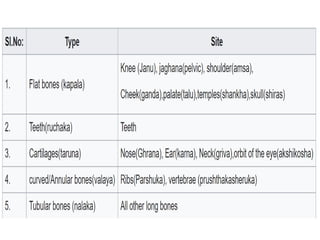
• Kapala-Asthi - These are flat in nature. Literally it means bone
which covers and protects the brain .
• • Valaya-Asthi - These are round in shape or particularly hemi
circle in shape.
• • Taruna-Asthi - These are soft in nature . Literally it means which
have either not fully developed i.e. ossified. Also the bones of
child have come under same scenario.
• • Nalika-Asthi - These are long like tubes and hollow from within.
They are reed shaped.
• • Ruchaka-Asthi - The bones which are different from all and are
utilized to chew food and enjoy the taste. These are for taste
sensation.
Formation of asthi dhatu
• पृथिव्यग्न्यनिलादीनां सङ्घातः स्वोष्मणा कृतः||
३०||
• खरत्वं प्रकरोत्यस्य जायतेऽस्थि ततो नृणाम्|
• Because of the action of asthi dhātvagni on
the aggregation of prithvi, agni and anila,
roughness is attained during the formation of
the asthi
• The asthi dhatu is formed from its predecessor adipose
tissue (meda dhatu. The nourishing portion of adipose
tissue meda dhatu and constituents of nutrient fluid
(ahara rasa) are transformed into asthi dhatu by action of
factors responsible for its metabolism (asthi
dhatvagni). Agni mahabhuta and vayu mahabhuta play a
major role in the solidification and roughness of asthi by
acting upon prithvi mahabhuta components of adipose
tissue (meda dhatu
• Porosity in bones are due to actions of vayu and akasha
mahabhuta.
UPADHATU
• During the process of metabolism and
development of asthi dhatu, nails (nakha) are
formed as the metabolic byproducts (upadhatu).
[Su. Sa. Sutra Sthana 46/529] Sharangadhara
considered teeth (danta) only as metabolic
byproduct.[Sha. Sa. Purva khanda chapter 5]
• कफः पित्तं मलः खेषु स्वेदः स्यान्नखरोम च |
नेत्रविट् त्वक्षु च स्नेहो धातूनां क्रमशो मलाः ||५२९||
MALA
• Scalp hair (kesha) and body hair(loma) are
waste products of metabolism of asthi dhatu.
[Cha.Sa. CHI15/18]
स्यात्किट्टं केशलोमास्थ्नो
Number of athi
• There are total 360 well-formed asthi in
human body. [Cha. Sa.Sharira Sthana 7/6].
Sushruta opines the total number as 300.
[Su.Sa. Sharira Sthana 5/18]
Time span
• The asthi dhatu is formed on 5th day from the
nutrient fluid (ahara rasa). [Cha.Sa.
Chikitsa Sthana 15/20-21]
• Sushruta opines that the asthi dhatu is formed
in a time span of 12060 kala (twenty days).
[Su.Sa.Sutra Sthana 14/14]
Asthi kshaya and vriddhi
• Signs of decrease
• loss of scalp and body-hair, beard, nails and teeth
• fatigue
• loose joints
• pain in bones
• dryness
• breaking of teeth and nails
• [Cha. Sa. Sutra Sthana 17/67], [Su. Sa. Sutra Sthana 15/9]
• Signs of increase
• extra tooth and bony growth [Su. Sa. Sutra Sthana 15/14]
ASTHI SARA
• पार्ष्णिगुल्फजान्वरत्निजत्रुचिबुकशिरःपर्वस्थूलाःस्थूलास्थिनखदन्ता
श्चास्थिसाराः|
तेमहोत्साहाःक्रियावन्तःक्लेशसहाःसारस्थिरशरीराभवन्त्यायुष्मन्त
श्च|
• Person with asthi dhatu sara has prominent heels
(parshni), ankles (gulpha), knee joint (janu), elbows
(aratni), collarbones (jatru), chin (chibuka), head (shira),
flanks (parshva) and joints and also bones and teeth. Such
persons are excess enthusiastic, very active, enduring,
having strong and firm body as well as longevity.

asthi dhatu asthi dhatu .pptx

  • 1.
  • 2.
    ASTHI VYUTPATTI • Hardsubstance which remains left even after most part of body has been decayed. • अस्यते इतत अस्स्थ| ( – अस्यते अस ् धातु +कक्थन प्रत्यय (Su.Sh.5/22) • Asyate kshipyate iti asthi
  • 3.
    Importance of asthidhatu • अभ्यन्तरगतैः सारैर्यथा तिष्ठन्ति भूरुहाः | अस्थिसारैस्तथा देहा ध्रियन्ते देहिनां ध्रुवम् ||२१|| तस्माच्चिरविनष्टेषु त्वङ्मांसेषु शरीरिणाम् | अस्थीनि न विनश्यन्ति साराण्येतानि देहिनाम् | मांसान्यत्र निबद्धानि सिराभिः स्नायुभिस्तथा | अस्थीन्यालम्बनं कृत्वा न शीर्यन्ते पतन्ति वा ||२३||
  • 4.
    • Asthi iscompared to a strong hard wood of a tree.Like how a strong hard wood supports the tree,asthi dhatu helps in mainting errect posture • According to Susruta it is substance which remains even after else very part like flesh, muscles etc. are shattered even after burying the body after death. It remains as last identity of person even after demise • Asthi helps in the proper attachment of masa ,sira and snayu without falling.
  • 6.
    1.Kikasam: round structures 2.Kulyam: tubular or canal like structure 3. Svadayitam: animals like dogs like it 4. Medasteja: essence of Medadhatu (adipose tissue) 5. Sara: extract of body which remains even after death 6. Majjakrit: which produces the Majja dhatu 7. Dehadharakam: which maintains body frame (skeleton) and bears body weight 9. Karkaram: rough Medojam = which is produced from meda
  • 7.
    PANCHABHAUTIKACONSTITUTION • Asthi haspredominance of Prithivi and Vayu Mahabhuta. • qualities of Prithvi Mahabhuta, Asthi is strong and heavy and as per qualities of Vayu Mahabhuta,Asthi is dry and rough.
  • 8.
    ASTHI KARMA • DehaDharana. • Majja Pushti. • Asthi supports the Mamsa, Sira and Snayu
  • 9.
    TYPES • Kapala-Asthi -These are flat in nature. Literally it means bone which covers and protects the brain . • • Valaya-Asthi - These are round in shape or particularly hemi circle in shape. • • Taruna-Asthi - These are soft in nature . Literally it means which have either not fully developed i.e. ossified. Also the bones of child have come under same scenario. • • Nalika-Asthi - These are long like tubes and hollow from within. They are reed shaped. • • Ruchaka-Asthi - The bones which are different from all and are utilized to chew food and enjoy the taste. These are for taste sensation.
  • 11.
    Formation of asthidhatu • पृथिव्यग्न्यनिलादीनां सङ्घातः स्वोष्मणा कृतः|| ३०|| • खरत्वं प्रकरोत्यस्य जायतेऽस्थि ततो नृणाम्| • Because of the action of asthi dhātvagni on the aggregation of prithvi, agni and anila, roughness is attained during the formation of the asthi
  • 12.
    • The asthidhatu is formed from its predecessor adipose tissue (meda dhatu. The nourishing portion of adipose tissue meda dhatu and constituents of nutrient fluid (ahara rasa) are transformed into asthi dhatu by action of factors responsible for its metabolism (asthi dhatvagni). Agni mahabhuta and vayu mahabhuta play a major role in the solidification and roughness of asthi by acting upon prithvi mahabhuta components of adipose tissue (meda dhatu • Porosity in bones are due to actions of vayu and akasha mahabhuta.
  • 13.
    UPADHATU • During theprocess of metabolism and development of asthi dhatu, nails (nakha) are formed as the metabolic byproducts (upadhatu). [Su. Sa. Sutra Sthana 46/529] Sharangadhara considered teeth (danta) only as metabolic byproduct.[Sha. Sa. Purva khanda chapter 5] • कफः पित्तं मलः खेषु स्वेदः स्यान्नखरोम च | नेत्रविट् त्वक्षु च स्नेहो धातूनां क्रमशो मलाः ||५२९||
  • 14.
    MALA • Scalp hair(kesha) and body hair(loma) are waste products of metabolism of asthi dhatu. [Cha.Sa. CHI15/18] स्यात्किट्टं केशलोमास्थ्नो
  • 15.
    Number of athi •There are total 360 well-formed asthi in human body. [Cha. Sa.Sharira Sthana 7/6]. Sushruta opines the total number as 300. [Su.Sa. Sharira Sthana 5/18]
  • 16.
    Time span • Theasthi dhatu is formed on 5th day from the nutrient fluid (ahara rasa). [Cha.Sa. Chikitsa Sthana 15/20-21] • Sushruta opines that the asthi dhatu is formed in a time span of 12060 kala (twenty days). [Su.Sa.Sutra Sthana 14/14]
  • 17.
    Asthi kshaya andvriddhi • Signs of decrease • loss of scalp and body-hair, beard, nails and teeth • fatigue • loose joints • pain in bones • dryness • breaking of teeth and nails • [Cha. Sa. Sutra Sthana 17/67], [Su. Sa. Sutra Sthana 15/9] • Signs of increase • extra tooth and bony growth [Su. Sa. Sutra Sthana 15/14]
  • 18.
    ASTHI SARA • पार्ष्णिगुल्फजान्वरत्निजत्रुचिबुकशिरःपर्वस्थूलाःस्थूलास्थिनखदन्ता श्चास्थिसाराः| तेमहोत्साहाःक्रियावन्तःक्लेशसहाःसारस्थिरशरीराभवन्त्यायुष्मन्त श्च| •Person with asthi dhatu sara has prominent heels (parshni), ankles (gulpha), knee joint (janu), elbows (aratni), collarbones (jatru), chin (chibuka), head (shira), flanks (parshva) and joints and also bones and teeth. Such persons are excess enthusiastic, very active, enduring, having strong and firm body as well as longevity.