

Facile Regio and Stereoselective Hydrometalation of Alkynes with a 
Combination of Carboxylic Acids and Group 10 Transition Metal 
Complexes: Selective Hydrogenation of Alkynes with Formic Acid 
Presented by 
Ashok Jangid 
School of chemical sciences 
Central university of Gujarat
Outline 
Introduction 
Objective 
Reaction path 
Importance of the study 
Conclusion
Introduction 
Conversion of alkynes to alkens can be achieved by hydrogenation 
 Lindlars catalyst 
 Raney nikel 
 Pd/C 
These methods are often suffers from the lack of chemo and stereoselectivity 
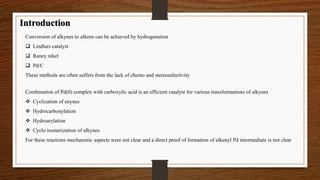
Combination of Pd(0) complex with carboxylic acid is an efficient catalyst for various transformations of alkynes 
 Cyclization of enynes 
 Hydrocarbonylation 
 Hydroarylation 
 Cyclo isomerization of alkynes 
For these reactions mechanistic aspects were not clear and a direct proof of formation of alkenyl Pd intermediate is not clear
Objectives 
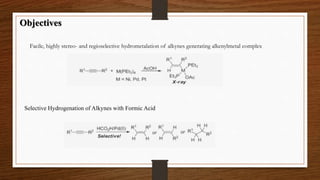
Facile, highly stereo- and regioselective hydrometalation of alkynes generating alkenylmetal complex 
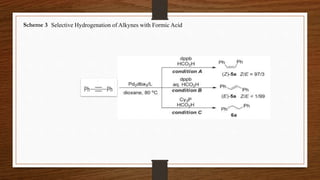
Selective Hydrogenation of Alkynes with Formic Acid
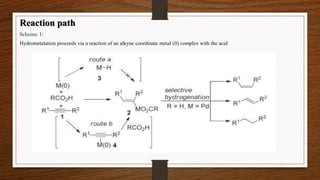
Reaction path 
Scheme 1: 
Hydrometalation proceeds via a reaction of an alkyne coordinate metal (0) complex with the acid
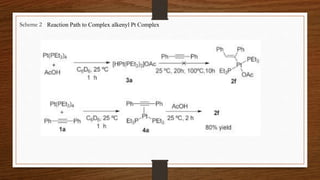
Scheme 2 Reaction Path to Complex alkenyl Pt Complex
Scheme 3 Selective Hydrogenation of Alkynes with Formic Acid
Importance of the study 
 Isolation of alkenyl Pd intermediate 
 Characteristic property of group 10 transition metals 
 By using formic acid selective hydrogenation of alkynes
Conclusion 
Facile hydrometalation of alkynes with a combination of carboxylic acids and group 10 transition 
metal complexes M(PEt3)4 (M = Ni, Pd, Pt) to afford fully characterized alkenyl metals was 
revealed. This finding provides direct proof for the reaction mechanism involving the combination 
of carboxylic acid and zerovalent palladium catalyst. On the basis of this finding, an unprecedented 
controllable hydrogenation of alkynes with formic acid was developed to selectively produce cis-, 
trans-alkenes and alkanes by slightly tuning the conditions.
References 
Trost, B. M. Chem.—Eur. J. 1998, 4, 2405. 
Lee, D. C.; Rise, F. Tetrahedron Lett. 1989, 30, 651. 
Kalck, P.; Urrutigoiy, M.; Dechy-Cabaret, O. Top. Organomet. Chem. 2006, 18, 97. 
C. H.; Jung, H. H.; Kim, K. S. Angew. Chem., Int. Ed. 2003, 42, 805. 
B. M.; Brieden, W.; Baringhaus, K. H. Angew. Chem., Int. Ed. 1992, 31, 1335. 
Yamamoto, Y.; Radhakrishnan, U. Chem. Soc. Rev. 1999, 28, 199.
For your kind attention !!!!!!!!!!!!!!!!!!
Ashok Selective hydroformylation

Ashok Selective hydroformylation

  • 1.
    Facile Regio andStereoselective Hydrometalation of Alkynes with a Combination of Carboxylic Acids and Group 10 Transition Metal Complexes: Selective Hydrogenation of Alkynes with Formic Acid Presented by Ashok Jangid School of chemical sciences Central university of Gujarat
  • 2.
    Outline Introduction Objective Reaction path Importance of the study Conclusion
  • 3.
    Introduction Conversion ofalkynes to alkens can be achieved by hydrogenation  Lindlars catalyst  Raney nikel  Pd/C These methods are often suffers from the lack of chemo and stereoselectivity Combination of Pd(0) complex with carboxylic acid is an efficient catalyst for various transformations of alkynes  Cyclization of enynes  Hydrocarbonylation  Hydroarylation  Cyclo isomerization of alkynes For these reactions mechanistic aspects were not clear and a direct proof of formation of alkenyl Pd intermediate is not clear
  • 4.
    Objectives Facile, highlystereo- and regioselective hydrometalation of alkynes generating alkenylmetal complex Selective Hydrogenation of Alkynes with Formic Acid
  • 5.
    Reaction path Scheme1: Hydrometalation proceeds via a reaction of an alkyne coordinate metal (0) complex with the acid
  • 6.
    Scheme 2 ReactionPath to Complex alkenyl Pt Complex
  • 7.
    Scheme 3 SelectiveHydrogenation of Alkynes with Formic Acid
  • 8.
    Importance of thestudy  Isolation of alkenyl Pd intermediate  Characteristic property of group 10 transition metals  By using formic acid selective hydrogenation of alkynes
  • 9.
    Conclusion Facile hydrometalationof alkynes with a combination of carboxylic acids and group 10 transition metal complexes M(PEt3)4 (M = Ni, Pd, Pt) to afford fully characterized alkenyl metals was revealed. This finding provides direct proof for the reaction mechanism involving the combination of carboxylic acid and zerovalent palladium catalyst. On the basis of this finding, an unprecedented controllable hydrogenation of alkynes with formic acid was developed to selectively produce cis-, trans-alkenes and alkanes by slightly tuning the conditions.
  • 10.
    References Trost, B.M. Chem.—Eur. J. 1998, 4, 2405. Lee, D. C.; Rise, F. Tetrahedron Lett. 1989, 30, 651. Kalck, P.; Urrutigoiy, M.; Dechy-Cabaret, O. Top. Organomet. Chem. 2006, 18, 97. C. H.; Jung, H. H.; Kim, K. S. Angew. Chem., Int. Ed. 2003, 42, 805. B. M.; Brieden, W.; Baringhaus, K. H. Angew. Chem., Int. Ed. 1992, 31, 1335. Yamamoto, Y.; Radhakrishnan, U. Chem. Soc. Rev. 1999, 28, 199.
  • 11.
    For your kindattention !!!!!!!!!!!!!!!!!!