ATRIAL SEPTAL DEFECT
EMBRYOLOGY
CLASSIFICATION
SINUS VENOSUS ASD
KUNTAL SURANA
LTMGH, CVTS DEPARTMENT
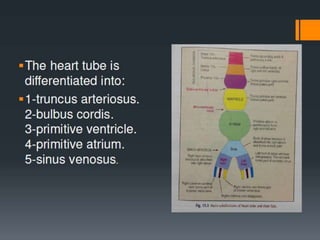
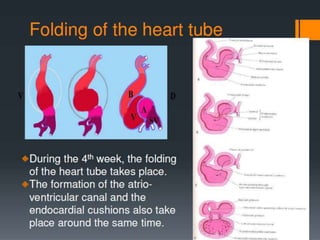
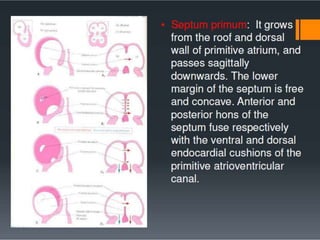
EMBRYOLOGY
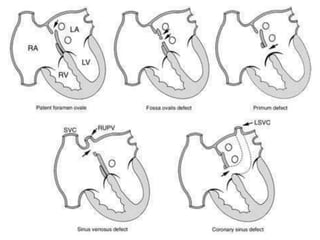
CLASSIFICATION
• Ostium Secundum (85%)
• Ostium Primum (6%)
• Sinus Venosus (8%)
• Common atrium (1pt)
CRAIG & SELZER 1968
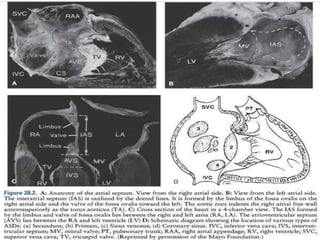
• Ostium secundum defects (75%- 85% of ASDs)
are located in the region of the fossa ovalis.
• Ostium primum defects (10 - 15%) occur in the
lower portion of the atrial septum.
• Sinus venosus defects (5 - 10%) are located near
the orifice of the superior vena cava.
• Sinus venosus defects of IVC type (1%).
• Coronary sinus (1%) septal defect (in which a
defect between the coronary sinus and the left
atrium allows a left-to-right shunt to occur
through an “unroofed” coronary sinus).
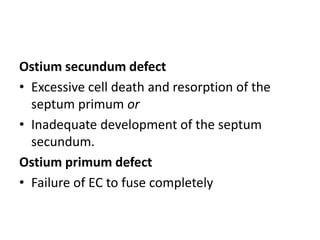
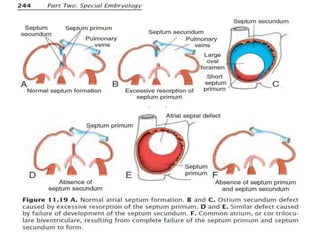
Ostium secundum defect
• Excessive cell death and resorption of the
septum primum or
• Inadequate development of the septum
secundum.
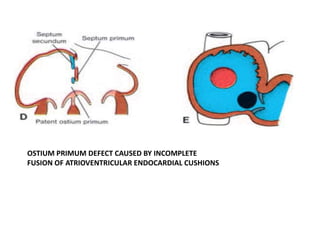
Ostium primum defect
• Failure of EC to fuse completely
OSTIUM PRIMUM DEFECT CAUSED BY INCOMPLETE
FUSION OF ATRIOVENTRICULAR ENDOCARDIAL CUSHIONS
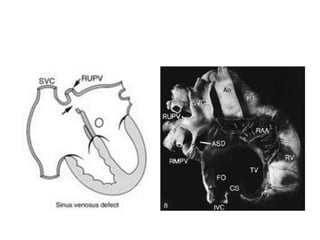
• Sinus venosus defects occur outside the margins
of the fossa ovalis, in relation to the venous
connections of the right atrium. They are located
posterior and superior to the fossa ovalis . Most
often, the defect is rimmed by atrial septal tissue
only anteroinferiorly. Its posterior aspect is the
right atrial free wall, and its superior border is
often absent because of an overriding superior
vena cava. Infrequently, the defect may be
directly posterior to the fossa ovalis or may be
posteroinferior such that the inferior vena cava
may join both atria
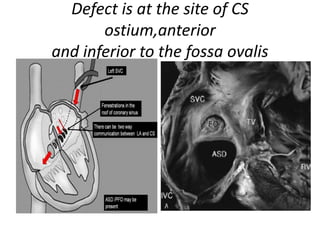
Defect is at the site of CS
ostium,anterior
and inferior to the fossa ovalis
• The left horn of sinus venosus forms the CS.
The CS defect (unroofed CS) results from
failure of the wall between the left atrium
and CS to develop. There may be complete or
partial unroofing of the CS resulting in direct
communication with the left atrium. Almost
always this anomaly is associated with left
SVC.
BASED ON SIZE
• SMALL: > 3mm - < 6 mm
• MODERATE: ≥ 6 - < 12mm
• LARGE: ≥ 12mm
McMohan et al 2002
• SMALL: 4 - 5MM
• MEDIUM: 6 – 8MM
• LARGE: > 8MM
Anita Saxena 2005
INCIDENCE
• ASD constitutes 8-10% of congenital heart defects
in children.
• Incidence = 56 per 100,000 live births
• Recent estimates are much higher (100 per
100,000 live births), likely due to increased
recognition in the era of common use of
echocardiography
• Female : male ratio for secundum ASD = 2:1
• For sinus venosus ASD= 1:1
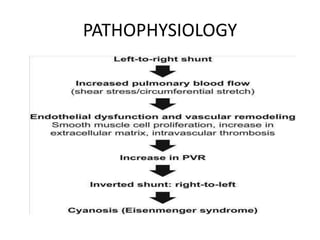
PATHOPHYSIOLOGY
SINUS VENOSUS ASD
• Sinus venosus atrial septal defects account for only
10% of atrial septal defects.
• Most children with sinus venosus atrial septal defects
are asymptomatic but may develop symptoms as they
age.
• Excellent surgical results with a mortality rate near 0%
can be expected. This is particularly true in patients
who undergo repair when younger than 15 years.
• An atrial septal defect was the first lesion repaired
using cardiopulmonary bypass in 1954 by John Gibbon,
MD, at the Mayo Clinic.
PATHOPHYSIOLOGY
• The more common sinus venosus type defect
occurs in the upper atrial septum and is
contiguous with the superior vena cava (SVC).
• The lesion is rostral and posterior to the fossa
ovalis (where secundum type defects occur)
and is separate from it.
• It is almost always associated with anomalous
pulmonary venous drainage of the right upper
pulmonary vein into the SVC.
• Less commonly, the defect may occur at the
junction of the right atrium and inferior vena cava
and be associated with anomalous connection of
the right lower pulmonary vein to the IVC.
• Rarely, sinus venosus defects occur posterior to
the fossa ovalis without bordering the SVC or IVC.
The predominant hemodynamic consequence is a
left-to-right shunt through the defect.
CAUSES
• During normal embryonic development, the right horn of the sinus
venosus encompasses the right SVC and IVC.
• If abnormal resorption of the sinus venosus occurs, an atrial septal
defect results near the orifice of either the SVC or IVC.
• Sinus venosus atrial septal defects occur more often as an isolated
abnormality.
• Other abnormalities may exacerbate an atrial septal defect. For
instance, systemic hypertension in an adult with a sinus venosus
atrial septal defect may result in left ventricular hypertrophy and
reduce left ventricular compliance, which, in turn, exacerbates the
atrial level left-to-right shunt. Mitral stenosis, which is either
congenital or acquired, may also exacerbate the atrial level left-to-
right shunt.
SURGICAL MANAGEMENT
• Sinus venosus defects do not close spontaneously.
• Asymptomatic children generally undergo repair when aged
3-5 years.
• Adults with left-to-right shunts greater than 1.5-2:1 benefit
from surgical closure.
• Patients with significant pulmonary hypertension and
elevated pulmonary vascular resistance unresponsive to
pulmonary vasodilator therapy may not be good candidates
for surgical repair.
• Such patients may develop acute right ventricular failure if
their heart no longer has the ability to shunt right to left at
the atrial communication in response to increases in
pulmonary vascular resistance.
• Repair is performed most often through a standard median
sternotomy.
• More cosmetic incisions may also be used, such as partial
sternotomies, small right anterior thoracotomies, and
inframammary incisions.
• All approaches require the use of cardiopulmonary bypass for
closure of the atrial septal defect.
• Transcatheter occlusion devices are not indicated for the closure of
sinus venosus atrial septal defects because of the position of the
defect and because of the lack of surrounding tissue adequate to
seat such an occlusion device.
• Such a device may obstruct SVC flow and does not achieve
redirection of the anomalous right pulmonary venous flow to the
left atrium.
• A patch (synthetic material or pericardium) is used to
redirect blood flow from the right superior pulmonary
vein into the left atrium.
• This effectively closes the interatrial communication
while also correcting the anomalous pulmonary venous
drainage. Sometimes, to avoid creating SVC
obstruction, a patch is placed on the anterior surface of
the SVC. Care is taken to avoid injuring the nearby
sinus node.
• Ligation of the azygous vein may also be required to
eliminate its drainage into the left atrium and to
prevent the resulting residual right-to-left shunt.
• When the location of the anomalous venous drainage is in the high
SVC and is far from the atrial-caval junction, a different surgical
approach can be used to decrease the probability of caval stenosis
or pulmonary vein stenosis. As described by Warden et al, the
repair consists of division of the SVC just above the take off of the
anomalous pulmonary vein.
• The distal caval end is oversewn or patched to assure no pulmonary
vein compromise.
• Next, the well-mobilized cava is anastomosed to the right atrial
appendage after amputation of the most distal end.
• The atrial septal defect is then closed by sewing a patch to cover
the atrial septal defect and divided SVC orifice, thereby baffling the
anomalous vein to the left atrium.
• This method is very effective in patients with more
complicated pulmonary venous anomalies.
• Although a relatively recent advance in the treatment
of high anomalous pulmonary venous drainage, this
operation has become the procedure of choice for
more difficult cases.
• All reported series have demonstrated excellent results
with little or no pulmonary venous or SVC stenosis.
• In addition, concern for injury to the conduction
system or sinus node have not been observed to date.
THANK YOU

ASD by Dr Kuntal Surana

  • 1.
    ATRIAL SEPTAL DEFECT EMBRYOLOGY CLASSIFICATION SINUSVENOSUS ASD KUNTAL SURANA LTMGH, CVTS DEPARTMENT
  • 2.
  • 14.
  • 15.
    • Ostium Secundum(85%) • Ostium Primum (6%) • Sinus Venosus (8%) • Common atrium (1pt) CRAIG & SELZER 1968
  • 16.
    • Ostium secundumdefects (75%- 85% of ASDs) are located in the region of the fossa ovalis. • Ostium primum defects (10 - 15%) occur in the lower portion of the atrial septum. • Sinus venosus defects (5 - 10%) are located near the orifice of the superior vena cava. • Sinus venosus defects of IVC type (1%). • Coronary sinus (1%) septal defect (in which a defect between the coronary sinus and the left atrium allows a left-to-right shunt to occur through an “unroofed” coronary sinus).
  • 18.
    Ostium secundum defect •Excessive cell death and resorption of the septum primum or • Inadequate development of the septum secundum. Ostium primum defect • Failure of EC to fuse completely
  • 20.
    OSTIUM PRIMUM DEFECTCAUSED BY INCOMPLETE FUSION OF ATRIOVENTRICULAR ENDOCARDIAL CUSHIONS
  • 22.
    • Sinus venosusdefects occur outside the margins of the fossa ovalis, in relation to the venous connections of the right atrium. They are located posterior and superior to the fossa ovalis . Most often, the defect is rimmed by atrial septal tissue only anteroinferiorly. Its posterior aspect is the right atrial free wall, and its superior border is often absent because of an overriding superior vena cava. Infrequently, the defect may be directly posterior to the fossa ovalis or may be posteroinferior such that the inferior vena cava may join both atria
  • 23.
    Defect is atthe site of CS ostium,anterior and inferior to the fossa ovalis
  • 24.
    • The lefthorn of sinus venosus forms the CS. The CS defect (unroofed CS) results from failure of the wall between the left atrium and CS to develop. There may be complete or partial unroofing of the CS resulting in direct communication with the left atrium. Almost always this anomaly is associated with left SVC.
  • 25.
    BASED ON SIZE •SMALL: > 3mm - < 6 mm • MODERATE: ≥ 6 - < 12mm • LARGE: ≥ 12mm McMohan et al 2002 • SMALL: 4 - 5MM • MEDIUM: 6 – 8MM • LARGE: > 8MM Anita Saxena 2005
  • 26.
    INCIDENCE • ASD constitutes8-10% of congenital heart defects in children. • Incidence = 56 per 100,000 live births • Recent estimates are much higher (100 per 100,000 live births), likely due to increased recognition in the era of common use of echocardiography • Female : male ratio for secundum ASD = 2:1 • For sinus venosus ASD= 1:1
  • 27.
  • 28.
    SINUS VENOSUS ASD •Sinus venosus atrial septal defects account for only 10% of atrial septal defects. • Most children with sinus venosus atrial septal defects are asymptomatic but may develop symptoms as they age. • Excellent surgical results with a mortality rate near 0% can be expected. This is particularly true in patients who undergo repair when younger than 15 years. • An atrial septal defect was the first lesion repaired using cardiopulmonary bypass in 1954 by John Gibbon, MD, at the Mayo Clinic.
  • 29.
    PATHOPHYSIOLOGY • The morecommon sinus venosus type defect occurs in the upper atrial septum and is contiguous with the superior vena cava (SVC). • The lesion is rostral and posterior to the fossa ovalis (where secundum type defects occur) and is separate from it. • It is almost always associated with anomalous pulmonary venous drainage of the right upper pulmonary vein into the SVC.
  • 30.
    • Less commonly,the defect may occur at the junction of the right atrium and inferior vena cava and be associated with anomalous connection of the right lower pulmonary vein to the IVC. • Rarely, sinus venosus defects occur posterior to the fossa ovalis without bordering the SVC or IVC. The predominant hemodynamic consequence is a left-to-right shunt through the defect.
  • 31.
    CAUSES • During normalembryonic development, the right horn of the sinus venosus encompasses the right SVC and IVC. • If abnormal resorption of the sinus venosus occurs, an atrial septal defect results near the orifice of either the SVC or IVC. • Sinus venosus atrial septal defects occur more often as an isolated abnormality. • Other abnormalities may exacerbate an atrial septal defect. For instance, systemic hypertension in an adult with a sinus venosus atrial septal defect may result in left ventricular hypertrophy and reduce left ventricular compliance, which, in turn, exacerbates the atrial level left-to-right shunt. Mitral stenosis, which is either congenital or acquired, may also exacerbate the atrial level left-to- right shunt.
  • 32.
    SURGICAL MANAGEMENT • Sinusvenosus defects do not close spontaneously. • Asymptomatic children generally undergo repair when aged 3-5 years. • Adults with left-to-right shunts greater than 1.5-2:1 benefit from surgical closure. • Patients with significant pulmonary hypertension and elevated pulmonary vascular resistance unresponsive to pulmonary vasodilator therapy may not be good candidates for surgical repair. • Such patients may develop acute right ventricular failure if their heart no longer has the ability to shunt right to left at the atrial communication in response to increases in pulmonary vascular resistance.
  • 33.
    • Repair isperformed most often through a standard median sternotomy. • More cosmetic incisions may also be used, such as partial sternotomies, small right anterior thoracotomies, and inframammary incisions. • All approaches require the use of cardiopulmonary bypass for closure of the atrial septal defect. • Transcatheter occlusion devices are not indicated for the closure of sinus venosus atrial septal defects because of the position of the defect and because of the lack of surrounding tissue adequate to seat such an occlusion device. • Such a device may obstruct SVC flow and does not achieve redirection of the anomalous right pulmonary venous flow to the left atrium.
  • 34.
    • A patch(synthetic material or pericardium) is used to redirect blood flow from the right superior pulmonary vein into the left atrium. • This effectively closes the interatrial communication while also correcting the anomalous pulmonary venous drainage. Sometimes, to avoid creating SVC obstruction, a patch is placed on the anterior surface of the SVC. Care is taken to avoid injuring the nearby sinus node. • Ligation of the azygous vein may also be required to eliminate its drainage into the left atrium and to prevent the resulting residual right-to-left shunt.
  • 35.
    • When thelocation of the anomalous venous drainage is in the high SVC and is far from the atrial-caval junction, a different surgical approach can be used to decrease the probability of caval stenosis or pulmonary vein stenosis. As described by Warden et al, the repair consists of division of the SVC just above the take off of the anomalous pulmonary vein. • The distal caval end is oversewn or patched to assure no pulmonary vein compromise. • Next, the well-mobilized cava is anastomosed to the right atrial appendage after amputation of the most distal end. • The atrial septal defect is then closed by sewing a patch to cover the atrial septal defect and divided SVC orifice, thereby baffling the anomalous vein to the left atrium.
  • 36.
    • This methodis very effective in patients with more complicated pulmonary venous anomalies. • Although a relatively recent advance in the treatment of high anomalous pulmonary venous drainage, this operation has become the procedure of choice for more difficult cases. • All reported series have demonstrated excellent results with little or no pulmonary venous or SVC stenosis. • In addition, concern for injury to the conduction system or sinus node have not been observed to date.
  • 37.