10 – Atrial septal defect
Dr. Zeeshan Abdul Nasir
PGY3
Cardiac surgery
MTI - PIC
• Definition
• Embryology
• Surgical anatomy of Right Atrium
• Classification
• Pathophysiology
• Clinical manifestation
• Physical examination
• Investigations
• Management
Definition
• Communication between the atria resulting from a deficiency of
tissue in the septum causing a left to right flow.
• Acyanotic congenital heart disease.
• Severity depends on:
• Size of defect
• Size of shunt
• Resulting from asymptomatic to right sided overload, PAH.
Embryology
• Primitive atrium – partitioned into
right and left atria by growth of the
Septum primum – Thin crescent
shaped membrane that grows from
the roof of the primitive atrium toward
the endocardial cushion.
• Foramen primum – composed of the
free edge of the septum primum and
the endocardial cushions
• Fenestrations develop in the
septum primum – coalesce to
form the Ostium secundum.
• Septum primum fuses with the
endocardial cushions.
• Failure of this fusion  Primum
ASD
• Ostium secundum maintains a
right-to-left atrial flow – fetal
circulation.
• Septum secundum – forms to
the right of the septum
primum, growing toward the
endocardial cushions and
usually closing the Ostium
secundum.
• Failure to close  Secundum
ASD
Surgical anatomy of
the Right atrium
a. Crista terminalis
b. Fossa ovalis
c. Coronary sinus
d. Thebesian valve (Coronary sinus)
e. Eustachian valve (IVC)
f. Tendon of Todaro
g. AV node
h. Bundle of his
• SA node
Classification
• According to location
• Secundum ASD
• Primum ASD
• Sinus venosus ASD
• SVC type
• IVC type
• Coronary sinus ASD
• According to size
• In younger children:
• Small defect < 3 mm
• Mod defect 3 – 8 mm
• Large defect > 8 mm
• In older children:
• Small < 6 mm
• Mod 6 – 12 mm
• Large > 12 mm
Secundum ASDs
• MC type – 70 to 75 % of ASDs
• Location – Midportion of the
atrial septum, within or including
the fossa ovalis
• Single or multiple
Primum ASDs
• 15 – 20 %
• Part of the spectrum of Atrioventricular
septal defects (AV Canal defects or
endocardial cushion defects).
• Occur in the inferior – anterior portion
of the atrial septum.
• Cleft in the anterior leaflet of the mitral
valve (mitral valve cleft) – MR
• Mostly associated with Down’s
syndrome.
Sinus venosus ASD
• 5 – 10 %
• Involves the portion of the atrial wall derived from the sinus venosus
– no direct communication between the right and left atria
• Typically at the orifice of SVC at the junction of the RA
• Less frequently in the region of the IVC
• Associated with partial anomalous pulmonary venous drainage
(PAPVD) – pulmonary drainage to RA instead of LA.
Coronary sinus ASD
• Defect in the roof of the
coronary sinus  direct
communication with the LA.
• Rare
• Usually associated with
complex CHDs.
• Divided into
• CSASD with LSVC
• CSASD without LSVC
Pathophysiology
• Moderate – to – large defects – Shunt of oxygenated blood flows from
L  R atrium
• Volume overload and dilation of the RA and RV
• Tricuspid and pulmonary annulus may dilate and become
incompetent
• Inc flow into the lungs  Irreversible pulmonary vascular injury
(Endothelial dysfunction and vascular remodelling) – Inc in PVR 
inverted shunt: R  L
• Eisenmenger syndrome (Cyanosis)
Clinical manifestation
• Asymptomatic
• Infants
• Recurrent chest infections
• FTT
• Older children
• Mild fatigue
• Dyspnea that may worsen with age
• Cyanosis
Physical examination
• Precordium
• Inspection
• Precordial bulge
• Palpation
• Prominent right ventricular heave felt along the lower left sternal border and
the subcostal area
• Auscultation
• Wide, fixed splitting of the S2
• ESM – Left 2nd
& 3rd
sternal border
Investigations
• Non – invasive
• Chest X-Ray
• ECG
• Echocardiography
• Invasive
• Cardiac catheterization
Chest X-ray
• Small shunt across the ASD – Normal CXR
• Large shunt –
• Cardiomegaly (RA and RV enlargement)
• Increased pulmonary vascular markings extending to the periphery
ECG
• Prolonged PR interval – due to enlargement of RA – 1st
degree heart
block
• Crochetage sign – notched R waves in inferior leads
Echo
• Diagnostic
Cardiac catheterization
• In whom pulmonary vascular resistance may be a concern.
• Diagnosing associated lesions i.e.
• PAPVD
• MS
• Direct measurement of intracardiac and pulmonary artery pressure
• PVR can be calculated
Management
• Medical therapy
• Interventional therapy
• Surgical therapy
Spontaneous closure
• In patients with an ASD < 3 mm in size diagnosed before 3 months of
age – 100% of patients at 1 ½ year of age.
• 80% in b/w 3 – 8 mm.
• Spontaneous closure uncommon after 1st
year.
Medical management
• Aim to reduce volume overload and to strengthen functions of heart
muscles.
• Symptomatic children:
• Diuretics – relieve ventricular overload, peripheral and pulmonary congestion
• Rate control and anticoagulation – Afib
• Anti hypertensives i.e. Captopril, to reduce afterload
Interventional therapy
• Trans-catheter device closure of ASD
• Indicated in:
• Secundum ASD with Qp:Qs ≥ 1.5:1
• 5 mm or more but less than 32 mm
• A significant L  R shunt with clinical evidence of RV volume overload
• There must be enough rim (~4 mm) of septal tissue around the defect for
appropriate placement of the device
• Contra-indication:
• Resting pulmonary HTN
• Failed attempted device closure
• No sufficient rim to engage the device
• Sinus venosus defect – device closure would threaten obstruction of
pulmonary veins, IVC and SVC
• Recent infection or sepsis/Bleeding disorders
• Pregnancy
• Intracardiac thrombi
• Devices available are:
• Amplatzer septal occlude
• Rashkind ASD occlude
• Cardioseal device
• HELEX
• PFOStar
Post device closure follow up
• Aspirin 5 mg/kg/day for 6 months
• F/U echo for:
• Device position
• Residual shunting
• Complications
• F/U echo at
• 24 hours
• 1 month
• 6 months
• 1 year
Complications of device closure
• Device misalignment/embolization
• Device erosion of atrial wall or aorta
• Device impingement on adjacent structures i.e. AV valve, Coronary
sinus, SVC
• Infection including endocarditis
• Thromboembolic complications
• Valvular regurgitation
• Residual shunt
Surgical closure
• Indications:
• When device closure is not considered appropriate
• CCF in infancy not responding to medical therapy
• Sinus venosus defect
• Secundum ASD + unfavorable anatomy not amenable to p/c closure;
• ASD Diameter > 35 mm
• Inadequate septal rims to permit device deployment
• Close proximity to AV valve, coronary sinus, or venae cavae
• Timing – Usually delayed until the patient is 2 – 4 years old (spont
closure !)
Set up
• Standard invasive monitoring and general anesthesia.
• Median sternotomy, heparinization at 300U/kg.
• Standard aorto-bicaval venous cannulation, and patient cooled to 30–
32oC. Antegrade cardioplegia.
Secundum ASD
• Primary closure
• Because of the oval shape of most
secundum defects, 80 per cent
can be closed by the primary
suture technique. A double layer
of polypropylene is begun at the
inferior limit of the defect, as this
margin is typically most difficult to
define. Before complete closure of
the defect, entrapped air should
be evacuated from the left atrium.
• Patch closure
• If the defect is large or rounder in shape, patch closure should be performed to avoid closure
under tension and distortion of atrial anatomy. A patch of autologous pericardium that is slightly
smaller than the relaxed size of the defect can be used, again beginning the suture line inferiorly.
Polytetrafluoroethylene, Dacron, and bovine pericardium are also suitable patch materials.
Sinus venosus defect
• The ASD is generally more superior and posterior than the typical
secundum ASD. The right upper pulmonary veins typically drain into
the junction of the SVC and right atrium.
• Occasionally, multiple veins drain the right upper lobe and may enter
the SVC some distance from its atrial junction.
• Careful circumferential dissection of the SVC allows identification of
these anomalous venous connections for cannulation site selection
and planning of the repair.
• Injury to the right phrenic nerve must be avoided during dissection of
the lateral aspect of the SVC.
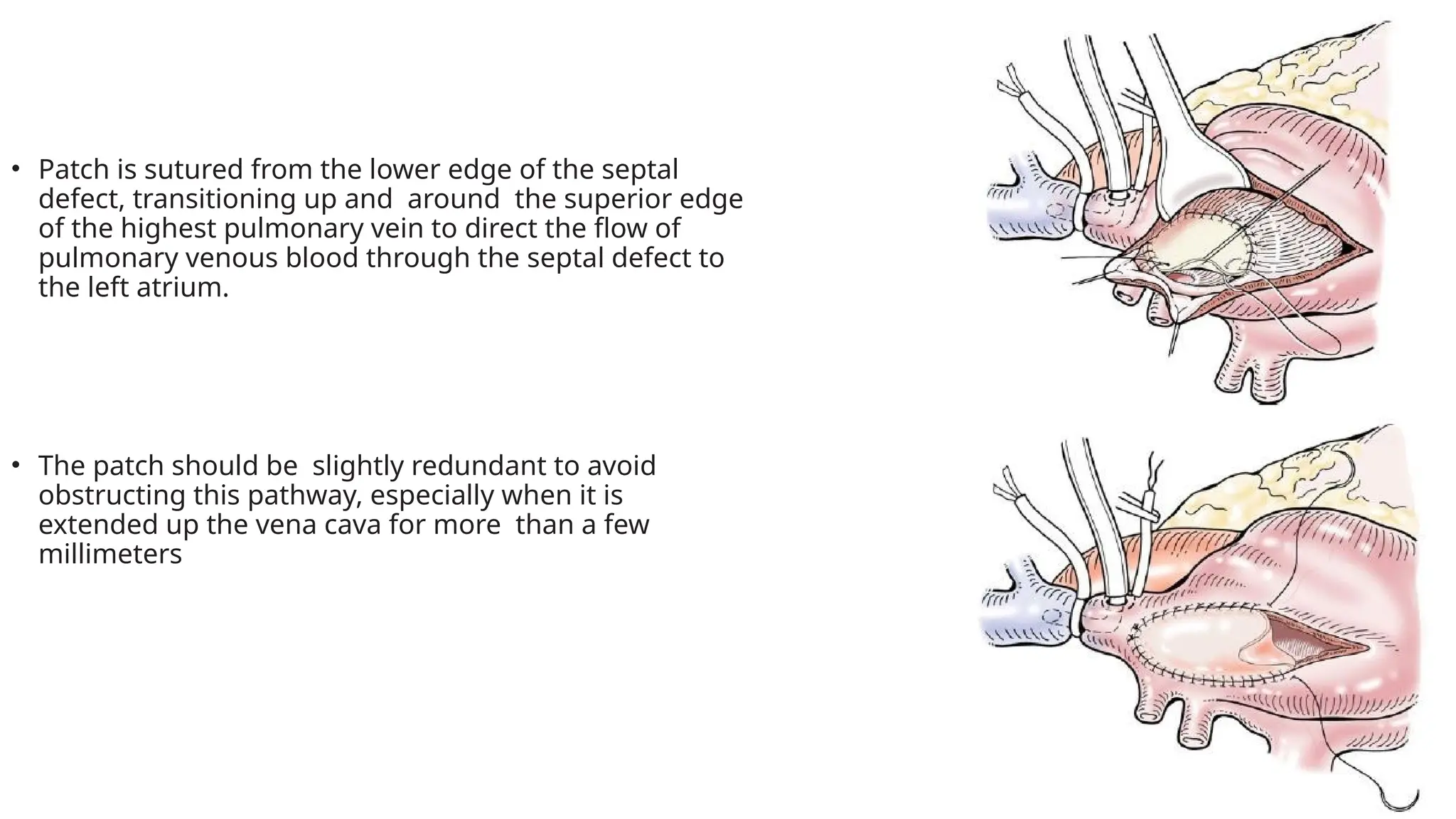
Baffle repair
• If the pulmonary veins drain to the cavoatrial junction area, baffle repair of the defect using a
pericardial patch is performed.
• Patch is sutured from the lower edge of the septal
defect, transitioning up and around the superior edge
of the highest pulmonary vein to direct the flow of
pulmonary venous blood through the septal defect to
the left atrium.
• The patch should be slightly redundant to avoid
obstructing this pathway, especially when it is
extended up the vena cava for more than a few
millimeters
Warden repair
• If pulmonary veins enter some
distance up the SVC
• or if the right SVC is unusually small as
seen in the presence of a persistent
left SVC, the so-called Warden repair is
performed,
• directing the lower SVC flow through
the septal defect, with translocation of
the upper SVC to the right atrial
appendage.
Thank you

10 – Atrial septal defects Zeeshan.pptx

  • 1.
    10 – Atrialseptal defect Dr. Zeeshan Abdul Nasir PGY3 Cardiac surgery MTI - PIC
  • 2.
    • Definition • Embryology •Surgical anatomy of Right Atrium • Classification • Pathophysiology • Clinical manifestation • Physical examination • Investigations • Management
  • 3.
    Definition • Communication betweenthe atria resulting from a deficiency of tissue in the septum causing a left to right flow. • Acyanotic congenital heart disease. • Severity depends on: • Size of defect • Size of shunt • Resulting from asymptomatic to right sided overload, PAH.
  • 4.
    Embryology • Primitive atrium– partitioned into right and left atria by growth of the Septum primum – Thin crescent shaped membrane that grows from the roof of the primitive atrium toward the endocardial cushion. • Foramen primum – composed of the free edge of the septum primum and the endocardial cushions
  • 5.
    • Fenestrations developin the septum primum – coalesce to form the Ostium secundum. • Septum primum fuses with the endocardial cushions. • Failure of this fusion  Primum ASD • Ostium secundum maintains a right-to-left atrial flow – fetal circulation.
  • 6.
    • Septum secundum– forms to the right of the septum primum, growing toward the endocardial cushions and usually closing the Ostium secundum. • Failure to close  Secundum ASD
  • 7.
    Surgical anatomy of theRight atrium a. Crista terminalis b. Fossa ovalis c. Coronary sinus d. Thebesian valve (Coronary sinus) e. Eustachian valve (IVC) f. Tendon of Todaro g. AV node h. Bundle of his • SA node
  • 11.
    Classification • According tolocation • Secundum ASD • Primum ASD • Sinus venosus ASD • SVC type • IVC type • Coronary sinus ASD
  • 12.
    • According tosize • In younger children: • Small defect < 3 mm • Mod defect 3 – 8 mm • Large defect > 8 mm • In older children: • Small < 6 mm • Mod 6 – 12 mm • Large > 12 mm
  • 13.
    Secundum ASDs • MCtype – 70 to 75 % of ASDs • Location – Midportion of the atrial septum, within or including the fossa ovalis • Single or multiple
  • 14.
    Primum ASDs • 15– 20 % • Part of the spectrum of Atrioventricular septal defects (AV Canal defects or endocardial cushion defects). • Occur in the inferior – anterior portion of the atrial septum. • Cleft in the anterior leaflet of the mitral valve (mitral valve cleft) – MR • Mostly associated with Down’s syndrome.
  • 15.
    Sinus venosus ASD •5 – 10 % • Involves the portion of the atrial wall derived from the sinus venosus – no direct communication between the right and left atria • Typically at the orifice of SVC at the junction of the RA • Less frequently in the region of the IVC • Associated with partial anomalous pulmonary venous drainage (PAPVD) – pulmonary drainage to RA instead of LA.
  • 16.
    Coronary sinus ASD •Defect in the roof of the coronary sinus  direct communication with the LA. • Rare • Usually associated with complex CHDs. • Divided into • CSASD with LSVC • CSASD without LSVC
  • 17.
    Pathophysiology • Moderate –to – large defects – Shunt of oxygenated blood flows from L  R atrium • Volume overload and dilation of the RA and RV • Tricuspid and pulmonary annulus may dilate and become incompetent • Inc flow into the lungs  Irreversible pulmonary vascular injury (Endothelial dysfunction and vascular remodelling) – Inc in PVR  inverted shunt: R  L • Eisenmenger syndrome (Cyanosis)
  • 18.
    Clinical manifestation • Asymptomatic •Infants • Recurrent chest infections • FTT • Older children • Mild fatigue • Dyspnea that may worsen with age • Cyanosis
  • 19.
    Physical examination • Precordium •Inspection • Precordial bulge • Palpation • Prominent right ventricular heave felt along the lower left sternal border and the subcostal area • Auscultation • Wide, fixed splitting of the S2 • ESM – Left 2nd & 3rd sternal border
  • 20.
    Investigations • Non –invasive • Chest X-Ray • ECG • Echocardiography • Invasive • Cardiac catheterization
  • 21.
    Chest X-ray • Smallshunt across the ASD – Normal CXR • Large shunt – • Cardiomegaly (RA and RV enlargement) • Increased pulmonary vascular markings extending to the periphery
  • 23.
    ECG • Prolonged PRinterval – due to enlargement of RA – 1st degree heart block • Crochetage sign – notched R waves in inferior leads
  • 24.
  • 25.
    Cardiac catheterization • Inwhom pulmonary vascular resistance may be a concern. • Diagnosing associated lesions i.e. • PAPVD • MS • Direct measurement of intracardiac and pulmonary artery pressure • PVR can be calculated
  • 26.
    Management • Medical therapy •Interventional therapy • Surgical therapy
  • 27.
    Spontaneous closure • Inpatients with an ASD < 3 mm in size diagnosed before 3 months of age – 100% of patients at 1 ½ year of age. • 80% in b/w 3 – 8 mm. • Spontaneous closure uncommon after 1st year.
  • 28.
    Medical management • Aimto reduce volume overload and to strengthen functions of heart muscles. • Symptomatic children: • Diuretics – relieve ventricular overload, peripheral and pulmonary congestion • Rate control and anticoagulation – Afib • Anti hypertensives i.e. Captopril, to reduce afterload
  • 29.
    Interventional therapy • Trans-catheterdevice closure of ASD • Indicated in: • Secundum ASD with Qp:Qs ≥ 1.5:1 • 5 mm or more but less than 32 mm • A significant L  R shunt with clinical evidence of RV volume overload • There must be enough rim (~4 mm) of septal tissue around the defect for appropriate placement of the device
  • 30.
    • Contra-indication: • Restingpulmonary HTN • Failed attempted device closure • No sufficient rim to engage the device • Sinus venosus defect – device closure would threaten obstruction of pulmonary veins, IVC and SVC • Recent infection or sepsis/Bleeding disorders • Pregnancy • Intracardiac thrombi
  • 31.
    • Devices availableare: • Amplatzer septal occlude • Rashkind ASD occlude • Cardioseal device • HELEX • PFOStar
  • 33.
    Post device closurefollow up • Aspirin 5 mg/kg/day for 6 months • F/U echo for: • Device position • Residual shunting • Complications • F/U echo at • 24 hours • 1 month • 6 months • 1 year
  • 34.
    Complications of deviceclosure • Device misalignment/embolization • Device erosion of atrial wall or aorta • Device impingement on adjacent structures i.e. AV valve, Coronary sinus, SVC • Infection including endocarditis • Thromboembolic complications • Valvular regurgitation • Residual shunt
  • 35.
    Surgical closure • Indications: •When device closure is not considered appropriate • CCF in infancy not responding to medical therapy • Sinus venosus defect • Secundum ASD + unfavorable anatomy not amenable to p/c closure; • ASD Diameter > 35 mm • Inadequate septal rims to permit device deployment • Close proximity to AV valve, coronary sinus, or venae cavae • Timing – Usually delayed until the patient is 2 – 4 years old (spont closure !)
  • 36.
    Set up • Standardinvasive monitoring and general anesthesia. • Median sternotomy, heparinization at 300U/kg. • Standard aorto-bicaval venous cannulation, and patient cooled to 30– 32oC. Antegrade cardioplegia.
  • 37.
    Secundum ASD • Primaryclosure • Because of the oval shape of most secundum defects, 80 per cent can be closed by the primary suture technique. A double layer of polypropylene is begun at the inferior limit of the defect, as this margin is typically most difficult to define. Before complete closure of the defect, entrapped air should be evacuated from the left atrium.
  • 38.
    • Patch closure •If the defect is large or rounder in shape, patch closure should be performed to avoid closure under tension and distortion of atrial anatomy. A patch of autologous pericardium that is slightly smaller than the relaxed size of the defect can be used, again beginning the suture line inferiorly. Polytetrafluoroethylene, Dacron, and bovine pericardium are also suitable patch materials.
  • 39.
    Sinus venosus defect •The ASD is generally more superior and posterior than the typical secundum ASD. The right upper pulmonary veins typically drain into the junction of the SVC and right atrium. • Occasionally, multiple veins drain the right upper lobe and may enter the SVC some distance from its atrial junction. • Careful circumferential dissection of the SVC allows identification of these anomalous venous connections for cannulation site selection and planning of the repair. • Injury to the right phrenic nerve must be avoided during dissection of the lateral aspect of the SVC.
  • 40.
    Baffle repair • Ifthe pulmonary veins drain to the cavoatrial junction area, baffle repair of the defect using a pericardial patch is performed.
  • 41.
    • Patch issutured from the lower edge of the septal defect, transitioning up and around the superior edge of the highest pulmonary vein to direct the flow of pulmonary venous blood through the septal defect to the left atrium. • The patch should be slightly redundant to avoid obstructing this pathway, especially when it is extended up the vena cava for more than a few millimeters
  • 42.
    Warden repair • Ifpulmonary veins enter some distance up the SVC • or if the right SVC is unusually small as seen in the presence of a persistent left SVC, the so-called Warden repair is performed, • directing the lower SVC flow through the septal defect, with translocation of the upper SVC to the right atrial appendage.
  • 43.