Solving
Trigonometric
Equations
Objectives
o Solving Trigonometric Equations.
o Find extraneous solutions from trigonometric equations.
Vocabulary
 Trigonometric Equations.
Introduction
 Solving Trigonometric Equations.
Trigonometric equations are, as the name implies, equations that
involve trigonometric functions. Similar in many ways to solving
polynomial equations or rational equations, only specific values of the
variable will be solutions, if there are solutions at all. Often we will
solve a trigonometric equation over a specified interval. However, just
as often, we will be asked to find all possible solutions, and as
trigonometric functions are periodic, solutions are repeated within
each period. In other words, trigonometric equations may have an
infinite number of solutions. Additionally, like rational equations, the
domain of the function must be considered before we assume that any
solution is valid.
Introduction
 Solving trigonometric equations requires the same techniques
as solving algebraic equations. We read the equation from left
to right, horizontally, like a sentence. We look for known
patterns, factor, find common denominators, and substitute
certain expressions with a variable to make solving a more
straightforward process. However, with trigonometric
equations, we also have the advantage of using the identities we
already know.
Real life
applications
of
trigonometry
Solve equations for a given interval
Solve sin ∅ cos ∅ −
1
2
cos ∅ = 0. 𝐼𝑓 0 ≤ ∅ ≤ 180°.
Solution:
* Factor cos ∅
𝑐𝑜𝑠 ∅ sin ∅ −
1
2
= 0
* Use zero product property:
• cos ∅ = 0 or sin ∅ −
1
2
= 0
• ∅ = 90° sin ∅ =
1
2
• ∅ = 30° 𝑜𝑟 150°
• The solutions are 30°, 90°, 150°.
Solve equations for
a given interval
Practice
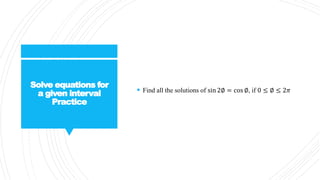
 Find all the solutions of sin 2∅ = cos ∅, if 0 ≤ ∅ ≤ 2𝜋
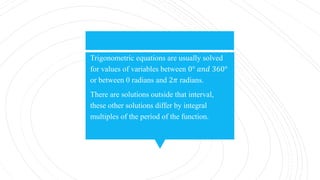
Trigonometric equations are usually solved
for values of variables between 0° 𝑎𝑛𝑑 360°
or between 0 radians and 2𝜋 radians.
There are solutions outside that interval,
these other solutions differ by integral
multiples of the period of the function.
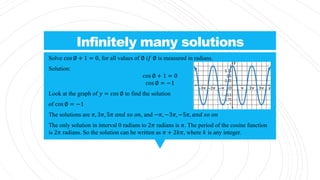
Infinitely many solutions
Solve cos ∅ + 1 = 0, for all values of ∅ 𝑖𝑓 ∅ is measured in radians.
Solution:
cos ∅ + 1 = 0
cos ∅ = −1
Look at the graph of 𝑦 = cos ∅ to find the solution
of cos ∅ = −1
The solutions are 𝜋, 3𝜋, 5𝜋 𝑎𝑛𝑑 𝑠𝑜 𝑜𝑛, and −𝜋, −3𝜋, −5𝜋, 𝑎𝑛𝑑 𝑠𝑜 𝑜𝑛
The only solution in interval 0 radians to 2𝜋 radians is 𝜋. The period of the cosine function
is 2𝜋 radians. So the solution can be written as 𝜋 + 2𝑘𝜋, where 𝑘 is any integer.
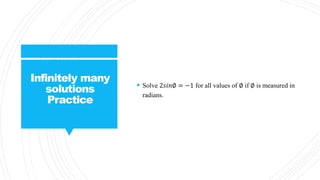
Infinitely many
solutions
Practice
 Solve 2𝑠𝑖𝑛∅ = −1 for all values of ∅ if ∅ is measured in
radians.

Solving trigonometric equations 1

  • 1.
  • 2.
    Objectives o Solving TrigonometricEquations. o Find extraneous solutions from trigonometric equations.
  • 3.
  • 4.
    Introduction  Solving TrigonometricEquations. Trigonometric equations are, as the name implies, equations that involve trigonometric functions. Similar in many ways to solving polynomial equations or rational equations, only specific values of the variable will be solutions, if there are solutions at all. Often we will solve a trigonometric equation over a specified interval. However, just as often, we will be asked to find all possible solutions, and as trigonometric functions are periodic, solutions are repeated within each period. In other words, trigonometric equations may have an infinite number of solutions. Additionally, like rational equations, the domain of the function must be considered before we assume that any solution is valid.
  • 5.
    Introduction  Solving trigonometricequations requires the same techniques as solving algebraic equations. We read the equation from left to right, horizontally, like a sentence. We look for known patterns, factor, find common denominators, and substitute certain expressions with a variable to make solving a more straightforward process. However, with trigonometric equations, we also have the advantage of using the identities we already know.
  • 6.
  • 7.
    Solve equations fora given interval Solve sin ∅ cos ∅ − 1 2 cos ∅ = 0. 𝐼𝑓 0 ≤ ∅ ≤ 180°. Solution: * Factor cos ∅ 𝑐𝑜𝑠 ∅ sin ∅ − 1 2 = 0 * Use zero product property: • cos ∅ = 0 or sin ∅ − 1 2 = 0 • ∅ = 90° sin ∅ = 1 2 • ∅ = 30° 𝑜𝑟 150° • The solutions are 30°, 90°, 150°.
  • 8.
    Solve equations for agiven interval Practice  Find all the solutions of sin 2∅ = cos ∅, if 0 ≤ ∅ ≤ 2𝜋
  • 9.
    Trigonometric equations areusually solved for values of variables between 0° 𝑎𝑛𝑑 360° or between 0 radians and 2𝜋 radians. There are solutions outside that interval, these other solutions differ by integral multiples of the period of the function.
  • 10.
    Infinitely many solutions Solvecos ∅ + 1 = 0, for all values of ∅ 𝑖𝑓 ∅ is measured in radians. Solution: cos ∅ + 1 = 0 cos ∅ = −1 Look at the graph of 𝑦 = cos ∅ to find the solution of cos ∅ = −1 The solutions are 𝜋, 3𝜋, 5𝜋 𝑎𝑛𝑑 𝑠𝑜 𝑜𝑛, and −𝜋, −3𝜋, −5𝜋, 𝑎𝑛𝑑 𝑠𝑜 𝑜𝑛 The only solution in interval 0 radians to 2𝜋 radians is 𝜋. The period of the cosine function is 2𝜋 radians. So the solution can be written as 𝜋 + 2𝑘𝜋, where 𝑘 is any integer.
  • 11.
    Infinitely many solutions Practice  Solve2𝑠𝑖𝑛∅ = −1 for all values of ∅ if ∅ is measured in radians.