Mathematic pure 1(coordinate geometry) email:racsostudenthelp@gmail.com 
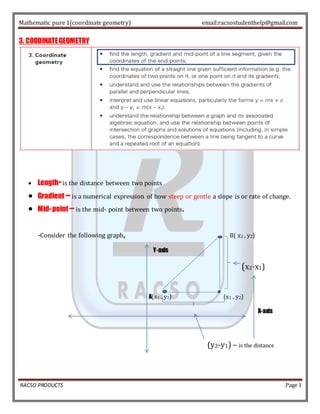
3. COODINATE GEOMETRY 
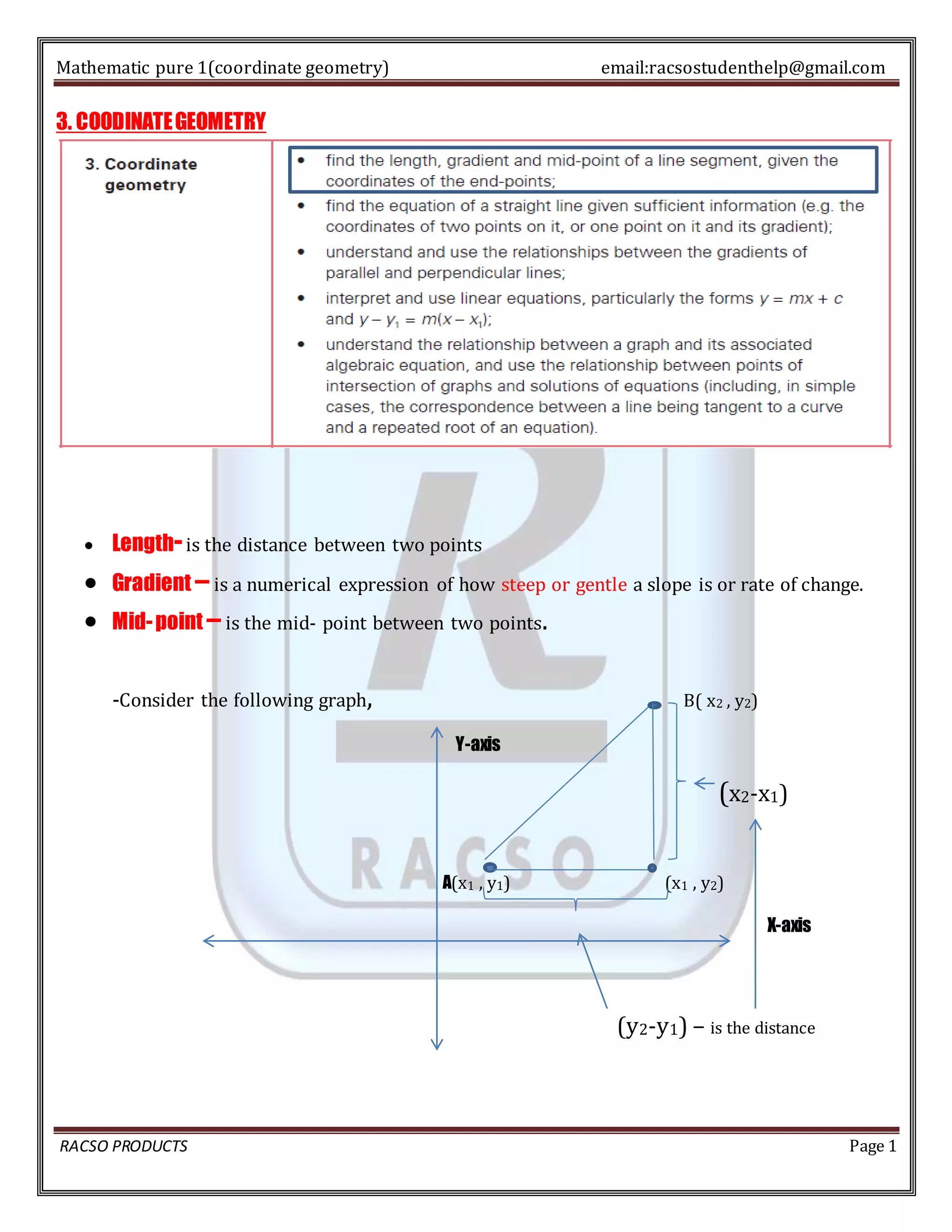
 Length- is the distance between two points 
 Gradient – is a numerical expression of how steep or gentle a slope is or rate of change. 
 Mid- point – is the mid- point between two points. 
-Consider the following graph, B( x2 , y2) 
Y-axis 
(x2-x1) 
A(x1 , y1) (x1 , y2) 
X-axis 
(y2-y1) – is the distance 
RACSO PRODUCTS Page 1
Mathematic pure 1(coordinate geometry) email:racsostudenthelp@gmail.com 
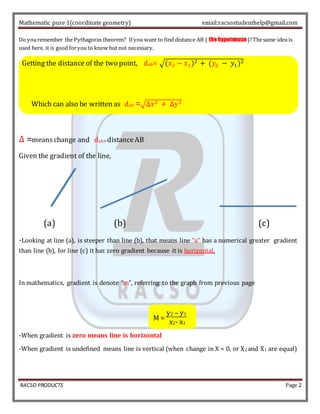
Do you remember the Pythagoras theorem? If you want to find distance AB ( the hypotenuse )? The same idea is 
used here, it is good for you to know but not necessary. 
Getting the distance of the two point, dab= √(푥2 − 푥1 )2 + (푦2 − 푦1 )2 
Which can also be written as dab =√Δ푥2 + Δ푦2 
Δ =means change and dab= distance AB 
Given the gradient of the line, 
(a) (b) (c) 
-Looking at line (a), is steeper than line (b), that means line “a” has a numerical greater gradient 
than line (b), for line (c) it has zero gradient because it is horizontal. 
In mathematics, gradient is denote “m”, referring to the graph from previous page 
M = 
y2 – y1 
x2- x1 
-When gradient is zero means line is horizontal 
-When gradient is undefined means line is vertical (when change in X = 0, or X2 and X1 are equal) 
RACSO PRODUCTS Page 2
Mathematic pure 1(coordinate geometry) email:racsostudenthelp@gmail.com 
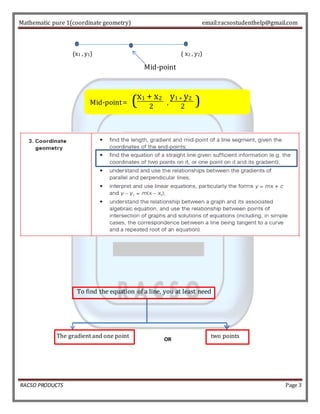
(x1 , y1) ( x2 , y2) 
Mid-point 
Mid-point = (x1 + x2 
2 
, 
y1 + y2 
2 
) 
To find the equation of a line, you at least need 
The gradient and one point two points 
OR 
RACSO PRODUCTS Page 3
Mathematic pure 1(coordinate geometry) email:racsostudenthelp@gmail.com 
-IF GIVEN THE GRADIENT AND A POINT 
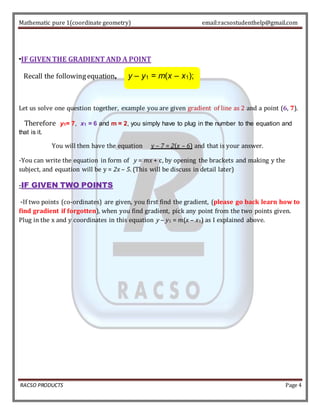
Recall the following equation, y – y1 = m(x – x1); 
Let us solve one question together, example you are given gradient of line as 2 and a point (6, 7). 
Therefore y1= 7, x1 = 6 and m = 2, you simply have to plug in the number to the equation and 
that is it. 
You will then have the equation y – 7 = 2(x – 6) and that is your answer. 
-You can write the equation in form of y = mx + c, by opening the brackets and making y the 
subject, and equation will be y = 2x – 5. (This will be discuss in detail later) 
-IF GIVEN TWO POINTS 
-If two points (co-ordinates) are given, you first find the gradient, (please go back learn how to 
find gradient if forgotten), when you find gradient, pick any point from the two points given. 
Plug in the x and y coordinates in this equation y – y1 = m(x – x1) as I explained above. 
RACSO PRODUCTS Page 4
Mathematic pure 1(coordinate geometry) email:racsostudenthelp@gmail.com 
 If two lines are parallel, means they have the same gradient, and when two lines are 
perpendicular to each other means, if I take the gradient of the 1st line multiply to the 
gradient of the 2nd line it is equal to -1. Taking gradient one as M1 and line two as M2 this 
means ( M1 x M2 = -1 ) 
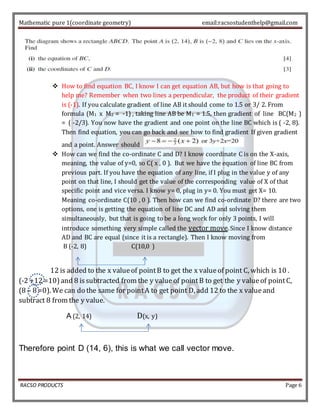
 Looking at the diagram ( from CIE May/June 2007, Question 6) 
Line AD is parallel to line BC, but perpendicular to line AB and line DC. 
-below is the questions they asked from this diagram. 
RACSO PRODUCTS Page 5
Mathematic pure 1(coordinate geometry) email:racsostudenthelp@gmail.com 
 How to find equation BC, I know I can get equation AB, but how is that going to 
help me? Remember when two lines a perpendicular, the product of their gradient 
is (-1). If you calculate gradient of line AB it should come to 1.5 or 3/ 2. From 
formula (M1 x M2 = -1) , taking line AB be M1 = 1.5, then gradient of line BC(M2 ) 
= ( -2/3). You now have the gradient and one point on the line BC which is ( -2, 8). 
Then find equation, you can go back and see how to find gradient If given gradient 
and a point. Answer should 
 How can we find the co-ordinate C and D? I know coordinate C is on the X-axis, 
meaning, the value of y=0, so C( x , 0 ). But we have the equation of line BC from 
previous part. If you have the equation of any line, if I plug in the value y of any 
point on that line, I should get the value of the corresponding value of X of that 
specific point and vice versa. I know y= 0, plug in y= 0. You must get X= 10. 
Meaning co-ordinate C(10 , 0 ). Then how can we find co-ordinate D? there are two 
options, one is getting the equation of line DC and AD and solving them 
simultaneously, but that is going to be a long work for only 3 points, I will 
introduce something very simple called the vector move. Since I know distance 
AD and BC are equal (since it is a rectangle). Then I know moving from 
B (-2, 8) C(10,0 ) 
12 is added to the x value of point B to get the x value of point C, which is 10 . 
(-2 +12 =10) and 8 is subtracted from the y value of point B to get the y value of point C, 
(8 – 8 =0). We can do the same for point A to get point D, add 12 to the x value and 
subtract 8 from the y value. 
A (2, 14) D(x, y) 
Therefore point D (14, 6), this is what we call vector move. 
RACSO PRODUCTS Page 6
Mathematic pure 1(coordinate geometry) email:racsostudenthelp@gmail.com 
-We discussed this from previous sections, you can write the equation of a line in form of 
y – y1 = m(x – x1) or y = mx + c. I advise you to use y – y1 = m(x – x1) unless specified in 
the question that should be written in form of y = mx + c. 
RACSO PRODUCTS Page 7
Mathematic pure 1(coordinate geometry) email:racsostudenthelp@gmail.com 
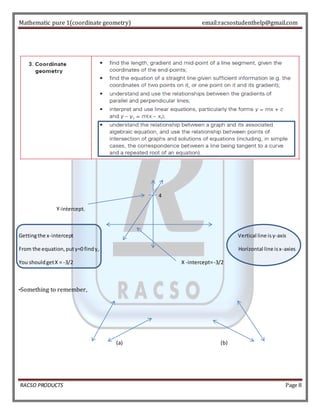
4 
Y-intercept. 
Getting the x-intercept Vertical line is y-axis 
From the equation, put y=0 find y, Horizontal line is x-axies 
You should get X = -3/2 X -intercept= -3/2 
-Something to remember, 
(a) (b) 
RACSO PRODUCTS Page 8
Mathematic pure 1(coordinate geometry) email:racsostudenthelp@gmail.com 
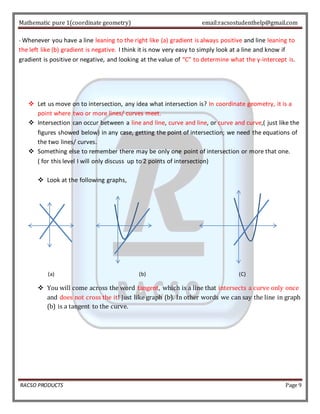
- Whenever you have a line leaning to the right like (a) gradient is always positive and line leaning to 
the left like (b) gradient is negative. I think it is now very easy to simply look at a line and know if 
gradient is positive or negative, and looking at the value of “C” to determine what the y-intercept is. 
 Let us move on to intersection, any idea what intersection is? In coordinate geometry, it is a 
point where two or more lines/ curves meet. 
 Intersection can occur between a line and line, curve and line, or curve and curve,( just like the 
figures showed below) in any case, getting the point of intersection; we need the equations of 
the two lines/ curves. 
 Something else to remember there may be only one point of intersection or more that one. 
( for this level I will only discuss up to 2 points of intersection) 
 Look at the following graphs, 
(a) (b) (C) 
 You will come across the word tangent, which is a line that intersects a curve only once 
and does not cross the it! Just like graph (b). In other words we can say the line in graph 
(b) is a tangent to the curve. 
RACSO PRODUCTS Page 9
Mathematic pure 1(coordinate geometry) email:racsostudenthelp@gmail.com 
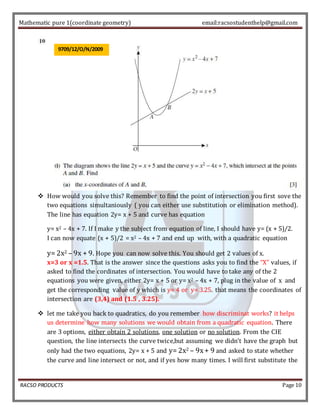
9709/12/O/N/2009 
 How would you solve this? Remember to find the point of intersection you first sove the 
two equations simultaniously ( you can either use substitution or elimination method). 
The line has equation 2y= x + 5 and curve has equation 
y= x2 – 4x + 7. If I make y the subject from equation of line, I should have y= (x + 5)/2. 
I can now equate (x + 5)/2 = x2 – 4x + 7 and end up with, with a quadratic equation 
y= 2x2 – 9x + 9. Hope you can now solve this. You should get 2 values of x. 
x=3 or x =1.5. That is the answer since the questions asks you to find the “X” values, if 
asked to find the cordinates of intersection. You would have to take any of the 2 
equations you were given, either 2y= x + 5 or y= x2 – 4x + 7, plug in the value of x and 
get the corresponding value of y which is y= 4 or y= 3.25. that means the coordinates of 
intersection are (3,4) and (1.5 , 3.25). 
 let me take you back to quadratics, do you remember how discriminat works? it helps 
us determine how many solutions we would obtain from a quadratic equation. There 
are 3 options, either obtain 2 solutions, one solution or no solution. From the CIE 
question, the line intersects the curve twice,but assuming we didn’t have the graph but 
only had the two equations, 2y= x + 5 and y= 2x2 – 9x + 9 and asked to state whether 
the curve and line intersect or not, and if yes how many times. I will first substitute the 
RACSO PRODUCTS Page 10
Mathematic pure 1(coordinate geometry) email:racsostudenthelp@gmail.com 
one equation into the other, make it look like this, y= 2x2 – 9x + 9, and this is the point 
where discriminants comes in handy! 
- If b2 - 4ac < 0 no solution, if b2 - 4ac = 0, only one solution ( sometimes 
means the line only intersects a curve once, meaning the line is a tangent) and if 
b2 - 4ac > 0 , there are two solutions( the lines don’t intersect) 
-From the expression, b2 - 4ac and looking at equation y= 2x2 – 9x + 9, b= -9 , a=2 
and c=9. If solved, 92- 4(2)9= 9. 9 is greater than zero, so there are two 
solutions as we have seen from graph, there two values of x. 
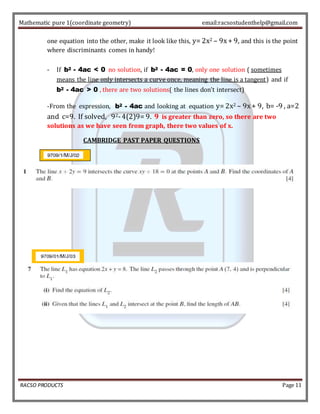
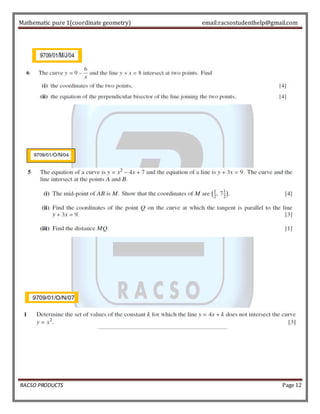
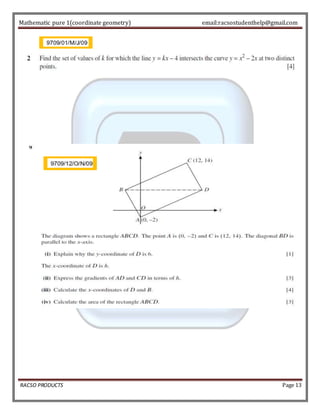
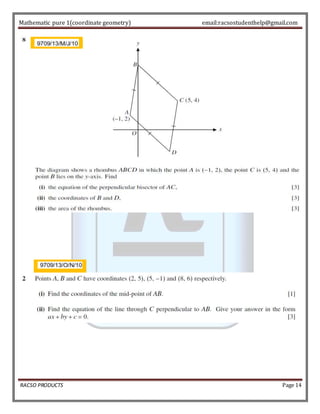
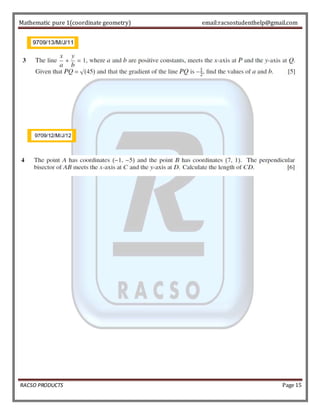
CAMBRIDGE PAST PAPER QUESTIONS 
RACSO PRODUCTS Page 11
Mathematic pure 1(coordinate geometry) email:racsostudenthelp@gmail.com 
RACSO PRODUCTS Page 12
Mathematic pure 1(coordinate geometry) email:racsostudenthelp@gmail.com 
RACSO PRODUCTS Page 13
Mathematic pure 1(coordinate geometry) email:racsostudenthelp@gmail.com 
RACSO PRODUCTS Page 14
Mathematic pure 1(coordinate geometry) email:racsostudenthelp@gmail.com 
RACSO PRODUCTS Page 15

AS LEVEL COORDINATE GEOMETRY EXPLAINED

  • 1.
    Mathematic pure 1(coordinategeometry) email:racsostudenthelp@gmail.com 3. COODINATE GEOMETRY  Length- is the distance between two points  Gradient – is a numerical expression of how steep or gentle a slope is or rate of change.  Mid- point – is the mid- point between two points. -Consider the following graph, B( x2 , y2) Y-axis (x2-x1) A(x1 , y1) (x1 , y2) X-axis (y2-y1) – is the distance RACSO PRODUCTS Page 1
  • 2.
    Mathematic pure 1(coordinategeometry) email:racsostudenthelp@gmail.com Do you remember the Pythagoras theorem? If you want to find distance AB ( the hypotenuse )? The same idea is used here, it is good for you to know but not necessary. Getting the distance of the two point, dab= √(푥2 − 푥1 )2 + (푦2 − 푦1 )2 Which can also be written as dab =√Δ푥2 + Δ푦2 Δ =means change and dab= distance AB Given the gradient of the line, (a) (b) (c) -Looking at line (a), is steeper than line (b), that means line “a” has a numerical greater gradient than line (b), for line (c) it has zero gradient because it is horizontal. In mathematics, gradient is denote “m”, referring to the graph from previous page M = y2 – y1 x2- x1 -When gradient is zero means line is horizontal -When gradient is undefined means line is vertical (when change in X = 0, or X2 and X1 are equal) RACSO PRODUCTS Page 2
  • 3.
    Mathematic pure 1(coordinategeometry) email:racsostudenthelp@gmail.com (x1 , y1) ( x2 , y2) Mid-point Mid-point = (x1 + x2 2 , y1 + y2 2 ) To find the equation of a line, you at least need The gradient and one point two points OR RACSO PRODUCTS Page 3
  • 4.
    Mathematic pure 1(coordinategeometry) email:racsostudenthelp@gmail.com -IF GIVEN THE GRADIENT AND A POINT Recall the following equation, y – y1 = m(x – x1); Let us solve one question together, example you are given gradient of line as 2 and a point (6, 7). Therefore y1= 7, x1 = 6 and m = 2, you simply have to plug in the number to the equation and that is it. You will then have the equation y – 7 = 2(x – 6) and that is your answer. -You can write the equation in form of y = mx + c, by opening the brackets and making y the subject, and equation will be y = 2x – 5. (This will be discuss in detail later) -IF GIVEN TWO POINTS -If two points (co-ordinates) are given, you first find the gradient, (please go back learn how to find gradient if forgotten), when you find gradient, pick any point from the two points given. Plug in the x and y coordinates in this equation y – y1 = m(x – x1) as I explained above. RACSO PRODUCTS Page 4
  • 5.
    Mathematic pure 1(coordinategeometry) email:racsostudenthelp@gmail.com  If two lines are parallel, means they have the same gradient, and when two lines are perpendicular to each other means, if I take the gradient of the 1st line multiply to the gradient of the 2nd line it is equal to -1. Taking gradient one as M1 and line two as M2 this means ( M1 x M2 = -1 )  Looking at the diagram ( from CIE May/June 2007, Question 6) Line AD is parallel to line BC, but perpendicular to line AB and line DC. -below is the questions they asked from this diagram. RACSO PRODUCTS Page 5
  • 6.
    Mathematic pure 1(coordinategeometry) email:racsostudenthelp@gmail.com  How to find equation BC, I know I can get equation AB, but how is that going to help me? Remember when two lines a perpendicular, the product of their gradient is (-1). If you calculate gradient of line AB it should come to 1.5 or 3/ 2. From formula (M1 x M2 = -1) , taking line AB be M1 = 1.5, then gradient of line BC(M2 ) = ( -2/3). You now have the gradient and one point on the line BC which is ( -2, 8). Then find equation, you can go back and see how to find gradient If given gradient and a point. Answer should  How can we find the co-ordinate C and D? I know coordinate C is on the X-axis, meaning, the value of y=0, so C( x , 0 ). But we have the equation of line BC from previous part. If you have the equation of any line, if I plug in the value y of any point on that line, I should get the value of the corresponding value of X of that specific point and vice versa. I know y= 0, plug in y= 0. You must get X= 10. Meaning co-ordinate C(10 , 0 ). Then how can we find co-ordinate D? there are two options, one is getting the equation of line DC and AD and solving them simultaneously, but that is going to be a long work for only 3 points, I will introduce something very simple called the vector move. Since I know distance AD and BC are equal (since it is a rectangle). Then I know moving from B (-2, 8) C(10,0 ) 12 is added to the x value of point B to get the x value of point C, which is 10 . (-2 +12 =10) and 8 is subtracted from the y value of point B to get the y value of point C, (8 – 8 =0). We can do the same for point A to get point D, add 12 to the x value and subtract 8 from the y value. A (2, 14) D(x, y) Therefore point D (14, 6), this is what we call vector move. RACSO PRODUCTS Page 6
  • 7.
    Mathematic pure 1(coordinategeometry) email:racsostudenthelp@gmail.com -We discussed this from previous sections, you can write the equation of a line in form of y – y1 = m(x – x1) or y = mx + c. I advise you to use y – y1 = m(x – x1) unless specified in the question that should be written in form of y = mx + c. RACSO PRODUCTS Page 7
  • 8.
    Mathematic pure 1(coordinategeometry) email:racsostudenthelp@gmail.com 4 Y-intercept. Getting the x-intercept Vertical line is y-axis From the equation, put y=0 find y, Horizontal line is x-axies You should get X = -3/2 X -intercept= -3/2 -Something to remember, (a) (b) RACSO PRODUCTS Page 8
  • 9.
    Mathematic pure 1(coordinategeometry) email:racsostudenthelp@gmail.com - Whenever you have a line leaning to the right like (a) gradient is always positive and line leaning to the left like (b) gradient is negative. I think it is now very easy to simply look at a line and know if gradient is positive or negative, and looking at the value of “C” to determine what the y-intercept is.  Let us move on to intersection, any idea what intersection is? In coordinate geometry, it is a point where two or more lines/ curves meet.  Intersection can occur between a line and line, curve and line, or curve and curve,( just like the figures showed below) in any case, getting the point of intersection; we need the equations of the two lines/ curves.  Something else to remember there may be only one point of intersection or more that one. ( for this level I will only discuss up to 2 points of intersection)  Look at the following graphs, (a) (b) (C)  You will come across the word tangent, which is a line that intersects a curve only once and does not cross the it! Just like graph (b). In other words we can say the line in graph (b) is a tangent to the curve. RACSO PRODUCTS Page 9
  • 10.
    Mathematic pure 1(coordinategeometry) email:racsostudenthelp@gmail.com 9709/12/O/N/2009  How would you solve this? Remember to find the point of intersection you first sove the two equations simultaniously ( you can either use substitution or elimination method). The line has equation 2y= x + 5 and curve has equation y= x2 – 4x + 7. If I make y the subject from equation of line, I should have y= (x + 5)/2. I can now equate (x + 5)/2 = x2 – 4x + 7 and end up with, with a quadratic equation y= 2x2 – 9x + 9. Hope you can now solve this. You should get 2 values of x. x=3 or x =1.5. That is the answer since the questions asks you to find the “X” values, if asked to find the cordinates of intersection. You would have to take any of the 2 equations you were given, either 2y= x + 5 or y= x2 – 4x + 7, plug in the value of x and get the corresponding value of y which is y= 4 or y= 3.25. that means the coordinates of intersection are (3,4) and (1.5 , 3.25).  let me take you back to quadratics, do you remember how discriminat works? it helps us determine how many solutions we would obtain from a quadratic equation. There are 3 options, either obtain 2 solutions, one solution or no solution. From the CIE question, the line intersects the curve twice,but assuming we didn’t have the graph but only had the two equations, 2y= x + 5 and y= 2x2 – 9x + 9 and asked to state whether the curve and line intersect or not, and if yes how many times. I will first substitute the RACSO PRODUCTS Page 10
  • 11.
    Mathematic pure 1(coordinategeometry) email:racsostudenthelp@gmail.com one equation into the other, make it look like this, y= 2x2 – 9x + 9, and this is the point where discriminants comes in handy! - If b2 - 4ac < 0 no solution, if b2 - 4ac = 0, only one solution ( sometimes means the line only intersects a curve once, meaning the line is a tangent) and if b2 - 4ac > 0 , there are two solutions( the lines don’t intersect) -From the expression, b2 - 4ac and looking at equation y= 2x2 – 9x + 9, b= -9 , a=2 and c=9. If solved, 92- 4(2)9= 9. 9 is greater than zero, so there are two solutions as we have seen from graph, there two values of x. CAMBRIDGE PAST PAPER QUESTIONS RACSO PRODUCTS Page 11
  • 12.
    Mathematic pure 1(coordinategeometry) email:racsostudenthelp@gmail.com RACSO PRODUCTS Page 12
  • 13.
    Mathematic pure 1(coordinategeometry) email:racsostudenthelp@gmail.com RACSO PRODUCTS Page 13
  • 14.
    Mathematic pure 1(coordinategeometry) email:racsostudenthelp@gmail.com RACSO PRODUCTS Page 14
  • 15.
    Mathematic pure 1(coordinategeometry) email:racsostudenthelp@gmail.com RACSO PRODUCTS Page 15