EQUATION OF A LINE,
INCLINATION OF A LINE &
PARALLEL LINES
Mr Ngcobo
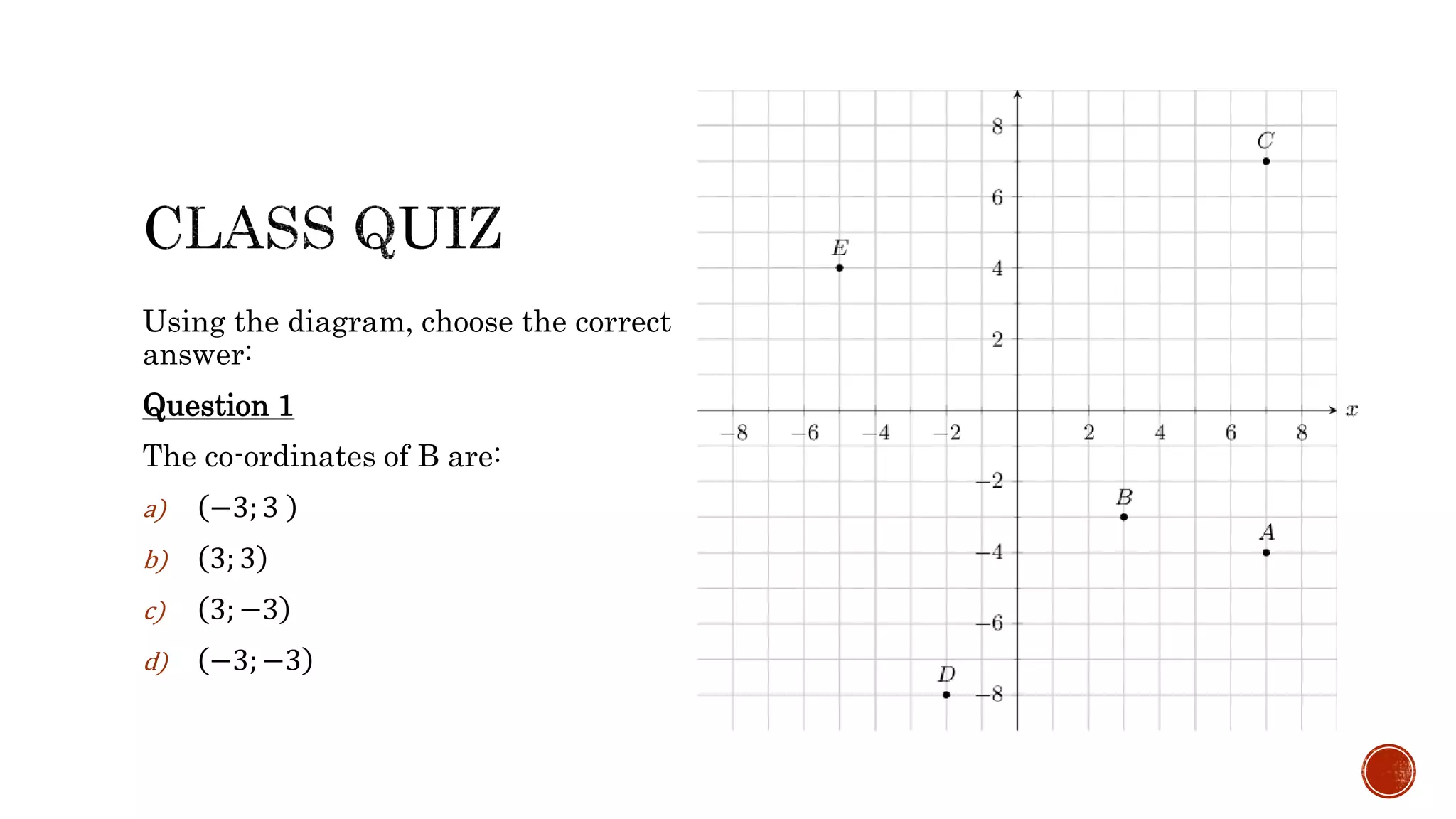
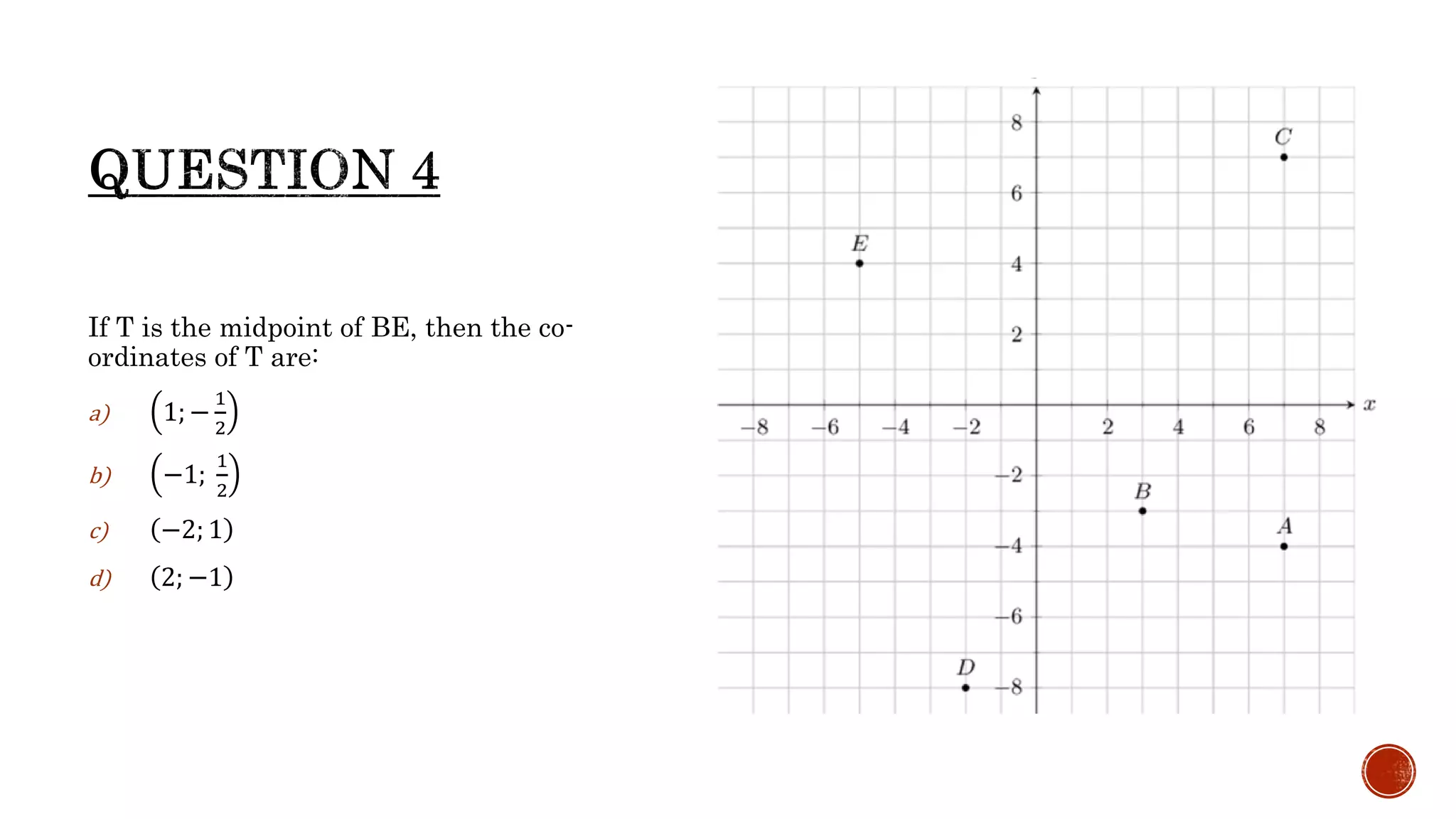
Using the diagram, choose the correct
answer:
Question 1
The co-ordinates of B are:
a) −3; 3
b) 3; 3
c) 3; −3
d) −3; −3
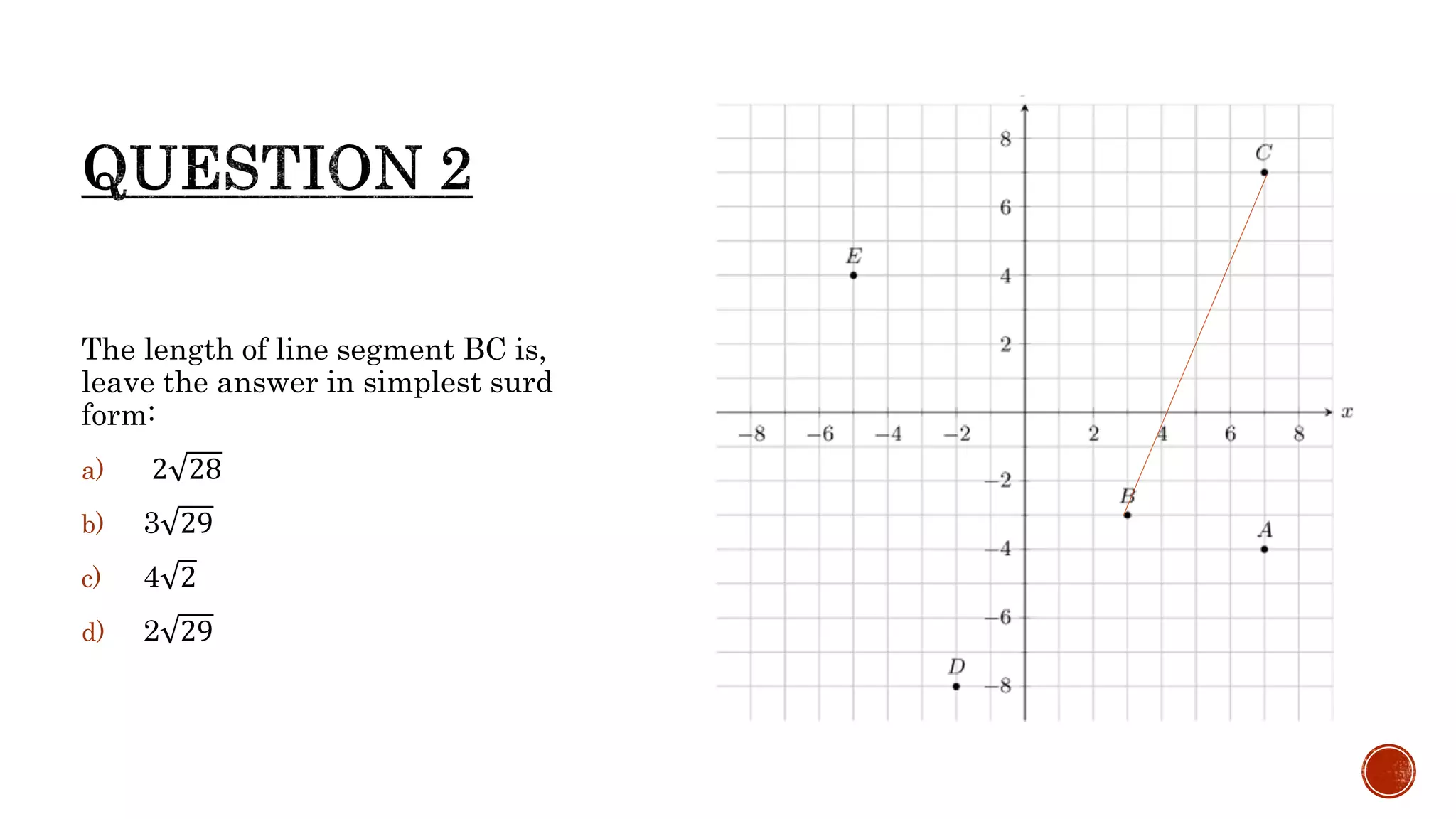
The length of line segment BC is,
leave the answer in simplest surd
form:
a) 2 28
b) 3 29
c) 4 2
d) 2 29
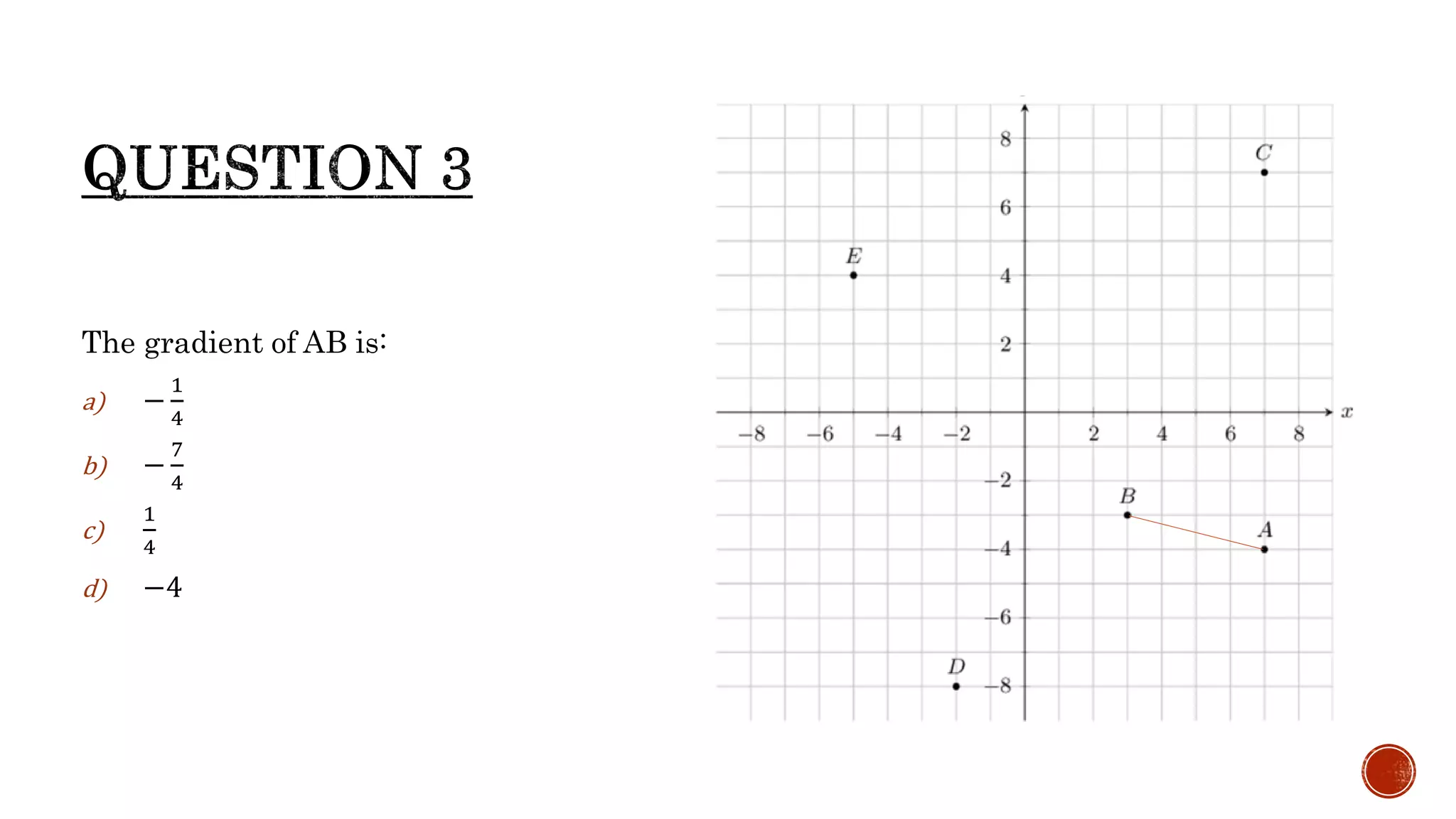
The gradient of AB is:
a) −
1
4
b) −
7
4
c)
1
4
d) −4
If T is the midpoint of BE, then the co-
ordinates of T are:
a) 1; −
1
2
b) −1;
1
2
c) −2; 1
d) 2; −1
The gradient–point form of the straight line equation
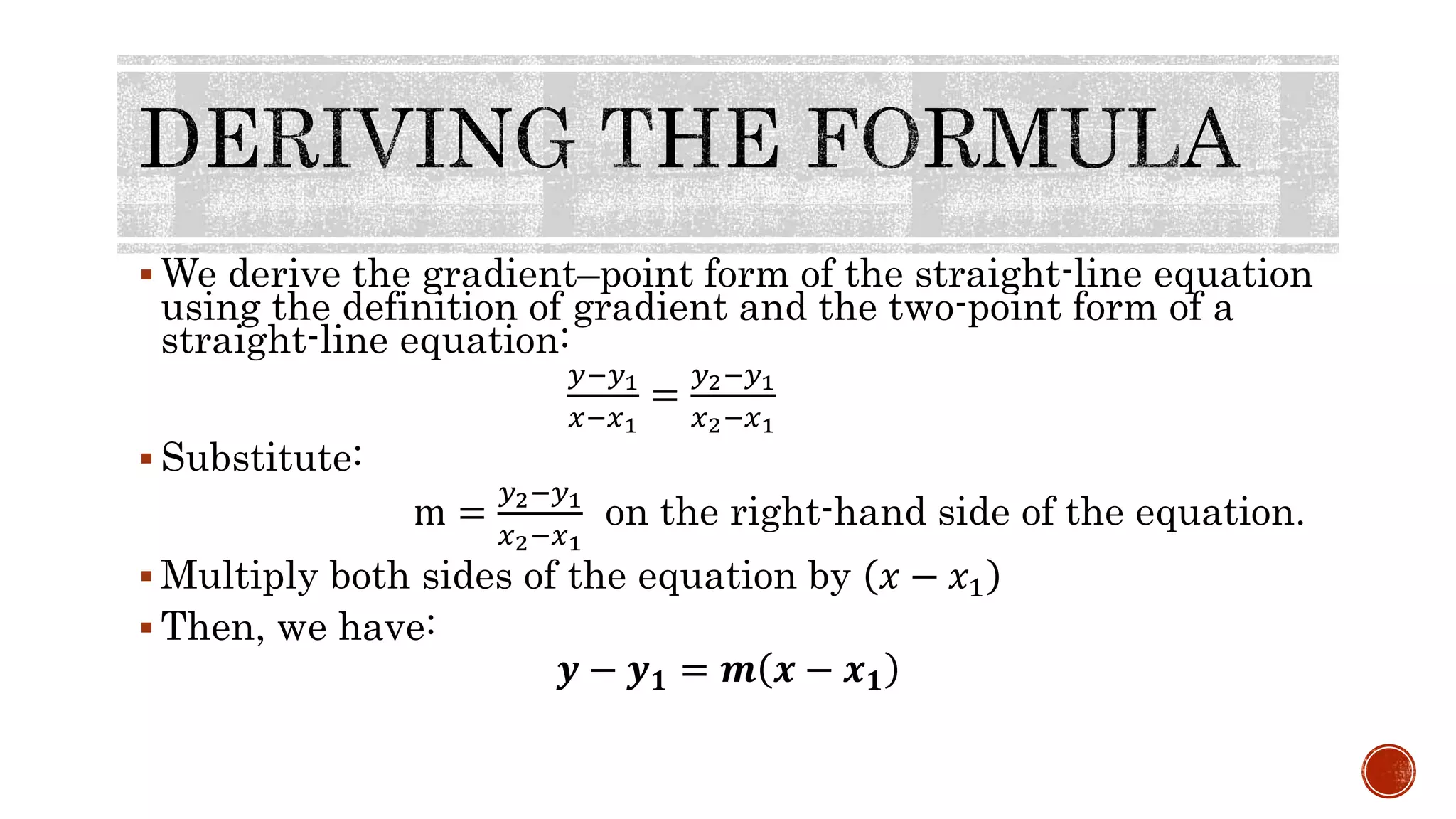
 We derive the gradient–point form of the straight-line equation
using the definition of gradient and the two-point form of a
straight-line equation:
𝑦−𝑦1
𝑥−𝑥1
=
𝑦2−𝑦1
𝑥2−𝑥1
 Substitute:
m =
𝑦2−𝑦1
𝑥2−𝑥1
on the right-hand side of the equation.
 Multiply both sides of the equation by 𝑥 − 𝑥1
 Then, we have:
𝒚 − 𝒚 𝟏 = 𝒎 𝒙 − 𝒙 𝟏
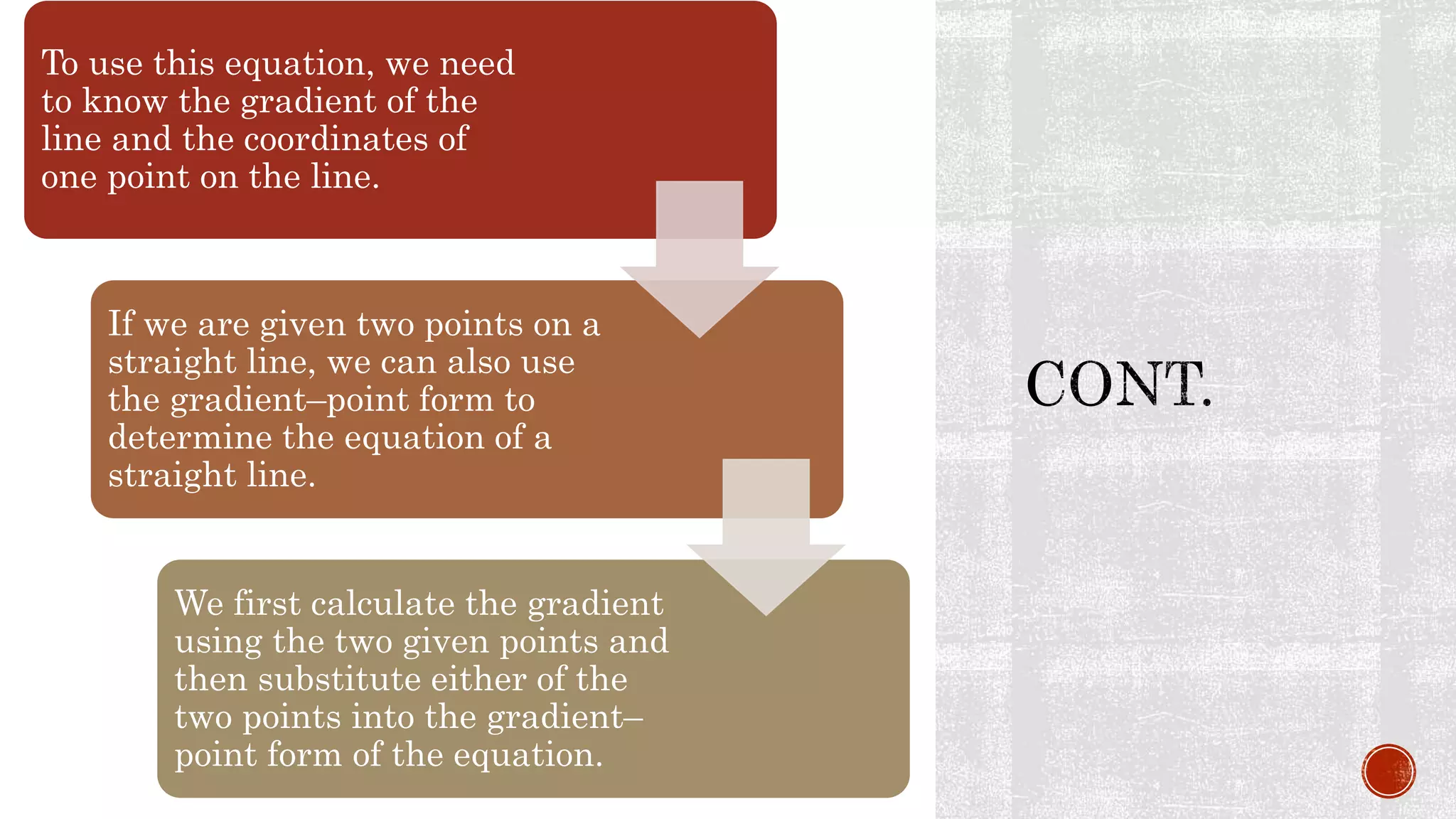
To use this equation, we need
to know the gradient of the
line and the coordinates of
one point on the line.
If we are given two points on a
straight line, we can also use
the gradient–point form to
determine the equation of a
straight line.
We first calculate the gradient
using the two given points and
then substitute either of the
two points into the gradient–
point form of the equation.
QUESTION
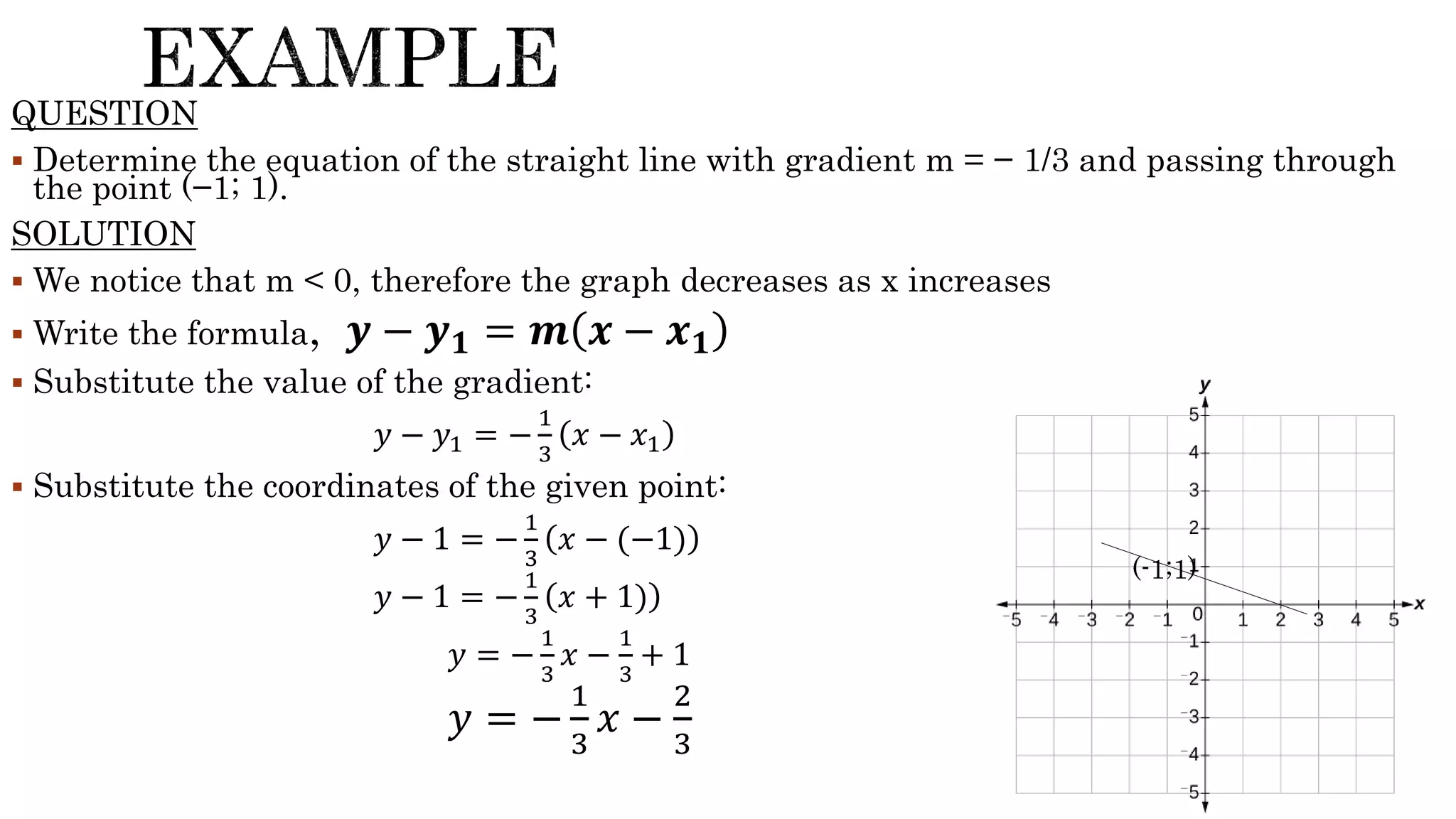
 Determine the equation of the straight line with gradient m = − 1/3 and passing through
the point (−1; 1).
SOLUTION
 We notice that m < 0, therefore the graph decreases as x increases
 Write the formula, 𝒚 − 𝒚 𝟏 = 𝒎 𝒙 − 𝒙 𝟏
 Substitute the value of the gradient:
𝑦 − 𝑦1 = −
1
3
𝑥 − 𝑥1
 Substitute the coordinates of the given point:
𝑦 − 1 = −
1
3
𝑥 − (−1)
𝑦 − 1 = −
1
3
𝑥 + 1)
𝑦 = −
1
3
𝑥 −
1
3
+ 1
𝑦 = −
1
3
𝑥 −
2
3
(-1;1)
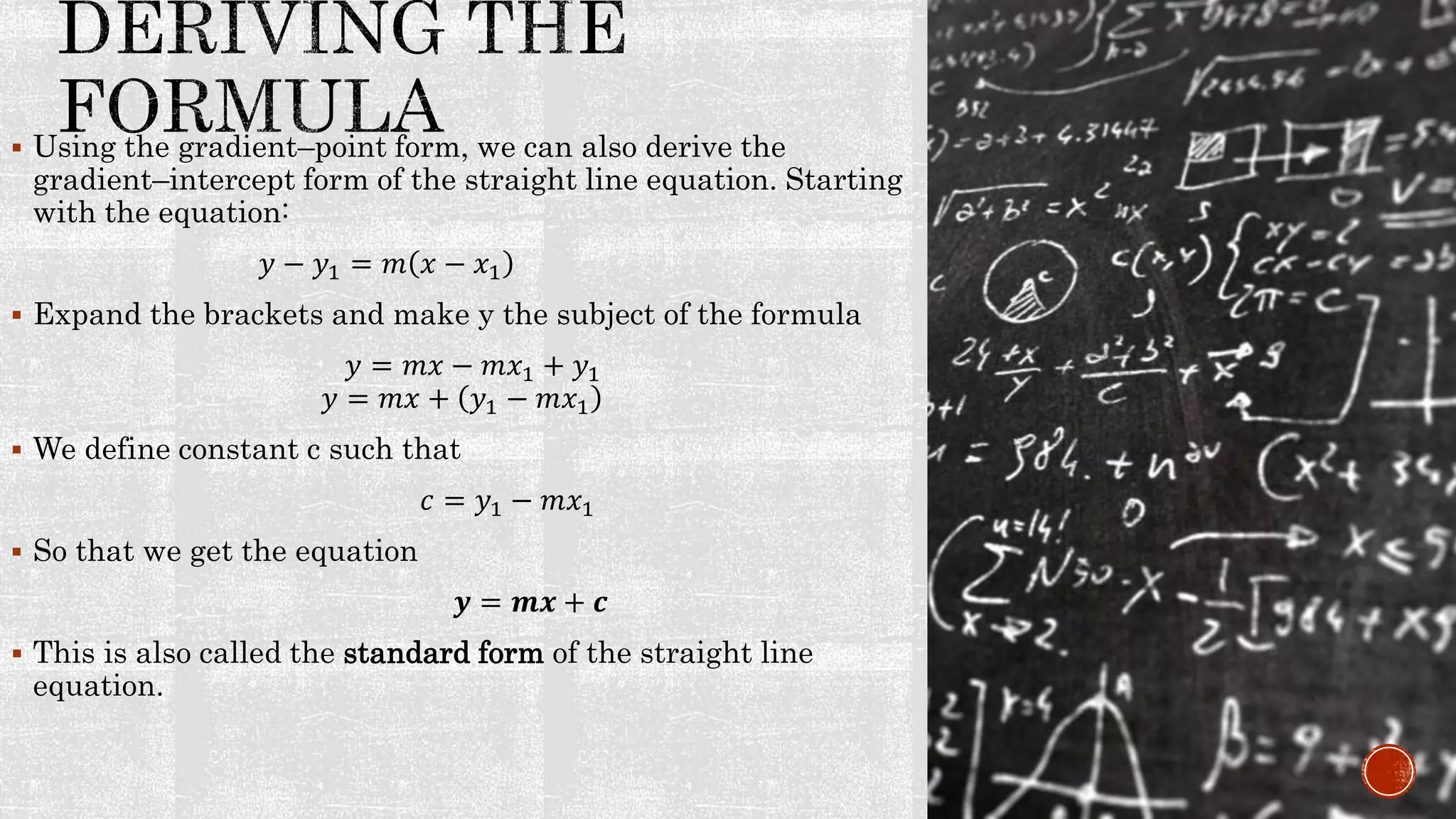
 Using the gradient–point form, we can also derive the
gradient–intercept form of the straight line equation. Starting
with the equation:
𝑦 − 𝑦1 = 𝑚 𝑥 − 𝑥1
 Expand the brackets and make y the subject of the formula
𝑦 = 𝑚𝑥 − 𝑚𝑥1 + 𝑦1
𝑦 = 𝑚𝑥 + 𝑦1 − 𝑚𝑥1
 We define constant c such that
𝑐 = 𝑦1 − 𝑚𝑥1
 So that we get the equation
𝒚 = 𝒎𝒙 + 𝒄
 This is also called the standard form of the straight line
equation.
CONT.
 Notice that when x = 0, we have
𝑦 = 𝑚 0 + 𝑐
= 𝑐
 Therefore c is the y-intercept of
the straight line.
EXAMPLE
Question
 Determine the equation of the
straight line with gradient m =
−2 and passing through the point
(−1; 7).
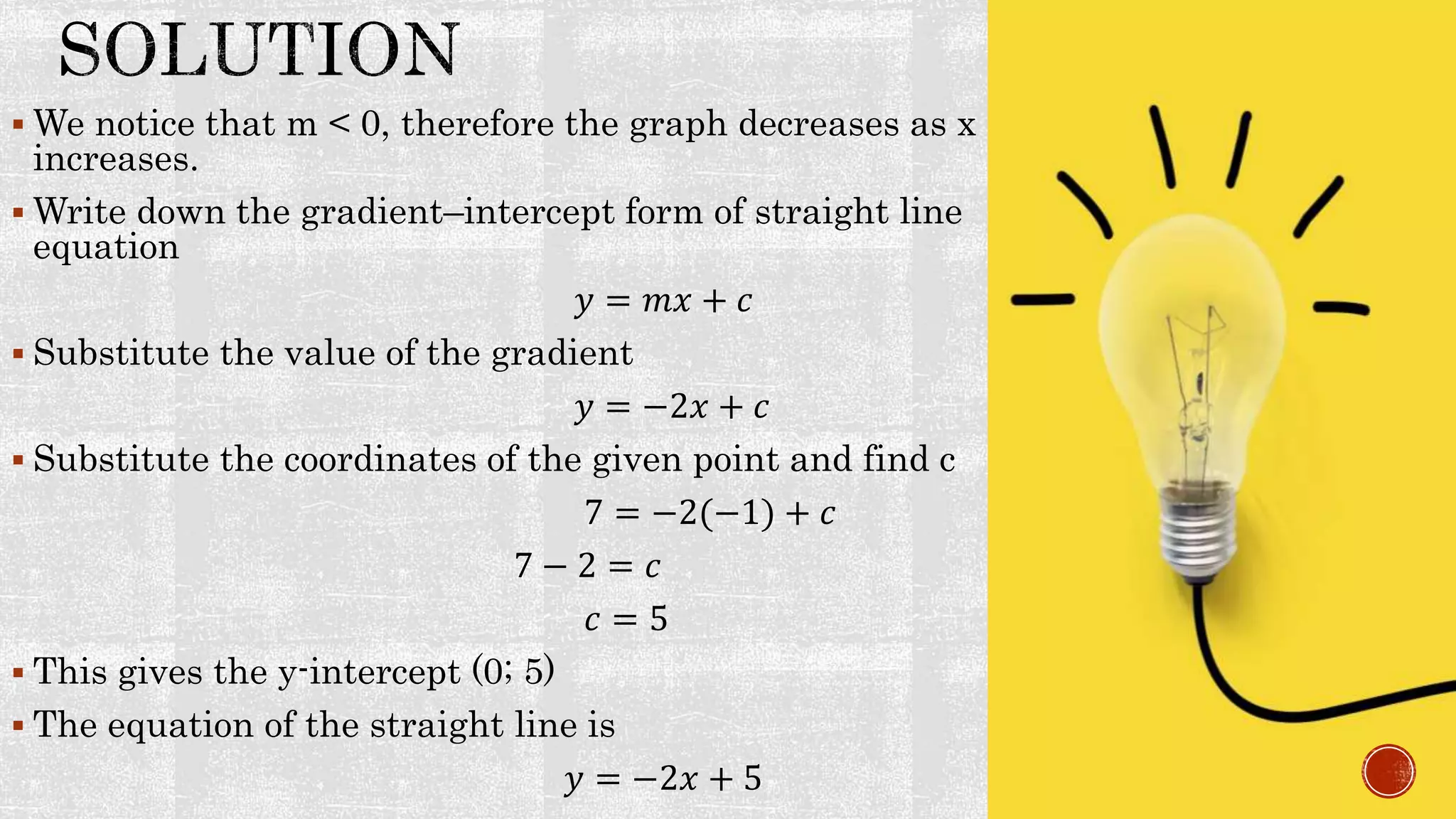
 We notice that m < 0, therefore the graph decreases as x
increases.
 Write down the gradient–intercept form of straight line
equation
𝑦 = 𝑚𝑥 + 𝑐
 Substitute the value of the gradient
𝑦 = −2𝑥 + 𝑐
 Substitute the coordinates of the given point and find c
7 = −2(−1) + 𝑐
7 − 2 = 𝑐
𝑐 = 5
 This gives the y-intercept (0; 5)
 The equation of the straight line is
𝑦 = −2𝑥 + 5
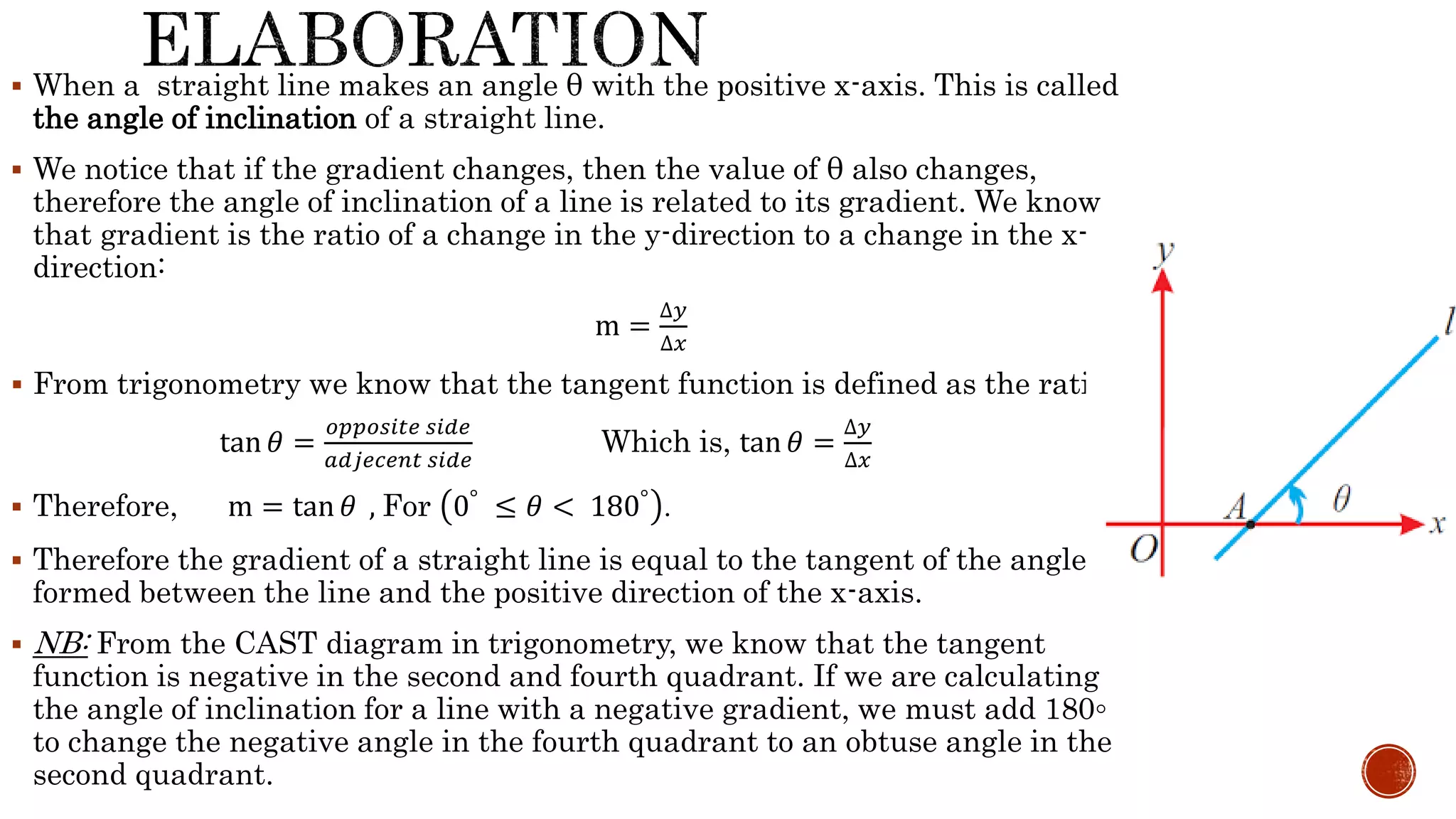
 When a straight line makes an angle θ with the positive x-axis. This is called
the angle of inclination of a straight line.
 We notice that if the gradient changes, then the value of θ also changes,
therefore the angle of inclination of a line is related to its gradient. We know
that gradient is the ratio of a change in the y-direction to a change in the x-
direction:
m =
∆𝑦
∆𝑥
 From trigonometry we know that the tangent function is defined as the ratio:
tan 𝜃 =
𝑜𝑝𝑝𝑜𝑠𝑖𝑡𝑒 𝑠𝑖𝑑𝑒
𝑎𝑑𝑗𝑒𝑐𝑒𝑛𝑡 𝑠𝑖𝑑𝑒
Which is, tan 𝜃 =
∆𝑦
∆𝑥
 Therefore, m = tan 𝜃 , For 0° ≤ 𝜃 < 180° .
 Therefore the gradient of a straight line is equal to the tangent of the angle
formed between the line and the positive direction of the x-axis.
 NB: From the CAST diagram in trigonometry, we know that the tangent
function is negative in the second and fourth quadrant. If we are calculating
the angle of inclination for a line with a negative gradient, we must add 180◦
to change the negative angle in the fourth quadrant to an obtuse angle in the
second quadrant.
EXAMPLEQUESTION
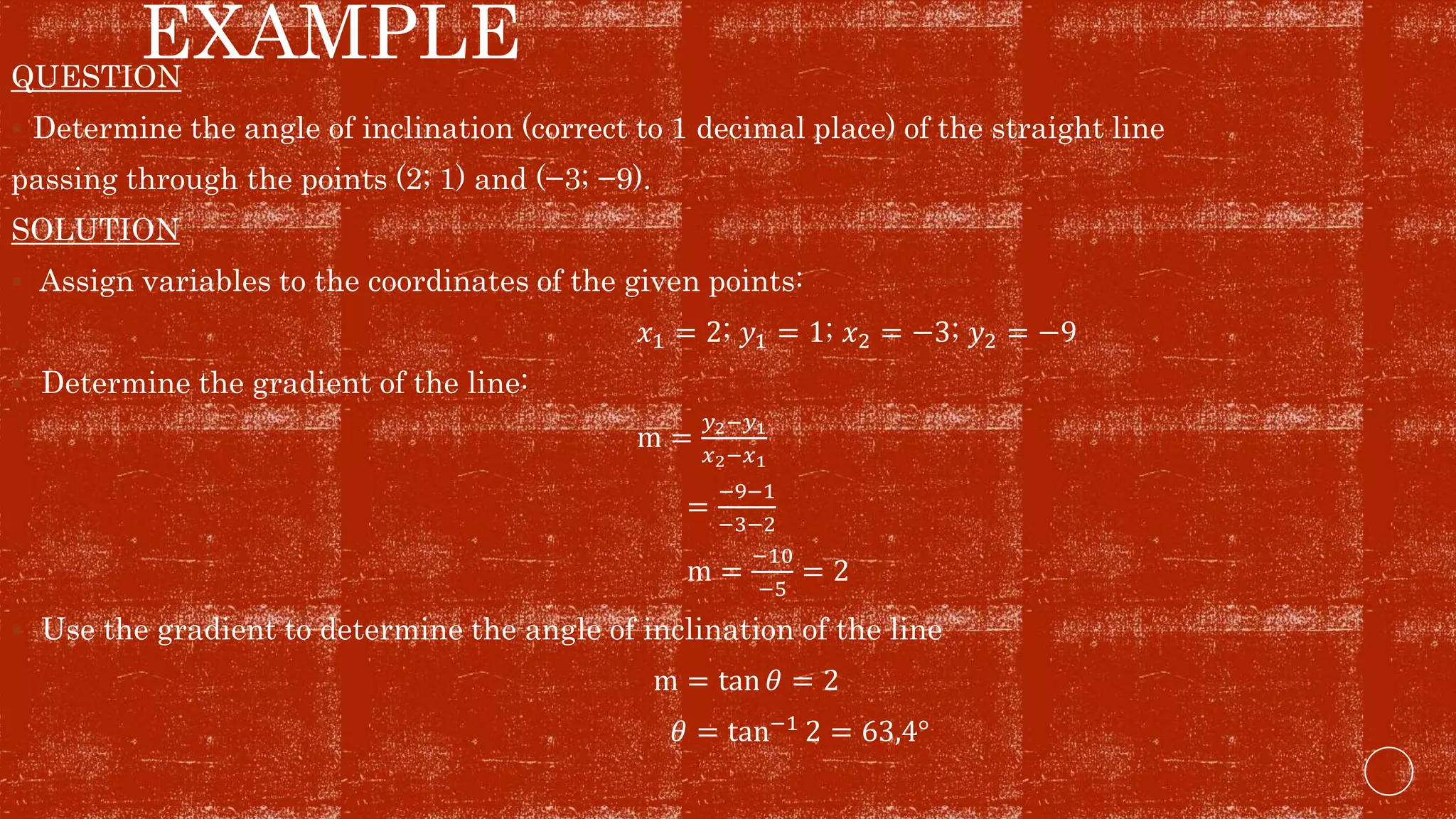
 Determine the angle of inclination (correct to 1 decimal place) of the straight line
passing through the points (2; 1) and (−3; −9).
SOLUTION
 Assign variables to the coordinates of the given points:
𝑥1 = 2; 𝑦1 = 1; 𝑥2 = −3; 𝑦2 = −9
 Determine the gradient of the line:
m =
𝑦2−𝑦1
𝑥2−𝑥1
=
−9−1
−3−2
m =
−10
−5
= 2
 Use the gradient to determine the angle of inclination of the line
m = tan 𝜃 = 2
𝜃 = tan−1 2 = 63,4°
PARALLEL
LINES
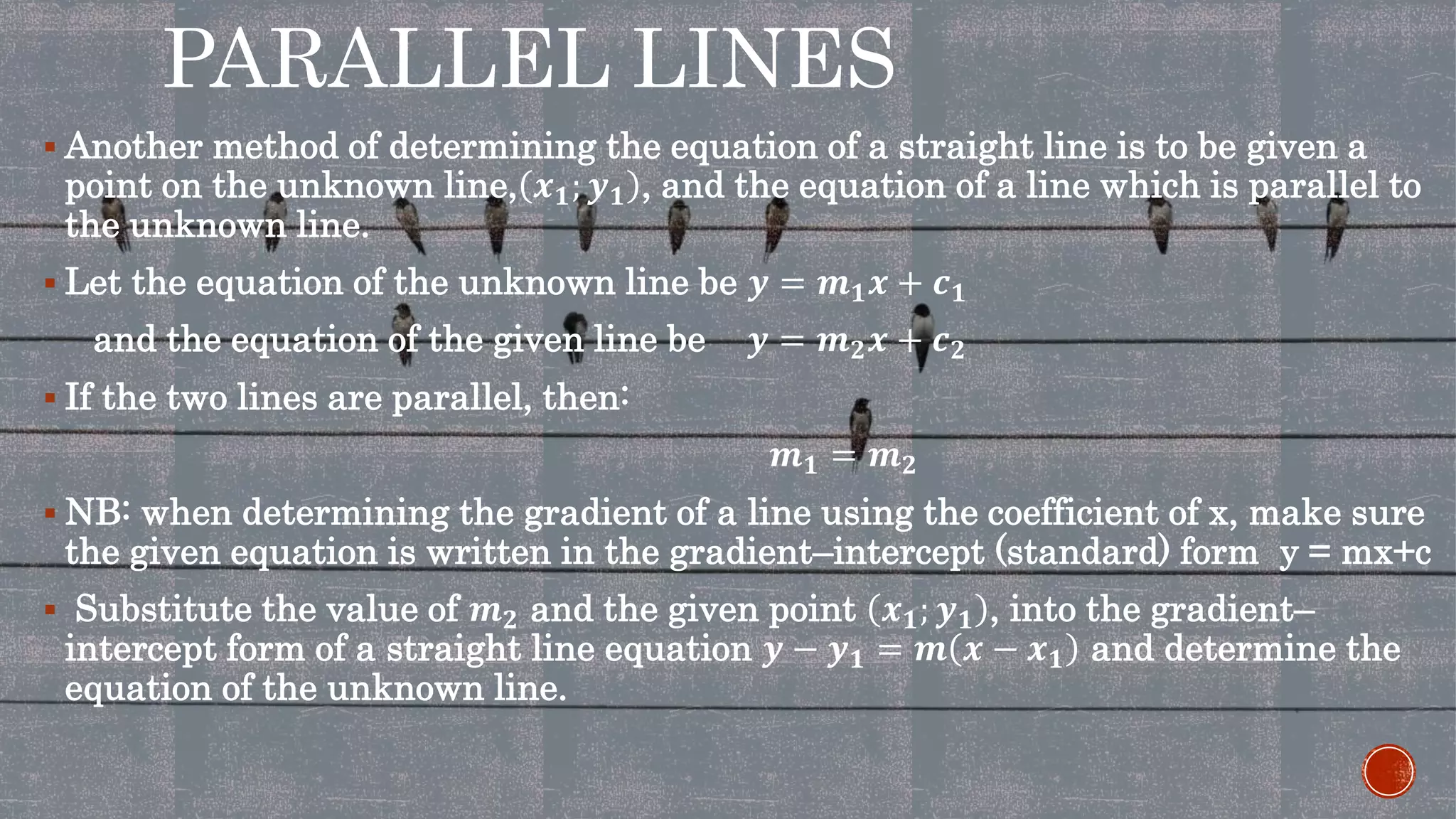
PARALLEL LINES
 Another method of determining the equation of a straight line is to be given a
point on the unknown line, 𝒙 𝟏; 𝒚 𝟏 , and the equation of a line which is parallel to
the unknown line.
 Let the equation of the unknown line be 𝒚 = 𝒎 𝟏 𝒙 + 𝒄 𝟏
and the equation of the given line be 𝒚 = 𝒎 𝟐 𝒙 + 𝒄 𝟐
 If the two lines are parallel, then:
𝒎 𝟏 = 𝒎 𝟐
 NB: when determining the gradient of a line using the coefficient of x, make sure
the given equation is written in the gradient–intercept (standard) form y = mx+c
 Substitute the value of 𝒎 𝟐 and the given point 𝒙 𝟏; 𝒚 𝟏 , into the gradient–
intercept form of a straight line equation 𝒚 − 𝒚 𝟏 = 𝒎 𝒙 − 𝒙 𝟏 and determine the
equation of the unknown line.
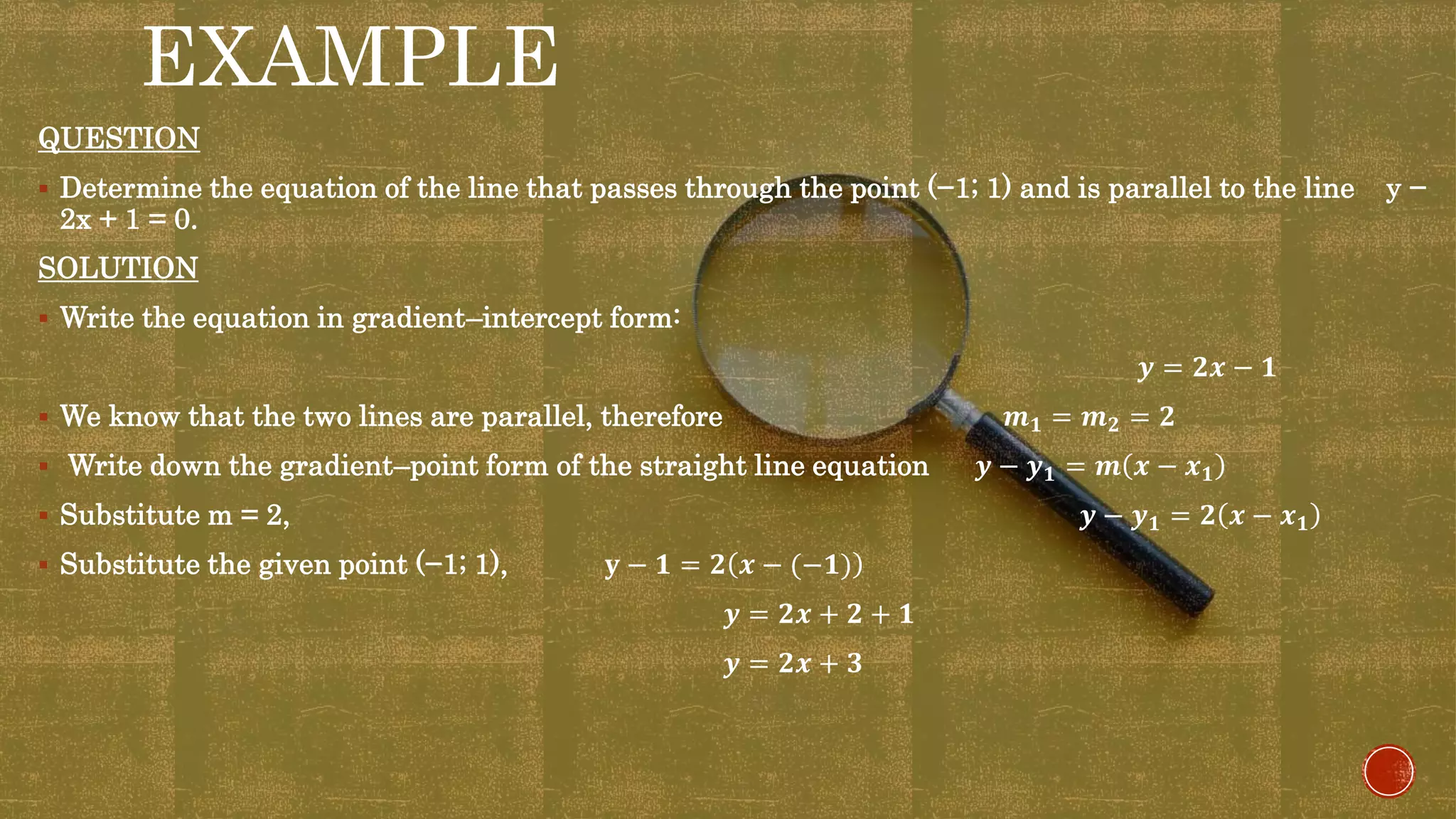
EXAMPLE
QUESTION
 Determine the equation of the line that passes through the point (−1; 1) and is parallel to the line y −
2x + 1 = 0.
SOLUTION
 Write the equation in gradient–intercept form:
𝒚 = 𝟐𝒙 − 𝟏
 We know that the two lines are parallel, therefore 𝒎 𝟏 = 𝒎 𝟐 = 𝟐
 Write down the gradient–point form of the straight line equation 𝒚 − 𝒚 𝟏 = 𝒎 𝒙 − 𝒙 𝟏
 Substitute m = 2, 𝒚 − 𝒚 𝟏 = 𝟐 𝒙 − 𝒙 𝟏
 Substitute the given point (−1; 1), 𝐲 − 𝟏 = 𝟐 𝒙 − (−𝟏)
𝒚 = 𝟐𝒙 + 𝟐 + 𝟏
𝒚 = 𝟐𝒙 + 𝟑
Determine the equation of
the straight line and its
angle of inclination,
passing through the point
(3; 1) and is parallel to a
line y-4x+2=0
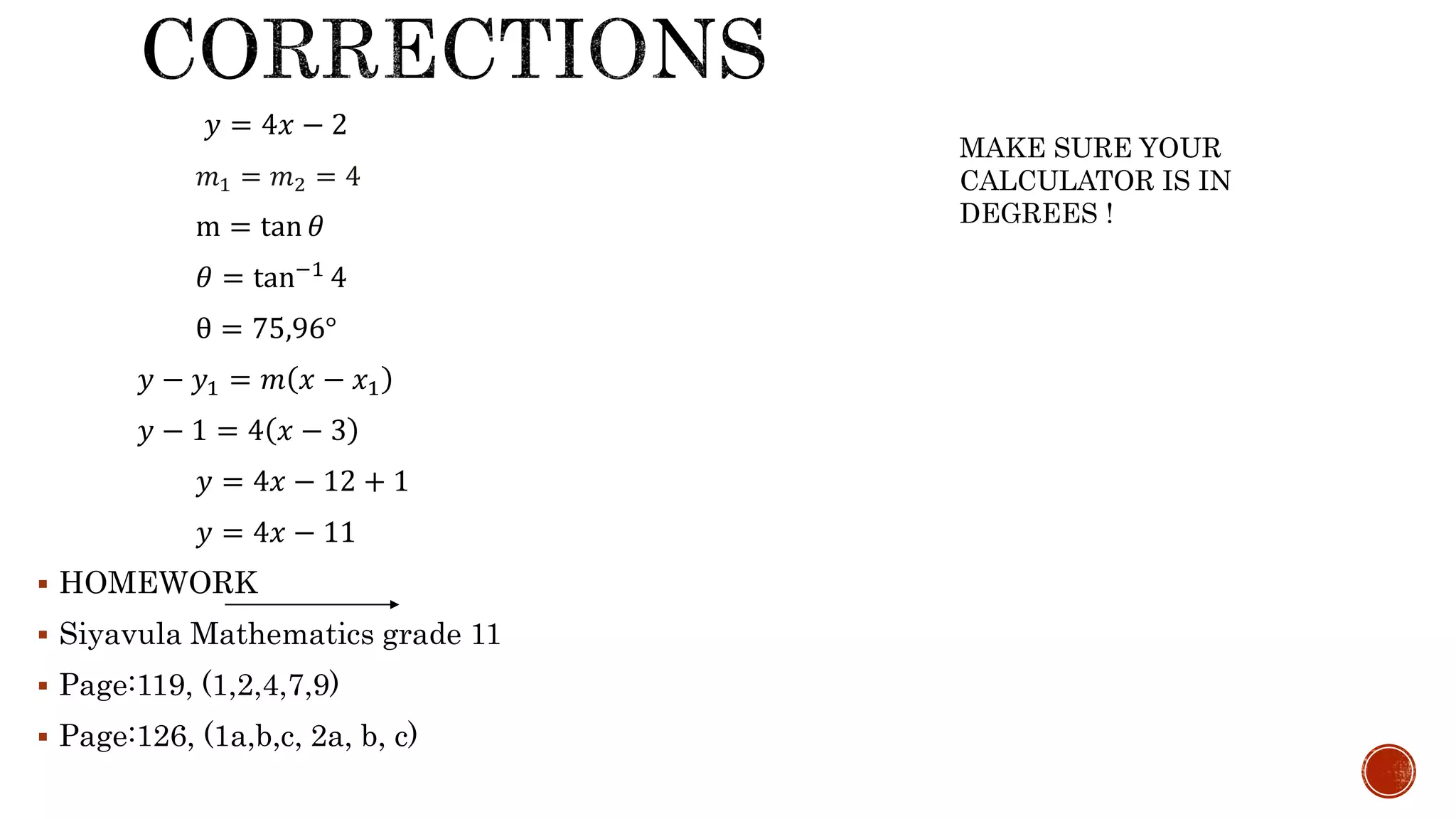
𝑦 = 4𝑥 − 2
𝑚1 = 𝑚2 = 4
m = tan 𝜃
𝜃 = tan−1 4
θ = 75,96°
𝑦 − 𝑦1 = 𝑚 𝑥 − 𝑥1
𝑦 − 1 = 4 𝑥 − 3
𝑦 = 4𝑥 − 12 + 1
𝑦 = 4𝑥 − 11
 HOMEWORK
 Siyavula Mathematics grade 11
 Page:119, (1,2,4,7,9)
 Page:126, (1a,b,c, 2a, b, c)
MAKE SURE YOUR
CALCULATOR IS IN
DEGREES !
IN A PIECE OF PAPER
CLOSE YOUR BOOKS
AND WRITE THREE
THINGS THEY YOU
LEARNT TODAY.

Analytical geometry slides

  • 1.
    EQUATION OF ALINE, INCLINATION OF A LINE & PARALLEL LINES Mr Ngcobo
  • 2.
    Using the diagram,choose the correct answer: Question 1 The co-ordinates of B are: a) −3; 3 b) 3; 3 c) 3; −3 d) −3; −3
  • 3.
    The length ofline segment BC is, leave the answer in simplest surd form: a) 2 28 b) 3 29 c) 4 2 d) 2 29
  • 4.
    The gradient ofAB is: a) − 1 4 b) − 7 4 c) 1 4 d) −4
  • 5.
    If T isthe midpoint of BE, then the co- ordinates of T are: a) 1; − 1 2 b) −1; 1 2 c) −2; 1 d) 2; −1
  • 6.
    The gradient–point formof the straight line equation
  • 7.
     We derivethe gradient–point form of the straight-line equation using the definition of gradient and the two-point form of a straight-line equation: 𝑦−𝑦1 𝑥−𝑥1 = 𝑦2−𝑦1 𝑥2−𝑥1  Substitute: m = 𝑦2−𝑦1 𝑥2−𝑥1 on the right-hand side of the equation.  Multiply both sides of the equation by 𝑥 − 𝑥1  Then, we have: 𝒚 − 𝒚 𝟏 = 𝒎 𝒙 − 𝒙 𝟏
  • 8.
    To use thisequation, we need to know the gradient of the line and the coordinates of one point on the line. If we are given two points on a straight line, we can also use the gradient–point form to determine the equation of a straight line. We first calculate the gradient using the two given points and then substitute either of the two points into the gradient– point form of the equation.
  • 9.
    QUESTION  Determine theequation of the straight line with gradient m = − 1/3 and passing through the point (−1; 1). SOLUTION  We notice that m < 0, therefore the graph decreases as x increases  Write the formula, 𝒚 − 𝒚 𝟏 = 𝒎 𝒙 − 𝒙 𝟏  Substitute the value of the gradient: 𝑦 − 𝑦1 = − 1 3 𝑥 − 𝑥1  Substitute the coordinates of the given point: 𝑦 − 1 = − 1 3 𝑥 − (−1) 𝑦 − 1 = − 1 3 𝑥 + 1) 𝑦 = − 1 3 𝑥 − 1 3 + 1 𝑦 = − 1 3 𝑥 − 2 3 (-1;1)
  • 11.
     Using thegradient–point form, we can also derive the gradient–intercept form of the straight line equation. Starting with the equation: 𝑦 − 𝑦1 = 𝑚 𝑥 − 𝑥1  Expand the brackets and make y the subject of the formula 𝑦 = 𝑚𝑥 − 𝑚𝑥1 + 𝑦1 𝑦 = 𝑚𝑥 + 𝑦1 − 𝑚𝑥1  We define constant c such that 𝑐 = 𝑦1 − 𝑚𝑥1  So that we get the equation 𝒚 = 𝒎𝒙 + 𝒄  This is also called the standard form of the straight line equation.
  • 12.
    CONT.  Notice thatwhen x = 0, we have 𝑦 = 𝑚 0 + 𝑐 = 𝑐  Therefore c is the y-intercept of the straight line. EXAMPLE Question  Determine the equation of the straight line with gradient m = −2 and passing through the point (−1; 7).
  • 13.
     We noticethat m < 0, therefore the graph decreases as x increases.  Write down the gradient–intercept form of straight line equation 𝑦 = 𝑚𝑥 + 𝑐  Substitute the value of the gradient 𝑦 = −2𝑥 + 𝑐  Substitute the coordinates of the given point and find c 7 = −2(−1) + 𝑐 7 − 2 = 𝑐 𝑐 = 5  This gives the y-intercept (0; 5)  The equation of the straight line is 𝑦 = −2𝑥 + 5
  • 15.
     When astraight line makes an angle θ with the positive x-axis. This is called the angle of inclination of a straight line.  We notice that if the gradient changes, then the value of θ also changes, therefore the angle of inclination of a line is related to its gradient. We know that gradient is the ratio of a change in the y-direction to a change in the x- direction: m = ∆𝑦 ∆𝑥  From trigonometry we know that the tangent function is defined as the ratio: tan 𝜃 = 𝑜𝑝𝑝𝑜𝑠𝑖𝑡𝑒 𝑠𝑖𝑑𝑒 𝑎𝑑𝑗𝑒𝑐𝑒𝑛𝑡 𝑠𝑖𝑑𝑒 Which is, tan 𝜃 = ∆𝑦 ∆𝑥  Therefore, m = tan 𝜃 , For 0° ≤ 𝜃 < 180° .  Therefore the gradient of a straight line is equal to the tangent of the angle formed between the line and the positive direction of the x-axis.  NB: From the CAST diagram in trigonometry, we know that the tangent function is negative in the second and fourth quadrant. If we are calculating the angle of inclination for a line with a negative gradient, we must add 180◦ to change the negative angle in the fourth quadrant to an obtuse angle in the second quadrant.
  • 16.
    EXAMPLEQUESTION  Determine theangle of inclination (correct to 1 decimal place) of the straight line passing through the points (2; 1) and (−3; −9). SOLUTION  Assign variables to the coordinates of the given points: 𝑥1 = 2; 𝑦1 = 1; 𝑥2 = −3; 𝑦2 = −9  Determine the gradient of the line: m = 𝑦2−𝑦1 𝑥2−𝑥1 = −9−1 −3−2 m = −10 −5 = 2  Use the gradient to determine the angle of inclination of the line m = tan 𝜃 = 2 𝜃 = tan−1 2 = 63,4°
  • 17.
  • 18.
    PARALLEL LINES  Anothermethod of determining the equation of a straight line is to be given a point on the unknown line, 𝒙 𝟏; 𝒚 𝟏 , and the equation of a line which is parallel to the unknown line.  Let the equation of the unknown line be 𝒚 = 𝒎 𝟏 𝒙 + 𝒄 𝟏 and the equation of the given line be 𝒚 = 𝒎 𝟐 𝒙 + 𝒄 𝟐  If the two lines are parallel, then: 𝒎 𝟏 = 𝒎 𝟐  NB: when determining the gradient of a line using the coefficient of x, make sure the given equation is written in the gradient–intercept (standard) form y = mx+c  Substitute the value of 𝒎 𝟐 and the given point 𝒙 𝟏; 𝒚 𝟏 , into the gradient– intercept form of a straight line equation 𝒚 − 𝒚 𝟏 = 𝒎 𝒙 − 𝒙 𝟏 and determine the equation of the unknown line.
  • 19.
    EXAMPLE QUESTION  Determine theequation of the line that passes through the point (−1; 1) and is parallel to the line y − 2x + 1 = 0. SOLUTION  Write the equation in gradient–intercept form: 𝒚 = 𝟐𝒙 − 𝟏  We know that the two lines are parallel, therefore 𝒎 𝟏 = 𝒎 𝟐 = 𝟐  Write down the gradient–point form of the straight line equation 𝒚 − 𝒚 𝟏 = 𝒎 𝒙 − 𝒙 𝟏  Substitute m = 2, 𝒚 − 𝒚 𝟏 = 𝟐 𝒙 − 𝒙 𝟏  Substitute the given point (−1; 1), 𝐲 − 𝟏 = 𝟐 𝒙 − (−𝟏) 𝒚 = 𝟐𝒙 + 𝟐 + 𝟏 𝒚 = 𝟐𝒙 + 𝟑
  • 20.
    Determine the equationof the straight line and its angle of inclination, passing through the point (3; 1) and is parallel to a line y-4x+2=0
  • 21.
    𝑦 = 4𝑥− 2 𝑚1 = 𝑚2 = 4 m = tan 𝜃 𝜃 = tan−1 4 θ = 75,96° 𝑦 − 𝑦1 = 𝑚 𝑥 − 𝑥1 𝑦 − 1 = 4 𝑥 − 3 𝑦 = 4𝑥 − 12 + 1 𝑦 = 4𝑥 − 11  HOMEWORK  Siyavula Mathematics grade 11  Page:119, (1,2,4,7,9)  Page:126, (1a,b,c, 2a, b, c) MAKE SURE YOUR CALCULATOR IS IN DEGREES !
  • 22.
    IN A PIECEOF PAPER CLOSE YOUR BOOKS AND WRITE THREE THINGS THEY YOU LEARNT TODAY.