The Binomial Theorem
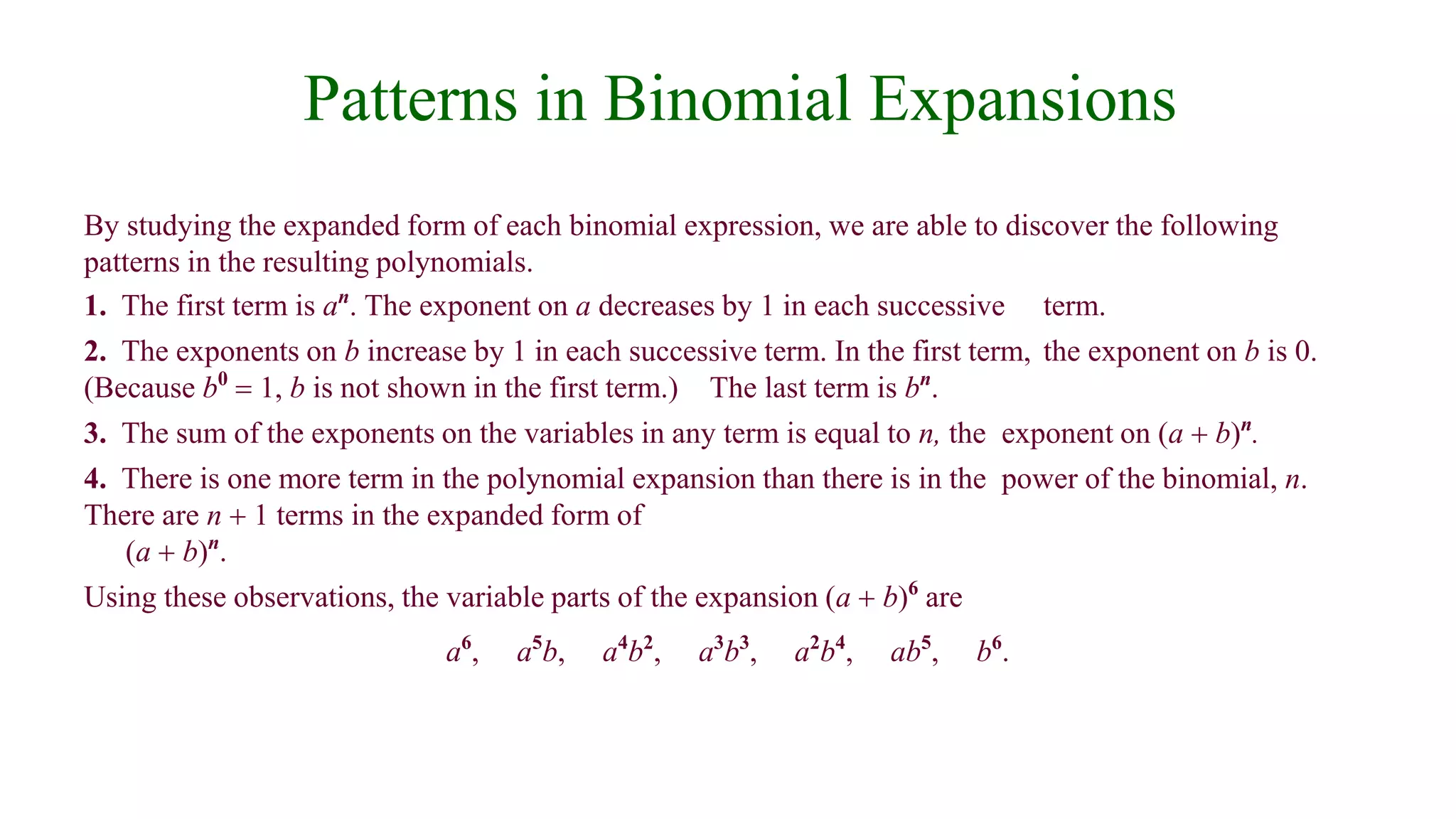
By studying the expanded form of each binomial expression, we are able to discover the following
patterns in the resulting polynomials.
1. The first term is an
. The exponent on a decreases by 1 in each successive term.
2. The exponents on b increase by 1 in each successive term. In the first term, the exponent on b is 0.
(Because b0
= 1, b is not shown in the first term.) The last term is bn
.
3. The sum of the exponents on the variables in any term is equal to n, the exponent on (a + b)n
.
4. There is one more term in the polynomial expansion than there is in the power of the binomial, n.
There are n + 1 terms in the expanded form of
(a + b)n
.
Using these observations, the variable parts of the expansion (a + b)6
are
a6
, a5
b, a4
b2
, a3
b3
, a2
b4
, ab5
, b6
.
Patterns in Binomial Expansions
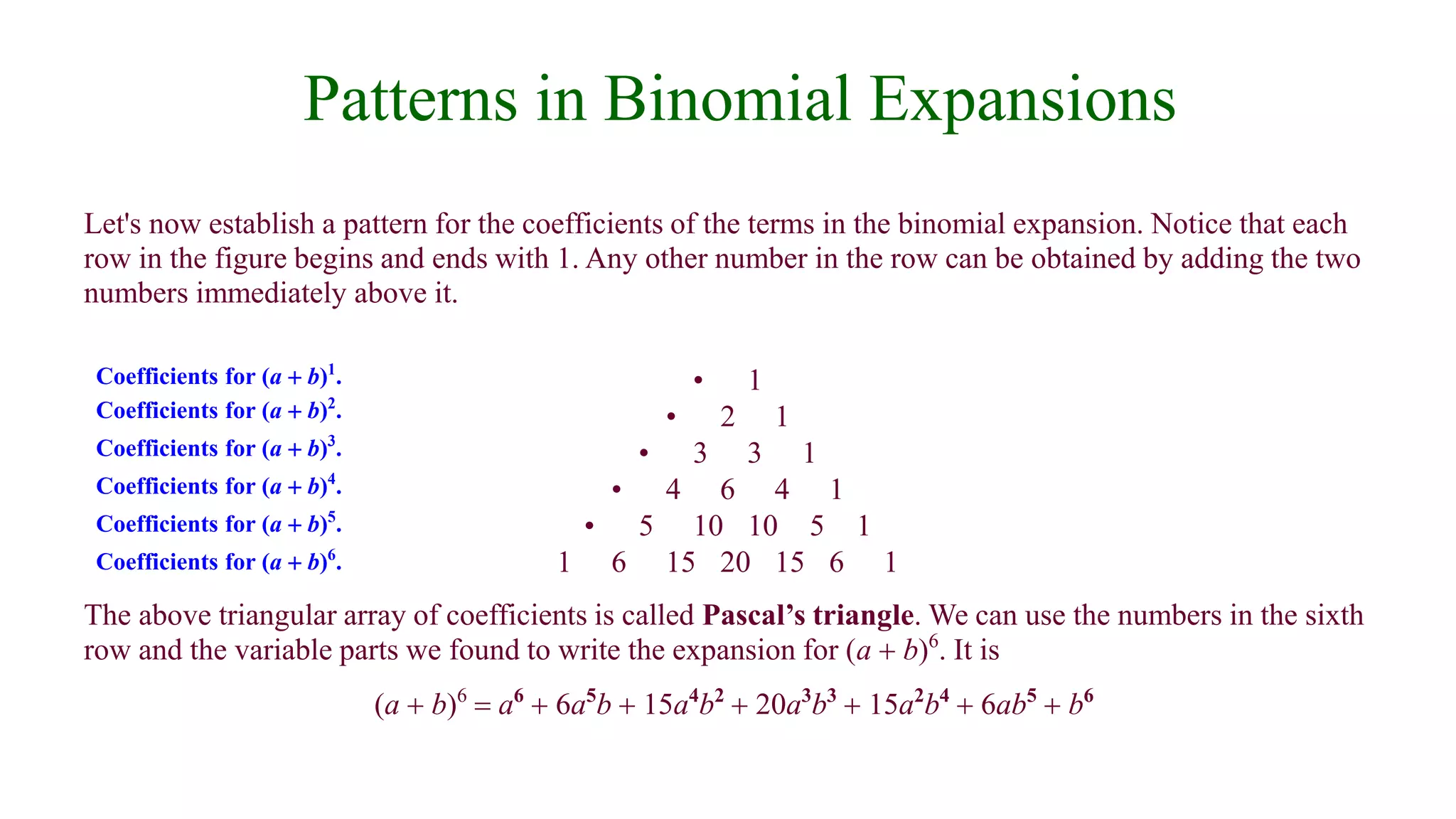
Let's now establish a pattern for the coefficients of the terms in the binomial expansion. Notice that each
row in the figure begins and ends with 1. Any other number in the row can be obtained by adding the two
numbers immediately above it.
Coefficients for (a + b)1
.
Coefficients for (a + b)2
.
Coefficients for (a + b)3
.
Coefficients for (a + b)4
.
Coefficients for (a + b)5
.
Coefficients for (a + b)6
.
• 1
• 2 1
• 3 3 1
• 4 6 4 1
• 5 10 10 5 1
1 6 15 20 15 6 1
The above triangular array of coefficients is called Pascal’s triangle. We can use the numbers in the sixth
row and the variable parts we found to write the expansion for (a + b)6
. It is
(a + b)6
= a6
+ 6a5
b + 15a4
b2
+ 20a3
b3
+ 15a2
b4
+ 6ab5
+ b6
Patterns in Binomial Expansions
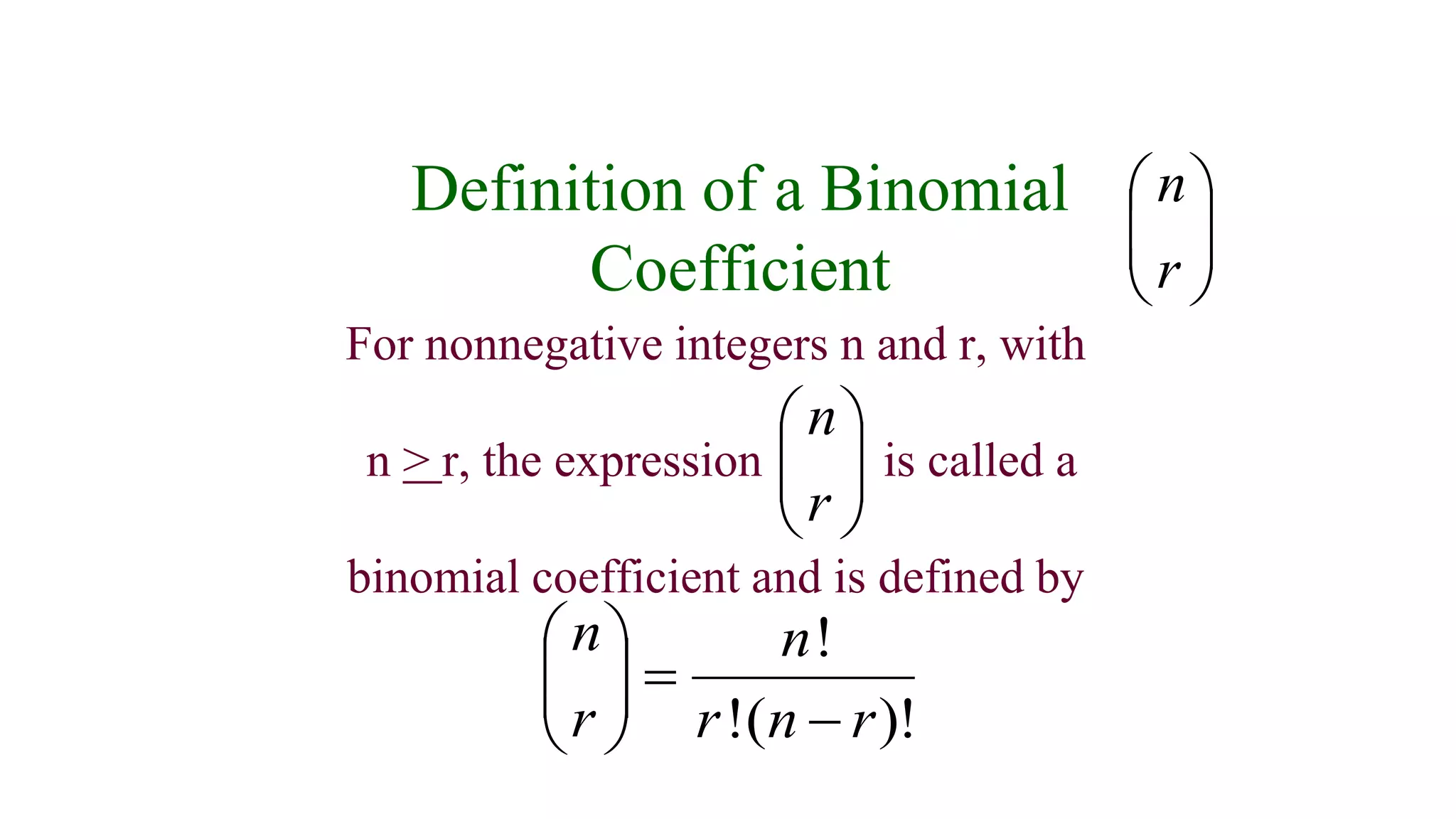
Definition of a Binomial
Coefficient
For nonnegative integers n and r, with
n > r, the expression is called a
binomial coefficient and is defined by








r
n








r
n
)!
(
!
!
r
n
r
n
r
n

=








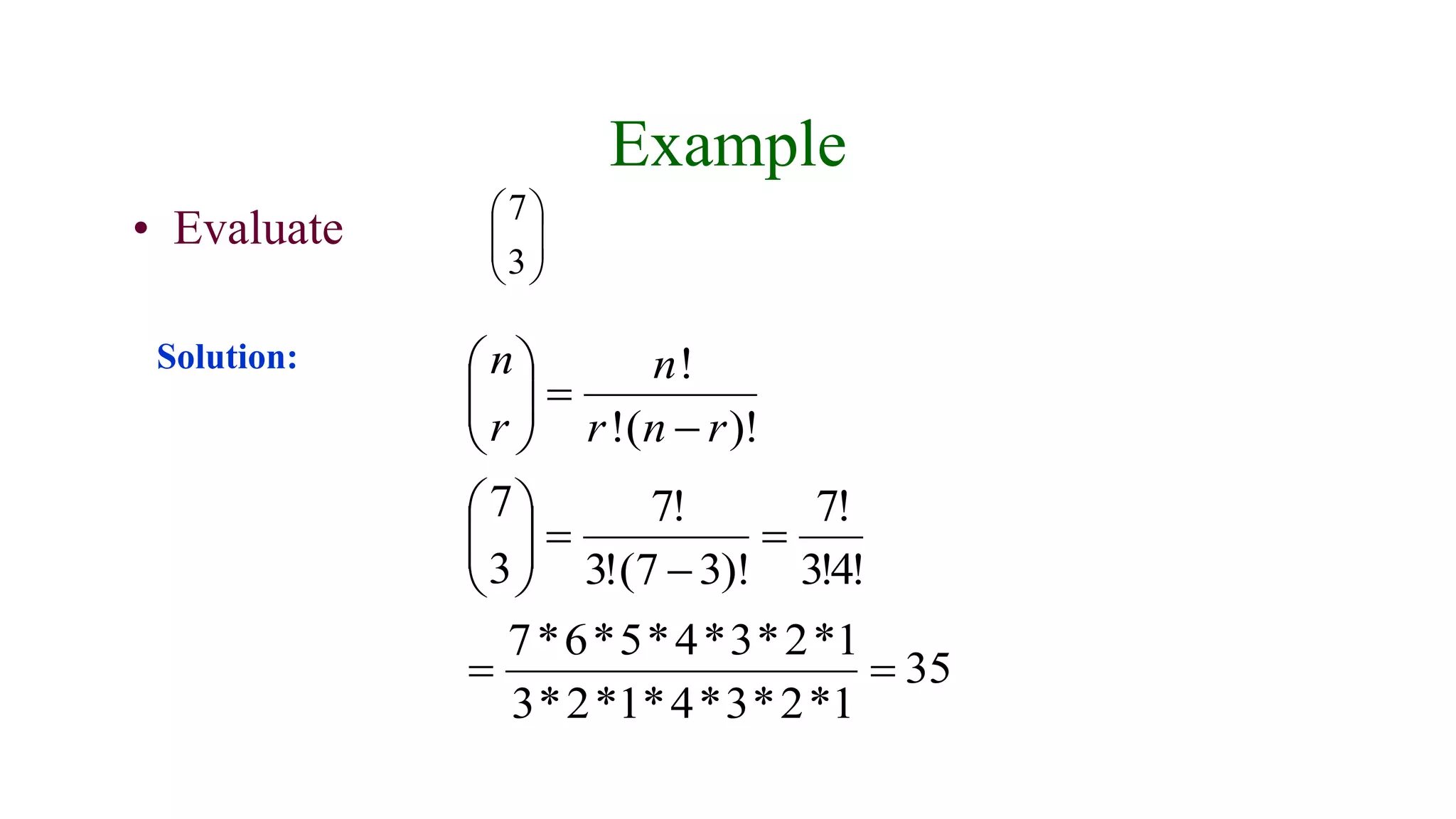
Example








3
7
• Evaluate
Solution:
35
1
*
2
*
3
*
4
*
1
*
2
*
3
1
*
2
*
3
*
4
*
5
*
6
*
7
!
4
!
3
!
7
)!
3
7
(
!
3
!
7
3
7
)!
(
!
!
=
=
=

=









=








r
n
r
n
r
n
A Formula for Expanding Binomials:
The Binomial Theorem
n
n
n
n
n
b
n
n
b
a
n
b
a
n
a
n
b
a 







+
+








+








+








=
+ 

...
3
1
0
)
( 2
2
1
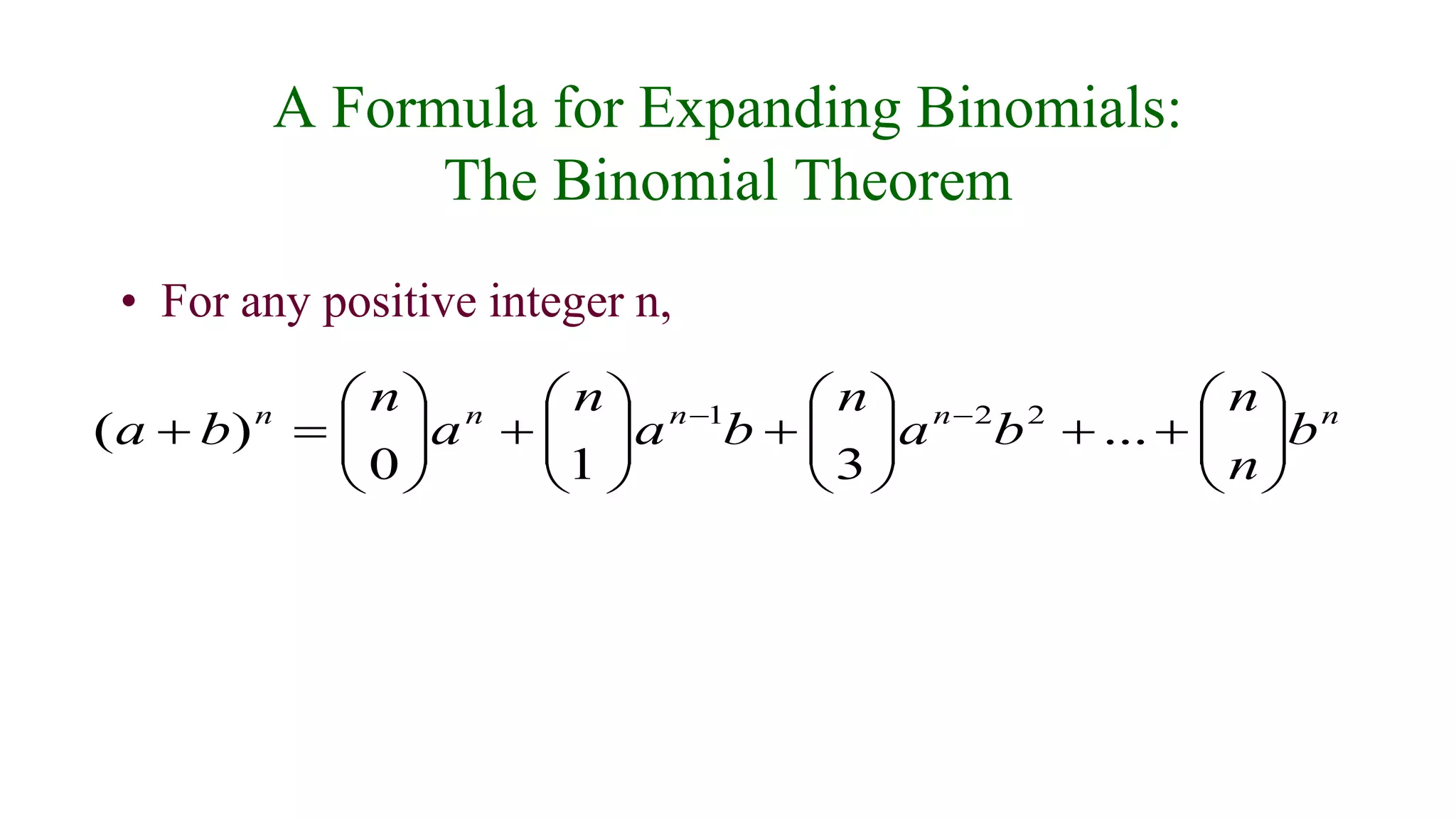
• For any positive integer n,
Example
3
)
4
( +
x
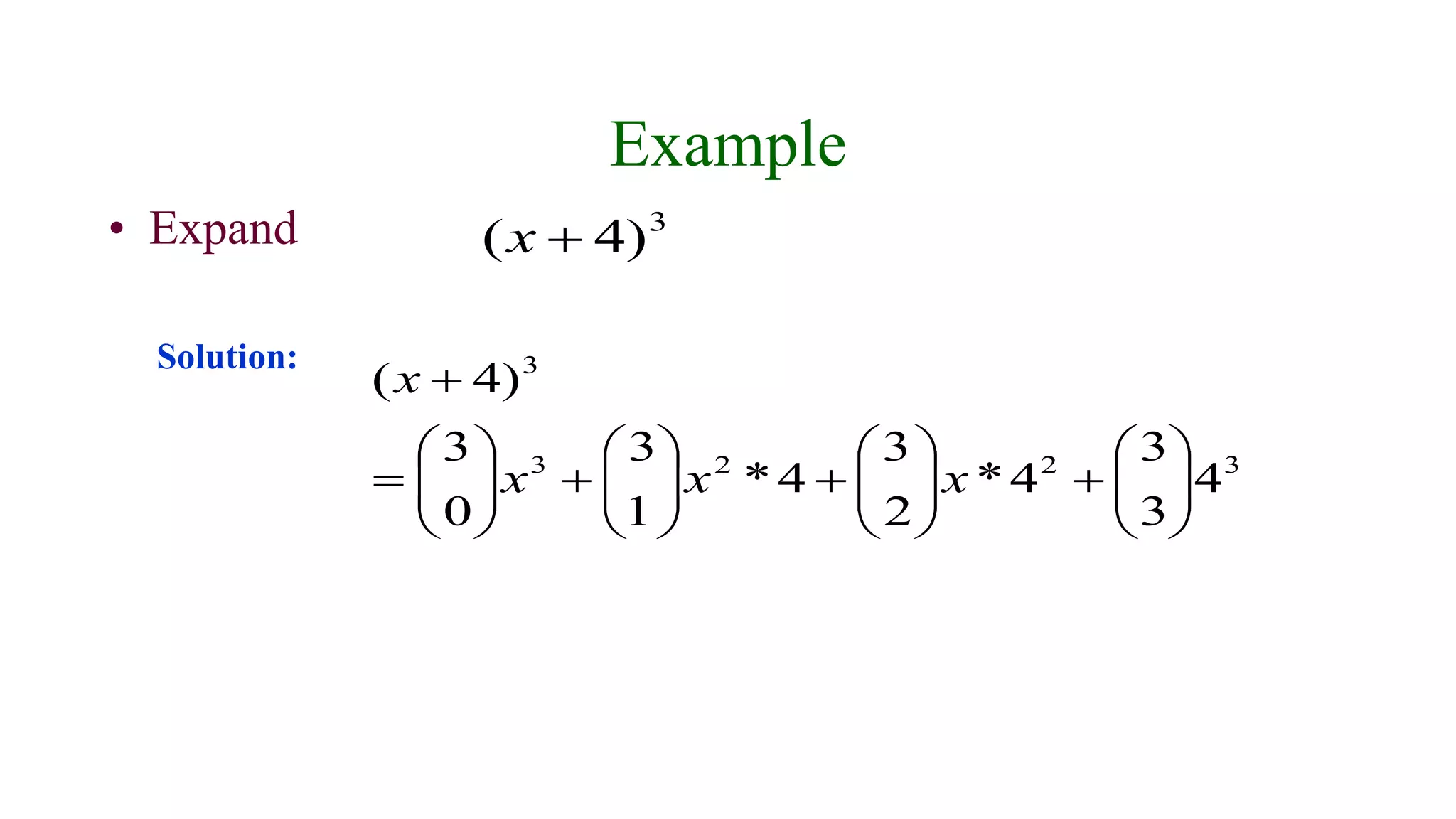
• Expand
Solution:
3
2
2
3
3
4
3
3
4
*
2
3
4
*
1
3
0
3
)
4
(








+








+








+








=
+
x
x
x
x
Example cont.
3
)
4
( +
x
• Expand
Solution:
64
48
12
64
!
0
!
3
!
3
16
!
1
!
2
!
3
4
!
2
!
1
!
3
!
3
!
0
!
3
4
3
3
4
*
2
3
4
*
1
3
0
3
)
4
(
2
3
2
3
3
2
2
3
3
+
+
+
=
+
+
+
=








+








+








+








=
+
x
x
x
x
x
x
x
x
x
x
Finding a Particular Term in a Binomial
Expansion
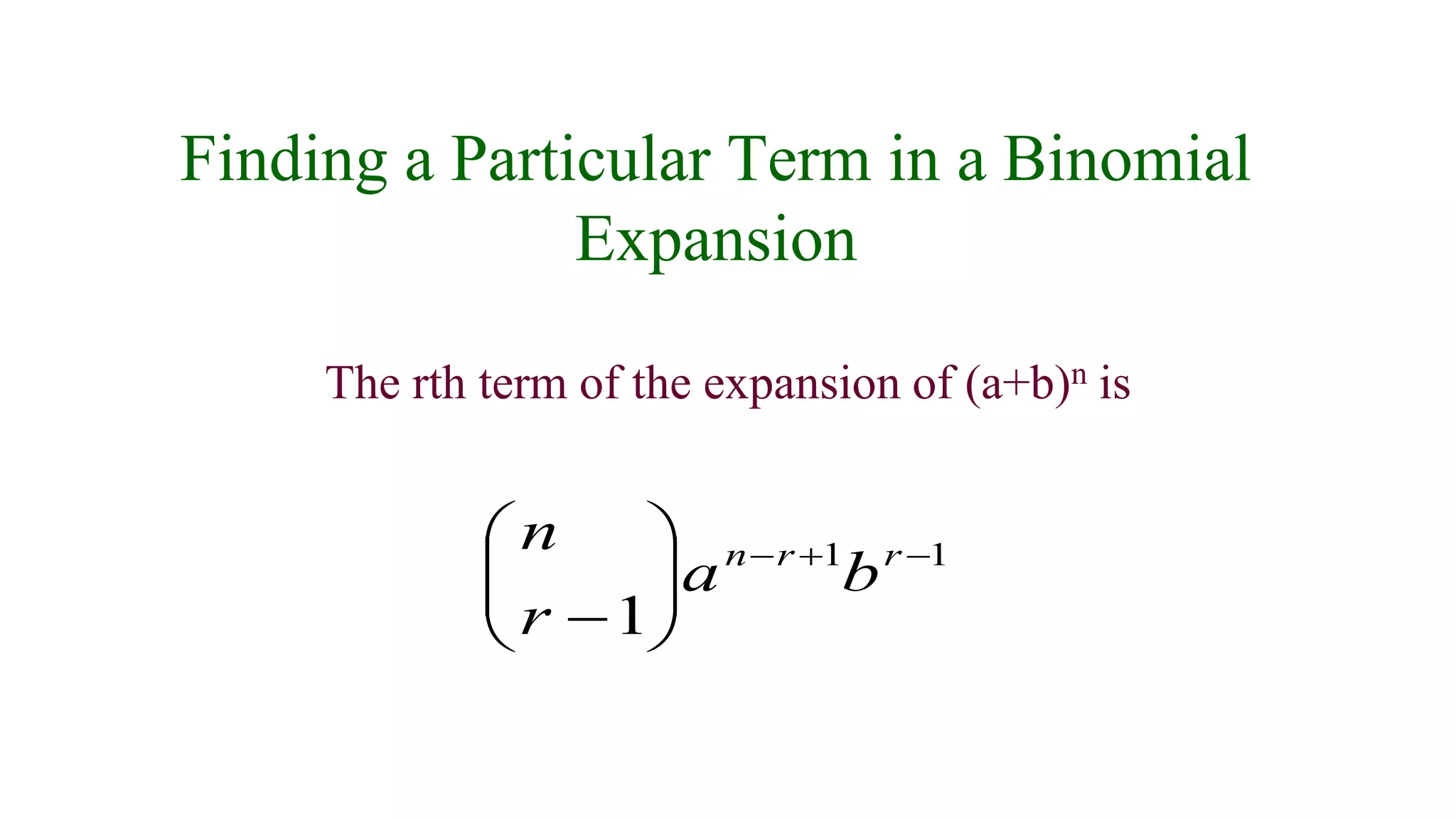
The rth term of the expansion of (a+b)n is
1
1
1

+










r
r
n
b
a
r
n
Example
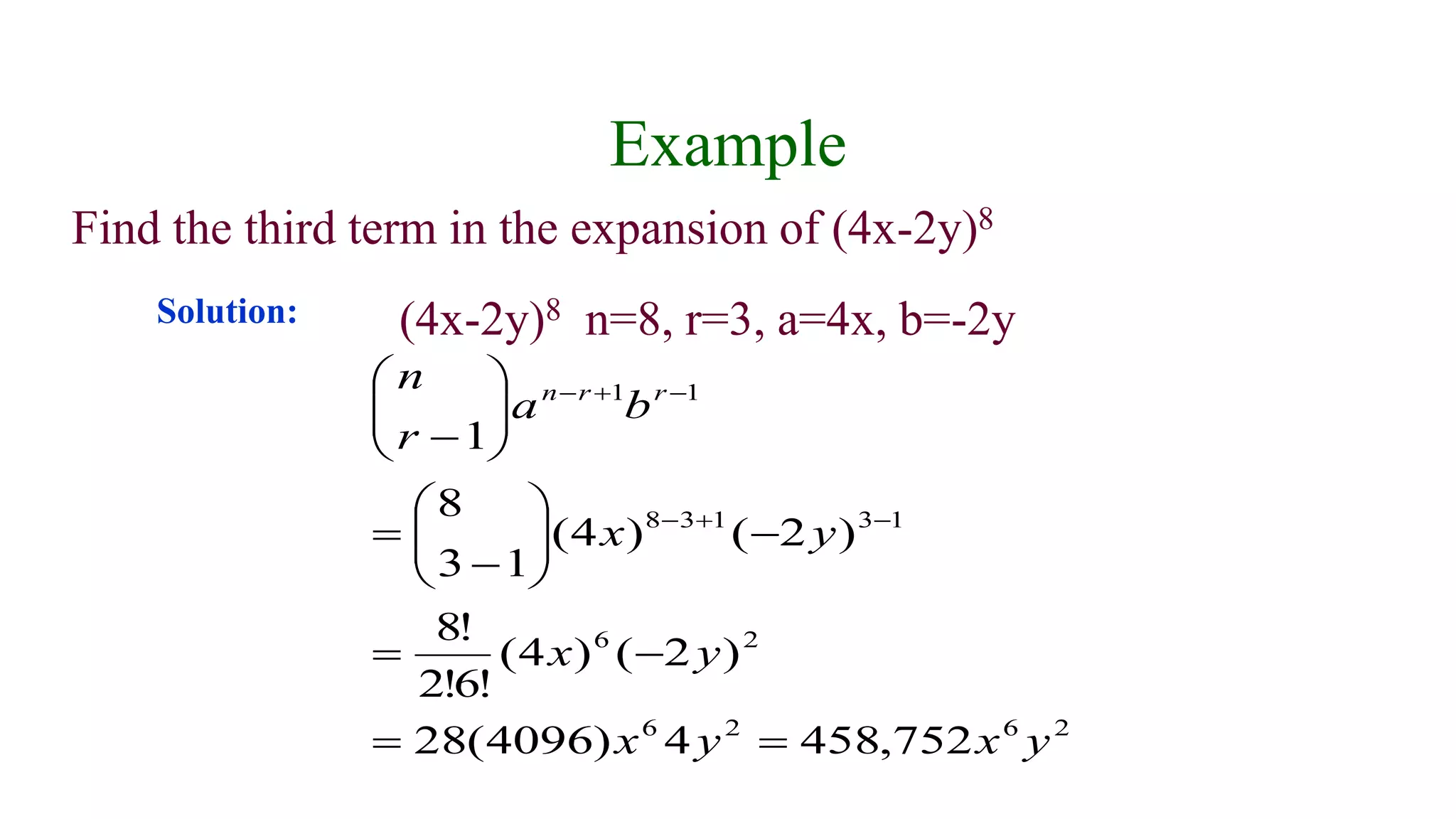
Find the third term in the expansion of (4x-2y)8
(4x-2y)8 n=8, r=3, a=4x, b=-2y
Solution:
2
6
2
6
2
6
1
3
1
3
8
1
1
752
,
458
4
)
4096
(
28
)
2
(
)
4
(
!
6
!
2
!
8
)
2
(
)
4
(
1
3
8
1
y
x
y
x
y
x
y
x
b
a
r
n r
r
n
=
=

=










=










+


+

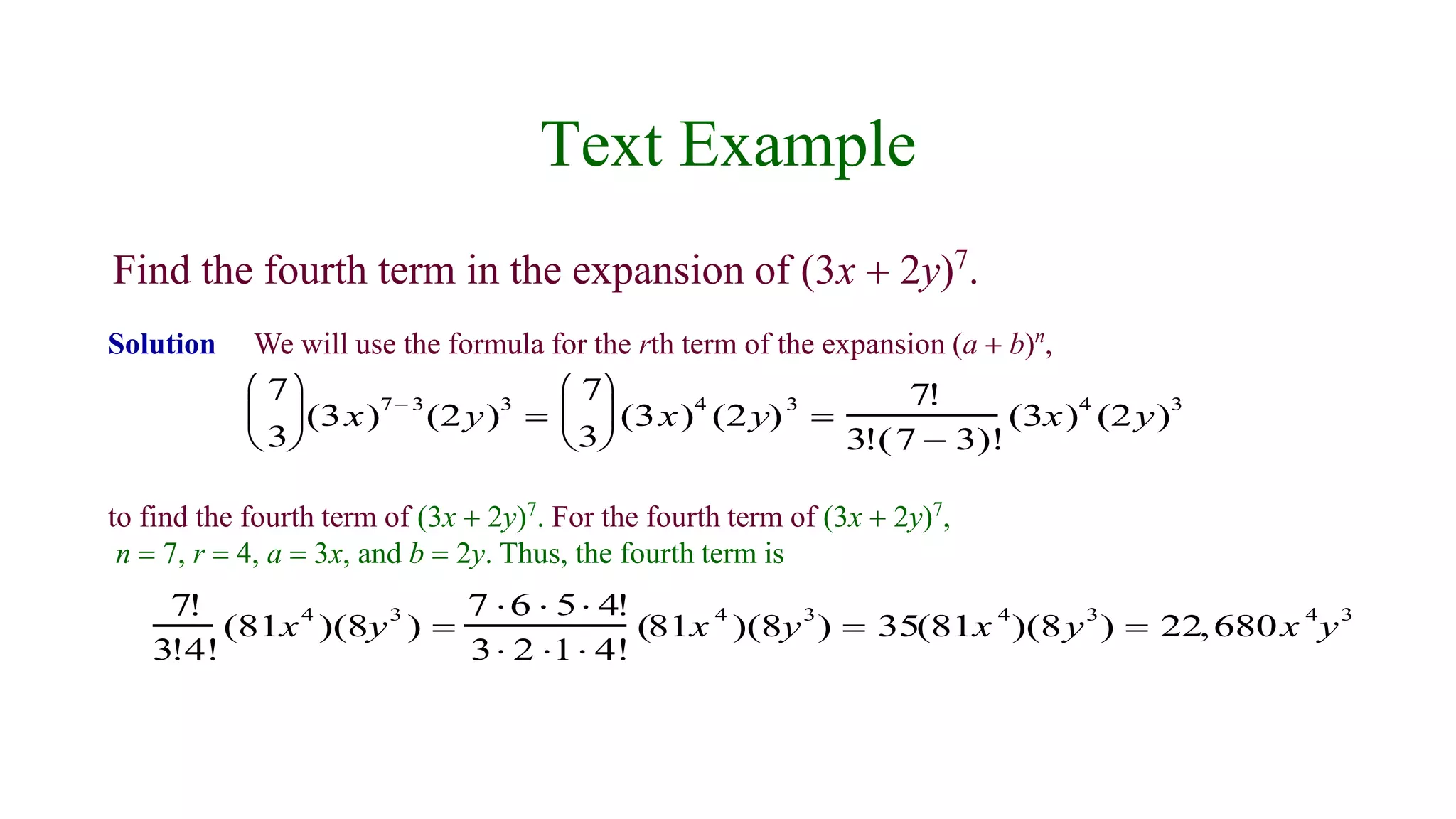
Find the fourth term in the expansion of (3x + 2y)7
.
Text Example
7
3






(3x)7 3
(2y)3
=
7
3






(3x)4
(2y)3
=
7!
3!(7  3)!
(3x)4
(2y)3
Solution We will use the formula for the rth term of the expansion (a + b)n
,
to find the fourth term of (3x + 2y)7
. For the fourth term of (3x + 2y)7
,
n = 7, r = 4, a = 3x, and b = 2y. Thus, the fourth term is
7!
3!4!
(81x4
)(8y3
) =
7 6  5 4!
3 2 1 4!
(81x 4
)(8y3
) = 35(81x 4
)(8y3
) = 22,680x 4
y3

The Binomial Theorem.pptx

  • 1.
  • 2.
    By studying theexpanded form of each binomial expression, we are able to discover the following patterns in the resulting polynomials. 1. The first term is an . The exponent on a decreases by 1 in each successive term. 2. The exponents on b increase by 1 in each successive term. In the first term, the exponent on b is 0. (Because b0 = 1, b is not shown in the first term.) The last term is bn . 3. The sum of the exponents on the variables in any term is equal to n, the exponent on (a + b)n . 4. There is one more term in the polynomial expansion than there is in the power of the binomial, n. There are n + 1 terms in the expanded form of (a + b)n . Using these observations, the variable parts of the expansion (a + b)6 are a6 , a5 b, a4 b2 , a3 b3 , a2 b4 , ab5 , b6 . Patterns in Binomial Expansions
  • 3.
    Let's now establisha pattern for the coefficients of the terms in the binomial expansion. Notice that each row in the figure begins and ends with 1. Any other number in the row can be obtained by adding the two numbers immediately above it. Coefficients for (a + b)1 . Coefficients for (a + b)2 . Coefficients for (a + b)3 . Coefficients for (a + b)4 . Coefficients for (a + b)5 . Coefficients for (a + b)6 . • 1 • 2 1 • 3 3 1 • 4 6 4 1 • 5 10 10 5 1 1 6 15 20 15 6 1 The above triangular array of coefficients is called Pascal’s triangle. We can use the numbers in the sixth row and the variable parts we found to write the expansion for (a + b)6 . It is (a + b)6 = a6 + 6a5 b + 15a4 b2 + 20a3 b3 + 15a2 b4 + 6ab5 + b6 Patterns in Binomial Expansions
  • 4.
    Definition of aBinomial Coefficient For nonnegative integers n and r, with n > r, the expression is called a binomial coefficient and is defined by         r n         r n )! ( ! ! r n r n r n  =        
  • 5.
  • 6.
    A Formula forExpanding Binomials: The Binomial Theorem n n n n n b n n b a n b a n a n b a         + +         +         +         = +   ... 3 1 0 ) ( 2 2 1 • For any positive integer n,
  • 7.
  • 8.
    Example cont. 3 ) 4 ( + x •Expand Solution: 64 48 12 64 ! 0 ! 3 ! 3 16 ! 1 ! 2 ! 3 4 ! 2 ! 1 ! 3 ! 3 ! 0 ! 3 4 3 3 4 * 2 3 4 * 1 3 0 3 ) 4 ( 2 3 2 3 3 2 2 3 3 + + + = + + + =         +         +         +         = + x x x x x x x x x x
  • 9.
    Finding a ParticularTerm in a Binomial Expansion The rth term of the expansion of (a+b)n is 1 1 1  +           r r n b a r n
  • 10.
    Example Find the thirdterm in the expansion of (4x-2y)8 (4x-2y)8 n=8, r=3, a=4x, b=-2y Solution: 2 6 2 6 2 6 1 3 1 3 8 1 1 752 , 458 4 ) 4096 ( 28 ) 2 ( ) 4 ( ! 6 ! 2 ! 8 ) 2 ( ) 4 ( 1 3 8 1 y x y x y x y x b a r n r r n = =  =           =           +   + 
  • 11.
    Find the fourthterm in the expansion of (3x + 2y)7 . Text Example 7 3       (3x)7 3 (2y)3 = 7 3       (3x)4 (2y)3 = 7! 3!(7  3)! (3x)4 (2y)3 Solution We will use the formula for the rth term of the expansion (a + b)n , to find the fourth term of (3x + 2y)7 . For the fourth term of (3x + 2y)7 , n = 7, r = 4, a = 3x, and b = 2y. Thus, the fourth term is 7! 3!4! (81x4 )(8y3 ) = 7 6  5 4! 3 2 1 4! (81x 4 )(8y3 ) = 35(81x 4 )(8y3 ) = 22,680x 4 y3