Accounting Standard - AS 11
The Effects of Changes in Foreign
Exchange Rates
Objective
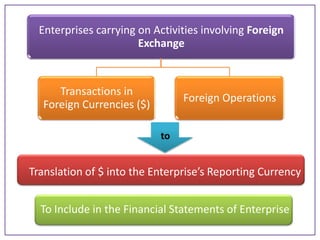
Enterprises carrying on Activities involving Foreign
Exchange

Transactions in
Foreign Currencies ($)

Foreign Operations
to

Translation of $ into the Enterprise’s Reporting Currency
To Include in the Financial Statements of Enterprise
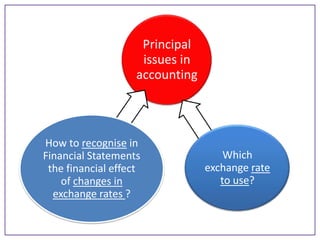
Principal
issues in
accounting

How to recognise in
Financial Statements
the financial effect
of changes in
exchange rates ?

Which
exchange rate
to use?
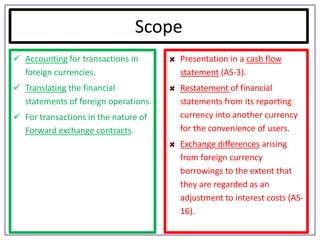
Scope
 Accounting for transactions in
foreign currencies.

Presentation in a cash flow
statement (AS-3).

 Translating the financial
statements of foreign operations.

Restatement of financial
statements from its reporting
currency into another currency
for the convenience of users.

 For transactions in the nature of
Forward exchange contracts.

Exchange differences arising
from foreign currency
borrowings to the extent that
they are regarded as an
adjustment to interest costs (AS16).
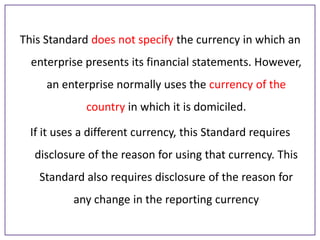
This Standard does not specify the currency in which an
enterprise presents its financial statements. However,
an enterprise normally uses the currency of the

country in which it is domiciled.
If it uses a different currency, this Standard requires

disclosure of the reason for using that currency. This
Standard also requires disclosure of the reason for
any change in the reporting currency
Some Important Terms...
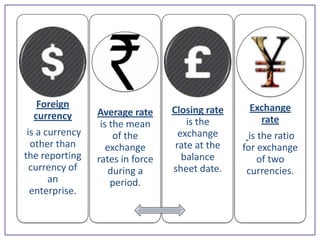
Foreign
currency
is a currency
other than
the reporting
currency of
an
enterprise.

Average rate
is the mean
of the
exchange
rates in force
during a
period.

Closing rate
is the
exchange
rate at the
balance
sheet date.

Exchange
rate
is the ratio
for exchange
of two
currencies.
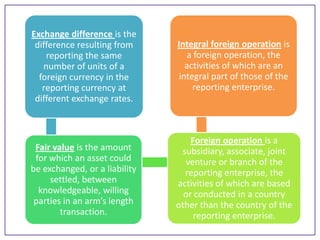
Exchange difference is the
difference resulting from
reporting the same
number of units of a
foreign currency in the
reporting currency at
different exchange rates.

Integral foreign operation is
a foreign operation, the
activities of which are an
integral part of those of the
reporting enterprise.

Fair value is the amount
for which an asset could
be exchanged, or a liability
settled, between
knowledgeable, willing
parties in an arm’s length
transaction.

Foreign operation is a
subsidiary, associate, joint
venture or branch of the
reporting enterprise, the
activities of which are based
or conducted in a country
other than the country of the
reporting enterprise.
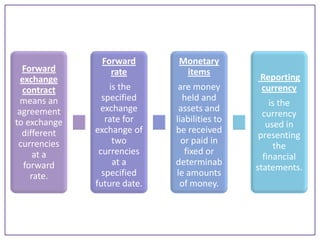
Forward
exchange
contract
means an
agreement
to exchange
different
currencies
at a
forward
rate.

Forward
rate

Monetary
items

is the
specified
exchange
rate for
exchange of
two
currencies
at a
specified
future date.

are money
held and
assets and
liabilities to
be received
or paid in
fixed or
determinab
le amounts
of money.

Reporting
currency

is the
currency
used in
presenting
the
financial
statements.
FOREIGN CURRENCY TRANSACTION
A transaction which is denominated in or requires settlement in a
foreign currency, including transactions arising when an enterprise
either:
 buys or sells goods or services whose price is denominated in a
foreign currency
 borrows or lends funds when the amounts payable or receivable
are denominated in a foreign currency.
 becomes a party to an unperformed forward exchange contract;
or
 otherwise acquires or disposes of assets, or incurs or settles
liabilities, denominated in a foreign currency
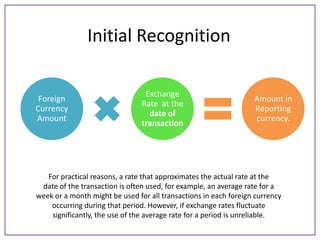
Initial Recognition
Foreign
Currency
Amount

Exchange
Rate at the
date of
transaction

Amount in
Reporting
currency.

For practical reasons, a rate that approximates the actual rate at the
date of the transaction is often used, for example, an average rate for a
week or a month might be used for all transactions in each foreign currency
occurring during that period. However, if exchange rates fluctuate
significantly, the use of the average rate for a period is unreliable.
At Subsequent Balance Sheet Dates
31.03.20XX
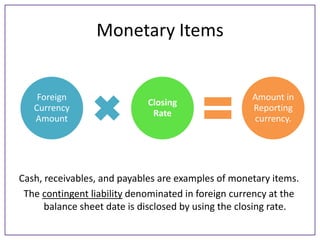
Monetary Items

Foreign
Currency
Amount

Closing
Rate

Amount in
Reporting
currency.

Cash, receivables, and payables are examples of monetary items.
The contingent liability denominated in foreign currency at the
balance sheet date is disclosed by using the closing rate.
However, in certain circumstances, the closing rate may not reflect
with reasonable accuracy the amount in reporting currency that is
likely to be realised from, or required to disburse, a foreign

currency monetary item at the balance sheet date, e.g., where
there are restrictions on remittances or where the closing rate is
unrealistic and it is not possible to effect an exchange of currencies

at that rate at the balance sheet date. In such circumstances, the
relevant monetary item should be reported in the reporting
currency at the amount which is likely to be realised from, or

required to disburse, such item at the balance sheet date.
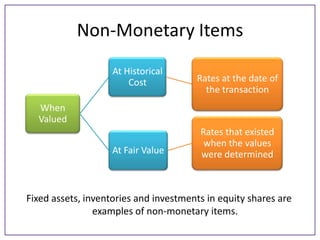
Non-Monetary Items
At Historical
Cost

Rates at the date of
the transaction

When
Valued
At Fair Value

Rates that existed
when the values
were determined

Fixed assets, inventories and investments in equity shares are
examples of non-monetary items.
Recognition of Exchange Differences
Exchange differences arising on settlement of monetary items or
reporting an enterprise’s monetary items , at rates different

from those at which they were initially recorded during the
period, or reported in previous financial statements, should be
recognised as income or as expenses in the perio d in which

they arise, with the exception of exchange differences dealt
with non integral financial operations.
Net Investment in a Non-integral
Foreign Operation
Exchange differences arising on a monetary item that, in substance,
forms part of an enterprise’s net investment in a non-integral
foreign operation should be accumulated in a foreign currency
translation reserve in the enterprise’s financial statements until
the disposal of the net investment, at which time they should be
recognised as income or as expense.
Financial Statements of Foreign
Operations
The method used to translate the financial statements of a foreign operation
depends on the way in which it is financed and operates in relation to the
reporting enterprise.
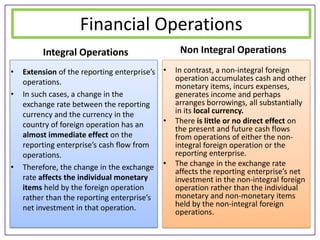
Financial Operations
Integral Operations
•
•

•

Extension of the reporting enterprise’s •
operations.
In such cases, a change in the
exchange rate between the reporting
currency and the currency in the
•
country of foreign operation has an
almost immediate effect on the
reporting enterprise’s cash flow from
operations.
Therefore, the change in the exchange •
rate affects the individual monetary
items held by the foreign operation
rather than the reporting enterprise’s
net investment in that operation.

Non Integral Operations
In contrast, a non-integral foreign
operation accumulates cash and other
monetary items, incurs expenses,
generates income and perhaps
arranges borrowings, all substantially
in its local currency.
There is little or no direct effect on
the present and future cash flows
from operations of either the nonintegral foreign operation or the
reporting enterprise.
The change in the exchange rate
affects the reporting enterprise’s net
investment in the non-integral foreign
operation rather than the individual
monetary and non-monetary items
held by the non-integral foreign
operations.
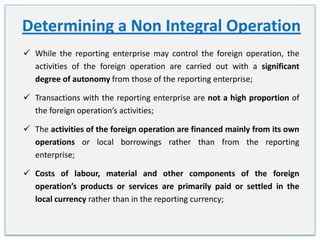
Determining a Non Integral Operation
 While the reporting enterprise may control the foreign operation, the
activities of the foreign operation are carried out with a significant
degree of autonomy from those of the reporting enterprise;
 Transactions with the reporting enterprise are not a high proportion of
the foreign operation’s activities;
 The activities of the foreign operation are financed mainly from its own
operations or local borrowings rather than from the reporting
enterprise;
 Costs of labour, material and other components of the foreign
operation’s products or services are primarily paid or settled in the
local currency rather than in the reporting currency;
Determining a Non Integral Operation
 The foreign operation’s sales are mainly in currencies other than the
reporting currency;
 Cash flows of the reporting enterprise are insulated from the day-to-day
activities of the foreign operation rather than being directly affected by
the activities of the foreign operation;
 Sales prices for the foreign operation’s products are not primarily
responsive on a short-term basis to changes in exchange rates but are
determined more by local competition or local government regulation;
 There is an active local sales market for the foreign operation’s products,
although there also might be significant amounts of exports.
TRANSLATION

OF
FINANCIAL STATEMENTS
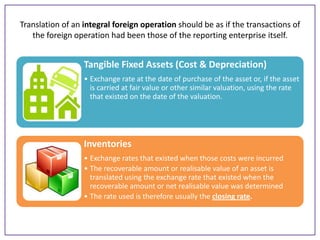
Translation of an integral foreign operation should be as if the transactions of
the foreign operation had been those of the reporting enterprise itself.

Tangible Fixed Assets (Cost & Depreciation)
• Exchange rate at the date of purchase of the asset or, if the asset
is carried at fair value or other similar valuation, using the rate
that existed on the date of the valuation.

Inventories
• Exchange rates that existed when those costs were incurred
• The recoverable amount or realisable value of an asset is
translated using the exchange rate that existed when the
recoverable amount or net realisable value was determined
• The rate used is therefore usually the closing rate.
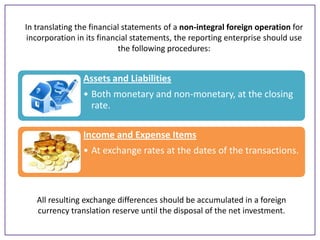
In translating the financial statements of a non-integral foreign operation for
incorporation in its financial statements, the reporting enterprise should use
the following procedures:

Assets and Liabilities
• Both monetary and non-monetary, at the closing
rate.
Income and Expense Items

• At exchange rates at the dates of the transactions.

All resulting exchange differences should be accumulated in a foreign
currency translation reserve until the disposal of the net investment.
Disposal of a Non-integral Foreign
Operation
The cumulative amount of the exchange differences which have
been deferred and which relate to that operation should be
recognised as income or as expenses.
Forward Exchange Contracts
•

In case of a forward exchange contract with regard to a foreign exchange

transaction other than liabilities incurred for acquiring fixed assets:
– Difference between the forward rate and the exchange rate at the date of
the transaction should be recognised as income/expense over the life of
the contract, any profit or loss on cancellation or renewal should be
recognised as income/expense for the period.
– If the forward exchange contract relates to liabilities incurred for
acquiring fixed assets such difference should be adjusted in the carrying
amount of the respective fixed assets
Disclosure
• The amount of exchange differences included in the net profit or
loss for the period; and
• net exchange differences accumulated in foreign currency
translation reserve as a separate component of shareholders’
funds, and a reconciliation of the amount of such exchange
differences at the beginning and end of the period.
When There Is A Change In The Classification Of A Significant Foreign

Operation, An Enterprise Should Disclose:
(a) the nature of the change in classification;
(b) the reason for the change;
(c) the impact of the change in classification on shareholders’ funds;
(d) the impact on net profit or loss for each prior period presented
had the change in classification occurred at the beginning of
the earliest period presented.
* The effect on foreign currency monetary items or on the financial
statements of a foreign operation of a change in exchange rates
occurring after the balance sheet date is disclosed in accordance with
AS 4, Contingencies and Events Occurring After the Balance Sheet Date.

* Disclosure is also encouraged of an enterprise’s foreign currency

risk management policy.
Gains and losses on foreign currency transactions and exchange
differences arising on the translation of the financial statements of
foreign operations may have associated tax effects which are
accounted for in accordance with AS 22, Accounting for Taxes on
Income.
Accounting standard (AS - 11)

Accounting standard (AS - 11)

  • 1.
    Accounting Standard -AS 11 The Effects of Changes in Foreign Exchange Rates
  • 2.
  • 3.
    Enterprises carrying onActivities involving Foreign Exchange Transactions in Foreign Currencies ($) Foreign Operations to Translation of $ into the Enterprise’s Reporting Currency To Include in the Financial Statements of Enterprise
  • 4.
    Principal issues in accounting How torecognise in Financial Statements the financial effect of changes in exchange rates ? Which exchange rate to use?
  • 5.
    Scope  Accounting fortransactions in foreign currencies. Presentation in a cash flow statement (AS-3).  Translating the financial statements of foreign operations. Restatement of financial statements from its reporting currency into another currency for the convenience of users.  For transactions in the nature of Forward exchange contracts. Exchange differences arising from foreign currency borrowings to the extent that they are regarded as an adjustment to interest costs (AS16).
  • 6.
    This Standard doesnot specify the currency in which an enterprise presents its financial statements. However, an enterprise normally uses the currency of the country in which it is domiciled. If it uses a different currency, this Standard requires disclosure of the reason for using that currency. This Standard also requires disclosure of the reason for any change in the reporting currency
  • 7.
  • 8.
    Foreign currency is a currency otherthan the reporting currency of an enterprise. Average rate is the mean of the exchange rates in force during a period. Closing rate is the exchange rate at the balance sheet date. Exchange rate is the ratio for exchange of two currencies.
  • 9.
    Exchange difference isthe difference resulting from reporting the same number of units of a foreign currency in the reporting currency at different exchange rates. Integral foreign operation is a foreign operation, the activities of which are an integral part of those of the reporting enterprise. Fair value is the amount for which an asset could be exchanged, or a liability settled, between knowledgeable, willing parties in an arm’s length transaction. Foreign operation is a subsidiary, associate, joint venture or branch of the reporting enterprise, the activities of which are based or conducted in a country other than the country of the reporting enterprise.
  • 10.
    Forward exchange contract means an agreement to exchange different currencies ata forward rate. Forward rate Monetary items is the specified exchange rate for exchange of two currencies at a specified future date. are money held and assets and liabilities to be received or paid in fixed or determinab le amounts of money. Reporting currency is the currency used in presenting the financial statements.
  • 11.
    FOREIGN CURRENCY TRANSACTION Atransaction which is denominated in or requires settlement in a foreign currency, including transactions arising when an enterprise either:  buys or sells goods or services whose price is denominated in a foreign currency  borrows or lends funds when the amounts payable or receivable are denominated in a foreign currency.  becomes a party to an unperformed forward exchange contract; or  otherwise acquires or disposes of assets, or incurs or settles liabilities, denominated in a foreign currency
  • 12.
    Initial Recognition Foreign Currency Amount Exchange Rate atthe date of transaction Amount in Reporting currency. For practical reasons, a rate that approximates the actual rate at the date of the transaction is often used, for example, an average rate for a week or a month might be used for all transactions in each foreign currency occurring during that period. However, if exchange rates fluctuate significantly, the use of the average rate for a period is unreliable.
  • 13.
    At Subsequent BalanceSheet Dates 31.03.20XX
  • 14.
    Monetary Items Foreign Currency Amount Closing Rate Amount in Reporting currency. Cash,receivables, and payables are examples of monetary items. The contingent liability denominated in foreign currency at the balance sheet date is disclosed by using the closing rate.
  • 15.
    However, in certaincircumstances, the closing rate may not reflect with reasonable accuracy the amount in reporting currency that is likely to be realised from, or required to disburse, a foreign currency monetary item at the balance sheet date, e.g., where there are restrictions on remittances or where the closing rate is unrealistic and it is not possible to effect an exchange of currencies at that rate at the balance sheet date. In such circumstances, the relevant monetary item should be reported in the reporting currency at the amount which is likely to be realised from, or required to disburse, such item at the balance sheet date.
  • 16.
    Non-Monetary Items At Historical Cost Ratesat the date of the transaction When Valued At Fair Value Rates that existed when the values were determined Fixed assets, inventories and investments in equity shares are examples of non-monetary items.
  • 17.
    Recognition of ExchangeDifferences Exchange differences arising on settlement of monetary items or reporting an enterprise’s monetary items , at rates different from those at which they were initially recorded during the period, or reported in previous financial statements, should be recognised as income or as expenses in the perio d in which they arise, with the exception of exchange differences dealt with non integral financial operations.
  • 18.
    Net Investment ina Non-integral Foreign Operation Exchange differences arising on a monetary item that, in substance, forms part of an enterprise’s net investment in a non-integral foreign operation should be accumulated in a foreign currency translation reserve in the enterprise’s financial statements until the disposal of the net investment, at which time they should be recognised as income or as expense.
  • 19.
    Financial Statements ofForeign Operations The method used to translate the financial statements of a foreign operation depends on the way in which it is financed and operates in relation to the reporting enterprise.
  • 20.
    Financial Operations Integral Operations • • • Extensionof the reporting enterprise’s • operations. In such cases, a change in the exchange rate between the reporting currency and the currency in the • country of foreign operation has an almost immediate effect on the reporting enterprise’s cash flow from operations. Therefore, the change in the exchange • rate affects the individual monetary items held by the foreign operation rather than the reporting enterprise’s net investment in that operation. Non Integral Operations In contrast, a non-integral foreign operation accumulates cash and other monetary items, incurs expenses, generates income and perhaps arranges borrowings, all substantially in its local currency. There is little or no direct effect on the present and future cash flows from operations of either the nonintegral foreign operation or the reporting enterprise. The change in the exchange rate affects the reporting enterprise’s net investment in the non-integral foreign operation rather than the individual monetary and non-monetary items held by the non-integral foreign operations.
  • 21.
    Determining a NonIntegral Operation  While the reporting enterprise may control the foreign operation, the activities of the foreign operation are carried out with a significant degree of autonomy from those of the reporting enterprise;  Transactions with the reporting enterprise are not a high proportion of the foreign operation’s activities;  The activities of the foreign operation are financed mainly from its own operations or local borrowings rather than from the reporting enterprise;  Costs of labour, material and other components of the foreign operation’s products or services are primarily paid or settled in the local currency rather than in the reporting currency;
  • 22.
    Determining a NonIntegral Operation  The foreign operation’s sales are mainly in currencies other than the reporting currency;  Cash flows of the reporting enterprise are insulated from the day-to-day activities of the foreign operation rather than being directly affected by the activities of the foreign operation;  Sales prices for the foreign operation’s products are not primarily responsive on a short-term basis to changes in exchange rates but are determined more by local competition or local government regulation;  There is an active local sales market for the foreign operation’s products, although there also might be significant amounts of exports.
  • 23.
  • 24.
    Translation of anintegral foreign operation should be as if the transactions of the foreign operation had been those of the reporting enterprise itself. Tangible Fixed Assets (Cost & Depreciation) • Exchange rate at the date of purchase of the asset or, if the asset is carried at fair value or other similar valuation, using the rate that existed on the date of the valuation. Inventories • Exchange rates that existed when those costs were incurred • The recoverable amount or realisable value of an asset is translated using the exchange rate that existed when the recoverable amount or net realisable value was determined • The rate used is therefore usually the closing rate.
  • 25.
    In translating thefinancial statements of a non-integral foreign operation for incorporation in its financial statements, the reporting enterprise should use the following procedures: Assets and Liabilities • Both monetary and non-monetary, at the closing rate. Income and Expense Items • At exchange rates at the dates of the transactions. All resulting exchange differences should be accumulated in a foreign currency translation reserve until the disposal of the net investment.
  • 26.
    Disposal of aNon-integral Foreign Operation The cumulative amount of the exchange differences which have been deferred and which relate to that operation should be recognised as income or as expenses.
  • 27.
    Forward Exchange Contracts • Incase of a forward exchange contract with regard to a foreign exchange transaction other than liabilities incurred for acquiring fixed assets: – Difference between the forward rate and the exchange rate at the date of the transaction should be recognised as income/expense over the life of the contract, any profit or loss on cancellation or renewal should be recognised as income/expense for the period. – If the forward exchange contract relates to liabilities incurred for acquiring fixed assets such difference should be adjusted in the carrying amount of the respective fixed assets
  • 28.
    Disclosure • The amountof exchange differences included in the net profit or loss for the period; and • net exchange differences accumulated in foreign currency translation reserve as a separate component of shareholders’ funds, and a reconciliation of the amount of such exchange differences at the beginning and end of the period.
  • 29.
    When There IsA Change In The Classification Of A Significant Foreign Operation, An Enterprise Should Disclose: (a) the nature of the change in classification; (b) the reason for the change; (c) the impact of the change in classification on shareholders’ funds; (d) the impact on net profit or loss for each prior period presented had the change in classification occurred at the beginning of the earliest period presented.
  • 30.
    * The effecton foreign currency monetary items or on the financial statements of a foreign operation of a change in exchange rates occurring after the balance sheet date is disclosed in accordance with AS 4, Contingencies and Events Occurring After the Balance Sheet Date. * Disclosure is also encouraged of an enterprise’s foreign currency risk management policy.
  • 31.
    Gains and losseson foreign currency transactions and exchange differences arising on the translation of the financial statements of foreign operations may have associated tax effects which are accounted for in accordance with AS 22, Accounting for Taxes on Income.