Central Banks and Monetary Policy
Central Bank  Apex institution of the monetary system Regulate the functioning of the commercial banks of the country  Promote the financial and economic stability of a country   Regulate credit and money supply in the country
Functions of a Central Bank Note Issuing Agency Banker to the State Bankers Banker Controls Credit Lender of the Last Resort Manages Exchange Rate.
Note Issuing Agency Monopoly over issuing notes in the country Exceptions are One rupee notes Minimum reserve system Maintenance of minimum reserve of gold and foreign exchange securities based on which currency is printed.
Banker to the State Balances of central government kept with RBI No interest payment on this Receives and makes payment on behalf of the government Arranging new loans for central government  Manages public debt Lends to the central government
Banker’s Banker Custodian of the cash reserve of the commercial banks Lender of the last resort As a bank of central clearance, settlement and transfer.
Lender of Last Resort Commercial banks can approach Central Bank for loan in times of emergency Loan issued on the strength of foreign securities or by discounting of bills
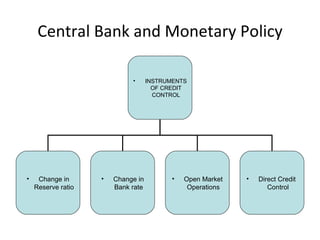
Central Bank and Monetary Policy INSTRUMENTS OF CREDIT CONTROL Change in Reserve ratio Open Market Operations Direct Credit  Control Change in Bank rate
Cash Reserve Ratio The RBI insists that the commercial banks keep a certain proportion(%) of their deposit as  a reserve with the RBI.  This is done to control the money supply in the economy. Depending on the requirement the central bank RBI can increase (or decrease ) the reserve ratio to increase (decrease) the money supply.
Statutory Liquidity Ratio A certain percent of the commercial bank’s deposit should be invested in government bonds and treasury bills. These treasury bills can be discounted in times of emergency. Mechanism for credit control.
Open Market Operations Powerful tool of monetary policy. If the central bank wants to increase the money supply into the financial system it can buy government securities from the open market. Similarly if the central bank wants to reduce the money supply it would sell government security in the open market.
The buyer of the security writes a cheque drawn on his bank( commercial bank) in favour of the central bank. The reserves of the commercial bank is reduced while paying the central bank. Credit creation capacity of the commercial bank is also reduced.
Changing the bank rate: The interest charged by the central bank on the amount given as loan to the commercial bank (for meeting the depositors demand and reserve requirements) is known as bank rate.
The central bank can influence the money supply growth by changing the bank rate from time to time. If the central bank wants to inject more liquidity into the banking system it will lower the bank rate. Commercial banks would borrow more and this would increase the money supply. Exactly opposite would happen if the central bank wants to decrease the money supply (or credit creation) of the economy. It would increase the bank rate.
Direct  Credit Control The central bank can administer the interest rates directly.  Fix the quantity of bank deposit  Direct the allocation of credit.
 

Monetary policy 1 0810

  • 1.
    Central Banks andMonetary Policy
  • 2.
    Central Bank Apex institution of the monetary system Regulate the functioning of the commercial banks of the country Promote the financial and economic stability of a country Regulate credit and money supply in the country
  • 3.
    Functions of aCentral Bank Note Issuing Agency Banker to the State Bankers Banker Controls Credit Lender of the Last Resort Manages Exchange Rate.
  • 4.
    Note Issuing AgencyMonopoly over issuing notes in the country Exceptions are One rupee notes Minimum reserve system Maintenance of minimum reserve of gold and foreign exchange securities based on which currency is printed.
  • 5.
    Banker to theState Balances of central government kept with RBI No interest payment on this Receives and makes payment on behalf of the government Arranging new loans for central government Manages public debt Lends to the central government
  • 6.
    Banker’s Banker Custodianof the cash reserve of the commercial banks Lender of the last resort As a bank of central clearance, settlement and transfer.
  • 7.
    Lender of LastResort Commercial banks can approach Central Bank for loan in times of emergency Loan issued on the strength of foreign securities or by discounting of bills
  • 8.
    Central Bank andMonetary Policy INSTRUMENTS OF CREDIT CONTROL Change in Reserve ratio Open Market Operations Direct Credit Control Change in Bank rate
  • 9.
    Cash Reserve RatioThe RBI insists that the commercial banks keep a certain proportion(%) of their deposit as a reserve with the RBI. This is done to control the money supply in the economy. Depending on the requirement the central bank RBI can increase (or decrease ) the reserve ratio to increase (decrease) the money supply.
  • 10.
    Statutory Liquidity RatioA certain percent of the commercial bank’s deposit should be invested in government bonds and treasury bills. These treasury bills can be discounted in times of emergency. Mechanism for credit control.
  • 11.
    Open Market OperationsPowerful tool of monetary policy. If the central bank wants to increase the money supply into the financial system it can buy government securities from the open market. Similarly if the central bank wants to reduce the money supply it would sell government security in the open market.
  • 12.
    The buyer ofthe security writes a cheque drawn on his bank( commercial bank) in favour of the central bank. The reserves of the commercial bank is reduced while paying the central bank. Credit creation capacity of the commercial bank is also reduced.
  • 13.
    Changing the bankrate: The interest charged by the central bank on the amount given as loan to the commercial bank (for meeting the depositors demand and reserve requirements) is known as bank rate.
  • 14.
    The central bankcan influence the money supply growth by changing the bank rate from time to time. If the central bank wants to inject more liquidity into the banking system it will lower the bank rate. Commercial banks would borrow more and this would increase the money supply. Exactly opposite would happen if the central bank wants to decrease the money supply (or credit creation) of the economy. It would increase the bank rate.
  • 15.
    Direct CreditControl The central bank can administer the interest rates directly. Fix the quantity of bank deposit Direct the allocation of credit.
  • 16.