Understanding
Ind AS
CA PRANAV JOSHI, PARTNER | P. G. JOSHI & CO.
Financial
Instruments
IND AS 32, IND AS 109, IND AS 107
Overview of the Session
3CA Pranav Joshi, Partner | P. G. Joshi & Co., Chartered Accountants
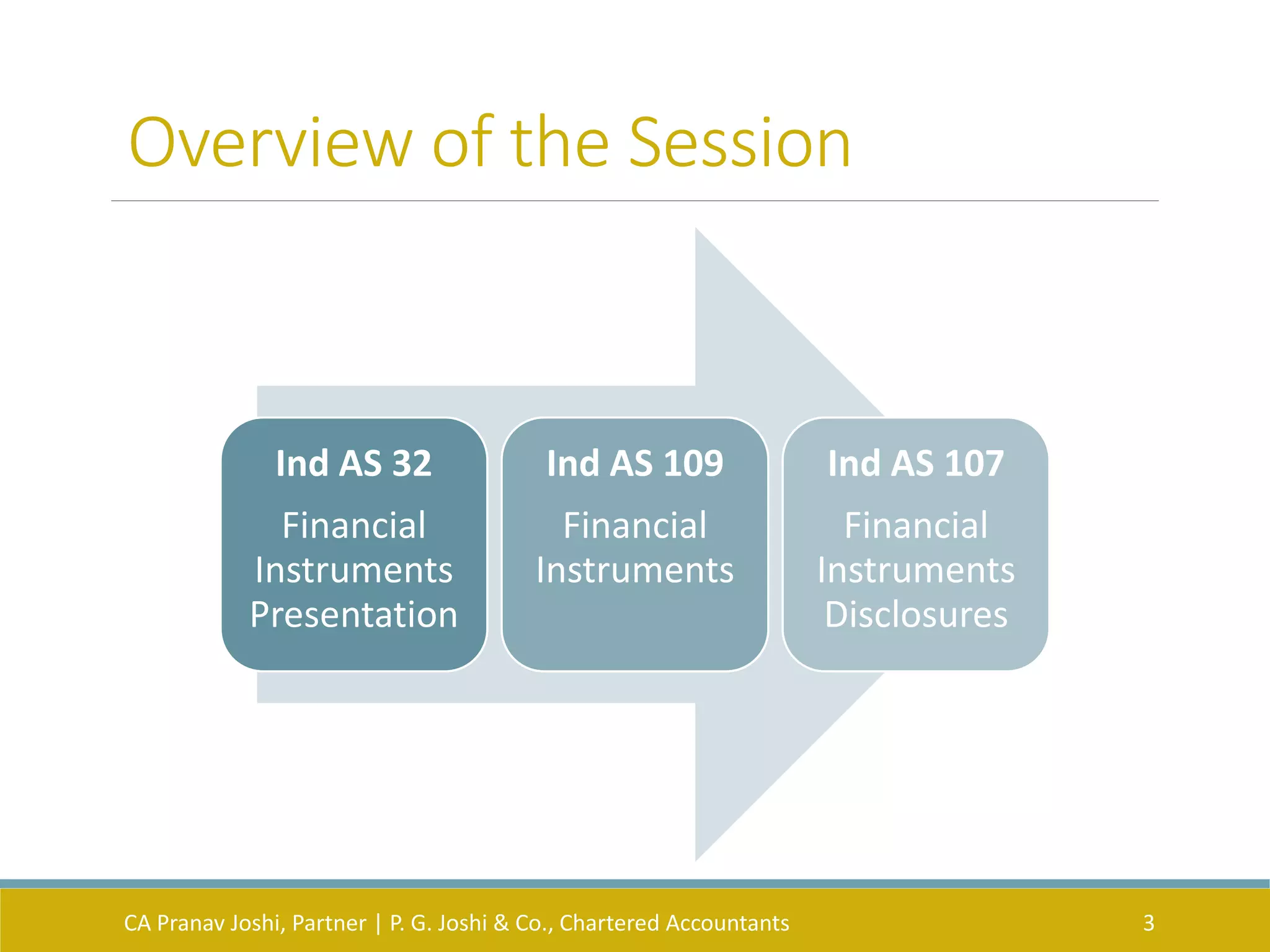
Ind AS 32
Financial
Instruments
Presentation
Ind AS 109
Financial
Instruments
Ind AS 107
Financial
Instruments
Disclosures
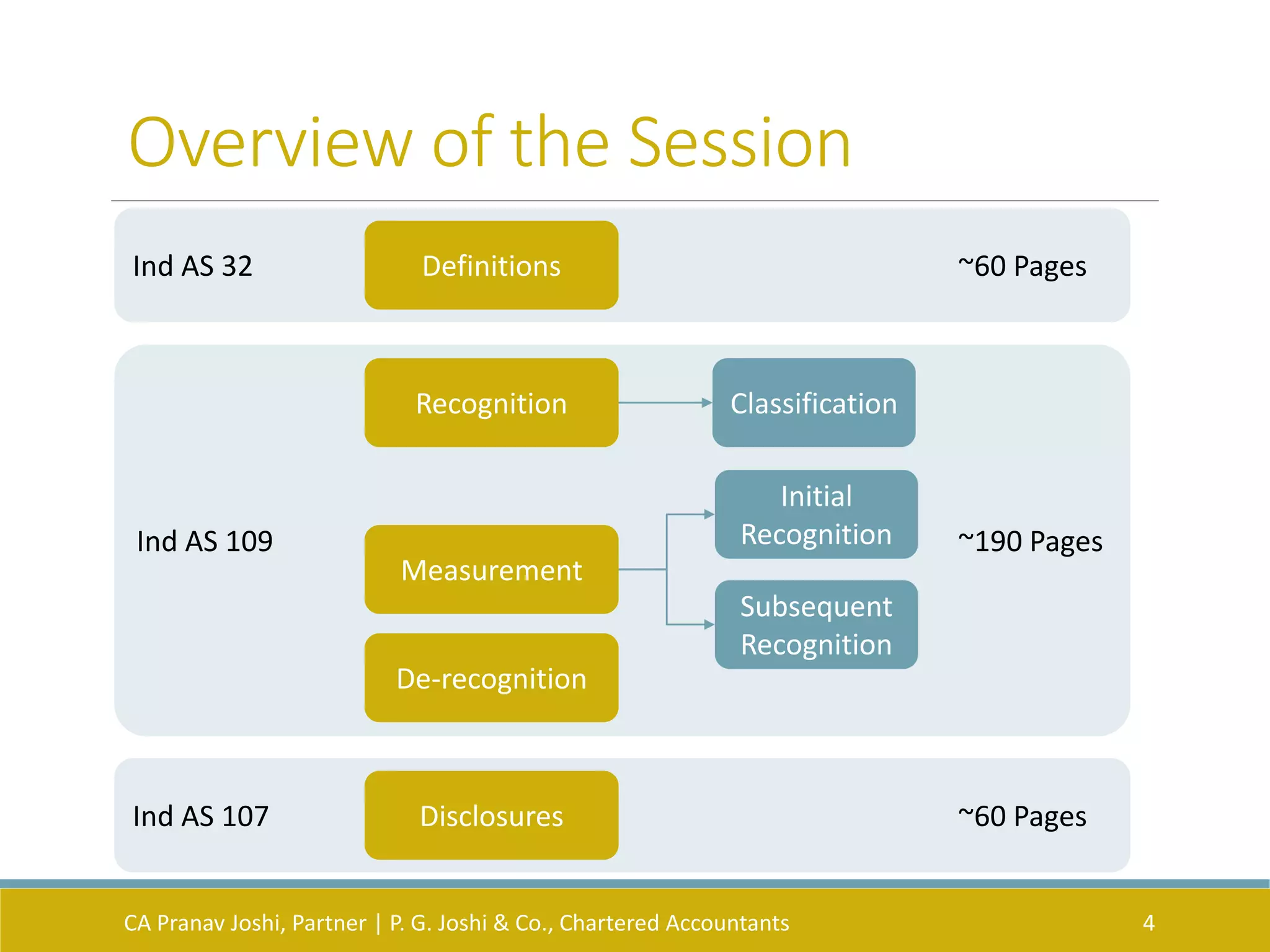
Ind AS 109 ~190 Pages
Ind AS 107 ~60 Pages
Ind AS 32 ~60 Pages
Overview of the Session
Definitions
Recognition
Measurement
De-recognition
Disclosures
Initial
Recognition
Subsequent
Recognition
4CA Pranav Joshi, Partner | P. G. Joshi & Co., Chartered Accountants
Classification
CA Pranav Joshi, Partner | P. G. Joshi & Co., Chartered Accountants
“The presentation covers only the central theme of
the standards on Financial Instruments. Exceptions
to rules are ignored unless relevant to the
discussion and are specifically included in the
presentation.”
5
Ind AS 32
Financial Instruments:
Presentation
DEFINITIONS
6CA Pranav Joshi, Partner | P. G. Joshi & Co., Chartered Accountants
“The objective of this Standard is to establish
principles for presenting financial instruments as
liabilities or equity and for offsetting financial
assets and financial liabilities.”
Objective
7CA Pranav Joshi, Partner | P. G. Joshi & Co., Chartered Accountants
Objective
8CA Pranav Joshi, Partner | P. G. Joshi & Co., Chartered Accountants
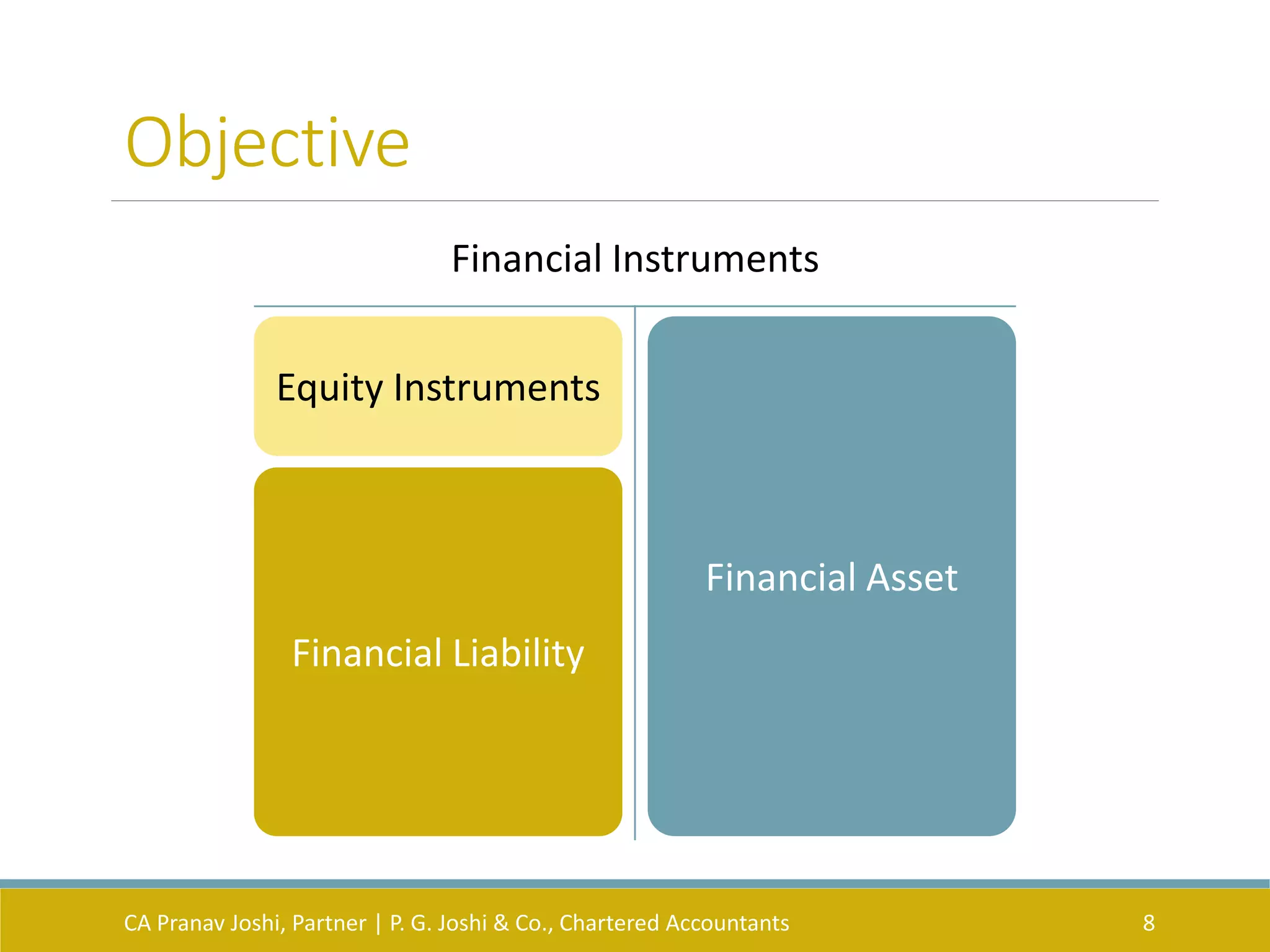
Financial Instruments
Financial Asset
Financial Liability
Equity Instruments
Scope
9CA Pranav Joshi, Partner | P. G. Joshi & Co., Chartered Accountants
This Standard shall be applied by all entities to all
types of financial instruments except:
◦ Share-based payments
◦ Insurance Contracts
◦ Employee benefits & Loan Co
◦ Interest in Subsidiaries, Associates & Joint Ventures
CA Pranav Joshi, Partner | P. G. Joshi & Co., Chartered Accountants
Definitions
10
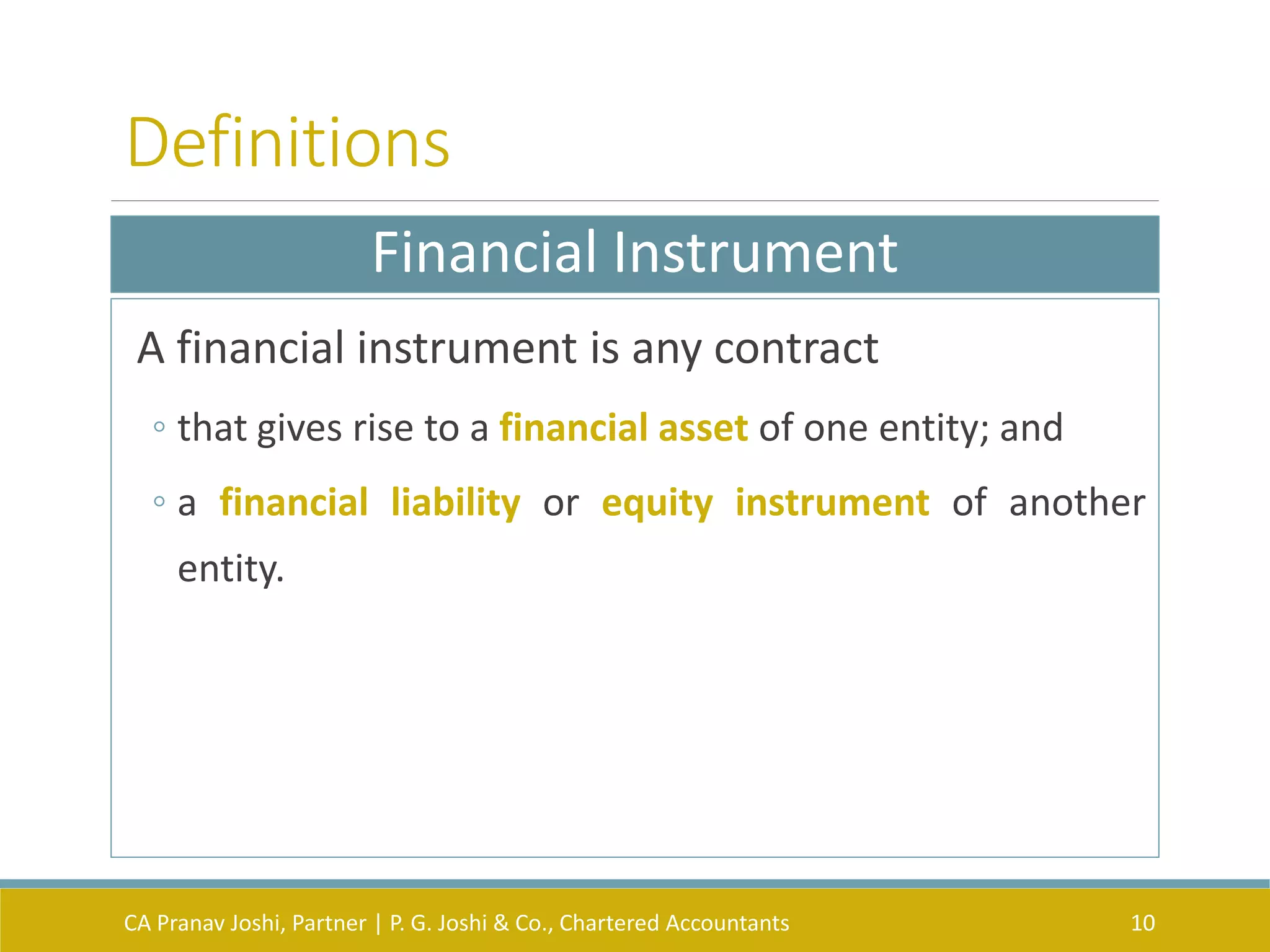
A financial instrument is any contract
◦ that gives rise to a financial asset of one entity; and
◦ a financial liability or equity instrument of another
entity.
Financial Instrument
CA Pranav Joshi, Partner | P. G. Joshi & Co., Chartered Accountants
Definitions
11
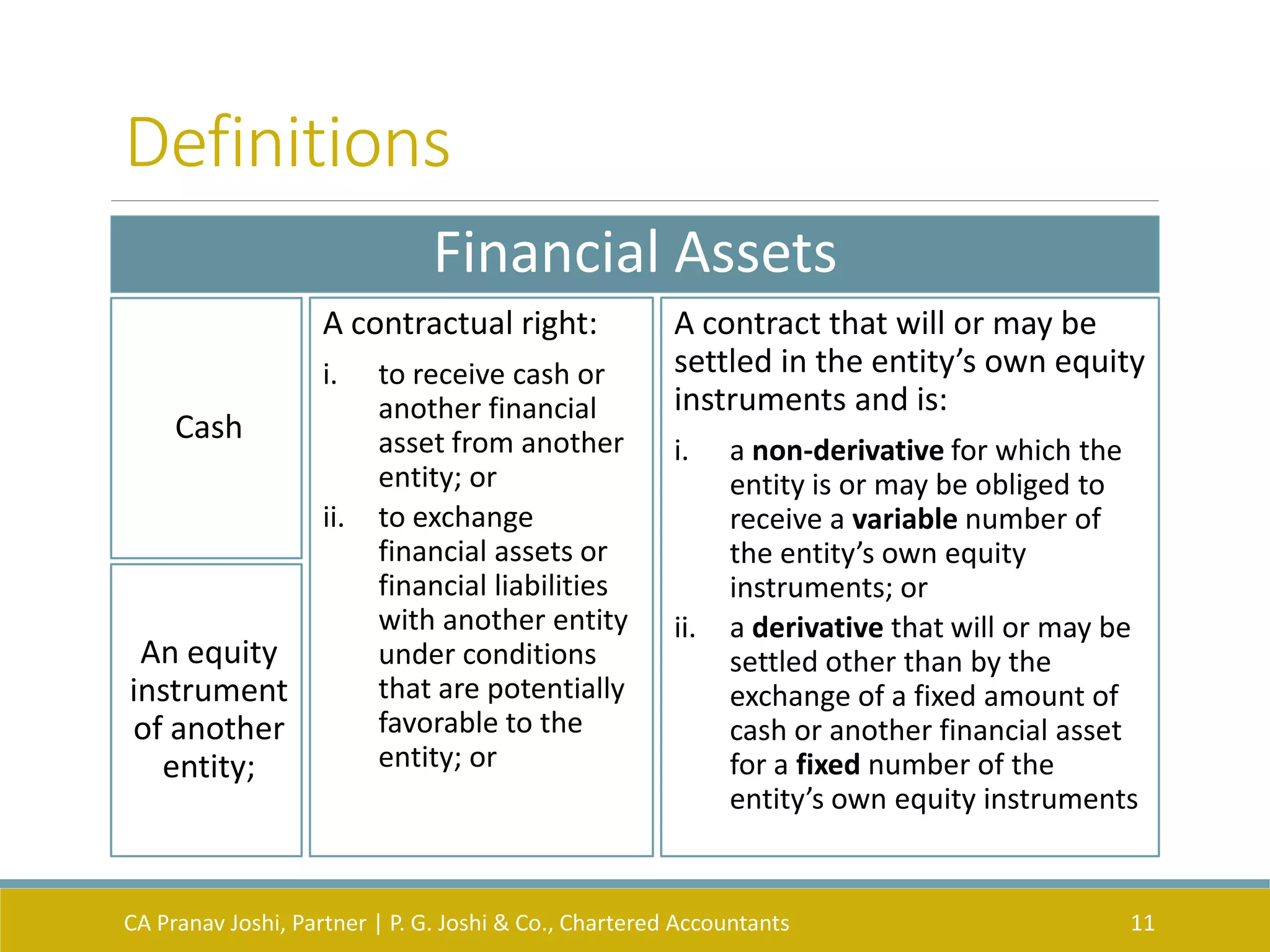
Financial Assets
Cash
An equity
instrument
of another
entity;
A contractual right:
i. to receive cash or
another financial
asset from another
entity; or
ii. to exchange
financial assets or
financial liabilities
with another entity
under conditions
that are potentially
favorable to the
entity; or
A contract that will or may be
settled in the entity’s own equity
instruments and is:
i. a non-derivative for which the
entity is or may be obliged to
receive a variable number of
the entity’s own equity
instruments; or
ii. a derivative that will or may be
settled other than by the
exchange of a fixed amount of
cash or another financial asset
for a fixed number of the
entity’s own equity instruments
CA Pranav Joshi, Partner | P. G. Joshi & Co., Chartered Accountants
Understanding the Definition
12
Cash: Cash is by a definition a Financial Asset. It
includes cash held in foreign currency translated in
to the asset’s functional currency.
An equity instrument of another entity: Equity
Shares of another entity.
◦ If I purchase 100 shares in Microsoft Inc., the investment
would meet the definition of Financial Asset.
CA Pranav Joshi, Partner | P. G. Joshi & Co., Chartered Accountants
Understanding the Definition
13
A contractual right:
to receive cash or another financial asset from
another entity; or
◦ A typical example of such an asset would be trade
receivables as these represent contractual right to receive
cash. Rs. 100
Receivable
Rs. 100
Payable
Financial Asset
CA Pranav Joshi, Partner | P. G. Joshi & Co., Chartered Accountants
Understanding the Definition
14
A contractual right:
to exchange financial assets or financial liabilities
with another entity under conditions that are
potentially favorable to the entity;
◦ An entity holds a contract to buy apples for Rs. 100/kg
while the current selling price/market price of apples is
Rs. 120/kg.
CA Pranav Joshi, Partner | P. G. Joshi & Co., Chartered Accountants
Understanding the Definition
15
A contract that will or may be settled in the entity’s
own equity instruments and is:
◦ a non-derivative for which the entity is or may be obliged
to receive a variable number of the entity’s own equity
instruments; or
◦ A Ltd. takes a Rs. 1 Crore loan from B Ltd. A Ltd. will repay the loan
in 1 year in shares of A Ltd. The number of shares will be
determined by dividing Rs. 1 Crore by the share price in 1 year’s
time i.e. the number of shares to be given is variable.
CA Pranav Joshi, Partner | P. G. Joshi & Co., Chartered Accountants
Definitions
16
Financial Liability
A contractual obligation
i. to deliver cash or another
financial asset to another entity;
or
ii. to exchange financial assets or
financial liabilities with another
entity under conditions that are
potentially unfavorable to the
entity; or
A contract that will or may be
settled in the entity’s own equity
instruments and is:
i. a non-derivative for which the
entity is or may be obliged to
deliver a variable number of the
entity’s own equity instruments;
or
ii. a derivative that will or may be
settled other than by the
exchange of a fixed amount of
cash or another financial asset
for a fixed number of the
entity’s own equity instruments.
CA Pranav Joshi, Partner | P. G. Joshi & Co., Chartered Accountants
Understanding the Definition
17
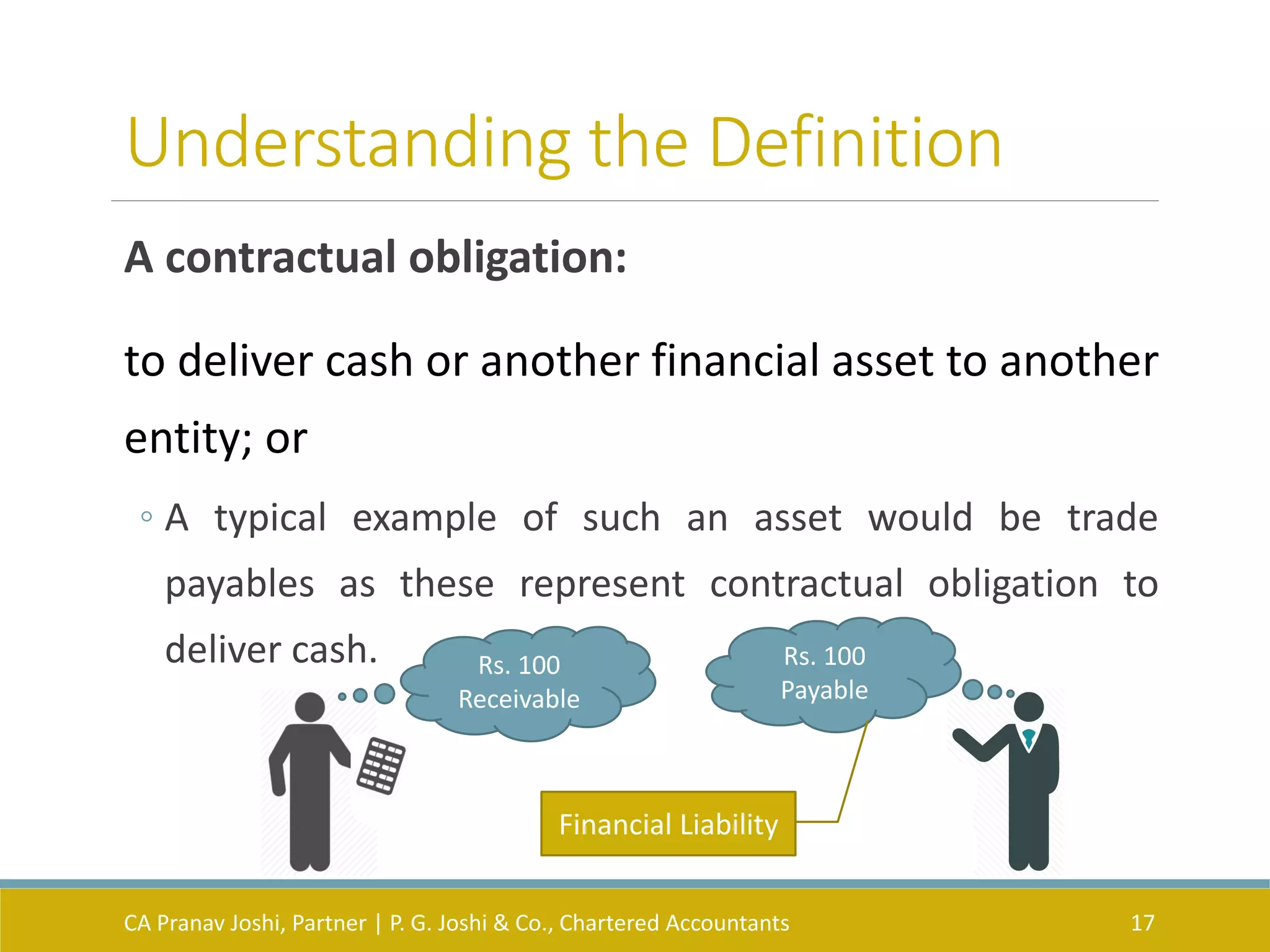
A contractual obligation:
to deliver cash or another financial asset to another
entity; or
◦ A typical example of such an asset would be trade
payables as these represent contractual obligation to
deliver cash. Rs. 100
Receivable
Rs. 100
Payable
Financial Liability
CA Pranav Joshi, Partner | P. G. Joshi & Co., Chartered Accountants
Understanding the Definition
18
A contractual obligation:
to exchange financial assets or financial liabilities
with another entity under conditions that are
potentially unfavorable to the entity;
◦ An entity holds a contract to sell apples for Rs. 100/kg
while the current selling price/market price of apples is
Rs. 120/kg.
CA Pranav Joshi, Partner | P. G. Joshi & Co., Chartered Accountants
Understanding the Definition
19
A contract that will or may be settled in the entity’s
own equity instruments and is:
a non-derivative for which the entity is or may be
obliged to deliver a variable number of the entity’s own
equity instruments; or
◦ A Ltd. takes a Rs. 1 Crore loan from B Ltd. A Ltd. will repay the
loan in 1 year in shares of A Ltd. The number of shares will be
determined by dividing Rs. 1 Crore by the share price in 1
year’s time i.e. the number of shares to be given is variable.
CA Pranav Joshi, Partner | P. G. Joshi & Co., Chartered Accountants
Definitions
20
Equity Instrument
An equity instrument is any contract that
evidences a residual interest in the assets of an
entity after deducting all of its liabilities.
These are instruments which are neither Financial
Assets or Financial Liabilities.
Eg: Ordinary Shares
CA Pranav Joshi, Partner | P. G. Joshi & Co., Chartered Accountants
Puttable Instruments
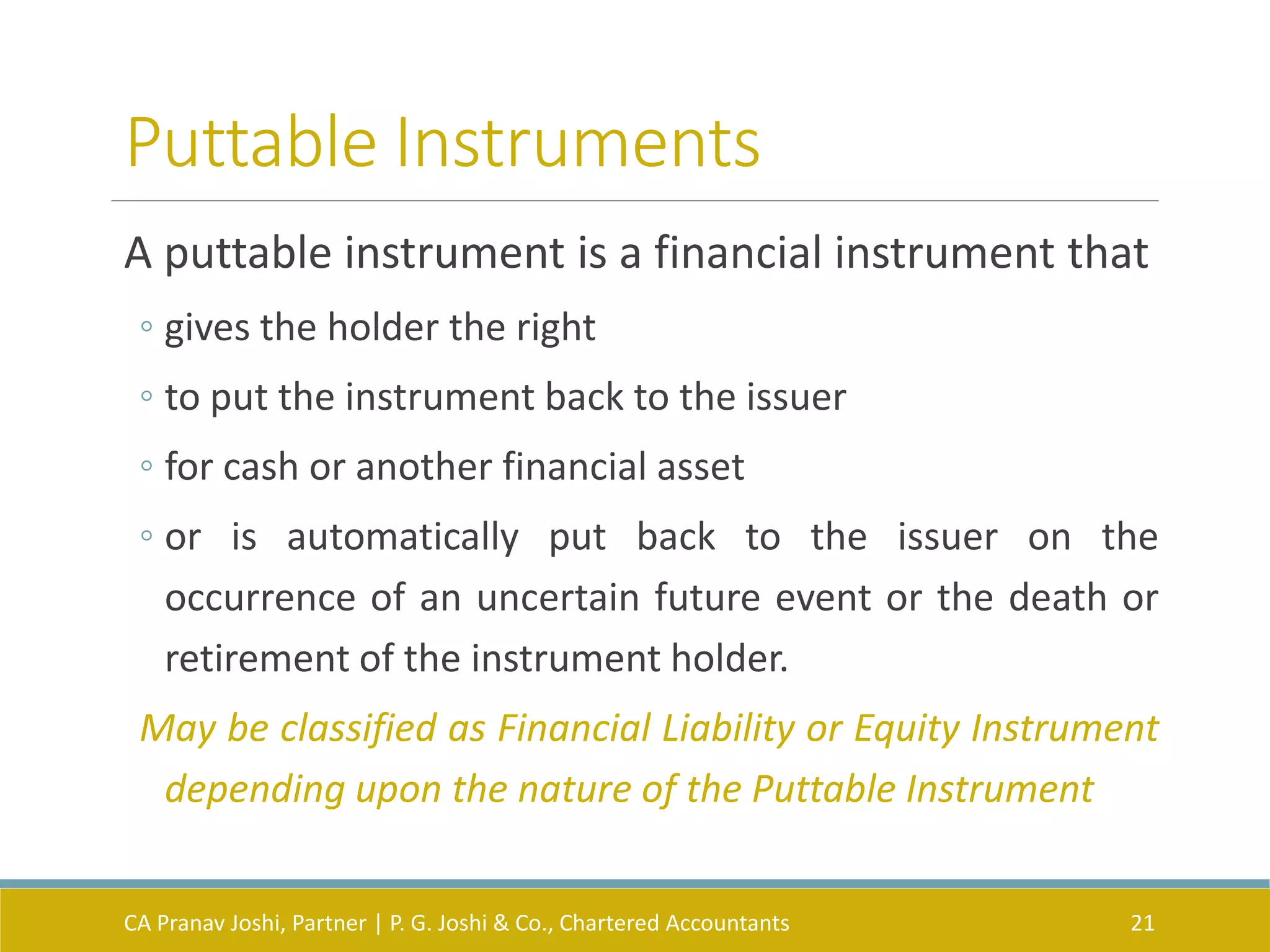
A puttable instrument is a financial instrument that
◦ gives the holder the right
◦ to put the instrument back to the issuer
◦ for cash or another financial asset
◦ or is automatically put back to the issuer on the
occurrence of an uncertain future event or the death or
retirement of the instrument holder.
May be classified as Financial Liability or Equity Instrument
depending upon the nature of the Puttable Instrument
21
CA Pranav Joshi, Partner | P. G. Joshi & Co., Chartered Accountants
Illustration
22
Issuer Purchaser
I want to
Sell it back!
Yes Sir!
$
$
$
$
$
$
$
$
CA Pranav Joshi, Partner | P. G. Joshi & Co., Chartered Accountants
Recap
This standard gives rules for classification of an
Financial Instrument into:
 Financial Asset
 Financial Liability
 Equity Instrument
23
CA Pranav Joshi, Partner | P. G. Joshi & Co., Chartered Accountants
Let’s Classify
24
Borrowings from Bank
Financial
Liability
Obligation to deliver
cash
Bank Deposits
Financial
Asset
Right to receive cash
Equity Shares of Infosys
Financial
Asset
Equity Instrument of
another entity
Forward contract - In the
money
Financial
Asset
Favorable Contract
Preference Shares
redeemable after 3 years
Financial
Liability
Obligation to deliver
cash on redemption
Instrument Classification Explanation
Ind AS 109
Financial Instruments
RECOGNITION, MEASUREMENT
& DE-RECOGNITION
CA Pranav Joshi, Partner | P. G. Joshi & Co., Chartered Accountants 25
CA Pranav Joshi, Partner | P. G. Joshi & Co., Chartered Accountants
Objective
“The objective of this Standard is to establish
principles for the financial reporting of financial
assets and financial liabilities
that will present relevant and useful information to
users of financial statements for their assessment
of the amounts, timing and uncertainty of an
entity’s future cash flows.”
26
CA Pranav Joshi, Partner | P. G. Joshi & Co., Chartered Accountants
Scope
This Standard shall be applied by all entities to all
types of financial instruments except those
specified in the standard (Interests in subsidiaries, associated
and joint ventures, Leasing commitments, Employee benefits, Financial
Instruments resulting in Business Combinations, Insurance Contracts)
“Applicable to all entities but not all financial
instruments”
27
CA Pranav Joshi, Partner | P. G. Joshi & Co., Chartered Accountants
Recognition
An entity shall recognise a financial asset or a
financial liability in its balance sheet when, and
only when, the entity becomes party to the
contractual provisions of the instrument.
◦ Unconditional receivables and payables are recognised as
assets or liabilities when the entity becomes a party to
the contract and, as a consequence, has a legal right to
receive or a legal obligation to pay cash.
28
CA Pranav Joshi, Partner | P. G. Joshi & Co., Chartered Accountants
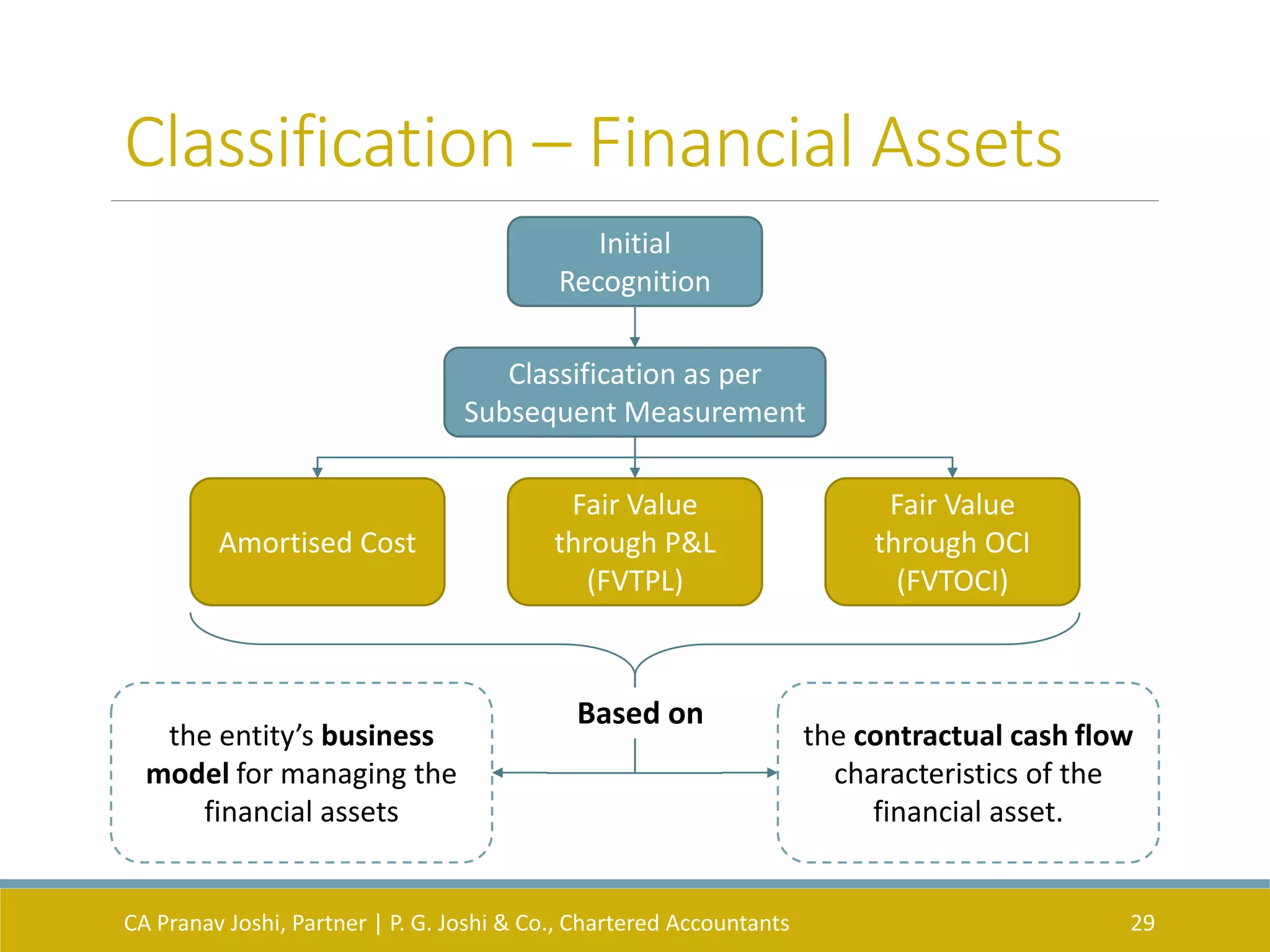
Classification – Financial Assets
29
Initial
Recognition
Classification as per
Subsequent Measurement
Amortised Cost
Fair Value
through P&L
(FVTPL)
Fair Value
through OCI
(FVTOCI)
the entity’s business
model for managing the
financial assets
the contractual cash flow
characteristics of the
financial asset.
Based on
CA Pranav Joshi, Partner | P. G. Joshi & Co., Chartered Accountants
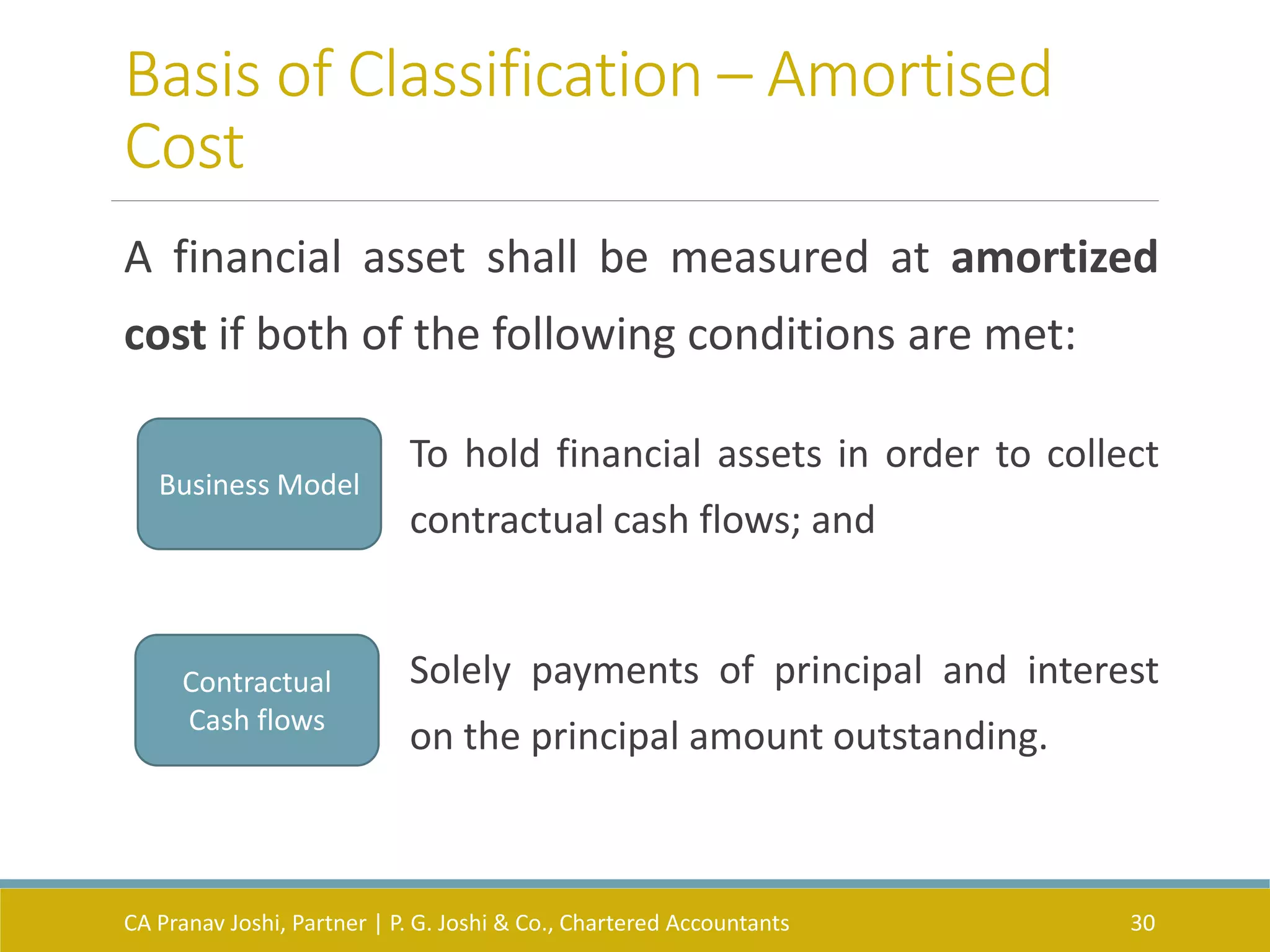
Basis of Classification – Amortised
Cost
A financial asset shall be measured at amortized
cost if both of the following conditions are met:
30
To hold financial assets in order to collect
contractual cash flows; and
Business Model
Contractual
Cash flows
Solely payments of principal and interest
on the principal amount outstanding.
CA Pranav Joshi, Partner | P. G. Joshi & Co., Chartered Accountants
Basis of Classification - FVTOCI
A financial asset shall be measured at Fair Value
Through Other Comprehensive Income if both of
the following conditions are met:
31
Business Model
Contractual
Cash flows
Solely payments of principal and interest
on the principal amount outstanding.
To hold financial assets for collecting
contractual cash flows and selling financial
assets
CA Pranav Joshi, Partner | P. G. Joshi & Co., Chartered Accountants
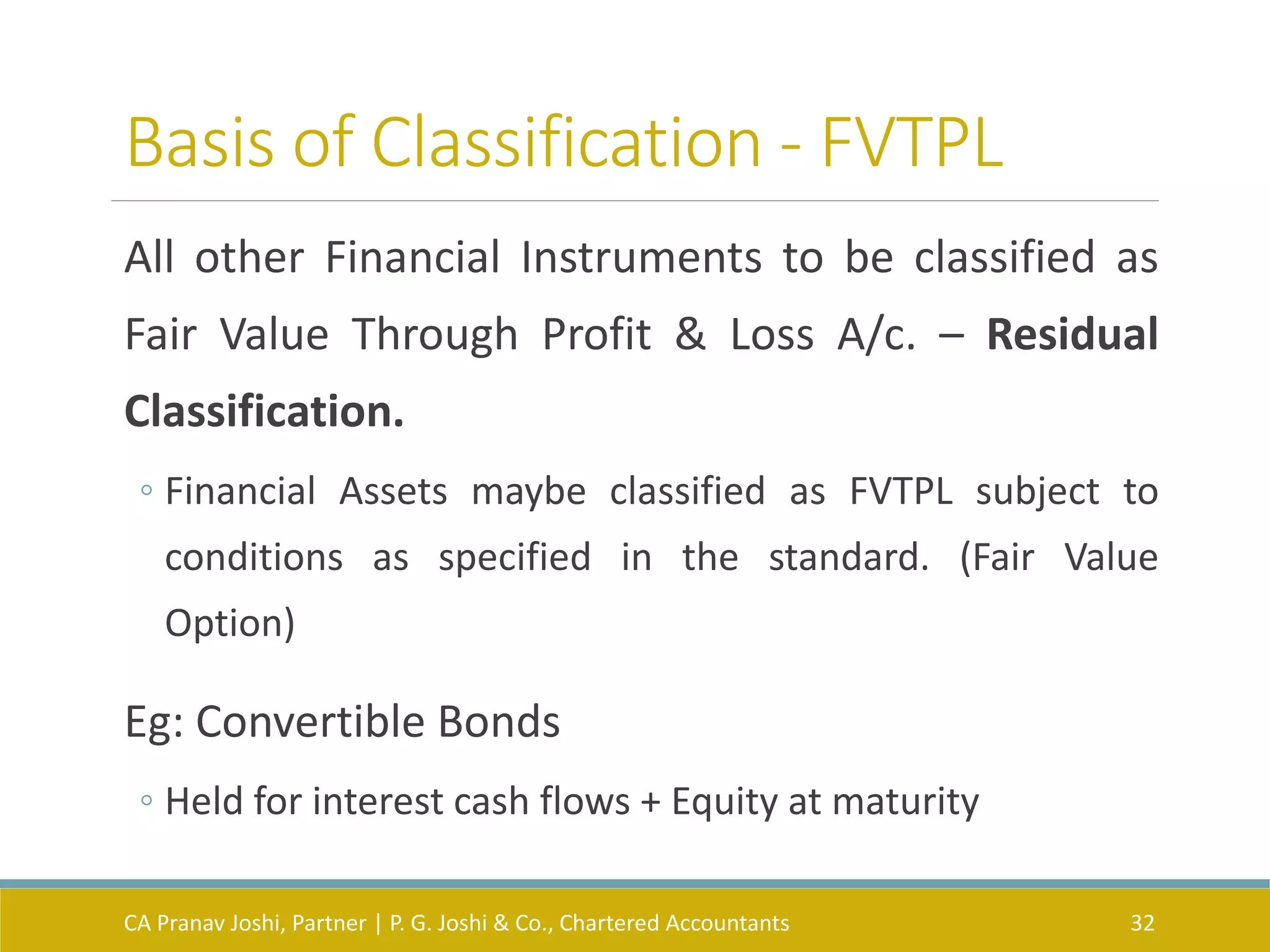
Basis of Classification - FVTPL
All other Financial Instruments to be classified as
Fair Value Through Profit & Loss A/c. – Residual
Classification.
◦ Financial Assets maybe classified as FVTPL subject to
conditions as specified in the standard. (Fair Value
Option)
Eg: Convertible Bonds
◦ Held for interest cash flows + Equity at maturity
32
CA Pranav Joshi, Partner | P. G. Joshi & Co., Chartered Accountants
Q&A
Q - Why do we classify Financial Assets held for Cash
flows and Capital Appreciation as Fair Value through
OCI and as Fair Value through P&L?
A – If the Financial Assets held for sale are with an
entity on the reporting date, any gain/loss by change in
the FV of the Financial Asset is only notional. It is not
actual gain. And thus it is not part of the P&L A/c.
33
Fair Value through OCI
CA Pranav Joshi, Partner | P. G. Joshi & Co., Chartered Accountants
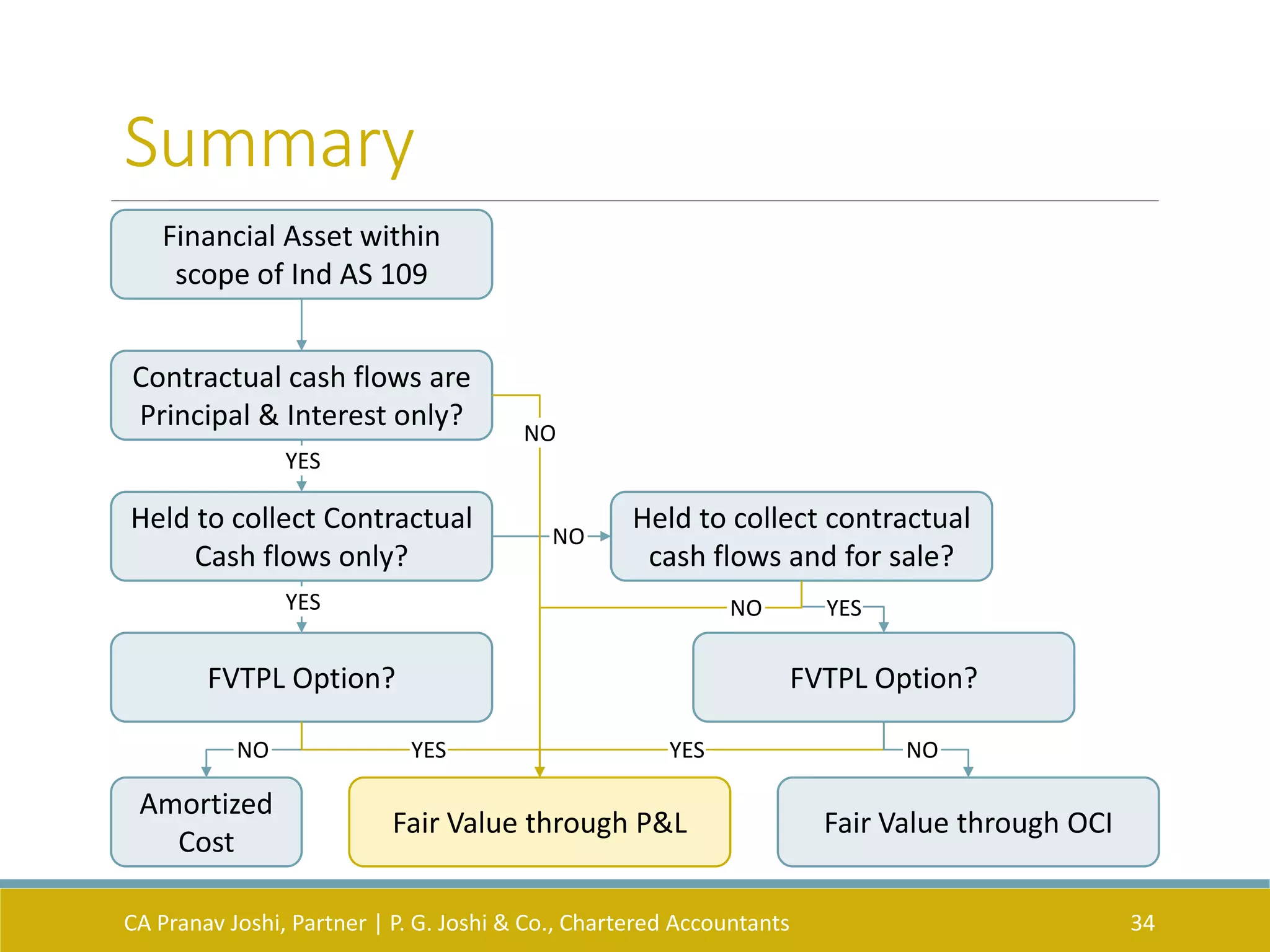
Summary
34
Financial Asset within
scope of Ind AS 109
Contractual cash flows are
Principal & Interest only?
Held to collect Contractual
Cash flows only?
Held to collect contractual
cash flows and for sale?
FVTPL Option?
Amortized
Cost
Fair Value through P&L
NO
NO
NO
NOYES
YES
YES
FVTPL Option?
YES
NO YES
CA Pranav Joshi, Partner | P. G. Joshi & Co., Chartered Accountants
Classification – Financial Liabilities
An entity shall classify all financial liabilities as
subsequently measured at amortized cost except in
case of certain specific exceptions given in the
standard including
◦ If measuring at Fair Value through Profit or Loss results in
more relevant information.
The standard does not talk about measuring
Financial Liabilities at Fair Value through OCI.
35
CA Pranav Joshi, Partner | P. G. Joshi & Co., Chartered Accountants
Reclassification
36
• When, and only when, an entity changes its
business model for managing financial assets.
Financial Assets
• An entity shall not reclassify any financial
liability.
Financial Liabilities
CA Pranav Joshi, Partner | P. G. Joshi & Co., Chartered Accountants
Initial Measurement
At initial recognition, an entity shall measure a
financial asset or financial liability at its Fair Value
plus or minus transaction costs that are directly
attributable to the acquisition or issue of the
financial asset or financial liability.
In the case of a financial asset or financial liability
at fair value through profit or loss, at Fair Value.
37
CA Pranav Joshi, Partner | P. G. Joshi & Co., Chartered Accountants
Subsequent Measurement
After initial recognition, an entity shall measure a
financial asset at:
38
Amortised
Cost
Fair Value
through P&L
Fair Value
through OCI
CA Pranav Joshi, Partner | P. G. Joshi & Co., Chartered Accountants
Derecognition
39
The contractual rights to
the cash flows from the
financial asset expire
 Entity transfers the
financial asset and
 the transfer qualifies for
derecognition
Financial Assets
It is extinguished
(Obligation specified in the contract is
discharged, cancelled or expires)
Financial Liabilities
Ind AS 107
Disclosures
CA Pranav Joshi, Partner | P. G. Joshi & Co., Chartered Accountants 40
CA Pranav Joshi, Partner | P. G. Joshi & Co., Chartered Accountants
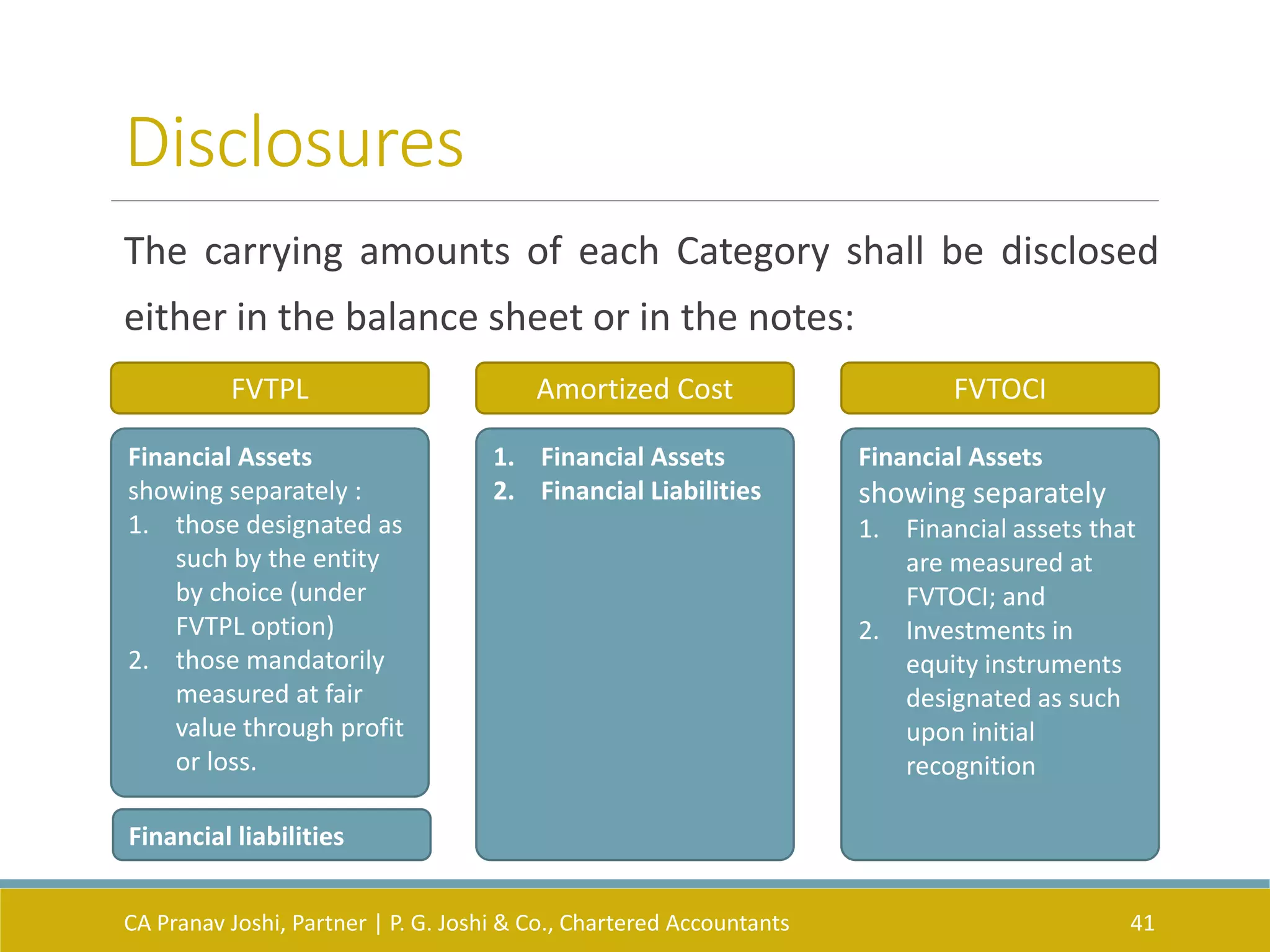
Disclosures
The carrying amounts of each Category shall be disclosed
either in the balance sheet or in the notes:
41
FVTPL Amortized Cost FVTOCI
Financial Assets
showing separately :
1. those designated as
such by the entity
by choice (under
FVTPL option)
2. those mandatorily
measured at fair
value through profit
or loss.
Financial liabilities
1. Financial Assets
2. Financial Liabilities
Financial Assets
showing separately
1. Financial assets that
are measured at
FVTOCI; and
2. Investments in
equity instruments
designated as such
upon initial
recognition
CA Pranav Joshi, Partner | P. G. Joshi & Co., Chartered Accountants
Sections not discussed
Hedge Accounting
Impairment
Accounting of Embedded Derivatives
42
Thank You
CA Pranav Joshi
Partner
P. G. Joshi & Co., Chartered Accountants
www.pgjco.com

Ind AS on Financial Instruments

  • 1.
    Understanding Ind AS CA PRANAVJOSHI, PARTNER | P. G. JOSHI & CO.
  • 2.
    Financial Instruments IND AS 32,IND AS 109, IND AS 107
  • 3.
    Overview of theSession 3CA Pranav Joshi, Partner | P. G. Joshi & Co., Chartered Accountants Ind AS 32 Financial Instruments Presentation Ind AS 109 Financial Instruments Ind AS 107 Financial Instruments Disclosures
  • 4.
    Ind AS 109~190 Pages Ind AS 107 ~60 Pages Ind AS 32 ~60 Pages Overview of the Session Definitions Recognition Measurement De-recognition Disclosures Initial Recognition Subsequent Recognition 4CA Pranav Joshi, Partner | P. G. Joshi & Co., Chartered Accountants Classification
  • 5.
    CA Pranav Joshi,Partner | P. G. Joshi & Co., Chartered Accountants “The presentation covers only the central theme of the standards on Financial Instruments. Exceptions to rules are ignored unless relevant to the discussion and are specifically included in the presentation.” 5
  • 6.
    Ind AS 32 FinancialInstruments: Presentation DEFINITIONS 6CA Pranav Joshi, Partner | P. G. Joshi & Co., Chartered Accountants
  • 7.
    “The objective ofthis Standard is to establish principles for presenting financial instruments as liabilities or equity and for offsetting financial assets and financial liabilities.” Objective 7CA Pranav Joshi, Partner | P. G. Joshi & Co., Chartered Accountants
  • 8.
    Objective 8CA Pranav Joshi,Partner | P. G. Joshi & Co., Chartered Accountants Financial Instruments Financial Asset Financial Liability Equity Instruments
  • 9.
    Scope 9CA Pranav Joshi,Partner | P. G. Joshi & Co., Chartered Accountants This Standard shall be applied by all entities to all types of financial instruments except: ◦ Share-based payments ◦ Insurance Contracts ◦ Employee benefits & Loan Co ◦ Interest in Subsidiaries, Associates & Joint Ventures
  • 10.
    CA Pranav Joshi,Partner | P. G. Joshi & Co., Chartered Accountants Definitions 10 A financial instrument is any contract ◦ that gives rise to a financial asset of one entity; and ◦ a financial liability or equity instrument of another entity. Financial Instrument
  • 11.
    CA Pranav Joshi,Partner | P. G. Joshi & Co., Chartered Accountants Definitions 11 Financial Assets Cash An equity instrument of another entity; A contractual right: i. to receive cash or another financial asset from another entity; or ii. to exchange financial assets or financial liabilities with another entity under conditions that are potentially favorable to the entity; or A contract that will or may be settled in the entity’s own equity instruments and is: i. a non-derivative for which the entity is or may be obliged to receive a variable number of the entity’s own equity instruments; or ii. a derivative that will or may be settled other than by the exchange of a fixed amount of cash or another financial asset for a fixed number of the entity’s own equity instruments
  • 12.
    CA Pranav Joshi,Partner | P. G. Joshi & Co., Chartered Accountants Understanding the Definition 12 Cash: Cash is by a definition a Financial Asset. It includes cash held in foreign currency translated in to the asset’s functional currency. An equity instrument of another entity: Equity Shares of another entity. ◦ If I purchase 100 shares in Microsoft Inc., the investment would meet the definition of Financial Asset.
  • 13.
    CA Pranav Joshi,Partner | P. G. Joshi & Co., Chartered Accountants Understanding the Definition 13 A contractual right: to receive cash or another financial asset from another entity; or ◦ A typical example of such an asset would be trade receivables as these represent contractual right to receive cash. Rs. 100 Receivable Rs. 100 Payable Financial Asset
  • 14.
    CA Pranav Joshi,Partner | P. G. Joshi & Co., Chartered Accountants Understanding the Definition 14 A contractual right: to exchange financial assets or financial liabilities with another entity under conditions that are potentially favorable to the entity; ◦ An entity holds a contract to buy apples for Rs. 100/kg while the current selling price/market price of apples is Rs. 120/kg.
  • 15.
    CA Pranav Joshi,Partner | P. G. Joshi & Co., Chartered Accountants Understanding the Definition 15 A contract that will or may be settled in the entity’s own equity instruments and is: ◦ a non-derivative for which the entity is or may be obliged to receive a variable number of the entity’s own equity instruments; or ◦ A Ltd. takes a Rs. 1 Crore loan from B Ltd. A Ltd. will repay the loan in 1 year in shares of A Ltd. The number of shares will be determined by dividing Rs. 1 Crore by the share price in 1 year’s time i.e. the number of shares to be given is variable.
  • 16.
    CA Pranav Joshi,Partner | P. G. Joshi & Co., Chartered Accountants Definitions 16 Financial Liability A contractual obligation i. to deliver cash or another financial asset to another entity; or ii. to exchange financial assets or financial liabilities with another entity under conditions that are potentially unfavorable to the entity; or A contract that will or may be settled in the entity’s own equity instruments and is: i. a non-derivative for which the entity is or may be obliged to deliver a variable number of the entity’s own equity instruments; or ii. a derivative that will or may be settled other than by the exchange of a fixed amount of cash or another financial asset for a fixed number of the entity’s own equity instruments.
  • 17.
    CA Pranav Joshi,Partner | P. G. Joshi & Co., Chartered Accountants Understanding the Definition 17 A contractual obligation: to deliver cash or another financial asset to another entity; or ◦ A typical example of such an asset would be trade payables as these represent contractual obligation to deliver cash. Rs. 100 Receivable Rs. 100 Payable Financial Liability
  • 18.
    CA Pranav Joshi,Partner | P. G. Joshi & Co., Chartered Accountants Understanding the Definition 18 A contractual obligation: to exchange financial assets or financial liabilities with another entity under conditions that are potentially unfavorable to the entity; ◦ An entity holds a contract to sell apples for Rs. 100/kg while the current selling price/market price of apples is Rs. 120/kg.
  • 19.
    CA Pranav Joshi,Partner | P. G. Joshi & Co., Chartered Accountants Understanding the Definition 19 A contract that will or may be settled in the entity’s own equity instruments and is: a non-derivative for which the entity is or may be obliged to deliver a variable number of the entity’s own equity instruments; or ◦ A Ltd. takes a Rs. 1 Crore loan from B Ltd. A Ltd. will repay the loan in 1 year in shares of A Ltd. The number of shares will be determined by dividing Rs. 1 Crore by the share price in 1 year’s time i.e. the number of shares to be given is variable.
  • 20.
    CA Pranav Joshi,Partner | P. G. Joshi & Co., Chartered Accountants Definitions 20 Equity Instrument An equity instrument is any contract that evidences a residual interest in the assets of an entity after deducting all of its liabilities. These are instruments which are neither Financial Assets or Financial Liabilities. Eg: Ordinary Shares
  • 21.
    CA Pranav Joshi,Partner | P. G. Joshi & Co., Chartered Accountants Puttable Instruments A puttable instrument is a financial instrument that ◦ gives the holder the right ◦ to put the instrument back to the issuer ◦ for cash or another financial asset ◦ or is automatically put back to the issuer on the occurrence of an uncertain future event or the death or retirement of the instrument holder. May be classified as Financial Liability or Equity Instrument depending upon the nature of the Puttable Instrument 21
  • 22.
    CA Pranav Joshi,Partner | P. G. Joshi & Co., Chartered Accountants Illustration 22 Issuer Purchaser I want to Sell it back! Yes Sir! $ $ $ $ $ $ $ $
  • 23.
    CA Pranav Joshi,Partner | P. G. Joshi & Co., Chartered Accountants Recap This standard gives rules for classification of an Financial Instrument into:  Financial Asset  Financial Liability  Equity Instrument 23
  • 24.
    CA Pranav Joshi,Partner | P. G. Joshi & Co., Chartered Accountants Let’s Classify 24 Borrowings from Bank Financial Liability Obligation to deliver cash Bank Deposits Financial Asset Right to receive cash Equity Shares of Infosys Financial Asset Equity Instrument of another entity Forward contract - In the money Financial Asset Favorable Contract Preference Shares redeemable after 3 years Financial Liability Obligation to deliver cash on redemption Instrument Classification Explanation
  • 25.
    Ind AS 109 FinancialInstruments RECOGNITION, MEASUREMENT & DE-RECOGNITION CA Pranav Joshi, Partner | P. G. Joshi & Co., Chartered Accountants 25
  • 26.
    CA Pranav Joshi,Partner | P. G. Joshi & Co., Chartered Accountants Objective “The objective of this Standard is to establish principles for the financial reporting of financial assets and financial liabilities that will present relevant and useful information to users of financial statements for their assessment of the amounts, timing and uncertainty of an entity’s future cash flows.” 26
  • 27.
    CA Pranav Joshi,Partner | P. G. Joshi & Co., Chartered Accountants Scope This Standard shall be applied by all entities to all types of financial instruments except those specified in the standard (Interests in subsidiaries, associated and joint ventures, Leasing commitments, Employee benefits, Financial Instruments resulting in Business Combinations, Insurance Contracts) “Applicable to all entities but not all financial instruments” 27
  • 28.
    CA Pranav Joshi,Partner | P. G. Joshi & Co., Chartered Accountants Recognition An entity shall recognise a financial asset or a financial liability in its balance sheet when, and only when, the entity becomes party to the contractual provisions of the instrument. ◦ Unconditional receivables and payables are recognised as assets or liabilities when the entity becomes a party to the contract and, as a consequence, has a legal right to receive or a legal obligation to pay cash. 28
  • 29.
    CA Pranav Joshi,Partner | P. G. Joshi & Co., Chartered Accountants Classification – Financial Assets 29 Initial Recognition Classification as per Subsequent Measurement Amortised Cost Fair Value through P&L (FVTPL) Fair Value through OCI (FVTOCI) the entity’s business model for managing the financial assets the contractual cash flow characteristics of the financial asset. Based on
  • 30.
    CA Pranav Joshi,Partner | P. G. Joshi & Co., Chartered Accountants Basis of Classification – Amortised Cost A financial asset shall be measured at amortized cost if both of the following conditions are met: 30 To hold financial assets in order to collect contractual cash flows; and Business Model Contractual Cash flows Solely payments of principal and interest on the principal amount outstanding.
  • 31.
    CA Pranav Joshi,Partner | P. G. Joshi & Co., Chartered Accountants Basis of Classification - FVTOCI A financial asset shall be measured at Fair Value Through Other Comprehensive Income if both of the following conditions are met: 31 Business Model Contractual Cash flows Solely payments of principal and interest on the principal amount outstanding. To hold financial assets for collecting contractual cash flows and selling financial assets
  • 32.
    CA Pranav Joshi,Partner | P. G. Joshi & Co., Chartered Accountants Basis of Classification - FVTPL All other Financial Instruments to be classified as Fair Value Through Profit & Loss A/c. – Residual Classification. ◦ Financial Assets maybe classified as FVTPL subject to conditions as specified in the standard. (Fair Value Option) Eg: Convertible Bonds ◦ Held for interest cash flows + Equity at maturity 32
  • 33.
    CA Pranav Joshi,Partner | P. G. Joshi & Co., Chartered Accountants Q&A Q - Why do we classify Financial Assets held for Cash flows and Capital Appreciation as Fair Value through OCI and as Fair Value through P&L? A – If the Financial Assets held for sale are with an entity on the reporting date, any gain/loss by change in the FV of the Financial Asset is only notional. It is not actual gain. And thus it is not part of the P&L A/c. 33
  • 34.
    Fair Value throughOCI CA Pranav Joshi, Partner | P. G. Joshi & Co., Chartered Accountants Summary 34 Financial Asset within scope of Ind AS 109 Contractual cash flows are Principal & Interest only? Held to collect Contractual Cash flows only? Held to collect contractual cash flows and for sale? FVTPL Option? Amortized Cost Fair Value through P&L NO NO NO NOYES YES YES FVTPL Option? YES NO YES
  • 35.
    CA Pranav Joshi,Partner | P. G. Joshi & Co., Chartered Accountants Classification – Financial Liabilities An entity shall classify all financial liabilities as subsequently measured at amortized cost except in case of certain specific exceptions given in the standard including ◦ If measuring at Fair Value through Profit or Loss results in more relevant information. The standard does not talk about measuring Financial Liabilities at Fair Value through OCI. 35
  • 36.
    CA Pranav Joshi,Partner | P. G. Joshi & Co., Chartered Accountants Reclassification 36 • When, and only when, an entity changes its business model for managing financial assets. Financial Assets • An entity shall not reclassify any financial liability. Financial Liabilities
  • 37.
    CA Pranav Joshi,Partner | P. G. Joshi & Co., Chartered Accountants Initial Measurement At initial recognition, an entity shall measure a financial asset or financial liability at its Fair Value plus or minus transaction costs that are directly attributable to the acquisition or issue of the financial asset or financial liability. In the case of a financial asset or financial liability at fair value through profit or loss, at Fair Value. 37
  • 38.
    CA Pranav Joshi,Partner | P. G. Joshi & Co., Chartered Accountants Subsequent Measurement After initial recognition, an entity shall measure a financial asset at: 38 Amortised Cost Fair Value through P&L Fair Value through OCI
  • 39.
    CA Pranav Joshi,Partner | P. G. Joshi & Co., Chartered Accountants Derecognition 39 The contractual rights to the cash flows from the financial asset expire  Entity transfers the financial asset and  the transfer qualifies for derecognition Financial Assets It is extinguished (Obligation specified in the contract is discharged, cancelled or expires) Financial Liabilities
  • 40.
    Ind AS 107 Disclosures CAPranav Joshi, Partner | P. G. Joshi & Co., Chartered Accountants 40
  • 41.
    CA Pranav Joshi,Partner | P. G. Joshi & Co., Chartered Accountants Disclosures The carrying amounts of each Category shall be disclosed either in the balance sheet or in the notes: 41 FVTPL Amortized Cost FVTOCI Financial Assets showing separately : 1. those designated as such by the entity by choice (under FVTPL option) 2. those mandatorily measured at fair value through profit or loss. Financial liabilities 1. Financial Assets 2. Financial Liabilities Financial Assets showing separately 1. Financial assets that are measured at FVTOCI; and 2. Investments in equity instruments designated as such upon initial recognition
  • 42.
    CA Pranav Joshi,Partner | P. G. Joshi & Co., Chartered Accountants Sections not discussed Hedge Accounting Impairment Accounting of Embedded Derivatives 42
  • 43.
    Thank You CA PranavJoshi Partner P. G. Joshi & Co., Chartered Accountants www.pgjco.com