Prepared by Nitin S Poojary
1
Prepared by Nitin S. Poojary
Agenda
 Objective and Scope
 Key Definitions
 Disclosures
 Ind AS v/s AS
 Assets should be carried at no more than their
recoverable amount, i.e. the amount expected
to be recovered through use of the asset, or its
fair value less cost to sale.
 Specify procedures to be followed to ensure
that assets are not carried at more than
recoverable amount
 Specify when an impairment loss should be
reversed.
 Specify required disclosures.
 Applies to all assets except
 Inventories (Ind AS 2)
 Assets arising from construction contracts (Ind AS 11)
 Deferred tax assets (Ind AS 12)
 Financial assets (Ind AS 107)
 Assets arising from employee benefits (Ind AS 102)
 Investment property measured at fair value (Ind AS 40)
 Biological assets measured at fair value less estimated point-of
sale costs(Ind AS 41)
 Assets arising from insurance contracts (Ind AS 104)
 Non-current assets classified as held for sale (Ind AS 105)
 Applicable to impairment of financial assets like
subsidiaries, associates, joint ventures
Agenda
 Objective and Scope
 Key Terms
 Disclosures
 Ind AS v/s AS
 ILGIC Impact
 Impairment Loss
 Recoverable Amount
 Carrying Amount
 Fair Value less cost to sell
 Value in Use
 Cash Generating unit
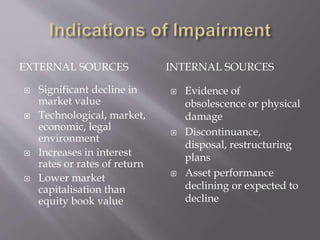
EXTERNAL SOURCES INTERNAL SOURCES
 Significant decline in
market value
 Technological, market,
economic, legal
environment
 Increases in interest
rates or rates of return
 Lower market
capitalisation than
equity book value
 Evidence of
obsolescence or physical
damage
 Discontinuance,
disposal, restructuring
plans
 Asset performance
declining or expected to
decline
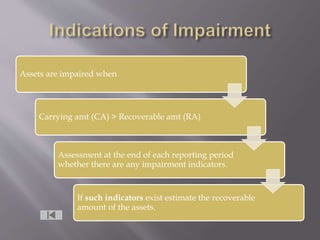
Assets are impaired when
Carrying amt (CA) > Recoverable amt (RA)
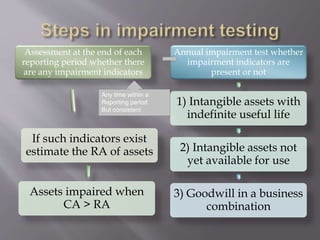
Assessment at the end of each reporting period
whether there are any impairment indicators.
If such indicators exist estimate the recoverable
amount of the assets.
Assessment at the end of each
reporting period whether there
are any impairment indicators
If such indicators exist
estimate the RA of assets
Assets impaired when
CA > RA
Annual impairment test whether
impairment indicators are
present or not
1) Intangible assets with
indefinite useful life
2) Intangible assets not
yet available for use
3) Goodwill in a business
combination
Any time within a
Reporting period
But consistent
Recoverable
amt = greater
of following
Value in use [VIU] = PV of
estimated future cash flows to
be derived from an asset/ CGU
continuing use & ultimate
disposal
Fair value less cost of sell =
(FVLCS) = Amt obtainable from
the sale of asset/ CGU in an
arm’s length transaction less of
costs of disposals
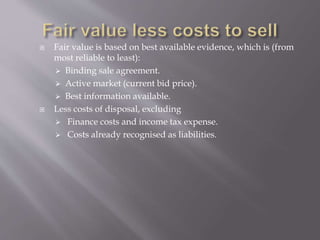
 Fair value is based on best available evidence, which is (from
most reliable to least):
 Binding sale agreement.
 Active market (current bid price).
 Best information available.
 Less costs of disposal, excluding
 Finance costs and income tax expense.
 Costs already recognised as liabilities.
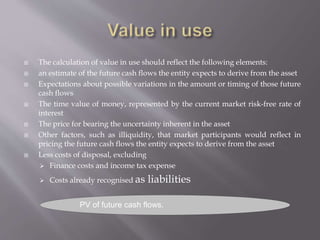
 The calculation of value in use should reflect the following elements:
 an estimate of the future cash flows the entity expects to derive from the asset
 Expectations about possible variations in the amount or timing of those future
cash flows
 The time value of money, represented by the current market risk-free rate of
interest
 The price for bearing the uncertainty inherent in the asset
 Other factors, such as illiquidity, that market participants would reflect in
pricing the future cash flows the entity expects to derive from the asset
 Less costs of disposal, excluding
 Finance costs and income tax expense
 Costs already recognised as liabilities
PV of future cash flows.
Cash generating Unit
[CGU]
Smallest identifiable
group of assets.
That generates cash inflows
Largely
independent
from other
[groups of
assets]
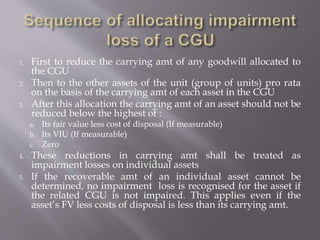
1. First to reduce the carrying amt of any goodwill allocated to
the CGU
2. Then to the other assets of the unit (group of units) pro rata
on the basis of the carrying amt of each asset in the CGU
3. After this allocation the carrying amt of an asset should not be
reduced below the highest of :
a. Its fair value less cost of disposal (If measurable)
b. Its VIU (If measurable)
c. Zero
4. These reductions in carrying amt shall be treated as
impairment losses on individual assets
5. If the recoverable amt of an individual asset cannot be
determined, no impairment loss is recognised for the asset if
the related CGU is not impaired. This applies even if the
asset’s FV less costs of disposal is less than its carrying amt.
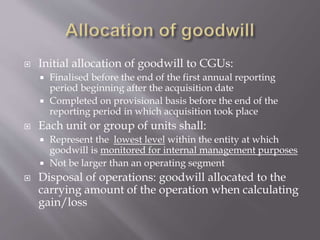
 Initial allocation of goodwill to CGUs:
 Finalised before the end of the first annual reporting
period beginning after the acquisition date
 Completed on provisional basis before the end of the
reporting period in which acquisition took place
 Each unit or group of units shall:
 Represent the lowest level within the entity at which
goodwill is monitored for internal management purposes
 Not be larger than an operating segment
 Disposal of operations: goodwill allocated to the
carrying amount of the operation when calculating
gain/loss
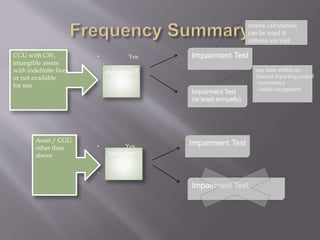
 Yes
 No
 Yes
 No
CGU with GW,
intangible assets
with indefinite lives
or not available
for use
Asset / CGU
other than
above
Indication ?
Indication ?
Impairment Test
Impairment Test
(at least annually)
Impairment Test
Impairment Test
recent calculation
can be used if
criteria are met
any time within an
Annual reporting period
- consistency
- Initial recognition
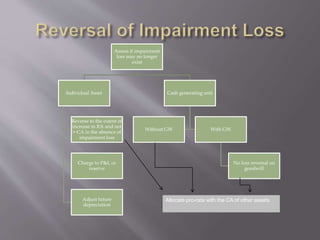
Assess if impairment
loss may no longer
exist
Individual Asset
Reverse to the extent of
increase in RA and not
> CA in the absence of
impairment loss
Charge to P&L or
reserve
Adjust future
depreciation
Cash generating unit
Without GW With GW
No loss reversal on
goodwill
Allocate pro-rata with the CA of other assets
Agenda
 Objective and Scope
 Key Terms
 Disclosures
 Ind AS v/s AS
 ILGIC Impact
 Amount of impairment losses recognised /
reversed during the period in
 Income statement and
 Directly to equity
 If recognised in income statement disclosure of
where items are included
 Segment reporting information
 By category of asset
 Disclosures when impairment losses are material for an
individual asset
 Information on basis used for determining recoverable
amount
 Discount rate used.
Agenda
 Objective and Scope
 Key Terms
 Disclosures
 Ind AS v/s AS
 ILGIC Impact
 Reversal of Impairment Loss on Goodwill
 Reversal of impairment loss on goodwill is not permitted under
IND AS36.
 AS28 requires reversal of impairment loss on goodwill when
impairment loss was caused by a specific external event of
exceptional nature that is not expected to recur and subsequent
external events have occurred that reverse the effect of that
event
 Applicability to Discontinued Operations –
Impairment
 IND AS36 is not applicable to impairment on assets under
discontinuing operations which is covered under IAS 105 -
Non-current Assets Held for Sale and Discontinued Operations.
 AS-28 includes section on impairment in case of Discontinuing
Operations
 Impairment loss allocation
 Under IND AS36, impairment loss is first allocated to goodwill in a
cash-generating unit with balance allocated over other assets pro-
rata.
 Under AS28, for allocation of goodwill to a cash-generating unit,
bottom-up and then top-down test performed leading to
differences in measurement.
 Acquired & Internally generated intangibles
 Under IND AS36, irrespective of an indication of impairment,
annual impairment reviews are required for intangible assets with
indefinite useful lives and for assets not yet ready to use as well as
goodwill acquired in a business combination.
 Under AS28, annual impairment review is required for intangible
assets amortized over ten years from the date when the asset is
available for use and for assets not yet ready for use.
Agenda
 Objective and Scope
 Key Definitions
 Recognition and Measurement
 Disclosures
 Ind AS v/s AS
 ILGIC Impact
Ind as 36

Ind as 36

  • 1.
    Prepared by NitinS Poojary 1 Prepared by Nitin S. Poojary
  • 2.
    Agenda  Objective andScope  Key Definitions  Disclosures  Ind AS v/s AS
  • 3.
     Assets shouldbe carried at no more than their recoverable amount, i.e. the amount expected to be recovered through use of the asset, or its fair value less cost to sale.  Specify procedures to be followed to ensure that assets are not carried at more than recoverable amount  Specify when an impairment loss should be reversed.  Specify required disclosures.
  • 4.
     Applies toall assets except  Inventories (Ind AS 2)  Assets arising from construction contracts (Ind AS 11)  Deferred tax assets (Ind AS 12)  Financial assets (Ind AS 107)  Assets arising from employee benefits (Ind AS 102)  Investment property measured at fair value (Ind AS 40)  Biological assets measured at fair value less estimated point-of sale costs(Ind AS 41)  Assets arising from insurance contracts (Ind AS 104)  Non-current assets classified as held for sale (Ind AS 105)  Applicable to impairment of financial assets like subsidiaries, associates, joint ventures
  • 5.
    Agenda  Objective andScope  Key Terms  Disclosures  Ind AS v/s AS  ILGIC Impact
  • 6.
     Impairment Loss Recoverable Amount  Carrying Amount  Fair Value less cost to sell  Value in Use  Cash Generating unit
  • 7.
    EXTERNAL SOURCES INTERNALSOURCES  Significant decline in market value  Technological, market, economic, legal environment  Increases in interest rates or rates of return  Lower market capitalisation than equity book value  Evidence of obsolescence or physical damage  Discontinuance, disposal, restructuring plans  Asset performance declining or expected to decline
  • 8.
    Assets are impairedwhen Carrying amt (CA) > Recoverable amt (RA) Assessment at the end of each reporting period whether there are any impairment indicators. If such indicators exist estimate the recoverable amount of the assets.
  • 9.
    Assessment at theend of each reporting period whether there are any impairment indicators If such indicators exist estimate the RA of assets Assets impaired when CA > RA Annual impairment test whether impairment indicators are present or not 1) Intangible assets with indefinite useful life 2) Intangible assets not yet available for use 3) Goodwill in a business combination Any time within a Reporting period But consistent
  • 10.
    Recoverable amt = greater offollowing Value in use [VIU] = PV of estimated future cash flows to be derived from an asset/ CGU continuing use & ultimate disposal Fair value less cost of sell = (FVLCS) = Amt obtainable from the sale of asset/ CGU in an arm’s length transaction less of costs of disposals
  • 11.
     Fair valueis based on best available evidence, which is (from most reliable to least):  Binding sale agreement.  Active market (current bid price).  Best information available.  Less costs of disposal, excluding  Finance costs and income tax expense.  Costs already recognised as liabilities.
  • 12.
     The calculationof value in use should reflect the following elements:  an estimate of the future cash flows the entity expects to derive from the asset  Expectations about possible variations in the amount or timing of those future cash flows  The time value of money, represented by the current market risk-free rate of interest  The price for bearing the uncertainty inherent in the asset  Other factors, such as illiquidity, that market participants would reflect in pricing the future cash flows the entity expects to derive from the asset  Less costs of disposal, excluding  Finance costs and income tax expense  Costs already recognised as liabilities PV of future cash flows.
  • 13.
    Cash generating Unit [CGU] Smallestidentifiable group of assets. That generates cash inflows Largely independent from other [groups of assets]
  • 14.
    1. First toreduce the carrying amt of any goodwill allocated to the CGU 2. Then to the other assets of the unit (group of units) pro rata on the basis of the carrying amt of each asset in the CGU 3. After this allocation the carrying amt of an asset should not be reduced below the highest of : a. Its fair value less cost of disposal (If measurable) b. Its VIU (If measurable) c. Zero 4. These reductions in carrying amt shall be treated as impairment losses on individual assets 5. If the recoverable amt of an individual asset cannot be determined, no impairment loss is recognised for the asset if the related CGU is not impaired. This applies even if the asset’s FV less costs of disposal is less than its carrying amt.
  • 15.
     Initial allocationof goodwill to CGUs:  Finalised before the end of the first annual reporting period beginning after the acquisition date  Completed on provisional basis before the end of the reporting period in which acquisition took place  Each unit or group of units shall:  Represent the lowest level within the entity at which goodwill is monitored for internal management purposes  Not be larger than an operating segment  Disposal of operations: goodwill allocated to the carrying amount of the operation when calculating gain/loss
  • 16.
     Yes  No Yes  No CGU with GW, intangible assets with indefinite lives or not available for use Asset / CGU other than above Indication ? Indication ? Impairment Test Impairment Test (at least annually) Impairment Test Impairment Test recent calculation can be used if criteria are met any time within an Annual reporting period - consistency - Initial recognition
  • 17.
    Assess if impairment lossmay no longer exist Individual Asset Reverse to the extent of increase in RA and not > CA in the absence of impairment loss Charge to P&L or reserve Adjust future depreciation Cash generating unit Without GW With GW No loss reversal on goodwill Allocate pro-rata with the CA of other assets
  • 18.
    Agenda  Objective andScope  Key Terms  Disclosures  Ind AS v/s AS  ILGIC Impact
  • 19.
     Amount ofimpairment losses recognised / reversed during the period in  Income statement and  Directly to equity  If recognised in income statement disclosure of where items are included  Segment reporting information  By category of asset  Disclosures when impairment losses are material for an individual asset  Information on basis used for determining recoverable amount  Discount rate used.
  • 20.
    Agenda  Objective andScope  Key Terms  Disclosures  Ind AS v/s AS  ILGIC Impact
  • 21.
     Reversal ofImpairment Loss on Goodwill  Reversal of impairment loss on goodwill is not permitted under IND AS36.  AS28 requires reversal of impairment loss on goodwill when impairment loss was caused by a specific external event of exceptional nature that is not expected to recur and subsequent external events have occurred that reverse the effect of that event  Applicability to Discontinued Operations – Impairment  IND AS36 is not applicable to impairment on assets under discontinuing operations which is covered under IAS 105 - Non-current Assets Held for Sale and Discontinued Operations.  AS-28 includes section on impairment in case of Discontinuing Operations
  • 22.
     Impairment lossallocation  Under IND AS36, impairment loss is first allocated to goodwill in a cash-generating unit with balance allocated over other assets pro- rata.  Under AS28, for allocation of goodwill to a cash-generating unit, bottom-up and then top-down test performed leading to differences in measurement.  Acquired & Internally generated intangibles  Under IND AS36, irrespective of an indication of impairment, annual impairment reviews are required for intangible assets with indefinite useful lives and for assets not yet ready to use as well as goodwill acquired in a business combination.  Under AS28, annual impairment review is required for intangible assets amortized over ten years from the date when the asset is available for use and for assets not yet ready for use.
  • 23.
    Agenda  Objective andScope  Key Definitions  Recognition and Measurement  Disclosures  Ind AS v/s AS  ILGIC Impact

Editor's Notes

  • #10 CA – Carrying Amt RA – recoverable Amt
  • #14 Key factor: ability to generate independent cash inflows -If an active market exists for the output of an asset group, then it is a CGU even if the output is only sold to another division with the entity -The focus is on cash inflows, not net cash flows • Consider how management makes decisions about continuing or disposing of assets / operations • Consider how management monitors operations
  • #18 CA not to be increased above the lower of i)RA ii) CA that wud hv been determined (net of depn) had no impairment loss been recognised for the asset in prior periods --The amt of reversal of impairment loss that would otherwise have been allocated to the asset shall be allocated pro-rata to the other assets of the units, except goodwill