BY Priyanka (Leader)
Kalpana Bhangre
Rohit Kadam
Chirag Shah
Vinayak Nair
Suchi Gala
Anam Shaikh
Suman Yadav
Viral Patel
Prahlad Kulkarni
Sunil
 Written Documents issued by
Government or Regulatory Body
 In India, issued by ICAI on 21st
April,1977
 Initiated by Kumar Mangalam Birla,
chairman committee of Corporate
Governance for Financial Disclosures
 Also initiated by Chair person of
NACAS
 Standardise the diverse Accounting
Policies
 Add the reliability to the Financial
Statement
 Eradicate baffling variation in treatment of
accounting aspects
 Facilitate inter-firm and intra-firm
comparison
 In India, 32 Accounting Standards as IAS
under NACAS
 As per International, there are 41
Accounting Standards called as IFRS
 Adopted by 8 countries in the world
 70 to 80 countries planning to adhere
IFRS
 Clause 50 added to the listing agreement
mandatory
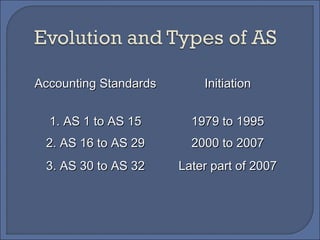
Accounting StandardsAccounting Standards InitiationInitiation
1. AS 1 to AS 151. AS 1 to AS 15 1979 to 19951979 to 1995
2. AS 16 to AS 292. AS 16 to AS 29 2000 to 20072000 to 2007
3. AS 30 to AS 323. AS 30 to AS 32 Later part of 2007Later part of 2007
 Specific policies adapted to prepare
AS
 Should be disclosed at one place
 Deals with disclosure of accounting
policies
Purpose :-
1. Better understanding of AS
2. Better comparison analysis
3. Mostly needed w.r.t Depreciation
 Used for computation of Cost of
inventories and to show in Balance
Sheet till it is sold
Consists of :-
1. Raw Materials
2. Work in progress
3. Finished goods
4. Spares, etc
 Determination of Cost of Inventories
Cost of purchase (Purchase price,
duties & taxes, freight inwards)
Cost of conversion
 Determination of Net realisable
value
 Comparison of cost and net
realisable
 Incoming and outgoing of cash
 Act as barometer to judge surplus and
deficit
 Explain Cash flow under 3 heads :-
1. Cash flow from operating activities
2. Cash flow from financing activities
3. Cash flow from investing activities
 Events occurring between the preparation of
balance sheet date and date on which financial
statement are accepted
 Non adjusting events do not effect balance
sheet but there are appropriately disclosed
E.g. Adjusting events
 Generally uses Conservative concepts of
Accounting like Bankruptcy, frauds & errors.
 Net profit or loss for the period
 Prior period item
 Changes in accounting estimates and
policies
 Net profit/loss for period Consists of 2
component
1. Profit and loss of ordinary activities
2. Profit and loss of extra ordinary
activities
 Occurs due to obsolescence
 Distribution of total cost to its useful
life
 A non-cash expenditure
 Different methods of computation
1. Straight line method ( SLM )
2. Written-down value or diminishing
value (WDV)
 AS 7 addresses issue of allocation of
revenue & cost attributable to contract
activity
 Construction Contract are 2 types
1. Fixed price Construction Contract
2. Cost plus Construction Contract
 To calculate profit and loss contract revenue
and cost must be calculated
 Profit/loss is to be calculated separately for
each contract
Includes
1. Salaries, wages and other related costs of
personnel.
2. Costs of materials and services consumed.
3. A reasonable allocation of overhead costs.
4. Payment to outside bodies for research and
development projects related to the enterprise.
5. an appropriate amortisation of the cost of
building, equipment and facilities which have no
alternative economic use, to the extent that they
are used for research and development.
 Means gross inflow of cash and other
consideration like arising out of :-
 For an item to be recognized as revenue
a) It should be measurable
b) There should be reasonably certainty
about its collectability
 Areas covered
a. Sale of goods/service c. Interest
b. Dividend d. Royalty
 Assets held with the intention of being
used for the purpose of producing and
providing goods and services
 Sometimes the total expenditure of a fixed
may be allocated to its component parts &
each such part should be depreciated
separately
 Shown at either Historical or Revalued
value
 P & L’s on disposal of FA are to be
recognized in P & L
THANK YOU

Accounting standards ppt from 1 to 10

  • 1.
    BY Priyanka (Leader) KalpanaBhangre Rohit Kadam Chirag Shah Vinayak Nair Suchi Gala Anam Shaikh Suman Yadav Viral Patel Prahlad Kulkarni Sunil
  • 2.
     Written Documentsissued by Government or Regulatory Body  In India, issued by ICAI on 21st April,1977  Initiated by Kumar Mangalam Birla, chairman committee of Corporate Governance for Financial Disclosures  Also initiated by Chair person of NACAS
  • 3.
     Standardise thediverse Accounting Policies  Add the reliability to the Financial Statement  Eradicate baffling variation in treatment of accounting aspects  Facilitate inter-firm and intra-firm comparison
  • 4.
     In India,32 Accounting Standards as IAS under NACAS  As per International, there are 41 Accounting Standards called as IFRS  Adopted by 8 countries in the world  70 to 80 countries planning to adhere IFRS  Clause 50 added to the listing agreement mandatory
  • 5.
    Accounting StandardsAccounting StandardsInitiationInitiation 1. AS 1 to AS 151. AS 1 to AS 15 1979 to 19951979 to 1995 2. AS 16 to AS 292. AS 16 to AS 29 2000 to 20072000 to 2007 3. AS 30 to AS 323. AS 30 to AS 32 Later part of 2007Later part of 2007
  • 6.
     Specific policiesadapted to prepare AS  Should be disclosed at one place  Deals with disclosure of accounting policies Purpose :- 1. Better understanding of AS 2. Better comparison analysis 3. Mostly needed w.r.t Depreciation
  • 7.
     Used forcomputation of Cost of inventories and to show in Balance Sheet till it is sold Consists of :- 1. Raw Materials 2. Work in progress 3. Finished goods 4. Spares, etc
  • 8.
     Determination ofCost of Inventories Cost of purchase (Purchase price, duties & taxes, freight inwards) Cost of conversion  Determination of Net realisable value  Comparison of cost and net realisable
  • 9.
     Incoming andoutgoing of cash  Act as barometer to judge surplus and deficit  Explain Cash flow under 3 heads :- 1. Cash flow from operating activities 2. Cash flow from financing activities 3. Cash flow from investing activities
  • 10.
     Events occurringbetween the preparation of balance sheet date and date on which financial statement are accepted  Non adjusting events do not effect balance sheet but there are appropriately disclosed E.g. Adjusting events  Generally uses Conservative concepts of Accounting like Bankruptcy, frauds & errors.
  • 11.
     Net profitor loss for the period  Prior period item  Changes in accounting estimates and policies  Net profit/loss for period Consists of 2 component 1. Profit and loss of ordinary activities 2. Profit and loss of extra ordinary activities
  • 12.
     Occurs dueto obsolescence  Distribution of total cost to its useful life  A non-cash expenditure  Different methods of computation 1. Straight line method ( SLM ) 2. Written-down value or diminishing value (WDV)
  • 13.
     AS 7addresses issue of allocation of revenue & cost attributable to contract activity  Construction Contract are 2 types 1. Fixed price Construction Contract 2. Cost plus Construction Contract  To calculate profit and loss contract revenue and cost must be calculated  Profit/loss is to be calculated separately for each contract
  • 14.
    Includes 1. Salaries, wagesand other related costs of personnel. 2. Costs of materials and services consumed. 3. A reasonable allocation of overhead costs. 4. Payment to outside bodies for research and development projects related to the enterprise. 5. an appropriate amortisation of the cost of building, equipment and facilities which have no alternative economic use, to the extent that they are used for research and development.
  • 15.
     Means grossinflow of cash and other consideration like arising out of :-  For an item to be recognized as revenue a) It should be measurable b) There should be reasonably certainty about its collectability  Areas covered a. Sale of goods/service c. Interest b. Dividend d. Royalty
  • 16.
     Assets heldwith the intention of being used for the purpose of producing and providing goods and services  Sometimes the total expenditure of a fixed may be allocated to its component parts & each such part should be depreciated separately  Shown at either Historical or Revalued value  P & L’s on disposal of FA are to be recognized in P & L
  • 17.