Prepared by Nitin S Poojary
1
Prepared by Nitin Poojary
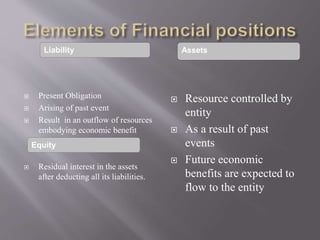
 Present Obligation
 Arising of past event
 Result in an outflow of resources
embodying economic benefit
 Residual interest in the assets
after deducting all its liabilities.
 Resource controlled by
entity
 As a result of past
events
 Future economic
benefits are expected to
flow to the entity
Liability
Equity
Assets
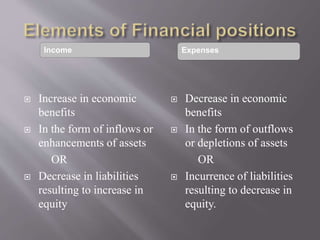
 Increase in economic
benefits
 In the form of inflows or
enhancements of assets
OR
 Decrease in liabilities
resulting to increase in
equity
 Decrease in economic
benefits
 In the form of outflows
or depletions of assets
OR
 Incurrence of liabilities
resulting to decrease in
equity.
Income Expenses
Agenda
 Objective and Scope
 Key Definitions
 Recognition and Measurement
 Disclosures
 Ind AS v/s AS
 The objective of IND AS 38 is to prescribe the
accounting treatment for intangible assets that are
not dealt with specifically in another IND AS.
 The Standard requires an entity to recognise an
intangible asset if, and only if, certain criteria are
met.
 The Standard also specifies how to measure the
carrying amount of intangible assets and requires
certain disclosures regarding intangible assets.
 IND AS 38 applies to all intangible assets other than:
 Financial assets
 Exploration and evaluation assets (extractive industries)
 Expenditure on the development and extraction of minerals,
oil, natural gas, and similar resources
 Intangible assets arising from insurance contracts issued by
insurance companies
 Intangible assets covered by another IND AS, such as:
 Intangibles held for sale
 Deferred tax assets
 Lease assets
 Assets arising from employee benefits plan
 Goodwill acquired under business combination.
Agenda
 Objective and Scope
 Key Definitions
 Recognition and Measurement
 Disclosures
 Ind AS v/s AS
 Asset
 A resource controlled by the
entity as a result of past events,
 From which future economic
benefits are expected to flow to
the entity
 Intangible Asset
 An identifiable non
monetary asset
without physical
substance
Difference from existing AS
The existing standard defines an intangible asset as an identifiable
non-monetary asset without physical substance held for use in the
production or supply of goods or services, for rental to others, or
for administrative purposes whereas in Ind AS 38, the requirement
for the asset to be held for use in the production or supply of goods
or services, for rental to others, or for administrative purposes has
been removed from the definition of an intangible asset.
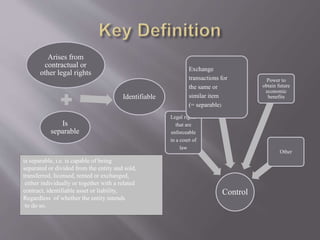
Arises from
contractual or
other legal rights
Is
separable
Identifiable
Control
Legal rights
that are
enforceable
in a court of
law
Exchange
transactions for
the same or
similar item
(= separable)
Power to
obtain future
economic
benefits
Other
is separable, i.e. is capable of being
separated or divided from the entity and sold,
transferred, licensed, rented or exchanged,
either individually or together with a related
contract, identifiable asset or liability,
Regardless of whether the entity intends
to do so.
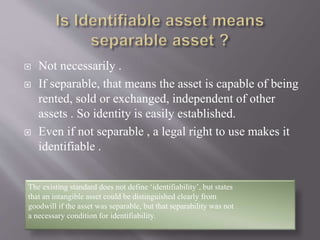
 Not necessarily .
 If separable, that means the asset is capable of being
rented, sold or exchanged, independent of other
assets . So identity is easily established.
 Even if not separable , a legal right to use makes it
identifiable .
The existing standard does not define ‘identifiability’, but states
that an intangible asset could be distinguished clearly from
goodwill if the asset was separable, but that separability was not
a necessary condition for identifiability.
 The future economic benefits flowing from an
intangible asset may include revenue from the sale
of products or services, cost savings, or other
benefits resulting from the use of the asset by the
entity.
 It is not necessary that future economic benefit has
to accrue through income generation alone. It could
be from cost saving too. Hence subject to
compliance of other conditions, capitalization is
possible.
Agenda
 Objective and Scope
 Key Definitions
 Recognition and Measurement
 Disclosures
 Ind AS v/s AS
 Recognition criteria. IND AS 38 requires an entity to recognise an
intangible asset, whether purchased or self-created (at cost) if, and
only if:
a. It is probable that the future economic benefits that are attributable to the
asset will flow to the entity; and
b. The cost of the asset can be measured reliably.
 An entity shall assess the probability of expected future economic
benefits using reasonable and supportable assumptions that
represent management’s best estimate of the set of economic
conditions that will exist over the useful life of the asset.
 Separate acquisition
 The probability criterion (a) is always considered to be satisfied.
The reliable measurement criterion (b) is usually satisfied.
 If an intangible item does not meet both the definition of and the criteria for recognition as an intangible asset, IND AS 38
requires the expenditure on this item to be recognised as an expense when it is incurred.
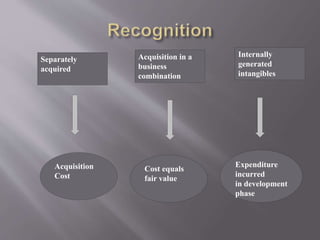
Separately
acquired
Acquisition in a
business
combination
Internally
generated
intangibles
Acquisition
Cost
Cost equals
fair value
Expenditure
incurred
in development
phase
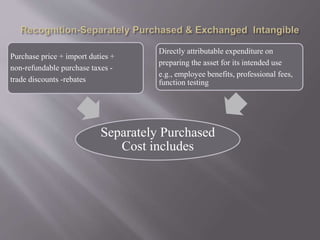
Separately Purchased
Cost includes
Purchase price + import duties +
non-refundable purchase taxes -
trade discounts -rebates
Directly attributable expenditure on
preparing the asset for its intended use
e.g., employee benefits, professional fees,
function testing
 There is a presumption that the fair value (and
therefore the cost) of an intangible asset acquired in
a business combination can be measured reliably.
 An expenditure (included in the cost of acquisition)
on an intangible item that does not meet both the
definition of and recognition criteria for an
intangible asset should form part of the amount
attributed to the goodwill recognised at the
acquisition date.
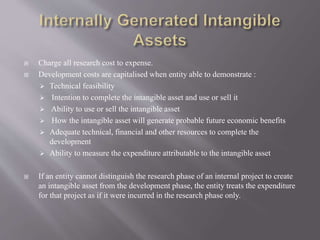
 Charge all research cost to expense.
 Development costs are capitalised when entity able to demonstrate :
 Technical feasibility
 Intention to complete the intangible asset and use or sell it
 Ability to use or sell the intangible asset
 How the intangible asset will generate probable future economic benefits
 Adequate technical, financial and other resources to complete the
development
 Ability to measure the expenditure attributable to the intangible asset
 If an entity cannot distinguish the research phase of an internal project to create
an intangible asset from the development phase, the entity treats the expenditure
for that project as if it were incurred in the research phase only.
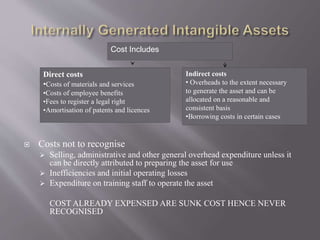
 Costs not to recognise
 Selling, administrative and other general overhead expenditure unless it
can be directly attributed to preparing the asset for use
 Inefficiencies and initial operating losses
 Expenditure on training staff to operate the asset
COST ALREADY EXPENSED ARE SUNK COST HENCE NEVER
RECOGNISED
Direct costs
•Costs of materials and services
•Costs of employee benefits
•Fees to register a legal right
•Amortisation of patents and licences
Indirect costs
• Overheads to the extent necessary
to generate the asset and can be
allocated on a reasonable and
consistent basis
•Borrowing costs in certain cases
Cost Includes
 Cost that do not meet the recognition criteria (including
not meeting the definition of an intangible asset),e.g.
 Internally generated goodwill
 Internally generated brands, mastheads, publishing
titles, customer list & items “similar in substance”
 Research
 Start-up costs (establishment, pre-opening and pre-
operating costs)
 Training
 Advertising and promotional activities
 Relocating and re-organising (restructuring)
 Subsequent expenditure is capitalised when the item
meets
 Definition of an intangible asset
 General recognition criteria for intangible assets
 Recognition of subsequent expenditure will be rare
 Expense subsequent expenditure on brands,
mastheads, publishing titles, customers lists and
items similar in substance
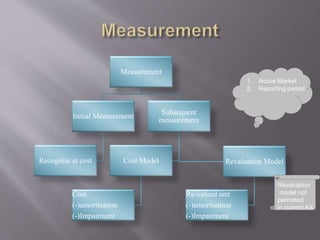
Measurement
Initial Measurement
Recognise at cost
Subsequent
measurement
Cost Model
Cost
(-)amortisation
(-)Impairment
Revaluation Model
Re-valued amt
(-)amortisation
(-)Impairment
1. Active Market
2. Reporting period
Revaluation
model not
permitted
in current AS
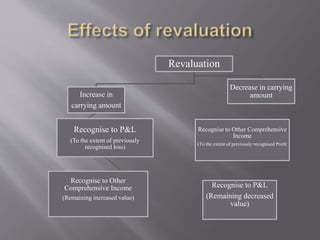
Revaluation
Increase in
carrying amount
Recognise to P&L
(To the extent of previously
recognised loss)
Recognise to Other
Comprehensive Income
(Remaining increased value)
Decrease in carrying
amount
Recognise to Other Comprehensive
Income
(To the extent of previously recognised Profit
Recognise to P&L
(Remaining decreased
value)
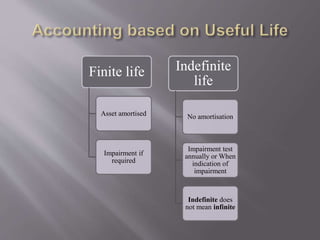
Finite life
Asset amortised
Impairment if
required
Indefinite
life
No amortisation
Impairment test
annually or When
indication of
impairment
Indefinite does
not mean infinite
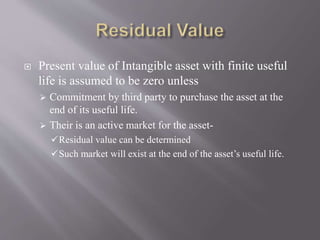
 Present value of Intangible asset with finite useful
life is assumed to be zero unless
 Commitment by third party to purchase the asset at the
end of its useful life.
 Their is an active market for the asset-
Residual value can be determined
Such market will exist at the end of the asset’s useful life.
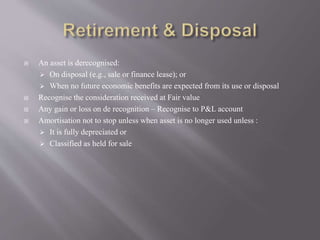
 An asset is derecognised:
 On disposal (e.g., sale or finance lease); or
 When no future economic benefits are expected from its use or disposal
 Recognise the consideration received at Fair value
 Any gain or loss on de recognition – Recognise to P&L account
 Amortisation not to stop unless when asset is no longer used unless :
 It is fully depreciated or
 Classified as held for sale
Agenda
 Objective and Scope
 Key Definitions
 Recognition and Measurement
 Disclosures
 Ind AS v/s AS
 For each class of intangible asset, disclose: [IAS 38.118 and 38.122]
 useful life or amortisation rate
 Amortisation method
 Gross carrying amount
 Accumulated amortisation and impairment losses
 Line items in the income statement in which amortisation is included
 Basis for determining that an intangible has an indefinite life
 Description and carrying amount of individually material intangible
assets
 Certain special disclosures about intangible assets acquired by way of
government grants
 Information about intangible assets whose title is restricted
 Contractual commitments to acquire intangible assets
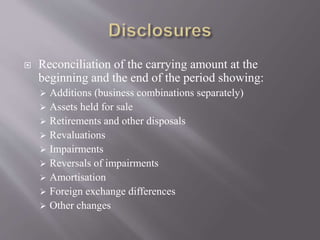
 Reconciliation of the carrying amount at the
beginning and the end of the period showing:
 Additions (business combinations separately)
 Assets held for sale
 Retirements and other disposals
 Revaluations
 Impairments
 Reversals of impairments
 Amortisation
 Foreign exchange differences
 Other changes
Agenda
 Objective and Scope
 Key Definitions
 Recognition and Measurement
 Disclosures
 Ind AS v/s AS
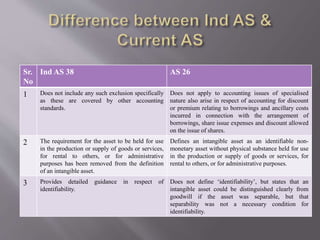
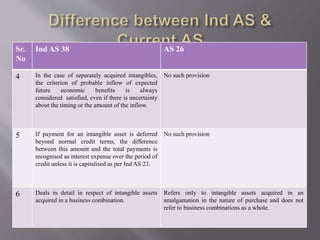
Sr.
No
Ind AS 38 AS 26
1 Does not include any such exclusion specifically
as these are covered by other accounting
standards.
Does not apply to accounting issues of specialised
nature also arise in respect of accounting for discount
or premium relating to borrowings and ancillary costs
incurred in connection with the arrangement of
borrowings, share issue expenses and discount allowed
on the issue of shares.
2 The requirement for the asset to be held for use
in the production or supply of goods or services,
for rental to others, or for administrative
purposes has been removed from the definition
of an intangible asset.
Defines an intangible asset as an identifiable non-
monetary asset without physical substance held for use
in the production or supply of goods or services, for
rental to others, or for administrative purposes.
3 Provides detailed guidance in respect of
identifiability.
Does not define ‘identifiability’, but states that an
intangible asset could be distinguished clearly from
goodwill if the asset was separable, but that
separability was not a necessary condition for
identifiability.
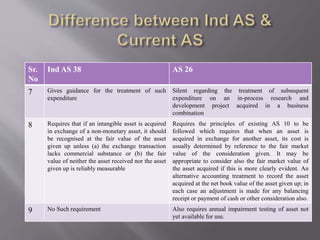
Sr.
No
Ind AS 38 AS 26
4 In the case of separately acquired intangibles,
the criterion of probable inflow of expected
future economic benefits is always
considered satisfied, even if there is uncertainty
about the timing or the amount of the inflow.
No such provision
5 If payment for an intangible asset is deferred
beyond normal credit terms, the difference
between this amount and the total payments is
recognised as interest expense over the period of
credit unless it is capitalised as per Ind AS 23.
No such provision
6 Deals in detail in respect of intangible assets
acquired in a business combination.
Refers only to intangible assets acquired in an
amalgamation in the nature of purchase and does not
refer to business combinations as a whole.
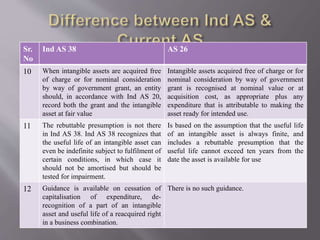
Sr.
No
Ind AS 38 AS 26
7 Gives guidance for the treatment of such
expenditure
Silent regarding the treatment of subsequent
expenditure on an in-process research and
development project acquired in a business
combination
8 Requires that if an intangible asset is acquired
in exchange of a non-monetary asset, it should
be recognised at the fair value of the asset
given up unless (a) the exchange transaction
lacks commercial substance or (b) the fair
value of neither the asset received nor the asset
given up is reliably measurable
Requires the principles of existing AS 10 to be
followed which requires that when an asset is
acquired in exchange for another asset, its cost is
usually determined by reference to the fair market
value of the consideration given. It may be
appropriate to consider also the fair market value of
the asset acquired if this is more clearly evident. An
alternative accounting treatment to record the asset
acquired at the net book value of the asset given up; in
each case an adjustment is made for any balancing
receipt or payment of cash or other consideration also.
9 No Such requirement Also requires annual impairment testing of asset not
yet available for use.
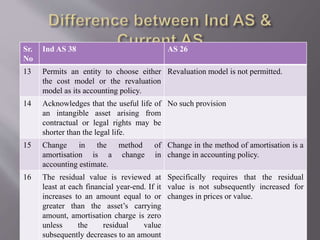
Sr.
No
Ind AS 38 AS 26
10 When intangible assets are acquired free
of charge or for nominal consideration
by way of government grant, an entity
should, in accordance with Ind AS 20,
record both the grant and the intangible
asset at fair value
Intangible assets acquired free of charge or for
nominal consideration by way of government
grant is recognised at nominal value or at
acquisition cost, as appropriate plus any
expenditure that is attributable to making the
asset ready for intended use.
11 The rebuttable presumption is not there
in Ind AS 38. Ind AS 38 recognizes that
the useful life of an intangible asset can
even be indefinite subject to fulfilment of
certain conditions, in which case it
should not be amortised but should be
tested for impairment.
Is based on the assumption that the useful life
of an intangible asset is always finite, and
includes a rebuttable presumption that the
useful life cannot exceed ten years from the
date the asset is available for use
12 Guidance is available on cessation of
capitalisation of expenditure, de-
recognition of a part of an intangible
asset and useful life of a reacquired right
in a business combination.
There is no such guidance.
Sr.
No
Ind AS 38 AS 26
13 Permits an entity to choose either
the cost model or the revaluation
model as its accounting policy.
Revaluation model is not permitted.
14 Acknowledges that the useful life of
an intangible asset arising from
contractual or legal rights may be
shorter than the legal life.
No such provision
15 Change in the method of
amortisation is a change in
accounting estimate.
Change in the method of amortisation is a
change in accounting policy.
16 The residual value is reviewed at
least at each financial year-end. If it
increases to an amount equal to or
greater than the asset’s carrying
amount, amortisation charge is zero
unless the residual value
subsequently decreases to an amount
Specifically requires that the residual
value is not subsequently increased for
changes in prices or value.
Agenda
 Objective and Scope
 Key Definitions
 Recognition and Measurement
 Disclosures
 Ind AS v/s AS
Ind as 38

Ind as 38

  • 1.
    Prepared by NitinS Poojary 1 Prepared by Nitin Poojary
  • 2.
     Present Obligation Arising of past event  Result in an outflow of resources embodying economic benefit  Residual interest in the assets after deducting all its liabilities.  Resource controlled by entity  As a result of past events  Future economic benefits are expected to flow to the entity Liability Equity Assets
  • 3.
     Increase ineconomic benefits  In the form of inflows or enhancements of assets OR  Decrease in liabilities resulting to increase in equity  Decrease in economic benefits  In the form of outflows or depletions of assets OR  Incurrence of liabilities resulting to decrease in equity. Income Expenses
  • 4.
    Agenda  Objective andScope  Key Definitions  Recognition and Measurement  Disclosures  Ind AS v/s AS
  • 5.
     The objectiveof IND AS 38 is to prescribe the accounting treatment for intangible assets that are not dealt with specifically in another IND AS.  The Standard requires an entity to recognise an intangible asset if, and only if, certain criteria are met.  The Standard also specifies how to measure the carrying amount of intangible assets and requires certain disclosures regarding intangible assets.
  • 6.
     IND AS38 applies to all intangible assets other than:  Financial assets  Exploration and evaluation assets (extractive industries)  Expenditure on the development and extraction of minerals, oil, natural gas, and similar resources  Intangible assets arising from insurance contracts issued by insurance companies  Intangible assets covered by another IND AS, such as:  Intangibles held for sale  Deferred tax assets  Lease assets  Assets arising from employee benefits plan  Goodwill acquired under business combination.
  • 7.
    Agenda  Objective andScope  Key Definitions  Recognition and Measurement  Disclosures  Ind AS v/s AS
  • 8.
     Asset  Aresource controlled by the entity as a result of past events,  From which future economic benefits are expected to flow to the entity  Intangible Asset  An identifiable non monetary asset without physical substance Difference from existing AS The existing standard defines an intangible asset as an identifiable non-monetary asset without physical substance held for use in the production or supply of goods or services, for rental to others, or for administrative purposes whereas in Ind AS 38, the requirement for the asset to be held for use in the production or supply of goods or services, for rental to others, or for administrative purposes has been removed from the definition of an intangible asset.
  • 9.
    Arises from contractual or otherlegal rights Is separable Identifiable Control Legal rights that are enforceable in a court of law Exchange transactions for the same or similar item (= separable) Power to obtain future economic benefits Other is separable, i.e. is capable of being separated or divided from the entity and sold, transferred, licensed, rented or exchanged, either individually or together with a related contract, identifiable asset or liability, Regardless of whether the entity intends to do so.
  • 10.
     Not necessarily.  If separable, that means the asset is capable of being rented, sold or exchanged, independent of other assets . So identity is easily established.  Even if not separable , a legal right to use makes it identifiable . The existing standard does not define ‘identifiability’, but states that an intangible asset could be distinguished clearly from goodwill if the asset was separable, but that separability was not a necessary condition for identifiability.
  • 11.
     The futureeconomic benefits flowing from an intangible asset may include revenue from the sale of products or services, cost savings, or other benefits resulting from the use of the asset by the entity.  It is not necessary that future economic benefit has to accrue through income generation alone. It could be from cost saving too. Hence subject to compliance of other conditions, capitalization is possible.
  • 12.
    Agenda  Objective andScope  Key Definitions  Recognition and Measurement  Disclosures  Ind AS v/s AS
  • 13.
     Recognition criteria.IND AS 38 requires an entity to recognise an intangible asset, whether purchased or self-created (at cost) if, and only if: a. It is probable that the future economic benefits that are attributable to the asset will flow to the entity; and b. The cost of the asset can be measured reliably.  An entity shall assess the probability of expected future economic benefits using reasonable and supportable assumptions that represent management’s best estimate of the set of economic conditions that will exist over the useful life of the asset.  Separate acquisition  The probability criterion (a) is always considered to be satisfied. The reliable measurement criterion (b) is usually satisfied.  If an intangible item does not meet both the definition of and the criteria for recognition as an intangible asset, IND AS 38 requires the expenditure on this item to be recognised as an expense when it is incurred.
  • 14.
  • 15.
    Separately Purchased Cost includes Purchaseprice + import duties + non-refundable purchase taxes - trade discounts -rebates Directly attributable expenditure on preparing the asset for its intended use e.g., employee benefits, professional fees, function testing
  • 16.
     There isa presumption that the fair value (and therefore the cost) of an intangible asset acquired in a business combination can be measured reliably.  An expenditure (included in the cost of acquisition) on an intangible item that does not meet both the definition of and recognition criteria for an intangible asset should form part of the amount attributed to the goodwill recognised at the acquisition date.
  • 17.
     Charge allresearch cost to expense.  Development costs are capitalised when entity able to demonstrate :  Technical feasibility  Intention to complete the intangible asset and use or sell it  Ability to use or sell the intangible asset  How the intangible asset will generate probable future economic benefits  Adequate technical, financial and other resources to complete the development  Ability to measure the expenditure attributable to the intangible asset  If an entity cannot distinguish the research phase of an internal project to create an intangible asset from the development phase, the entity treats the expenditure for that project as if it were incurred in the research phase only.
  • 18.
     Costs notto recognise  Selling, administrative and other general overhead expenditure unless it can be directly attributed to preparing the asset for use  Inefficiencies and initial operating losses  Expenditure on training staff to operate the asset COST ALREADY EXPENSED ARE SUNK COST HENCE NEVER RECOGNISED Direct costs •Costs of materials and services •Costs of employee benefits •Fees to register a legal right •Amortisation of patents and licences Indirect costs • Overheads to the extent necessary to generate the asset and can be allocated on a reasonable and consistent basis •Borrowing costs in certain cases Cost Includes
  • 19.
     Cost thatdo not meet the recognition criteria (including not meeting the definition of an intangible asset),e.g.  Internally generated goodwill  Internally generated brands, mastheads, publishing titles, customer list & items “similar in substance”  Research  Start-up costs (establishment, pre-opening and pre- operating costs)  Training  Advertising and promotional activities  Relocating and re-organising (restructuring)
  • 20.
     Subsequent expenditureis capitalised when the item meets  Definition of an intangible asset  General recognition criteria for intangible assets  Recognition of subsequent expenditure will be rare  Expense subsequent expenditure on brands, mastheads, publishing titles, customers lists and items similar in substance
  • 21.
    Measurement Initial Measurement Recognise atcost Subsequent measurement Cost Model Cost (-)amortisation (-)Impairment Revaluation Model Re-valued amt (-)amortisation (-)Impairment 1. Active Market 2. Reporting period Revaluation model not permitted in current AS
  • 22.
    Revaluation Increase in carrying amount Recogniseto P&L (To the extent of previously recognised loss) Recognise to Other Comprehensive Income (Remaining increased value) Decrease in carrying amount Recognise to Other Comprehensive Income (To the extent of previously recognised Profit Recognise to P&L (Remaining decreased value)
  • 23.
    Finite life Asset amortised Impairmentif required Indefinite life No amortisation Impairment test annually or When indication of impairment Indefinite does not mean infinite
  • 24.
     Present valueof Intangible asset with finite useful life is assumed to be zero unless  Commitment by third party to purchase the asset at the end of its useful life.  Their is an active market for the asset- Residual value can be determined Such market will exist at the end of the asset’s useful life.
  • 25.
     An assetis derecognised:  On disposal (e.g., sale or finance lease); or  When no future economic benefits are expected from its use or disposal  Recognise the consideration received at Fair value  Any gain or loss on de recognition – Recognise to P&L account  Amortisation not to stop unless when asset is no longer used unless :  It is fully depreciated or  Classified as held for sale
  • 26.
    Agenda  Objective andScope  Key Definitions  Recognition and Measurement  Disclosures  Ind AS v/s AS
  • 27.
     For eachclass of intangible asset, disclose: [IAS 38.118 and 38.122]  useful life or amortisation rate  Amortisation method  Gross carrying amount  Accumulated amortisation and impairment losses  Line items in the income statement in which amortisation is included  Basis for determining that an intangible has an indefinite life  Description and carrying amount of individually material intangible assets  Certain special disclosures about intangible assets acquired by way of government grants  Information about intangible assets whose title is restricted  Contractual commitments to acquire intangible assets
  • 28.
     Reconciliation ofthe carrying amount at the beginning and the end of the period showing:  Additions (business combinations separately)  Assets held for sale  Retirements and other disposals  Revaluations  Impairments  Reversals of impairments  Amortisation  Foreign exchange differences  Other changes
  • 29.
    Agenda  Objective andScope  Key Definitions  Recognition and Measurement  Disclosures  Ind AS v/s AS
  • 30.
    Sr. No Ind AS 38AS 26 1 Does not include any such exclusion specifically as these are covered by other accounting standards. Does not apply to accounting issues of specialised nature also arise in respect of accounting for discount or premium relating to borrowings and ancillary costs incurred in connection with the arrangement of borrowings, share issue expenses and discount allowed on the issue of shares. 2 The requirement for the asset to be held for use in the production or supply of goods or services, for rental to others, or for administrative purposes has been removed from the definition of an intangible asset. Defines an intangible asset as an identifiable non- monetary asset without physical substance held for use in the production or supply of goods or services, for rental to others, or for administrative purposes. 3 Provides detailed guidance in respect of identifiability. Does not define ‘identifiability’, but states that an intangible asset could be distinguished clearly from goodwill if the asset was separable, but that separability was not a necessary condition for identifiability.
  • 31.
    Sr. No Ind AS 38AS 26 4 In the case of separately acquired intangibles, the criterion of probable inflow of expected future economic benefits is always considered satisfied, even if there is uncertainty about the timing or the amount of the inflow. No such provision 5 If payment for an intangible asset is deferred beyond normal credit terms, the difference between this amount and the total payments is recognised as interest expense over the period of credit unless it is capitalised as per Ind AS 23. No such provision 6 Deals in detail in respect of intangible assets acquired in a business combination. Refers only to intangible assets acquired in an amalgamation in the nature of purchase and does not refer to business combinations as a whole.
  • 32.
    Sr. No Ind AS 38AS 26 7 Gives guidance for the treatment of such expenditure Silent regarding the treatment of subsequent expenditure on an in-process research and development project acquired in a business combination 8 Requires that if an intangible asset is acquired in exchange of a non-monetary asset, it should be recognised at the fair value of the asset given up unless (a) the exchange transaction lacks commercial substance or (b) the fair value of neither the asset received nor the asset given up is reliably measurable Requires the principles of existing AS 10 to be followed which requires that when an asset is acquired in exchange for another asset, its cost is usually determined by reference to the fair market value of the consideration given. It may be appropriate to consider also the fair market value of the asset acquired if this is more clearly evident. An alternative accounting treatment to record the asset acquired at the net book value of the asset given up; in each case an adjustment is made for any balancing receipt or payment of cash or other consideration also. 9 No Such requirement Also requires annual impairment testing of asset not yet available for use.
  • 33.
    Sr. No Ind AS 38AS 26 10 When intangible assets are acquired free of charge or for nominal consideration by way of government grant, an entity should, in accordance with Ind AS 20, record both the grant and the intangible asset at fair value Intangible assets acquired free of charge or for nominal consideration by way of government grant is recognised at nominal value or at acquisition cost, as appropriate plus any expenditure that is attributable to making the asset ready for intended use. 11 The rebuttable presumption is not there in Ind AS 38. Ind AS 38 recognizes that the useful life of an intangible asset can even be indefinite subject to fulfilment of certain conditions, in which case it should not be amortised but should be tested for impairment. Is based on the assumption that the useful life of an intangible asset is always finite, and includes a rebuttable presumption that the useful life cannot exceed ten years from the date the asset is available for use 12 Guidance is available on cessation of capitalisation of expenditure, de- recognition of a part of an intangible asset and useful life of a reacquired right in a business combination. There is no such guidance.
  • 34.
    Sr. No Ind AS 38AS 26 13 Permits an entity to choose either the cost model or the revaluation model as its accounting policy. Revaluation model is not permitted. 14 Acknowledges that the useful life of an intangible asset arising from contractual or legal rights may be shorter than the legal life. No such provision 15 Change in the method of amortisation is a change in accounting estimate. Change in the method of amortisation is a change in accounting policy. 16 The residual value is reviewed at least at each financial year-end. If it increases to an amount equal to or greater than the asset’s carrying amount, amortisation charge is zero unless the residual value subsequently decreases to an amount Specifically requires that the residual value is not subsequently increased for changes in prices or value.
  • 35.
    Agenda  Objective andScope  Key Definitions  Recognition and Measurement  Disclosures  Ind AS v/s AS

Editor's Notes

  • #16 Cost that cannot be included are advertising cost, Administration cost/staff training cost, Initial operating losses.