08
FINANCIAL
REPORTING
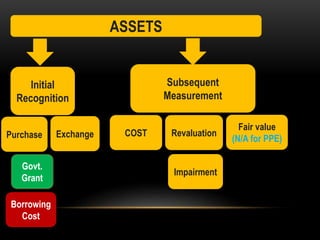
ASSETS
Initial
Recognition
Subsequent
Measurement
Purchase Exchange
Govt.
Grant
Borrowing
Cost
COST Revaluation
Impairment
Fair value
(N/A for PPE)
Cost Revaluation Fair value
N/A for PPE
Historic cost
Increase in value is not
recorded
Increase in value is
recorded
Increase in value is
recorded
Impairment is recorded Impairment is recorded Impairment is recorded
Not required every year Required every year
Gains are recorded as
revaluation reserve through
other comprehensive
income
Gains / losses are
charged to P&L
Impairment losses goes
to P&L
Losses goes to P&L after
writing off existing
revaluation reserves
Models used for recognition of Assets
SUBSEQUENT MEASUREMENT
1. Cost Model: historical cost less acc.
Depreciation. No upward adjustment to value
due to changing circumstances.
2. Revaluation Model: initially recorded at cost,
but increase when asset’s value appreciates.
Impairment: Both in Cost Model & Revaluation
Model. Asset value decreased to recoverable
amount i.e. higher of (a) fair value less cost of
disposal and (b) value in use.
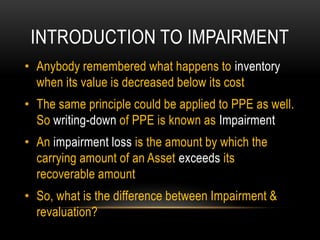
INTRODUCTION TO IMPAIRMENT
• Anybody remembered what happens to inventory
when its value is decreased below its cost
• The same principle could be applied to PPE as well.
So writing-down of PPE is known as Impairment
• An impairment loss is the amount by which the
carrying amount of an Asset exceeds its
recoverable amount
• So, what is the difference between Impairment &
revaluation?
INTERNAL INDICATORS;
• Physical damage or
obsolescence
• A significant change in
extent or manner in which
asset is being used
• An accumulation of costs
significantly in excess of
the amount originally
expected to acquire or
construct the asset
• A projection or forecast
that demonstrates
continuing losses
associated with an asset
EXTERNAL INDICATORS;
• Significant decrease in
fair value of asset
• Significant adverse
market changes affecting
the value of asset
IMPAIRMENT INDICATORS
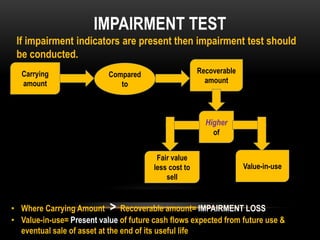
IMPAIRMENT TEST
If impairment indicators are present then impairment test should
be conducted.
Carrying
amount
Compared
to
Recoverable
amount
Higher
of
Fair value
less cost to
sell
Value-in-use
• Where Carrying Amount > Recoverable amount= IMPAIRMENT LOSS
• Value-in-use= Present value of future cash flows expected from future use &
eventual sale of asset at the end of its useful life
TEST YOURSELF (COST MODEL)
• Cruz Ltd. performs an impairment test for its
equipment
• The carrying amount of equipment is $200,000;
its fair value less cost to sell is $180,000 and
value-in-use is $205,000
Required;
Calculate impairment loss
SOLUTION
In this question, Although fair value is less
than the carrying amount but value-in-use is
greater than the carrying amount of $200,000.
Hence, there is no impairment loss
TEST YOURSELF (COST MODEL)
• Cruz Ltd. performs an impairment test for its
equipment
• The carrying amount of equipment is $200,000;
its fair value less cost to sell is $180,000 and
value-in-use is $175,000
Required;
Journal entry to record impairment loss
SOLUTION
• Carrying amount will be compared with higher of Fair value
less cost to sell & value-in-use
• $200,000- $180,000= $20,000
• Entry;
Impairment loss 20,000
Accumulated depreciation &
impairment losses 20,000
Note; Accumulated impairment loss account can also be
credited separately
Impairment loss is presented in “other income / expense a/c” in
the income statement
TEST YOURSELF (COST MODEL)
• At Dec 31, 2014 Hanoi company has an equipment costing $26,000 and
accumulated depreciation of $12,000
• The equipment has a total useful life of 4 years with $2,000 residual value
& further information relating to equipment is as follows;
• Equipment’s carrying amount on Dec31 ,2014= $14,000
• Hanoi uses straight line depreciation and during 2014, depreciation was
$6,000 (26,000- 2,000 / 4)
• Hanoi determined that recoverable amount for this asset on Dec31,2014
is $11,000
• The remaining useful of equipment after Dec31, 2014 is 2 years
• On Dec 31, 2015, the useful life of asset is same but NIL residual value
• In Jan 1st,2016. the recoverable amount is $4,000
Record the necessary entries in 2014, 2015 & 2016
SOLUTION
• Assuming deprecation for 2014 is already booked,
the entries can be started from impairment;
Dec31, 2014
Impairment loss 3,000
Accumulated dep.& impairment loss 3,000
(14,000-11,000= 3,000)
SOLUTION
Dec31, 2015
Depreciation 5,500
Accumulated dep. 5,500
(11,000 / 2)
Jan1, 2016
Impairment loss 1,500
Accumulated dep. & impairment losses 1,500
(5,500- 4,000= 1,500)
TEST YOURSELF (COST MODEL)- VALUE IN USE
• On Dec31, 2015, Verma Ltd. Tests a machine for impairment
• Carrying amount= $200,000 & remaining useful life is 5 years
• Due to specialized nature of machine, there is no fair value available
• Verma Ltd. Determines recoverable amount on the basis of value-in-use
• To calculate this value, the company uses its future cash flows based on
the company’s internal cash budget
• The pre-tax discount rate is 8%
• The company expects to have cash flows of $40,000 per annum over the
next 5 years and machine will have a salvage value of $10,000 at the end
of 5th year
• All cash flows occur at the end of year
Record the Journal entry for Dec31, 2015 along with the relevant calculations
SOLUTION
• Calculation of value-in-use;
• 40,000 * 3.992 =159,708
• 10,000* 0.681 =6,806
Value-in-use =166,514
• Carrying amount = 200,000
• Impairment loss = 200,000 – 166,514
=$33,486
SOLUTION
• Journal entry;
Impairment loss 33,486
Accumulated dep. & impairment losses 33,486
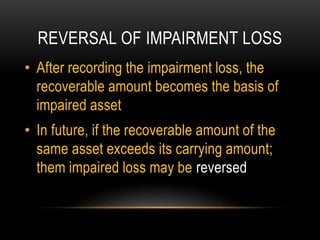
REVERSAL OF IMPAIRMENT LOSS
• After recording the impairment loss, the
recoverable amount becomes the basis of
impaired asset
• In future, if the recoverable amount of the
same asset exceeds its carrying amount;
them impaired loss may be reversed
Reversal of Impairment Loss
Cost Model
Credited as
“Reversal of
impairment loss” up
till Historical
carrying amount
Any amount above
Historical carrying
amount will be
IGNORED
Revaluation Model
Credited as
“Reversal of
impairment loss” up
till Historical
carrying amount
Any amount above
Historical carrying
amount will be
credited as
“Revaluation
surplus”
TEST YOURSELF (COST MODEL)- REVERSAL
• Tan company purchased equipment of Jan1,2015 for
$300,000
• It has a useful life of 3 years with NIL residual value
• Straight line depreciation method is used
• On Dec31,2015 the recoverable amount is $180,000
• On Dec31,2016 the recoverable amount is $96,000
Record the entries on Dec 31, 2015 & Dec 31,2016
SOLUTION
Dec 31,2015;
Depreciation 100,000
Accumulated dep. 100,000
(Depreciation booked= 300,000 / 3)
Carrying amount= 300,000- 100,000= 200,000
Recoverable amount = 180,000
Impairment loss 20,000
Accumulated dep. & impairment losses 20,000
(Impairment loss booked)
SOLUTION
Dec 31,2016;
Depreciation 90,000
Accumulated dep. 90,000
(Depreciation booked= 180,000 / 2)
Carrying amount= 180,000- 90,000= 90,000
Recoverable amount = 96,000
Accumulated dep. & impairment losses 6,000
Recovery of impairment loss 6,000
(Impairment loss recovered)
Recovery of impairment loss should be shown in “other income” in
income statement
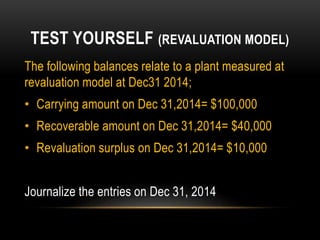
TEST YOURSELF (REVALUATION MODEL)
The following balances relate to a plant measured at
revaluation model at Dec31 2014;
• Carrying amount on Dec 31,2014= $100,000
• Recoverable amount on Dec 31,2014= $40,000
• Revaluation surplus on Dec 31,2014= $10,000
Journalize the entries on Dec 31, 2014
SOLUTION
Journal entry
First step; If there is an existing revaluation surplus, its should
be written off first
Revaluation surplus 10,000
Plant 10,000
Second step; Now the balance is impairment loss (100,000-
40,000= 60,000- 10,000= $50,000)
Impairment loss 50,000
Accumulated dep, & impairment losses 50,000
TEST YOURSELF (REVALUATION MODEL)- REVERSAL
• Tan company purchased equipment of Jan1,2015 for
$300,000
• It has a useful life of 3 years with NIL residual value
• Straight line depreciation method is used
• On Dec31,2015 the recoverable amount is $180,000
• On Dec31,2016 the recoverable amount is $106,000
Record the entries on Dec 31, 2015 & Dec 31,2016
SOLUTION
Dec 31,2015;
Depreciation 100,000
Accumulated dep. 100,000
(Depreciation booked= 300,000 / 3)
Carrying amount= 300,000- 100,000= 200,000
Recoverable amount = 180,000
Impairment loss 20,000
Accumulated dep. & impairment losses 20,000
(Impairment loss booked)
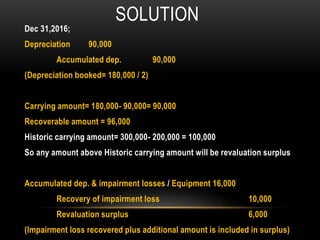
SOLUTION
Dec 31,2016;
Depreciation 90,000
Accumulated dep. 90,000
(Depreciation booked= 180,000 / 2)
Carrying amount= 180,000- 90,000= 90,000
Recoverable amount = 96,000
Historic carrying amount= 300,000- 200,000 = 100,000
So any amount above Historic carrying amount will be revaluation surplus
Accumulated dep. & impairment losses / Equipment 16,000
Recovery of impairment loss 10,000
Revaluation surplus 6,000
(Impairment loss recovered plus additional amount is included in surplus)

Financial Reporting Assets

  • 1.
  • 2.
  • 3.
    Cost Revaluation Fairvalue N/A for PPE Historic cost Increase in value is not recorded Increase in value is recorded Increase in value is recorded Impairment is recorded Impairment is recorded Impairment is recorded Not required every year Required every year Gains are recorded as revaluation reserve through other comprehensive income Gains / losses are charged to P&L Impairment losses goes to P&L Losses goes to P&L after writing off existing revaluation reserves Models used for recognition of Assets
  • 4.
    SUBSEQUENT MEASUREMENT 1. CostModel: historical cost less acc. Depreciation. No upward adjustment to value due to changing circumstances. 2. Revaluation Model: initially recorded at cost, but increase when asset’s value appreciates. Impairment: Both in Cost Model & Revaluation Model. Asset value decreased to recoverable amount i.e. higher of (a) fair value less cost of disposal and (b) value in use.
  • 5.
    INTRODUCTION TO IMPAIRMENT •Anybody remembered what happens to inventory when its value is decreased below its cost • The same principle could be applied to PPE as well. So writing-down of PPE is known as Impairment • An impairment loss is the amount by which the carrying amount of an Asset exceeds its recoverable amount • So, what is the difference between Impairment & revaluation?
  • 6.
    INTERNAL INDICATORS; • Physicaldamage or obsolescence • A significant change in extent or manner in which asset is being used • An accumulation of costs significantly in excess of the amount originally expected to acquire or construct the asset • A projection or forecast that demonstrates continuing losses associated with an asset EXTERNAL INDICATORS; • Significant decrease in fair value of asset • Significant adverse market changes affecting the value of asset IMPAIRMENT INDICATORS
  • 7.
    IMPAIRMENT TEST If impairmentindicators are present then impairment test should be conducted. Carrying amount Compared to Recoverable amount Higher of Fair value less cost to sell Value-in-use • Where Carrying Amount > Recoverable amount= IMPAIRMENT LOSS • Value-in-use= Present value of future cash flows expected from future use & eventual sale of asset at the end of its useful life
  • 8.
    TEST YOURSELF (COSTMODEL) • Cruz Ltd. performs an impairment test for its equipment • The carrying amount of equipment is $200,000; its fair value less cost to sell is $180,000 and value-in-use is $205,000 Required; Calculate impairment loss
  • 9.
    SOLUTION In this question,Although fair value is less than the carrying amount but value-in-use is greater than the carrying amount of $200,000. Hence, there is no impairment loss
  • 10.
    TEST YOURSELF (COSTMODEL) • Cruz Ltd. performs an impairment test for its equipment • The carrying amount of equipment is $200,000; its fair value less cost to sell is $180,000 and value-in-use is $175,000 Required; Journal entry to record impairment loss
  • 11.
    SOLUTION • Carrying amountwill be compared with higher of Fair value less cost to sell & value-in-use • $200,000- $180,000= $20,000 • Entry; Impairment loss 20,000 Accumulated depreciation & impairment losses 20,000 Note; Accumulated impairment loss account can also be credited separately Impairment loss is presented in “other income / expense a/c” in the income statement
  • 12.
    TEST YOURSELF (COSTMODEL) • At Dec 31, 2014 Hanoi company has an equipment costing $26,000 and accumulated depreciation of $12,000 • The equipment has a total useful life of 4 years with $2,000 residual value & further information relating to equipment is as follows; • Equipment’s carrying amount on Dec31 ,2014= $14,000 • Hanoi uses straight line depreciation and during 2014, depreciation was $6,000 (26,000- 2,000 / 4) • Hanoi determined that recoverable amount for this asset on Dec31,2014 is $11,000 • The remaining useful of equipment after Dec31, 2014 is 2 years • On Dec 31, 2015, the useful life of asset is same but NIL residual value • In Jan 1st,2016. the recoverable amount is $4,000 Record the necessary entries in 2014, 2015 & 2016
  • 13.
    SOLUTION • Assuming deprecationfor 2014 is already booked, the entries can be started from impairment; Dec31, 2014 Impairment loss 3,000 Accumulated dep.& impairment loss 3,000 (14,000-11,000= 3,000)
  • 14.
    SOLUTION Dec31, 2015 Depreciation 5,500 Accumulateddep. 5,500 (11,000 / 2) Jan1, 2016 Impairment loss 1,500 Accumulated dep. & impairment losses 1,500 (5,500- 4,000= 1,500)
  • 15.
    TEST YOURSELF (COSTMODEL)- VALUE IN USE • On Dec31, 2015, Verma Ltd. Tests a machine for impairment • Carrying amount= $200,000 & remaining useful life is 5 years • Due to specialized nature of machine, there is no fair value available • Verma Ltd. Determines recoverable amount on the basis of value-in-use • To calculate this value, the company uses its future cash flows based on the company’s internal cash budget • The pre-tax discount rate is 8% • The company expects to have cash flows of $40,000 per annum over the next 5 years and machine will have a salvage value of $10,000 at the end of 5th year • All cash flows occur at the end of year Record the Journal entry for Dec31, 2015 along with the relevant calculations
  • 16.
    SOLUTION • Calculation ofvalue-in-use; • 40,000 * 3.992 =159,708 • 10,000* 0.681 =6,806 Value-in-use =166,514 • Carrying amount = 200,000 • Impairment loss = 200,000 – 166,514 =$33,486
  • 17.
    SOLUTION • Journal entry; Impairmentloss 33,486 Accumulated dep. & impairment losses 33,486
  • 18.
    REVERSAL OF IMPAIRMENTLOSS • After recording the impairment loss, the recoverable amount becomes the basis of impaired asset • In future, if the recoverable amount of the same asset exceeds its carrying amount; them impaired loss may be reversed
  • 19.
    Reversal of ImpairmentLoss Cost Model Credited as “Reversal of impairment loss” up till Historical carrying amount Any amount above Historical carrying amount will be IGNORED Revaluation Model Credited as “Reversal of impairment loss” up till Historical carrying amount Any amount above Historical carrying amount will be credited as “Revaluation surplus”
  • 20.
    TEST YOURSELF (COSTMODEL)- REVERSAL • Tan company purchased equipment of Jan1,2015 for $300,000 • It has a useful life of 3 years with NIL residual value • Straight line depreciation method is used • On Dec31,2015 the recoverable amount is $180,000 • On Dec31,2016 the recoverable amount is $96,000 Record the entries on Dec 31, 2015 & Dec 31,2016
  • 21.
    SOLUTION Dec 31,2015; Depreciation 100,000 Accumulateddep. 100,000 (Depreciation booked= 300,000 / 3) Carrying amount= 300,000- 100,000= 200,000 Recoverable amount = 180,000 Impairment loss 20,000 Accumulated dep. & impairment losses 20,000 (Impairment loss booked)
  • 22.
    SOLUTION Dec 31,2016; Depreciation 90,000 Accumulateddep. 90,000 (Depreciation booked= 180,000 / 2) Carrying amount= 180,000- 90,000= 90,000 Recoverable amount = 96,000 Accumulated dep. & impairment losses 6,000 Recovery of impairment loss 6,000 (Impairment loss recovered) Recovery of impairment loss should be shown in “other income” in income statement
  • 23.
    TEST YOURSELF (REVALUATIONMODEL) The following balances relate to a plant measured at revaluation model at Dec31 2014; • Carrying amount on Dec 31,2014= $100,000 • Recoverable amount on Dec 31,2014= $40,000 • Revaluation surplus on Dec 31,2014= $10,000 Journalize the entries on Dec 31, 2014
  • 24.
    SOLUTION Journal entry First step;If there is an existing revaluation surplus, its should be written off first Revaluation surplus 10,000 Plant 10,000 Second step; Now the balance is impairment loss (100,000- 40,000= 60,000- 10,000= $50,000) Impairment loss 50,000 Accumulated dep, & impairment losses 50,000
  • 25.
    TEST YOURSELF (REVALUATIONMODEL)- REVERSAL • Tan company purchased equipment of Jan1,2015 for $300,000 • It has a useful life of 3 years with NIL residual value • Straight line depreciation method is used • On Dec31,2015 the recoverable amount is $180,000 • On Dec31,2016 the recoverable amount is $106,000 Record the entries on Dec 31, 2015 & Dec 31,2016
  • 26.
    SOLUTION Dec 31,2015; Depreciation 100,000 Accumulateddep. 100,000 (Depreciation booked= 300,000 / 3) Carrying amount= 300,000- 100,000= 200,000 Recoverable amount = 180,000 Impairment loss 20,000 Accumulated dep. & impairment losses 20,000 (Impairment loss booked)
  • 27.
    SOLUTION Dec 31,2016; Depreciation 90,000 Accumulateddep. 90,000 (Depreciation booked= 180,000 / 2) Carrying amount= 180,000- 90,000= 90,000 Recoverable amount = 96,000 Historic carrying amount= 300,000- 200,000 = 100,000 So any amount above Historic carrying amount will be revaluation surplus Accumulated dep. & impairment losses / Equipment 16,000 Recovery of impairment loss 10,000 Revaluation surplus 6,000 (Impairment loss recovered plus additional amount is included in surplus)