ACCOUNTING STANDARD-16 BORROWING COSTS
OBJECTIVE & SCOPE To prescribe the accounting treatment for borrowing costs Does not deal with the actual or imputed cost of owners’  equity,  including preference share capital not classified as a  liability
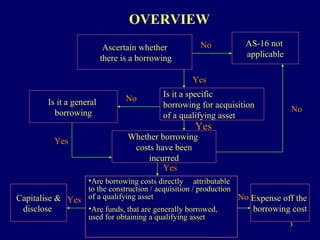
Ascertain whether there is a borrowing AS-16 not  applicable Is it a general  borrowing Is it a specific  borrowing for acquisition  of a qualifying asset Whether borrowing  costs have been incurred Capitalise & disclose  Expense off the  borrowing cost OVERVIEW No No Yes No Yes Yes No Yes Yes Are borrowing costs directly  attributable to the construction / acquisition / production of a qualifying asset Are funds, that are generally borrowed, used for obtaining a qualifying asset
DEFINITIONS Borrowing costs are interest and other costs incurred by an  enterprise in connection with the borrowing of funds Qualifying asset is an asset that  necessarily takes a   substantial period  of time to get ready for its intended  use or sale
BORROWING COSTS   Interest and commitment charges on bank & other short term  borrowings Amortisation of discounts or premiums relating to  borrowings Amortisation of ancillary costs incurred in connection with  the arrangement of borrowings Finance charges of assets acquired under finance leases or  under other similar arrangements Exchange differences arising from foreign currency  borrowings to the extent that they are regarded as an  adjustment to interest costs
QUALIFYING ASSETS Examples: Manufacturing plants Power generation facilities Inventories that require a substantial period of time to  bring them to a saleable condition Investment properties
QUALIFYING ASSETS Not to be included as qualifying assets:   Other Investments Inventories that are routinely manufactured or otherwise  produced in large quantities on repetitive basis over a short  period of time Assets that are ready for their intended use or sale when  acquired
RECOGNITION Capitalise borrowing costs that are directly  attributable to the acquisition, construction or  production of a qualifying asset Other borrowing costs to be expensed off Capitalise if it is probable that they will result in  future economic benefits to the enterprise and  costs can be measured reliably
CAPITALISATION   Specific borrowings Borrowing costs that would have been avoided if the  expenditure on the qualifying asset had not been made Actual borrowing costs incurred less any income on  temporary investment of those borrowings to be capitalised
CAPITALISATION General Borrowings Determine borrowing costs by applying a  capitalisation rate Capitalisation rate should be the weighted average of  the borrowing costs that are outstanding during the  period Borrowing costs capitalised not to exceed amount of  borrowing costs incurred
COMMENCEMENT OF CAPITALISATION Commence capitalisation when all the following conditions  are satisfied: Expenditure for the acquisition, construction or  production of a qualifying asset is being incurred Borrowing costs are being incurred Activities that are necessary to prepare the asset for its  intended use or sale are in progress
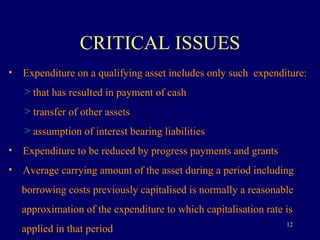
CRITICAL ISSUES Expenditure on a qualifying asset includes only such  expenditure:  that has resulted in payment of cash transfer of other assets assumption of interest bearing liabilities Expenditure to be reduced by progress payments and grants Average carrying amount of the asset during a period including  borrowing costs previously capitalised is normally a reasonable  approximation of the expenditure to which capitalisation rate is  applied in that period
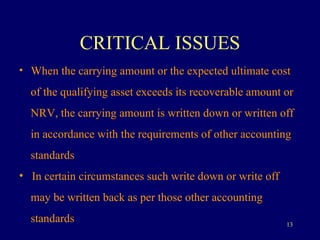
CRITICAL ISSUES When the carrying amount or the expected ultimate cost  of the qualifying asset exceeds its recoverable amount or  NRV, the carrying amount is written down or written off  in accordance with the requirements of other accounting  standards  In certain circumstances such write down or write off  may be written back as per those other accounting  standards
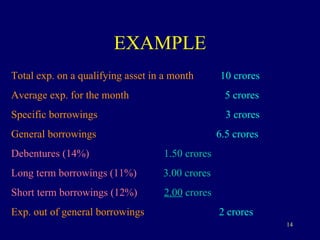
EXAMPLE Total exp. on a qualifying asset in a month  10 crores Average exp. for the month  5 crores Specific borrowings  3 crores General borrowings  6.5 crores Debentures (14%)  1.50 crores Long term borrowings (11%)   3.00 crores Short term borrowings (12%)   2.00  crores Exp. out of general borrowings  2 crores
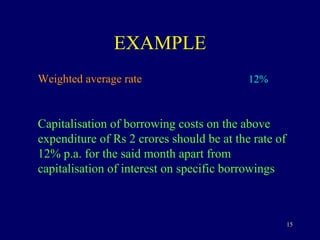
EXAMPLE Weighted average rate   12% Capitalisation of borrowing costs on the above expenditure of Rs 2 crores should be at the rate of 12% p.a. for the said month apart from capitalisation of interest on specific borrowings
SEQUENCE OF CAPITALISATION SPECIFIC BORROWINGS GENERAL BORROWINGS OWN FUNDS
SUSPENSION /CESSATION OF CAPITALISATION Suspend during extended periods in which active  development is interrupted Capitalisation should cease when substantially all  activities necessary to prepare the qualifying asset for its  intended use or sale are complete In case of construction of a qualifying asset in parts and  a completed part is capable of being used while  construction continues for the other parts, capitalization  of borrowing costs  in relation to a part should cease  when substantially all the activities necessary to prepare  that part for its intended use or sale are complete
DISCLOSURE The accounting policy adopted for borrowing costs The amount of borrowing costs capitalised during the  period
THANK YOU

As 16

  • 1.
  • 2.
    OBJECTIVE & SCOPETo prescribe the accounting treatment for borrowing costs Does not deal with the actual or imputed cost of owners’ equity, including preference share capital not classified as a liability
  • 3.
    Ascertain whether thereis a borrowing AS-16 not applicable Is it a general borrowing Is it a specific borrowing for acquisition of a qualifying asset Whether borrowing costs have been incurred Capitalise & disclose Expense off the borrowing cost OVERVIEW No No Yes No Yes Yes No Yes Yes Are borrowing costs directly attributable to the construction / acquisition / production of a qualifying asset Are funds, that are generally borrowed, used for obtaining a qualifying asset
  • 4.
    DEFINITIONS Borrowing costsare interest and other costs incurred by an enterprise in connection with the borrowing of funds Qualifying asset is an asset that necessarily takes a substantial period of time to get ready for its intended use or sale
  • 5.
    BORROWING COSTS Interest and commitment charges on bank & other short term borrowings Amortisation of discounts or premiums relating to borrowings Amortisation of ancillary costs incurred in connection with the arrangement of borrowings Finance charges of assets acquired under finance leases or under other similar arrangements Exchange differences arising from foreign currency borrowings to the extent that they are regarded as an adjustment to interest costs
  • 6.
    QUALIFYING ASSETS Examples:Manufacturing plants Power generation facilities Inventories that require a substantial period of time to bring them to a saleable condition Investment properties
  • 7.
    QUALIFYING ASSETS Notto be included as qualifying assets: Other Investments Inventories that are routinely manufactured or otherwise produced in large quantities on repetitive basis over a short period of time Assets that are ready for their intended use or sale when acquired
  • 8.
    RECOGNITION Capitalise borrowingcosts that are directly attributable to the acquisition, construction or production of a qualifying asset Other borrowing costs to be expensed off Capitalise if it is probable that they will result in future economic benefits to the enterprise and costs can be measured reliably
  • 9.
    CAPITALISATION Specific borrowings Borrowing costs that would have been avoided if the expenditure on the qualifying asset had not been made Actual borrowing costs incurred less any income on temporary investment of those borrowings to be capitalised
  • 10.
    CAPITALISATION General BorrowingsDetermine borrowing costs by applying a capitalisation rate Capitalisation rate should be the weighted average of the borrowing costs that are outstanding during the period Borrowing costs capitalised not to exceed amount of borrowing costs incurred
  • 11.
    COMMENCEMENT OF CAPITALISATIONCommence capitalisation when all the following conditions are satisfied: Expenditure for the acquisition, construction or production of a qualifying asset is being incurred Borrowing costs are being incurred Activities that are necessary to prepare the asset for its intended use or sale are in progress
  • 12.
    CRITICAL ISSUES Expenditureon a qualifying asset includes only such expenditure: that has resulted in payment of cash transfer of other assets assumption of interest bearing liabilities Expenditure to be reduced by progress payments and grants Average carrying amount of the asset during a period including borrowing costs previously capitalised is normally a reasonable approximation of the expenditure to which capitalisation rate is applied in that period
  • 13.
    CRITICAL ISSUES Whenthe carrying amount or the expected ultimate cost of the qualifying asset exceeds its recoverable amount or NRV, the carrying amount is written down or written off in accordance with the requirements of other accounting standards In certain circumstances such write down or write off may be written back as per those other accounting standards
  • 14.
    EXAMPLE Total exp.on a qualifying asset in a month 10 crores Average exp. for the month 5 crores Specific borrowings 3 crores General borrowings 6.5 crores Debentures (14%) 1.50 crores Long term borrowings (11%) 3.00 crores Short term borrowings (12%) 2.00 crores Exp. out of general borrowings 2 crores
  • 15.
    EXAMPLE Weighted averagerate 12% Capitalisation of borrowing costs on the above expenditure of Rs 2 crores should be at the rate of 12% p.a. for the said month apart from capitalisation of interest on specific borrowings
  • 16.
    SEQUENCE OF CAPITALISATIONSPECIFIC BORROWINGS GENERAL BORROWINGS OWN FUNDS
  • 17.
    SUSPENSION /CESSATION OFCAPITALISATION Suspend during extended periods in which active development is interrupted Capitalisation should cease when substantially all activities necessary to prepare the qualifying asset for its intended use or sale are complete In case of construction of a qualifying asset in parts and a completed part is capable of being used while construction continues for the other parts, capitalization of borrowing costs in relation to a part should cease when substantially all the activities necessary to prepare that part for its intended use or sale are complete
  • 18.
    DISCLOSURE The accountingpolicy adopted for borrowing costs The amount of borrowing costs capitalised during the period
  • 19.