
Presented By
HARISH.D
harishd267@gmail.com
Harishdcommerce.blogspot.com
Dual reporting system is in existence in India, one for financial
reporting and other for tax reporting. Many a time there are difference
between the income reported by a company to investors and the income
reported to tax authorities for assessing the tax liability company.
The former, known as Book Income, is determined in accordance with
the Generally Accepted Accounting Principle and the provision of the
Companies Act 1956 whereas the latter, known as Taxable Income is
computed as per the provision of Income tax 1961.
9/14/2018UOM- HRDC 25TH Refresher Course 2
Matching concept is a very significant concept of accounting. According to
this concept income and expense must be recognised in the period to
which they relate. In India, Profit & Loss is computed in accordance with
two different sets of provision one set is Profit & Loss as per Companies
Act, 2013 (earlier it was Companies Act, 1956) and second one is Profit &
Loss as per Income Tax Act, 1961 (for the purpose of computing taxable
income). Generally there is difference between Profit & Loss computed as
per above mentioned two different set of provisions. The root cause of this
difference is different treatment of some items of expenditure/income
under both set of provisions (i.e. Companies Act, 2013 and Income Tax
Act, 1961). Some expenditure which are allowed to be deducted under
Companies Act, 2013, may not be allowed to be deducted under Income
Tax Act, 1961 while computing the taxable income.
Matching concept of accounting and different treatment of
expenditure/income under above mentioned both Act gives rise to the
concept of Deferred Tax and accordingly ICAI issues an Accounting
Standard-22 “Accounting for Taxes on Income”, to prescribe the
accounting treatment for taxes on income since it is a very significant
item in the Statement of profit & Loss of an entity.
9/14/2018UOM- HRDC 25TH Refersher Course 3
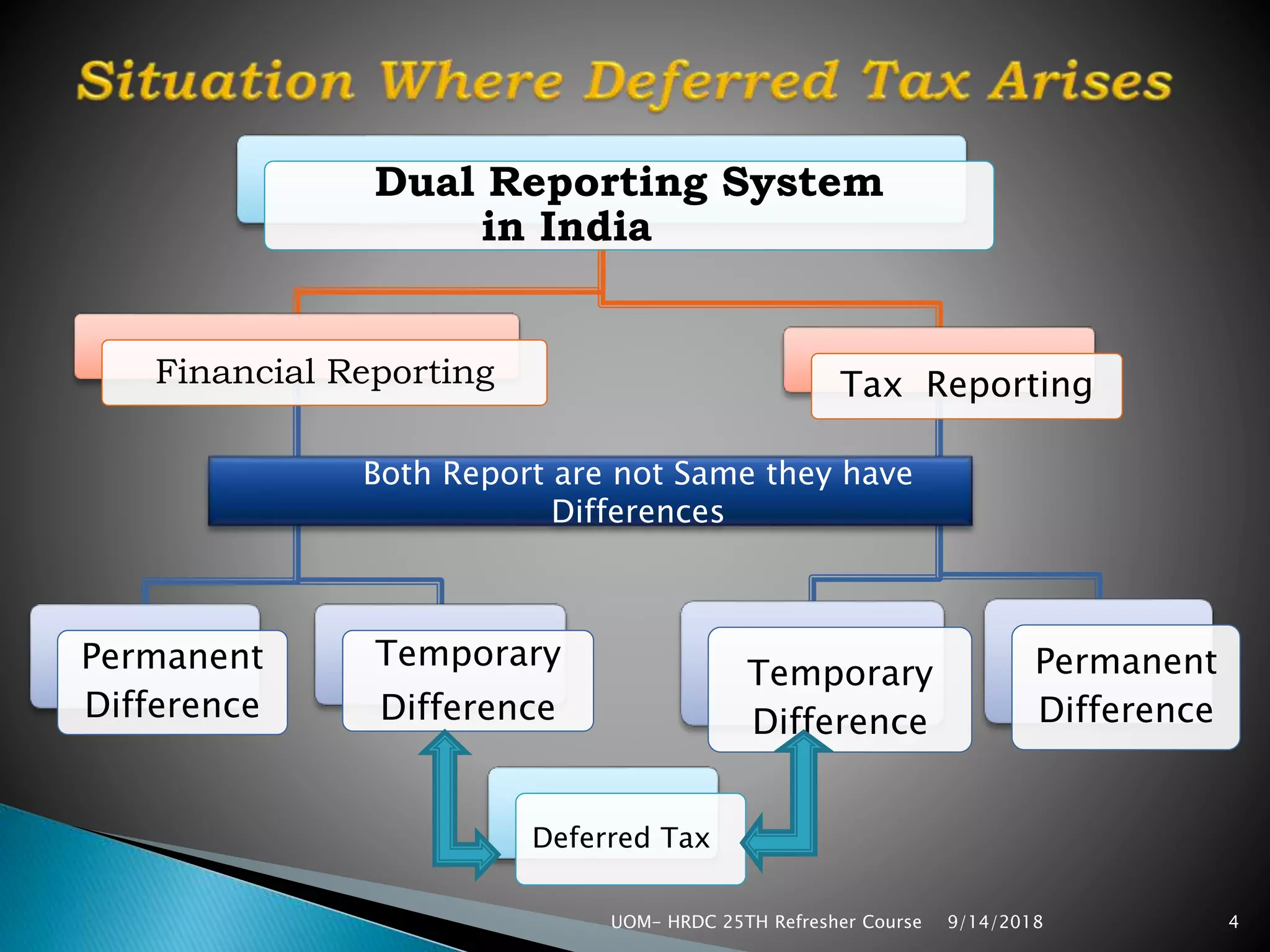
Dual Reporting System
in India
Financial Reporting
Permanent
Difference
Temporary
Difference
Tax Reporting
Temporary
Difference
Permanent
Difference
Deferred Tax
9/14/2018UOM- HRDC 25TH Refresher Course 4
Both Report are not Same they have
Differences
9/14/2018UOM- HRDC 25TH Refersher Course 5
Difference between Accounting Income and Taxable Income
 Difference in Allowances of Expenses in Income Tax act
Provision for Doubtful Debts
Charging Depreciation
Accrual Basis v/s Receipt Basis
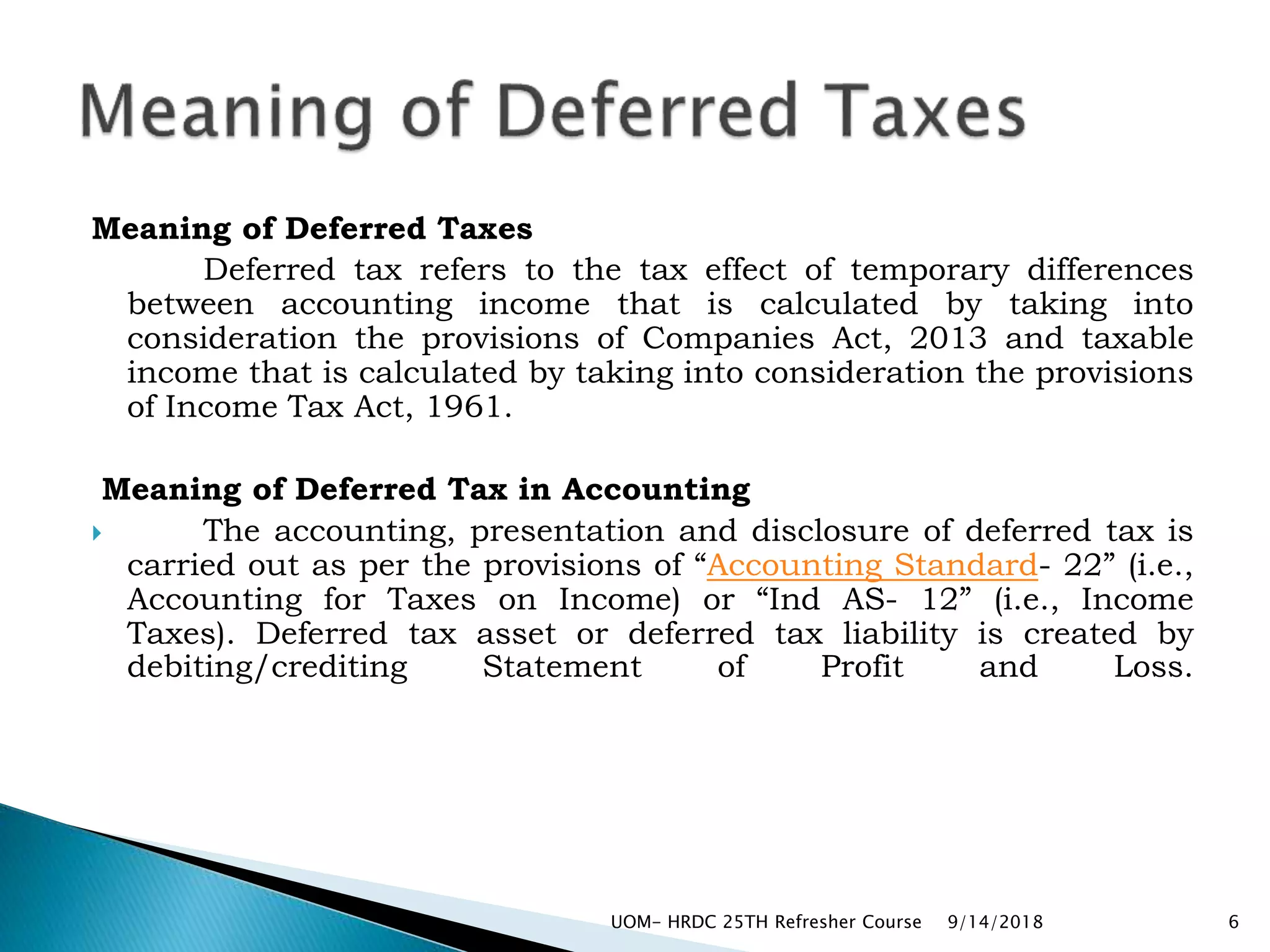
Meaning of Deferred Taxes
Deferred tax refers to the tax effect of temporary differences
between accounting income that is calculated by taking into
consideration the provisions of Companies Act, 2013 and taxable
income that is calculated by taking into consideration the provisions
of Income Tax Act, 1961.
Meaning of Deferred Tax in Accounting
 The accounting, presentation and disclosure of deferred tax is
carried out as per the provisions of “Accounting Standard- 22” (i.e.,
Accounting for Taxes on Income) or “Ind AS- 12” (i.e., Income
Taxes). Deferred tax asset or deferred tax liability is created by
debiting/crediting Statement of Profit and Loss.
9/14/2018UOM- HRDC 25TH Refresher Course 6
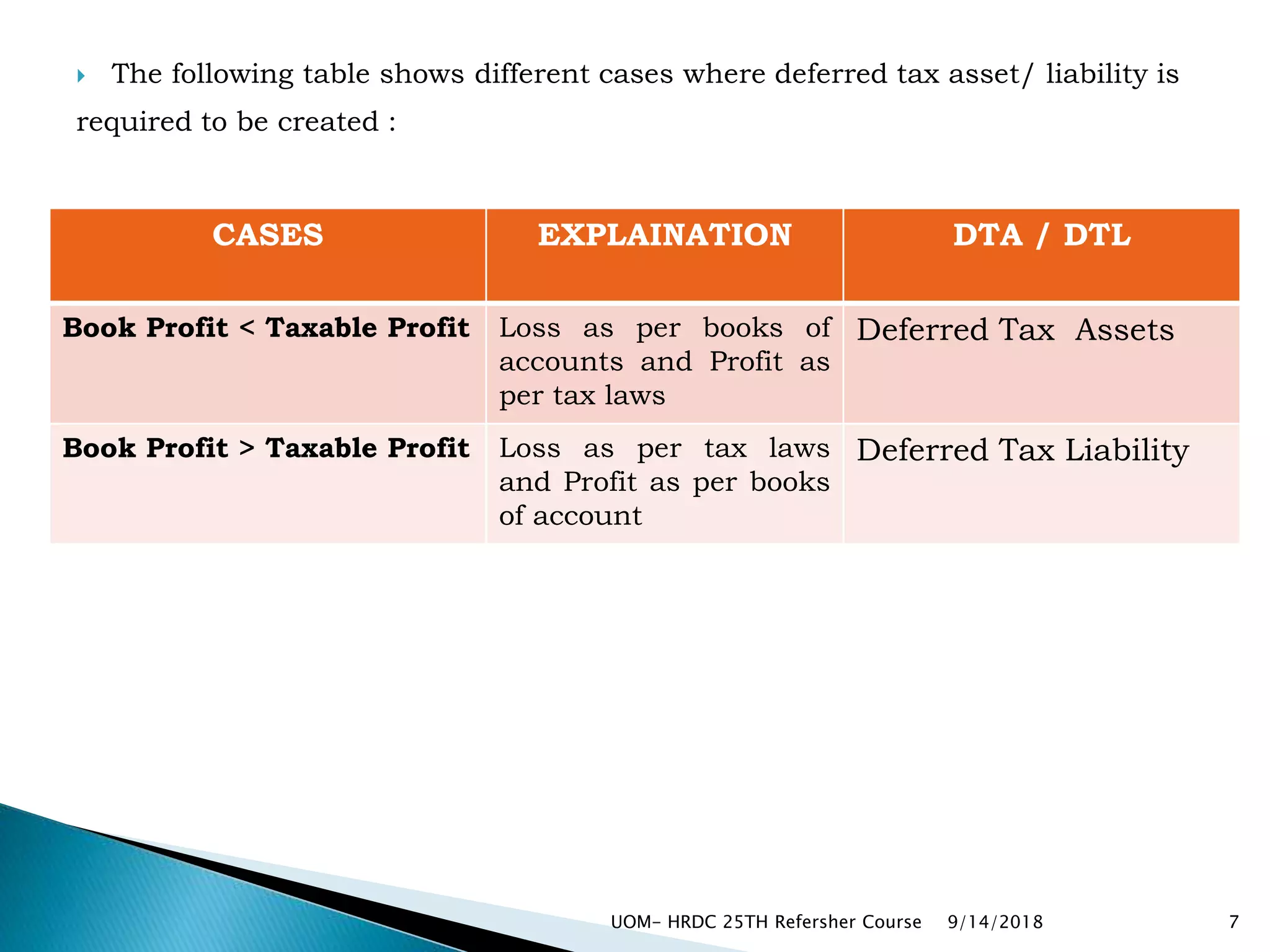
 The following table shows different cases where deferred tax asset/ liability is
required to be created :
9/14/2018UOM- HRDC 25TH Refersher Course 7
CASES EXPLAINATION DTA / DTL
Book Profit < Taxable Profit Loss as per books of
accounts and Profit as
per tax laws
Deferred Tax Assets
Book Profit > Taxable Profit Loss as per tax laws
and Profit as per books
of account
Deferred Tax Liability
 The book entries of deferred tax is very simple. We have to
create Deferred Tax liability A/c or Deferred Tax Asset A/c by
debiting or crediting Profit & Loss A/c respectively.
 The Deferred Tax is created at normal tax rate.
[1] Profit & Loss A/c Dr
To Deferred Tax Liability A/c
[2] Deferred Tax Asset A/c
To Profit & Loss A/c
Please, note that both the entries are not passed but only liability
or asset is created for net amount of deferred tax.
 If book profit is greater than taxable profit, create deferred tax
liability.
 If book profit is less than taxable profit, create deferred tax
asset.
9/14/2018UOM- HRDC 25TH Refresher Course 8
Income as per Books of Accounts
of Company
Income as per Books of IT
Authorities
Revenues 50,00,000-00 Revenues 50,00,000-00
Expenses as per
Books
10,00,000-00 Expenses as per
IT Authorities
12,00,000-00
Taxable Income 40,00,000-00 Taxable Income 38,00,000-00
Tax @ 30% 12,00,000-00 Tax @ 30% 11,40,000-00
9/14/2018UOM- HRDC 25TH Refresher Course 9
Less Tax Payable 60,000-00 as per IT authorities
Income as per Books of Accounts
of Company
Income as per Books of IT
Authorities
Revenues 50,00,000-00 Revenues 50,00,000-00
Expenses as per
Books
10,00,000-00 Expenses as per
IT Authorities
8,00,000-00
Taxable Income 40,00,000-00 Taxable Income 42,00,000-00
Tax @ 30% 12,00,000-00 Tax @ 30% 12,60,000-00
9/14/2018UOM- HRDC 25TH Refresher Course 10
Excess Tax Payable 60,000-00 as per IT authorities
9/14/2018UOM- HRDC 25TH Refresher Course 11

Deferred Tax Assets & Deferred Tax Liability

  • 1.
  • 2.
    Dual reporting systemis in existence in India, one for financial reporting and other for tax reporting. Many a time there are difference between the income reported by a company to investors and the income reported to tax authorities for assessing the tax liability company. The former, known as Book Income, is determined in accordance with the Generally Accepted Accounting Principle and the provision of the Companies Act 1956 whereas the latter, known as Taxable Income is computed as per the provision of Income tax 1961. 9/14/2018UOM- HRDC 25TH Refresher Course 2
  • 3.
    Matching concept isa very significant concept of accounting. According to this concept income and expense must be recognised in the period to which they relate. In India, Profit & Loss is computed in accordance with two different sets of provision one set is Profit & Loss as per Companies Act, 2013 (earlier it was Companies Act, 1956) and second one is Profit & Loss as per Income Tax Act, 1961 (for the purpose of computing taxable income). Generally there is difference between Profit & Loss computed as per above mentioned two different set of provisions. The root cause of this difference is different treatment of some items of expenditure/income under both set of provisions (i.e. Companies Act, 2013 and Income Tax Act, 1961). Some expenditure which are allowed to be deducted under Companies Act, 2013, may not be allowed to be deducted under Income Tax Act, 1961 while computing the taxable income. Matching concept of accounting and different treatment of expenditure/income under above mentioned both Act gives rise to the concept of Deferred Tax and accordingly ICAI issues an Accounting Standard-22 “Accounting for Taxes on Income”, to prescribe the accounting treatment for taxes on income since it is a very significant item in the Statement of profit & Loss of an entity. 9/14/2018UOM- HRDC 25TH Refersher Course 3
  • 4.
    Dual Reporting System inIndia Financial Reporting Permanent Difference Temporary Difference Tax Reporting Temporary Difference Permanent Difference Deferred Tax 9/14/2018UOM- HRDC 25TH Refresher Course 4 Both Report are not Same they have Differences
  • 5.
    9/14/2018UOM- HRDC 25THRefersher Course 5 Difference between Accounting Income and Taxable Income  Difference in Allowances of Expenses in Income Tax act Provision for Doubtful Debts Charging Depreciation Accrual Basis v/s Receipt Basis
  • 6.
    Meaning of DeferredTaxes Deferred tax refers to the tax effect of temporary differences between accounting income that is calculated by taking into consideration the provisions of Companies Act, 2013 and taxable income that is calculated by taking into consideration the provisions of Income Tax Act, 1961. Meaning of Deferred Tax in Accounting  The accounting, presentation and disclosure of deferred tax is carried out as per the provisions of “Accounting Standard- 22” (i.e., Accounting for Taxes on Income) or “Ind AS- 12” (i.e., Income Taxes). Deferred tax asset or deferred tax liability is created by debiting/crediting Statement of Profit and Loss. 9/14/2018UOM- HRDC 25TH Refresher Course 6
  • 7.
     The followingtable shows different cases where deferred tax asset/ liability is required to be created : 9/14/2018UOM- HRDC 25TH Refersher Course 7 CASES EXPLAINATION DTA / DTL Book Profit < Taxable Profit Loss as per books of accounts and Profit as per tax laws Deferred Tax Assets Book Profit > Taxable Profit Loss as per tax laws and Profit as per books of account Deferred Tax Liability
  • 8.
     The bookentries of deferred tax is very simple. We have to create Deferred Tax liability A/c or Deferred Tax Asset A/c by debiting or crediting Profit & Loss A/c respectively.  The Deferred Tax is created at normal tax rate. [1] Profit & Loss A/c Dr To Deferred Tax Liability A/c [2] Deferred Tax Asset A/c To Profit & Loss A/c Please, note that both the entries are not passed but only liability or asset is created for net amount of deferred tax.  If book profit is greater than taxable profit, create deferred tax liability.  If book profit is less than taxable profit, create deferred tax asset. 9/14/2018UOM- HRDC 25TH Refresher Course 8
  • 9.
    Income as perBooks of Accounts of Company Income as per Books of IT Authorities Revenues 50,00,000-00 Revenues 50,00,000-00 Expenses as per Books 10,00,000-00 Expenses as per IT Authorities 12,00,000-00 Taxable Income 40,00,000-00 Taxable Income 38,00,000-00 Tax @ 30% 12,00,000-00 Tax @ 30% 11,40,000-00 9/14/2018UOM- HRDC 25TH Refresher Course 9 Less Tax Payable 60,000-00 as per IT authorities
  • 10.
    Income as perBooks of Accounts of Company Income as per Books of IT Authorities Revenues 50,00,000-00 Revenues 50,00,000-00 Expenses as per Books 10,00,000-00 Expenses as per IT Authorities 8,00,000-00 Taxable Income 40,00,000-00 Taxable Income 42,00,000-00 Tax @ 30% 12,00,000-00 Tax @ 30% 12,60,000-00 9/14/2018UOM- HRDC 25TH Refresher Course 10 Excess Tax Payable 60,000-00 as per IT authorities
  • 11.
    9/14/2018UOM- HRDC 25THRefresher Course 11