ARGUS II
RETINAL PROSTHESIS SYSTEM
BY:-
RINKA SANATAN PRAMANIK
201406100210142
INTEGATED M.Sc BIOTECHNOLOGY
SEMESTER VIII
C.G.BHAKTA INSTITUTE OF BIOTECHNOLOGY
UKA TARSADIA UNIVERSITY
CONTENET
2
 Introduction
 Retinal pigmentosa
 Normal v/s Artificial vision
 Component of Argus II
 Working of Argus II
 Benefits of the Argus II System
 Limitations of the Argus II System
 Reference
Introduction
3
 Argus II is an electronic retinal implant
 It is manufactured by the American company Second Sight
Medical Products
 The technology and development of Argus II was pioneered
by Mark Humayun
 Argus II retinal prosthesis aimed at partially restoring vision
to people blinded by retinal degenerative diseases such as
retinitis pigmentosa (RP).
 Argus II retinal prosthesis system received CE (Conformité
Européenne) marking in March 2011 and the Food and
Drug Administration (FDA) approval in February 2013
Retinitis Pigmentosa
4
Source : the-health-wellness-blog.blogspot.in
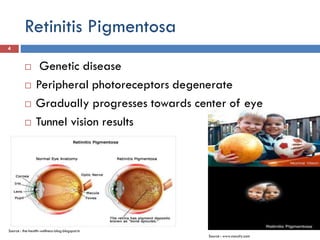
 Genetic disease
 Peripheral photoreceptors degenerate
 Gradually progresses towards center of eye
 Tunnel vision results
Source : www.nacuity.com
Normal v/s Artificial Vision
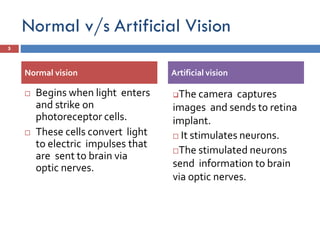
 Begins when light enters
and strike on
photoreceptor cells.
 These cells convert light
to electric impulses that
are sent to brain via
optic nerves.
The camera captures
images and sends to retina
implant.
 It stimulates neurons.
The stimulated neurons
send information to brain
via optic nerves.
5
Normal vision Artificial vision
6
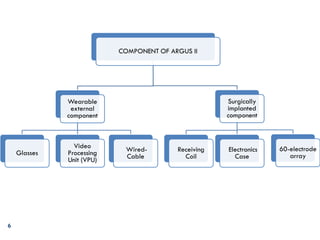
COMPONENT OF ARGUS II
Wearable
external
component
Glasses
Video
Processing
Unit (VPU)
Wired-
Cable
Surgically
implanted
component
Receiving
Coil
Electronics
Case
60-electrode
array
Component of Argus II
7
Source: www.pinterest.com
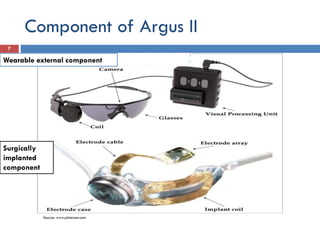
Wearable external component
Surgically
implanted
component
External component of Argus II
8
 The external component is comprised of
1. Glasses
2. Video Processing Unit (VPU)
3. Wired-cable
9
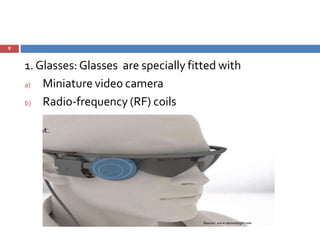
1. Glasses: Glasses are specially fitted with
a) Miniature video camera
b) Radio-frequency (RF) coils
Source : www.secondsight.com
10
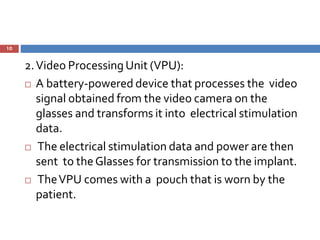
2.Video ProcessingUnit (VPU):
 A battery-powered device that processes the video
signal obtained from the video camera on the
glasses and transforms it into electrical stimulation
data.
 The electrical stimulation data and power are then
sent to theGlasses for transmission to the implant.
 TheVPU comes with a pouch that is worn by the
patient.
Implanted component of Argus II
11
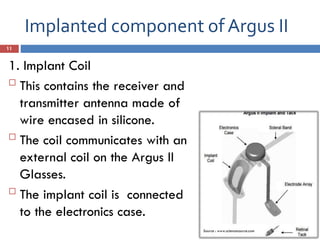
1. Implant Coil

This contains the receiver and
transmitter antenna made of
wire encased in silicone.

The coil communicates with an
external coil on the Argus II
Glasses.

The implant coil is connected
to the electronics case.
Source : www.sciencesource.com
12
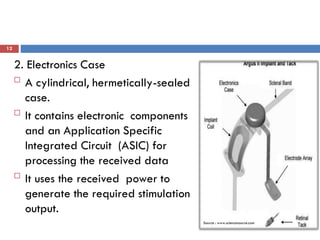
2. Electronics Case

A cylindrical, hermetically-sealed
case.

It contains electronic components
and an Application Specific
Integrated Circuit (ASIC) for
processing the received data

It uses the received power to
generate the required stimulation
output.
Source : www.sciencesource.com
13
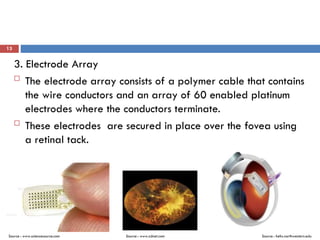
3. Electrode Array

The electrode array consists of a polymer cable that contains
the wire conductors and an array of 60 enabled platinum
electrodes where the conductors terminate.

These electrodes are secured in place over the fovea using
a retinal tack.
Source : helix.northwestern.eduSource : www.sciencesource.com Source : www.zdnet.com
14
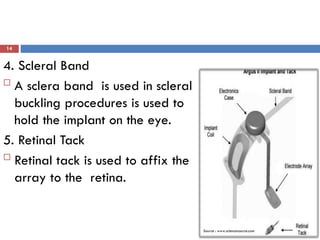
4. Scleral Band

A sclera band is used in scleral
buckling procedures is used to
hold the implant on the eye.
5. Retinal Tack

Retinal tack is used to affix the
array to the retina.
Source : www.sciencesource.com
Working of Argus II
15
Source : http://www.digibod.com/archives/1763
Working mechanism of retinal prosthetic
system
Benefits of the Argus II System
16
The Argus II System can improve patient’s orientation and
mobility, activities of daily living, and well-being:
 Locate doors and windows
 Sort light and dark clothes
 Avoid obstacles
 Feel more socially connected
 Enjoy being “visual” again
 Tracking players on a field
 Watching fireworks
Current Status
17
 45 clinical centers
 13 Countries(United States, UK , Canada,
Germany, France, Spain, Italy, Iran, Turkey,
Holland, Tiawan, Saudi Arabia and South Korea)
 Over 230 implant surgeries worldwide (May 17)
Limitations of the Argus II System
18
 Surgery is required to implant the electrode array.
 Repairing is difficult if any of the devices got
damaged.
 Those who lost their visions due to other reasons
could not use this device.
 The approximated cost of the device is
US$150,000
References
19
 A K Ahuja, J D Dorn, A Caspi, M J McMahon, G Dagnelie, L daCruz, P
Stanga, M S Humayun, R J Greenberg. Blind subjects implanted with the
Argus II retinal prosthesis are able to improve performance in a spatial-motor
task. British Journal Ophthalmol 2011.95:539e543
 Chuang. A. T, Margo. C. E, Greenberg. P. B. (2014). Retinal implants: a
systematic review. The British Journal of Ophthalmology. 98 (7)
 Christiaan. S and Gislin D,(2014) The functional performance of the Argus II
retinal prosthesis, Expert Rev Med Devices. 11(1): 23–30
20
 Lyndon da Cruz, Brian F Coley,Jessy Dorn,Francesco Merlini,
Eugene Filley, Punita Christopher, Fred K Chen, Varalakshmi
Wuyyuru, Jose Sahel, Paulo Stanga, Mark Humayun, Robert J
Greenberg, Gislin Dagnelie. (2012). The Argus II epiretinal
prosthesis system allows letter and word reading and long-term
function in patients with profound vision loss. British Journal
Ophthalmol 0:1–5.
 Reddy V, Maldonado RS, Humayun MS, Hahn P (2015) Bionic
Eye: A Glance at the Argus II retinal prosthesis. Adv Ophthalmol
Vis Syst 2(3): 00044.
21 Thank you

ARGUS II

  • 1.
    ARGUS II RETINAL PROSTHESISSYSTEM BY:- RINKA SANATAN PRAMANIK 201406100210142 INTEGATED M.Sc BIOTECHNOLOGY SEMESTER VIII C.G.BHAKTA INSTITUTE OF BIOTECHNOLOGY UKA TARSADIA UNIVERSITY
  • 2.
    CONTENET 2  Introduction  Retinalpigmentosa  Normal v/s Artificial vision  Component of Argus II  Working of Argus II  Benefits of the Argus II System  Limitations of the Argus II System  Reference
  • 3.
    Introduction 3  Argus IIis an electronic retinal implant  It is manufactured by the American company Second Sight Medical Products  The technology and development of Argus II was pioneered by Mark Humayun  Argus II retinal prosthesis aimed at partially restoring vision to people blinded by retinal degenerative diseases such as retinitis pigmentosa (RP).  Argus II retinal prosthesis system received CE (Conformité Européenne) marking in March 2011 and the Food and Drug Administration (FDA) approval in February 2013
  • 4.
    Retinitis Pigmentosa 4 Source :the-health-wellness-blog.blogspot.in  Genetic disease  Peripheral photoreceptors degenerate  Gradually progresses towards center of eye  Tunnel vision results Source : www.nacuity.com
  • 5.
    Normal v/s ArtificialVision  Begins when light enters and strike on photoreceptor cells.  These cells convert light to electric impulses that are sent to brain via optic nerves. The camera captures images and sends to retina implant.  It stimulates neurons. The stimulated neurons send information to brain via optic nerves. 5 Normal vision Artificial vision
  • 6.
    6 COMPONENT OF ARGUSII Wearable external component Glasses Video Processing Unit (VPU) Wired- Cable Surgically implanted component Receiving Coil Electronics Case 60-electrode array
  • 7.
    Component of ArgusII 7 Source: www.pinterest.com Wearable external component Surgically implanted component
  • 8.
    External component ofArgus II 8  The external component is comprised of 1. Glasses 2. Video Processing Unit (VPU) 3. Wired-cable
  • 9.
    9 1. Glasses: Glassesare specially fitted with a) Miniature video camera b) Radio-frequency (RF) coils Source : www.secondsight.com
  • 10.
    10 2.Video ProcessingUnit (VPU): A battery-powered device that processes the video signal obtained from the video camera on the glasses and transforms it into electrical stimulation data.  The electrical stimulation data and power are then sent to theGlasses for transmission to the implant.  TheVPU comes with a pouch that is worn by the patient.
  • 11.
    Implanted component ofArgus II 11 1. Implant Coil  This contains the receiver and transmitter antenna made of wire encased in silicone.  The coil communicates with an external coil on the Argus II Glasses.  The implant coil is connected to the electronics case. Source : www.sciencesource.com
  • 12.
    12 2. Electronics Case  Acylindrical, hermetically-sealed case.  It contains electronic components and an Application Specific Integrated Circuit (ASIC) for processing the received data  It uses the received power to generate the required stimulation output. Source : www.sciencesource.com
  • 13.
    13 3. Electrode Array  Theelectrode array consists of a polymer cable that contains the wire conductors and an array of 60 enabled platinum electrodes where the conductors terminate.  These electrodes are secured in place over the fovea using a retinal tack. Source : helix.northwestern.eduSource : www.sciencesource.com Source : www.zdnet.com
  • 14.
    14 4. Scleral Band  Asclera band is used in scleral buckling procedures is used to hold the implant on the eye. 5. Retinal Tack  Retinal tack is used to affix the array to the retina. Source : www.sciencesource.com
  • 15.
    Working of ArgusII 15 Source : http://www.digibod.com/archives/1763 Working mechanism of retinal prosthetic system
  • 16.
    Benefits of theArgus II System 16 The Argus II System can improve patient’s orientation and mobility, activities of daily living, and well-being:  Locate doors and windows  Sort light and dark clothes  Avoid obstacles  Feel more socially connected  Enjoy being “visual” again  Tracking players on a field  Watching fireworks
  • 17.
    Current Status 17  45clinical centers  13 Countries(United States, UK , Canada, Germany, France, Spain, Italy, Iran, Turkey, Holland, Tiawan, Saudi Arabia and South Korea)  Over 230 implant surgeries worldwide (May 17)
  • 18.
    Limitations of theArgus II System 18  Surgery is required to implant the electrode array.  Repairing is difficult if any of the devices got damaged.  Those who lost their visions due to other reasons could not use this device.  The approximated cost of the device is US$150,000
  • 19.
    References 19  A KAhuja, J D Dorn, A Caspi, M J McMahon, G Dagnelie, L daCruz, P Stanga, M S Humayun, R J Greenberg. Blind subjects implanted with the Argus II retinal prosthesis are able to improve performance in a spatial-motor task. British Journal Ophthalmol 2011.95:539e543  Chuang. A. T, Margo. C. E, Greenberg. P. B. (2014). Retinal implants: a systematic review. The British Journal of Ophthalmology. 98 (7)  Christiaan. S and Gislin D,(2014) The functional performance of the Argus II retinal prosthesis, Expert Rev Med Devices. 11(1): 23–30
  • 20.
    20  Lyndon daCruz, Brian F Coley,Jessy Dorn,Francesco Merlini, Eugene Filley, Punita Christopher, Fred K Chen, Varalakshmi Wuyyuru, Jose Sahel, Paulo Stanga, Mark Humayun, Robert J Greenberg, Gislin Dagnelie. (2012). The Argus II epiretinal prosthesis system allows letter and word reading and long-term function in patients with profound vision loss. British Journal Ophthalmol 0:1–5.  Reddy V, Maldonado RS, Humayun MS, Hahn P (2015) Bionic Eye: A Glance at the Argus II retinal prosthesis. Adv Ophthalmol Vis Syst 2(3): 00044.
  • 21.