Artificial Intelligence 1: Planning in the real world Lecturer: Tom Lenaerts SWITCH, Vlaams Interuniversitair Instituut voor Biotechnologie
Outline Time, schedules and resources Hierarchical task network planning Non-deterministic domains Conditional planning Execution monitoring and replanning Continuous planning Multi-agent planning
Time, schedules and resources Until know:  what actions to do Real-world:  + actions occur at certain moments in time. + actions have a beginning and an end. + actions take a certain amount of time. Job-shop scheduling: Complete a  set of jobs , each of which consists of a  sequence of actions , Where each action has a given  duration  and might require  resources .  Determine a schedule that  minimizes the total time  required to complete all jobs (respecting resource constraints).
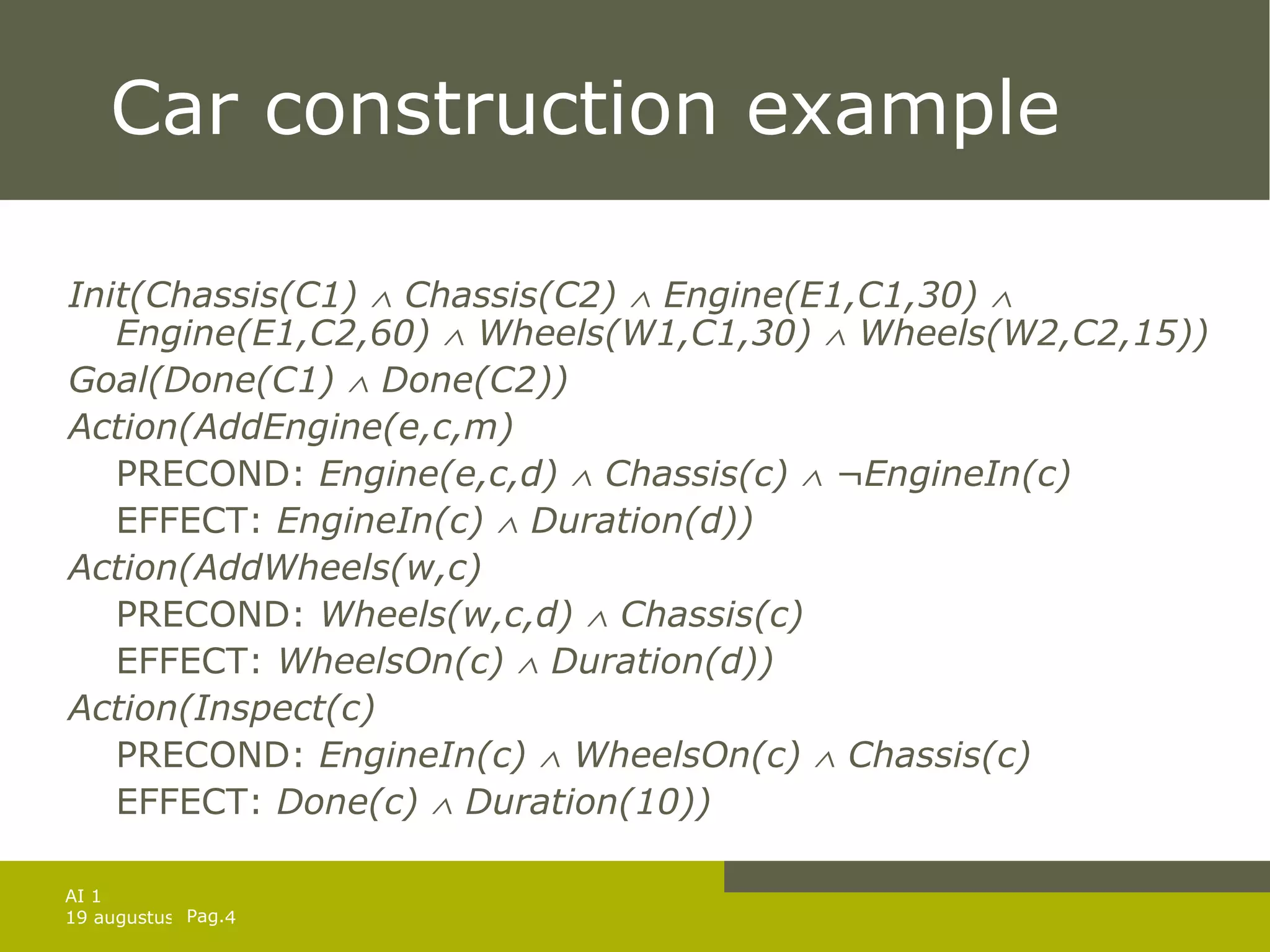
Car construction example Init(Chassis(C1)    Chassis(C2)    Engine(E1,C1,30)    Engine(E1,C2,60)    Wheels(W1,C1,30)    Wheels(W2,C2,15)) Goal(Done(C1)    Done(C2)) Action(AddEngine(e,c,m) PRECOND:  Engine(e,c,d)    Chassis(c)    ¬EngineIn(c) EFFECT:  EngineIn(c)    Duration(d))   Action(AddWheels(w,c) PRECOND:  Wheels(w,c,d)    Chassis(c) EFFECT:  WheelsOn(c)    Duration(d)) Action(Inspect(c) PRECOND:  EngineIn(c)    WheelsOn(c)    Chassis(c) EFFECT:  Done(c)    Duration(10))
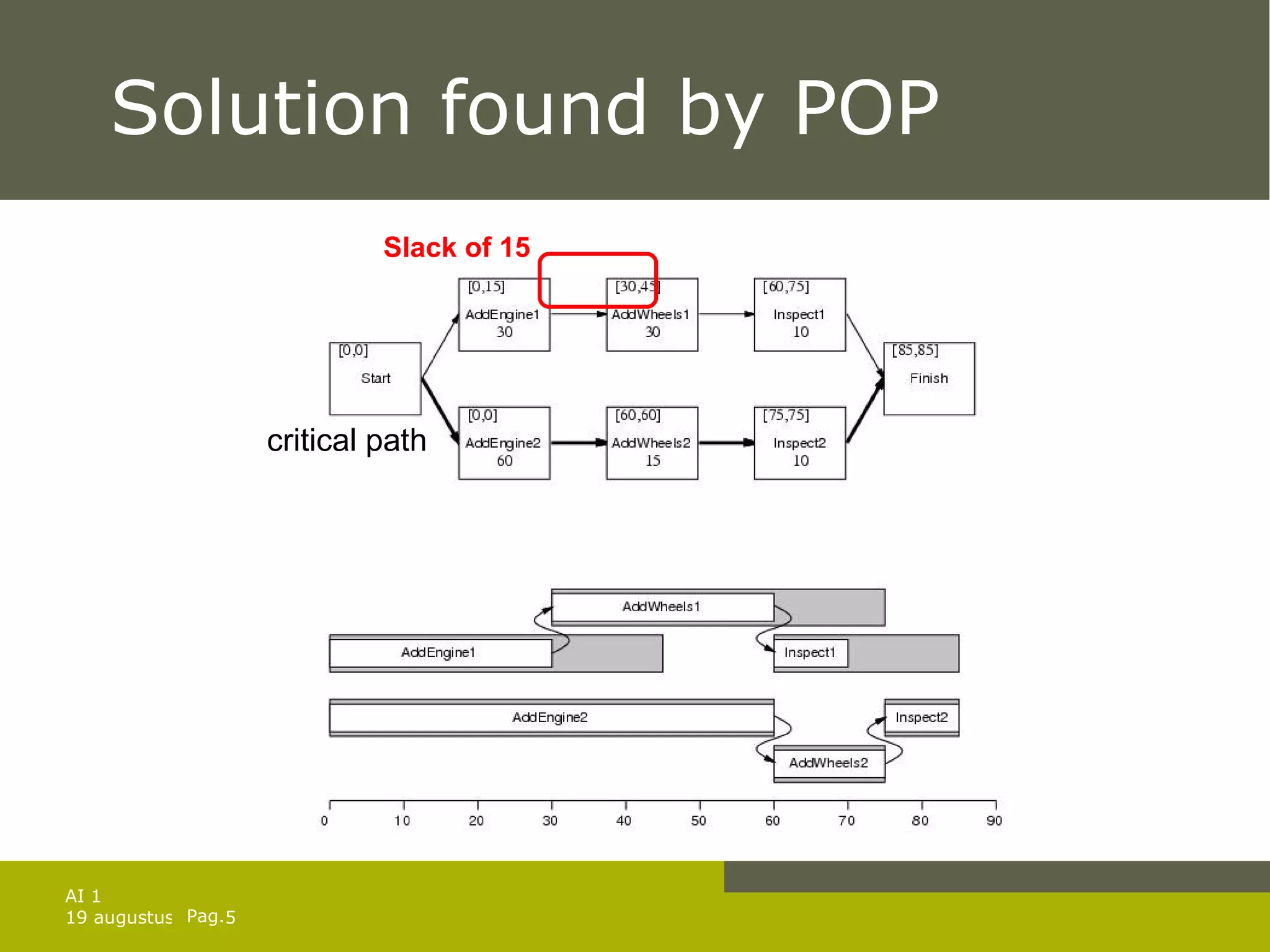
Solution found by POP Slack of 15 critical path
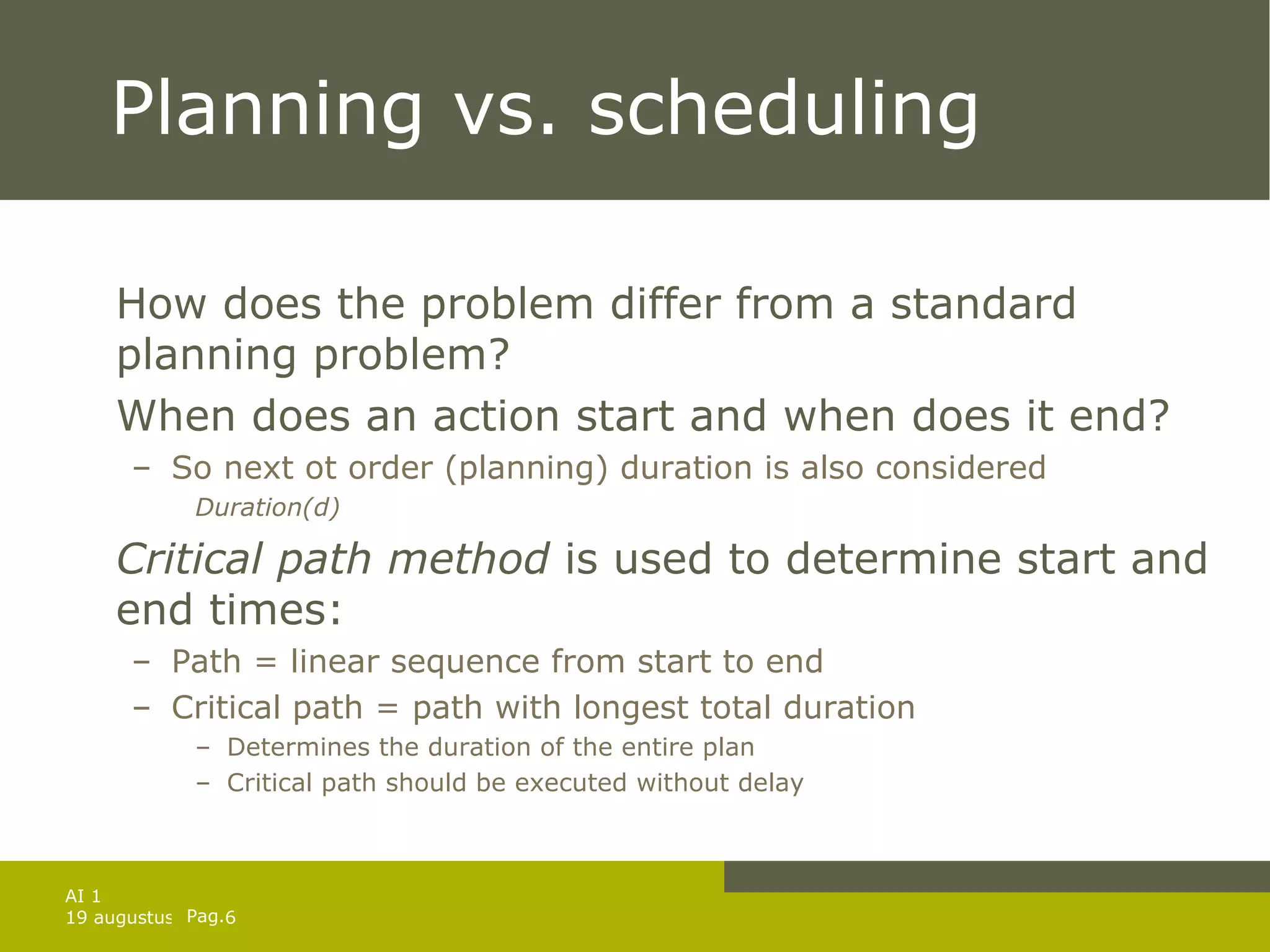
Planning vs. scheduling How does the problem differ from a standard planning problem? When does an action start and when does it end? So next ot order (planning) duration is also considered Duration(d) Critical path method  is used to determine start and end times: Path = linear sequence from start to end Critical path = path with longest total duration Determines the duration of the entire plan Critical path should be executed without delay
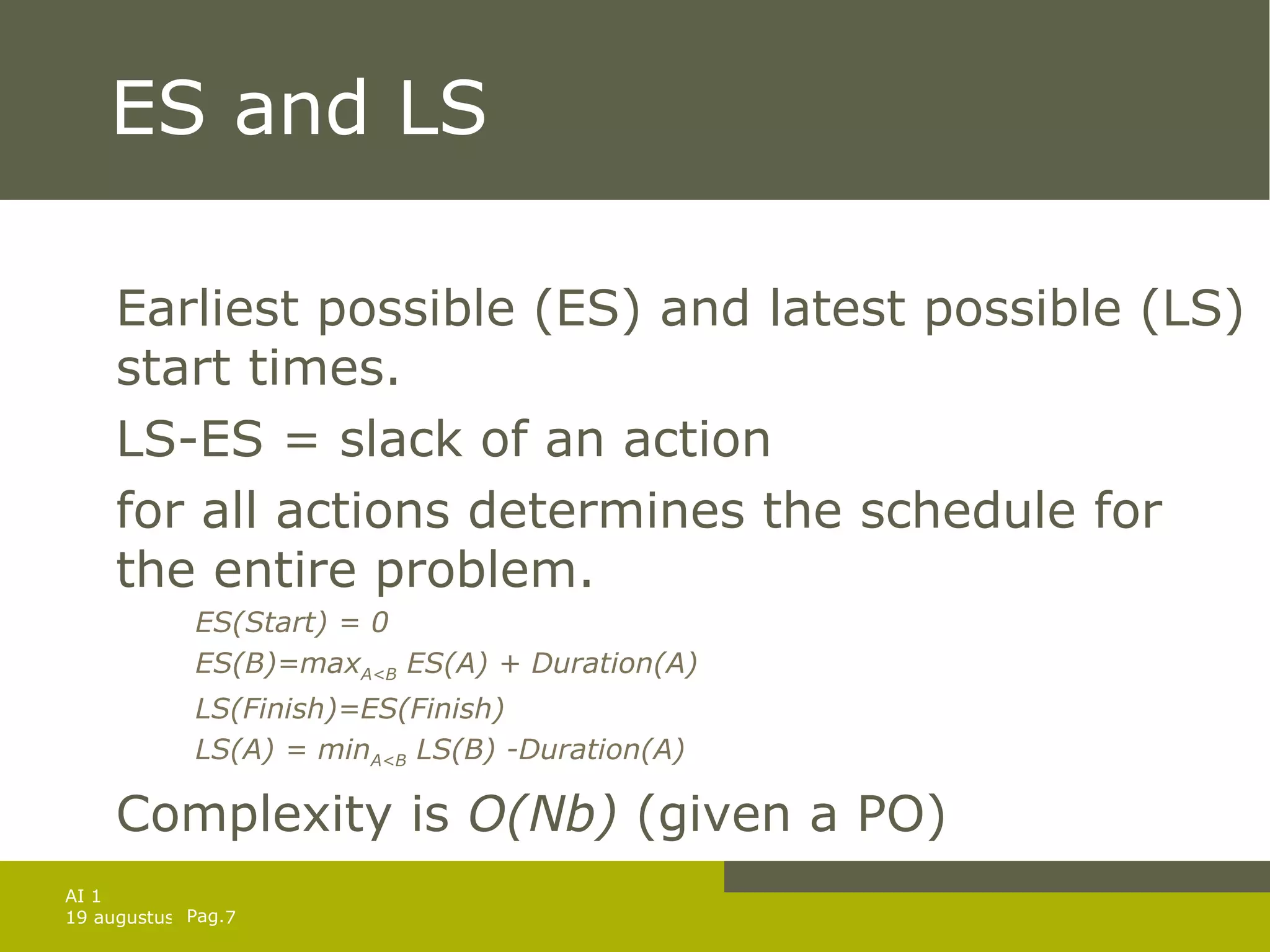
ES and LS Earliest possible (ES) and latest possible (LS) start times. LS-ES = slack of an action for all actions determines the schedule for the entire problem. ES(Start) = 0 ES(B)=max A<B  ES(A) + Duration(A) LS(Finish)=ES(Finish) LS(A) = min A<B  LS(B) -Duration(A) Complexity is  O(Nb)  (given a PO)
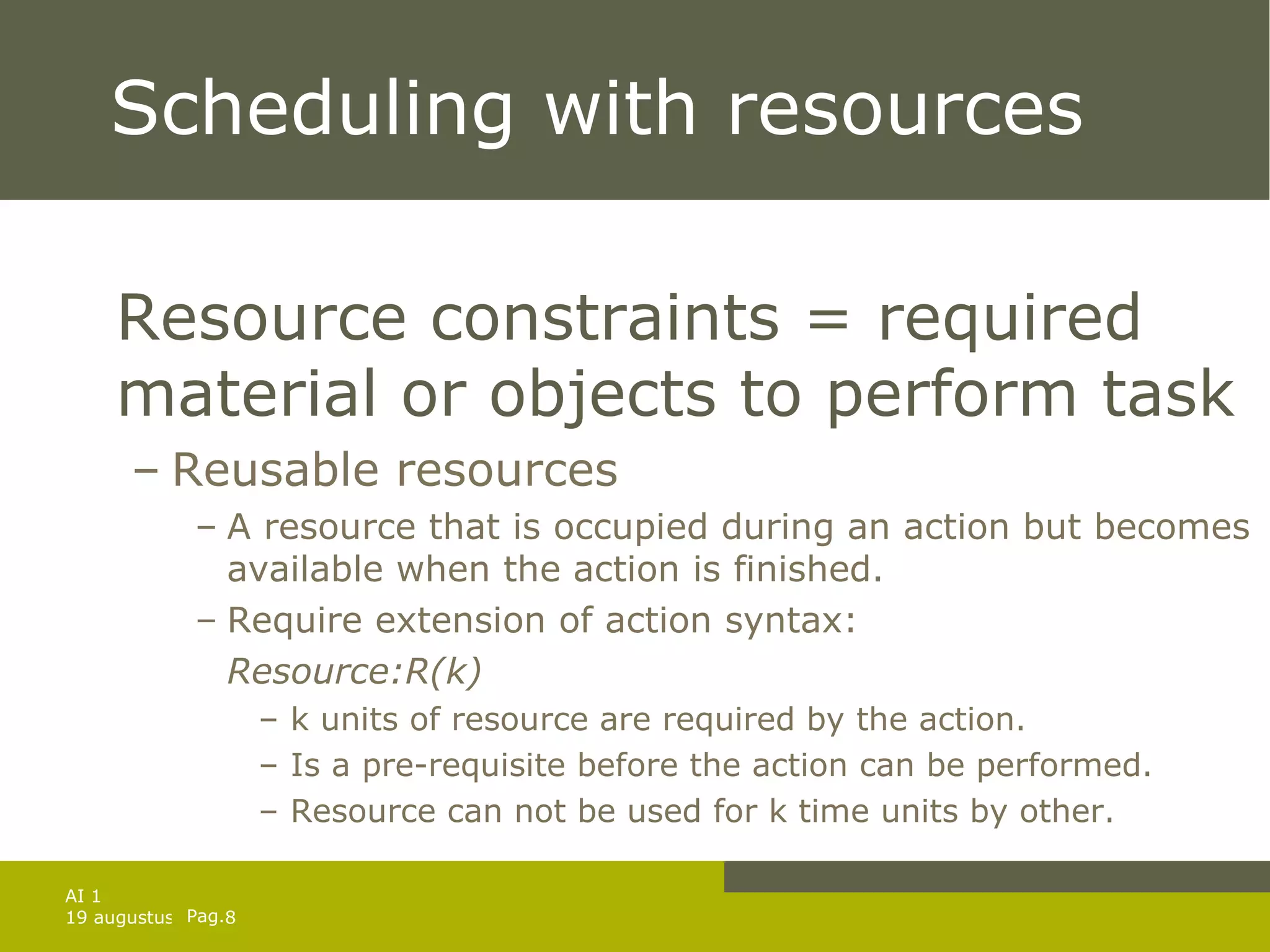
Scheduling with resources Resource constraints = required material or objects to perform task Reusable resources A resource that is occupied during an action but becomes available when the action is finished. Require extension of action syntax:  Resource:R(k) k units of resource are required by the action. Is a pre-requisite before the action can be performed. Resource can not be used for k time units by other.
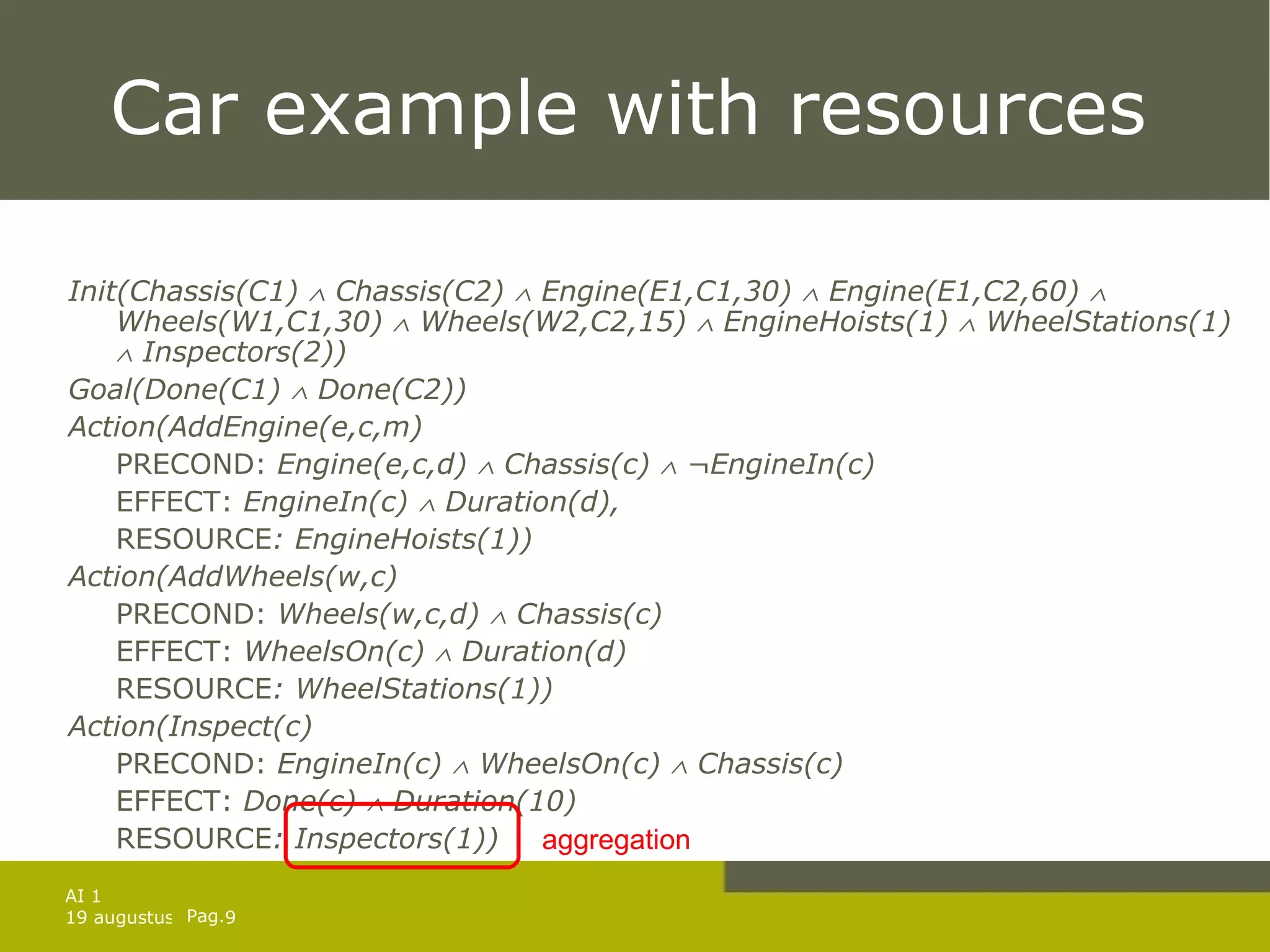
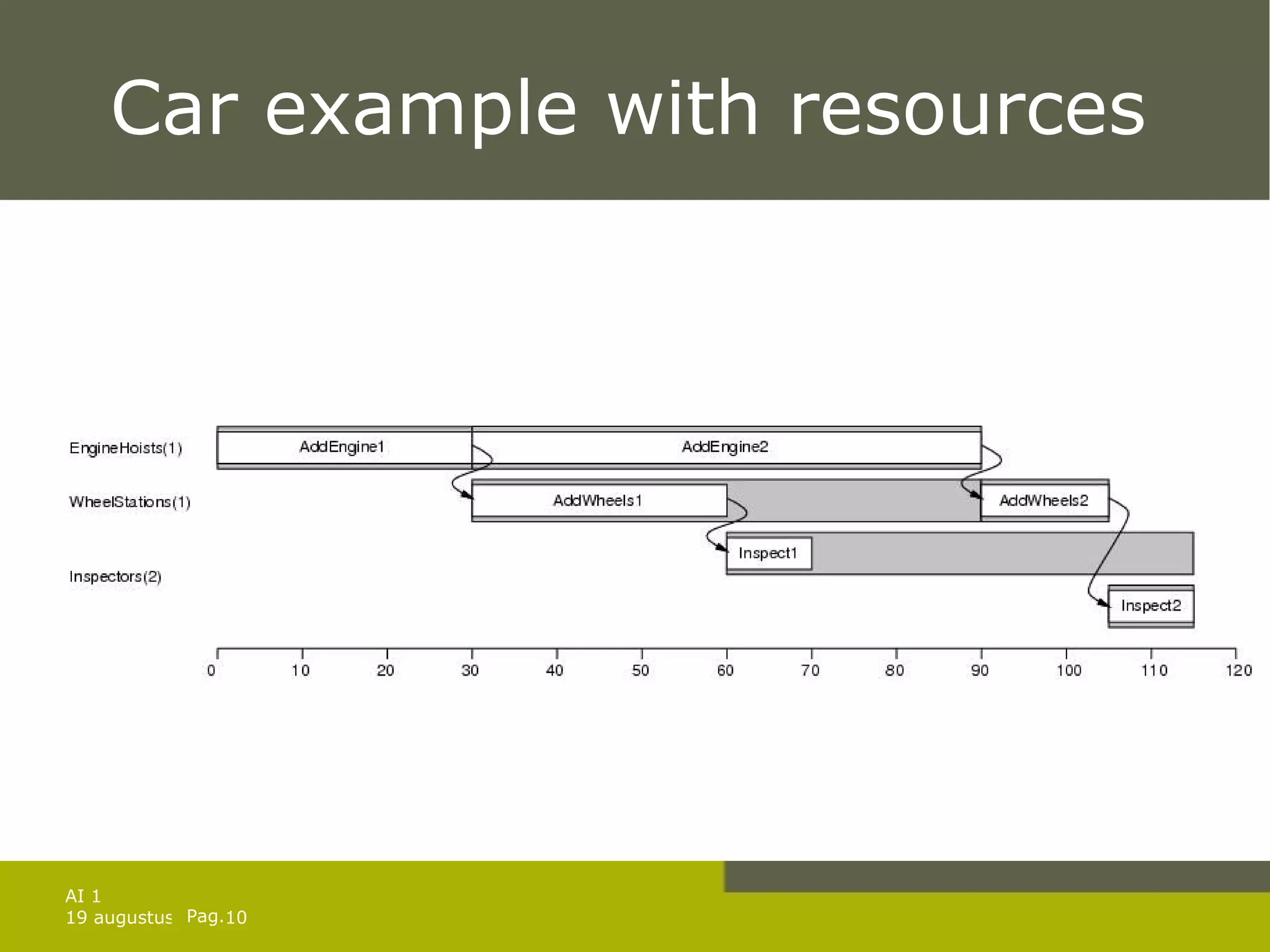
Car example with resources Init(Chassis(C1)    Chassis(C2)    Engine(E1,C1,30)    Engine(E1,C2,60)    Wheels(W1,C1,30)    Wheels(W2,C2,15)    EngineHoists(1)    WheelStations(1)    Inspectors(2)) Goal(Done(C1)    Done(C2)) Action(AddEngine(e,c,m) PRECOND:  Engine(e,c,d)    Chassis(c)    ¬EngineIn(c) EFFECT:  EngineIn(c)    Duration(d), RESOURCE : EngineHoists(1))   Action(AddWheels(w,c) PRECOND:  Wheels(w,c,d)    Chassis(c) EFFECT:  WheelsOn(c)    Duration(d) RESOURCE : WheelStations(1))   Action(Inspect(c) PRECOND:  EngineIn(c)    WheelsOn(c)    Chassis(c) EFFECT:  Done(c)    Duration(10) RESOURCE : Inspectors(1))   aggregation
Car example with resources
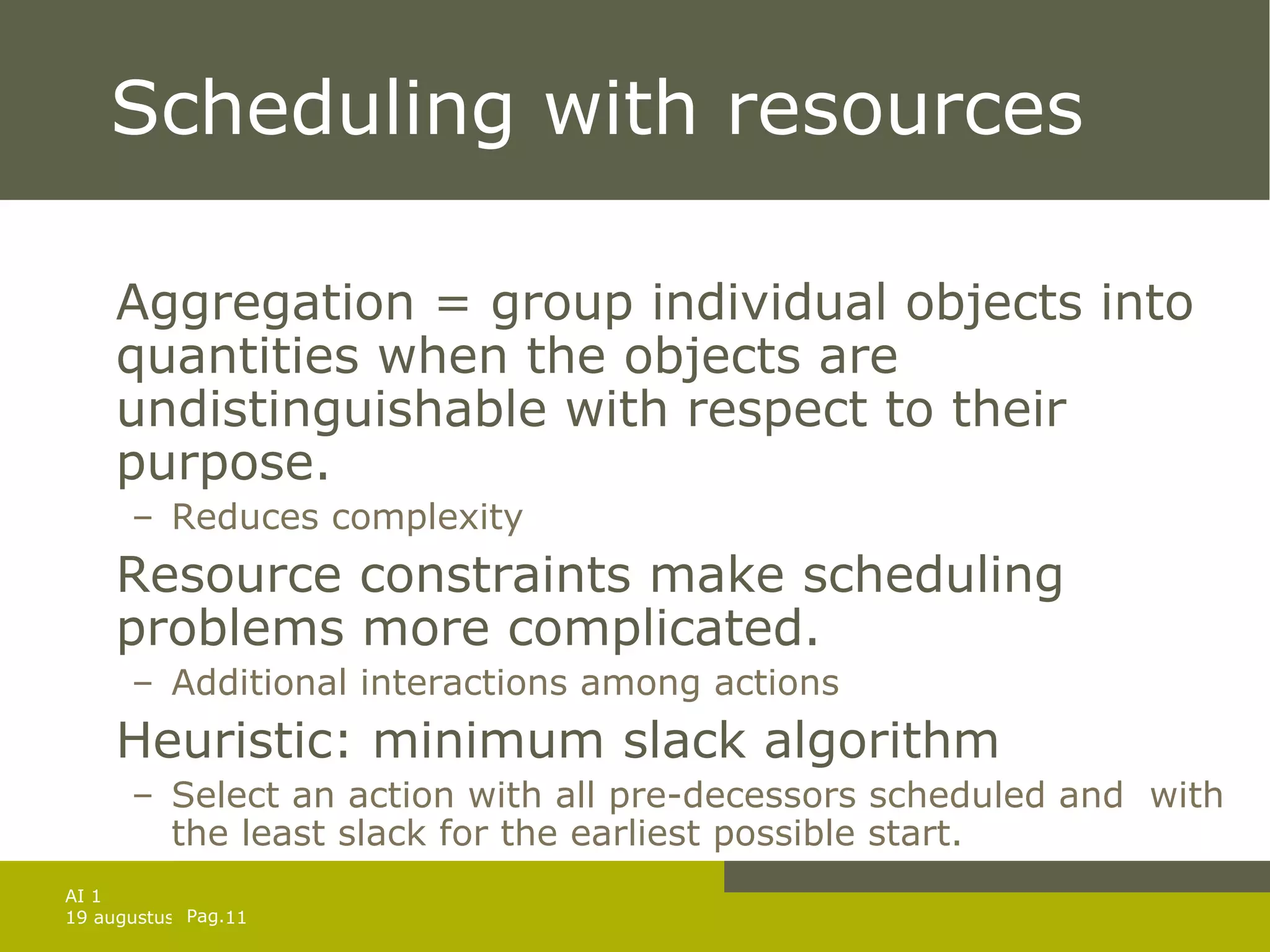
Scheduling with resources Aggregation = group individual objects into quantities when the objects are undistinguishable with respect to their purpose. Reduces complexity Resource constraints make scheduling problems more complicated. Additional interactions among actions Heuristic: minimum slack algorithm Select an action with all pre-decessors scheduled and  with the least slack for the earliest possible start.
Hierarchical task network planning Reduce complexity    hierarchical decomposition At each level of the hierarchy a computational task is reduced to a  small  number of activities at the next lower level. The computational cost of arranging these activities is low. Hierarchical task network (HTN) planning uses a  refinement  of actions through decomposition. e.g. building a house = getting a permit + hiring a contractor + doing the construction + paying the contractor. Refined until only primitive actions remain. Pure and hybrid HTN planning.
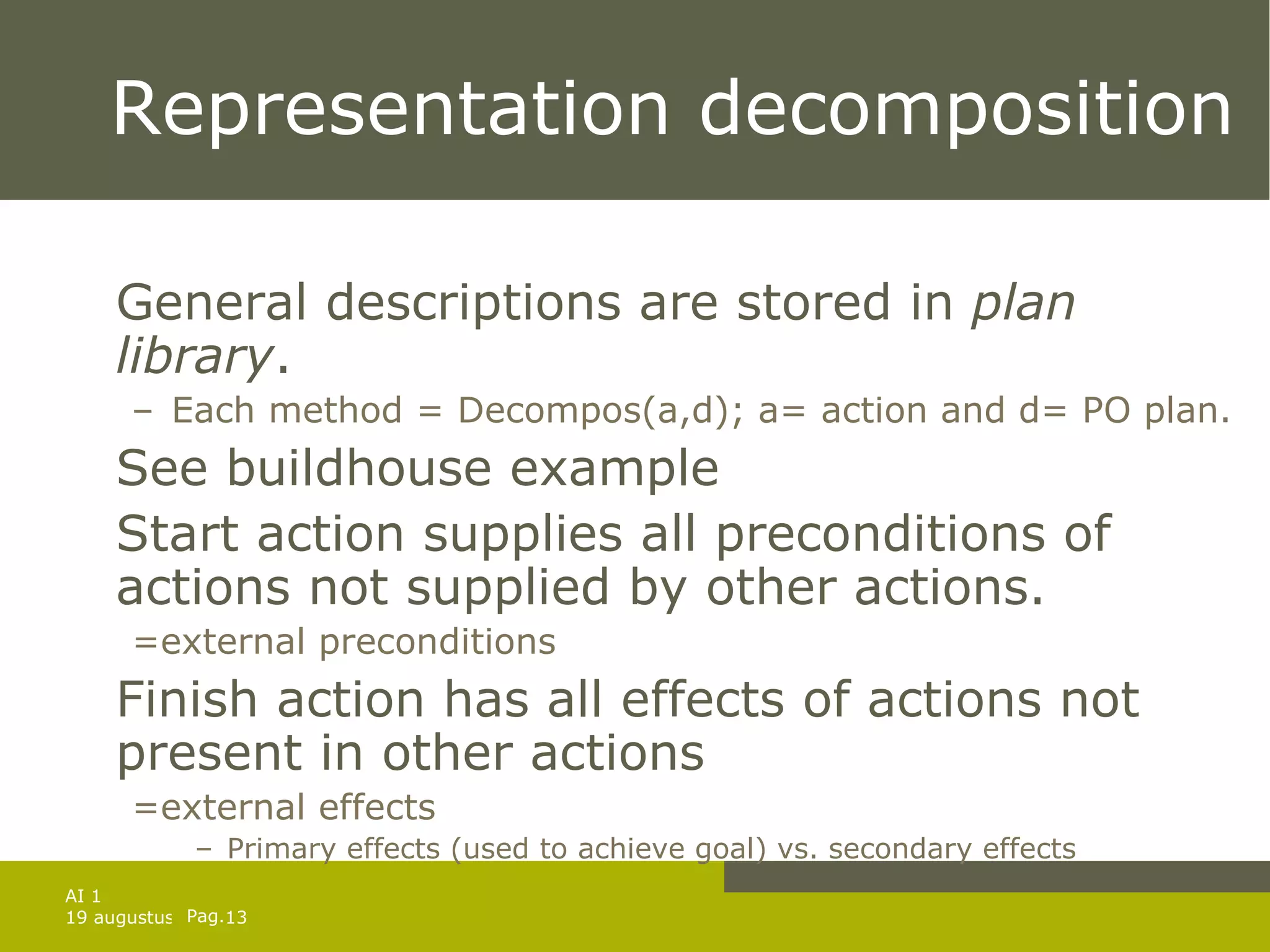
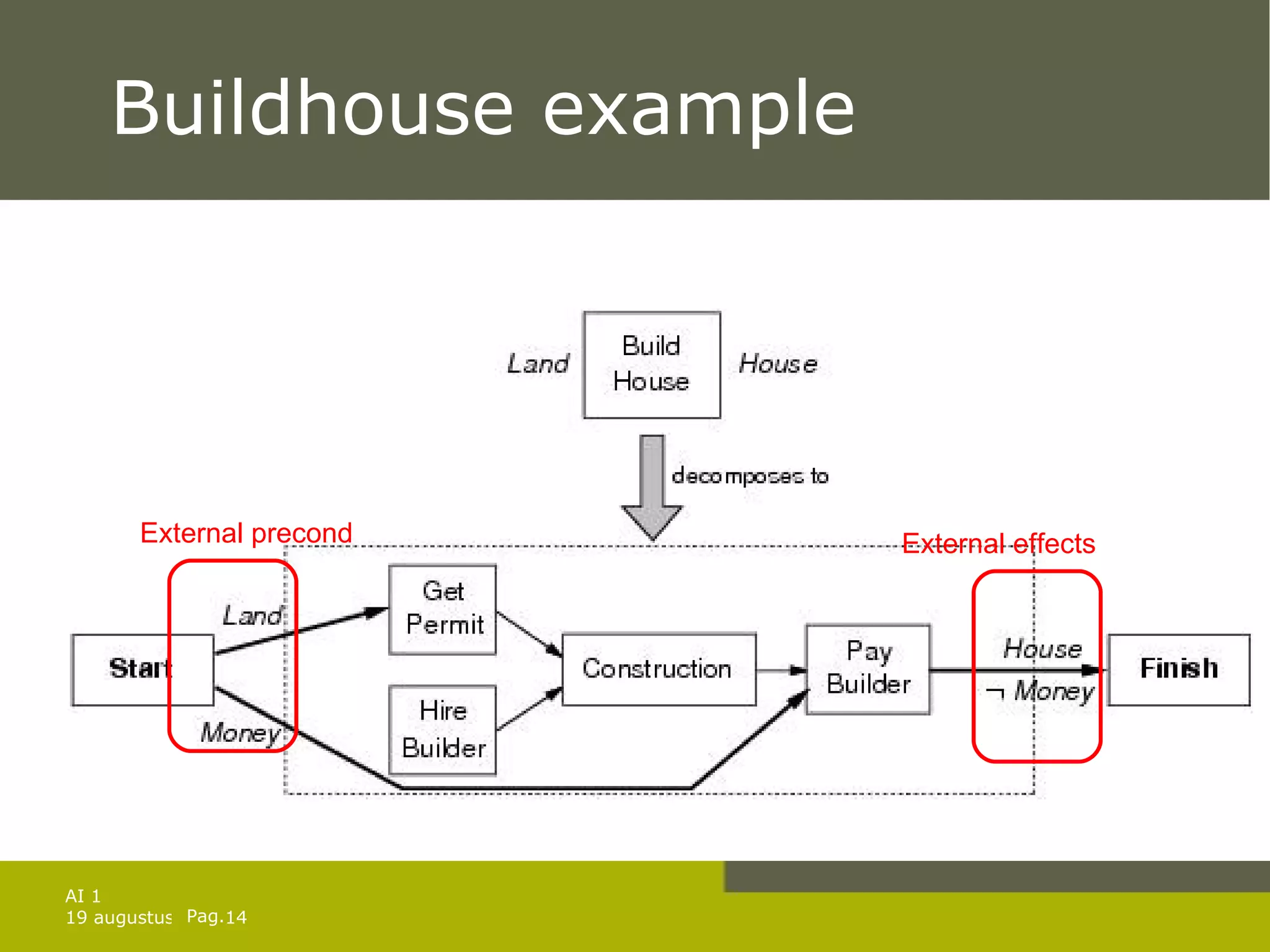
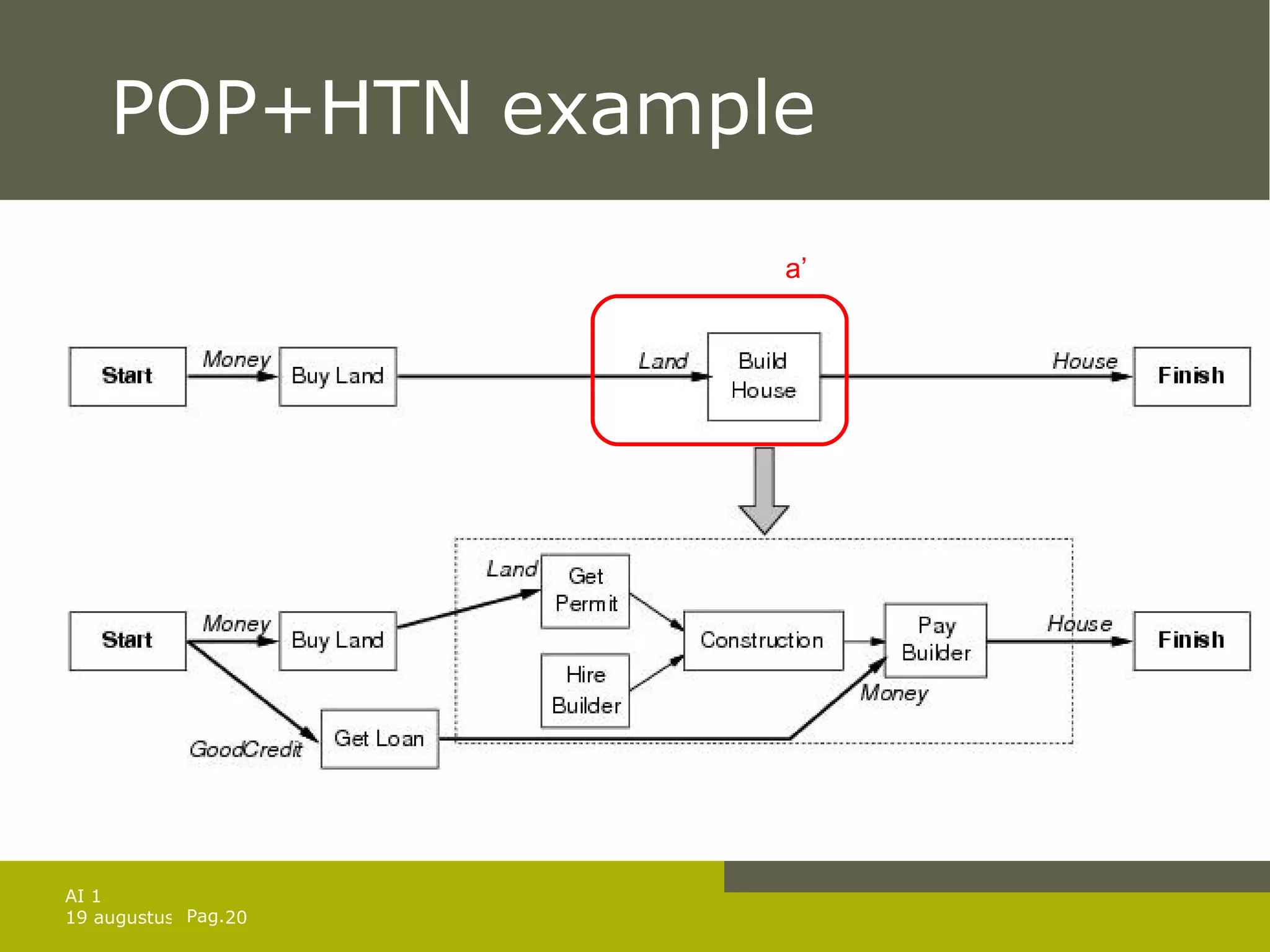
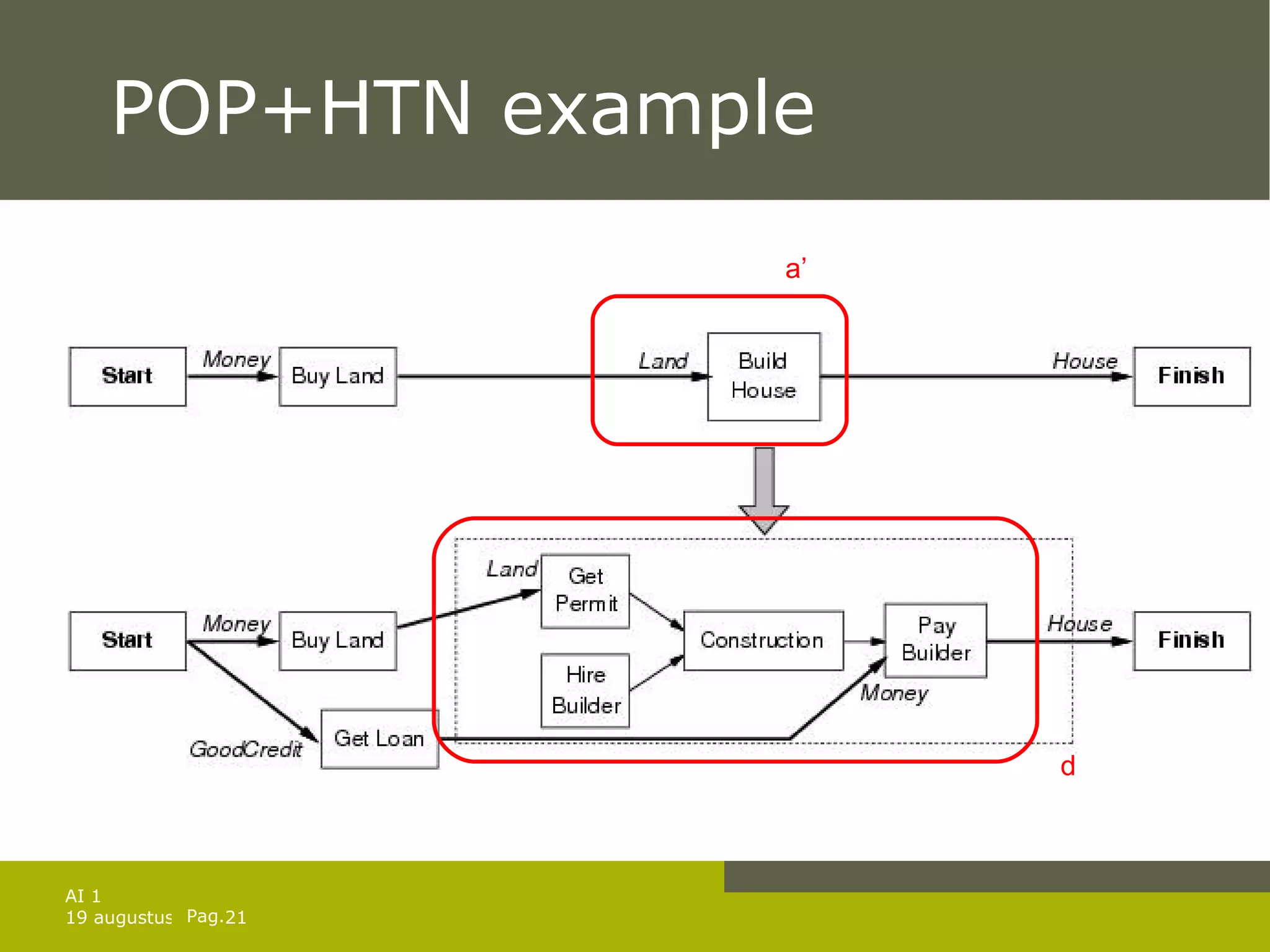
Representation decomposition General descriptions are stored in  plan library . Each method = Decompos(a,d); a= action and d= PO plan. See buildhouse example Start action supplies all preconditions of actions not supplied by other actions. =external preconditions Finish action has all effects of actions not present in other actions =external effects Primary effects (used to achieve goal) vs. secondary effects
Buildhouse example External precond External effects
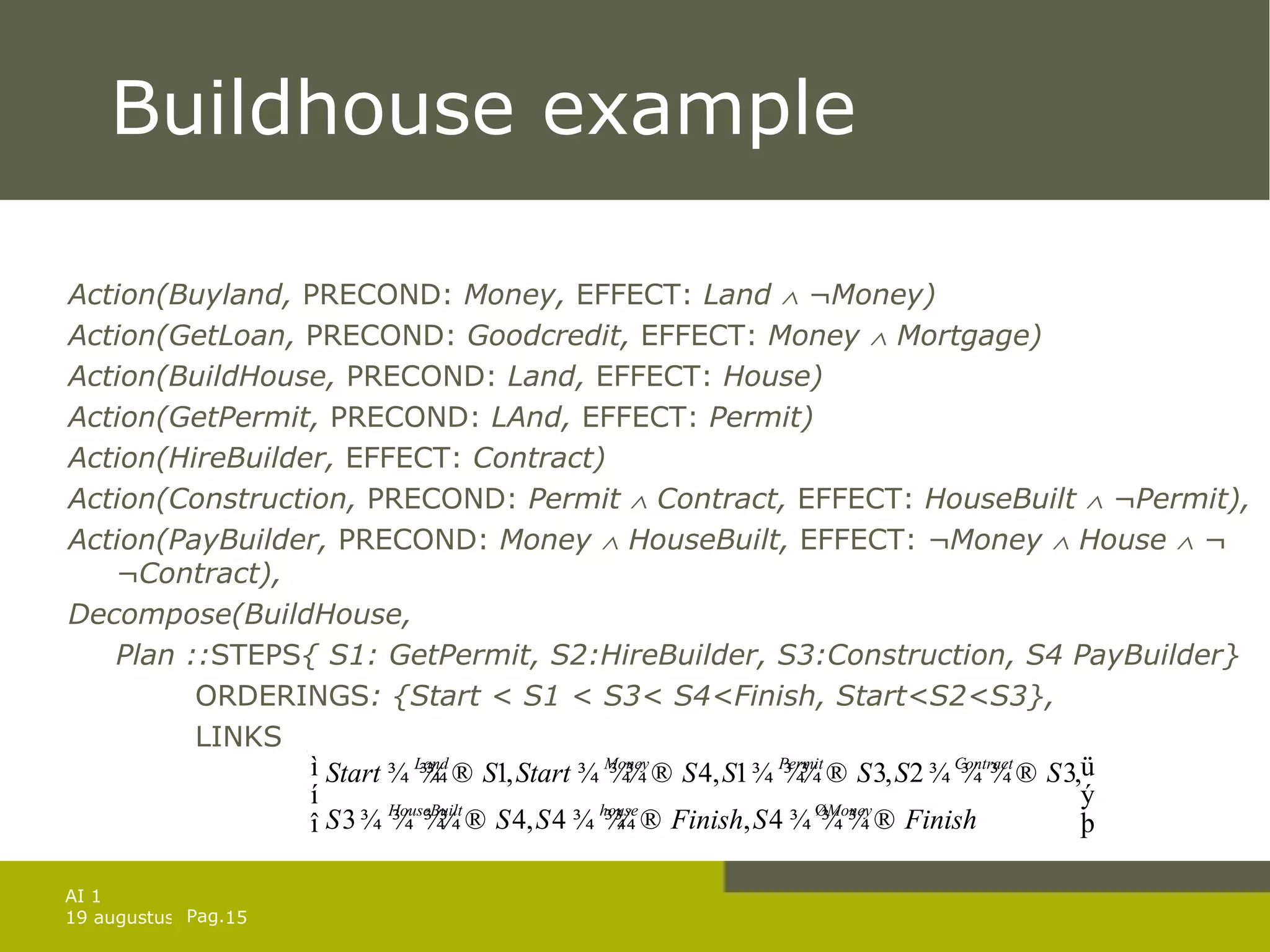
Buildhouse example Action(Buyland,  PRECOND:  Money,  EFFECT:  Land    ¬Money) Action(GetLoan,  PRECOND:  Goodcredit,  EFFECT:  Money    Mortgage) Action(BuildHouse,  PRECOND:  Land,  EFFECT:  House) Action(GetPermit,  PRECOND:  LAnd,  EFFECT:  Permit) Action(HireBuilder,  EFFECT:  Contract) Action(Construction,  PRECOND:  Permit    Contract,  EFFECT:  HouseBuilt    ¬Permit), Action(PayBuilder,  PRECOND:  Money    HouseBuilt,  EFFECT:  ¬Money    House    ¬ ¬Contract), Decompose(BuildHouse, Plan :: STEPS { S1: GetPermit, S2:HireBuilder, S3:Construction, S4 PayBuilder} ORDERINGS : {Start < S1 < S3< S4<Finish, Start<S2<S3}, LINKS
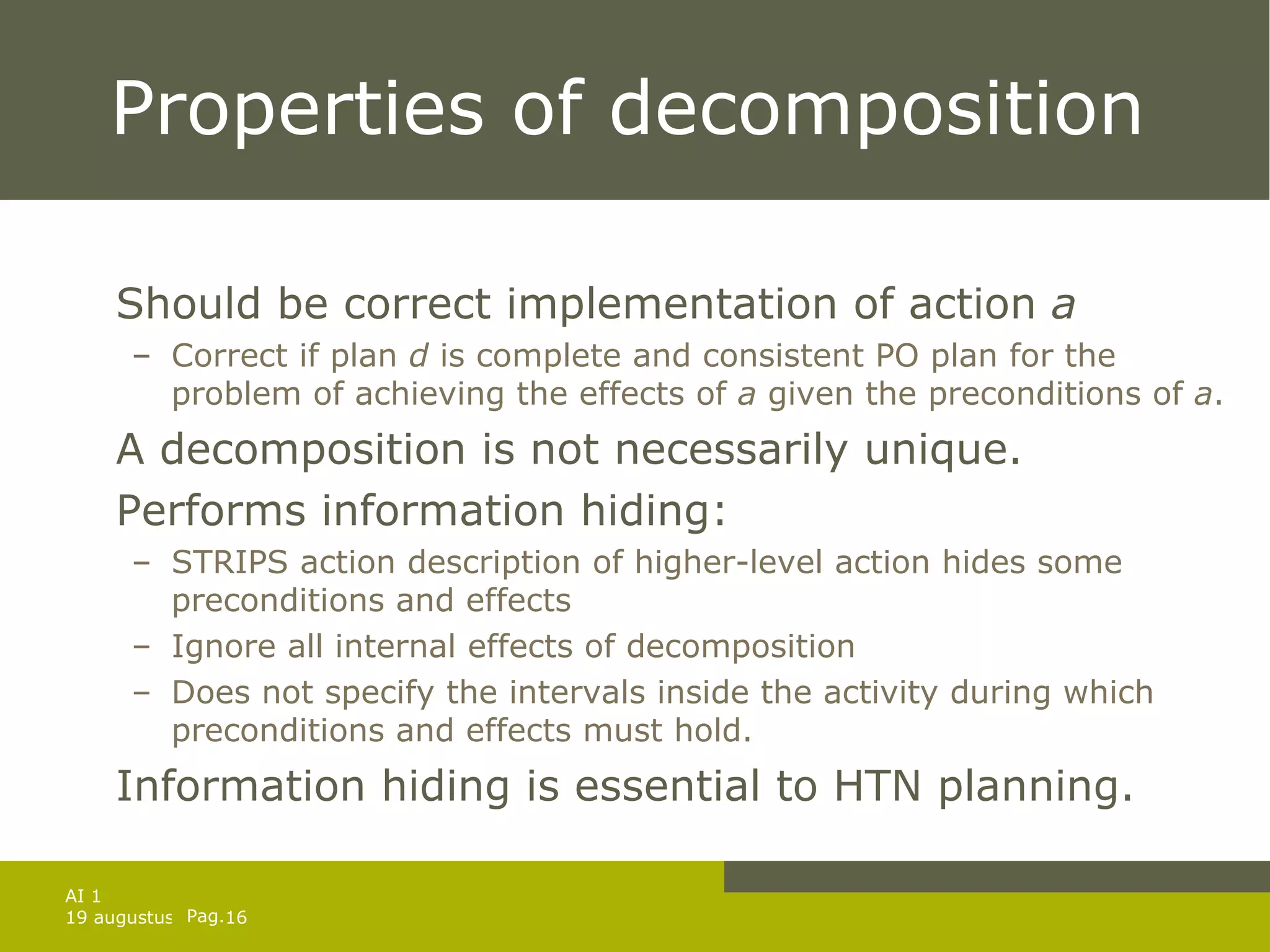
Properties of decomposition Should be correct implementation of action  a Correct if plan  d  is complete and consistent PO plan for the problem of achieving the effects of  a  given the preconditions of  a . A decomposition is not necessarily unique. Performs information hiding: STRIPS action description of higher-level action hides some preconditions and effects  Ignore all internal effects of decomposition Does not specify the intervals inside the activity during which preconditions and effects must hold. Information hiding is essential to HTN planning.
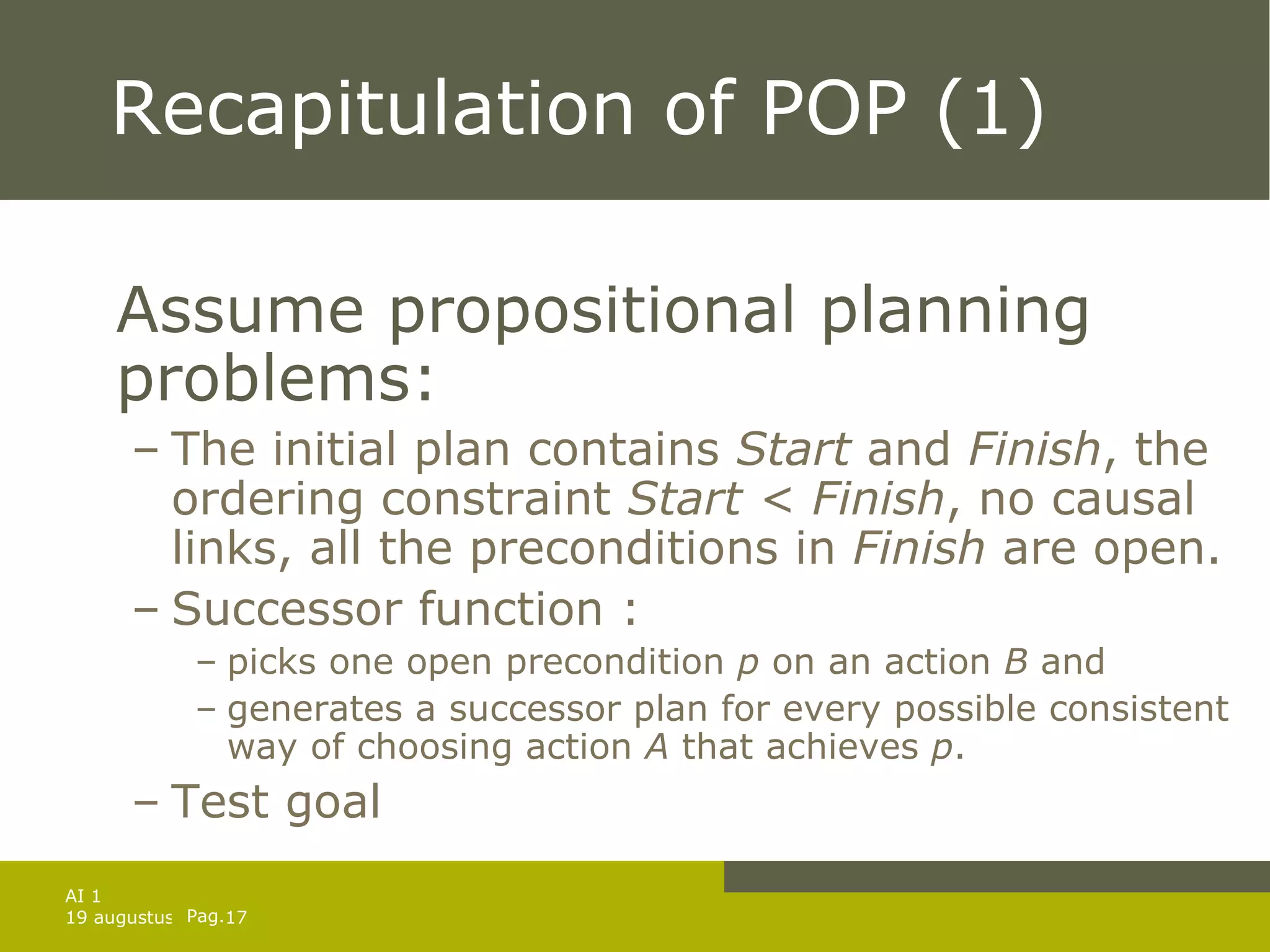
Recapitulation of POP (1) Assume propositional planning problems: The initial plan contains  Start  and  Finish , the ordering constraint  Start < Finish , no causal links, all the preconditions in  Finish  are open. Successor function : picks one open precondition  p  on an action  B  and generates a successor plan for every possible consistent way of choosing action  A  that achieves  p . Test goal
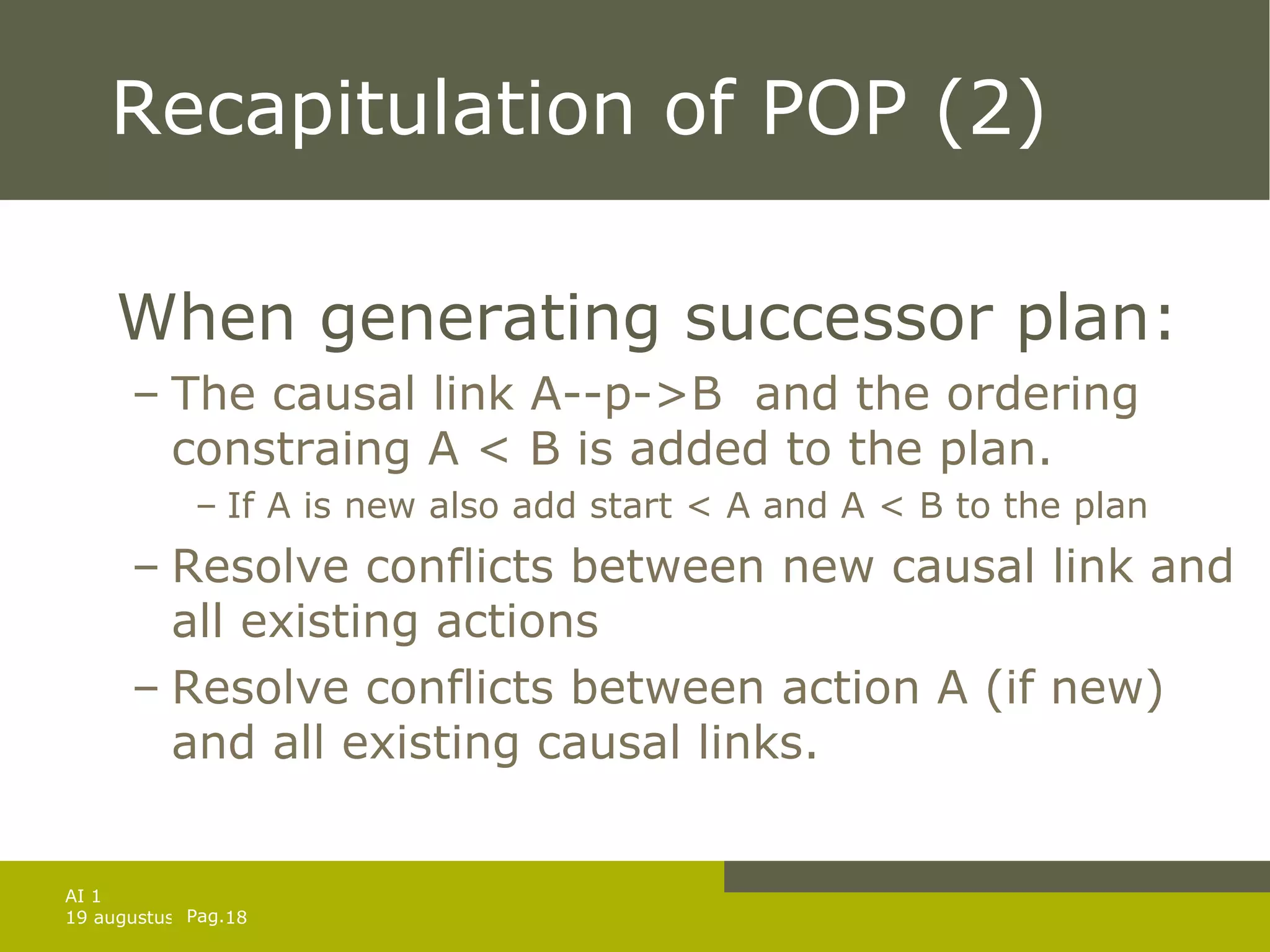
Recapitulation of POP (2) When generating successor plan: The causal link A--p->B  and the ordering constraing A < B is added to the plan. If A is new also add start < A and A < B to the plan Resolve conflicts between new causal link and all existing actions Resolve conflicts between action A (if new) and all existing causal links.
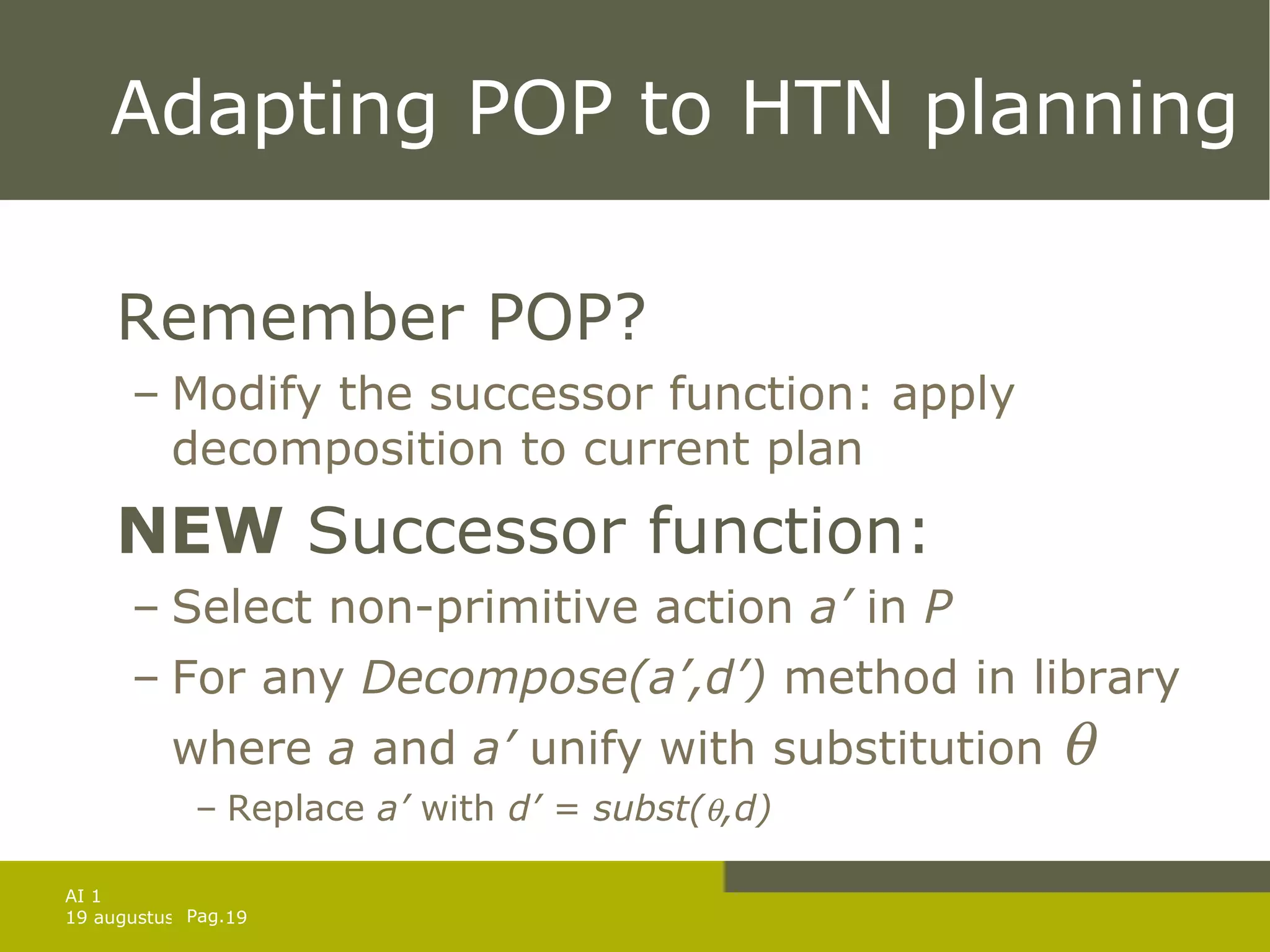
Adapting POP to HTN planning Remember POP? Modify the successor function: apply decomposition to current plan NEW  Successor function: Select non-primitive action  a’  in  P For any  Decompose(a’,d’)  method in library where  a  and  a’  unify with substitution   Replace  a’  with  d’ = subst(  ,d)
POP+HTN example a’
POP+HTN example a’ d
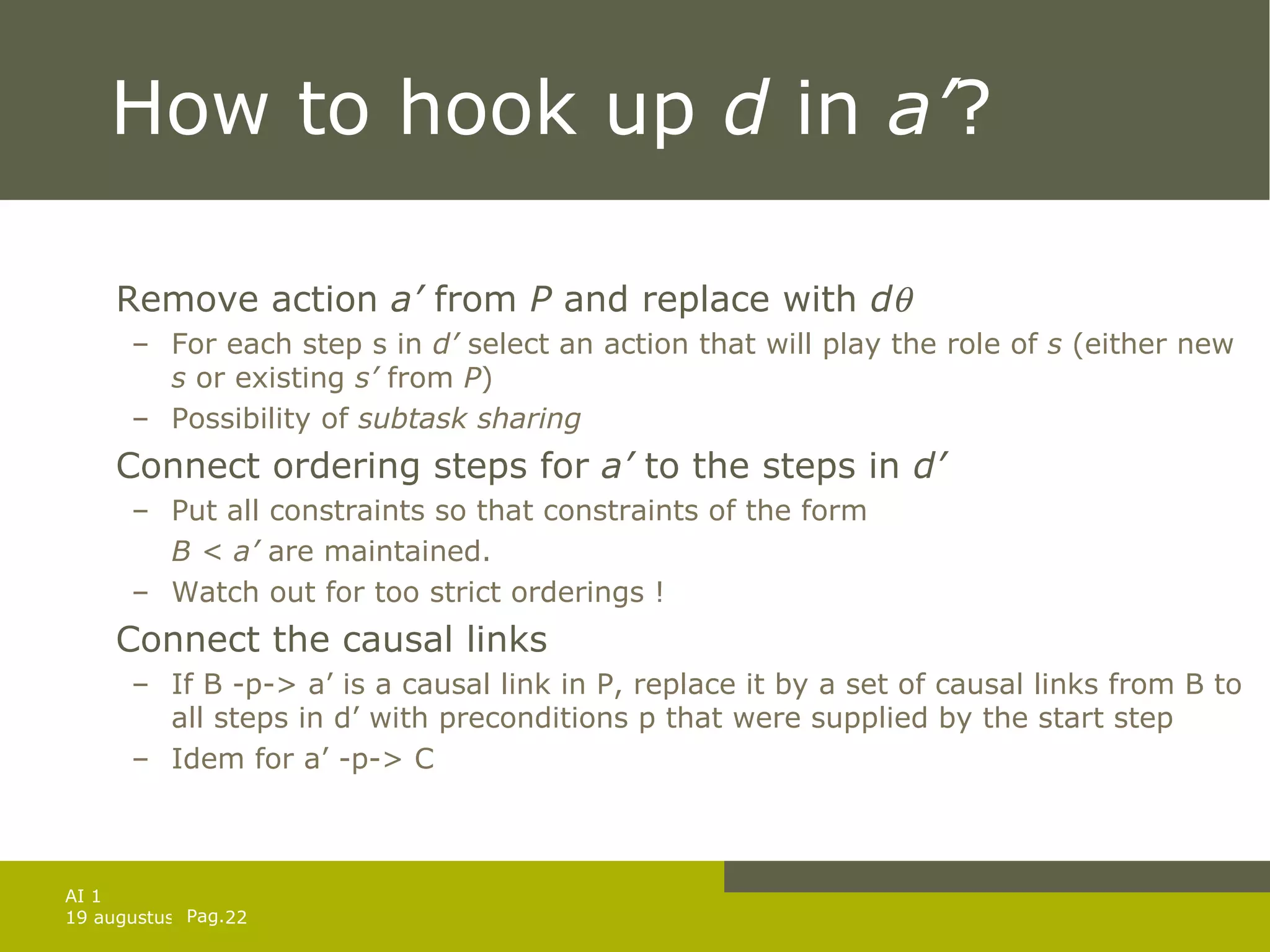
How to hook up  d  in  a’ ? Remove action  a’  from  P  and replace with  d  For each step s in  d’  select an action that will play the role of  s  (either new  s  or existing  s’  from  P ) Possibility of  subtask sharing Connect ordering steps for  a’  to the steps in  d’ Put all constraints so that constraints of the form  B < a’  are maintained. Watch out for too strict orderings ! Connect the causal links If B -p-> a’ is a causal link in P, replace it by a set of causal links from B to all steps in d’ with preconditions p that were supplied by the start step Idem for a’ -p-> C
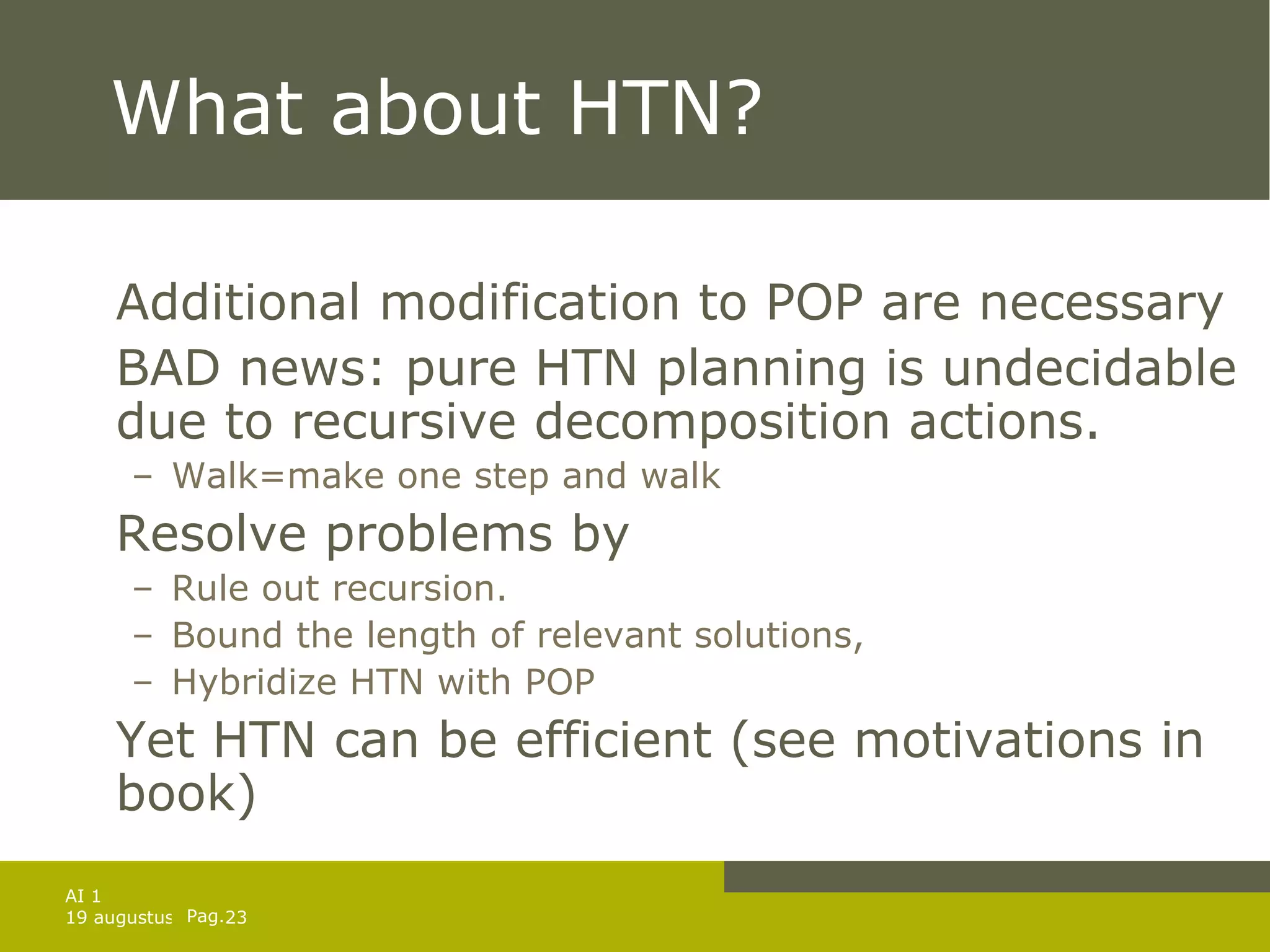
What about HTN? Additional modification to POP are necessary BAD news: pure HTN planning is undecidable due to recursive decomposition actions. Walk=make one step and walk Resolve problems by Rule out recursion. Bound the length of relevant solutions, Hybridize HTN with POP Yet HTN can be efficient (see motivations in book)
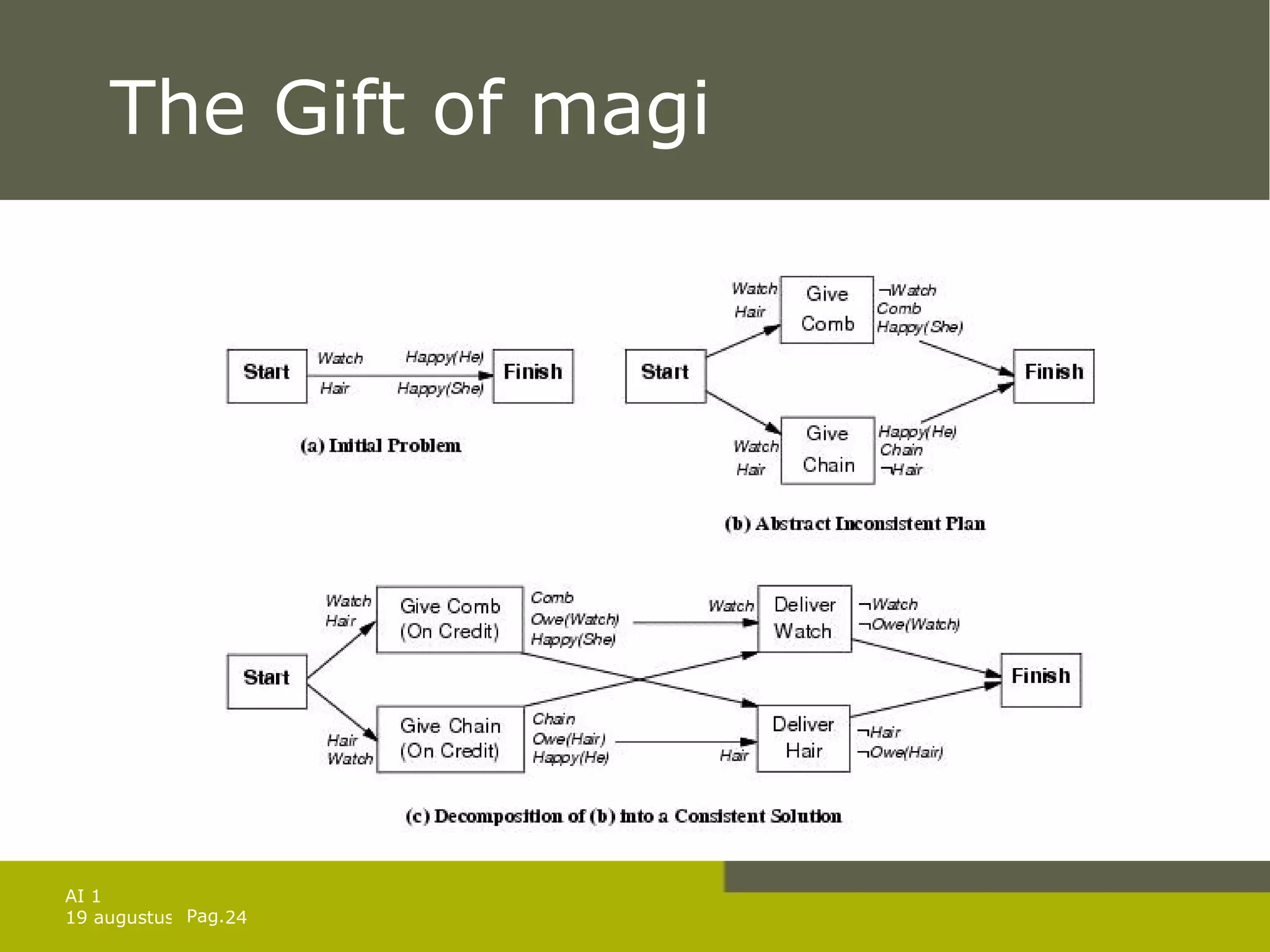
The Gift of magi
Non-deterministic domains So far: fully observable, static and deterministic domains. Agent can plan first and then execute plan with eyes closed Uncertain environment: incomplete (partially observable and/or nondeterministic) and incorrect (differences between world and model) information Use percepts Adapt plan when necessary Degree of uncertainty defined by indeterminacy Bounded: actions can have unpredictable effects, yet can be listed in action description axioms. Unbounded: preconditions and effects unknown or to large to enumerate.
Handling indeterminacy Sensorless planning (conformant planning) Find plan that achieves goal in all possible circumstances (regardless of initial state and action effects). Conditional planning (Contingency planning) Construct conditional plan with different branches for possible contingencies. Execution monitoring and replanning While constructing plan judge whether plan requires revision.  Continuous planning  Planning active for a life time: adapt to changed circumstances and reformulate goals if necessary.
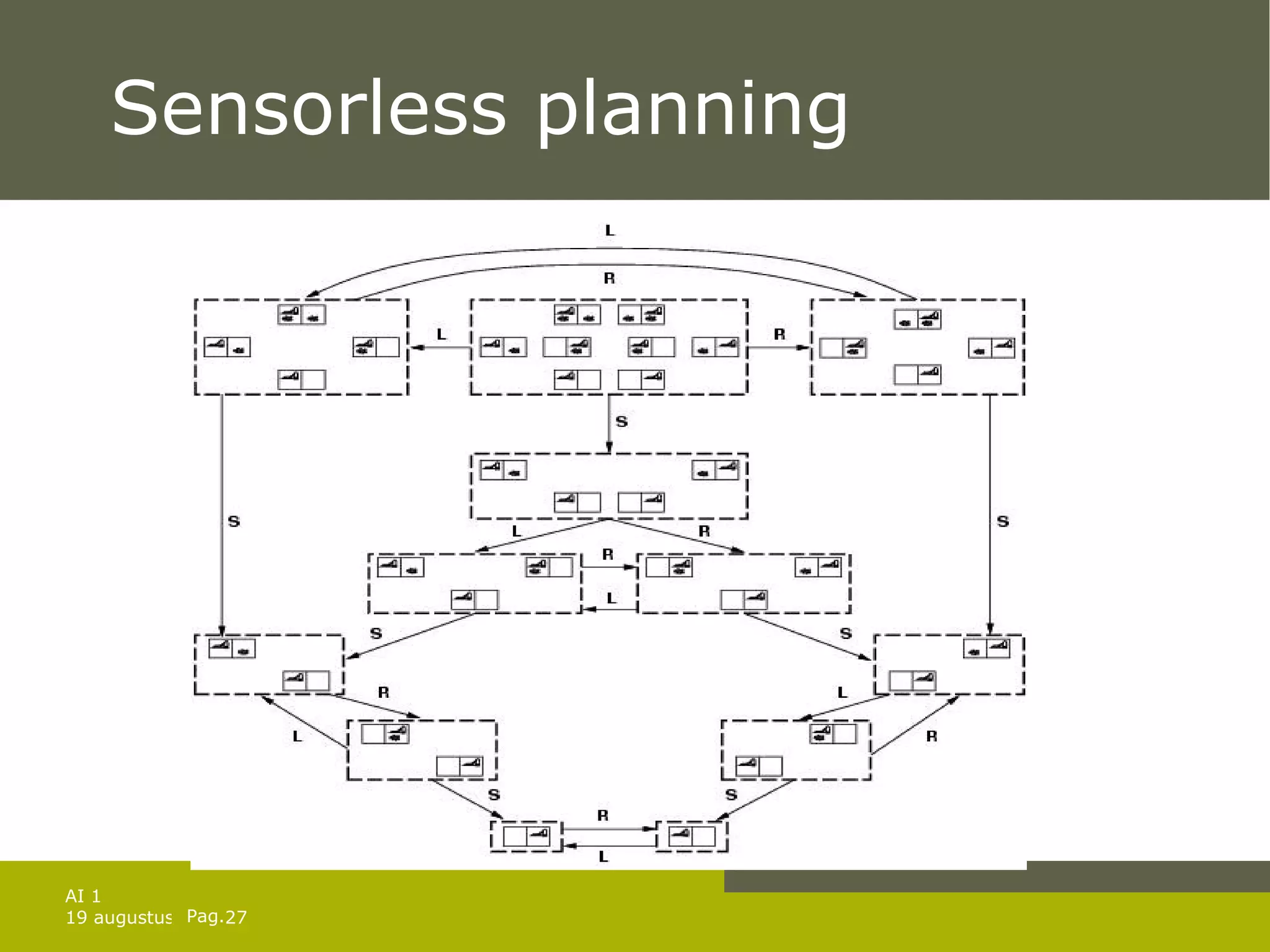
Sensorless planning
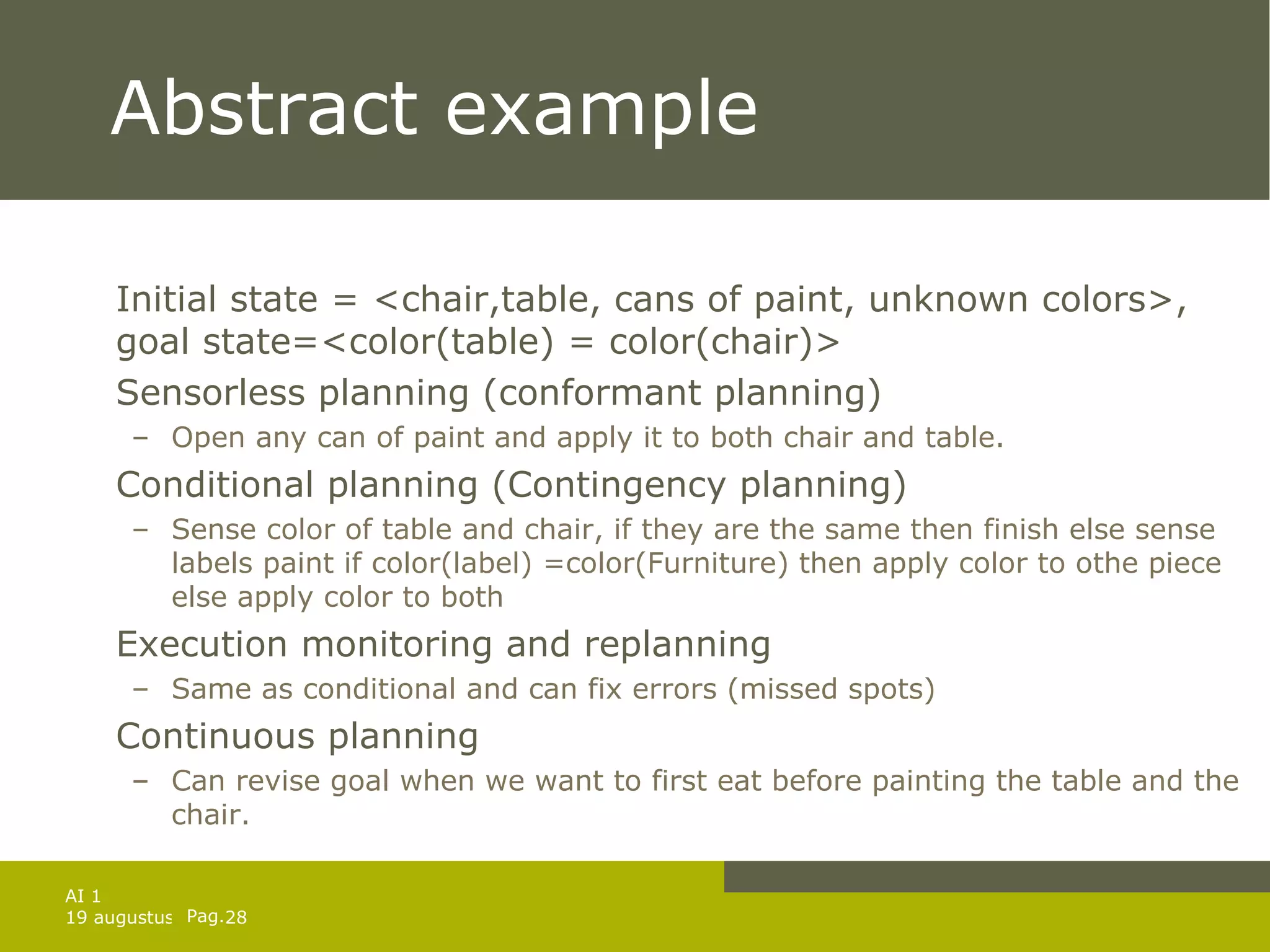
Abstract example Initial state = <chair,table, cans of paint, unknown colors>, goal state=<color(table) = color(chair)> Sensorless planning (conformant planning) Open any can of paint and apply it to both chair and table. Conditional planning (Contingency planning) Sense color of table and chair, if they are the same then finish else sense labels paint if color(label) =color(Furniture) then apply color to othe piece else apply color to both Execution monitoring and replanning Same as conditional and can fix errors (missed spots) Continuous planning  Can revise goal when we want to first eat before painting the table and the chair.
Conditional planning Deal with uncertainty by checking the environment to see what is really happening. Used in fully observable and nondeterministic environments:  The outcome of an action is unknown. Conditional steps will check the state of the environment. How to construct a conditional plan?
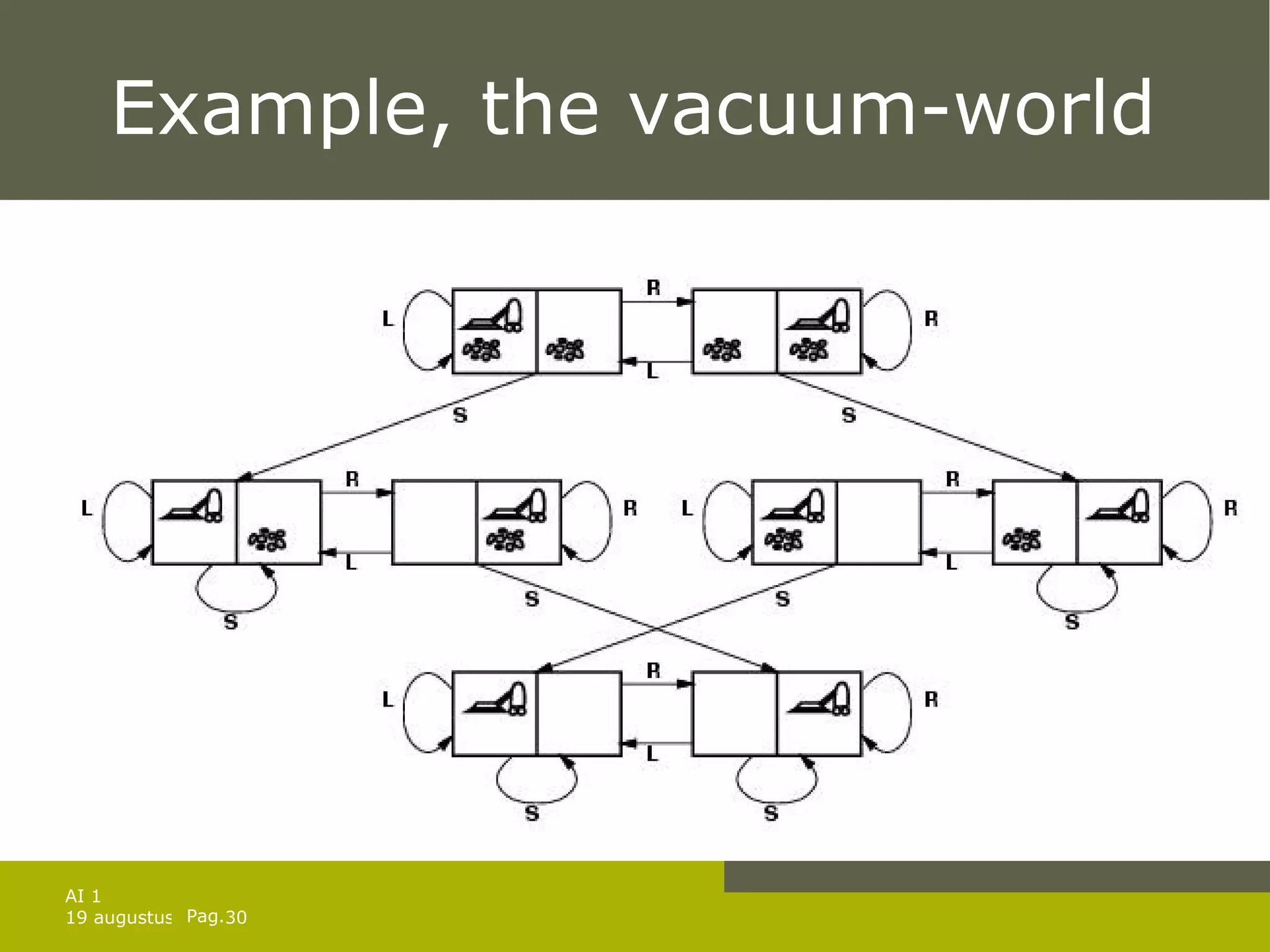
Example, the vacuum-world
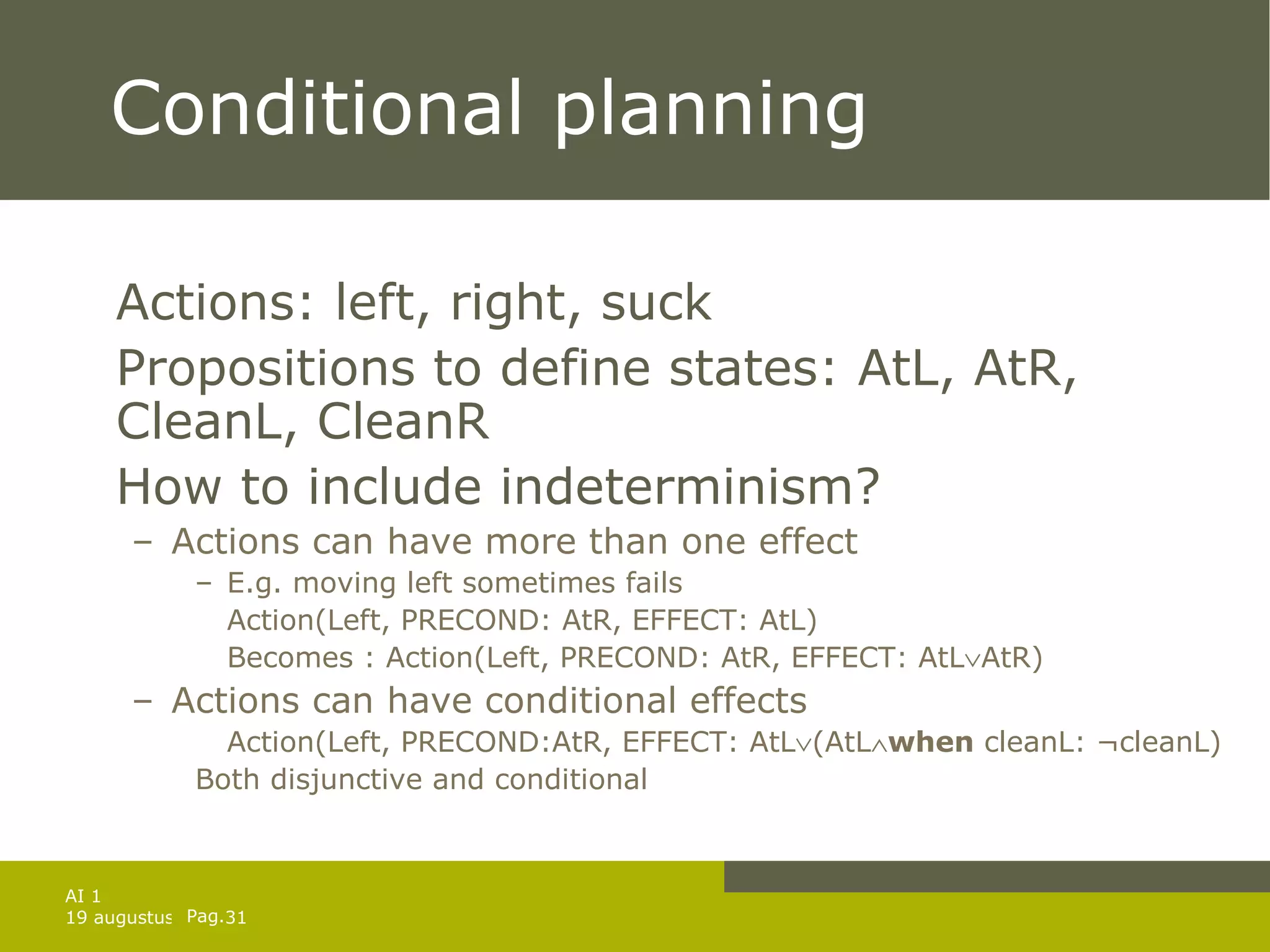
Conditional planning Actions: left, right, suck Propositions to define states: AtL, AtR, CleanL, CleanR How to include indeterminism? Actions can have more than one effect E.g. moving left sometimes fails Action(Left, PRECOND: AtR, EFFECT: AtL) Becomes : Action(Left, PRECOND: AtR, EFFECT: AtL  AtR) Actions can have conditional effects Action(Left, PRECOND:AtR, EFFECT: AtL  (AtL  when  cleanL: ¬cleanL) Both disjunctive and conditional
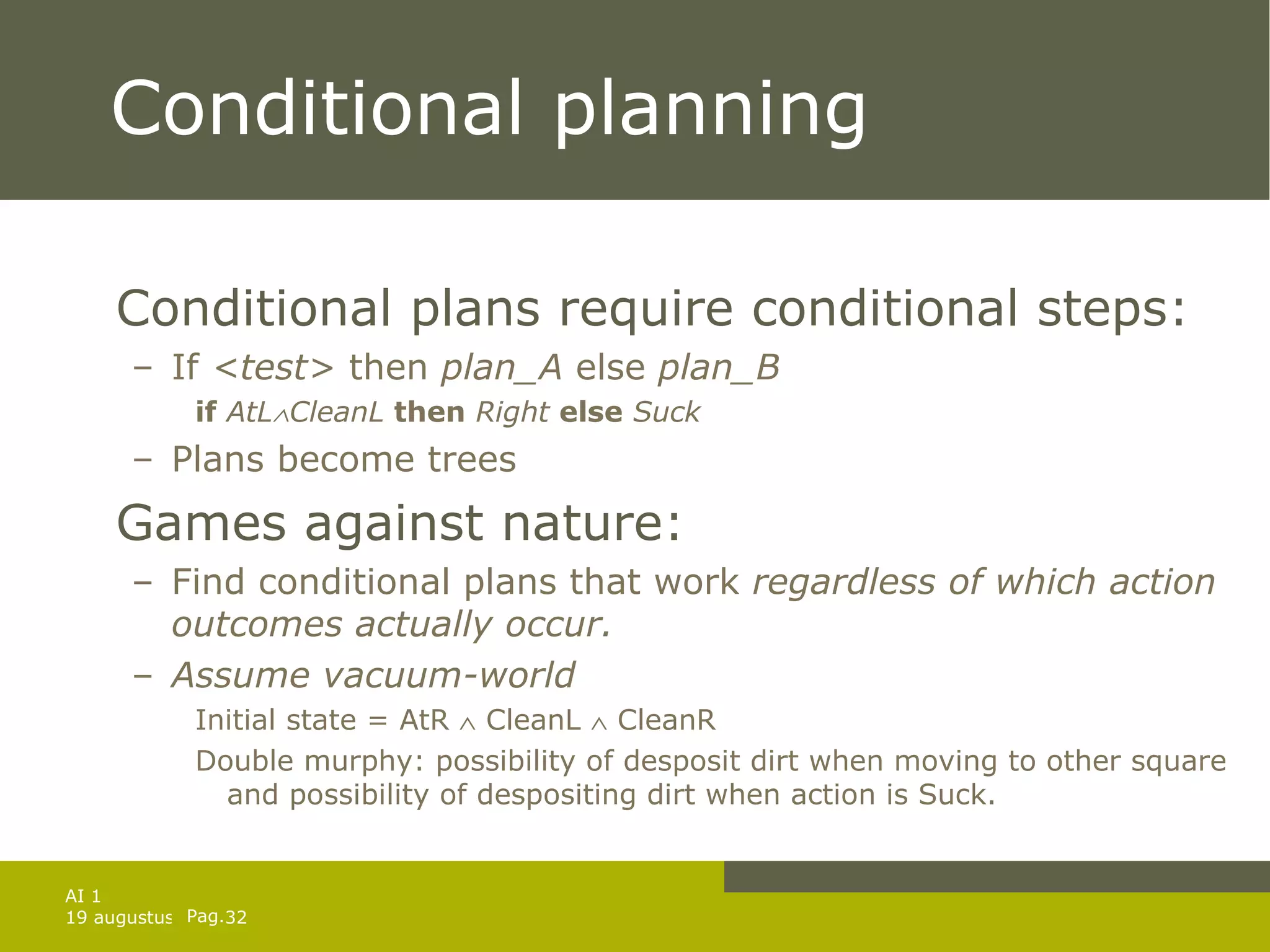
Conditional planning Conditional plans require conditional steps: If  <test>  then  plan_A  else  plan_B if   AtL  CleanL   then   Right   else   Suck Plans become trees Games against nature: Find conditional plans that work  regardless of which action outcomes actually occur. Assume vacuum-world Initial state = AtR    CleanL    CleanR Double murphy: possibility of desposit dirt when moving to other square and possibility of despositing dirt when action is Suck.
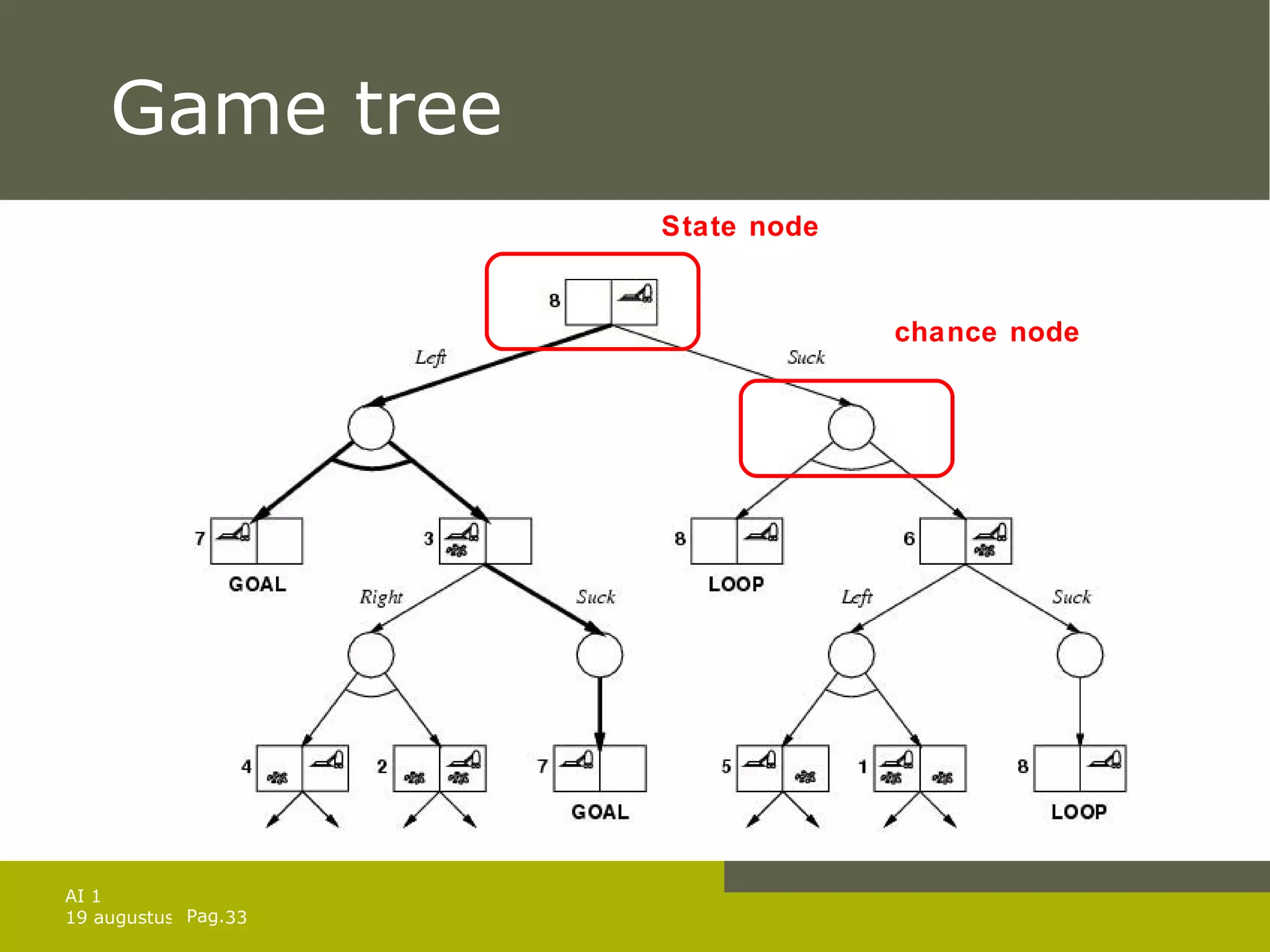
Game tree State node chance node
Solution of games against N. Solution is a subtree that Has a goal node at every leaf Specifies one action at each of its state nodes Includes every outcome branch at each of the chance nodes. In previous example: [ Left ,  if   AtL      CleanL      CleanR   then  []  else   Suck ] For exact solutions: use minimax algorithm with 2 modifications: Max and Min nodes become OR and AND nodes Algorithm returns conditional plan instead of single move
And-Or-search algorithm function  AND-OR-GRAPH-SEARCH( problem )  returns  a conditional plan  or  failure return  OR-SEARCH(INITIAL-STATE[ problem ],  problem , []) function  AND-SEARCH( state_set, problem, path )  returns  a conditional plan  or  failure for each  s i  in  state _ set   do plan i     OR-SEARCH( s i ,   problem,path  ) if  plan  = failure   then return  failure return  [  if   s 1   then   plan 1   else   if   s 2   then   plan 2   else  …  if   s n-1   then   plan n-1   else   plan n ] function  OR-SEARCH( state, problem, path )  returns  a conditional plan  or  failure if  GOAL-TEST[ problem ]( state )  then return  the empty plan if  state  is on  path  then return  failure for  action,state_set  in SUCCESSORS[ problem ]( state )  do plan    AND-SEARCH( state_set,   problem,  [ state  |  plan ]   ) if  plan     failure   then return  [ action  |  plan ] return  failure
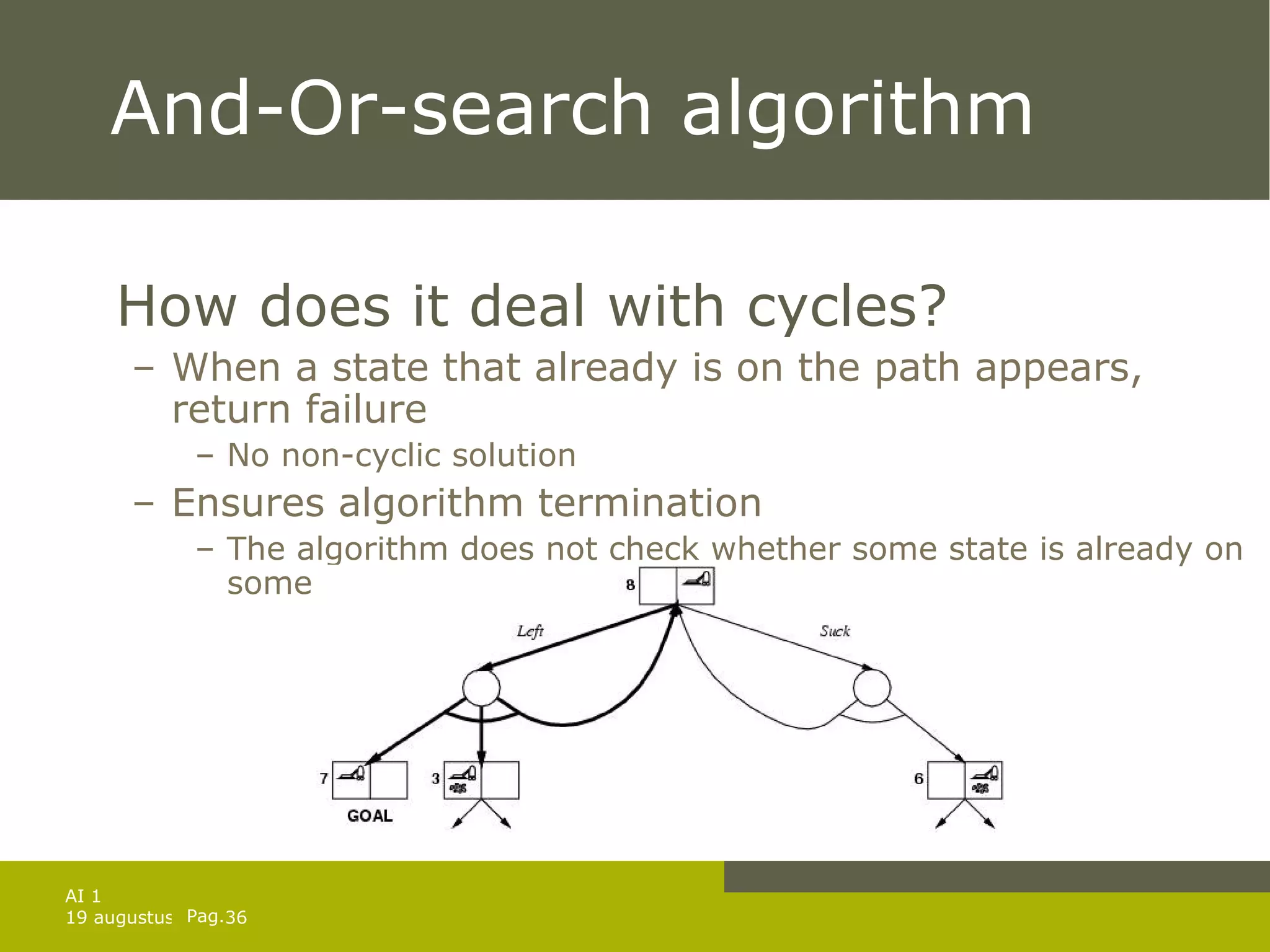
And-Or-search algorithm How does it deal with cycles? When a state that already is on the path appears, return failure No non-cyclic solution  Ensures algorithm termination The algorithm does not check whether some state is already on some other path from the root.
And-Or-search algorithm Sometimes only a cyclic solution exists  e.g. tripple murphy: sometimes the move is not performed [ Left ,  if   CleanL   then  []  else   Suck ] is not a solution Use label to repeat parts of plan ( but infinite loops ) [ L1 :  Left ,  if   AtR   then   L1   else   if   CleanL   then  []  else   Suck ]
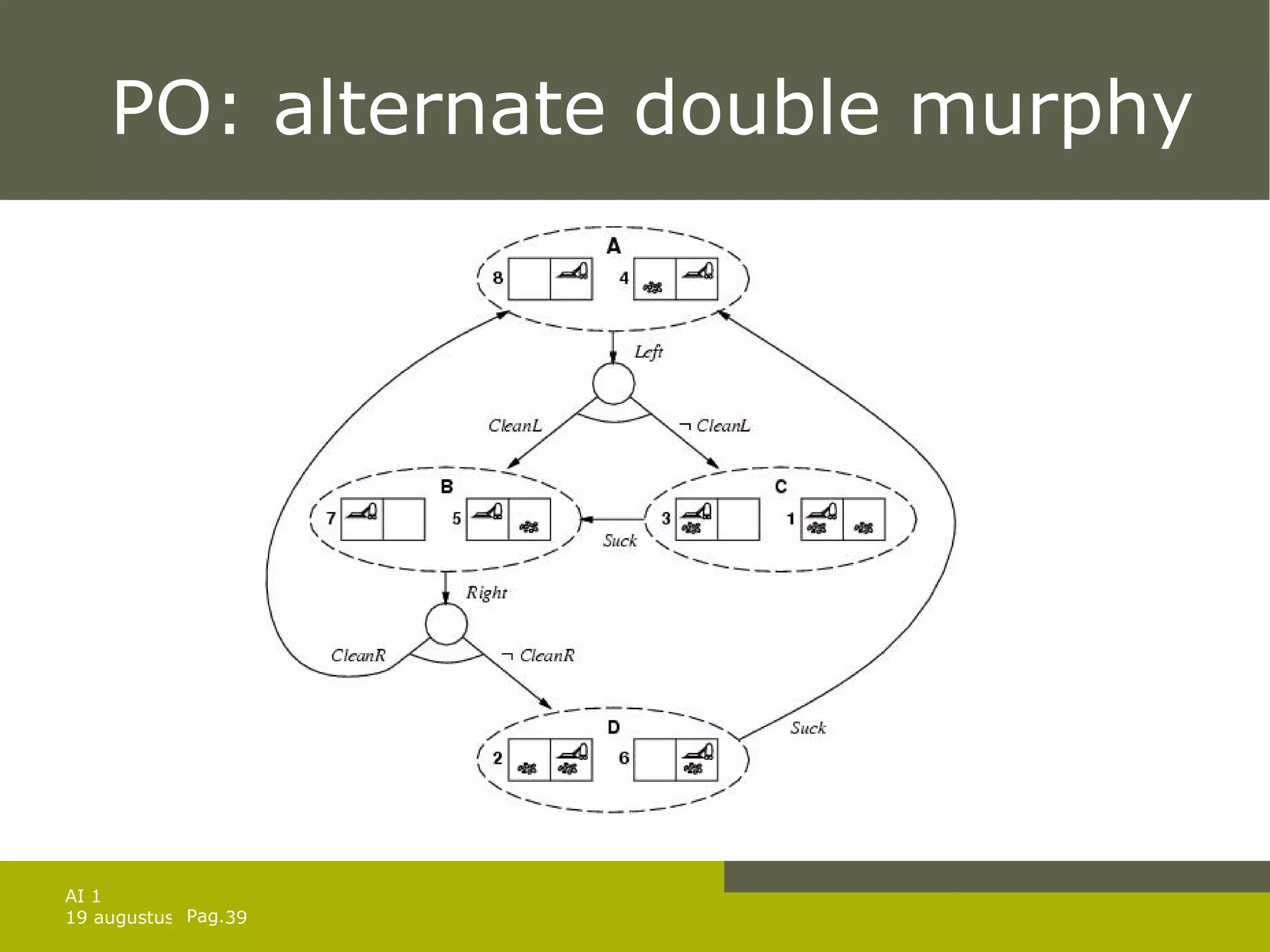
CP and partially observable env. Fully observable: conditional tests can ask any question and get an answer Partially observable??? The agent has limited information about the environment. Modeled by a state-set = belief states E.g. assume vacuum agent which can not sense presence or absence of dirt in other squares than the one it is on. + alternative murphy: dirt can be left behind when moving to other square. Solution in fully observable world:  keep moving left and right, sucking dirt whenever it appears until both squares are clean and I’m in square left.
PO: alternate double murphy
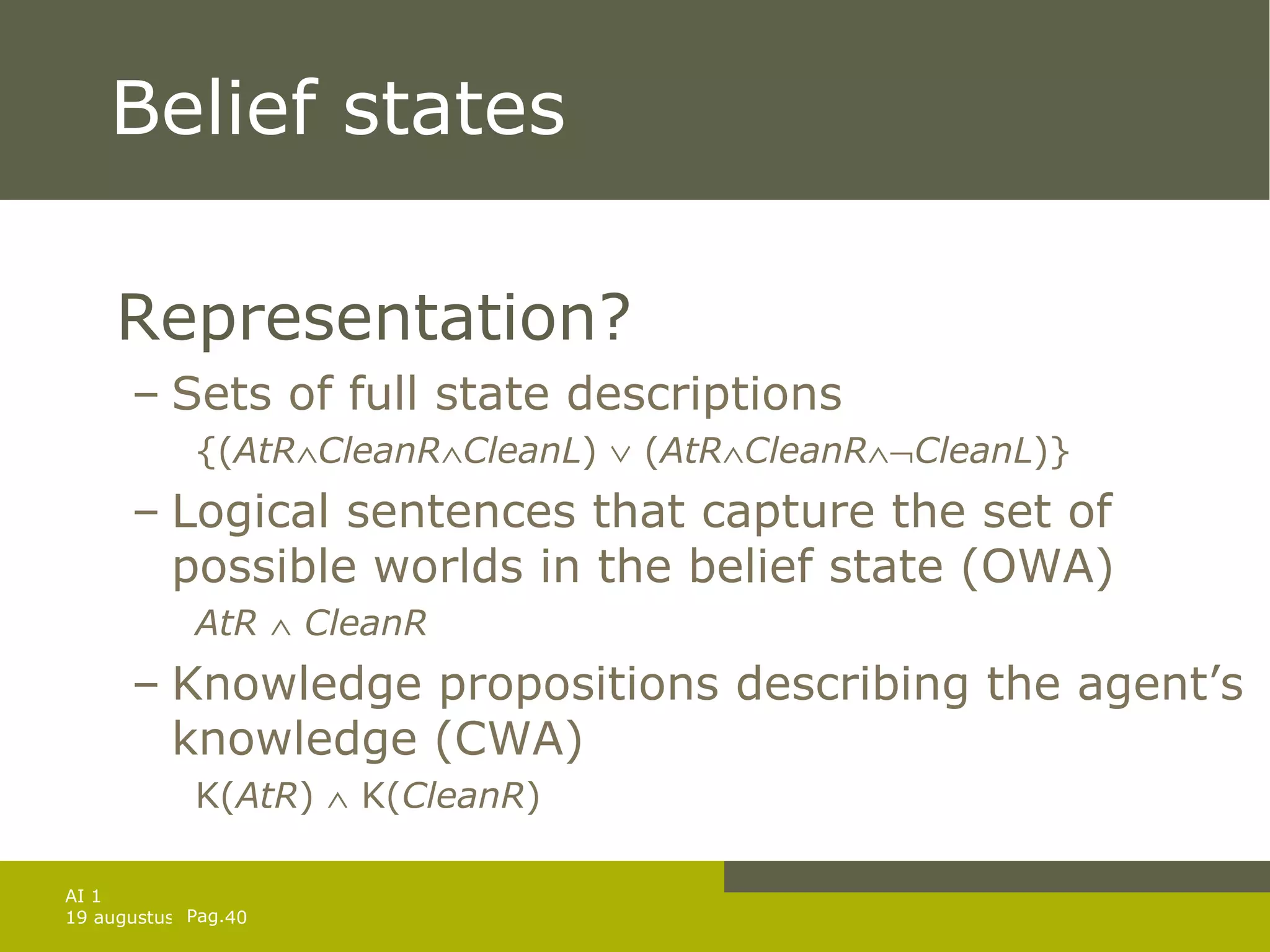
Belief states Representation? Sets of full state descriptions {( AtR  CleanR  CleanL )    ( AtR  CleanR  CleanL )} Logical sentences that capture the set of possible worlds in the belief state (OWA) AtR      CleanR Knowledge propositions describing the agent’s knowledge (CWA) K( AtR )    K( CleanR )
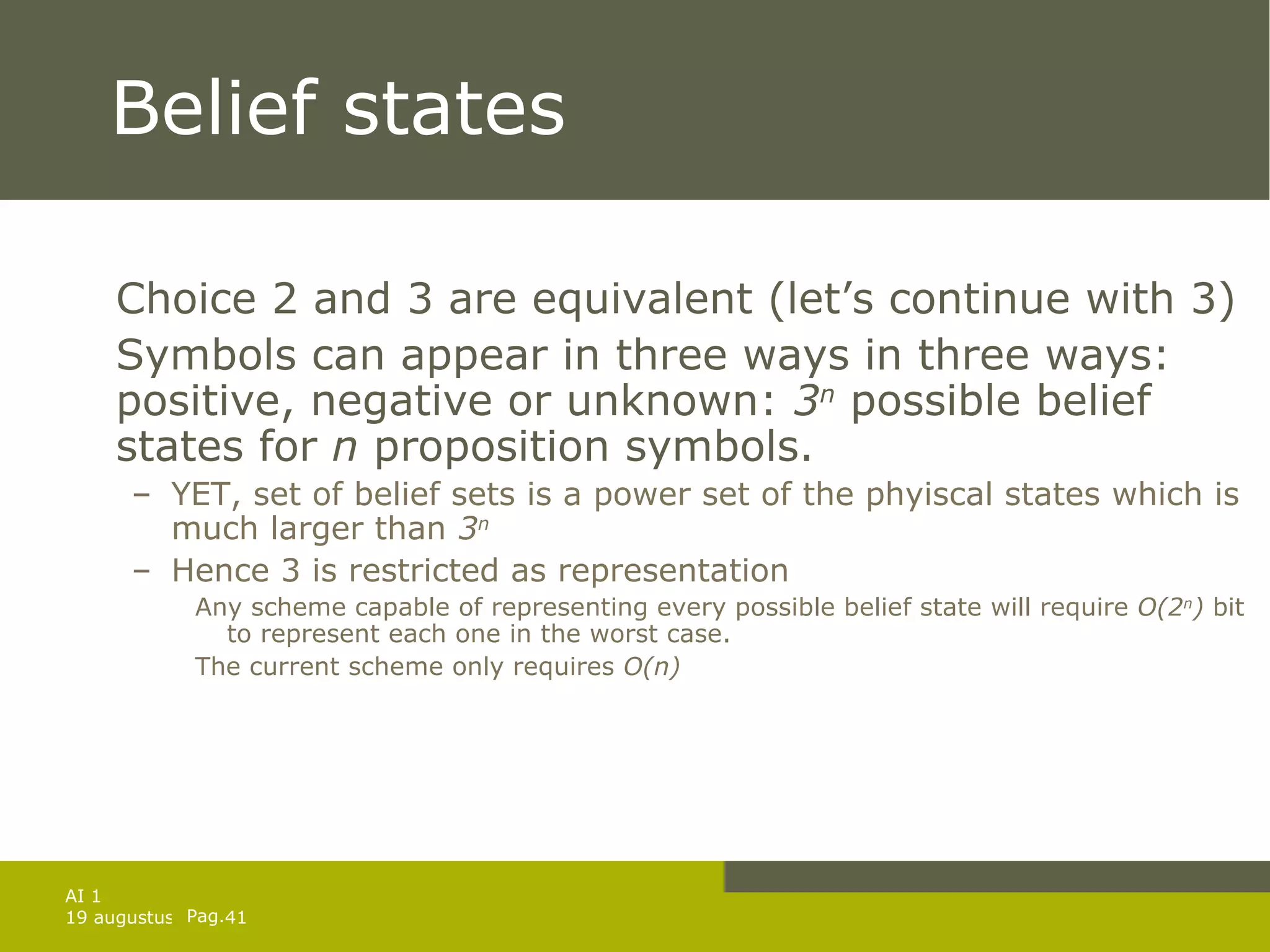
Belief states Choice 2 and 3 are equivalent (let’s continue with 3) Symbols can appear in three ways in three ways: positive, negative or unknown:  3 n  possible belief states for  n  proposition symbols. YET, set of belief sets is a power set of the phyiscal states which is much larger than  3 n Hence 3 is restricted as representation Any scheme capable of representing every possible belief state will require  O(2 n )  bit to represent each one in the worst case.  The current scheme only requires  O(n)
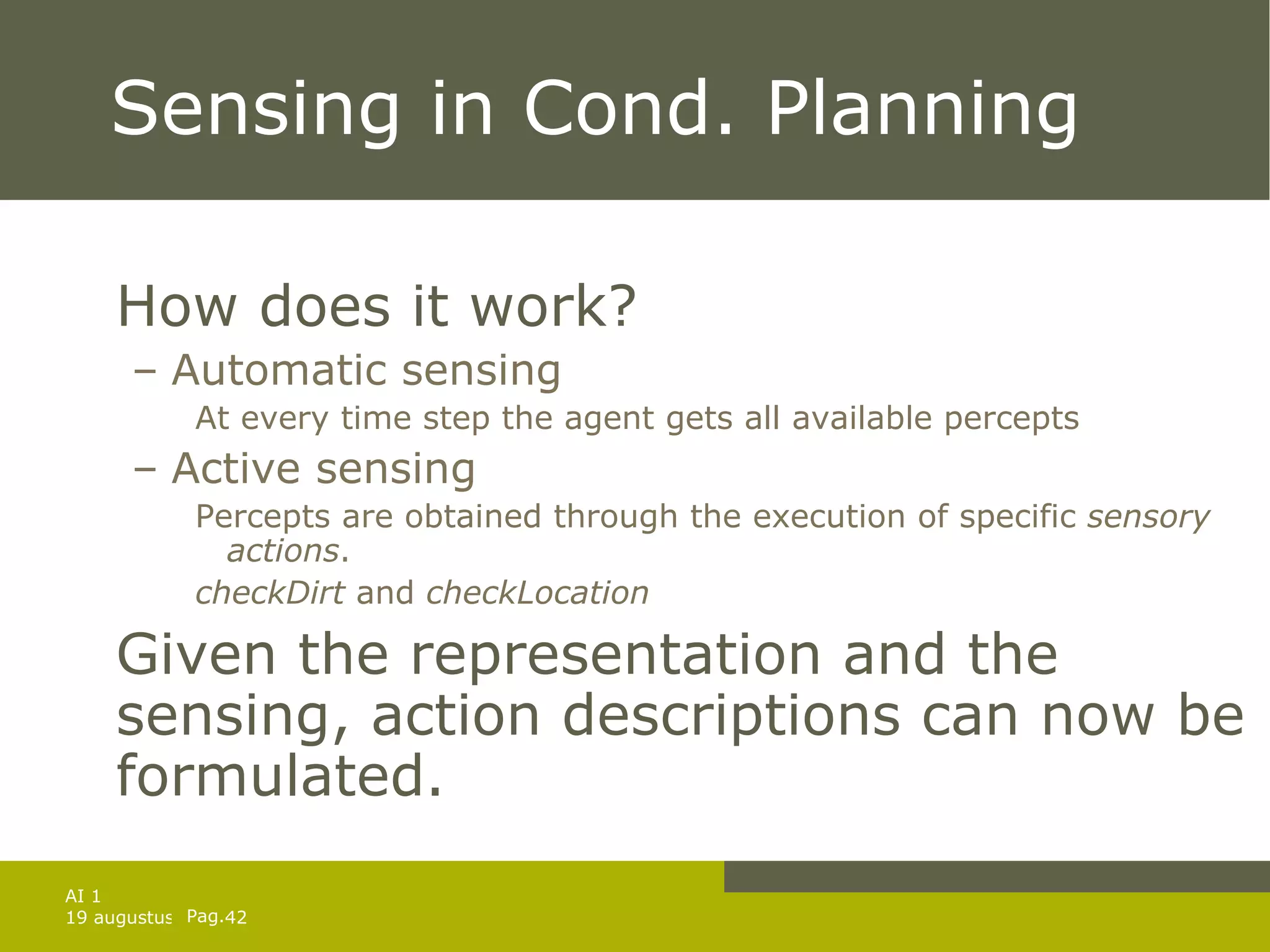
Sensing in Cond. Planning How does it work? Automatic sensing At every time step the agent gets all available percepts Active sensing Percepts are obtained through the execution of specific  sensory actions . checkDirt  and  checkLocation Given the representation and the sensing, action descriptions can now be formulated.
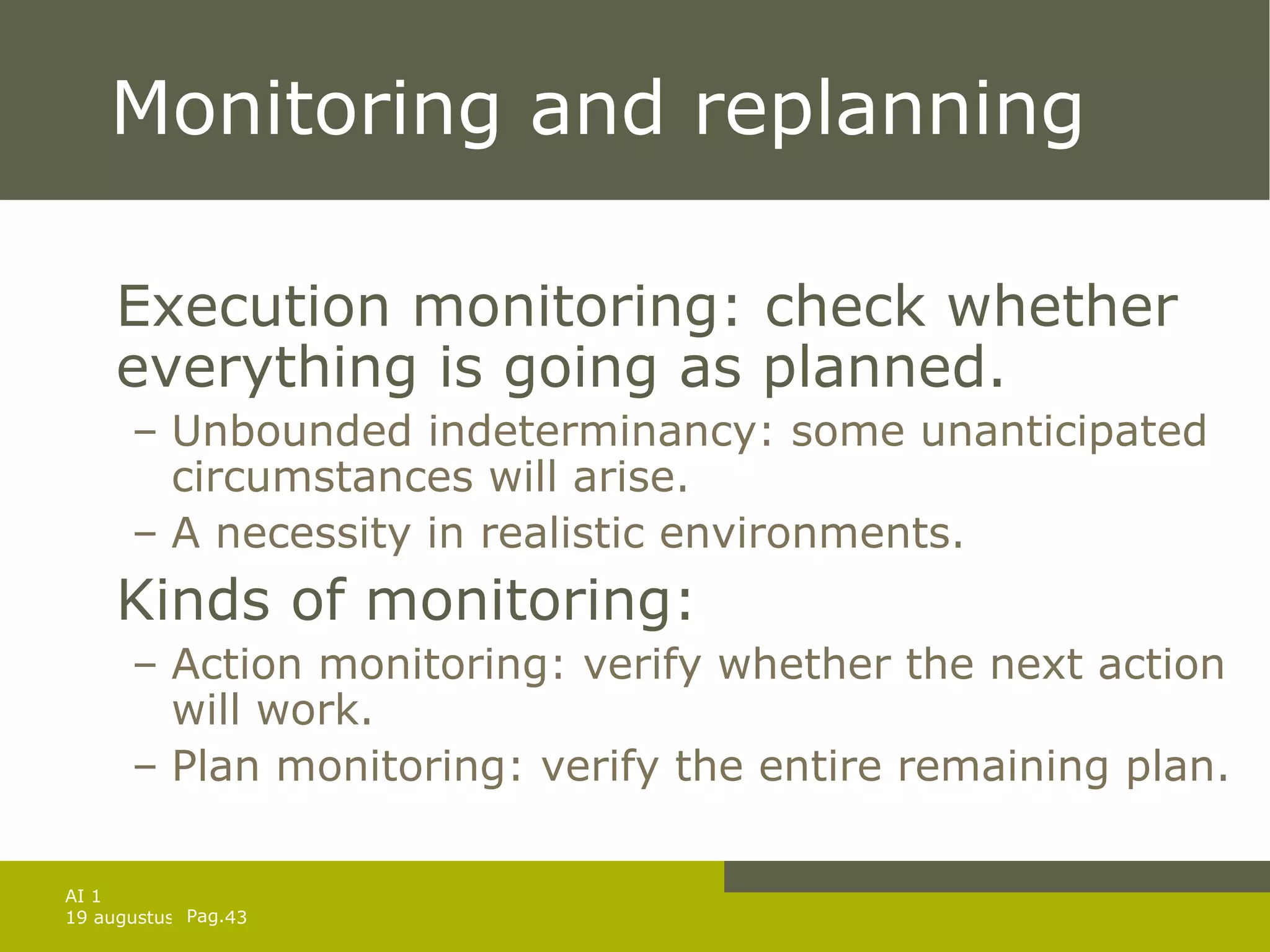
Monitoring and replanning Execution monitoring: check whether everything is going as planned. Unbounded indeterminancy: some unanticipated circumstances will arise. A necessity in realistic environments. Kinds of monitoring: Action monitoring: verify whether the next action will work. Plan monitoring: verify the entire remaining plan.
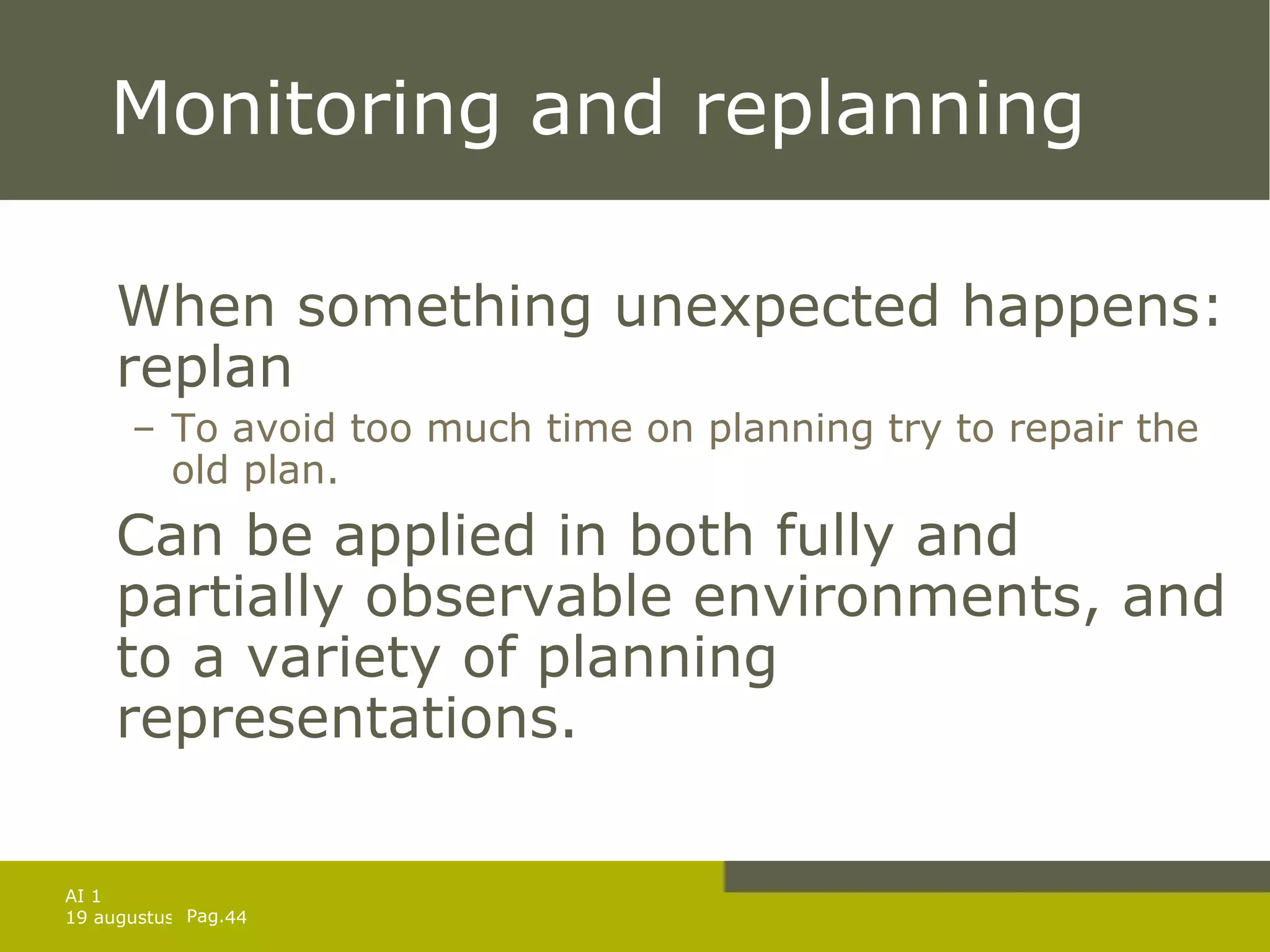
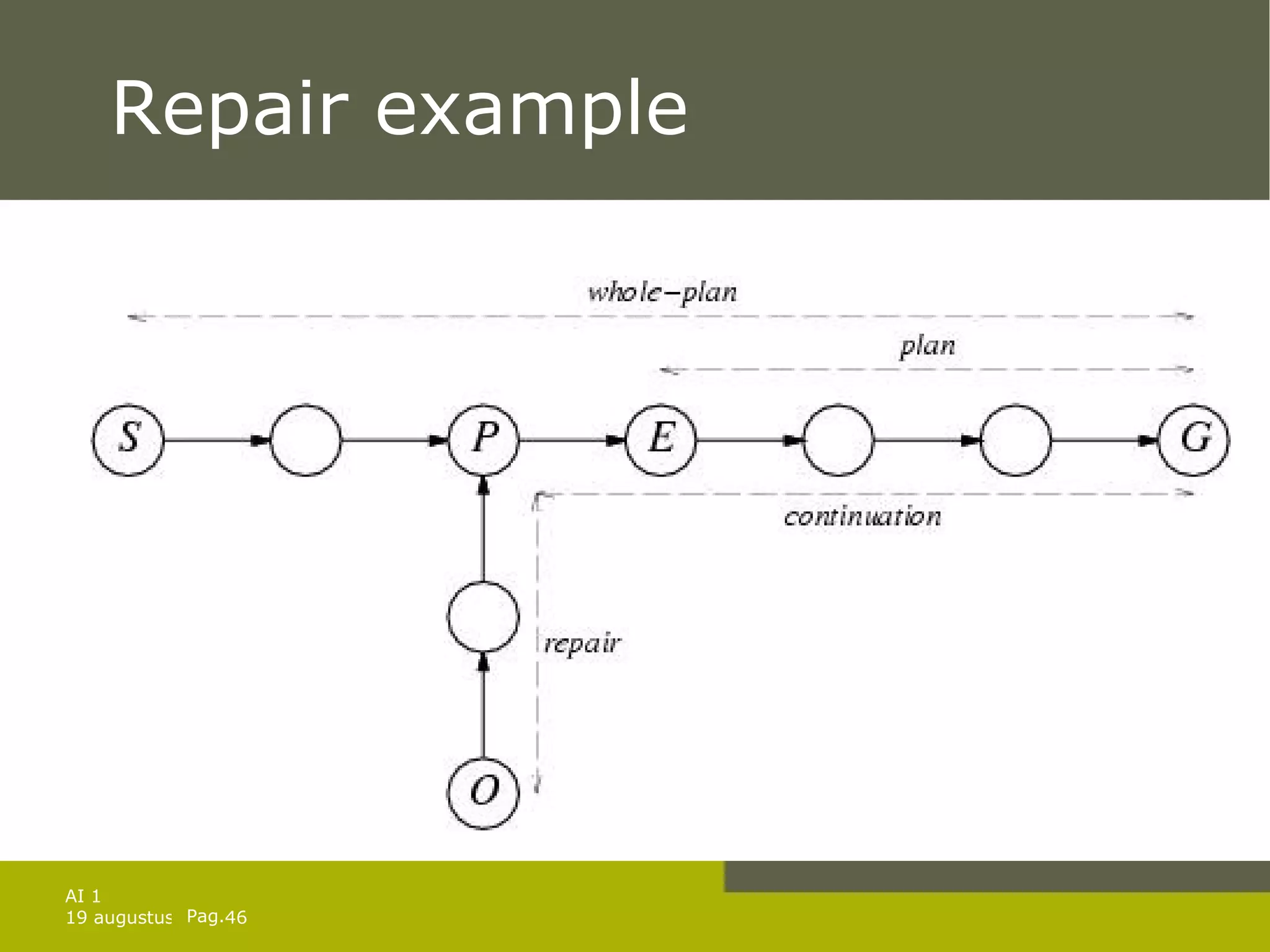
Monitoring and replanning When something unexpected happens: replan To avoid too much time on planning try to repair the old plan. Can be applied in both fully and partially observable environments, and to a variety of planning representations.
Replanning-agent function  REPLANNING-AGENT( percept )  returns  an action static:   KB , a knowledge base (+ action descriptions) plan , a plan initially [] whole_plan,  a plan initially [] goal , a goal TELL( KB , MAKE-PERCEPT-SENTENCE( percept , t )) current    STATE-DESCRIPTION( KB,t ) if  plan  = []  then return  the empty plan whole_plan     plan     PLANNER( current,   goal, KB ) if  PRECONDITIONS(FIRST( plan )) not currently true in  KB  then candidates    SORT( whole_plan, ordered by distance to  current )  find  state  s  in  candidates  such that failure    repair    PLANNER( current, s, KB ) continuation    the tail of  whole_plan  starting at  s   whole_plan     plan     APPEND( repair, continuation)   return  POP (plan)
Repair example
Repair example: painting Init(Color(Chair, Blue)   Color(Table,Green)    ContainsColor(BC,Blue)    PaintCan(BC)    ContainsColor(RC,Red)    PaintCan(RC))  Goal(Color(Chair,x)    Color(Table,x)) Action(Paint(object, color) PRECOND:  HavePaint(color) EFFECT:  Color(object, color)) Action(Open(can) PRECOND:  PaintCan(can)    ContainsColor(can,color) EFFECT:  HavePaint(color)) [Start; Open(BC); Paint(Table,Blue), Finish]
Repair example: painting Suppose that the agent now perceives that the colors of table and chair are different Figure out point in whole_plan to aim for Current state is identical as the precondition before  Paint Repair action sequence to get there. Repair =[] and plan=[ Paint ,  Finish ] Continue performing this new plan Will loop until table and chair are perceived as the same. Action monitoring can lead to less intelligent behavior Assume the red is selected and there is not enough paint to apply to both chair and table. Improved by doing  plan monitoring
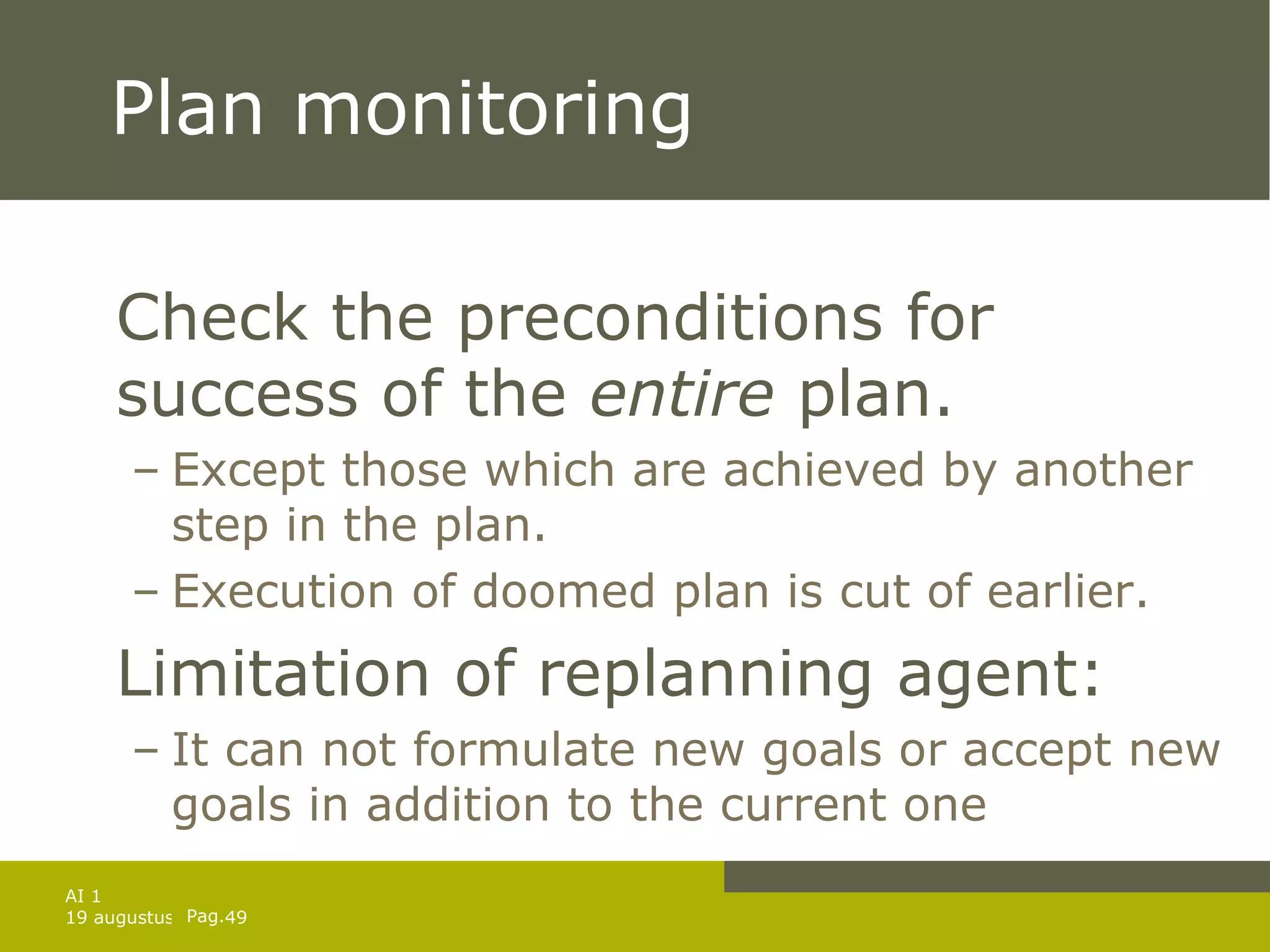
Plan monitoring Check the preconditions for success of the  entire  plan. Except those which are achieved by another step in the plan. Execution of doomed plan is cut of earlier. Limitation of replanning agent: It can not formulate new goals or accept new goals in addition to the current one
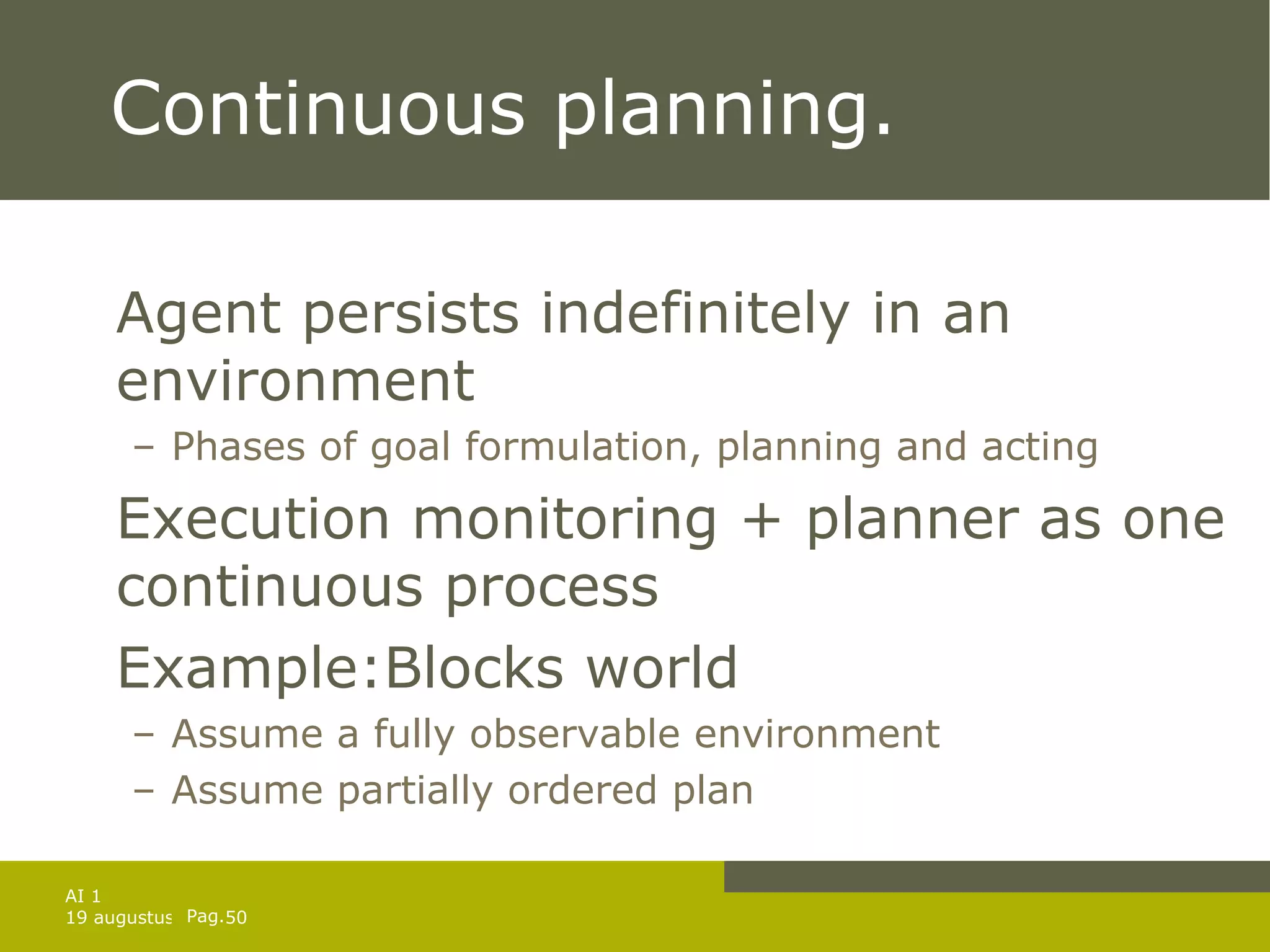
Continuous planning. Agent persists indefinitely in an environment Phases of goal formulation, planning and acting Execution monitoring + planner as one continuous process Example:Blocks world Assume a fully observable environment Assume partially ordered plan
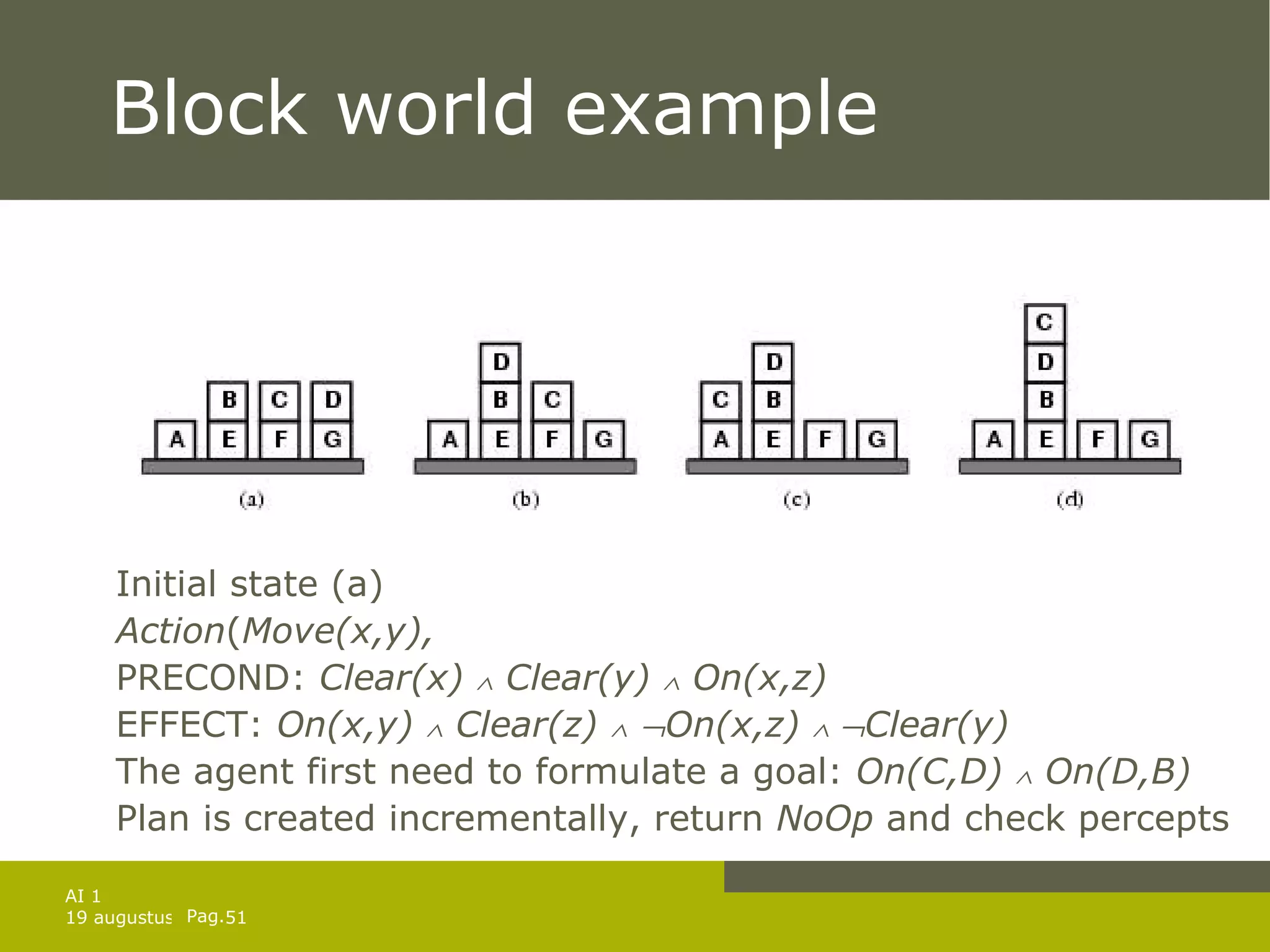
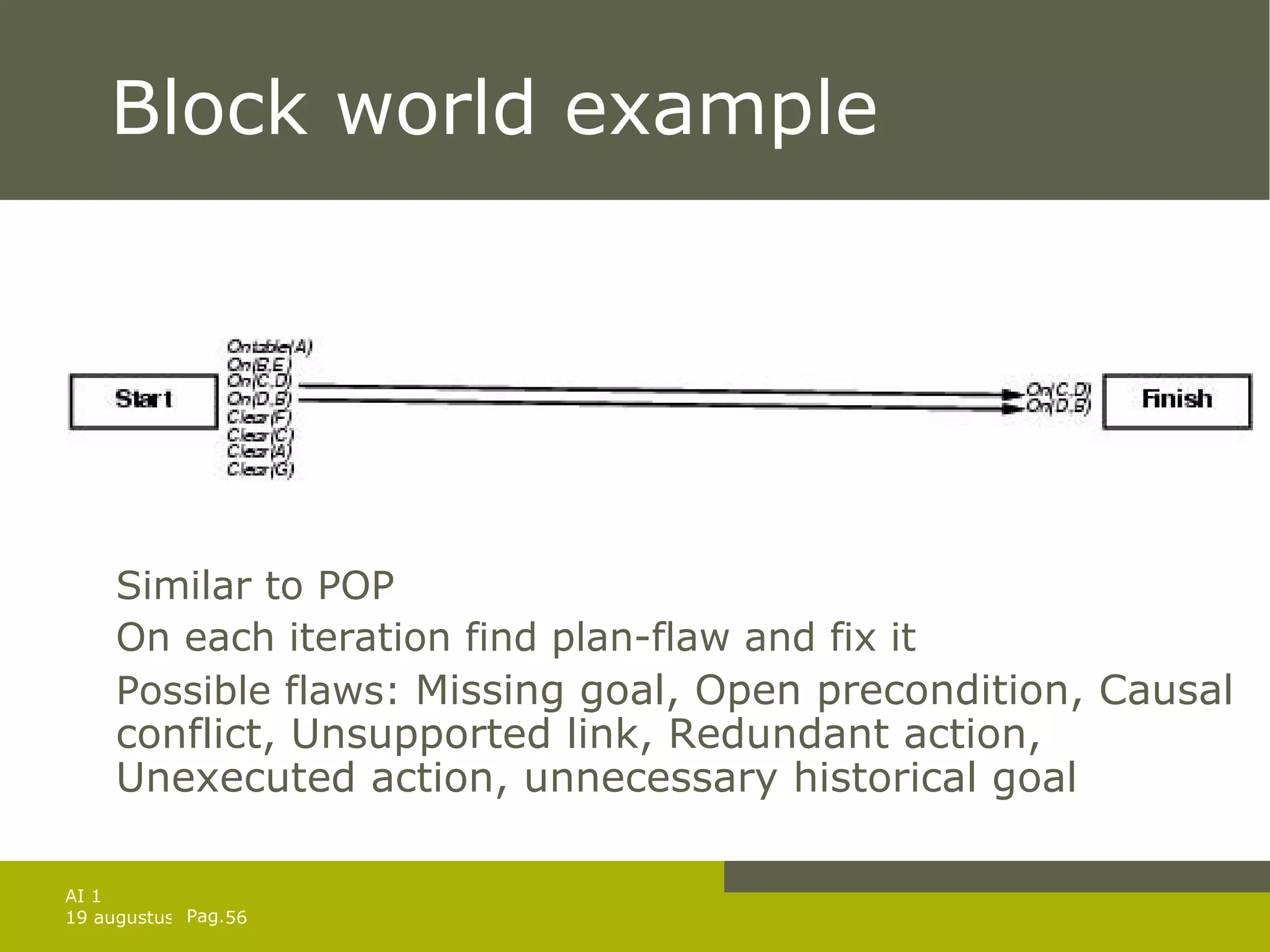
Block world example Initial state (a) Action ( Move(x,y), PRECOND:  Clear(x)    Clear(y)    On(x,z) EFFECT:  On(x,y)    Clear(z)      On(x,z)      Clear(y) The agent first need to formulate a goal:  On(C,D)    On(D,B) Plan is created incrementally, return  NoOp  and check percepts
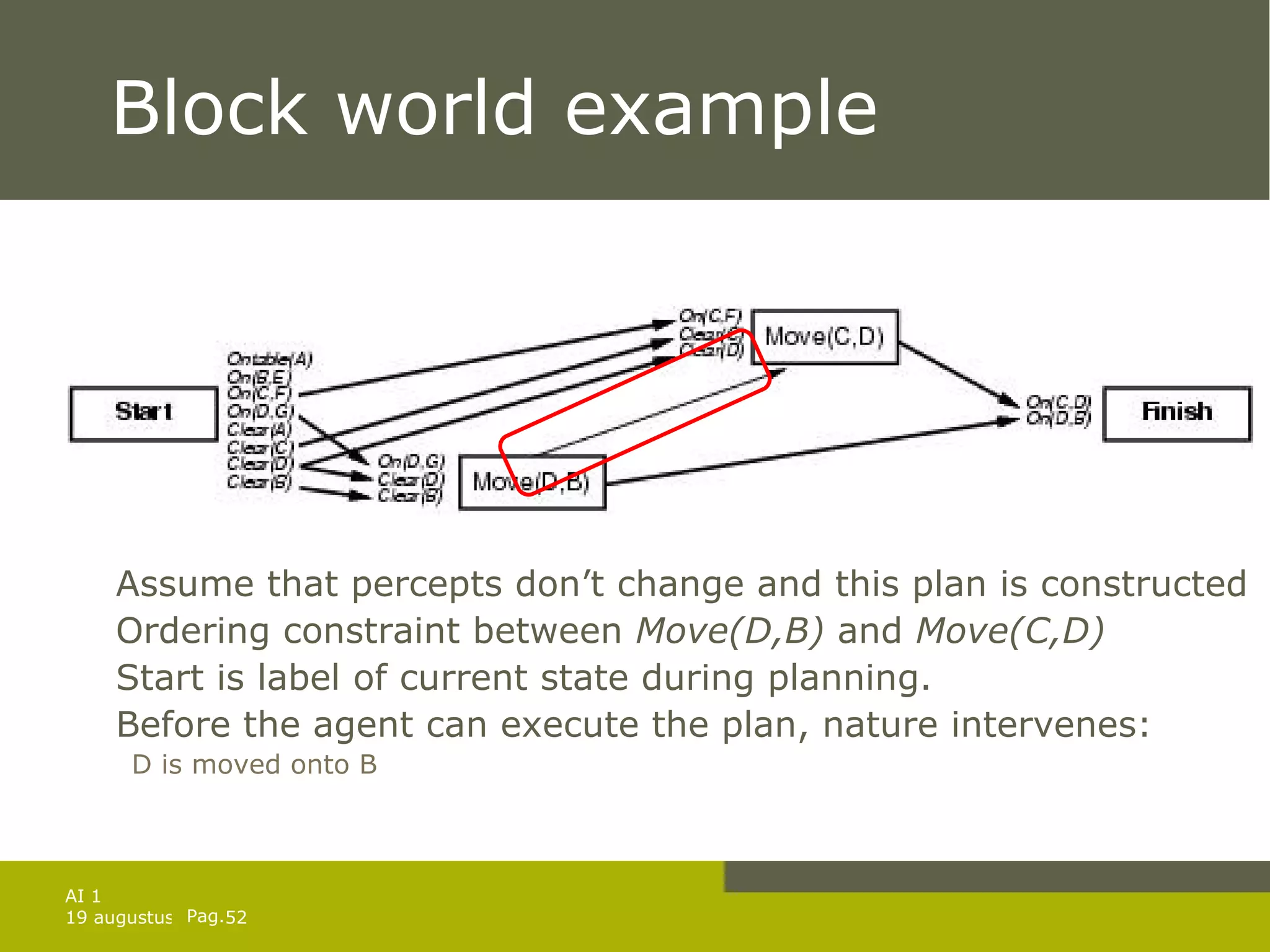
Block world example Assume that percepts don’t change and this plan is constructed Ordering constraint between  Move(D,B)  and  Move(C,D) Start is label of current state during planning. Before the agent can execute the plan, nature intervenes: D is moved onto B
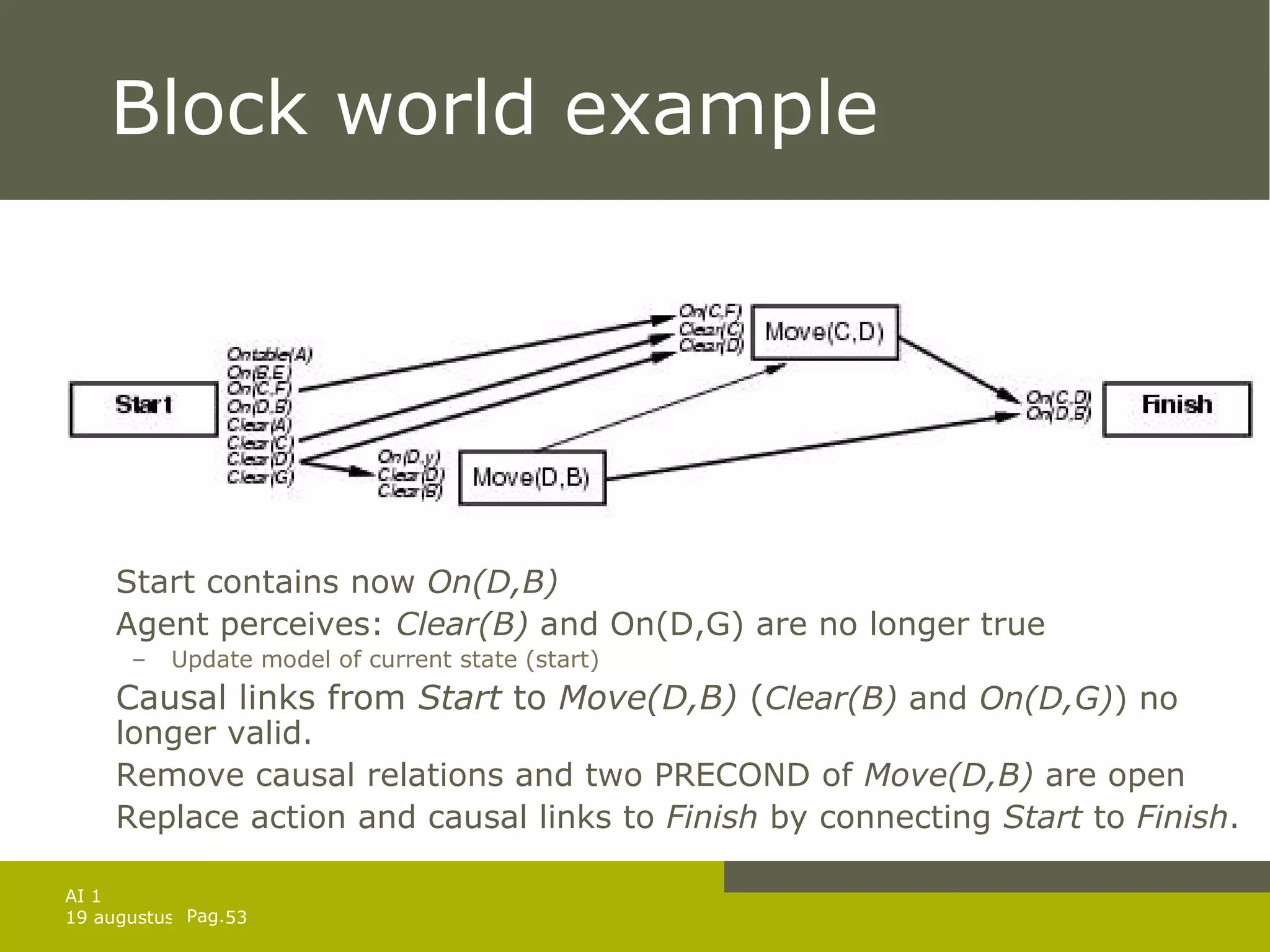
Block world example Start contains now  On(D,B) Agent perceives:  Clear(B)  and On(D,G) are no longer true Update model of current state (start) Causal links from  Start  to  Move(D,B)  ( Clear(B)  and  On(D,G) ) no longer valid. Remove causal relations and two PRECOND of  Move(D,B)  are open Replace action and causal links to  Finish  by connecting  Start  to  Finish .
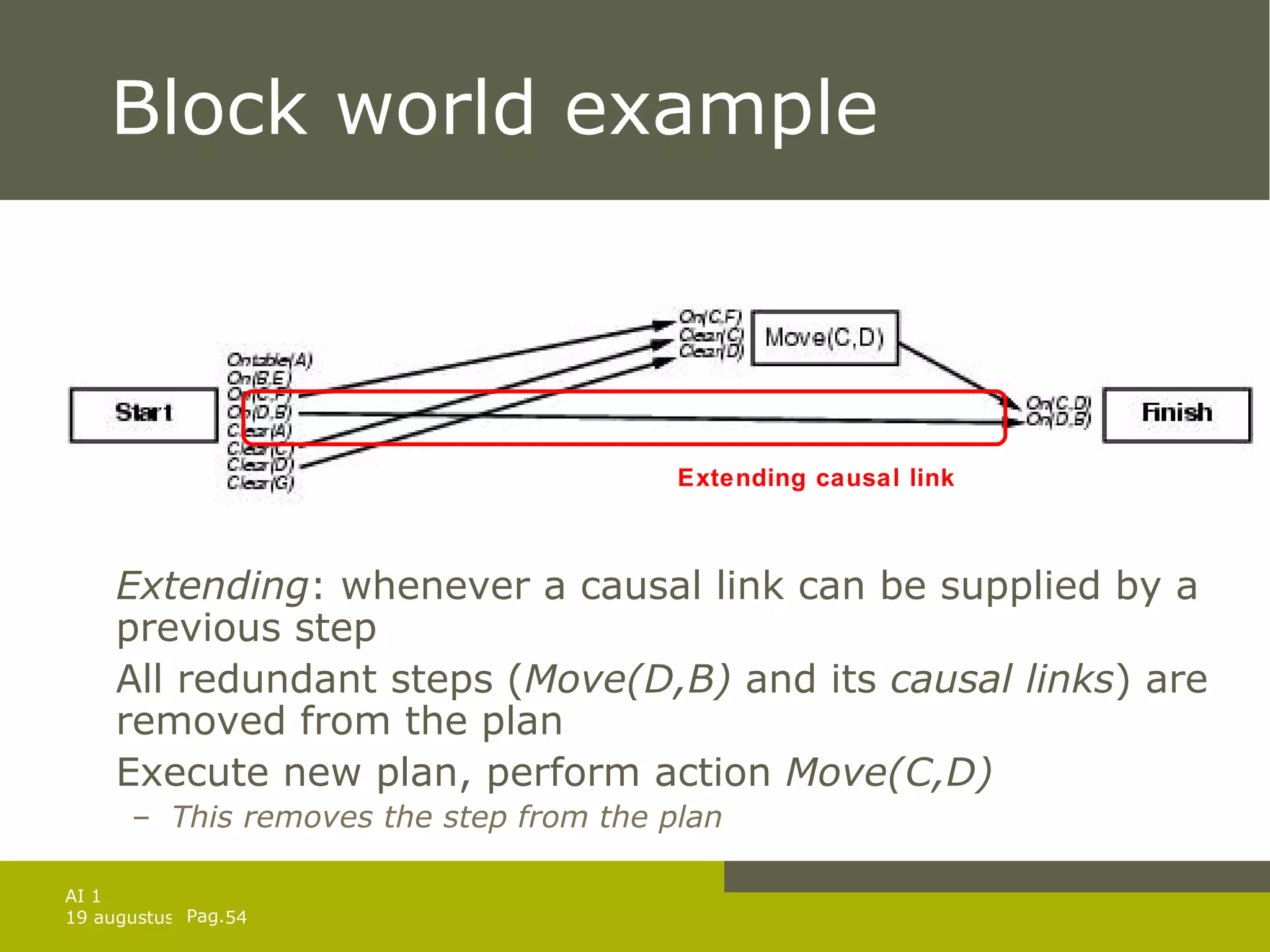
Block world example Extending : whenever a causal link can be supplied by a previous step All redundant steps ( Move(D,B)  and its  causal links ) are removed from the plan Execute new plan, perform action  Move(C,D) This removes the step from the plan Extending causal link
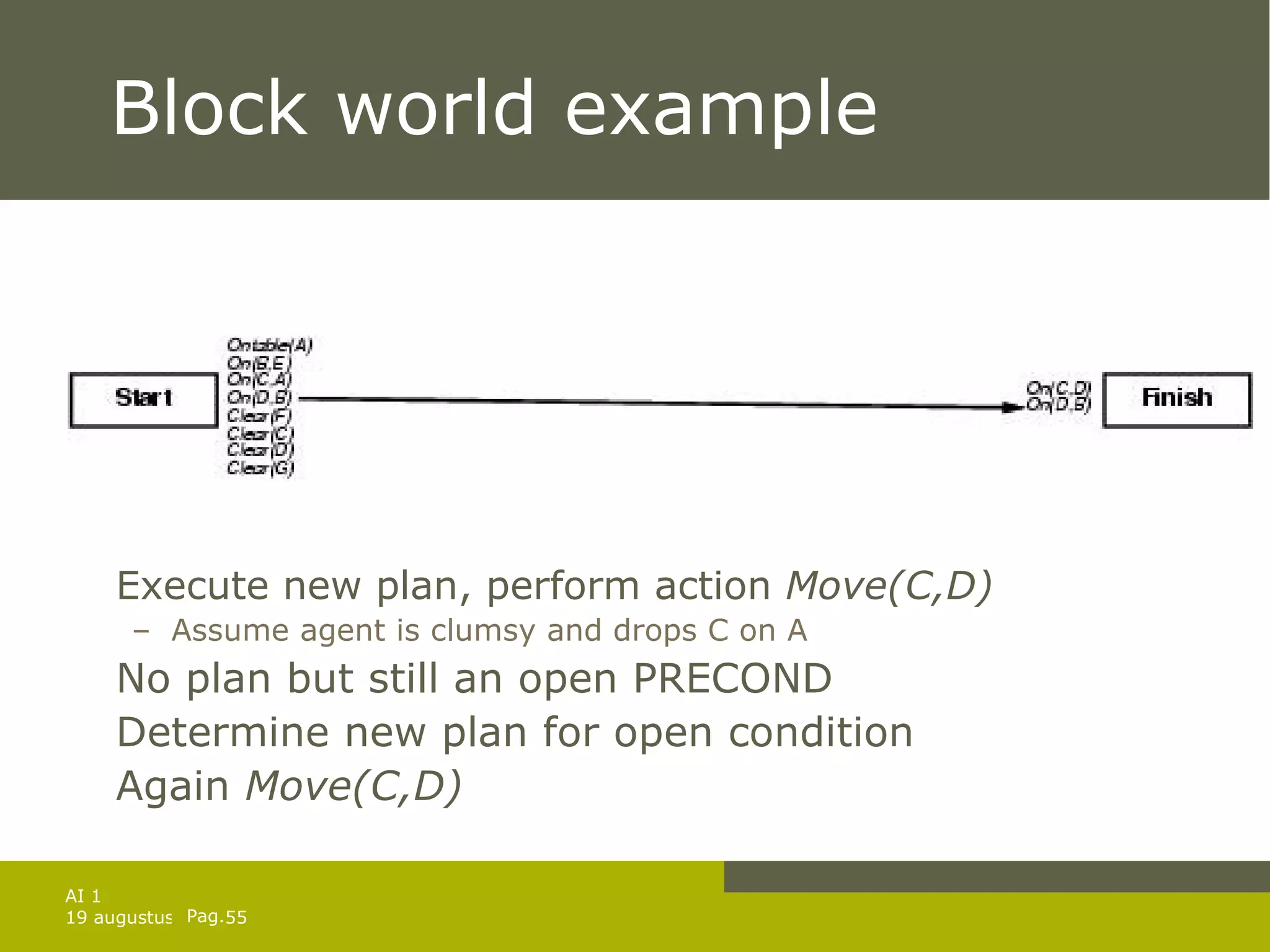
Block world example Execute new plan, perform action  Move(C,D) Assume agent is clumsy and drops C on A No plan but still an open PRECOND Determine new plan for open condition Again  Move(C,D)
Block world example Similar to POP On each iteration find plan-flaw and fix it Possible flaws:  Missing goal, Open precondition, Causal conflict, Unsupported link, Redundant action, Unexecuted action, unnecessary historical goal
Multi-agent planning So far we only discussed single-agent environments. Other agents can simply be added to the model of the world: Poor performance since agents are not indifferent ot other agents’ intentions In general two types of multi-agent environments: Cooperative Competitive
Cooperation: Joint goals and plans Multi-planning problem: assume double tennis example where agents want to return ball. Agents(A,B) Init(At(A,[Left,Baseline])   At(B,[Right, Net])    Approaching(Ball,[Right, Baseline])    PArtner(A,B)    Partner(B,A))  Goal(Returned(Ball)    At(agent,[x,Net])) Action(Hit(agent, Ball) PRECOND:  Approaching(Ball,[x,y])    At(agent,[x,y])    Partner(agent, partner)      At(partner,[x,y]) EFFECT:  Returned(Ball)) Action(Go(agent,[x,y]) PRECOND:  At(agent,[a,b]) EFFECT:  At(agent,[x,y])       At(agent,[a,b]))
Cooperation: Joint goals and plans A solution is a  joint-plan  consisting of actions for both agents. Example: A: [Go(A,[Right, Baseline]), Hit(A,Ball)] B: [NoOp(B), NoOp(B)] Or A: [Go(A,[Left, net), NoOp(A)] B: [Go(B,[Right, Baseline]), Hit(B, Ball)] Coordination  is required to reach same joint plan
Multi-body planning  Planning problem faced by a single centralized agent that can dictate action to each of several physical entities. Hence not truly multi-agent Important: synchronization of actions Assume for simplicity that every action takes one time step and at each point in the joint plan the actions are performed simultaneously [<Go(A,[Left,Net]), Go(B,[Right,Baseline]>; <NoOp(A), Hit(B, Ball)>] Planning can be performed using POP applied to the set of all possible joint actions. Size of this set???
Multi-body planning  Alternative to set of all joint actions: add extra concurrency lines to action description Concurrent action Action(Hit(A, Ball) CONCURRENT :   Hit(B,Ball)  PRECOND:  Approaching(Ball,[x,y])    At(A,[x,y])  EFFECT:  Returned(Ball)) Required actions (carrying object by two agents) Action(Carry(A, cooler, here, there) CONCURRENT : Carry(B,cooler, here there)  PRECOND:  …) Planner similar to POP with some small changes in possible ordering relations
Coordination mechanisms To ensure agreement on joint plan: use  convention . Convention = a constraint on the selection of joint plans (beyond the constraint that the joint plan must work if the agents adopt it). e.g. stick to your court or one player stays at the net. Conventions which are widely adopted= social laws e.g. language. Can be domain-specific or independent. Could arise through evolutionary process (flocking behavior).
Flocking example Three rules: Separation: Steer away from neighbors when you get too close Cohesion Steer toward the average position of neighbors  Alignment Steer toward average orientation (heading) of neighbors Flock exhibits  emergent behavior  of flying as a pseudo-rigid body.
Coordination mechanisms In the absence of conventions: Communication e.g. Mine! Or Yours! in tennis example The burden of arriving at a succesfull joint plan can be placed on Agent designer (agents are reactive, no explicit models of other agents) Agent (agents are deliberative, model of other agents required)
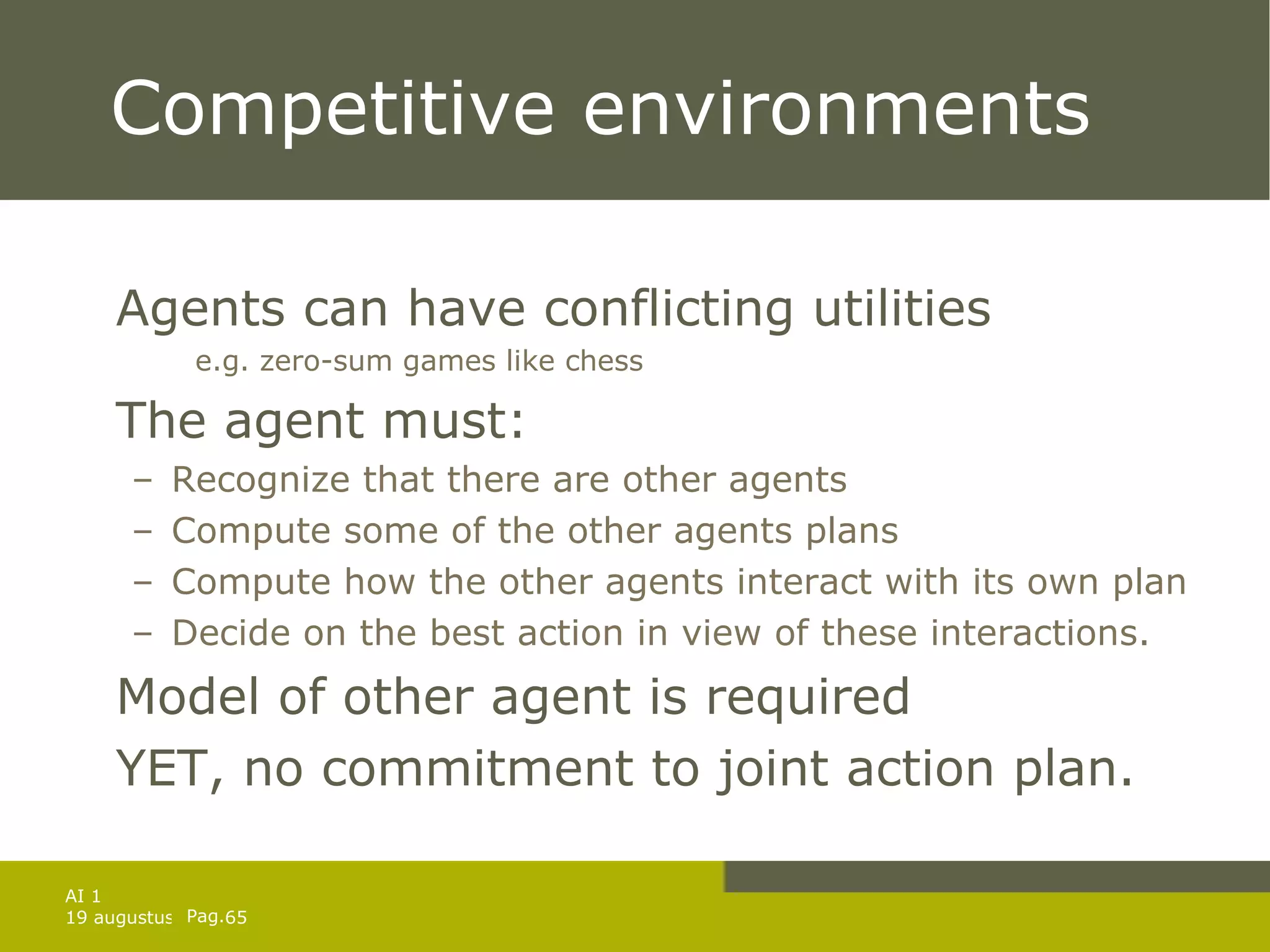
Competitive environments Agents can have conflicting utilities  e.g. zero-sum games like chess The agent must: Recognize that there are other agents Compute some of the other agents plans Compute how the other agents interact with its own plan Decide on the best action in view of these interactions. Model of other agent is required YET, no commitment to joint action plan.

Artificial Intelligence 1 Planning In The Real World

  • 1.
    Artificial Intelligence 1:Planning in the real world Lecturer: Tom Lenaerts SWITCH, Vlaams Interuniversitair Instituut voor Biotechnologie
  • 2.
    Outline Time, schedulesand resources Hierarchical task network planning Non-deterministic domains Conditional planning Execution monitoring and replanning Continuous planning Multi-agent planning
  • 3.
    Time, schedules andresources Until know: what actions to do Real-world: + actions occur at certain moments in time. + actions have a beginning and an end. + actions take a certain amount of time. Job-shop scheduling: Complete a set of jobs , each of which consists of a sequence of actions , Where each action has a given duration and might require resources . Determine a schedule that minimizes the total time required to complete all jobs (respecting resource constraints).
  • 4.
    Car construction exampleInit(Chassis(C1)  Chassis(C2)  Engine(E1,C1,30)  Engine(E1,C2,60)  Wheels(W1,C1,30)  Wheels(W2,C2,15)) Goal(Done(C1)  Done(C2)) Action(AddEngine(e,c,m) PRECOND: Engine(e,c,d)  Chassis(c)  ¬EngineIn(c) EFFECT: EngineIn(c)  Duration(d)) Action(AddWheels(w,c) PRECOND: Wheels(w,c,d)  Chassis(c) EFFECT: WheelsOn(c)  Duration(d)) Action(Inspect(c) PRECOND: EngineIn(c)  WheelsOn(c)  Chassis(c) EFFECT: Done(c)  Duration(10))
  • 5.
    Solution found byPOP Slack of 15 critical path
  • 6.
    Planning vs. schedulingHow does the problem differ from a standard planning problem? When does an action start and when does it end? So next ot order (planning) duration is also considered Duration(d) Critical path method is used to determine start and end times: Path = linear sequence from start to end Critical path = path with longest total duration Determines the duration of the entire plan Critical path should be executed without delay
  • 7.
    ES and LSEarliest possible (ES) and latest possible (LS) start times. LS-ES = slack of an action for all actions determines the schedule for the entire problem. ES(Start) = 0 ES(B)=max A<B ES(A) + Duration(A) LS(Finish)=ES(Finish) LS(A) = min A<B LS(B) -Duration(A) Complexity is O(Nb) (given a PO)
  • 8.
    Scheduling with resourcesResource constraints = required material or objects to perform task Reusable resources A resource that is occupied during an action but becomes available when the action is finished. Require extension of action syntax: Resource:R(k) k units of resource are required by the action. Is a pre-requisite before the action can be performed. Resource can not be used for k time units by other.
  • 9.
    Car example withresources Init(Chassis(C1)  Chassis(C2)  Engine(E1,C1,30)  Engine(E1,C2,60)  Wheels(W1,C1,30)  Wheels(W2,C2,15)  EngineHoists(1)  WheelStations(1)  Inspectors(2)) Goal(Done(C1)  Done(C2)) Action(AddEngine(e,c,m) PRECOND: Engine(e,c,d)  Chassis(c)  ¬EngineIn(c) EFFECT: EngineIn(c)  Duration(d), RESOURCE : EngineHoists(1)) Action(AddWheels(w,c) PRECOND: Wheels(w,c,d)  Chassis(c) EFFECT: WheelsOn(c)  Duration(d) RESOURCE : WheelStations(1)) Action(Inspect(c) PRECOND: EngineIn(c)  WheelsOn(c)  Chassis(c) EFFECT: Done(c)  Duration(10) RESOURCE : Inspectors(1)) aggregation
  • 10.
  • 11.
    Scheduling with resourcesAggregation = group individual objects into quantities when the objects are undistinguishable with respect to their purpose. Reduces complexity Resource constraints make scheduling problems more complicated. Additional interactions among actions Heuristic: minimum slack algorithm Select an action with all pre-decessors scheduled and with the least slack for the earliest possible start.
  • 12.
    Hierarchical task networkplanning Reduce complexity  hierarchical decomposition At each level of the hierarchy a computational task is reduced to a small number of activities at the next lower level. The computational cost of arranging these activities is low. Hierarchical task network (HTN) planning uses a refinement of actions through decomposition. e.g. building a house = getting a permit + hiring a contractor + doing the construction + paying the contractor. Refined until only primitive actions remain. Pure and hybrid HTN planning.
  • 13.
    Representation decomposition Generaldescriptions are stored in plan library . Each method = Decompos(a,d); a= action and d= PO plan. See buildhouse example Start action supplies all preconditions of actions not supplied by other actions. =external preconditions Finish action has all effects of actions not present in other actions =external effects Primary effects (used to achieve goal) vs. secondary effects
  • 14.
    Buildhouse example Externalprecond External effects
  • 15.
    Buildhouse example Action(Buyland, PRECOND: Money, EFFECT: Land  ¬Money) Action(GetLoan, PRECOND: Goodcredit, EFFECT: Money  Mortgage) Action(BuildHouse, PRECOND: Land, EFFECT: House) Action(GetPermit, PRECOND: LAnd, EFFECT: Permit) Action(HireBuilder, EFFECT: Contract) Action(Construction, PRECOND: Permit  Contract, EFFECT: HouseBuilt  ¬Permit), Action(PayBuilder, PRECOND: Money  HouseBuilt, EFFECT: ¬Money  House  ¬ ¬Contract), Decompose(BuildHouse, Plan :: STEPS { S1: GetPermit, S2:HireBuilder, S3:Construction, S4 PayBuilder} ORDERINGS : {Start < S1 < S3< S4<Finish, Start<S2<S3}, LINKS
  • 16.
    Properties of decompositionShould be correct implementation of action a Correct if plan d is complete and consistent PO plan for the problem of achieving the effects of a given the preconditions of a . A decomposition is not necessarily unique. Performs information hiding: STRIPS action description of higher-level action hides some preconditions and effects Ignore all internal effects of decomposition Does not specify the intervals inside the activity during which preconditions and effects must hold. Information hiding is essential to HTN planning.
  • 17.
    Recapitulation of POP(1) Assume propositional planning problems: The initial plan contains Start and Finish , the ordering constraint Start < Finish , no causal links, all the preconditions in Finish are open. Successor function : picks one open precondition p on an action B and generates a successor plan for every possible consistent way of choosing action A that achieves p . Test goal
  • 18.
    Recapitulation of POP(2) When generating successor plan: The causal link A--p->B and the ordering constraing A < B is added to the plan. If A is new also add start < A and A < B to the plan Resolve conflicts between new causal link and all existing actions Resolve conflicts between action A (if new) and all existing causal links.
  • 19.
    Adapting POP toHTN planning Remember POP? Modify the successor function: apply decomposition to current plan NEW Successor function: Select non-primitive action a’ in P For any Decompose(a’,d’) method in library where a and a’ unify with substitution  Replace a’ with d’ = subst(  ,d)
  • 20.
  • 21.
  • 22.
    How to hookup d in a’ ? Remove action a’ from P and replace with d  For each step s in d’ select an action that will play the role of s (either new s or existing s’ from P ) Possibility of subtask sharing Connect ordering steps for a’ to the steps in d’ Put all constraints so that constraints of the form B < a’ are maintained. Watch out for too strict orderings ! Connect the causal links If B -p-> a’ is a causal link in P, replace it by a set of causal links from B to all steps in d’ with preconditions p that were supplied by the start step Idem for a’ -p-> C
  • 23.
    What about HTN?Additional modification to POP are necessary BAD news: pure HTN planning is undecidable due to recursive decomposition actions. Walk=make one step and walk Resolve problems by Rule out recursion. Bound the length of relevant solutions, Hybridize HTN with POP Yet HTN can be efficient (see motivations in book)
  • 24.
  • 25.
    Non-deterministic domains Sofar: fully observable, static and deterministic domains. Agent can plan first and then execute plan with eyes closed Uncertain environment: incomplete (partially observable and/or nondeterministic) and incorrect (differences between world and model) information Use percepts Adapt plan when necessary Degree of uncertainty defined by indeterminacy Bounded: actions can have unpredictable effects, yet can be listed in action description axioms. Unbounded: preconditions and effects unknown or to large to enumerate.
  • 26.
    Handling indeterminacy Sensorlessplanning (conformant planning) Find plan that achieves goal in all possible circumstances (regardless of initial state and action effects). Conditional planning (Contingency planning) Construct conditional plan with different branches for possible contingencies. Execution monitoring and replanning While constructing plan judge whether plan requires revision. Continuous planning Planning active for a life time: adapt to changed circumstances and reformulate goals if necessary.
  • 27.
  • 28.
    Abstract example Initialstate = <chair,table, cans of paint, unknown colors>, goal state=<color(table) = color(chair)> Sensorless planning (conformant planning) Open any can of paint and apply it to both chair and table. Conditional planning (Contingency planning) Sense color of table and chair, if they are the same then finish else sense labels paint if color(label) =color(Furniture) then apply color to othe piece else apply color to both Execution monitoring and replanning Same as conditional and can fix errors (missed spots) Continuous planning Can revise goal when we want to first eat before painting the table and the chair.
  • 29.
    Conditional planning Dealwith uncertainty by checking the environment to see what is really happening. Used in fully observable and nondeterministic environments: The outcome of an action is unknown. Conditional steps will check the state of the environment. How to construct a conditional plan?
  • 30.
  • 31.
    Conditional planning Actions:left, right, suck Propositions to define states: AtL, AtR, CleanL, CleanR How to include indeterminism? Actions can have more than one effect E.g. moving left sometimes fails Action(Left, PRECOND: AtR, EFFECT: AtL) Becomes : Action(Left, PRECOND: AtR, EFFECT: AtL  AtR) Actions can have conditional effects Action(Left, PRECOND:AtR, EFFECT: AtL  (AtL  when cleanL: ¬cleanL) Both disjunctive and conditional
  • 32.
    Conditional planning Conditionalplans require conditional steps: If <test> then plan_A else plan_B if AtL  CleanL then Right else Suck Plans become trees Games against nature: Find conditional plans that work regardless of which action outcomes actually occur. Assume vacuum-world Initial state = AtR  CleanL  CleanR Double murphy: possibility of desposit dirt when moving to other square and possibility of despositing dirt when action is Suck.
  • 33.
    Game tree Statenode chance node
  • 34.
    Solution of gamesagainst N. Solution is a subtree that Has a goal node at every leaf Specifies one action at each of its state nodes Includes every outcome branch at each of the chance nodes. In previous example: [ Left , if AtL  CleanL  CleanR then [] else Suck ] For exact solutions: use minimax algorithm with 2 modifications: Max and Min nodes become OR and AND nodes Algorithm returns conditional plan instead of single move
  • 35.
    And-Or-search algorithm function AND-OR-GRAPH-SEARCH( problem ) returns a conditional plan or failure return OR-SEARCH(INITIAL-STATE[ problem ], problem , []) function AND-SEARCH( state_set, problem, path ) returns a conditional plan or failure for each s i in state _ set do plan i  OR-SEARCH( s i , problem,path ) if plan = failure then return failure return [ if s 1 then plan 1 else if s 2 then plan 2 else … if s n-1 then plan n-1 else plan n ] function OR-SEARCH( state, problem, path ) returns a conditional plan or failure if GOAL-TEST[ problem ]( state ) then return the empty plan if state is on path then return failure for action,state_set in SUCCESSORS[ problem ]( state ) do plan  AND-SEARCH( state_set, problem, [ state | plan ] ) if plan  failure then return [ action | plan ] return failure
  • 36.
    And-Or-search algorithm Howdoes it deal with cycles? When a state that already is on the path appears, return failure No non-cyclic solution Ensures algorithm termination The algorithm does not check whether some state is already on some other path from the root.
  • 37.
    And-Or-search algorithm Sometimesonly a cyclic solution exists e.g. tripple murphy: sometimes the move is not performed [ Left , if CleanL then [] else Suck ] is not a solution Use label to repeat parts of plan ( but infinite loops ) [ L1 : Left , if AtR then L1 else if CleanL then [] else Suck ]
  • 38.
    CP and partiallyobservable env. Fully observable: conditional tests can ask any question and get an answer Partially observable??? The agent has limited information about the environment. Modeled by a state-set = belief states E.g. assume vacuum agent which can not sense presence or absence of dirt in other squares than the one it is on. + alternative murphy: dirt can be left behind when moving to other square. Solution in fully observable world: keep moving left and right, sucking dirt whenever it appears until both squares are clean and I’m in square left.
  • 39.
  • 40.
    Belief states Representation?Sets of full state descriptions {( AtR  CleanR  CleanL )  ( AtR  CleanR  CleanL )} Logical sentences that capture the set of possible worlds in the belief state (OWA) AtR  CleanR Knowledge propositions describing the agent’s knowledge (CWA) K( AtR )  K( CleanR )
  • 41.
    Belief states Choice2 and 3 are equivalent (let’s continue with 3) Symbols can appear in three ways in three ways: positive, negative or unknown: 3 n possible belief states for n proposition symbols. YET, set of belief sets is a power set of the phyiscal states which is much larger than 3 n Hence 3 is restricted as representation Any scheme capable of representing every possible belief state will require O(2 n ) bit to represent each one in the worst case. The current scheme only requires O(n)
  • 42.
    Sensing in Cond.Planning How does it work? Automatic sensing At every time step the agent gets all available percepts Active sensing Percepts are obtained through the execution of specific sensory actions . checkDirt and checkLocation Given the representation and the sensing, action descriptions can now be formulated.
  • 43.
    Monitoring and replanningExecution monitoring: check whether everything is going as planned. Unbounded indeterminancy: some unanticipated circumstances will arise. A necessity in realistic environments. Kinds of monitoring: Action monitoring: verify whether the next action will work. Plan monitoring: verify the entire remaining plan.
  • 44.
    Monitoring and replanningWhen something unexpected happens: replan To avoid too much time on planning try to repair the old plan. Can be applied in both fully and partially observable environments, and to a variety of planning representations.
  • 45.
    Replanning-agent function REPLANNING-AGENT( percept ) returns an action static: KB , a knowledge base (+ action descriptions) plan , a plan initially [] whole_plan, a plan initially [] goal , a goal TELL( KB , MAKE-PERCEPT-SENTENCE( percept , t )) current  STATE-DESCRIPTION( KB,t ) if plan = [] then return the empty plan whole_plan  plan  PLANNER( current, goal, KB ) if PRECONDITIONS(FIRST( plan )) not currently true in KB then candidates  SORT( whole_plan, ordered by distance to current ) find state s in candidates such that failure  repair  PLANNER( current, s, KB ) continuation  the tail of whole_plan starting at s whole_plan  plan  APPEND( repair, continuation) return POP (plan)
  • 46.
  • 47.
    Repair example: paintingInit(Color(Chair, Blue)  Color(Table,Green)  ContainsColor(BC,Blue)  PaintCan(BC)  ContainsColor(RC,Red)  PaintCan(RC)) Goal(Color(Chair,x)  Color(Table,x)) Action(Paint(object, color) PRECOND: HavePaint(color) EFFECT: Color(object, color)) Action(Open(can) PRECOND: PaintCan(can)  ContainsColor(can,color) EFFECT: HavePaint(color)) [Start; Open(BC); Paint(Table,Blue), Finish]
  • 48.
    Repair example: paintingSuppose that the agent now perceives that the colors of table and chair are different Figure out point in whole_plan to aim for Current state is identical as the precondition before Paint Repair action sequence to get there. Repair =[] and plan=[ Paint , Finish ] Continue performing this new plan Will loop until table and chair are perceived as the same. Action monitoring can lead to less intelligent behavior Assume the red is selected and there is not enough paint to apply to both chair and table. Improved by doing plan monitoring
  • 49.
    Plan monitoring Checkthe preconditions for success of the entire plan. Except those which are achieved by another step in the plan. Execution of doomed plan is cut of earlier. Limitation of replanning agent: It can not formulate new goals or accept new goals in addition to the current one
  • 50.
    Continuous planning. Agentpersists indefinitely in an environment Phases of goal formulation, planning and acting Execution monitoring + planner as one continuous process Example:Blocks world Assume a fully observable environment Assume partially ordered plan
  • 51.
    Block world exampleInitial state (a) Action ( Move(x,y), PRECOND: Clear(x)  Clear(y)  On(x,z) EFFECT: On(x,y)  Clear(z)   On(x,z)   Clear(y) The agent first need to formulate a goal: On(C,D)  On(D,B) Plan is created incrementally, return NoOp and check percepts
  • 52.
    Block world exampleAssume that percepts don’t change and this plan is constructed Ordering constraint between Move(D,B) and Move(C,D) Start is label of current state during planning. Before the agent can execute the plan, nature intervenes: D is moved onto B
  • 53.
    Block world exampleStart contains now On(D,B) Agent perceives: Clear(B) and On(D,G) are no longer true Update model of current state (start) Causal links from Start to Move(D,B) ( Clear(B) and On(D,G) ) no longer valid. Remove causal relations and two PRECOND of Move(D,B) are open Replace action and causal links to Finish by connecting Start to Finish .
  • 54.
    Block world exampleExtending : whenever a causal link can be supplied by a previous step All redundant steps ( Move(D,B) and its causal links ) are removed from the plan Execute new plan, perform action Move(C,D) This removes the step from the plan Extending causal link
  • 55.
    Block world exampleExecute new plan, perform action Move(C,D) Assume agent is clumsy and drops C on A No plan but still an open PRECOND Determine new plan for open condition Again Move(C,D)
  • 56.
    Block world exampleSimilar to POP On each iteration find plan-flaw and fix it Possible flaws: Missing goal, Open precondition, Causal conflict, Unsupported link, Redundant action, Unexecuted action, unnecessary historical goal
  • 57.
    Multi-agent planning Sofar we only discussed single-agent environments. Other agents can simply be added to the model of the world: Poor performance since agents are not indifferent ot other agents’ intentions In general two types of multi-agent environments: Cooperative Competitive
  • 58.
    Cooperation: Joint goalsand plans Multi-planning problem: assume double tennis example where agents want to return ball. Agents(A,B) Init(At(A,[Left,Baseline])  At(B,[Right, Net])  Approaching(Ball,[Right, Baseline])  PArtner(A,B)  Partner(B,A)) Goal(Returned(Ball)  At(agent,[x,Net])) Action(Hit(agent, Ball) PRECOND: Approaching(Ball,[x,y])  At(agent,[x,y])  Partner(agent, partner)   At(partner,[x,y]) EFFECT: Returned(Ball)) Action(Go(agent,[x,y]) PRECOND: At(agent,[a,b]) EFFECT: At(agent,[x,y])   At(agent,[a,b]))
  • 59.
    Cooperation: Joint goalsand plans A solution is a joint-plan consisting of actions for both agents. Example: A: [Go(A,[Right, Baseline]), Hit(A,Ball)] B: [NoOp(B), NoOp(B)] Or A: [Go(A,[Left, net), NoOp(A)] B: [Go(B,[Right, Baseline]), Hit(B, Ball)] Coordination is required to reach same joint plan
  • 60.
    Multi-body planning Planning problem faced by a single centralized agent that can dictate action to each of several physical entities. Hence not truly multi-agent Important: synchronization of actions Assume for simplicity that every action takes one time step and at each point in the joint plan the actions are performed simultaneously [<Go(A,[Left,Net]), Go(B,[Right,Baseline]>; <NoOp(A), Hit(B, Ball)>] Planning can be performed using POP applied to the set of all possible joint actions. Size of this set???
  • 61.
    Multi-body planning Alternative to set of all joint actions: add extra concurrency lines to action description Concurrent action Action(Hit(A, Ball) CONCURRENT :  Hit(B,Ball) PRECOND: Approaching(Ball,[x,y])  At(A,[x,y]) EFFECT: Returned(Ball)) Required actions (carrying object by two agents) Action(Carry(A, cooler, here, there) CONCURRENT : Carry(B,cooler, here there) PRECOND: …) Planner similar to POP with some small changes in possible ordering relations
  • 62.
    Coordination mechanisms Toensure agreement on joint plan: use convention . Convention = a constraint on the selection of joint plans (beyond the constraint that the joint plan must work if the agents adopt it). e.g. stick to your court or one player stays at the net. Conventions which are widely adopted= social laws e.g. language. Can be domain-specific or independent. Could arise through evolutionary process (flocking behavior).
  • 63.
    Flocking example Threerules: Separation: Steer away from neighbors when you get too close Cohesion Steer toward the average position of neighbors Alignment Steer toward average orientation (heading) of neighbors Flock exhibits emergent behavior of flying as a pseudo-rigid body.
  • 64.
    Coordination mechanisms Inthe absence of conventions: Communication e.g. Mine! Or Yours! in tennis example The burden of arriving at a succesfull joint plan can be placed on Agent designer (agents are reactive, no explicit models of other agents) Agent (agents are deliberative, model of other agents required)
  • 65.
    Competitive environments Agentscan have conflicting utilities e.g. zero-sum games like chess The agent must: Recognize that there are other agents Compute some of the other agents plans Compute how the other agents interact with its own plan Decide on the best action in view of these interactions. Model of other agent is required YET, no commitment to joint action plan.