Planning
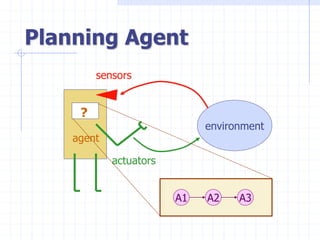
Planning Agent
environment
agent
?
sensors
actuators
A1 A2 A3
Outline
The Planning problem
Planning with State-space search
Partial-order planning
Hierarchical Planning
Planning problem
Classical planning environment: fully observable,
deterministic, finite, static and discrete.
Find a sequence of actions that achieves a given
goal when executed from a given initial world
state. That is, given
 a set of action descriptions (defining the possible primitive
actions by the agent),
 an initial state description, and
 a goal state description or predicate,
compute a plan, which is
 a sequence of action instances, such that executing them in
the initial state will change the world to a state satisfying
the goal-state description.
Goals are usually specified as a conjunction of
subgoals to be achieved
Planning vs. problem solving
Planning and problem solving methods can often
solve the same sorts of problems
Planning is more powerful because of the
representations and methods used
States, goals, and actions are decomposed into sets
of sentences (usually in first-order logic)
Search often proceeds through plan space rather
than state space (though first we will talk about
state-space planners)
Subgoals can be planned independently, reducing the
complexity of the planning problem
Choose actions to achieve a certain goal
But isn’t it exactly the same goal as for
problem solving?
Some difficulties with problem solving:
 The successor function is a black box: it
must be “applied” to a state to know which
actions are possible in that state and what
are the effects of each one
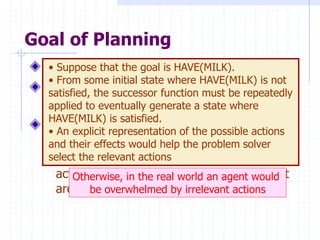
Goal of Planning
Otherwise, in the real world an agent would
be overwhelmed by irrelevant actions
• Suppose that the goal is HAVE(MILK).
• From some initial state where HAVE(MILK) is not
satisfied, the successor function must be repeatedly
applied to eventually generate a state where
HAVE(MILK) is satisfied.
• An explicit representation of the possible actions
and their effects would help the problem solver
select the relevant actions
Goal of Planning
Choose actions to achieve a certain goal
But isn’t it exactly the same goal as for
problem solving?
Some difficulties with problem solving:
 The goal test is another black-box function,
states are domain-specific data structures,
and heuristics must be supplied for each
new problem
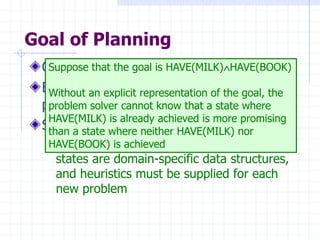
Suppose that the goal is HAVE(MILK)HAVE(BOOK)
Without an explicit representation of the goal, the
problem solver cannot know that a state where
HAVE(MILK) is already achieved is more promising
than a state where neither HAVE(MILK) nor
HAVE(BOOK) is achieved
Goal of Planning
Choose actions to achieve a certain goal
But isn’t it exactly the same goal as for
problem solving?
Some difficulties with problem solving:
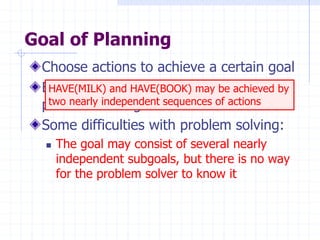
 The goal may consist of several nearly
independent subgoals, but there is no way
for the problem solver to know it
HAVE(MILK) and HAVE(BOOK) may be achieved by
two nearly independent sequences of actions
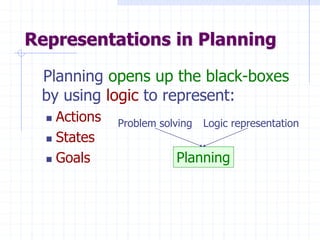
Representations in Planning
Planning opens up the black-boxes
by using logic to represent:
 Actions
 States
 Goals
Problem solving Logic representation
Planning
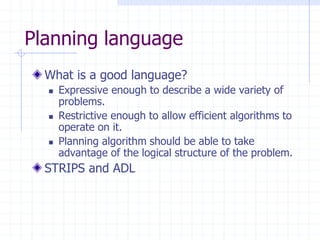
Planning language
What is a good language?
 Expressive enough to describe a wide variety of
problems.
 Restrictive enough to allow efficient algorithms to
operate on it.
 Planning algorithm should be able to take
advantage of the logical structure of the problem.
STRIPS and ADL
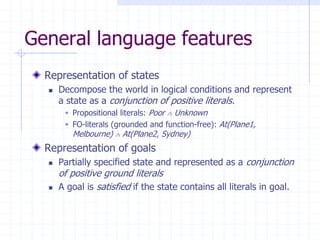
General language features
Representation of states
 Decompose the world in logical conditions and represent
a state as a conjunction of positive literals.
 Propositional literals: Poor  Unknown
 FO-literals (grounded and function-free): At(Plane1,
Melbourne)  At(Plane2, Sydney)
Representation of goals
 Partially specified state and represented as a conjunction
of positive ground literals
 A goal is satisfied if the state contains all literals in goal.
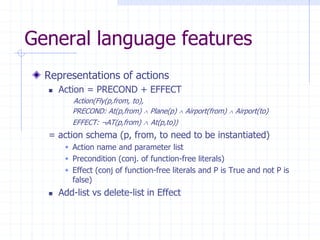
General language features
Representations of actions
 Action = PRECOND + EFFECT
Action(Fly(p,from, to),
PRECOND: At(p,from)  Plane(p)  Airport(from)  Airport(to)
EFFECT: ¬AT(p,from)  At(p,to))
= action schema (p, from, to need to be instantiated)
 Action name and parameter list
 Precondition (conj. of function-free literals)
 Effect (conj of function-free literals and P is True and not P is
false)
 Add-list vs delete-list in Effect
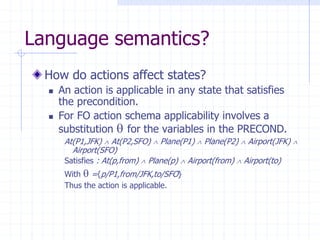
Language semantics?
How do actions affect states?
 An action is applicable in any state that satisfies
the precondition.
 For FO action schema applicability involves a
substitution  for the variables in the PRECOND.
At(P1,JFK)  At(P2,SFO)  Plane(P1)  Plane(P2)  Airport(JFK) 
Airport(SFO)
Satisfies : At(p,from)  Plane(p)  Airport(from)  Airport(to)
With  ={p/P1,from/JFK,to/SFO}
Thus the action is applicable.
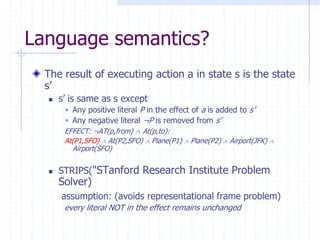
Language semantics?
The result of executing action a in state s is the state
s’
 s’ is same as s except
 Any positive literal P in the effect of a is added to s’
 Any negative literal ¬P is removed from s’
EFFECT: ¬AT(p,from)  At(p,to):
At(P1,SFO)  At(P2,SFO)  Plane(P1)  Plane(P2)  Airport(JFK) 
Airport(SFO)
 STRIPS("STanford Research Institute Problem
Solver)
assumption: (avoids representational frame problem)
every literal NOT in the effect remains unchanged
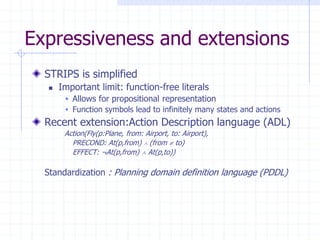
Expressiveness and extensions
STRIPS is simplified
 Important limit: function-free literals
 Allows for propositional representation
 Function symbols lead to infinitely many states and actions
Recent extension:Action Description language (ADL)
Action(Fly(p:Plane, from: Airport, to: Airport),
PRECOND: At(p,from)  (from  to)
EFFECT: ¬At(p,from)  At(p,to))
Standardization : Planning domain definition language (PDDL)
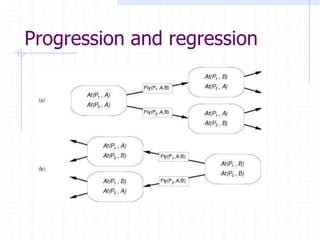
Planning with state-space search
Both forward and backward search possible
Progression planners
 forward state-space search
 Consider the effect of all possible actions in a given state
Regression planners
 backward state-space search
 To achieve a goal, what must have been true in the
previous state.
Progression and regression
Progression algorithm
Formulation as state-space search problem:
 Initial state = initial state of the planning problem
 Literals not appearing are false
 Actions = those whose preconditions are satisfied
 Add positive effects, delete negative
 Goal test = does the state satisfy the goal
 Step cost = each action costs 1
Inefficient:
 (1) irrelevant action problem
 (2) good heuristic required for efficient search
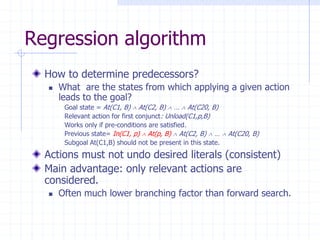
Regression algorithm
How to determine predecessors?
 What are the states from which applying a given action
leads to the goal?
Goal state = At(C1, B)  At(C2, B)  …  At(C20, B)
Relevant action for first conjunct: Unload(C1,p,B)
Works only if pre-conditions are satisfied.
Previous state= In(C1, p)  At(p, B)  At(C2, B)  …  At(C20, B)
Subgoal At(C1,B) should not be present in this state.
Actions must not undo desired literals (consistent)
Main advantage: only relevant actions are
considered.
 Often much lower branching factor than forward search.
Regression algorithm
General process for predecessor construction
 Give a goal description G
 Let A be an action that is relevant and consistent
 The predecessors is as follows:
 Any positive effects of A that appear in G are deleted.
 Each precondition literal of A is added , unless it already
appears.
Any standard search algorithm can be added to
perform the search.
Termination when predecessor satisfied by initial
state.
 In FO case, satisfaction might require a substitution.
Heuristics for state-space search
Neither progression or regression are very efficient
without a good heuristic.
 How many actions are needed to achieve the goal?
 Exact solution is NP hard, find a good estimate
Two approaches to find admissible heuristic:
 The optimal solution to the relaxed problem.
 Remove all preconditions from actions
 The subgoal independence assumption:
The cost of solving a conjunction of subgoals is approximated by
the sum of the costs of solving the subproblems independently.
Partial-order planning
Progression and regression planning are
totally ordered plan search forms.
 They cannot take advantage of problem
decomposition.
 Decisions must be made on how to sequence actions on
all the subproblems
Least commitment strategy:
 Delay choice during search
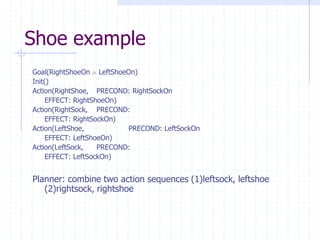
Shoe example
Goal(RightShoeOn  LeftShoeOn)
Init()
Action(RightShoe, PRECOND: RightSockOn
EFFECT: RightShoeOn)
Action(RightSock, PRECOND:
EFFECT: RightSockOn)
Action(LeftShoe, PRECOND: LeftSockOn
EFFECT: LeftShoeOn)
Action(LeftSock, PRECOND:
EFFECT: LeftSockOn)
Planner: combine two action sequences (1)leftsock, leftshoe
(2)rightsock, rightshoe
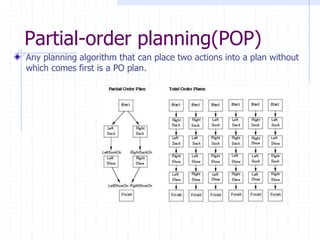
Partial-order planning(POP)
Any planning algorithm that can place two actions into a plan without
which comes first is a PO plan.
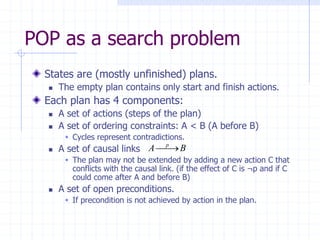
POP as a search problem
States are (mostly unfinished) plans.
 The empty plan contains only start and finish actions.
Each plan has 4 components:
 A set of actions (steps of the plan)
 A set of ordering constraints: A < B (A before B)
 Cycles represent contradictions.
 A set of causal links
 The plan may not be extended by adding a new action C that
conflicts with the causal link. (if the effect of C is ¬p and if C
could come after A and before B)
 A set of open preconditions.
 If precondition is not achieved by action in the plan.

A p

 B
Example of final plan
Actions={Rightsock, Rightshoe, Leftsock, Leftshoe,
Start, Finish}
Orderings={Rightsock < Rightshoe; Leftsock <
Leftshoe}
Links={Rightsock->Rightsockon -> Rightshoe,
Leftsock->Leftsockon-> Leftshoe, Rightshoe-
>Rightshoeon->Finish, …}
Open preconditions={}
POP as a search problem
A plan is consistent iff there are no cycles in the
ordering constraints and no conflicts with the causal
links.
A consistent plan with no open preconditions is a
solution.
A partial order plan is executed by repeatedly
choosing any of the possible next actions.
 This flexibility is a benefit in non-cooperative
environments.
Solving POP
Assume propositional planning problems:
 The initial plan contains Start and Finish, the ordering
constraint Start < Finish, no causal links, all the
preconditions in Finish are open.
 Successor function :
 picks one open precondition p on an action B and
 generates a successor plan for every possible consistent way of
choosing action A that achieves p.
 Test goal

RPT_AI-06_A_Planning Intro.ppt

  • 1.
  • 2.
  • 3.
    Outline The Planning problem Planningwith State-space search Partial-order planning Hierarchical Planning
  • 4.
    Planning problem Classical planningenvironment: fully observable, deterministic, finite, static and discrete. Find a sequence of actions that achieves a given goal when executed from a given initial world state. That is, given  a set of action descriptions (defining the possible primitive actions by the agent),  an initial state description, and  a goal state description or predicate, compute a plan, which is  a sequence of action instances, such that executing them in the initial state will change the world to a state satisfying the goal-state description. Goals are usually specified as a conjunction of subgoals to be achieved
  • 5.
    Planning vs. problemsolving Planning and problem solving methods can often solve the same sorts of problems Planning is more powerful because of the representations and methods used States, goals, and actions are decomposed into sets of sentences (usually in first-order logic) Search often proceeds through plan space rather than state space (though first we will talk about state-space planners) Subgoals can be planned independently, reducing the complexity of the planning problem
  • 6.
    Choose actions toachieve a certain goal But isn’t it exactly the same goal as for problem solving? Some difficulties with problem solving:  The successor function is a black box: it must be “applied” to a state to know which actions are possible in that state and what are the effects of each one Goal of Planning Otherwise, in the real world an agent would be overwhelmed by irrelevant actions • Suppose that the goal is HAVE(MILK). • From some initial state where HAVE(MILK) is not satisfied, the successor function must be repeatedly applied to eventually generate a state where HAVE(MILK) is satisfied. • An explicit representation of the possible actions and their effects would help the problem solver select the relevant actions
  • 7.
    Goal of Planning Chooseactions to achieve a certain goal But isn’t it exactly the same goal as for problem solving? Some difficulties with problem solving:  The goal test is another black-box function, states are domain-specific data structures, and heuristics must be supplied for each new problem Suppose that the goal is HAVE(MILK)HAVE(BOOK) Without an explicit representation of the goal, the problem solver cannot know that a state where HAVE(MILK) is already achieved is more promising than a state where neither HAVE(MILK) nor HAVE(BOOK) is achieved
  • 8.
    Goal of Planning Chooseactions to achieve a certain goal But isn’t it exactly the same goal as for problem solving? Some difficulties with problem solving:  The goal may consist of several nearly independent subgoals, but there is no way for the problem solver to know it HAVE(MILK) and HAVE(BOOK) may be achieved by two nearly independent sequences of actions
  • 9.
    Representations in Planning Planningopens up the black-boxes by using logic to represent:  Actions  States  Goals Problem solving Logic representation Planning
  • 10.
    Planning language What isa good language?  Expressive enough to describe a wide variety of problems.  Restrictive enough to allow efficient algorithms to operate on it.  Planning algorithm should be able to take advantage of the logical structure of the problem. STRIPS and ADL
  • 11.
    General language features Representationof states  Decompose the world in logical conditions and represent a state as a conjunction of positive literals.  Propositional literals: Poor  Unknown  FO-literals (grounded and function-free): At(Plane1, Melbourne)  At(Plane2, Sydney) Representation of goals  Partially specified state and represented as a conjunction of positive ground literals  A goal is satisfied if the state contains all literals in goal.
  • 12.
    General language features Representationsof actions  Action = PRECOND + EFFECT Action(Fly(p,from, to), PRECOND: At(p,from)  Plane(p)  Airport(from)  Airport(to) EFFECT: ¬AT(p,from)  At(p,to)) = action schema (p, from, to need to be instantiated)  Action name and parameter list  Precondition (conj. of function-free literals)  Effect (conj of function-free literals and P is True and not P is false)  Add-list vs delete-list in Effect
  • 13.
    Language semantics? How doactions affect states?  An action is applicable in any state that satisfies the precondition.  For FO action schema applicability involves a substitution  for the variables in the PRECOND. At(P1,JFK)  At(P2,SFO)  Plane(P1)  Plane(P2)  Airport(JFK)  Airport(SFO) Satisfies : At(p,from)  Plane(p)  Airport(from)  Airport(to) With  ={p/P1,from/JFK,to/SFO} Thus the action is applicable.
  • 14.
    Language semantics? The resultof executing action a in state s is the state s’  s’ is same as s except  Any positive literal P in the effect of a is added to s’  Any negative literal ¬P is removed from s’ EFFECT: ¬AT(p,from)  At(p,to): At(P1,SFO)  At(P2,SFO)  Plane(P1)  Plane(P2)  Airport(JFK)  Airport(SFO)  STRIPS("STanford Research Institute Problem Solver) assumption: (avoids representational frame problem) every literal NOT in the effect remains unchanged
  • 15.
    Expressiveness and extensions STRIPSis simplified  Important limit: function-free literals  Allows for propositional representation  Function symbols lead to infinitely many states and actions Recent extension:Action Description language (ADL) Action(Fly(p:Plane, from: Airport, to: Airport), PRECOND: At(p,from)  (from  to) EFFECT: ¬At(p,from)  At(p,to)) Standardization : Planning domain definition language (PDDL)
  • 16.
    Planning with state-spacesearch Both forward and backward search possible Progression planners  forward state-space search  Consider the effect of all possible actions in a given state Regression planners  backward state-space search  To achieve a goal, what must have been true in the previous state.
  • 17.
  • 18.
    Progression algorithm Formulation asstate-space search problem:  Initial state = initial state of the planning problem  Literals not appearing are false  Actions = those whose preconditions are satisfied  Add positive effects, delete negative  Goal test = does the state satisfy the goal  Step cost = each action costs 1 Inefficient:  (1) irrelevant action problem  (2) good heuristic required for efficient search
  • 19.
    Regression algorithm How todetermine predecessors?  What are the states from which applying a given action leads to the goal? Goal state = At(C1, B)  At(C2, B)  …  At(C20, B) Relevant action for first conjunct: Unload(C1,p,B) Works only if pre-conditions are satisfied. Previous state= In(C1, p)  At(p, B)  At(C2, B)  …  At(C20, B) Subgoal At(C1,B) should not be present in this state. Actions must not undo desired literals (consistent) Main advantage: only relevant actions are considered.  Often much lower branching factor than forward search.
  • 20.
    Regression algorithm General processfor predecessor construction  Give a goal description G  Let A be an action that is relevant and consistent  The predecessors is as follows:  Any positive effects of A that appear in G are deleted.  Each precondition literal of A is added , unless it already appears. Any standard search algorithm can be added to perform the search. Termination when predecessor satisfied by initial state.  In FO case, satisfaction might require a substitution.
  • 21.
    Heuristics for state-spacesearch Neither progression or regression are very efficient without a good heuristic.  How many actions are needed to achieve the goal?  Exact solution is NP hard, find a good estimate Two approaches to find admissible heuristic:  The optimal solution to the relaxed problem.  Remove all preconditions from actions  The subgoal independence assumption: The cost of solving a conjunction of subgoals is approximated by the sum of the costs of solving the subproblems independently.
  • 22.
    Partial-order planning Progression andregression planning are totally ordered plan search forms.  They cannot take advantage of problem decomposition.  Decisions must be made on how to sequence actions on all the subproblems Least commitment strategy:  Delay choice during search
  • 23.
    Shoe example Goal(RightShoeOn LeftShoeOn) Init() Action(RightShoe, PRECOND: RightSockOn EFFECT: RightShoeOn) Action(RightSock, PRECOND: EFFECT: RightSockOn) Action(LeftShoe, PRECOND: LeftSockOn EFFECT: LeftShoeOn) Action(LeftSock, PRECOND: EFFECT: LeftSockOn) Planner: combine two action sequences (1)leftsock, leftshoe (2)rightsock, rightshoe
  • 24.
    Partial-order planning(POP) Any planningalgorithm that can place two actions into a plan without which comes first is a PO plan.
  • 25.
    POP as asearch problem States are (mostly unfinished) plans.  The empty plan contains only start and finish actions. Each plan has 4 components:  A set of actions (steps of the plan)  A set of ordering constraints: A < B (A before B)  Cycles represent contradictions.  A set of causal links  The plan may not be extended by adding a new action C that conflicts with the causal link. (if the effect of C is ¬p and if C could come after A and before B)  A set of open preconditions.  If precondition is not achieved by action in the plan.  A p   B
  • 26.
    Example of finalplan Actions={Rightsock, Rightshoe, Leftsock, Leftshoe, Start, Finish} Orderings={Rightsock < Rightshoe; Leftsock < Leftshoe} Links={Rightsock->Rightsockon -> Rightshoe, Leftsock->Leftsockon-> Leftshoe, Rightshoe- >Rightshoeon->Finish, …} Open preconditions={}
  • 27.
    POP as asearch problem A plan is consistent iff there are no cycles in the ordering constraints and no conflicts with the causal links. A consistent plan with no open preconditions is a solution. A partial order plan is executed by repeatedly choosing any of the possible next actions.  This flexibility is a benefit in non-cooperative environments.
  • 28.
    Solving POP Assume propositionalplanning problems:  The initial plan contains Start and Finish, the ordering constraint Start < Finish, no causal links, all the preconditions in Finish are open.  Successor function :  picks one open precondition p on an action B and  generates a successor plan for every possible consistent way of choosing action A that achieves p.  Test goal