CT 5212: Artificial
Intelligence
CHAPTER 4:
Planning
1
• We studied how to take actions in the
world (search)
• We studied how to represent objects,
relations, etc. (logic)
• Now we will combine the two!
2
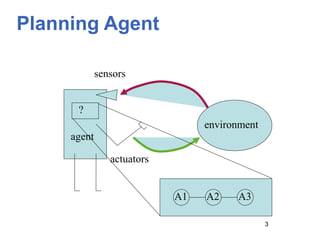
Planning Agent
3
environment
agent
?
sensors
actuators
A1 A2 A3
In planning, the idea is that you're given some
description of a starting state or
states; a goal state or states; and some set of
possible actions that the agent can
take. And you want to find the sequence of
actions that get you from the start
state to the goal state.
It’s pretty clear that you can cast this as a problem solving problem.
Remember
when we talked about problem solving, we were given a start state, and we
searched through a tree that was the sequences of actions that you could
take,
and we tried to find a nice short plan. So, planning problems can certainly be
viewed as problem-solving problems, but it may not be the best view to take.
4
Planning problem
• Classical planning environment: fully observable,
deterministic, finite, static and discrete.
• Find a sequence of actions that achieves a given goal when
executed from a given initial world state. That is, given
– a set of action descriptions (defining the possible primitive
actions by the agent),
– an initial state description, and
– a goal state description or predicate,
• compute a plan, which is
– a sequence of action instances, such that executing them in
the initial state will change the world to a state satisfying the
goal-state description.
• Goals are usually specified as a conjunction of subgoals to be
achieved
5
Planning vs. problem solving
• Planning and problem solving methods can
often solve the same sorts of problems
• Planning is more powerful because of the
representations and methods used
• States, goals, and actions are decomposed into
sets of sentences (usually in first-order logic)
• Search often proceeds through plan space
rather than state space (though first we will talk
about state-space planners)
• Subgoals can be planned independently,
reducing the complexity of the planning problem
6
Planning vs. Problem Solving….
Planning agent is very similar to
problem
solving agent
Constructs plans to achieve goals, then
executes
them
Planning agent is different from problem
solving agent in:
Representation of goals, states, actions
Use of explicit, logical representations
Way it searches for solutions
7
Challenges of AI and Planning
Closed world assumption: assumes that
world model contains everything the robot
needs to know: there can be no surprise
Frame problem: how to represent real
world situations in a manner that is
computationally tractable
8
Representations in Planning
• Planning using logic to represent:
– Actions
– States
– Goals
9
Problem solving Logic representation
Planning
Planning language
• What is a good language?
• Must represent
– States
– Goals
– Action.
• Must be
– Expressive enough to describe a wide variety of
problems.
– Restrictive enough to allow efficient algorithms to
operate.
10
Languages for Planning Problems
• STRIPS
– Stanford Research Institute Problem Solver
– Historically important
– Use first-order logic and theorem proving
to plan strategies from start to goal
– STRIPS language:
“Classical” approach that most planners use
Lends itself to efficient planning algorithms
• ADL
– Action Description Languages
– Relaxed some of the restrictions that made STRIPS inadequate for
real-world problems
• PDDL
– Planning Domain Definition Language
– Revised & enhanced for the needs of the International Planning
Competition
– Currently version 3.1 11
18
Planning Languages
• STRIPS is simplest
– Important limit: function-free literals
• Allows for propositional representation
• Function symbols lead to infinitely many states and actions
• But poor expressivity
• Extension:Action Description language (ADL)
– Allows negative literals
– Allows quantified variables, conjunctions, disjunctions in
goals
– Open World assumption
12
Planning Domain Definition
Language
• Components:
– Objects: things we are interested in
– Predicates: properties of objects, true or
false
– Initial state: state of the world we start in
– Goal specification: state we want to end
up in
– Actions: ways we can change state
• Format
– domain file: predicates and actions
– problem file: objects, initial state, goal
13
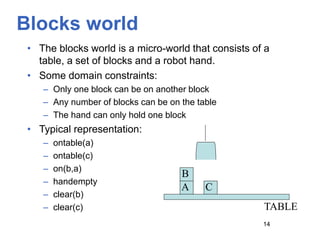
Blocks world
• The blocks world is a micro-world that consists of a
table, a set of blocks and a robot hand.
• Some domain constraints:
– Only one block can be on another block
– Any number of blocks can be on the table
– The hand can only hold one block
• Typical representation:
– ontable(a)
– ontable(c)
– on(b,a)
– handempty
– clear(b)
– clear(c)
14
A
B
C
TABLE
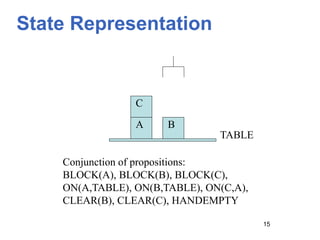
State Representation
15
Conjunction of propositions:
BLOCK(A), BLOCK(B), BLOCK(C),
ON(A,TABLE), ON(B,TABLE), ON(C,A),
CLEAR(B), CLEAR(C), HANDEMPTY
A B
C
TABLE
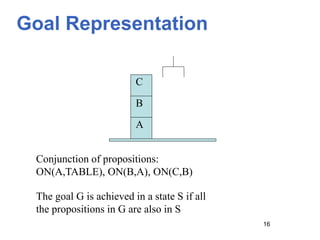
Goal Representation
16
A
B
C
Conjunction of propositions:
ON(A,TABLE), ON(B,A), ON(C,B)
The goal G is achieved in a state S if all
the propositions in G are also in S
Planning with state-space search
• The most straightforward approach is to use
state-space search
Search the space of states
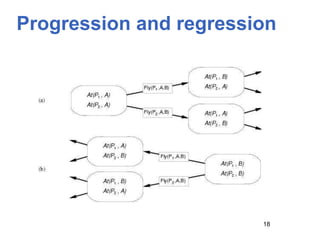
• Progression planners
– forward state-space search
– Consider the effect of all possible actions in a
given state
• Regression planners
– backward state-space search
– To achieve a goal, what must have been true in
the previous state. 17
Progression and regression
18
State-Space Formulation
• Formulation as state-space search
problem:
– Initial state = initial state of the planning
problem
• Literals not appearing are false
– Actions = those whose preconditions are
satisfied
• Add positive effects, delete negative
– Goal test = does the state satisfy the goal?
– Step cost = each action costs 1
– Solution is a sequence of actions. 19
Progression Algorithm
• No functions, so the number of states is
finite … any graph search that is a
complete planning algorithm.
– E.g. A*
• Inefficient:
– (1) irrelevant action problem
– (2) good heuristic required for efficient
search
20
Regression algorithm
• How to determine predecessors?
– What are the states from which applying a
given action leads to the goal?
• Actions must not undo desired literals
(consistent)
• Main advantage: only relevant actions
are considered.
– Often much lower branching factor than
forward search.
21
Regression algorithm
• General process for predecessor construction
– Give a goal description G
– Let A be an action that is relevant and consistent
– The predecessors is as follows:
• Any positive effects of A that appear in G are deleted.
• Each precondition literal of A is added , unless it already
appears.
• Any standard search algorithm can be added to
perform the search.
• Termination when predecessor satisfied by initial
state.
– In FO case, satisfaction might require a substitution.
22
Heuristics for state-space
search
• Neither progression or regression are very
efficient without a good heuristic.
– How many actions are needed to achieve the
goal?
– Exact solution is NP hard, find a good estimate
• Two approaches to find admissible heuristic:
– The optimal solution to the relaxed problem.
• Remove all preconditions from actions
– The subgoal independence assumption:
• The cost of solving a conjunction of subgoals is
approximated by the sum of the costs of solving the
subproblems independently. 23
Partial-order planning(POP)
• Progression and regression planning are
totally ordered plan search forms.
– They cannot take advantage of problem
decomposition.
• Decisions must be made on how to sequence
actions on all the subproblems
• Least commitment strategy:
– Delay choice during search
24
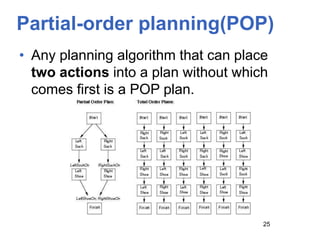
Partial-order planning(POP)
• Any planning algorithm that can place
two actions into a plan without which
comes first is a POP plan.
25
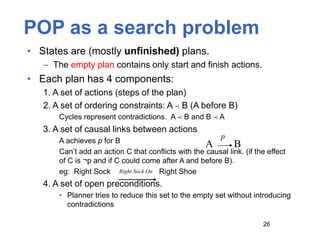
POP as a search problem
• States are (mostly unfinished) plans.
– The empty plan contains only start and finish actions.
• Each plan has 4 components:
1. A set of actions (steps of the plan)
2. A set of ordering constraints: A p B (A before B)
Cycles represent contradictions. A p B and B p A
3. A set of causal links between actions
A achieves p for B
Can’t add an action C that conflicts with the causal link. (if the effect
of C is ¬p and if C could come after A and before B).
eg: Right Sock Right Shoe
4. A set of open preconditions.
• Planner tries to reduce this set to the empty set without introducing
contradictions
26
A B
p
Right Sock On
27
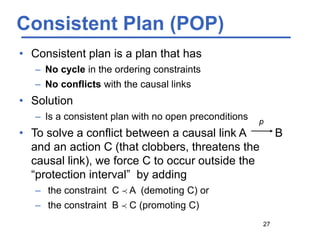
Consistent Plan (POP)
• Consistent plan is a plan that has
– No cycle in the ordering constraints
– No conflicts with the causal links
• Solution
– Is a consistent plan with no open preconditions
• To solve a conflict between a causal link A B
and an action C (that clobbers, threatens the
causal link), we force C to occur outside the
“protection interval” by adding
– the constraint C p A (demoting C) or
– the constraint B p C (promoting C)
p
28
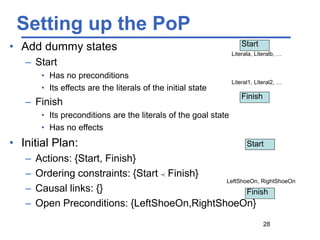
Setting up the PoP
• Add dummy states
– Start
• Has no preconditions
• Its effects are the literals of the initial state
– Finish
• Its preconditions are the literals of the goal state
• Has no effects
• Initial Plan:
– Actions: {Start, Finish}
– Ordering constraints: {Start p Finish}
– Causal links: {}
– Open Preconditions: {LeftShoeOn,RightShoeOn}
Start
Finish
Start
Finish
LeftShoeOn, RightShoeOn
Literal1, Literal2, …
Literala, Literalb, …
29
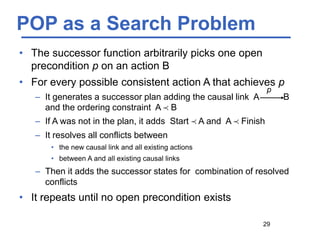
POP as a Search Problem
• The successor function arbitrarily picks one open
precondition p on an action B
• For every possible consistent action A that achieves p
– It generates a successor plan adding the causal link A B
and the ordering constraint A p B
– If A was not in the plan, it adds Start p A and A p Finish
– It resolves all conflicts between
• the new causal link and all existing actions
• between A and all existing causal links
– Then it adds the successor states for combination of resolved
conflicts
• It repeats until no open precondition exists
p
Planning graphs
• Used to achieve better heuristic estimates.
– A solution can also directly extracted using
GRAPHPLAN algorithm
• Consists of a sequence of levels that correspond
to time steps in the plan.
– Level 0 is the initial state.
– Each level consists of a set of literals and a set of
actions.
• Literals = all those that could be true at that time step,
depending upon the actions executed at the preceding time
step.
• Actions = all those actions that could have their
preconditions satisfied at that time step, depending on which
of the literals actually hold. 30
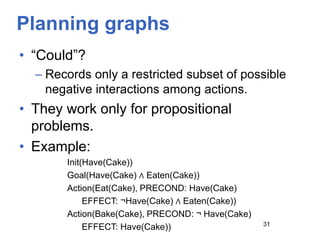
Planning graphs
• “Could”?
– Records only a restricted subset of possible
negative interactions among actions.
• They work only for propositional
problems.
• Example:
Init(Have(Cake))
Goal(Have(Cake) ∧ Eaten(Cake))
Action(Eat(Cake), PRECOND: Have(Cake)
EFFECT: ¬Have(Cake) ∧ Eaten(Cake))
Action(Bake(Cake), PRECOND: ¬ Have(Cake)
EFFECT: Have(Cake)) 31
Planning with propositional logic:
SATPLAN
32
• Planning can be done by proving theorem in
situation calculus.
• Test the satisfiability of a logical sentence:
– initial state ∧ all possible action descriptions ∧
goal
• Sentence contains propositions for every action
occurrence.
– A model will assign true to the actions that are part
of the correct plan and false to the others
– An assignment that corresponds to an incorrect plan
will not be a model because of inconsistency with
the assertion that the goal is true.
– If the planning is unsolvable the sentence will be

CH4_AI_Lecture.ppt

  • 1.
  • 2.
    • We studiedhow to take actions in the world (search) • We studied how to represent objects, relations, etc. (logic) • Now we will combine the two! 2
  • 3.
  • 4.
    In planning, theidea is that you're given some description of a starting state or states; a goal state or states; and some set of possible actions that the agent can take. And you want to find the sequence of actions that get you from the start state to the goal state. It’s pretty clear that you can cast this as a problem solving problem. Remember when we talked about problem solving, we were given a start state, and we searched through a tree that was the sequences of actions that you could take, and we tried to find a nice short plan. So, planning problems can certainly be viewed as problem-solving problems, but it may not be the best view to take. 4
  • 5.
    Planning problem • Classicalplanning environment: fully observable, deterministic, finite, static and discrete. • Find a sequence of actions that achieves a given goal when executed from a given initial world state. That is, given – a set of action descriptions (defining the possible primitive actions by the agent), – an initial state description, and – a goal state description or predicate, • compute a plan, which is – a sequence of action instances, such that executing them in the initial state will change the world to a state satisfying the goal-state description. • Goals are usually specified as a conjunction of subgoals to be achieved 5
  • 6.
    Planning vs. problemsolving • Planning and problem solving methods can often solve the same sorts of problems • Planning is more powerful because of the representations and methods used • States, goals, and actions are decomposed into sets of sentences (usually in first-order logic) • Search often proceeds through plan space rather than state space (though first we will talk about state-space planners) • Subgoals can be planned independently, reducing the complexity of the planning problem 6
  • 7.
    Planning vs. ProblemSolving…. Planning agent is very similar to problem solving agent Constructs plans to achieve goals, then executes them Planning agent is different from problem solving agent in: Representation of goals, states, actions Use of explicit, logical representations Way it searches for solutions 7
  • 8.
    Challenges of AIand Planning Closed world assumption: assumes that world model contains everything the robot needs to know: there can be no surprise Frame problem: how to represent real world situations in a manner that is computationally tractable 8
  • 9.
    Representations in Planning •Planning using logic to represent: – Actions – States – Goals 9 Problem solving Logic representation Planning
  • 10.
    Planning language • Whatis a good language? • Must represent – States – Goals – Action. • Must be – Expressive enough to describe a wide variety of problems. – Restrictive enough to allow efficient algorithms to operate. 10
  • 11.
    Languages for PlanningProblems • STRIPS – Stanford Research Institute Problem Solver – Historically important – Use first-order logic and theorem proving to plan strategies from start to goal – STRIPS language: “Classical” approach that most planners use Lends itself to efficient planning algorithms • ADL – Action Description Languages – Relaxed some of the restrictions that made STRIPS inadequate for real-world problems • PDDL – Planning Domain Definition Language – Revised & enhanced for the needs of the International Planning Competition – Currently version 3.1 11 18
  • 12.
    Planning Languages • STRIPSis simplest – Important limit: function-free literals • Allows for propositional representation • Function symbols lead to infinitely many states and actions • But poor expressivity • Extension:Action Description language (ADL) – Allows negative literals – Allows quantified variables, conjunctions, disjunctions in goals – Open World assumption 12
  • 13.
    Planning Domain Definition Language •Components: – Objects: things we are interested in – Predicates: properties of objects, true or false – Initial state: state of the world we start in – Goal specification: state we want to end up in – Actions: ways we can change state • Format – domain file: predicates and actions – problem file: objects, initial state, goal 13
  • 14.
    Blocks world • Theblocks world is a micro-world that consists of a table, a set of blocks and a robot hand. • Some domain constraints: – Only one block can be on another block – Any number of blocks can be on the table – The hand can only hold one block • Typical representation: – ontable(a) – ontable(c) – on(b,a) – handempty – clear(b) – clear(c) 14 A B C TABLE
  • 15.
    State Representation 15 Conjunction ofpropositions: BLOCK(A), BLOCK(B), BLOCK(C), ON(A,TABLE), ON(B,TABLE), ON(C,A), CLEAR(B), CLEAR(C), HANDEMPTY A B C TABLE
  • 16.
    Goal Representation 16 A B C Conjunction ofpropositions: ON(A,TABLE), ON(B,A), ON(C,B) The goal G is achieved in a state S if all the propositions in G are also in S
  • 17.
    Planning with state-spacesearch • The most straightforward approach is to use state-space search Search the space of states • Progression planners – forward state-space search – Consider the effect of all possible actions in a given state • Regression planners – backward state-space search – To achieve a goal, what must have been true in the previous state. 17
  • 18.
  • 19.
    State-Space Formulation • Formulationas state-space search problem: – Initial state = initial state of the planning problem • Literals not appearing are false – Actions = those whose preconditions are satisfied • Add positive effects, delete negative – Goal test = does the state satisfy the goal? – Step cost = each action costs 1 – Solution is a sequence of actions. 19
  • 20.
    Progression Algorithm • Nofunctions, so the number of states is finite … any graph search that is a complete planning algorithm. – E.g. A* • Inefficient: – (1) irrelevant action problem – (2) good heuristic required for efficient search 20
  • 21.
    Regression algorithm • Howto determine predecessors? – What are the states from which applying a given action leads to the goal? • Actions must not undo desired literals (consistent) • Main advantage: only relevant actions are considered. – Often much lower branching factor than forward search. 21
  • 22.
    Regression algorithm • Generalprocess for predecessor construction – Give a goal description G – Let A be an action that is relevant and consistent – The predecessors is as follows: • Any positive effects of A that appear in G are deleted. • Each precondition literal of A is added , unless it already appears. • Any standard search algorithm can be added to perform the search. • Termination when predecessor satisfied by initial state. – In FO case, satisfaction might require a substitution. 22
  • 23.
    Heuristics for state-space search •Neither progression or regression are very efficient without a good heuristic. – How many actions are needed to achieve the goal? – Exact solution is NP hard, find a good estimate • Two approaches to find admissible heuristic: – The optimal solution to the relaxed problem. • Remove all preconditions from actions – The subgoal independence assumption: • The cost of solving a conjunction of subgoals is approximated by the sum of the costs of solving the subproblems independently. 23
  • 24.
    Partial-order planning(POP) • Progressionand regression planning are totally ordered plan search forms. – They cannot take advantage of problem decomposition. • Decisions must be made on how to sequence actions on all the subproblems • Least commitment strategy: – Delay choice during search 24
  • 25.
    Partial-order planning(POP) • Anyplanning algorithm that can place two actions into a plan without which comes first is a POP plan. 25
  • 26.
    POP as asearch problem • States are (mostly unfinished) plans. – The empty plan contains only start and finish actions. • Each plan has 4 components: 1. A set of actions (steps of the plan) 2. A set of ordering constraints: A p B (A before B) Cycles represent contradictions. A p B and B p A 3. A set of causal links between actions A achieves p for B Can’t add an action C that conflicts with the causal link. (if the effect of C is ¬p and if C could come after A and before B). eg: Right Sock Right Shoe 4. A set of open preconditions. • Planner tries to reduce this set to the empty set without introducing contradictions 26 A B p Right Sock On
  • 27.
    27 Consistent Plan (POP) •Consistent plan is a plan that has – No cycle in the ordering constraints – No conflicts with the causal links • Solution – Is a consistent plan with no open preconditions • To solve a conflict between a causal link A B and an action C (that clobbers, threatens the causal link), we force C to occur outside the “protection interval” by adding – the constraint C p A (demoting C) or – the constraint B p C (promoting C) p
  • 28.
    28 Setting up thePoP • Add dummy states – Start • Has no preconditions • Its effects are the literals of the initial state – Finish • Its preconditions are the literals of the goal state • Has no effects • Initial Plan: – Actions: {Start, Finish} – Ordering constraints: {Start p Finish} – Causal links: {} – Open Preconditions: {LeftShoeOn,RightShoeOn} Start Finish Start Finish LeftShoeOn, RightShoeOn Literal1, Literal2, … Literala, Literalb, …
  • 29.
    29 POP as aSearch Problem • The successor function arbitrarily picks one open precondition p on an action B • For every possible consistent action A that achieves p – It generates a successor plan adding the causal link A B and the ordering constraint A p B – If A was not in the plan, it adds Start p A and A p Finish – It resolves all conflicts between • the new causal link and all existing actions • between A and all existing causal links – Then it adds the successor states for combination of resolved conflicts • It repeats until no open precondition exists p
  • 30.
    Planning graphs • Usedto achieve better heuristic estimates. – A solution can also directly extracted using GRAPHPLAN algorithm • Consists of a sequence of levels that correspond to time steps in the plan. – Level 0 is the initial state. – Each level consists of a set of literals and a set of actions. • Literals = all those that could be true at that time step, depending upon the actions executed at the preceding time step. • Actions = all those actions that could have their preconditions satisfied at that time step, depending on which of the literals actually hold. 30
  • 31.
    Planning graphs • “Could”? –Records only a restricted subset of possible negative interactions among actions. • They work only for propositional problems. • Example: Init(Have(Cake)) Goal(Have(Cake) ∧ Eaten(Cake)) Action(Eat(Cake), PRECOND: Have(Cake) EFFECT: ¬Have(Cake) ∧ Eaten(Cake)) Action(Bake(Cake), PRECOND: ¬ Have(Cake) EFFECT: Have(Cake)) 31
  • 32.
    Planning with propositionallogic: SATPLAN 32 • Planning can be done by proving theorem in situation calculus. • Test the satisfiability of a logical sentence: – initial state ∧ all possible action descriptions ∧ goal • Sentence contains propositions for every action occurrence. – A model will assign true to the actions that are part of the correct plan and false to the others – An assignment that corresponds to an incorrect plan will not be a model because of inconsistency with the assertion that the goal is true. – If the planning is unsolvable the sentence will be