Artificial Intelligence
&
Expert Systems
Lecture 1

Jayantha Amararachchi
Senior Lecturer (Higher Grade) /
Coordinator-Malabe Campus
What will cover today?
• Course overview
• What are Intelligent Systems?
• A brief history
• Turing Test
• Intelligent agents
What is “Artificial Intelligence”?
• Since ancient days, man has been building machines by
looking at the physical features/characteristics of
creatures (animals, birds etc) in nature. For example the
aero plane was invented by studying how a bird flies and
the boat was constructed by studying how fish float in the
water.
• After achieving success in above examples, the same
approach was continued and man started to look at how
other creatures ‘behave’. That is how man started to build
machines influenced by the ‘intelligence’ of creatures in
nature!
What is Artificial Intelligence? …
Q. What is intelligence?
• A1. Intelligence is the computational part of the ability
to achieve goals in the world. Varying kinds and
degrees of intelligence occur in people, many animals
and some machines.
• A2. According to the environmental changes,
that provides most suitable answer/action
quickly
What is Artificial Intelligence? …
• There are no clear agreements on the definition of AI
Q. What is artificial intelligence?
A1. It is the science and engineering of making intelligent
machines, especially intelligent computer programs.
A2. AI is the study of how to make computers do things
better which at the moment people do.
What is Artificial Intelligence? …
A3.AI is a collection of hard problems which can be solved
by humans and other living things, but for which we don’t
have good algorithms.
e. g.,
– understanding spoken natural language,
– medical diagnosis,
– circuit design,
– learning,
– self-adaptation,
– reasoning,
– chess playing,
– proving math theories, etc.
Introduction to AI
Big questions
•Can machines think?
•If so, how?
•If not, why?
•What does this say about human beings?
Introduction to AI …
Applications (AI agents)
• Chess
• Taxi Driver – ALVINN (Automated Land Vehicle
In Neural Network)
• Medical Diagnosis
• Interactive tutor
• Auto Pilot
• Robot – Emergency
• Home appliances
What’s easy and what’s hard?
• It’s easier to mechanize many of the high level cognitive tasks
associate with “intelligence” in people
– e. g., proving theorems, playing chess, some aspect of
medical diagnosis, etc.
• It’s very hard to mechanize tasks that animals can do easily
– walking around without running into things
– catching prey and avoiding predators
– interpreting complex sensory information (visual, hearing,
…)
– modeling the internal states of other animals from their
behavior
– working as a team (ants, bees)
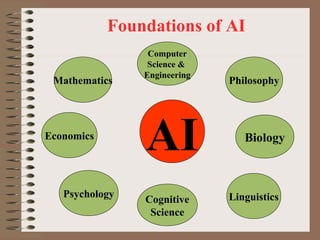
Foundations of AI
Mathematics

Economics

Psychology

Computer
Science &
Engineering

AI
Cognitive
Science

Philosophy

Biology

Linguistics
History of AI
• AI has roots in a number of scientific disciplines
– computer science and engineering (hardware and
software)
– philosophy (rules of reasoning)
– mathematics (logics, algorithms, optimization)
– cognitive science and psychology (modeling high level
human/animal thinking)
– neural science (model low level human/animal brain
activity)
– linguistics
• The birth of AI (1943 – 1956)
– Allen Turing: Turing machine and Turing test (1950)
– Claude Shannon: information theory; possibility of chess
playing computers
History of AI …
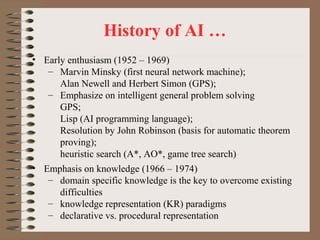
• Early enthusiasm (1952 – 1969)
– Marvin Minsky (first neural network machine);
Alan Newell and Herbert Simon (GPS);
– Emphasize on intelligent general problem solving
GPS;
Lisp (AI programming language);
Resolution by John Robinson (basis for automatic theorem
proving);
heuristic search (A*, AO*, game tree search)
• Emphasis on knowledge (1966 – 1974)
– domain specific knowledge is the key to overcome existing
difficulties
– knowledge representation (KR) paradigms
– declarative vs. procedural representation
History of AI …
• Knowledge-based systems (1969 – 1999)
– DENDRAL: the first knowledge intensive system
(determining 3D structures of complex chemical
compounds)
– MYCIN: first rule-based expert system (containing 450
rules for diagnosing blood infectious diseases)
EMYCIN: an ES shell
• AI became an industry (1980 – 1989)
– wide applications in various domains
– commercially available tools
History of AI …
• Current trends (1990 – present)
– more realistic goals
– more practical (application oriented)
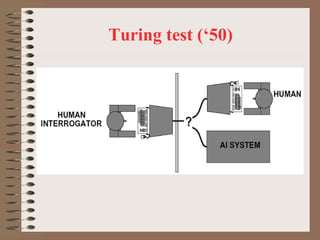
Turing Test
• Three rooms contain a person, a computer, and an
interrogator.
• The interrogator can communicate with the other two by
teleprinter.
• The interrogator tries to determine which is the person
and which is the machine.
• The machine tries to fool the interrogator into believing
that it is the person.
• If the machine succeeds, then we conclude that the
machine can think.
Acting Humanly
• Turing test (1950)
Turing test (‘50)
Turing Test …
Turing test problems &
conclusions
Predicted that by 2006 a machine might
have a 40% chance of fooling a lay person
for 5 min
Eliza
• ELIZA: A program that simulated a
psychotherapist interacting with a patient and
successfully passed the Turing Test.
• Coded at MIT during 1964-1966 by Joel
Weizenbaum.
Eliza
• This is a
transcript of a
conversation
with an Elizalike program
found in
Emacs
• Try typing
Meta-x
doctor
in your favorite
Emacs.

•• E: IIam the psychotherapist. Please, describe your
E: am the psychotherapist. Please, describe your
problems. Each time you are finished talking, type
RET twice.
RET twice.
•• P: I'm having aahard time with my students
P: I'm having hard time with my students
•• E: Why do you say that?
E: Why do you say that?
•• P: Well, they keep asking me for money
P: Well, they keep asking me for money
•• E: Maybe your plans have something to do with this.
E: Maybe your plans have something to do with this.
•• P: what plans?
P: what plans?
•• E: Is it because of your life that you say what plans?
E: Is it because of your life that you say what plans?
•• P: No, it's because IIdidn't know what you were talking
P: No, it's because didn't know what you were talking
about
about
•• E: Is it because you didn't know what IIwas talking
E: Is it because you didn't know what was talking
about that you came to me?
•• P: no, it's because i iwanted to see if you could pass the
P: no, it's because wanted to see if you could pass the
turing test
turing test
•• E: Does it bother you that you wanted to see if IIcould
E: Does it bother you that you wanted to see if could
really pass the turing test?
•• P: …..
P: …..
•• E: How do you reconcile problems at school?
E: How do you reconcile problems at school?
•• P: This is aawaste of time. Good bye
P: This is waste of time. Good bye
•• E: My secretary will send you aabill.
E: My secretary will send you bill.
The Loebner Contest
• A modern version of the Turing Test, held
annually, with a $100,000 cash prize.
• http://www.loebner.net/Prizef/loebner-prize.html
• Restricted topic (removed in 1995) and limited
time.
• Participants include a set of humans and a set of
computers and a set of judges.
• Scoring
– Rank from least human to most human.
– Highest median rank wins $2000.
– If better than a human, win $100,000.
(Nobody yet…)
What can AI systems do
Here are some example applications
• Computer vision: face recognition from a large set
• Robotics: autonomous (mostly) automobile
• Natural language processing: simple machine
translation
• Expert systems: medical diagnosis in a narrow domain
• Spoken language systems: ~1000 word continuous
speech
• Learning: text categorization into ~1000 topics
• Games: Grand Master level in chess (world
champion), checkers, etc.
What can’t AI systems do yet?
• Understand natural language robustly (e.g.,
read and understand articles in a newspaper)
• Surf the web
• Interpret an arbitrary visual scene
• Learn a natural language
• Construct plans in dynamic real-time domains
• Perform life-long learning

Artificail Intelligent lec-1

  • 1.
    Artificial Intelligence & Expert Systems Lecture1 Jayantha Amararachchi Senior Lecturer (Higher Grade) / Coordinator-Malabe Campus
  • 2.
    What will covertoday? • Course overview • What are Intelligent Systems? • A brief history • Turing Test • Intelligent agents
  • 3.
    What is “ArtificialIntelligence”? • Since ancient days, man has been building machines by looking at the physical features/characteristics of creatures (animals, birds etc) in nature. For example the aero plane was invented by studying how a bird flies and the boat was constructed by studying how fish float in the water. • After achieving success in above examples, the same approach was continued and man started to look at how other creatures ‘behave’. That is how man started to build machines influenced by the ‘intelligence’ of creatures in nature!
  • 4.
    What is ArtificialIntelligence? … Q. What is intelligence? • A1. Intelligence is the computational part of the ability to achieve goals in the world. Varying kinds and degrees of intelligence occur in people, many animals and some machines. • A2. According to the environmental changes, that provides most suitable answer/action quickly
  • 5.
    What is ArtificialIntelligence? … • There are no clear agreements on the definition of AI Q. What is artificial intelligence? A1. It is the science and engineering of making intelligent machines, especially intelligent computer programs. A2. AI is the study of how to make computers do things better which at the moment people do.
  • 6.
    What is ArtificialIntelligence? … A3.AI is a collection of hard problems which can be solved by humans and other living things, but for which we don’t have good algorithms. e. g., – understanding spoken natural language, – medical diagnosis, – circuit design, – learning, – self-adaptation, – reasoning, – chess playing, – proving math theories, etc.
  • 7.
    Introduction to AI Bigquestions •Can machines think? •If so, how? •If not, why? •What does this say about human beings?
  • 8.
    Introduction to AI… Applications (AI agents) • Chess • Taxi Driver – ALVINN (Automated Land Vehicle In Neural Network) • Medical Diagnosis • Interactive tutor • Auto Pilot • Robot – Emergency • Home appliances
  • 9.
    What’s easy andwhat’s hard? • It’s easier to mechanize many of the high level cognitive tasks associate with “intelligence” in people – e. g., proving theorems, playing chess, some aspect of medical diagnosis, etc. • It’s very hard to mechanize tasks that animals can do easily – walking around without running into things – catching prey and avoiding predators – interpreting complex sensory information (visual, hearing, …) – modeling the internal states of other animals from their behavior – working as a team (ants, bees)
  • 10.
    Foundations of AI Mathematics Economics Psychology Computer Science& Engineering AI Cognitive Science Philosophy Biology Linguistics
  • 11.
    History of AI •AI has roots in a number of scientific disciplines – computer science and engineering (hardware and software) – philosophy (rules of reasoning) – mathematics (logics, algorithms, optimization) – cognitive science and psychology (modeling high level human/animal thinking) – neural science (model low level human/animal brain activity) – linguistics • The birth of AI (1943 – 1956) – Allen Turing: Turing machine and Turing test (1950) – Claude Shannon: information theory; possibility of chess playing computers
  • 12.
    History of AI… • Early enthusiasm (1952 – 1969) – Marvin Minsky (first neural network machine); Alan Newell and Herbert Simon (GPS); – Emphasize on intelligent general problem solving GPS; Lisp (AI programming language); Resolution by John Robinson (basis for automatic theorem proving); heuristic search (A*, AO*, game tree search) • Emphasis on knowledge (1966 – 1974) – domain specific knowledge is the key to overcome existing difficulties – knowledge representation (KR) paradigms – declarative vs. procedural representation
  • 13.
    History of AI… • Knowledge-based systems (1969 – 1999) – DENDRAL: the first knowledge intensive system (determining 3D structures of complex chemical compounds) – MYCIN: first rule-based expert system (containing 450 rules for diagnosing blood infectious diseases) EMYCIN: an ES shell • AI became an industry (1980 – 1989) – wide applications in various domains – commercially available tools
  • 14.
    History of AI… • Current trends (1990 – present) – more realistic goals – more practical (application oriented)
  • 15.
    Turing Test • Threerooms contain a person, a computer, and an interrogator. • The interrogator can communicate with the other two by teleprinter. • The interrogator tries to determine which is the person and which is the machine. • The machine tries to fool the interrogator into believing that it is the person. • If the machine succeeds, then we conclude that the machine can think.
  • 16.
  • 17.
  • 18.
  • 19.
    Turing test problems& conclusions Predicted that by 2006 a machine might have a 40% chance of fooling a lay person for 5 min
  • 20.
    Eliza • ELIZA: Aprogram that simulated a psychotherapist interacting with a patient and successfully passed the Turing Test. • Coded at MIT during 1964-1966 by Joel Weizenbaum.
  • 21.
    Eliza • This isa transcript of a conversation with an Elizalike program found in Emacs • Try typing Meta-x doctor in your favorite Emacs. •• E: IIam the psychotherapist. Please, describe your E: am the psychotherapist. Please, describe your problems. Each time you are finished talking, type problems. Each time you are finished talking, type RET twice. RET twice. •• P: I'm having aahard time with my students P: I'm having hard time with my students •• E: Why do you say that? E: Why do you say that? •• P: Well, they keep asking me for money P: Well, they keep asking me for money •• E: Maybe your plans have something to do with this. E: Maybe your plans have something to do with this. •• P: what plans? P: what plans? •• E: Is it because of your life that you say what plans? E: Is it because of your life that you say what plans? •• P: No, it's because IIdidn't know what you were talking P: No, it's because didn't know what you were talking about about •• E: Is it because you didn't know what IIwas talking E: Is it because you didn't know what was talking about that you came to me? about that you came to me? •• P: no, it's because i iwanted to see if you could pass the P: no, it's because wanted to see if you could pass the turing test turing test •• E: Does it bother you that you wanted to see if IIcould E: Does it bother you that you wanted to see if could really pass the turing test? really pass the turing test? •• P: ….. P: ….. •• E: How do you reconcile problems at school? E: How do you reconcile problems at school? •• P: This is aawaste of time. Good bye P: This is waste of time. Good bye •• E: My secretary will send you aabill. E: My secretary will send you bill.
  • 22.
    The Loebner Contest •A modern version of the Turing Test, held annually, with a $100,000 cash prize. • http://www.loebner.net/Prizef/loebner-prize.html • Restricted topic (removed in 1995) and limited time. • Participants include a set of humans and a set of computers and a set of judges. • Scoring – Rank from least human to most human. – Highest median rank wins $2000. – If better than a human, win $100,000. (Nobody yet…)
  • 23.
    What can AIsystems do Here are some example applications • Computer vision: face recognition from a large set • Robotics: autonomous (mostly) automobile • Natural language processing: simple machine translation • Expert systems: medical diagnosis in a narrow domain • Spoken language systems: ~1000 word continuous speech • Learning: text categorization into ~1000 topics • Games: Grand Master level in chess (world champion), checkers, etc.
  • 24.
    What can’t AIsystems do yet? • Understand natural language robustly (e.g., read and understand articles in a newspaper) • Surf the web • Interpret an arbitrary visual scene • Learn a natural language • Construct plans in dynamic real-time domains • Perform life-long learning

Editor's Notes

  • #17 An interrogator asks questions of several “people” and tries to determine which are people and which are computers. Goal is to make computer act like a human.
  • #18 Predicted that by 2000 a machine might have a 30% chance of fooling a lay person for 5 min Anticipated major arguments against AI Suggested major components of AI:knowledge, reasoning, language understanding,learning Pb: not reproducible, constructive, allows no mathematical analysis