CSBS FDP on Artificial Intelligence
Dr. J. Felicia Lilian
(Based on Slides by Prof. Mausam, NPTEL
Stuart Russell, Peter Norvig)
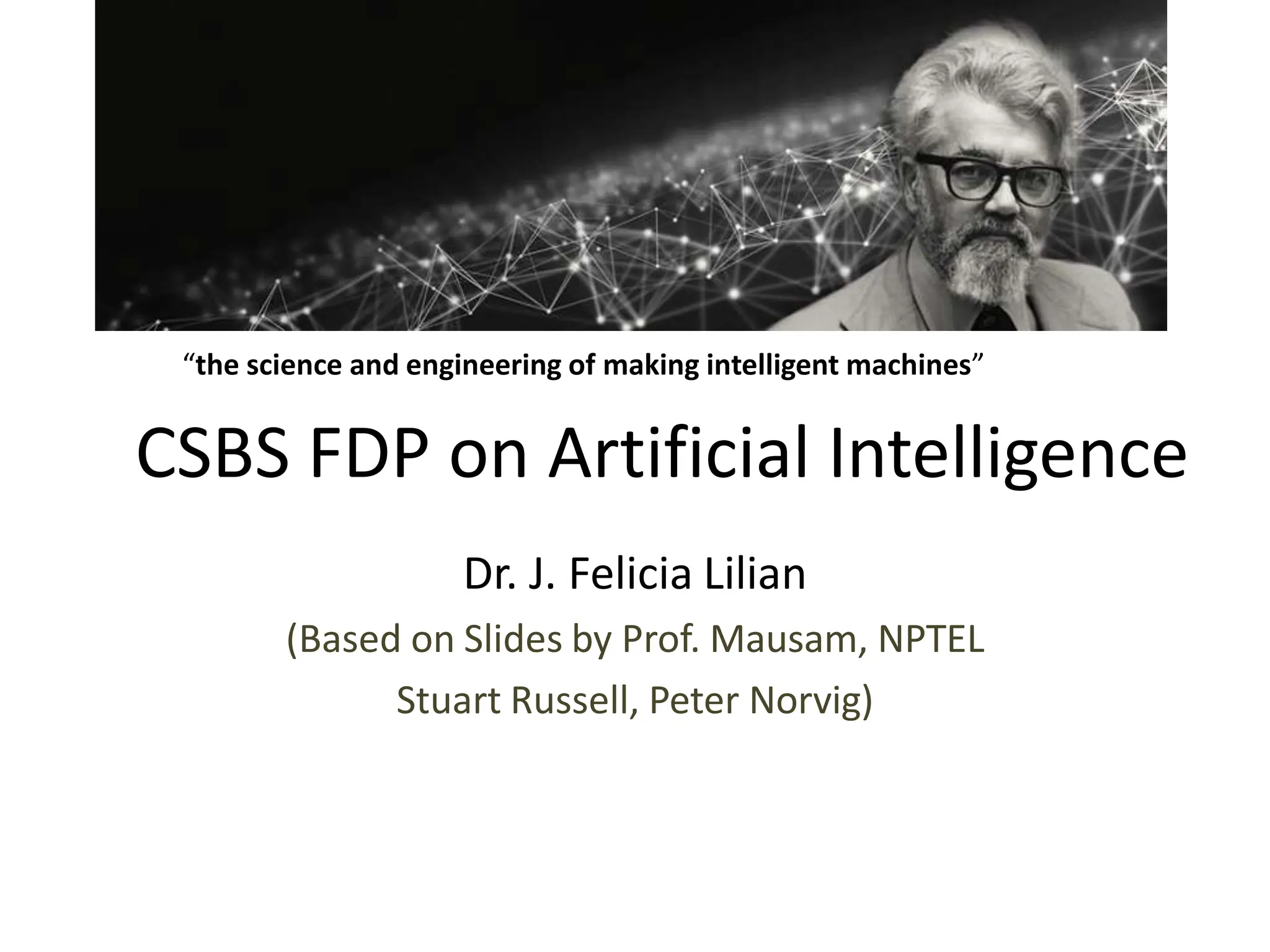
“the science and engineering of making intelligent machines”
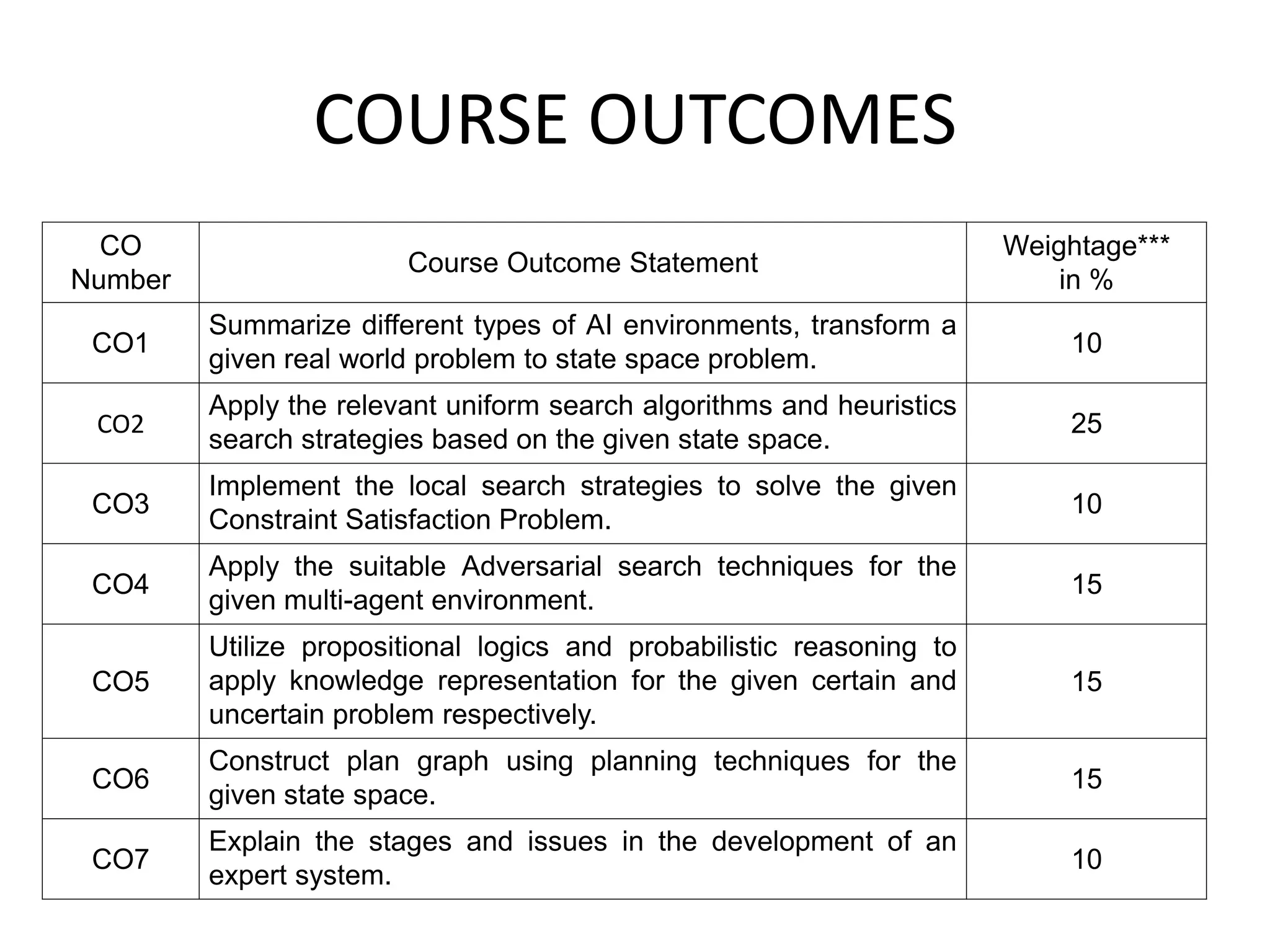
CO
Number
Course Outcome Statement
Weightage***
in %
CO1
Summarize different types of AI environments, transform a
given real world problem to state space problem.
10
CO2
Apply the relevant uniform search algorithms and heuristics
search strategies based on the given state space.
25
CO3
Implement the local search strategies to solve the given
Constraint Satisfaction Problem.
10
CO4
Apply the suitable Adversarial search techniques for the
given multi-agent environment.
15
CO5
Utilize propositional logics and probabilistic reasoning to
apply knowledge representation for the given certain and
uncertain problem respectively.
15
CO6
Construct plan graph using planning techniques for the
given state space.
15
CO7
Explain the stages and issues in the development of an
expert system.
10
COURSE OUTCOMES
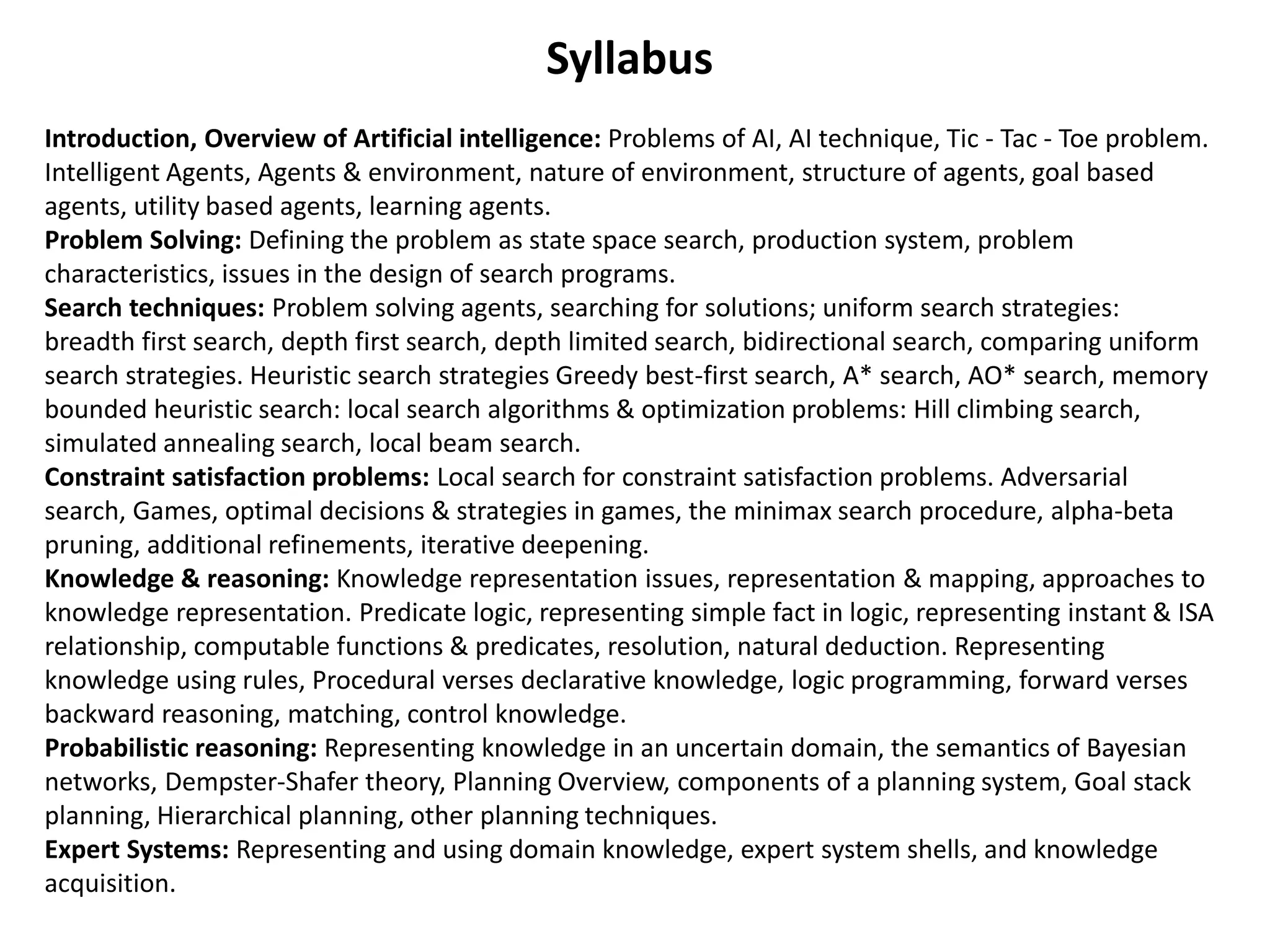
Syllabus
Introduction, Overview of Artificial intelligence: Problems of AI, AI technique, Tic - Tac - Toe problem.
Intelligent Agents, Agents & environment, nature of environment, structure of agents, goal based
agents, utility based agents, learning agents.
Problem Solving: Defining the problem as state space search, production system, problem
characteristics, issues in the design of search programs.
Search techniques: Problem solving agents, searching for solutions; uniform search strategies:
breadth first search, depth first search, depth limited search, bidirectional search, comparing uniform
search strategies. Heuristic search strategies Greedy best-first search, A* search, AO* search, memory
bounded heuristic search: local search algorithms & optimization problems: Hill climbing search,
simulated annealing search, local beam search.
Constraint satisfaction problems: Local search for constraint satisfaction problems. Adversarial
search, Games, optimal decisions & strategies in games, the minimax search procedure, alpha-beta
pruning, additional refinements, iterative deepening.
Knowledge & reasoning: Knowledge representation issues, representation & mapping, approaches to
knowledge representation. Predicate logic, representing simple fact in logic, representing instant & ISA
relationship, computable functions & predicates, resolution, natural deduction. Representing
knowledge using rules, Procedural verses declarative knowledge, logic programming, forward verses
backward reasoning, matching, control knowledge.
Probabilistic reasoning: Representing knowledge in an uncertain domain, the semantics of Bayesian
networks, Dempster-Shafer theory, Planning Overview, components of a planning system, Goal stack
planning, Hierarchical planning, other planning techniques.
Expert Systems: Representing and using domain knowledge, expert system shells, and knowledge
acquisition.
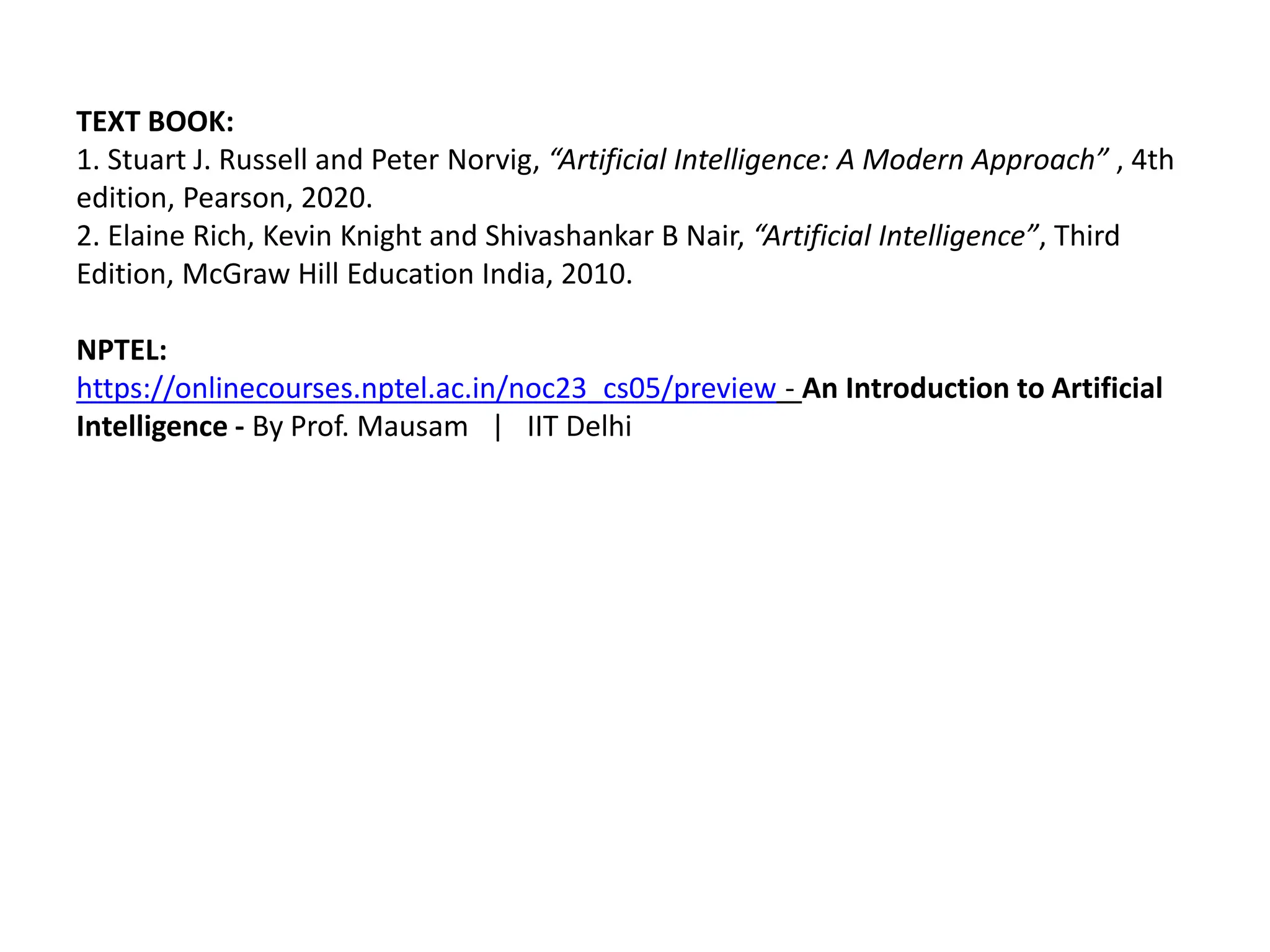
TEXT BOOK:
1. Stuart J. Russell and Peter Norvig, “Artificial Intelligence: A Modern Approach” , 4th
edition, Pearson, 2020.
2. Elaine Rich, Kevin Knight and Shivashankar B Nair, “Artificial Intelligence”, Third
Edition, McGraw Hill Education India, 2010.
NPTEL:
https://onlinecourses.nptel.ac.in/noc23_cs05/preview - An Introduction to Artificial
Intelligence - By Prof. Mausam | IIT Delhi
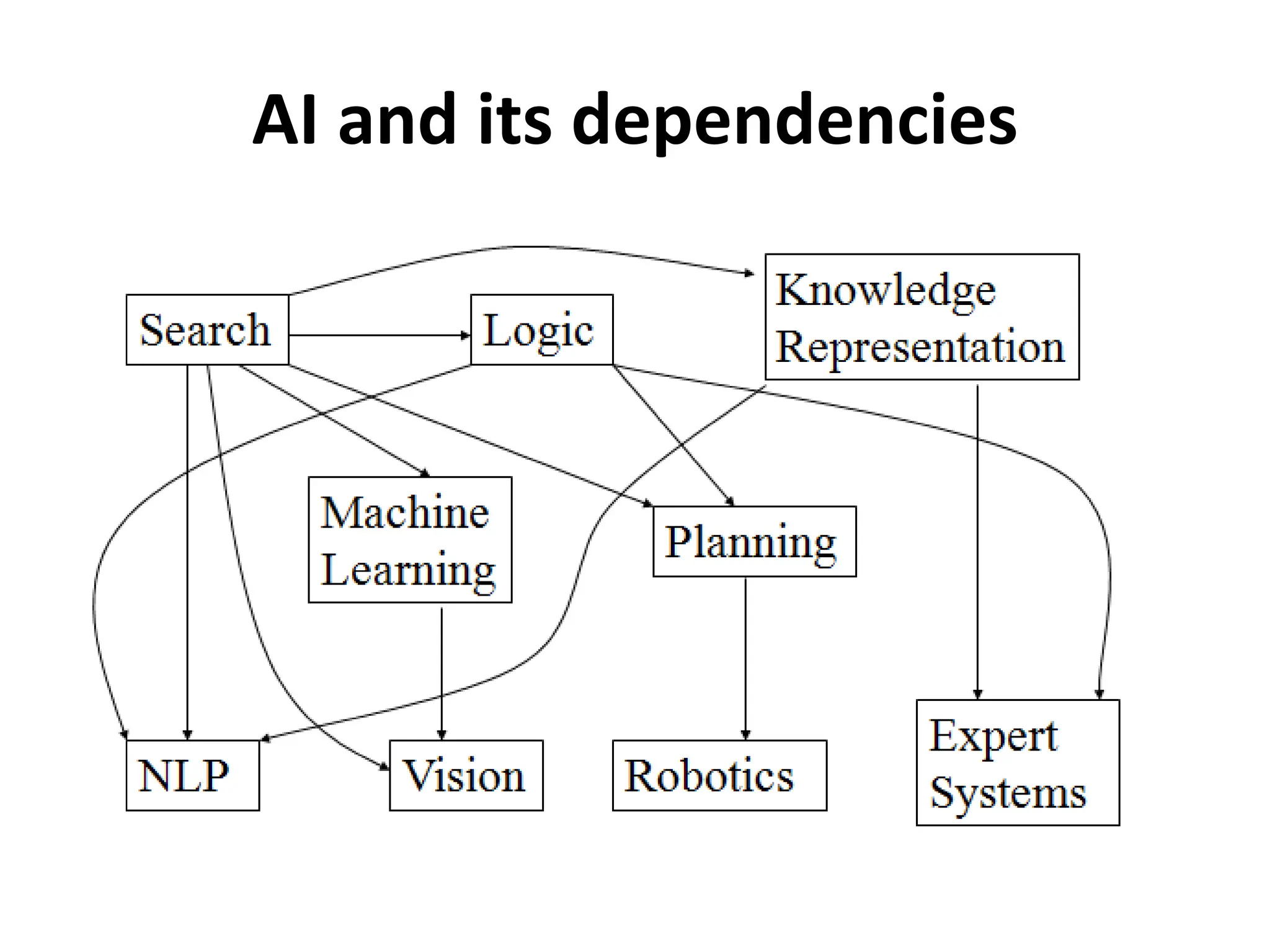
AI and its dependencies
MOTIVATION
Foundation of AI
Philosophy (428BC-present)
• Can formal rules be used to draw valid conclusions?
• How does the mental mind arise from a physical
brain?
• Where does knowledge come from?
• How does knowledge lead to action?
Mathematics (800 – present)
• What are the formal rules to draw valid conclusions?
• What can be computed?
• How do we reason with uncertain information?
Foundation of AI
Economics (1776-present)
• How should we make decisions so as to maximize payoff?
• How should we do this when others may not go along?
• How should we do this when the payoff may be far in the
future?
Neuroscience (1861-present)
• How do brains process information?
Psychology (1879-present)
• How do humans and animals think and act?
Linguistics (1957-present)
• How does language relate to thought?
HISTORY
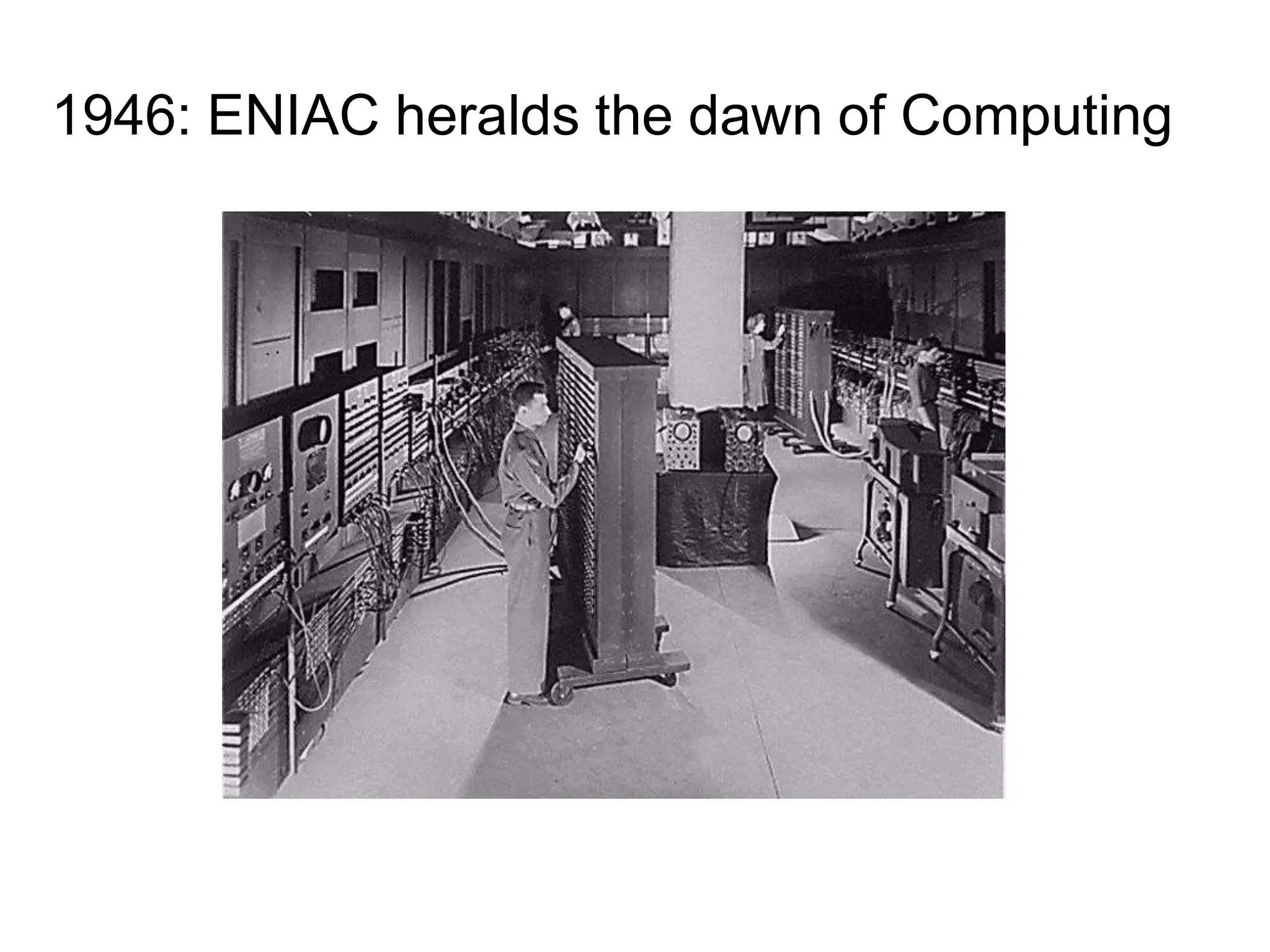
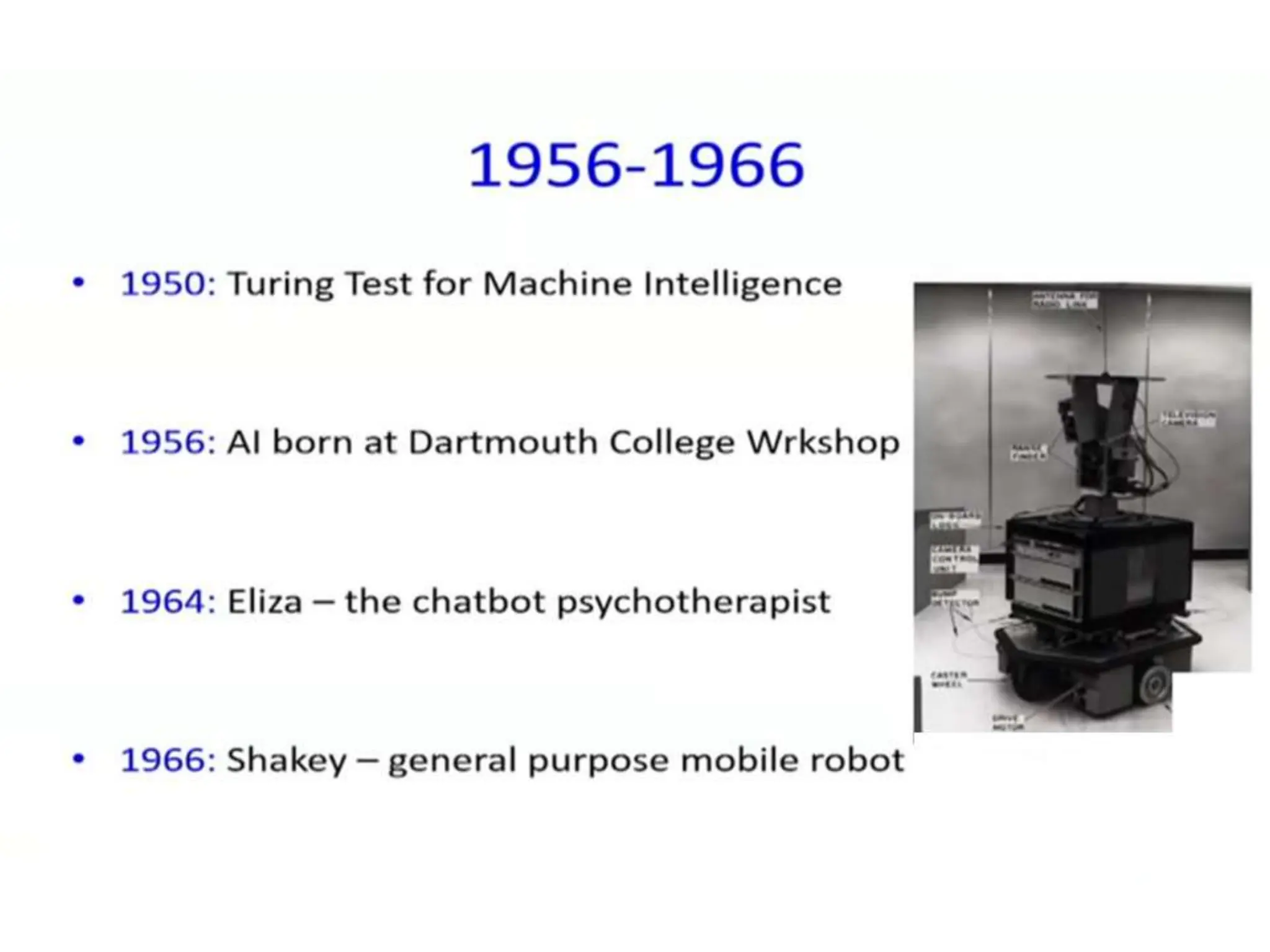
1946: ENIAC heralds the dawn of Computing
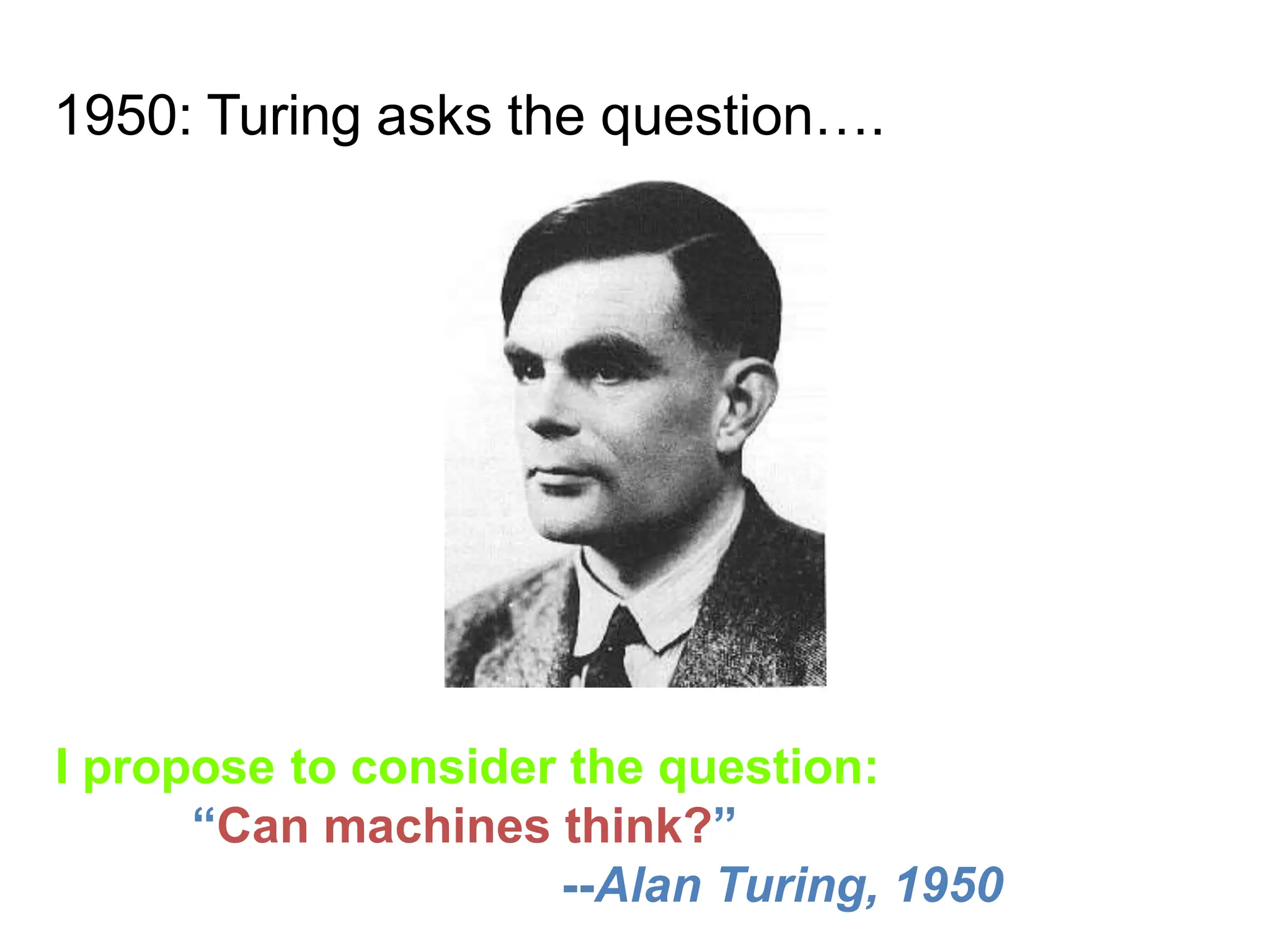
I propose to consider the question:
“Can machines think?”
--Alan Turing, 1950
1950: Turing asks the question….
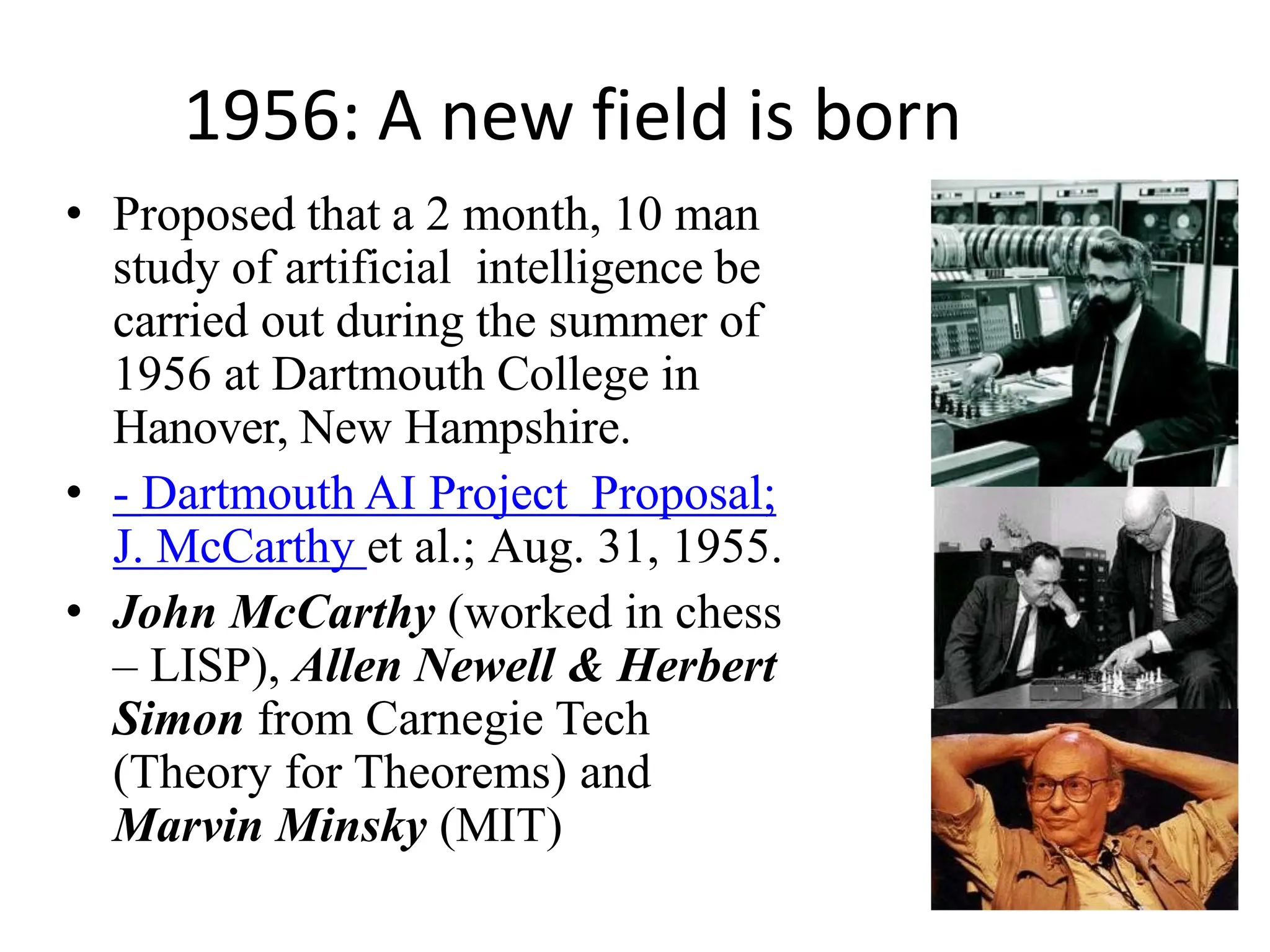
1956: A new field is born
• Proposed that a 2 month, 10 man
study of artificial intelligence be
carried out during the summer of
1956 at Dartmouth College in
Hanover, New Hampshire.
• - Dartmouth AI Project Proposal;
J. McCarthy et al.; Aug. 31, 1955.
• John McCarthy (worked in chess
– LISP), Allen Newell & Herbert
Simon from Carnegie Tech
(Theory for Theorems) and
Marvin Minsky (MIT)
AI SUCCESS
1996: EQP proves that
Robbin’sAlgebras are all boolean
[An Argonne lab program] has come up with a major mathematical
proof that would have been called creative if a human had thought of it.
-New York Times, December, 1996
----- EQP 0.9, June 1996 -----
The job began on eyas09.mcs.anl.gov, Wed Oct 2 12:25:37 1996
UNIT CONFLICT from 17666 and 2 at 678232.20 seconds.
PROOF
2 (wt=7) [] -(n(x + y) = n(x)).
3 (wt=13) [] n(n(n(x) + y) + n(x + y)) = y.
5 (wt=18) [para(3,3)] n(n(n(x + y) + n(x) + y) + y) = n(x + y).
6 (wt=19) [para(3,3)] n(n(n(n(x) + y) + x + y) + y) = n(n(x) + y).
…….
17666 (wt=33) [para(24,16426),demod([17547])] n(n(n(x) + x) ….
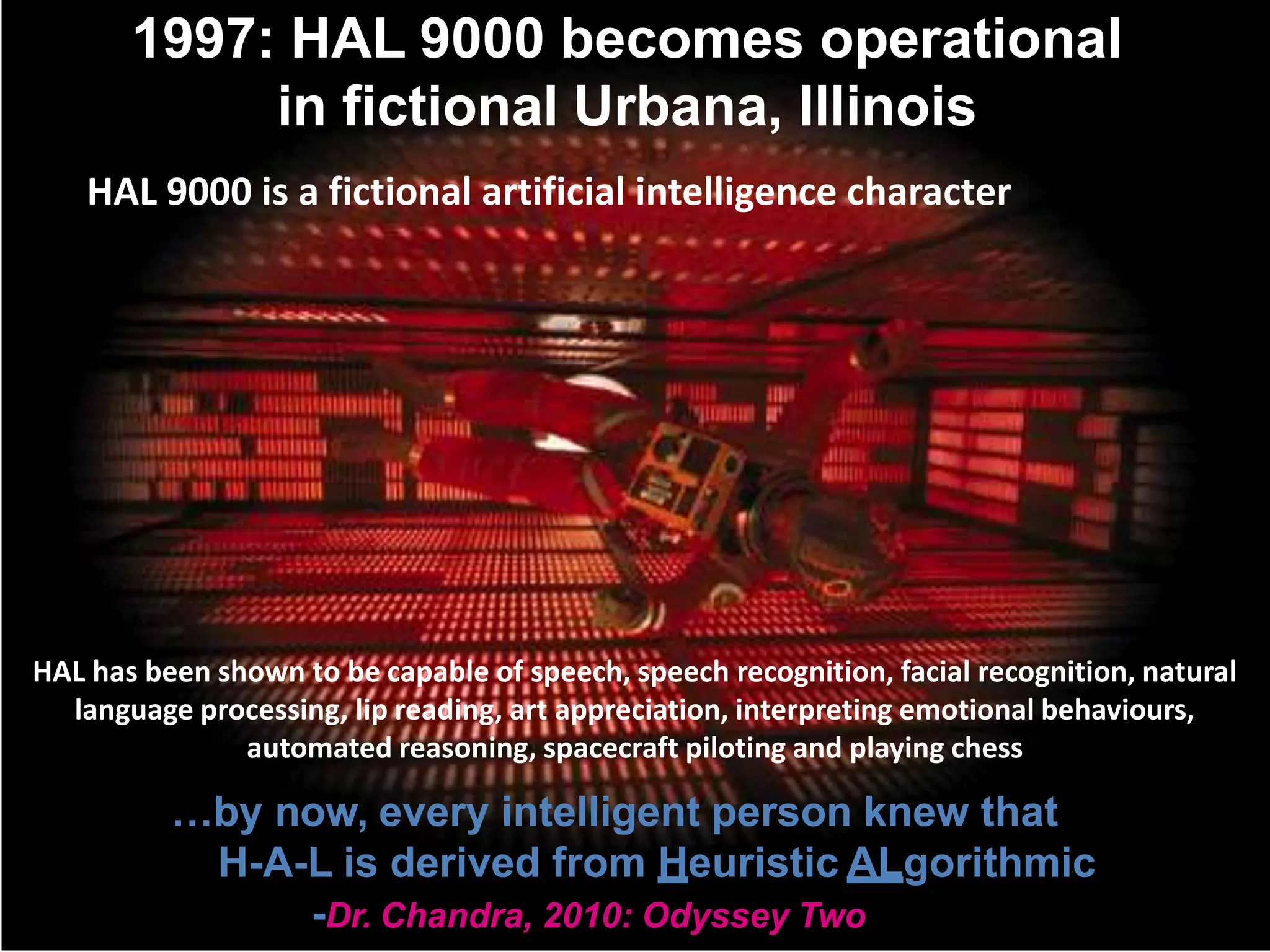
1997: HAL 9000 becomes operational
in fictional Urbana, Illinois
…by now, every intelligent person knew that
H-A-L is derived from Heuristic ALgorithmic
-Dr. Chandra, 2010: Odyssey Two
HAL 9000 is a fictional artificial intelligence character
HAL has been shown to be capable of speech, speech recognition, facial recognition, natural
language processing, lip reading, art appreciation, interpreting emotional behaviours,
automated reasoning, spacecraft piloting and playing chess
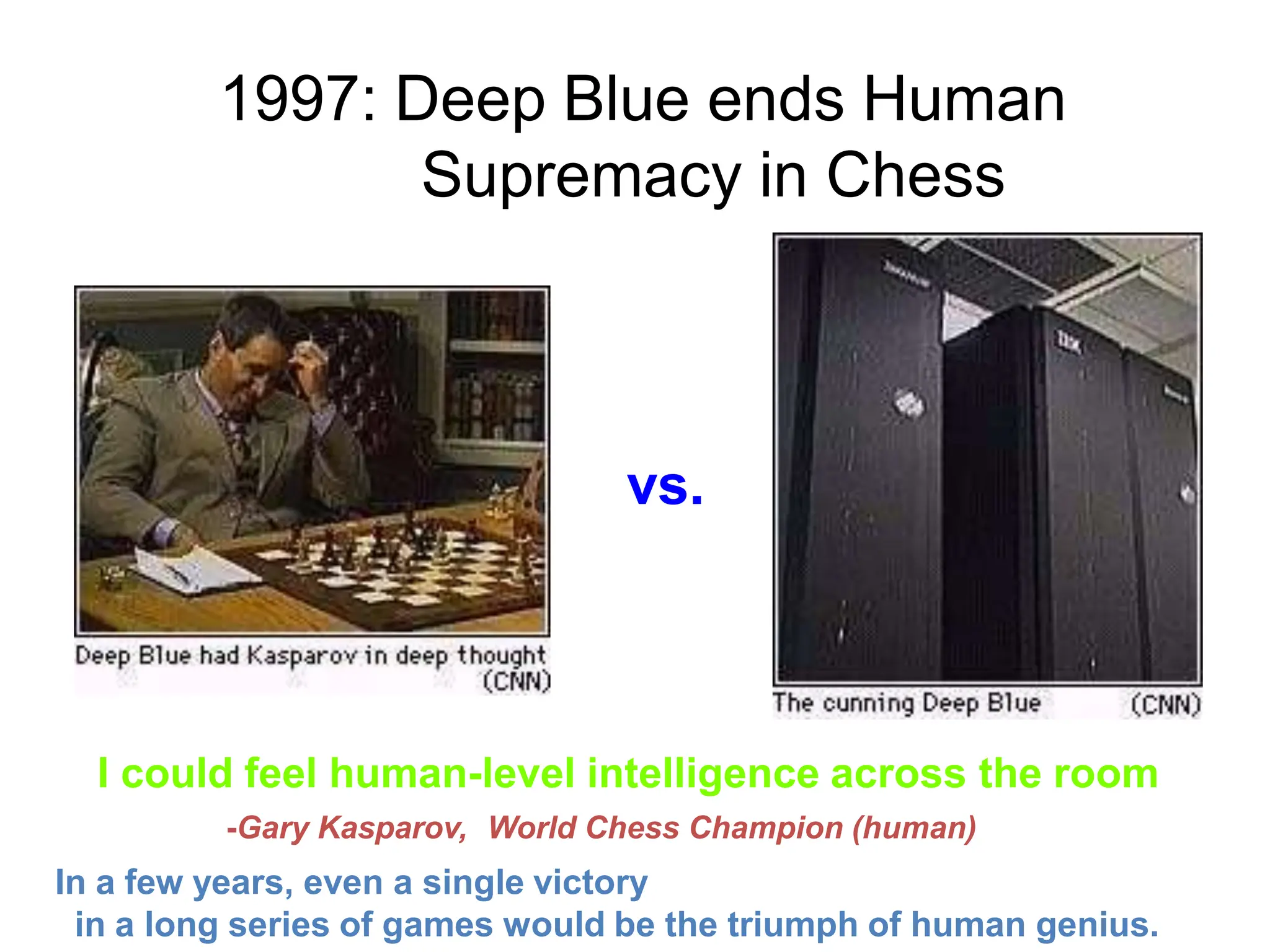
1997: Deep Blue ends Human
Supremacy in Chess
I could feel human-level intelligence across the room
-Gary Kasparov, World Chess Champion (human)
In a few years, even a single victory
in a long series of games would be the triumph of human genius.
vs.
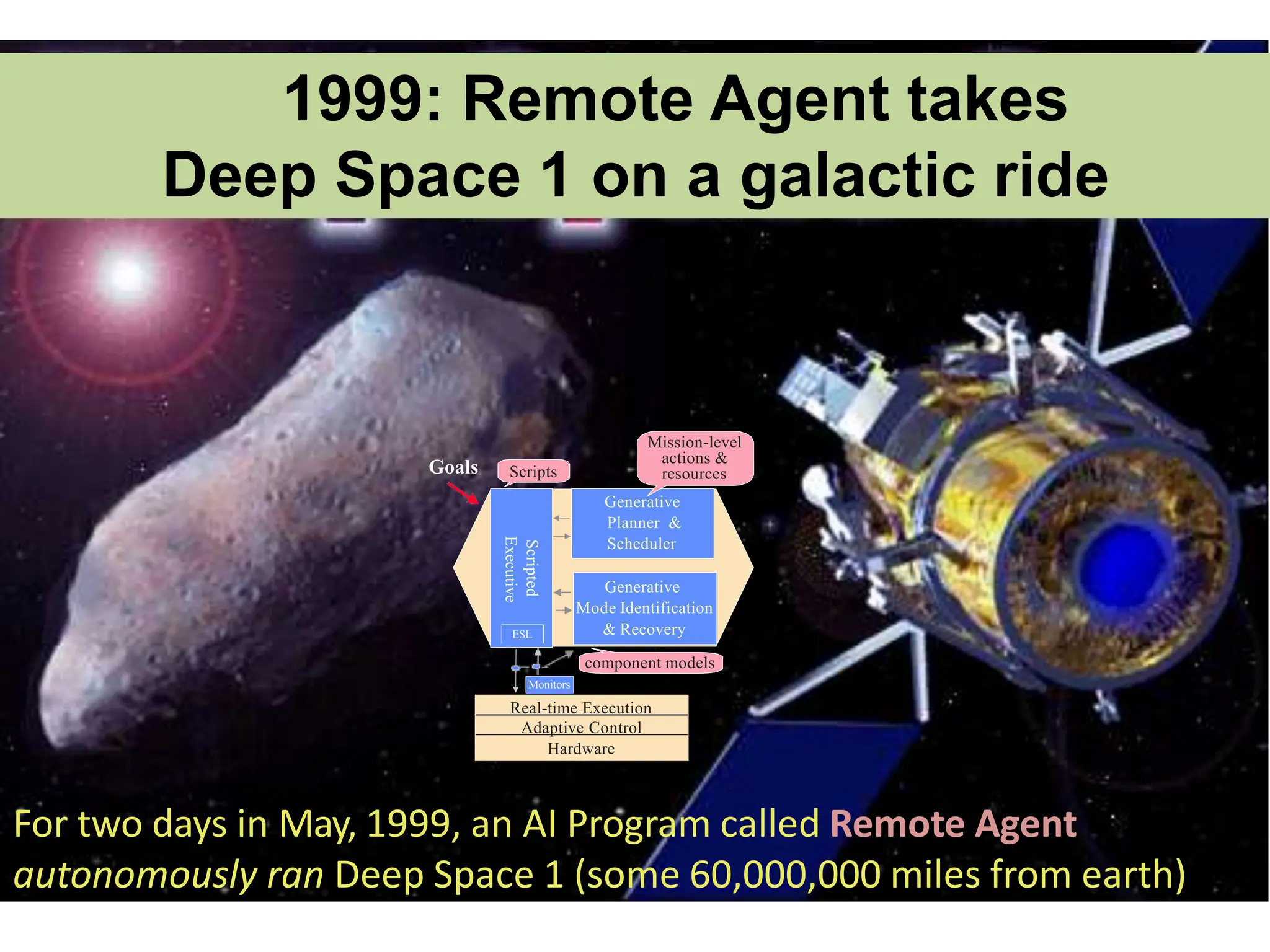
For two days in May, 1999, an AI Program called Remote Agent
autonomously ran Deep Space 1 (some 60,000,000 miles from earth)
Real-time Execution
Adaptive Control
Hardware
Scripted
Executive Generative
Planner &
Scheduler
Generative
Mode Identification
& Recovery
Scripts
Mission-level
actions &
resources
component models
ESL
Monitors
Goals
1999: Remote Agent takes
Deep Space 1 on a galactic ride
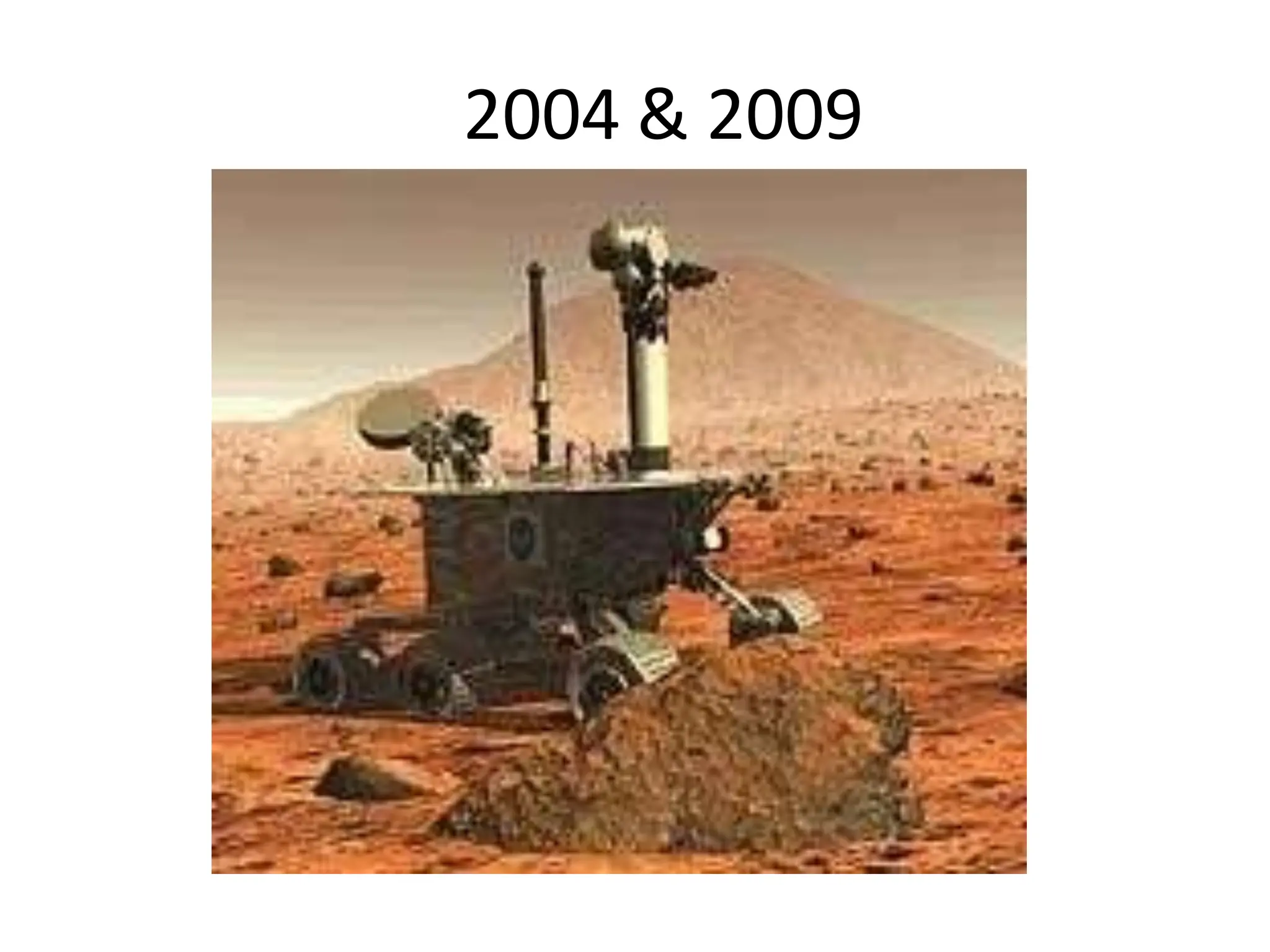
2004 & 2009
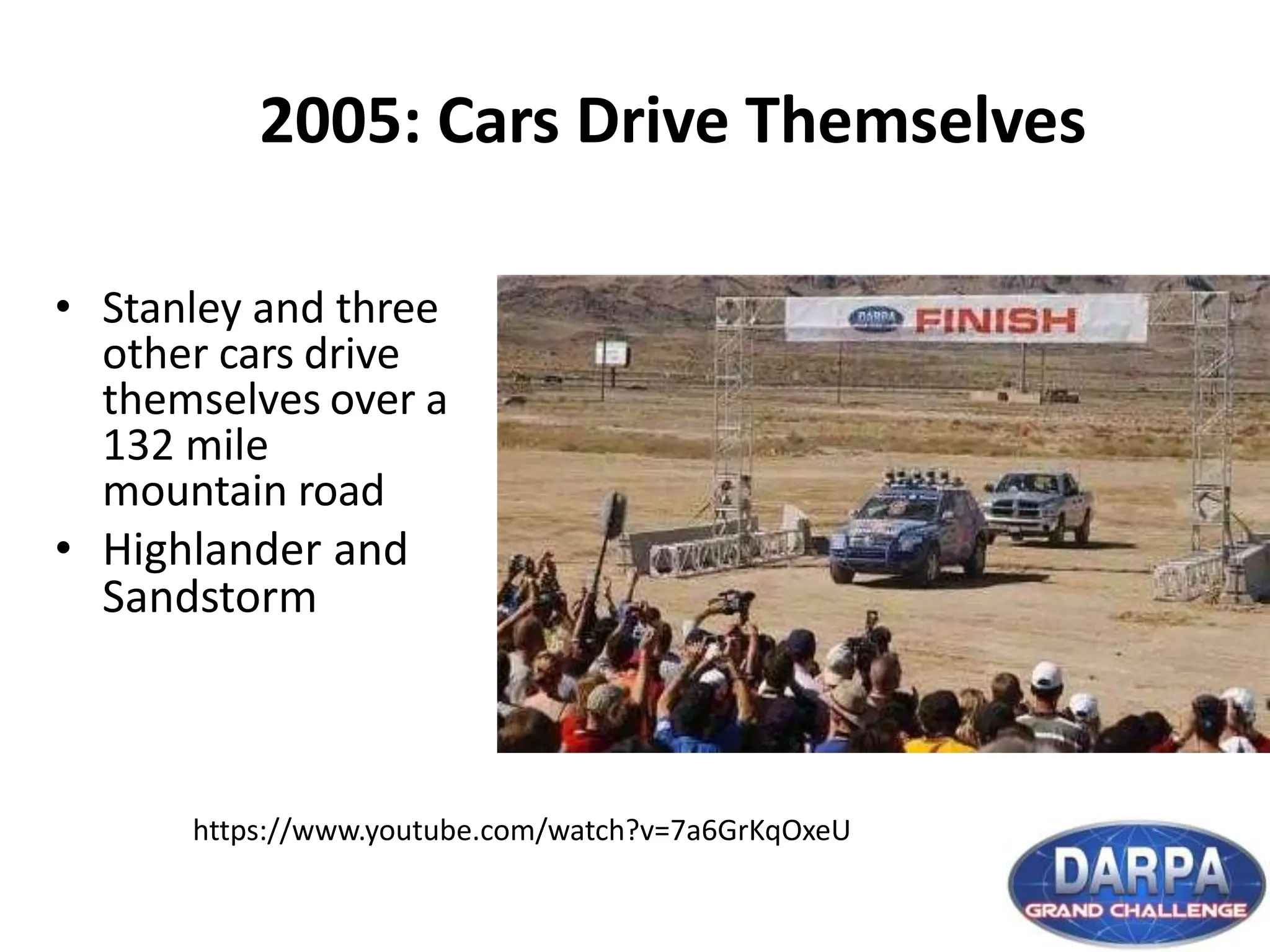
2005: Cars Drive Themselves
• Stanley and three
other cars drive
themselves over a
132 mile
mountain road
• Highlander and
Sandstorm
https://www.youtube.com/watch?v=7a6GrKqOxeU
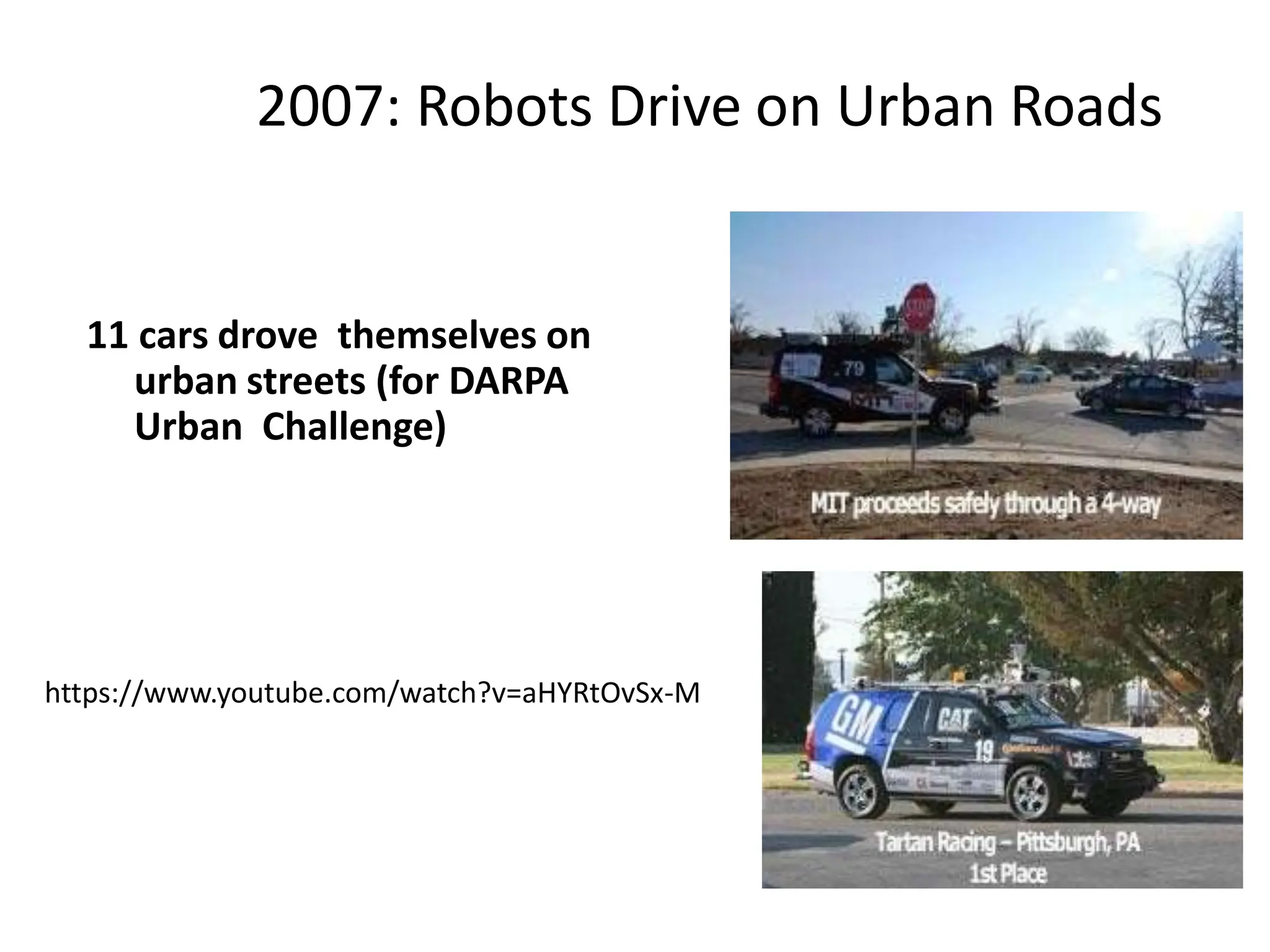
2007: Robots Drive on Urban Roads
11 cars drove themselves on
urban streets (for DARPA
Urban Challenge)
https://www.youtube.com/watch?v=aHYRtOvSx-M
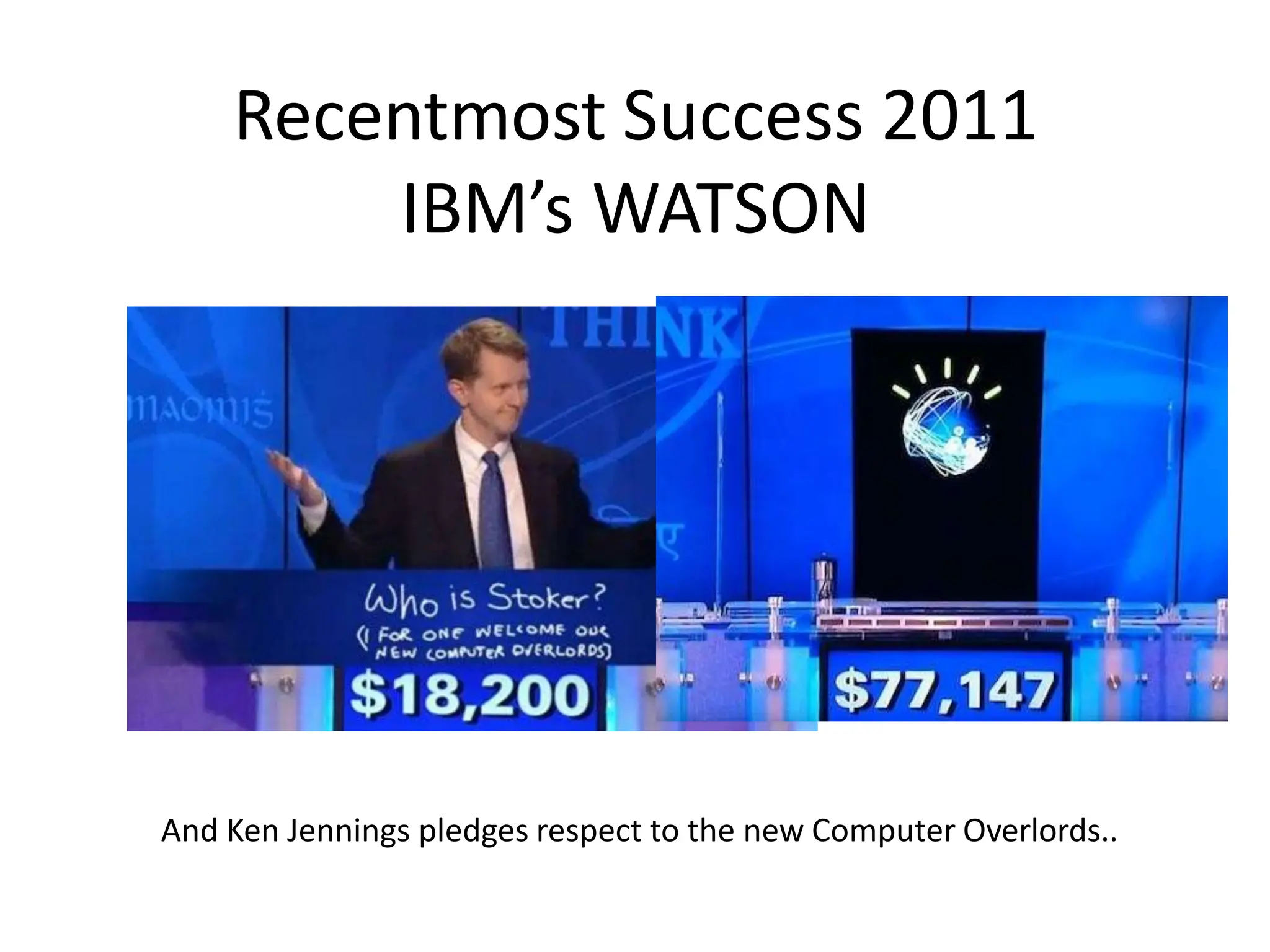
Recentmost Success 2011
IBM’s WATSON
And Ken Jennings pledges respect to the new Computer Overlords..
PRESENT
STATE-OF-ART
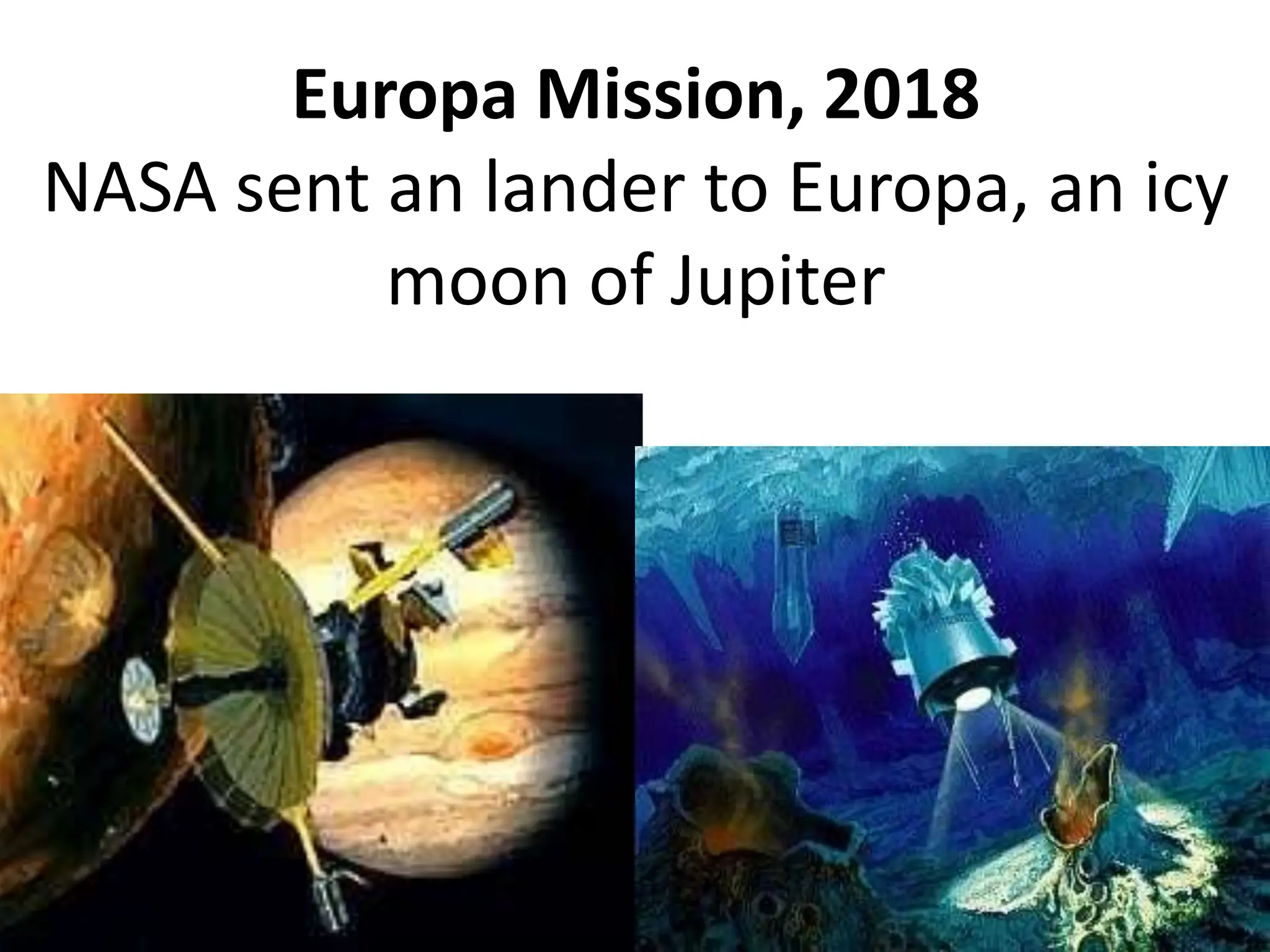
Europa Mission, 2018
NASA sent an lander to Europa, an icy
moon of Jupiter
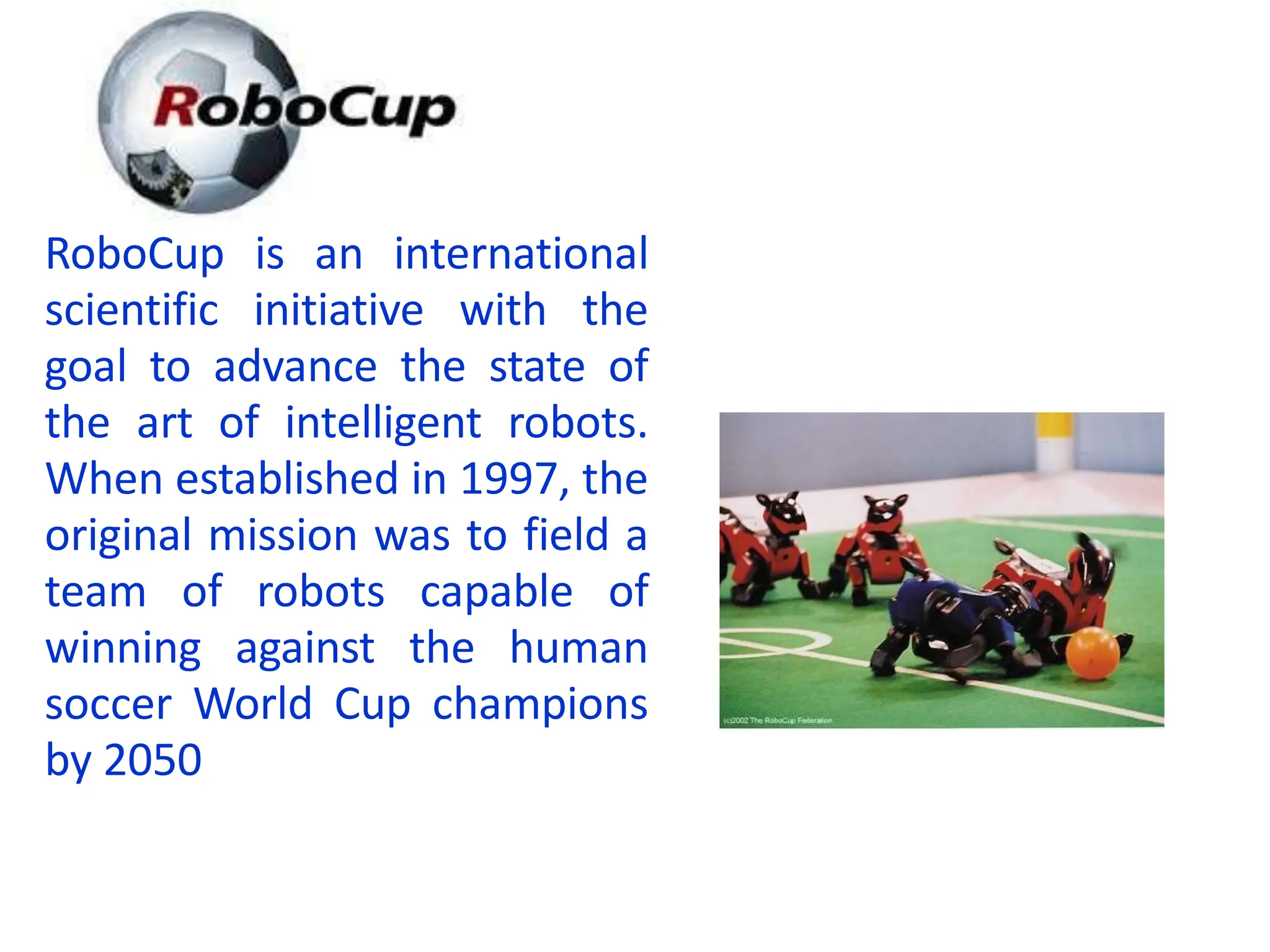
RoboCup is an international
scientific initiative with the
goal to advance the state of
the art of intelligent robots.
When established in 1997, the
original mission was to field a
team of robots capable of
winning against the human
soccer World Cup champions
by 2050
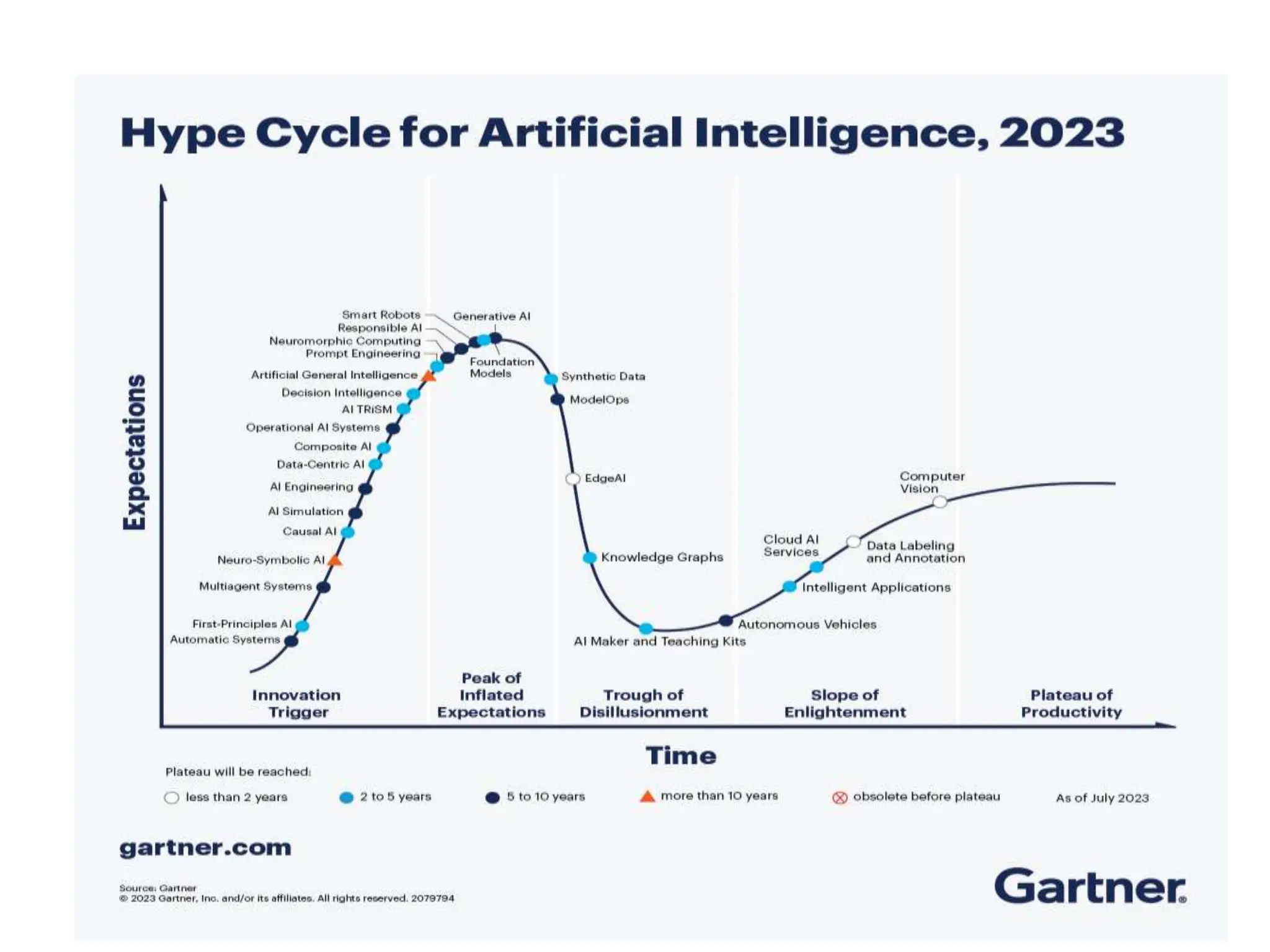
AI Today
• Autonomous planning & Control
• Scheduling
• Game playing
• Medical Diagnosis
• Logistics Planning
• Robotics
• Language Understanding and Problem Solving
• Text / Audio / Video Generations
Science of AI
• Physics: Where did the physical universe come
from?
• And what laws guide its dynamics?
• Biology: How did biological life evolve?
• And how do living organisms function?
• AI: What is the nature of intelligent
thought?
What is intelligence?
• Dictionary: capacity for learning, reasoning,
understanding, and similar forms of mental activity
• Ability to perceive and act in the world
• Reasoning: proving theorems, medical diagnosis
• Planning: take decisions
• Learning and Adaptation: recommend and learn
traffic patterns
• Understanding: text, speech, visual scene
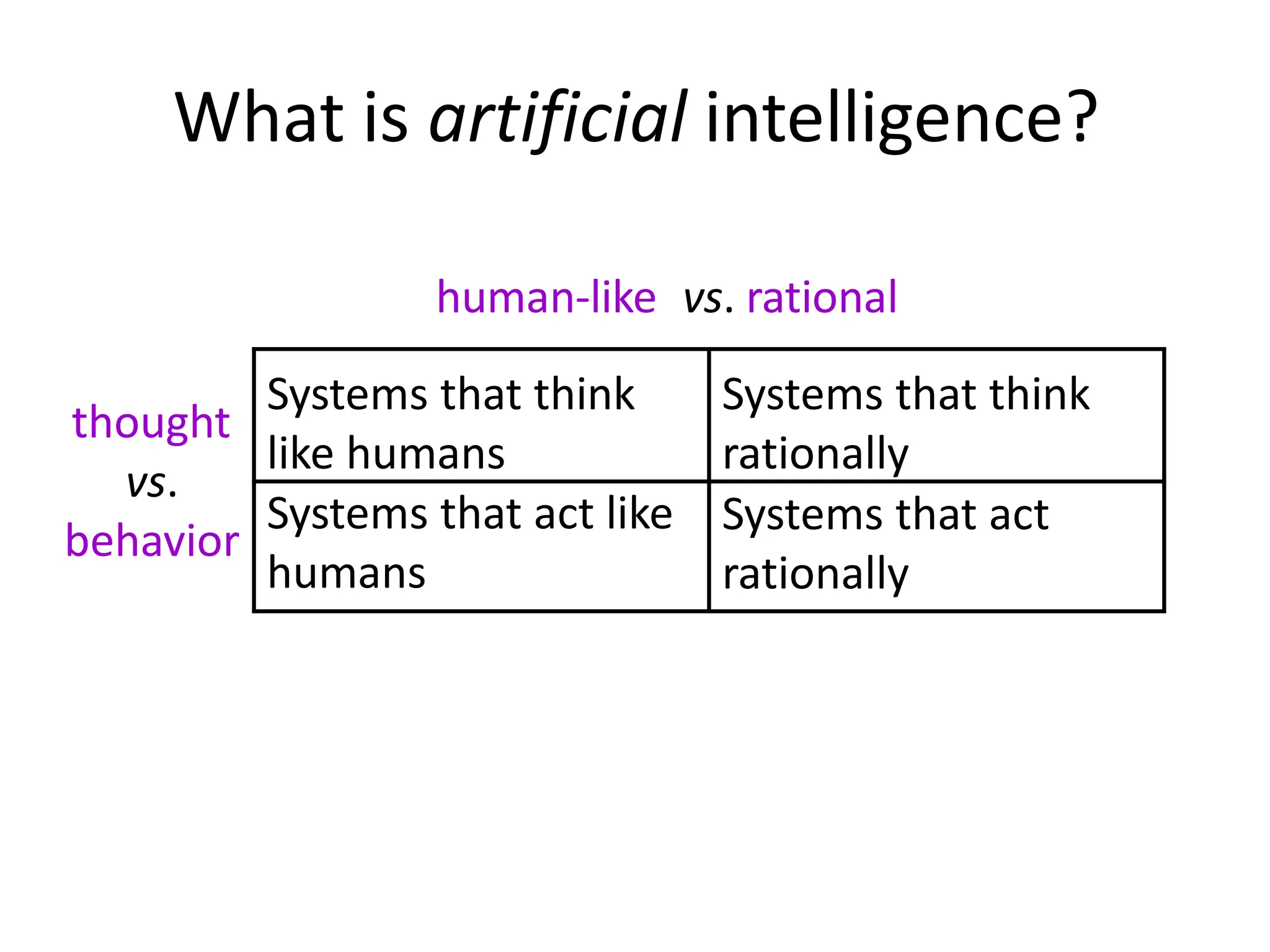
What is artificial intelligence?
thought
vs.
behavior
human-like vs. rational
“[automation of] activities
that we associate with human
thinking, activities such as
decision making, problem
solving, learning…” (Bellman
1978)
“The study of mental abilities
through the use of
computational models”
(Charniak & McDertmott
1985)
“The study of how to make “The branch of computer
computers to things at which, science that is concerned
at the moment, people are with the automation of
better” (Rich & Knight 1991) intelligent behavior” (Luger &
Stubblefield 1993)
What is artificial intelligence?
Systems that think
like humans
Systems that think
rationally
Systems that act like
humans
Systems that act
rationally
human-like vs. rational
thought
vs.
behavior
Thinking Humanly
• Cognitive Science
– Very hard to understand how humans think
• Post-facto rationalizations, irrationality of human thinking
• Do we want a machine that beats humans in chess or a
machine that thinks like humans while beating humans in
chess?
– Deep Blue supposedly DOESN’T think like humans..
• Thinking like humans important in applications
– Intelligent tutoring
– Expressing emotions in interfaces…
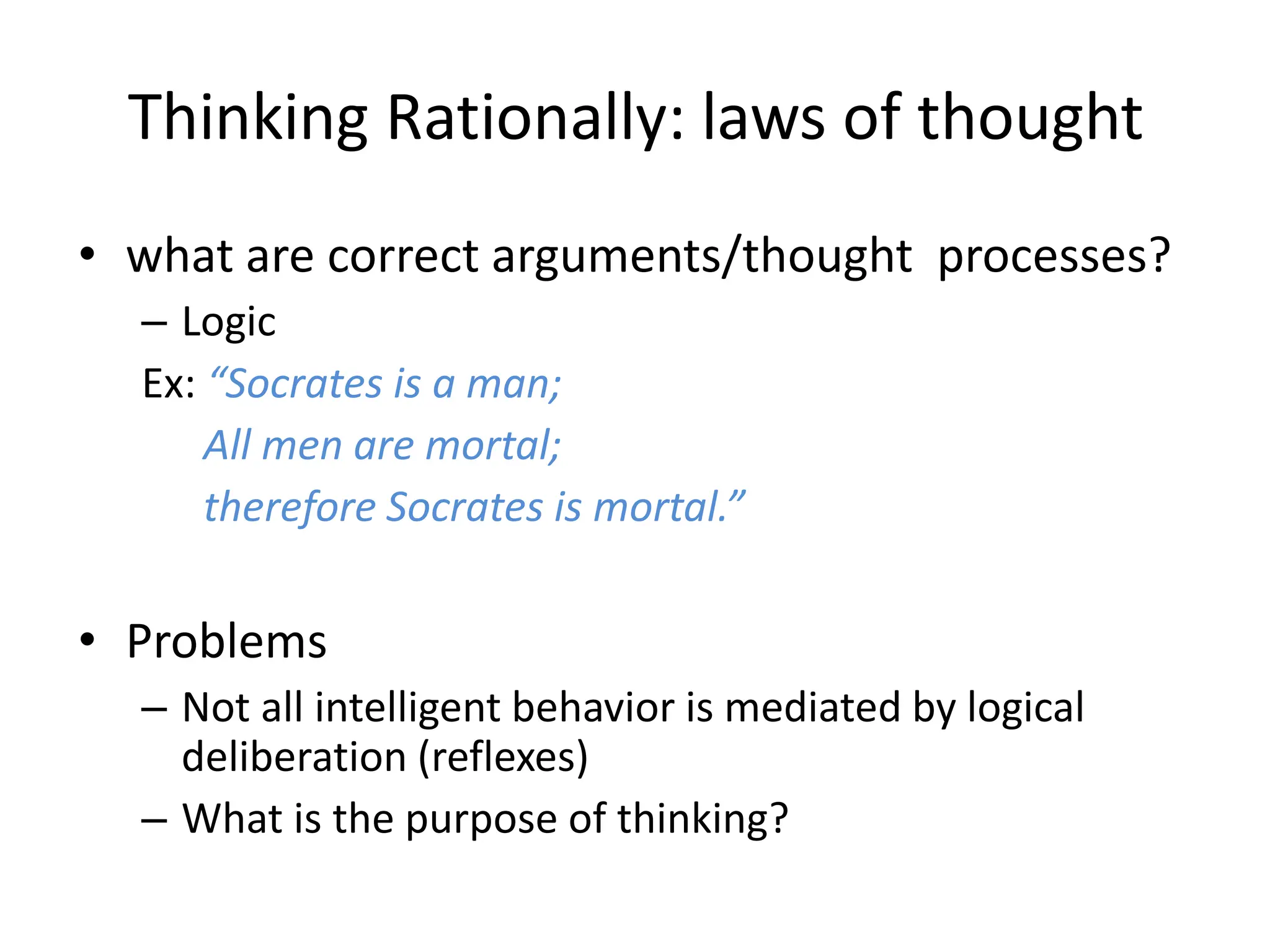
Thinking Rationally: laws of thought
• what are correct arguments/thought processes?
– Logic
Ex: “Socrates is a man;
All men are mortal;
therefore Socrates is mortal.”
• Problems
– Not all intelligent behavior is mediated by logical
deliberation (reflexes)
– What is the purpose of thinking?
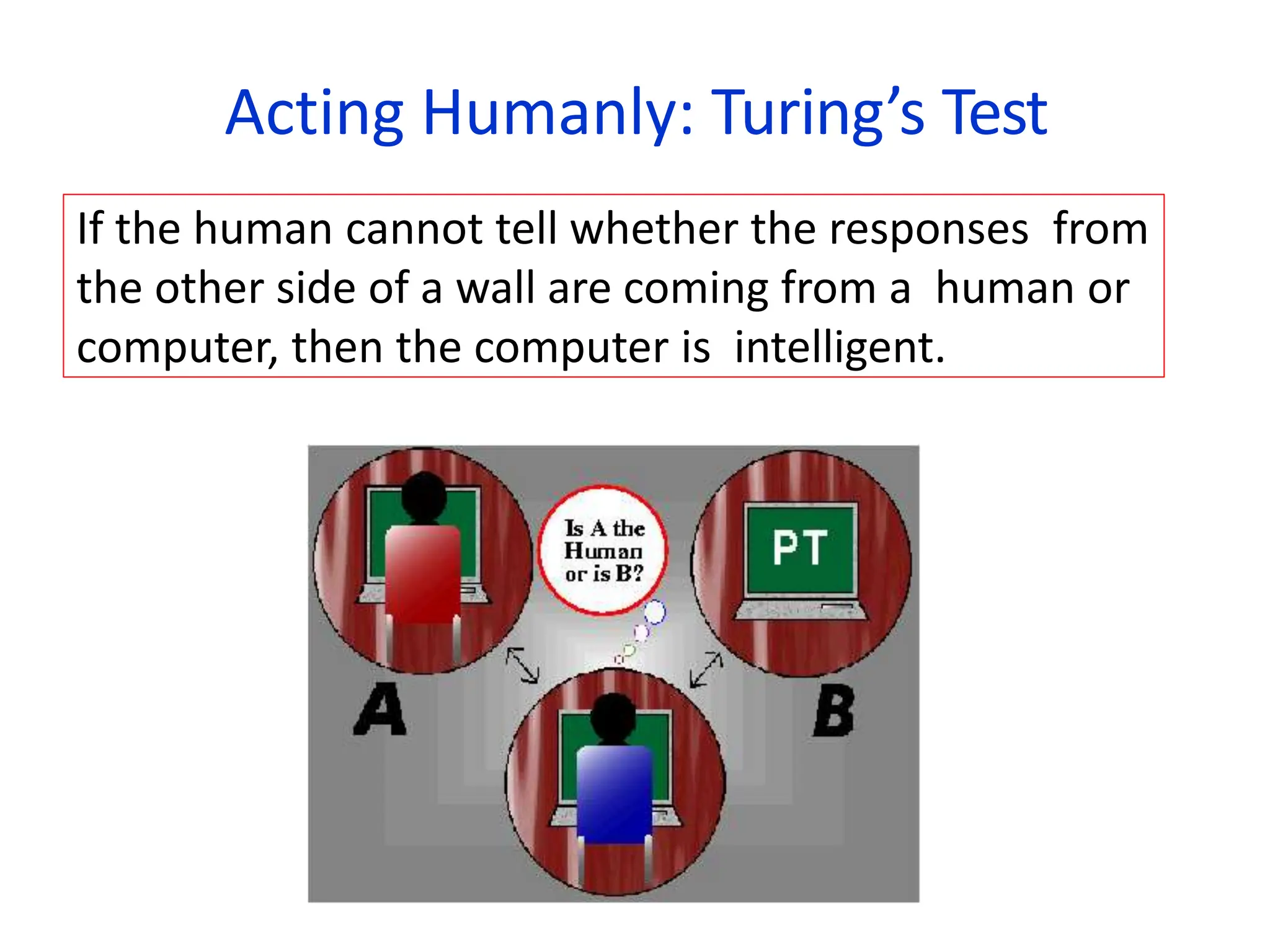
Acting Humanly: Turing’s Test
If the human cannot tell whether the responses from
the other side of a wall are coming from a human or
computer, then the computer is intelligent.
Acting Humanly
• Loebner Prize competition is modern version of
Turing Test
– Every year in Boston
– Expertise-dependent tests: limited conversation
• What if people call a human a machine?
– Make human-like errors
• Problems
– Not reproducible, constructive or mathematically analyzable
The quest for ‘artificial flight’ succeeded when Wright brothers stopped imitating
birds and learned about aerodynamics
Acting rationally
• Agent -> that acts,
• under autonomous control,
• perceiving their environment,
• persisting over a period,
• adapting to change and
• capable of taking goals.
• Rational Agent: doing the right thing
• Need not always be deliberative
– Reflexive
• Aristotle
• Every art and every inquiry, similarly
Every action and every pursuit
is thought to aim at some good.
Acting  Thinking?
• Weak AI Hypothesis vs. Strong AI hypothesis
– Weak Hyp: machines could act as if they are
intelligent
– Strong Hyp: machines that act intelligent have to
think intelligently too
Rational Agent
“For each possible percept sequence, a
rational agent should select an action that is
expected to maximize its performance
measure, given the evidence provided by the
percept sequence and whatever built-in
knowledge the agent has.''
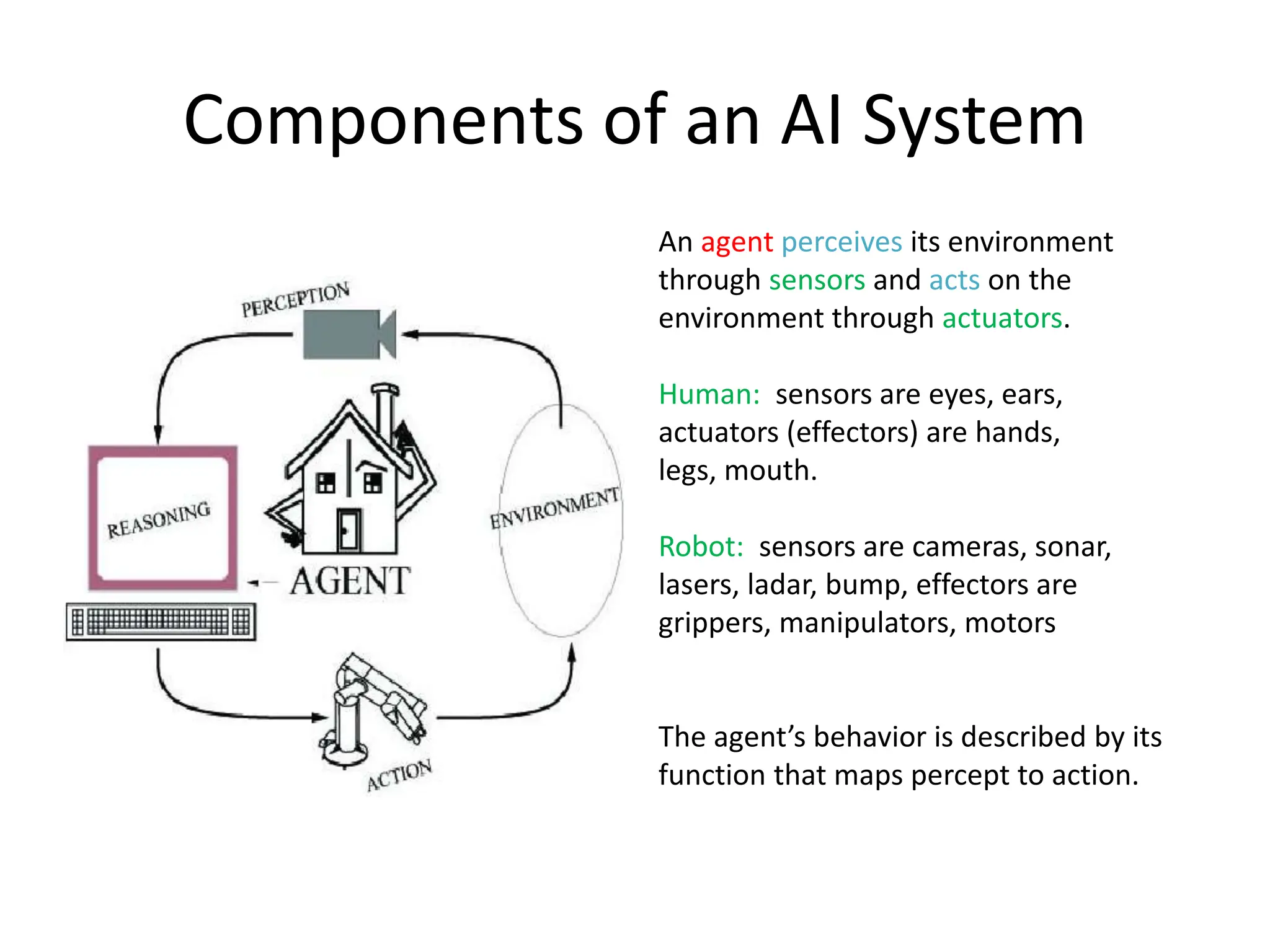
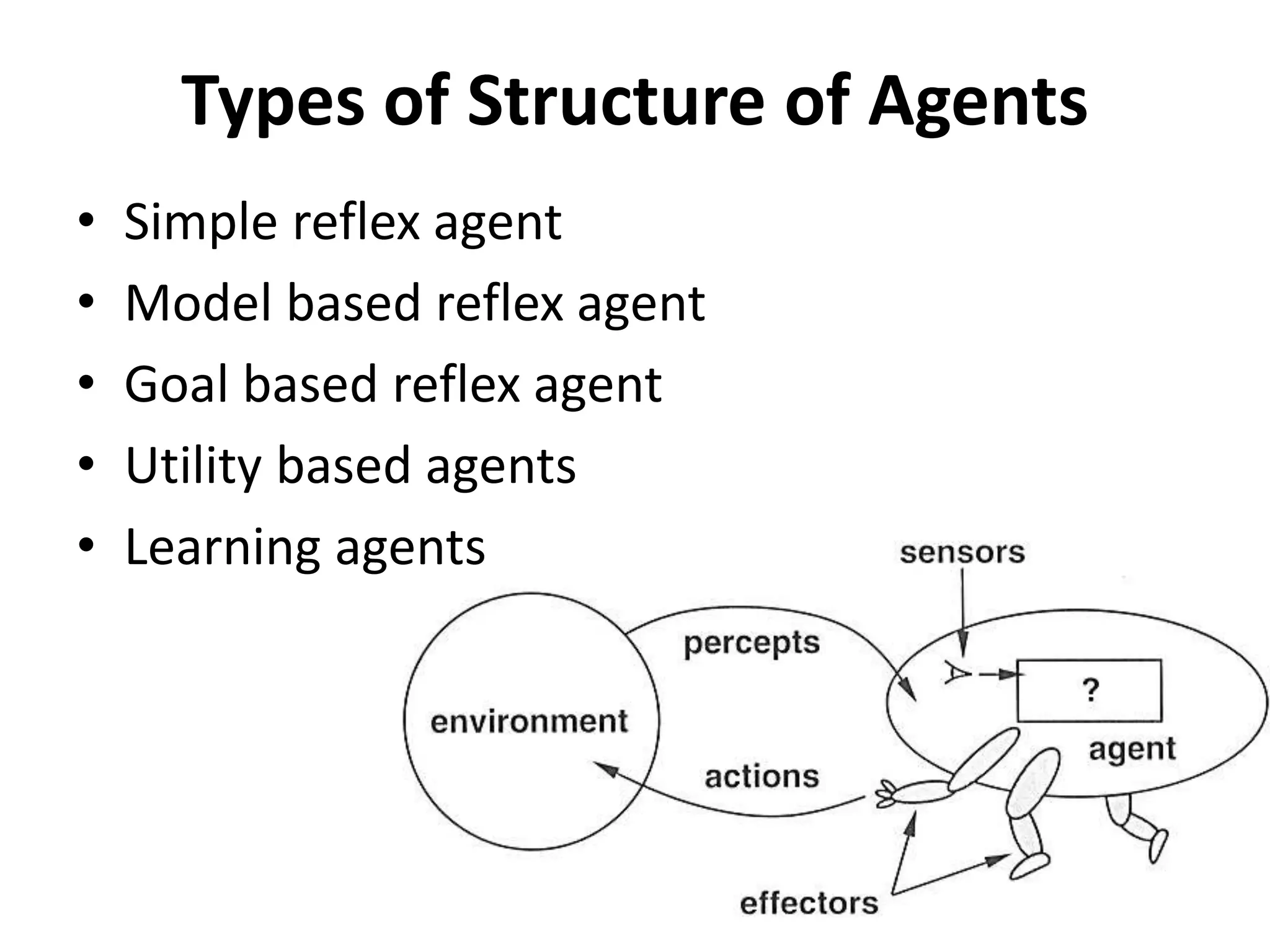
Components of an AI System
An agent perceives its environment
through sensors and acts on the
environment through actuators.
Human: sensors are eyes, ears,
actuators (effectors) are hands,
legs, mouth.
Robot: sensors are cameras, sonar,
lasers, ladar, bump, effectors are
grippers, manipulators, motors
The agent’s behavior is described by its
function that maps percept to action.
PEAS
• Use PEAS to describe task
– Performance measure
– Environment
– Actuators
– Sensors
Example: Taxi driver
• Performance measure: safe, fast, comfortable
(maximize profits)
• Environment: roads, other traffic,
pedestrians, customers
• Actuators: steering, accelerator, brake, signal,
horn
• Sensors: cameras, sonar, speedometer, GPS,
odometer, accelerometer, engine sensors
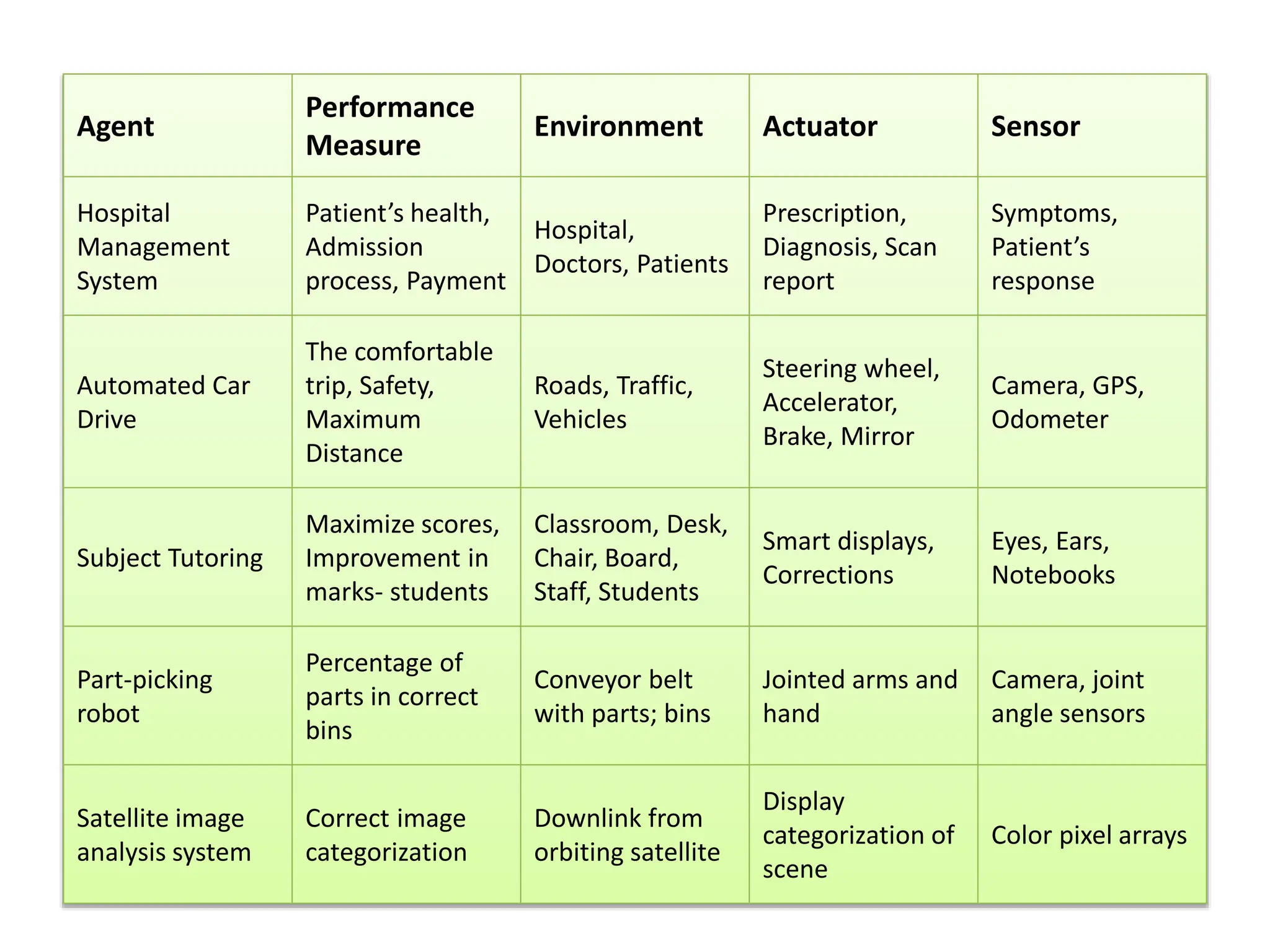
Agent
Performance
Measure
Environment Actuator Sensor
Hospital
Management
System
Patient’s health,
Admission
process, Payment
Hospital,
Doctors, Patients
Prescription,
Diagnosis, Scan
report
Symptoms,
Patient’s
response
Automated Car
Drive
The comfortable
trip, Safety,
Maximum
Distance
Roads, Traffic,
Vehicles
Steering wheel,
Accelerator,
Brake, Mirror
Camera, GPS,
Odometer
Subject Tutoring
Maximize scores,
Improvement in
marks- students
Classroom, Desk,
Chair, Board,
Staff, Students
Smart displays,
Corrections
Eyes, Ears,
Notebooks
Part-picking
robot
Percentage of
parts in correct
bins
Conveyor belt
with parts; bins
Jointed arms and
hand
Camera, joint
angle sensors
Satellite image
analysis system
Correct image
categorization
Downlink from
orbiting satellite
Display
categorization of
scene
Color pixel arrays
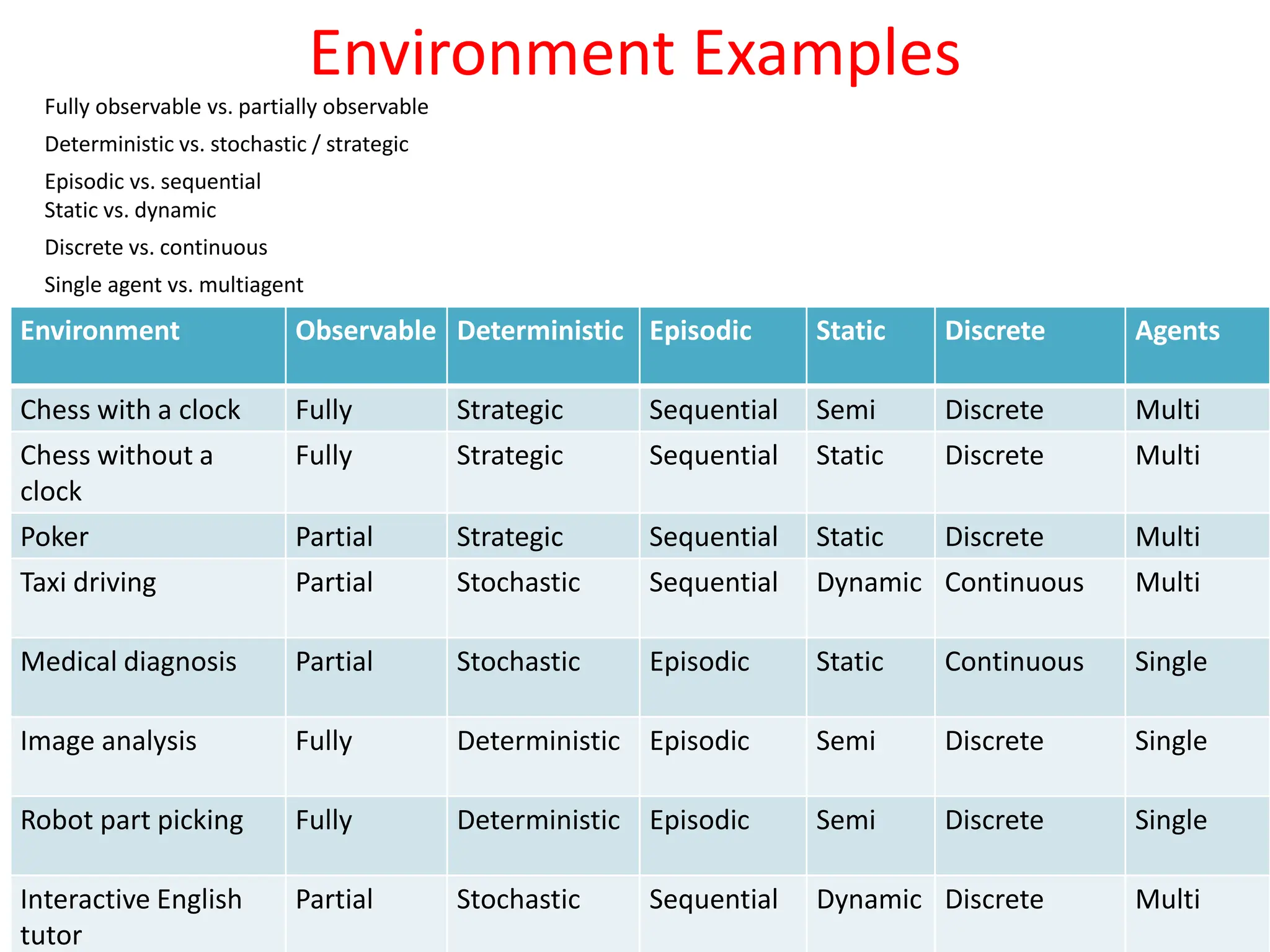
Environment Examples
Fully observable vs. partially observable
Deterministic vs. stochastic / strategic
Episodic vs. sequential
Static vs. dynamic
Discrete vs. continuous
Single agent vs. multiagent
Environment Observable Deterministic Episodic Static Discrete Agents
Chess with a clock Fully Strategic Sequential Semi Discrete Multi
Chess without a
clock
Fully Strategic Sequential Static Discrete Multi
Poker Partial Strategic Sequential Static Discrete Multi
Taxi driving Partial Stochastic Sequential Dynamic Continuous Multi
Medical diagnosis Partial Stochastic Episodic Static Continuous Single
Image analysis Fully Deterministic Episodic Semi Discrete Single
Robot part picking Fully Deterministic Episodic Semi Discrete Single
Interactive English
tutor
Partial Stochastic Sequential Dynamic Discrete Multi
Types of Structure of Agents
• Simple reflex agent
• Model based reflex agent
• Goal based reflex agent
• Utility based agents
• Learning agents
Assignment - 1
Construct an agent – Mention the PEAS and
structure of agent
RECENT ADVANCEMENTS IN AI
Advanced topics
MACHINE LEARNING
Machine Learning
• Machine learning is so intricately a part of our daily lives that we
sometimes don’t even know that we are relying on it. For instance, ask
Alexa to save a playlist or tag your pictures automatically in your phone.
There are so many other things that machines are doing day in and out.
With time, machine learning has evolved to mimic human understanding.
• Machine learning dates back to the pre-19th century.
– In 1642, Blaise Pascal invented the mechanical machine to add, subtract,
multiply, and divide.
– In 1679, Gottfried Wilhelm Leibniz devised the system of binary code.
• This is where it all started. Machine learning kept growing in leaps and
bounds throughout the 19th, 20th, and 21st centuries.
No-Code Machine Learning
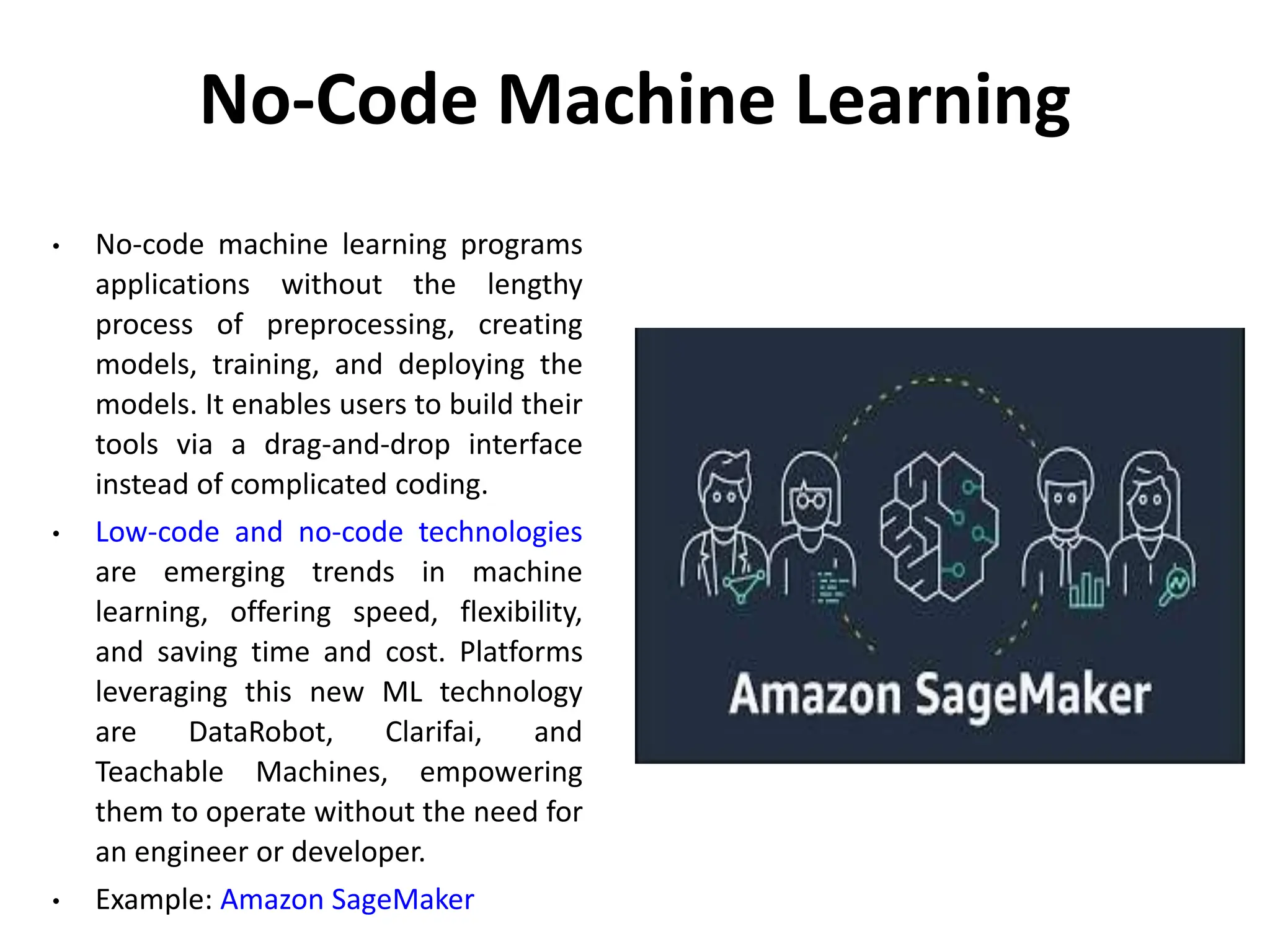
• No-code machine learning programs
applications without the lengthy
process of preprocessing, creating
models, training, and deploying the
models. It enables users to build their
tools via a drag-and-drop interface
instead of complicated coding.
• Low-code and no-code technologies
are emerging trends in machine
learning, offering speed, flexibility,
and saving time and cost. Platforms
leveraging this new ML technology
are DataRobot, Clarifai, and
Teachable Machines, empowering
them to operate without the need for
an engineer or developer.
• Example: Amazon SageMaker
Tiny ML
• IoT dominates the technology world. However, the
large-scale ML use cases have limited use. As the
saying goes, “Good things come in small packages”,
TinyML also offers powerful solutions for smaller-scale
applications.
• A web request takes a long time to traverse and deliver
data to a large server. To reduce latency, bandwidth,
and power consumption and ensure user privacy,
TinyML is applied on IoT edge devices for tracking and
predicting the collected data.
Automated Machine Learning
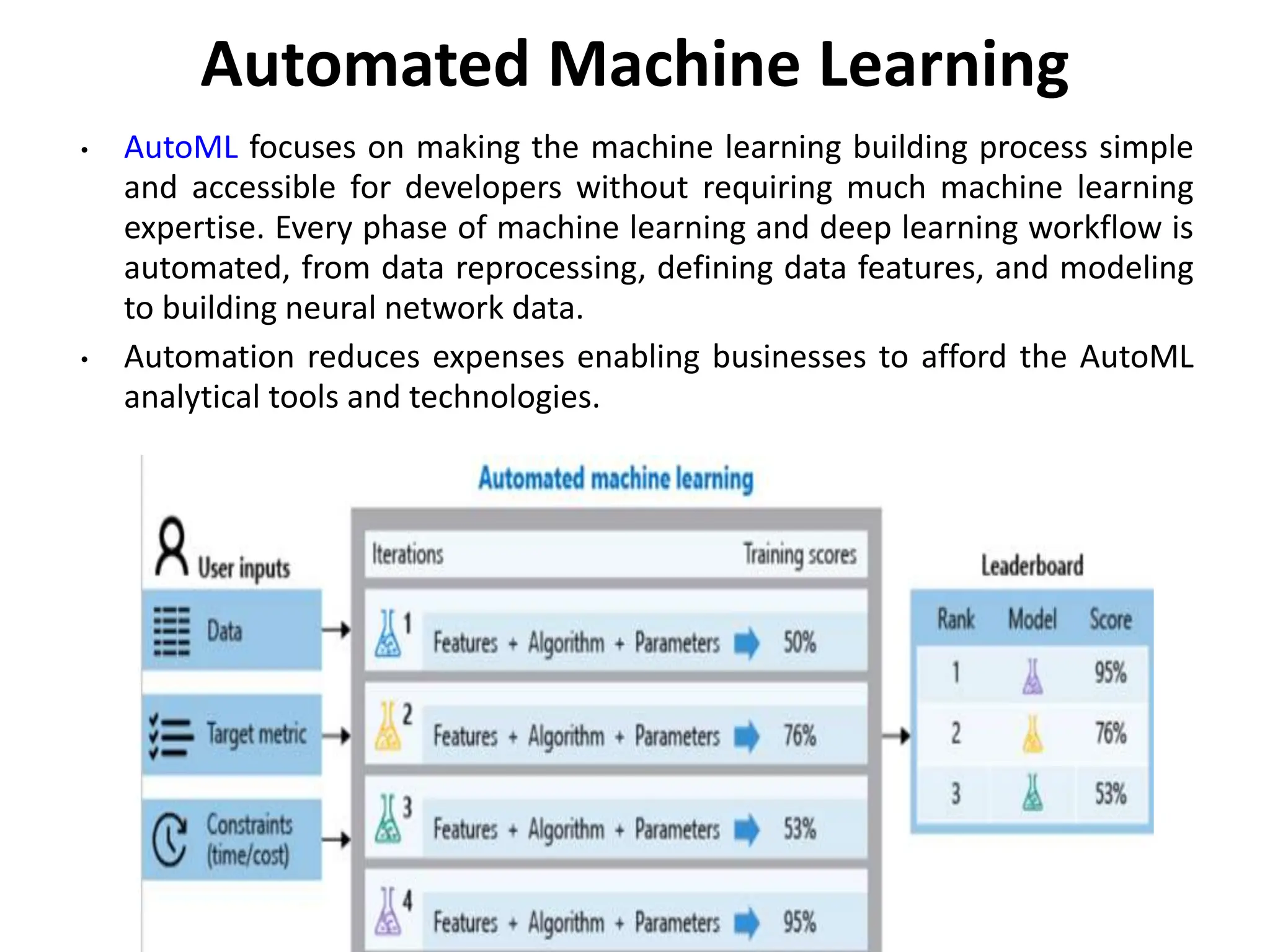
• AutoML focuses on making the machine learning building process simple
and accessible for developers without requiring much machine learning
expertise. Every phase of machine learning and deep learning workflow is
automated, from data reprocessing, defining data features, and modeling
to building neural network data.
• Automation reduces expenses enabling businesses to afford the AutoML
analytical tools and technologies.
Metaverses
• Metaverses envisioned as part of the evolution of the
internet in the Web 3.0 era are poised to become a
significant phenomenon. These digital realms
resemble alternate universes where individuals can
engage in various activities, conduct business,
generate income, and establish virtual lives.
• AI bots, for example, will assist users in selecting
services, while machine learning will contribute to
creating immersive environments within these
metaverses.
DEEP LEARNING
Self-Driving Cars
Deep Learning is used in self-driving vehicles to develop accurate models of
the world surrounding the car to make driving judgments. A neural network is
trained on an extensive collection of photos and driving data to produce
these models. The neural network may then generalize from this data to
anticipate what items are in a picture or what the automobile should perform
in each circumstance. Tesla is a well-known example.
Robotics
Deep learning algorithms have been widely employed in robotics to enable
robots to learn and improve their abilities autonomously. Deep-learning
machines are capable of learning from data in the same way that humans do.
It enables robots to enhance their task performance without requiring
human involvement. Deep learning algorithms have been used to enable
robots to travel in unfamiliar areas autonomously, identify and grip things,
and communicate with humans.
Deep Learning Latest Applications
Natural Language Processing
Deep Learning algorithms have transformed Natural Language Processing
by automating the extraction of meaning from text. These algorithms
have produced cutting-edge results on machine translation, question
answering, and text categorization tasks.
Healthcare
Deep Learning is applied in a variety of sectors, including healthcare. Deep
learning applications in healthcare can have a significant impact. Deep
Learning is used in healthcare to create prediction models for various
applications such as illness diagnosis, prognosis, and therapy
recommendations. Deep Learning is also being applied to develop novel
imaging techniques such as MRI and CT scan image reconstruction.
Deep Learning Latest Applications
Adding Sounds to Silent Movies
Deep Learning may be used to add audio to silent films automatically. It is
possible to accomplish this by training a deep neural network to map the
visual elements of a video to the appropriate audio. An extensive collection of
films with audio may be used to train the neural network. Once trained, the
neural network may automatically add audio to any silent film.
Fraud News Detection
One of the deep learning applications in business is news aggregation, which
uses deep Learning to detect and extract news content from websites
automatically. It outperforms standard approaches such as keyword-based
searches. Deep Learning has also been used to detect fake news. Because
Deep Learning computers may learn to recognize data patterns that indicate
fraudulent activities, deep Learning, for example, may be used to detect
trends in financial data that indicate fraud.
ARTIFICIAL INTELLIGENCE IN INDIAN
HEALTHCARE
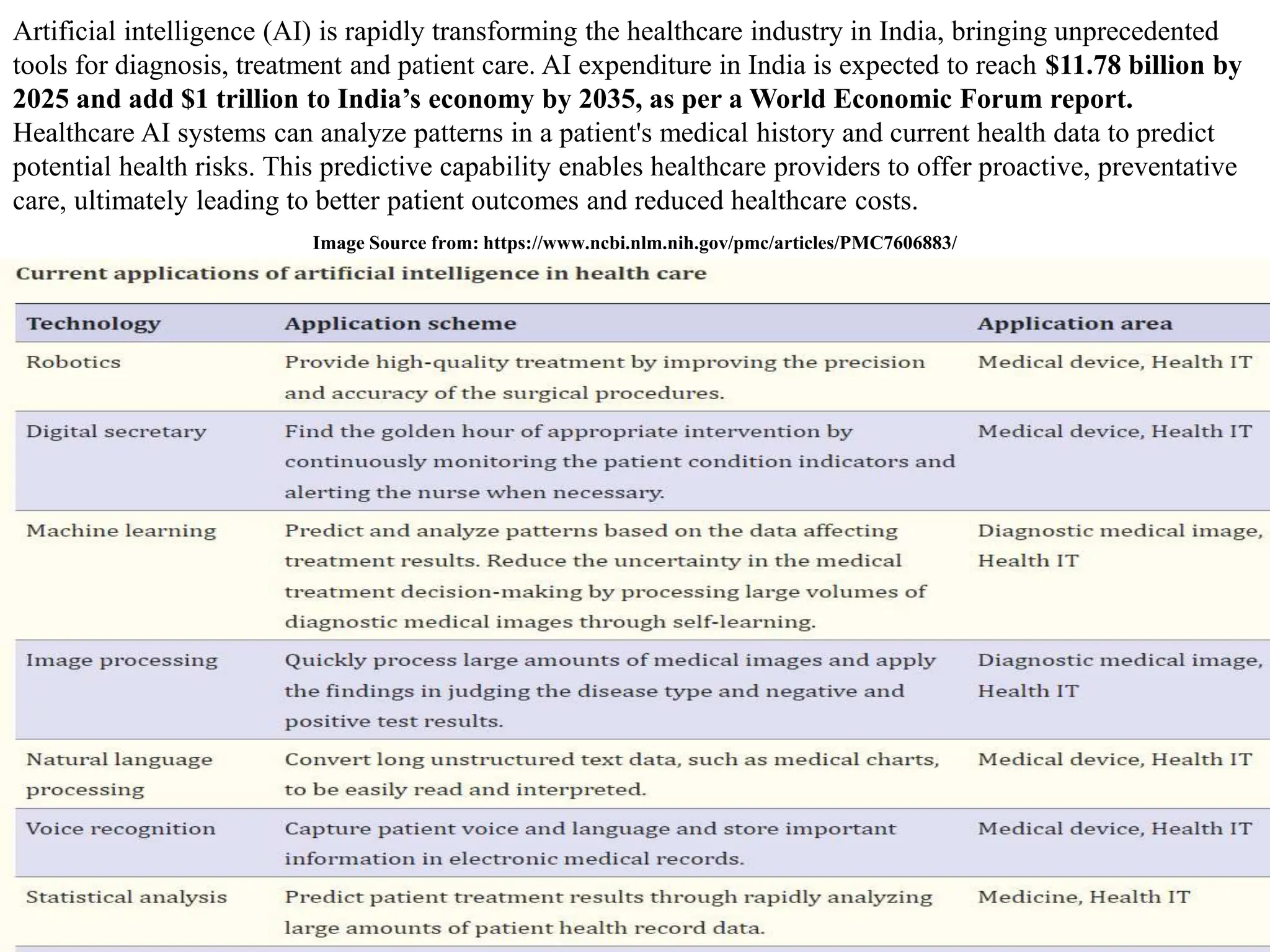
Artificial intelligence (AI) is rapidly transforming the healthcare industry in India, bringing unprecedented
tools for diagnosis, treatment and patient care. AI expenditure in India is expected to reach $11.78 billion by
2025 and add $1 trillion to India’s economy by 2035, as per a World Economic Forum report.
Healthcare AI systems can analyze patterns in a patient's medical history and current health data to predict
potential health risks. This predictive capability enables healthcare providers to offer proactive, preventative
care, ultimately leading to better patient outcomes and reduced healthcare costs.
Image Source from: https://www.ncbi.nlm.nih.gov/pmc/articles/PMC7606883/
AI IN FINANCE
Artificial intelligence (AI) in finance helps drive insights for data analytics, performance
measurement, predictions and forecasting, real-time calculations, customer servicing, intelligent
data retrieval, and more. It is a set of technologies that enables financial services organizations to
better understand markets and customers, analyze and learn from digital journeys, and engage in
a way that mimics human intelligence and interactions at scale.
Predictive modeling
Use data customer, risk, transaction, trading or other data insights to predict specific future
outcomes with high degree of precision. These capabilities can be helpful in fraud detection,
risk reduction, and customer future needs’ prediction.
Cybersecurity
Automate aspects of cybersecurity by continuously monitoring and analyzing network traffic
to detect, prevent, and respond to cyberattacks and threats.
Conversations
Delight your customers with human-like AI-powered contact center experiences, such as
banking concierge or customer center, to lower costs, and free up your human agents' time.
Transform personal finance and give customers more ways to manage their money by
bringing smart, intuitive experiences to your apps, websites, digital platforms, and virtual
tools.
Data science and analytics
Access a complete suite of data management, analytics, and machine learning tools to
generate insights and unlock value from data for business intelligence and decision making.
Recommendations
Deliver highly personalized recommendations for financial products and services, such as
investment advice or banking offers, based on customer journeys, peer interactions, risk
preferences, and financial goals.
Translation
Make your content, such as financial news, and apps multilingual with fast, dynamic machine
translation at scale to enhance customer interactions and reach more audiences wherever they
are.
Document processing
Extract structured and unstructured data from documents and analyze, search and store this data
for document-extensive processes, such as loan servicing, and investment opportunity discovery.
Image recognition
Derive insights from images and videos to accelerate insurance claims processing by assessing
damage to property such as real estate or vehicles, or expedite customer onboarding with KYC-
compliant identity document verification.
Conversations
Delight your customers with human-like AI-powered contact center experiences, such as banking
concierge or customer center, to lower costs, and free up your human agents' time. Transform
personal finance and give customers more ways to manage their money by bringing smart,
intuitive experiences to your apps, websites, digital platforms, and virtual tools.
GENAI
Generative AI impacts business as it relates to content discovery, creation,
authenticity and regulations. It also has the ability to automate human
work, as well as customer and employee experiences.
The critical technologies that fall into this category include the following:
Artificial general intelligence (AGI) is the (currently hypothetical)
intelligence of a machine that can accomplish any intellectual task that a
human can perform.
AI engineering is foundational for enterprise delivery of AI solutions at
scale. The discipline creates coherent enterprise development, delivery,
and operational AI-based systems.
Autonomic systems are self-managing physical or software systems
performing domain-bounded tasks that exhibit three fundamental
characteristics: autonomy, learning and agency.
Cloud AI services provide AI model building tools, APIs for prebuilt services
and associated middleware that enable the building/training, deployment
and consumption of machine learning (ML) models running on prebuilt
infrastructure as cloud services.
Composite AI refers to the combined application (or fusion) of different AI
techniques to improve the efficiency of learning to broaden the level of
knowledge representations. It solves a wider range of business problems in
a more effective manner.
Computer vision is a set of technologies that involves capturing, processing and analyzing real-
world images and videos to extract meaningful, contextual information from the physical world.
Data-centric AI is an approach that focuses on enhancing and enriching training data to drive
better AI outcomes. Data-centric AI also addresses data quality, privacy and scalability.
Edge AI refers to the use of AI techniques embedded in non-IT products, IoT endpoints, gateways
and edge servers. It spans use cases for consumer, commercial and industrial applications, such as
autonomous vehicles, enhanced capabilities of medical diagnostics and streaming video analytics.
Intelligent applications utilize learned adaptation to respond autonomously to people and
machines.
Model operationalization (ModelOps) is primarily focused on the end-to-end governance and life
cycle management of advanced analytics, AI and decision models.
Operational AI systems (OAISys) enable orchestration, automation and scaling of production-
ready and enterprise-grade AI, comprising ML, DNNs and Generative AI.
Prompt engineering is the discipline of providing inputs, in the form of text or images, to
generative AI models to specify and confine the set of responses the model can produce.
Smart robots are AI-powered, often mobile, machines designed to autonomously execute one or
more physical tasks.
Synthetic data is a class of data that is artificially generated rather than obtained from direct
observations of the real world.
EXPLAINABLE AI
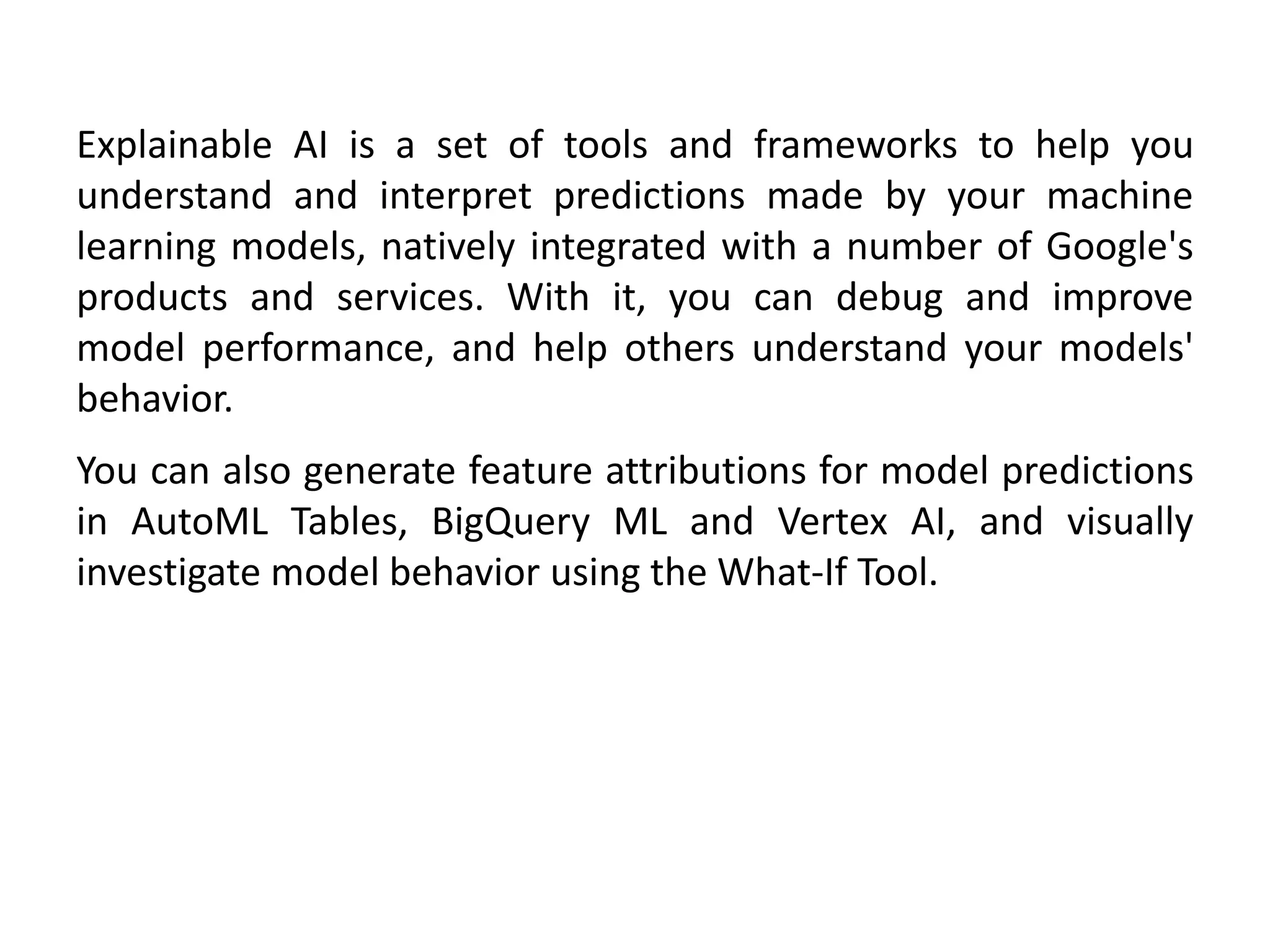
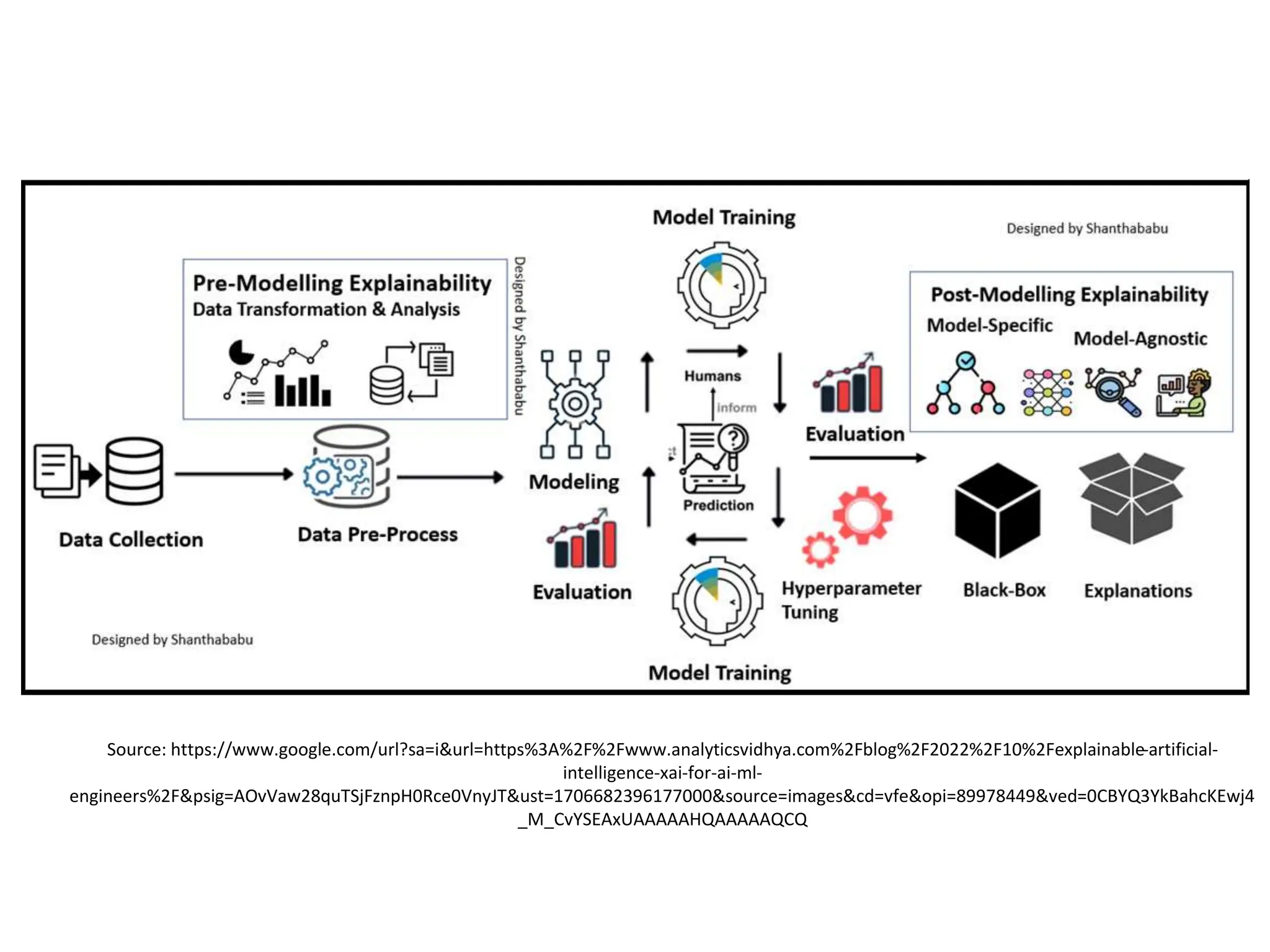
Explainable AI is a set of tools and frameworks to help you
understand and interpret predictions made by your machine
learning models, natively integrated with a number of Google's
products and services. With it, you can debug and improve
model performance, and help others understand your models'
behavior.
You can also generate feature attributions for model predictions
in AutoML Tables, BigQuery ML and Vertex AI, and visually
investigate model behavior using the What-If Tool.
Source: https://www.google.com/url?sa=i&url=https%3A%2F%2Fwww.analyticsvidhya.com%2Fblog%2F2022%2F10%2Fexplainable-artificial-
intelligence-xai-for-ai-ml-
engineers%2F&psig=AOvVaw28quTSjFznpH0Rce0VnyJT&ust=1706682396177000&source=images&cd=vfe&opi=89978449&ved=0CBYQ3YkBahcKEwj4
_M_CvYSEAxUAAAAAHQAAAAAQCQ
COMPUTER VISION
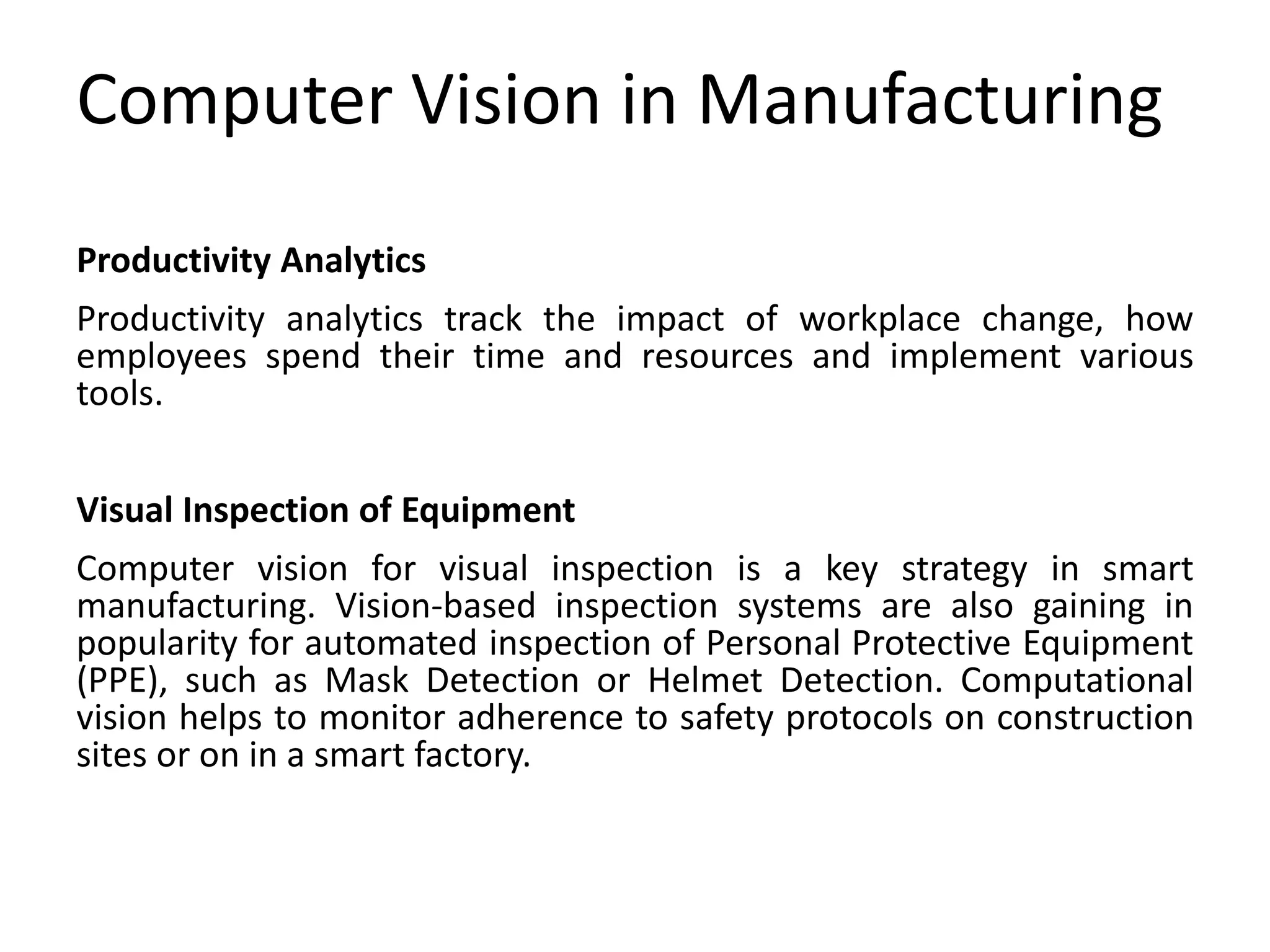
Computer Vision in Manufacturing
Productivity Analytics
Productivity analytics track the impact of workplace change, how
employees spend their time and resources and implement various
tools.
Visual Inspection of Equipment
Computer vision for visual inspection is a key strategy in smart
manufacturing. Vision-based inspection systems are also gaining in
popularity for automated inspection of Personal Protective Equipment
(PPE), such as Mask Detection or Helmet Detection. Computational
vision helps to monitor adherence to safety protocols on construction
sites or on in a smart factory.
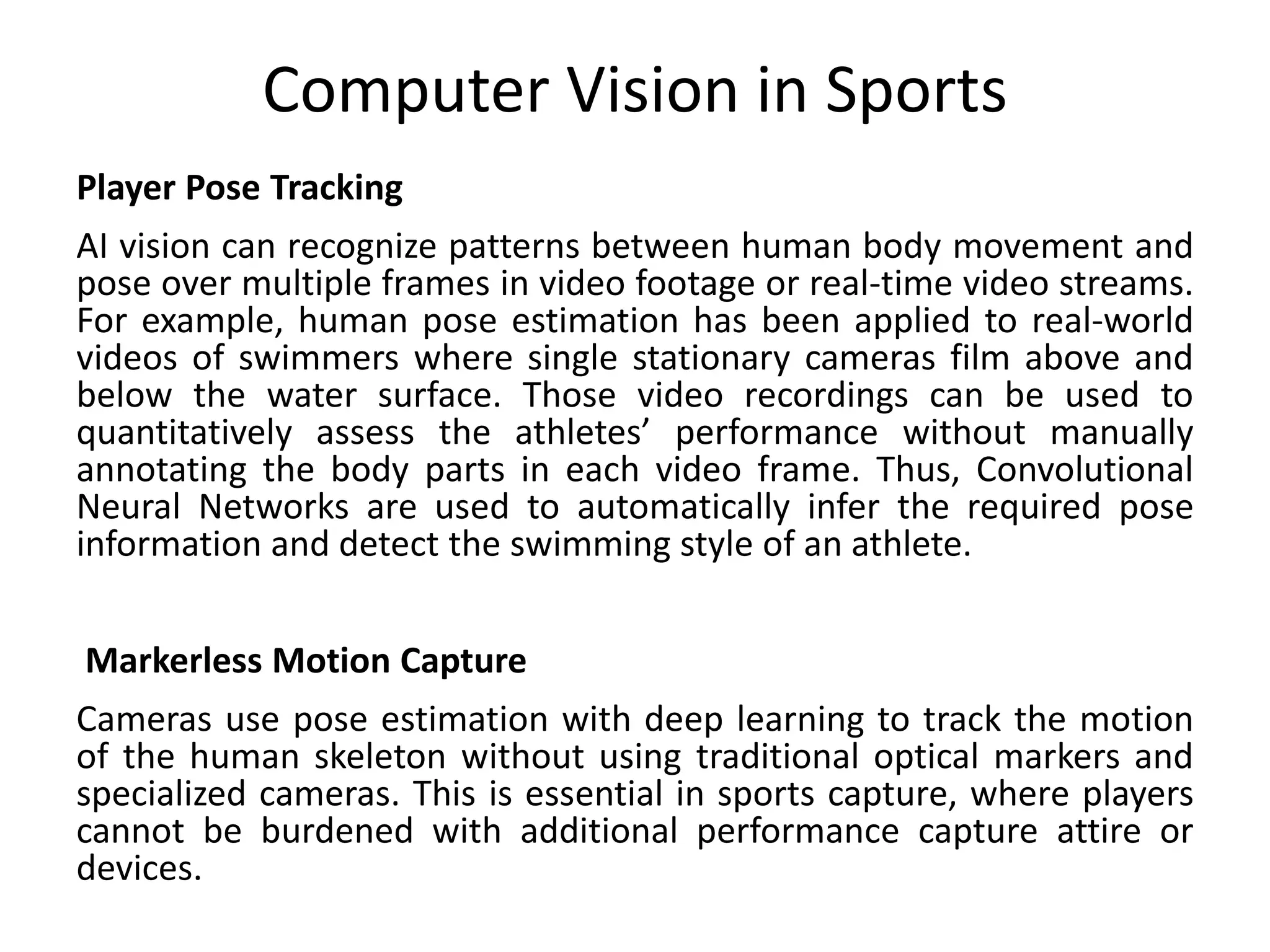
Computer Vision in Sports
Player Pose Tracking
AI vision can recognize patterns between human body movement and
pose over multiple frames in video footage or real-time video streams.
For example, human pose estimation has been applied to real-world
videos of swimmers where single stationary cameras film above and
below the water surface. Those video recordings can be used to
quantitatively assess the athletes’ performance without manually
annotating the body parts in each video frame. Thus, Convolutional
Neural Networks are used to automatically infer the required pose
information and detect the swimming style of an athlete.
Markerless Motion Capture
Cameras use pose estimation with deep learning to track the motion
of the human skeleton without using traditional optical markers and
specialized cameras. This is essential in sports capture, where players
cannot be burdened with additional performance capture attire or
devices.
21CB680
Artificial Intelligence Lab
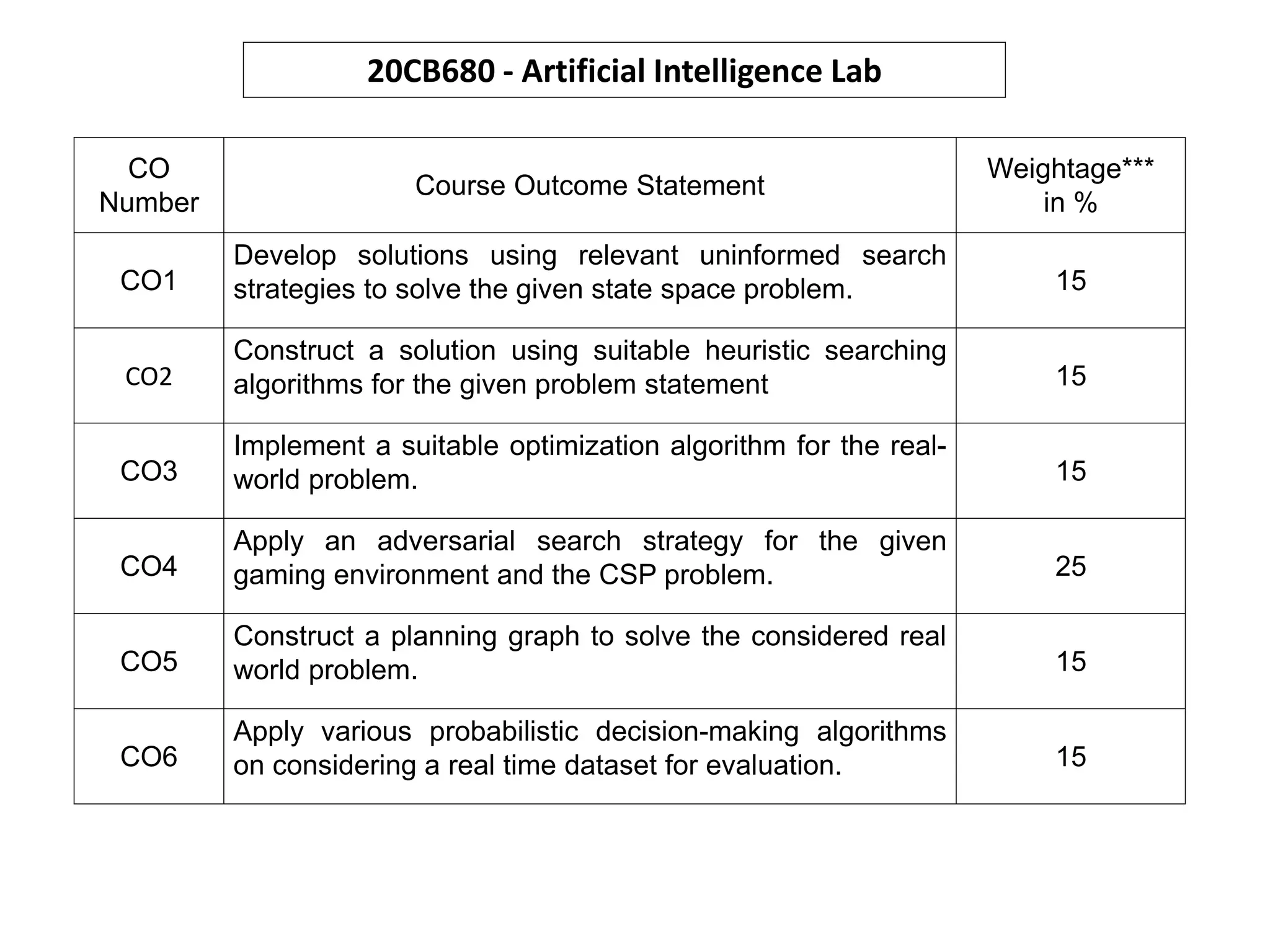
CO
Number
Course Outcome Statement
Weightage***
in %
CO1
Develop solutions using relevant uninformed search
strategies to solve the given state space problem. 15
CO2
Construct a solution using suitable heuristic searching
algorithms for the given problem statement 15
CO3
Implement a suitable optimization algorithm for the real-
world problem. 15
CO4
Apply an adversarial search strategy for the given
gaming environment and the CSP problem. 25
CO5
Construct a planning graph to solve the considered real
world problem. 15
CO6
Apply various probabilistic decision-making algorithms
on considering a real time dataset for evaluation. 15
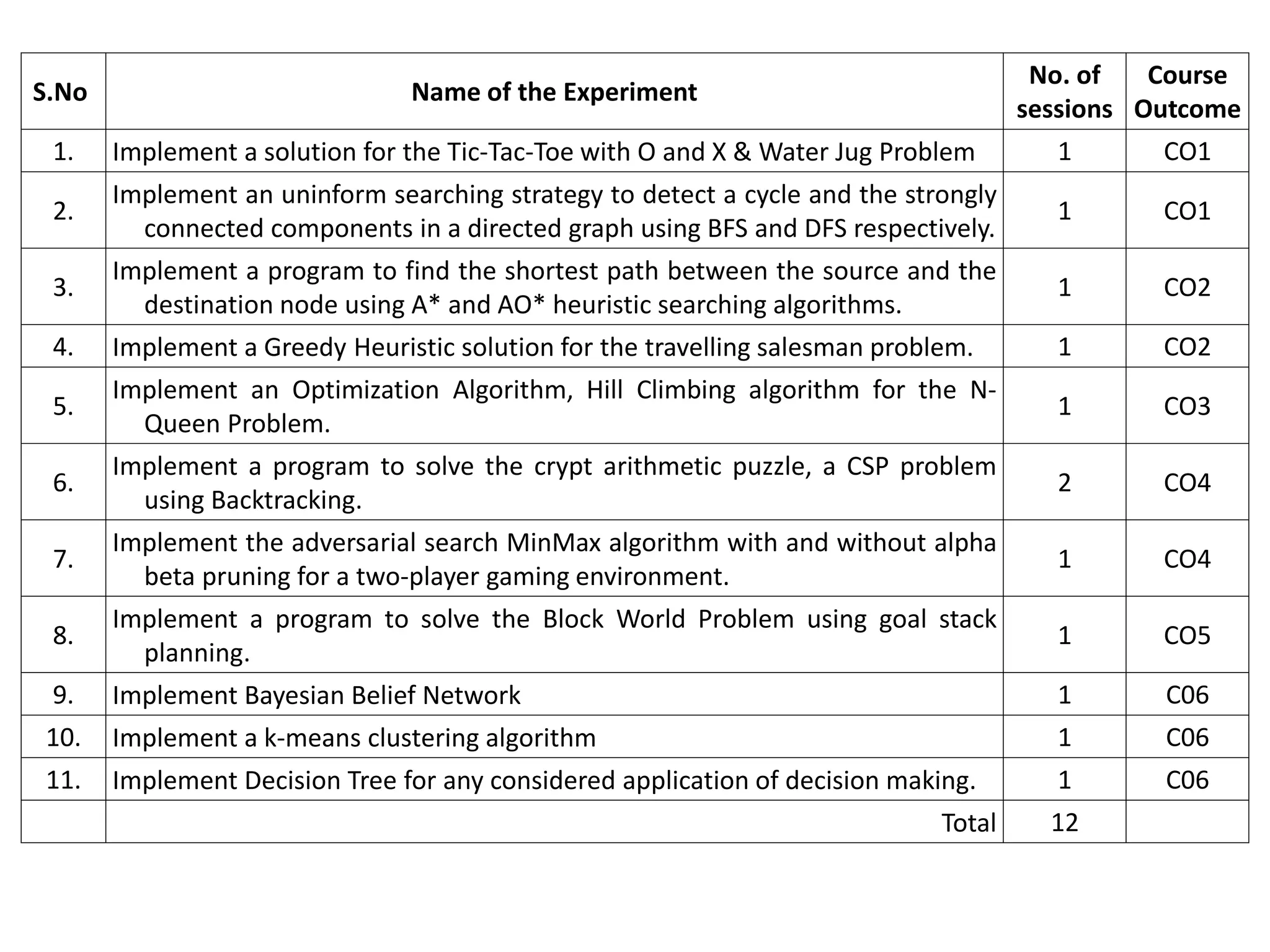
20CB680 - Artificial Intelligence Lab
S.No Name of the Experiment
No. of
sessions
Course
Outcome
1. Implement a solution for the Tic-Tac-Toe with O and X & Water Jug Problem 1 CO1
2.
Implement an uninform searching strategy to detect a cycle and the strongly
connected components in a directed graph using BFS and DFS respectively.
1 CO1
3.
Implement a program to find the shortest path between the source and the
destination node using A* and AO* heuristic searching algorithms.
1 CO2
4. Implement a Greedy Heuristic solution for the travelling salesman problem. 1 CO2
5.
Implement an Optimization Algorithm, Hill Climbing algorithm for the N-
Queen Problem.
1 CO3
6.
Implement a program to solve the crypt arithmetic puzzle, a CSP problem
using Backtracking.
2 CO4
7.
Implement the adversarial search MinMax algorithm with and without alpha
beta pruning for a two-player gaming environment.
1 CO4
8.
Implement a program to solve the Block World Problem using goal stack
planning.
1 CO5
9. Implement Bayesian Belief Network 1 C06
10. Implement a k-means clustering algorithm 1 C06
11. Implement Decision Tree for any considered application of decision making. 1 C06
Total 12
THANK YOU

Artificial Intelligence and its application

  • 1.
    CSBS FDP onArtificial Intelligence Dr. J. Felicia Lilian (Based on Slides by Prof. Mausam, NPTEL Stuart Russell, Peter Norvig) “the science and engineering of making intelligent machines”
  • 2.
    CO Number Course Outcome Statement Weightage*** in% CO1 Summarize different types of AI environments, transform a given real world problem to state space problem. 10 CO2 Apply the relevant uniform search algorithms and heuristics search strategies based on the given state space. 25 CO3 Implement the local search strategies to solve the given Constraint Satisfaction Problem. 10 CO4 Apply the suitable Adversarial search techniques for the given multi-agent environment. 15 CO5 Utilize propositional logics and probabilistic reasoning to apply knowledge representation for the given certain and uncertain problem respectively. 15 CO6 Construct plan graph using planning techniques for the given state space. 15 CO7 Explain the stages and issues in the development of an expert system. 10 COURSE OUTCOMES
  • 3.
    Syllabus Introduction, Overview ofArtificial intelligence: Problems of AI, AI technique, Tic - Tac - Toe problem. Intelligent Agents, Agents & environment, nature of environment, structure of agents, goal based agents, utility based agents, learning agents. Problem Solving: Defining the problem as state space search, production system, problem characteristics, issues in the design of search programs. Search techniques: Problem solving agents, searching for solutions; uniform search strategies: breadth first search, depth first search, depth limited search, bidirectional search, comparing uniform search strategies. Heuristic search strategies Greedy best-first search, A* search, AO* search, memory bounded heuristic search: local search algorithms & optimization problems: Hill climbing search, simulated annealing search, local beam search. Constraint satisfaction problems: Local search for constraint satisfaction problems. Adversarial search, Games, optimal decisions & strategies in games, the minimax search procedure, alpha-beta pruning, additional refinements, iterative deepening. Knowledge & reasoning: Knowledge representation issues, representation & mapping, approaches to knowledge representation. Predicate logic, representing simple fact in logic, representing instant & ISA relationship, computable functions & predicates, resolution, natural deduction. Representing knowledge using rules, Procedural verses declarative knowledge, logic programming, forward verses backward reasoning, matching, control knowledge. Probabilistic reasoning: Representing knowledge in an uncertain domain, the semantics of Bayesian networks, Dempster-Shafer theory, Planning Overview, components of a planning system, Goal stack planning, Hierarchical planning, other planning techniques. Expert Systems: Representing and using domain knowledge, expert system shells, and knowledge acquisition.
  • 4.
    TEXT BOOK: 1. StuartJ. Russell and Peter Norvig, “Artificial Intelligence: A Modern Approach” , 4th edition, Pearson, 2020. 2. Elaine Rich, Kevin Knight and Shivashankar B Nair, “Artificial Intelligence”, Third Edition, McGraw Hill Education India, 2010. NPTEL: https://onlinecourses.nptel.ac.in/noc23_cs05/preview - An Introduction to Artificial Intelligence - By Prof. Mausam | IIT Delhi
  • 5.
    AI and itsdependencies
  • 6.
  • 7.
    Foundation of AI Philosophy(428BC-present) • Can formal rules be used to draw valid conclusions? • How does the mental mind arise from a physical brain? • Where does knowledge come from? • How does knowledge lead to action? Mathematics (800 – present) • What are the formal rules to draw valid conclusions? • What can be computed? • How do we reason with uncertain information?
  • 8.
    Foundation of AI Economics(1776-present) • How should we make decisions so as to maximize payoff? • How should we do this when others may not go along? • How should we do this when the payoff may be far in the future? Neuroscience (1861-present) • How do brains process information? Psychology (1879-present) • How do humans and animals think and act? Linguistics (1957-present) • How does language relate to thought?
  • 9.
  • 10.
    1946: ENIAC heraldsthe dawn of Computing
  • 11.
    I propose toconsider the question: “Can machines think?” --Alan Turing, 1950 1950: Turing asks the question….
  • 12.
    1956: A newfield is born • Proposed that a 2 month, 10 man study of artificial intelligence be carried out during the summer of 1956 at Dartmouth College in Hanover, New Hampshire. • - Dartmouth AI Project Proposal; J. McCarthy et al.; Aug. 31, 1955. • John McCarthy (worked in chess – LISP), Allen Newell & Herbert Simon from Carnegie Tech (Theory for Theorems) and Marvin Minsky (MIT)
  • 17.
  • 18.
    1996: EQP provesthat Robbin’sAlgebras are all boolean [An Argonne lab program] has come up with a major mathematical proof that would have been called creative if a human had thought of it. -New York Times, December, 1996 ----- EQP 0.9, June 1996 ----- The job began on eyas09.mcs.anl.gov, Wed Oct 2 12:25:37 1996 UNIT CONFLICT from 17666 and 2 at 678232.20 seconds. PROOF 2 (wt=7) [] -(n(x + y) = n(x)). 3 (wt=13) [] n(n(n(x) + y) + n(x + y)) = y. 5 (wt=18) [para(3,3)] n(n(n(x + y) + n(x) + y) + y) = n(x + y). 6 (wt=19) [para(3,3)] n(n(n(n(x) + y) + x + y) + y) = n(n(x) + y). ……. 17666 (wt=33) [para(24,16426),demod([17547])] n(n(n(x) + x) ….
  • 19.
    1997: HAL 9000becomes operational in fictional Urbana, Illinois …by now, every intelligent person knew that H-A-L is derived from Heuristic ALgorithmic -Dr. Chandra, 2010: Odyssey Two HAL 9000 is a fictional artificial intelligence character HAL has been shown to be capable of speech, speech recognition, facial recognition, natural language processing, lip reading, art appreciation, interpreting emotional behaviours, automated reasoning, spacecraft piloting and playing chess
  • 20.
    1997: Deep Blueends Human Supremacy in Chess I could feel human-level intelligence across the room -Gary Kasparov, World Chess Champion (human) In a few years, even a single victory in a long series of games would be the triumph of human genius. vs.
  • 21.
    For two daysin May, 1999, an AI Program called Remote Agent autonomously ran Deep Space 1 (some 60,000,000 miles from earth) Real-time Execution Adaptive Control Hardware Scripted Executive Generative Planner & Scheduler Generative Mode Identification & Recovery Scripts Mission-level actions & resources component models ESL Monitors Goals 1999: Remote Agent takes Deep Space 1 on a galactic ride
  • 22.
  • 23.
    2005: Cars DriveThemselves • Stanley and three other cars drive themselves over a 132 mile mountain road • Highlander and Sandstorm https://www.youtube.com/watch?v=7a6GrKqOxeU
  • 24.
    2007: Robots Driveon Urban Roads 11 cars drove themselves on urban streets (for DARPA Urban Challenge) https://www.youtube.com/watch?v=aHYRtOvSx-M
  • 25.
    Recentmost Success 2011 IBM’sWATSON And Ken Jennings pledges respect to the new Computer Overlords..
  • 26.
  • 29.
    Europa Mission, 2018 NASAsent an lander to Europa, an icy moon of Jupiter
  • 30.
    RoboCup is aninternational scientific initiative with the goal to advance the state of the art of intelligent robots. When established in 1997, the original mission was to field a team of robots capable of winning against the human soccer World Cup champions by 2050
  • 35.
    AI Today • Autonomousplanning & Control • Scheduling • Game playing • Medical Diagnosis • Logistics Planning • Robotics • Language Understanding and Problem Solving • Text / Audio / Video Generations
  • 36.
    Science of AI •Physics: Where did the physical universe come from? • And what laws guide its dynamics? • Biology: How did biological life evolve? • And how do living organisms function? • AI: What is the nature of intelligent thought?
  • 37.
    What is intelligence? •Dictionary: capacity for learning, reasoning, understanding, and similar forms of mental activity • Ability to perceive and act in the world • Reasoning: proving theorems, medical diagnosis • Planning: take decisions • Learning and Adaptation: recommend and learn traffic patterns • Understanding: text, speech, visual scene
  • 38.
    What is artificialintelligence? thought vs. behavior human-like vs. rational “[automation of] activities that we associate with human thinking, activities such as decision making, problem solving, learning…” (Bellman 1978) “The study of mental abilities through the use of computational models” (Charniak & McDertmott 1985) “The study of how to make “The branch of computer computers to things at which, science that is concerned at the moment, people are with the automation of better” (Rich & Knight 1991) intelligent behavior” (Luger & Stubblefield 1993)
  • 39.
    What is artificialintelligence? Systems that think like humans Systems that think rationally Systems that act like humans Systems that act rationally human-like vs. rational thought vs. behavior
  • 40.
    Thinking Humanly • CognitiveScience – Very hard to understand how humans think • Post-facto rationalizations, irrationality of human thinking • Do we want a machine that beats humans in chess or a machine that thinks like humans while beating humans in chess? – Deep Blue supposedly DOESN’T think like humans.. • Thinking like humans important in applications – Intelligent tutoring – Expressing emotions in interfaces…
  • 41.
    Thinking Rationally: lawsof thought • what are correct arguments/thought processes? – Logic Ex: “Socrates is a man; All men are mortal; therefore Socrates is mortal.” • Problems – Not all intelligent behavior is mediated by logical deliberation (reflexes) – What is the purpose of thinking?
  • 42.
    Acting Humanly: Turing’sTest If the human cannot tell whether the responses from the other side of a wall are coming from a human or computer, then the computer is intelligent.
  • 43.
    Acting Humanly • LoebnerPrize competition is modern version of Turing Test – Every year in Boston – Expertise-dependent tests: limited conversation • What if people call a human a machine? – Make human-like errors • Problems – Not reproducible, constructive or mathematically analyzable The quest for ‘artificial flight’ succeeded when Wright brothers stopped imitating birds and learned about aerodynamics
  • 44.
    Acting rationally • Agent-> that acts, • under autonomous control, • perceiving their environment, • persisting over a period, • adapting to change and • capable of taking goals. • Rational Agent: doing the right thing • Need not always be deliberative – Reflexive • Aristotle • Every art and every inquiry, similarly Every action and every pursuit is thought to aim at some good.
  • 45.
    Acting  Thinking? •Weak AI Hypothesis vs. Strong AI hypothesis – Weak Hyp: machines could act as if they are intelligent – Strong Hyp: machines that act intelligent have to think intelligently too
  • 46.
    Rational Agent “For eachpossible percept sequence, a rational agent should select an action that is expected to maximize its performance measure, given the evidence provided by the percept sequence and whatever built-in knowledge the agent has.''
  • 47.
    Components of anAI System An agent perceives its environment through sensors and acts on the environment through actuators. Human: sensors are eyes, ears, actuators (effectors) are hands, legs, mouth. Robot: sensors are cameras, sonar, lasers, ladar, bump, effectors are grippers, manipulators, motors The agent’s behavior is described by its function that maps percept to action.
  • 48.
    PEAS • Use PEASto describe task – Performance measure – Environment – Actuators – Sensors
  • 49.
    Example: Taxi driver •Performance measure: safe, fast, comfortable (maximize profits) • Environment: roads, other traffic, pedestrians, customers • Actuators: steering, accelerator, brake, signal, horn • Sensors: cameras, sonar, speedometer, GPS, odometer, accelerometer, engine sensors
  • 50.
    Agent Performance Measure Environment Actuator Sensor Hospital Management System Patient’shealth, Admission process, Payment Hospital, Doctors, Patients Prescription, Diagnosis, Scan report Symptoms, Patient’s response Automated Car Drive The comfortable trip, Safety, Maximum Distance Roads, Traffic, Vehicles Steering wheel, Accelerator, Brake, Mirror Camera, GPS, Odometer Subject Tutoring Maximize scores, Improvement in marks- students Classroom, Desk, Chair, Board, Staff, Students Smart displays, Corrections Eyes, Ears, Notebooks Part-picking robot Percentage of parts in correct bins Conveyor belt with parts; bins Jointed arms and hand Camera, joint angle sensors Satellite image analysis system Correct image categorization Downlink from orbiting satellite Display categorization of scene Color pixel arrays
  • 51.
    Environment Examples Fully observablevs. partially observable Deterministic vs. stochastic / strategic Episodic vs. sequential Static vs. dynamic Discrete vs. continuous Single agent vs. multiagent Environment Observable Deterministic Episodic Static Discrete Agents Chess with a clock Fully Strategic Sequential Semi Discrete Multi Chess without a clock Fully Strategic Sequential Static Discrete Multi Poker Partial Strategic Sequential Static Discrete Multi Taxi driving Partial Stochastic Sequential Dynamic Continuous Multi Medical diagnosis Partial Stochastic Episodic Static Continuous Single Image analysis Fully Deterministic Episodic Semi Discrete Single Robot part picking Fully Deterministic Episodic Semi Discrete Single Interactive English tutor Partial Stochastic Sequential Dynamic Discrete Multi
  • 52.
    Types of Structureof Agents • Simple reflex agent • Model based reflex agent • Goal based reflex agent • Utility based agents • Learning agents
  • 53.
    Assignment - 1 Constructan agent – Mention the PEAS and structure of agent
  • 54.
    RECENT ADVANCEMENTS INAI Advanced topics
  • 56.
  • 57.
    Machine Learning • Machinelearning is so intricately a part of our daily lives that we sometimes don’t even know that we are relying on it. For instance, ask Alexa to save a playlist or tag your pictures automatically in your phone. There are so many other things that machines are doing day in and out. With time, machine learning has evolved to mimic human understanding. • Machine learning dates back to the pre-19th century. – In 1642, Blaise Pascal invented the mechanical machine to add, subtract, multiply, and divide. – In 1679, Gottfried Wilhelm Leibniz devised the system of binary code. • This is where it all started. Machine learning kept growing in leaps and bounds throughout the 19th, 20th, and 21st centuries.
  • 58.
    No-Code Machine Learning •No-code machine learning programs applications without the lengthy process of preprocessing, creating models, training, and deploying the models. It enables users to build their tools via a drag-and-drop interface instead of complicated coding. • Low-code and no-code technologies are emerging trends in machine learning, offering speed, flexibility, and saving time and cost. Platforms leveraging this new ML technology are DataRobot, Clarifai, and Teachable Machines, empowering them to operate without the need for an engineer or developer. • Example: Amazon SageMaker
  • 59.
    Tiny ML • IoTdominates the technology world. However, the large-scale ML use cases have limited use. As the saying goes, “Good things come in small packages”, TinyML also offers powerful solutions for smaller-scale applications. • A web request takes a long time to traverse and deliver data to a large server. To reduce latency, bandwidth, and power consumption and ensure user privacy, TinyML is applied on IoT edge devices for tracking and predicting the collected data.
  • 60.
    Automated Machine Learning •AutoML focuses on making the machine learning building process simple and accessible for developers without requiring much machine learning expertise. Every phase of machine learning and deep learning workflow is automated, from data reprocessing, defining data features, and modeling to building neural network data. • Automation reduces expenses enabling businesses to afford the AutoML analytical tools and technologies.

  • 61.
    Metaverses • Metaverses envisionedas part of the evolution of the internet in the Web 3.0 era are poised to become a significant phenomenon. These digital realms resemble alternate universes where individuals can engage in various activities, conduct business, generate income, and establish virtual lives. • AI bots, for example, will assist users in selecting services, while machine learning will contribute to creating immersive environments within these metaverses.
  • 62.
  • 63.
    Self-Driving Cars Deep Learningis used in self-driving vehicles to develop accurate models of the world surrounding the car to make driving judgments. A neural network is trained on an extensive collection of photos and driving data to produce these models. The neural network may then generalize from this data to anticipate what items are in a picture or what the automobile should perform in each circumstance. Tesla is a well-known example. Robotics Deep learning algorithms have been widely employed in robotics to enable robots to learn and improve their abilities autonomously. Deep-learning machines are capable of learning from data in the same way that humans do. It enables robots to enhance their task performance without requiring human involvement. Deep learning algorithms have been used to enable robots to travel in unfamiliar areas autonomously, identify and grip things, and communicate with humans.
  • 64.
    Deep Learning LatestApplications Natural Language Processing Deep Learning algorithms have transformed Natural Language Processing by automating the extraction of meaning from text. These algorithms have produced cutting-edge results on machine translation, question answering, and text categorization tasks. Healthcare Deep Learning is applied in a variety of sectors, including healthcare. Deep learning applications in healthcare can have a significant impact. Deep Learning is used in healthcare to create prediction models for various applications such as illness diagnosis, prognosis, and therapy recommendations. Deep Learning is also being applied to develop novel imaging techniques such as MRI and CT scan image reconstruction.
  • 65.
    Deep Learning LatestApplications Adding Sounds to Silent Movies Deep Learning may be used to add audio to silent films automatically. It is possible to accomplish this by training a deep neural network to map the visual elements of a video to the appropriate audio. An extensive collection of films with audio may be used to train the neural network. Once trained, the neural network may automatically add audio to any silent film. Fraud News Detection One of the deep learning applications in business is news aggregation, which uses deep Learning to detect and extract news content from websites automatically. It outperforms standard approaches such as keyword-based searches. Deep Learning has also been used to detect fake news. Because Deep Learning computers may learn to recognize data patterns that indicate fraudulent activities, deep Learning, for example, may be used to detect trends in financial data that indicate fraud.
  • 66.
    ARTIFICIAL INTELLIGENCE ININDIAN HEALTHCARE
  • 67.
    Artificial intelligence (AI)is rapidly transforming the healthcare industry in India, bringing unprecedented tools for diagnosis, treatment and patient care. AI expenditure in India is expected to reach $11.78 billion by 2025 and add $1 trillion to India’s economy by 2035, as per a World Economic Forum report. Healthcare AI systems can analyze patterns in a patient's medical history and current health data to predict potential health risks. This predictive capability enables healthcare providers to offer proactive, preventative care, ultimately leading to better patient outcomes and reduced healthcare costs. Image Source from: https://www.ncbi.nlm.nih.gov/pmc/articles/PMC7606883/
  • 68.
  • 69.
    Artificial intelligence (AI)in finance helps drive insights for data analytics, performance measurement, predictions and forecasting, real-time calculations, customer servicing, intelligent data retrieval, and more. It is a set of technologies that enables financial services organizations to better understand markets and customers, analyze and learn from digital journeys, and engage in a way that mimics human intelligence and interactions at scale. Predictive modeling Use data customer, risk, transaction, trading or other data insights to predict specific future outcomes with high degree of precision. These capabilities can be helpful in fraud detection, risk reduction, and customer future needs’ prediction. Cybersecurity Automate aspects of cybersecurity by continuously monitoring and analyzing network traffic to detect, prevent, and respond to cyberattacks and threats. Conversations Delight your customers with human-like AI-powered contact center experiences, such as banking concierge or customer center, to lower costs, and free up your human agents' time. Transform personal finance and give customers more ways to manage their money by bringing smart, intuitive experiences to your apps, websites, digital platforms, and virtual tools. Data science and analytics Access a complete suite of data management, analytics, and machine learning tools to generate insights and unlock value from data for business intelligence and decision making.
  • 70.
    Recommendations Deliver highly personalizedrecommendations for financial products and services, such as investment advice or banking offers, based on customer journeys, peer interactions, risk preferences, and financial goals. Translation Make your content, such as financial news, and apps multilingual with fast, dynamic machine translation at scale to enhance customer interactions and reach more audiences wherever they are. Document processing Extract structured and unstructured data from documents and analyze, search and store this data for document-extensive processes, such as loan servicing, and investment opportunity discovery. Image recognition Derive insights from images and videos to accelerate insurance claims processing by assessing damage to property such as real estate or vehicles, or expedite customer onboarding with KYC- compliant identity document verification. Conversations Delight your customers with human-like AI-powered contact center experiences, such as banking concierge or customer center, to lower costs, and free up your human agents' time. Transform personal finance and give customers more ways to manage their money by bringing smart, intuitive experiences to your apps, websites, digital platforms, and virtual tools.
  • 71.
  • 72.
    Generative AI impactsbusiness as it relates to content discovery, creation, authenticity and regulations. It also has the ability to automate human work, as well as customer and employee experiences. The critical technologies that fall into this category include the following: Artificial general intelligence (AGI) is the (currently hypothetical) intelligence of a machine that can accomplish any intellectual task that a human can perform. AI engineering is foundational for enterprise delivery of AI solutions at scale. The discipline creates coherent enterprise development, delivery, and operational AI-based systems. Autonomic systems are self-managing physical or software systems performing domain-bounded tasks that exhibit three fundamental characteristics: autonomy, learning and agency. Cloud AI services provide AI model building tools, APIs for prebuilt services and associated middleware that enable the building/training, deployment and consumption of machine learning (ML) models running on prebuilt infrastructure as cloud services. Composite AI refers to the combined application (or fusion) of different AI techniques to improve the efficiency of learning to broaden the level of knowledge representations. It solves a wider range of business problems in a more effective manner.

  • 73.
    Computer vision isa set of technologies that involves capturing, processing and analyzing real- world images and videos to extract meaningful, contextual information from the physical world. Data-centric AI is an approach that focuses on enhancing and enriching training data to drive better AI outcomes. Data-centric AI also addresses data quality, privacy and scalability. Edge AI refers to the use of AI techniques embedded in non-IT products, IoT endpoints, gateways and edge servers. It spans use cases for consumer, commercial and industrial applications, such as autonomous vehicles, enhanced capabilities of medical diagnostics and streaming video analytics. Intelligent applications utilize learned adaptation to respond autonomously to people and machines. Model operationalization (ModelOps) is primarily focused on the end-to-end governance and life cycle management of advanced analytics, AI and decision models. Operational AI systems (OAISys) enable orchestration, automation and scaling of production- ready and enterprise-grade AI, comprising ML, DNNs and Generative AI. Prompt engineering is the discipline of providing inputs, in the form of text or images, to generative AI models to specify and confine the set of responses the model can produce. Smart robots are AI-powered, often mobile, machines designed to autonomously execute one or more physical tasks. Synthetic data is a class of data that is artificially generated rather than obtained from direct observations of the real world.
  • 74.
  • 75.
    Explainable AI isa set of tools and frameworks to help you understand and interpret predictions made by your machine learning models, natively integrated with a number of Google's products and services. With it, you can debug and improve model performance, and help others understand your models' behavior. You can also generate feature attributions for model predictions in AutoML Tables, BigQuery ML and Vertex AI, and visually investigate model behavior using the What-If Tool.
  • 76.
  • 77.
  • 78.
    Computer Vision inManufacturing Productivity Analytics Productivity analytics track the impact of workplace change, how employees spend their time and resources and implement various tools. Visual Inspection of Equipment Computer vision for visual inspection is a key strategy in smart manufacturing. Vision-based inspection systems are also gaining in popularity for automated inspection of Personal Protective Equipment (PPE), such as Mask Detection or Helmet Detection. Computational vision helps to monitor adherence to safety protocols on construction sites or on in a smart factory.
  • 79.
    Computer Vision inSports Player Pose Tracking AI vision can recognize patterns between human body movement and pose over multiple frames in video footage or real-time video streams. For example, human pose estimation has been applied to real-world videos of swimmers where single stationary cameras film above and below the water surface. Those video recordings can be used to quantitatively assess the athletes’ performance without manually annotating the body parts in each video frame. Thus, Convolutional Neural Networks are used to automatically infer the required pose information and detect the swimming style of an athlete. Markerless Motion Capture Cameras use pose estimation with deep learning to track the motion of the human skeleton without using traditional optical markers and specialized cameras. This is essential in sports capture, where players cannot be burdened with additional performance capture attire or devices.
  • 80.
  • 81.
    CO Number Course Outcome Statement Weightage*** in% CO1 Develop solutions using relevant uninformed search strategies to solve the given state space problem. 15 CO2 Construct a solution using suitable heuristic searching algorithms for the given problem statement 15 CO3 Implement a suitable optimization algorithm for the real- world problem. 15 CO4 Apply an adversarial search strategy for the given gaming environment and the CSP problem. 25 CO5 Construct a planning graph to solve the considered real world problem. 15 CO6 Apply various probabilistic decision-making algorithms on considering a real time dataset for evaluation. 15 20CB680 - Artificial Intelligence Lab
  • 82.
    S.No Name ofthe Experiment No. of sessions Course Outcome 1. Implement a solution for the Tic-Tac-Toe with O and X & Water Jug Problem 1 CO1 2. Implement an uninform searching strategy to detect a cycle and the strongly connected components in a directed graph using BFS and DFS respectively. 1 CO1 3. Implement a program to find the shortest path between the source and the destination node using A* and AO* heuristic searching algorithms. 1 CO2 4. Implement a Greedy Heuristic solution for the travelling salesman problem. 1 CO2 5. Implement an Optimization Algorithm, Hill Climbing algorithm for the N- Queen Problem. 1 CO3 6. Implement a program to solve the crypt arithmetic puzzle, a CSP problem using Backtracking. 2 CO4 7. Implement the adversarial search MinMax algorithm with and without alpha beta pruning for a two-player gaming environment. 1 CO4 8. Implement a program to solve the Block World Problem using goal stack planning. 1 CO5 9. Implement Bayesian Belief Network 1 C06 10. Implement a k-means clustering algorithm 1 C06 11. Implement Decision Tree for any considered application of decision making. 1 C06 Total 12
  • 83.