George F Luger
ARTIFICIAL INTELLIGENCE 5th edition
Structures and Strategies for Complex Problem Solving
Artificial Intelligence:
Its Roots and Scope
Luger: Artificial Intelligence, 5th
edition. © Pearson Education Limited, 2005
1.1 From Eden to ENIAC: Attitudes
toward intelligence, Knowledge, and Human
Artifice
1.2 Overview of AI Application Areas
1.3 Artificial Intelligence – A Summary
1.4 Epilogue and References
1.5 Exercises
1
Definition of AI
– intelligent: Ability to solve a problem and ability to
memorise and access the information.
• AI: The branch of computer science that is
concerned with the automation of intelligent
behaviour.
• AI: The collection of problems and
methodologies studied by artificial intelligence
researchers.
2
Questions
• What is intelligence?
• Is intelligence a single faculty or a collection of distinct and
unrelated abilities?
• What is creativity?
• Can intelligence observed from behaviour or does it require
evidence from an internal mechanism.
• How knowledge is represented in the nerve tissue or living being?
• Can computers be intelligent or does intelligence require the
richness of sensation and experience of biological existence?
• What does happen when learning occurs?
3
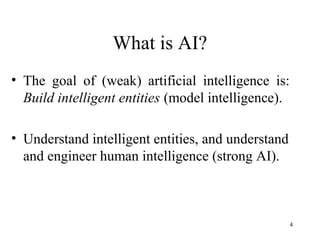
What is AI?
• The goal of (weak) artificial intelligence is:
Build intelligent entities (model intelligence).
• Understand intelligent entities, and understand
and engineer human intelligence (strong AI).
4
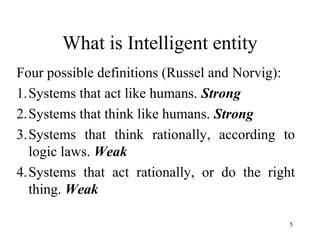
What is Intelligent entity
Four possible definitions (Russel and Norvig):
1.Systems that act like humans. Strong
2.Systems that think like humans. Strong
3.Systems that think rationally, according to
logic laws. Weak
4.Systems that act rationally, or do the right
thing. Weak
5
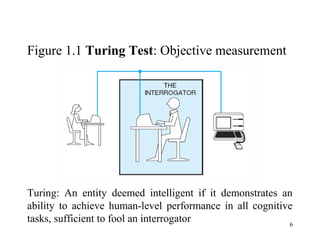
Figure 1.1 Turing Test: Objective measurement
Turing: An entity deemed intelligent if it demonstrates an
ability to achieve human-level performance in all cognitive
tasks, sufficient to fool an interrogator 6
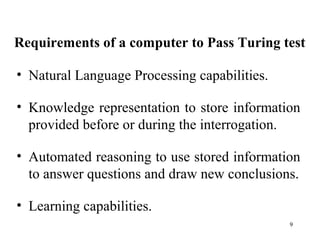
Requirements of a computer to Pass Turing test
• Natural Language Processing capabilities.
• Knowledge representation to store information
provided before or during the interrogation.
• Automated reasoning to use stored information
to answer questions and draw new conclusions.
• Learning capabilities.
9
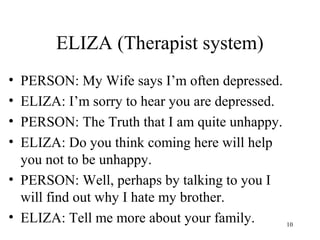
ELIZA (Therapist system)
• PERSON: My Wife says I’m often depressed.
• ELIZA: I’m sorry to hear you are depressed.
• PERSON: The Truth that I am quite unhappy.
• ELIZA: Do you think coming here will help
you not to be unhappy.
• PERSON: Well, perhaps by talking to you I
will find out why I hate my brother.
• ELIZA: Tell me more about your family. 10
Eliza
• ELIZA failed Turing test !
11
1.1.5 Biological and Social Models of Intelligence: Agents Theories
So far, we have approached the problem of building intelligent machines from the viewpoint of
mathematics, with the implicit belief of logical reasoning as paradigmatic of intelligence
itself, as well as with a commitment to “objective” foundations for logical reasoning. It also
reflects the underlying assumptions of the Turing test, particularly its emphasis on symbolic
reasoning as a test of intelligence, and the belief that a straightforward comparison with
human behavior was adequate to confirming machine intelligence.
The reliance on logic as a way of representing knowledge and on logical inference as the
primary mechanism for intelligent reasoning are so dominant in Western philosophy that
their “truth” often seems obvious and unassailable. It is no surprise, then, that approaches
based on these assumptions have dominated the science of artificial intelligence from its
inception almost through to the present day.
The latter half of the twentieth century has, however, seen numerous challenges to rationalist
philosophy. Various forms of philosophical relativism question the objective basis of
language, science, society, and thought itself. Ludwig Wittgenstein's later philosophy
(Wittgenstein 1953), has forced us to reconsider the basis on meaning in both natural and
formal languages. The work of Godel (1958) and Turing has cast doubt on the very
foundations of mathematics itself. Post-modern thought has changed our understanding of
meaning and value in the arts and society. Artificial intelligence has not been immune to
these criticisms; indeed, the difficulties that AI has encountered in achieving its goals are
often taken as evidence of the failure of the rationalist viewpoint .
12
Eliza
• ELIZA failed Turing test !
13
Specific Area
• It is difficult to learn everything, intelligent
entities should concentrate on a specific
domain.
• We need a domain expert
14
Important Research and Application Areas
1.2.1 Game Playing
1.2.2 Automated Reasoning and Theorem Proving
1.2.3 Expert Systems
1.2.4 Natural Language Understanding and Semantic Modeling
1.2.5 Modeling Human Performance
1.2.6 Planning and Robotics
1.2.7 Languages and Environments for AI
1.2.8 Machine Learning
1.2.9 Alternative Representations: Neural Nets and Genetic Algorithms
1.2.10 AI and Philosophy
Other areas
15
Important Research and Application Areas (Continued)
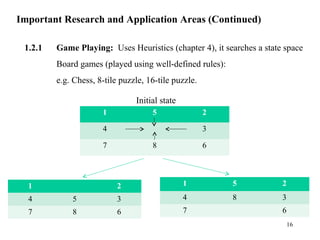
1.2.1 Game Playing: Uses Heuristics (chapter 4), it searches a state space
Board games (played using well-defined rules):
e.g. Chess, 8-tile puzzle, 16-tile puzzle.
1 5 2
4 3
7 8 6
Initial state
1 2
4 5 3
7 8 6
1 5 2
4 8 3
7 6
16
Important Research and Application Areas (Continued)
1.2.2 Automated Reasoning and Theorem Proving (more in Chapter 13)
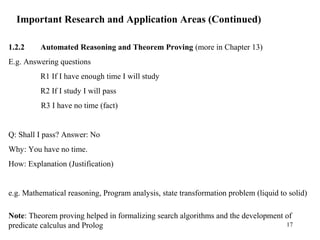
E.g. Answering questions
R1 If I have enough time I will study
R2 If I study I will pass
R3 I have no time (fact)
Q: Shall I pass? Answer: No
Why: You have no time.
How: Explanation (Justification)
e.g. Mathematical reasoning, Program analysis, state transformation problem (liquid to solid)
Note: Theorem proving helped in formalizing search algorithms and the development of
predicate calculus and Prolog 17
Important Research and Application Areas (Continued)
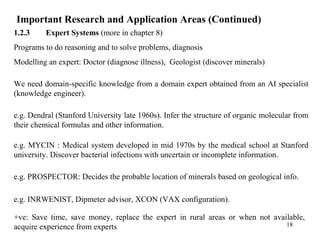
1.2.3 Expert Systems (more in chapter 8)
Programs to do reasoning and to solve problems, diagnosis
Modelling an expert: Doctor (diagnose illness), Geologist (discover minerals)
We need domain-specific knowledge from a domain expert obtained from an AI specialist
(knowledge engineer).
e.g. Dendral (Stanford University late 1960s). Infer the structure of organic molecular from
their chemical formulas and other information.
e.g. MYCIN : Medical system developed in mid 1970s by the medical school at Stanford
university. Discover bacterial infections with uncertain or incomplete information.
e.g. PROSPECTOR: Decides the probable location of minerals based on geological info.
e.g. INRWENIST, Dipmeter advisor, XCON (VAX configuration).
+ve: Save time, save money, replace the expert in rural areas or when not available,
acquire experience from experts 18
Important Research and Application Areas (Continued)
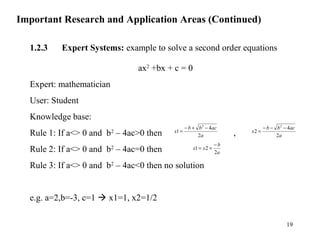
1.2.3 Expert Systems: example to solve a second order equations
ax2
+bx + c = 0
Expert: mathematician
User: Student
Knowledge base:
Rule 1: If a<> 0 and b2
– 4ac>0 then ,
Rule 2: If a<> 0 and b2
– 4ac=0 then
Rule 3: If a<> 0 and b2
– 4ac<0 then no solution
e.g. a=2,b=-3, c=1  x1=1, x2=1/2
a
acbb
x
2
4
1
2
−+−
=
a
acbb
x
2
4
2
2
−−−
=
a
b
xx
2
21
−
==
19
Important Research and Application Areas (Continued)
1.2.3 Deficiencies of Expert Systems
1.Difficulty in obtaining deep knowledge
2.Lack of robustness and flexibility: Lack the ability of going around the problem.
3.Inability to provide deep explanation
4.Difficulty in verification.
5.Little learning from experience.
20
Important Research and Application Areas (Continued)
1.2.4 Natural Language Understanding and Semantic Modelling
(more in chapters 7, 14)
Programs capable of understanding and generating human language.
It is part of human intelligence.
1.2.5 Modelling Human Performance (more in chapter 17)
Design of systems explicitly model the organization of the human mind
21
Important Research and Application Areas (Continued)
1.2.6 Planning and Robotics
Breaking the problem into smaller parts.
e.g. Going from Amman to Cairo
Go to Amman Airport through either taxi or bus
Go from Amman airport to Cairo airport using either Royal Jordanian plan
or Egypt airways
Going to a hotel from Cairo airport through either a taxi or a shuttle bus.
22
Important Research and Application Areas (Continued)
1.2.7 Languages and Environments for AI (LISP, Prolog) (more in
chapters 15 and 16)
Prolog: Programmation en Logique (Logic Programming).
Alain Colmerauer 1973
LISP: List Programming.
Programming languages to help programming AI applications.
Characteristics of such languages:
Knowledge representation
Search (e.g. Unification technique) 23
Important Research and Application Areas (Continued)
1.2.7 Languages and Environments for AI (LISP, Prolog) (more in
chapters 15 and 16)
Programming environments include knowledge-structuring techniques such as
object-oriented programming. High-level languages, such as Lisp and Prolog,
which support modular development, help manage program size and
complexity. Trace packages allow a programmer to reconstruct the execution of
a complex algorithm and make it possible to unravel the complexities of
heuristic search. Without such tools and techniques, it is doubtful that many
significant AI systems could have been built.
Many of these techniques are now standard tools for software engineering and
have little relationship to the core of AI theory. Others, such as object-oriented
programming, are of significant theoretical and practical interest. Finally, many
AI algorithms are also now built in more traditional computing languages, such
as C++ and Java.
The languages developed for artificial intelligence programming are intimately
bound to the theoretical structure of the field. We have built many of the
representational structures presneted in this book in Prolog, Lisp and Java and
make them available in Luger
24
Important Research and Application Areas (Continued)
1.2.8 Machine Learning: (more in chapters 11 and 12)
Learning from previous experience
Expert system performs the same computations once and once again without
remembering the solution it reached the first time.
Solution: Programs learn on their own from experience, analogy, examples
or by being “told” what to do.
e.g. Techniques: Case Based Reasoning (CBR), Instance-Based Learning
(IBL), exampler-based learning, ID3 trees.
e.g. Systems: Automated Mathematician, meta-DENDRAL, Teiresias,
25
Important Research and Application Areas (Continued)
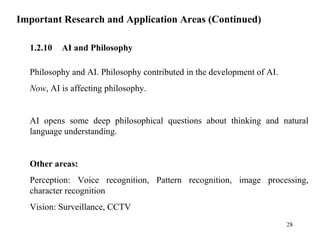
1.2.9 Alternative Representations: Neural Nets and Genetic
Algorithms
Alternative: Knowledge is not represented explicitly.
Artificial Neural Networks: Parallel Distributed Processing.
Genetic Algorithms: Natural selection and evolution.
Fuzzy Logic: Things are not black and white, there is a grey too.
MATLAB®
: ANNs, GAs, Fuzzy Logic toolboxes.
26
A simple Neuron (Crick and Asanuma, 1986)
AxonSynapse
Dendrite
Cell Body
27
Important Research and Application Areas (Continued)
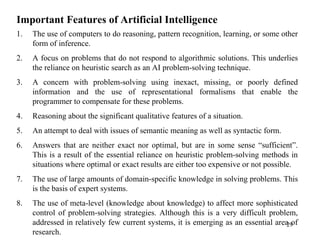
1.2.10 AI and Philosophy
Philosophy and AI. Philosophy contributed in the development of AI.
Now, AI is affecting philosophy.
AI opens some deep philosophical questions about thinking and natural
language understanding.
Other areas:
Perception: Voice recognition, Pattern recognition, image processing,
character recognition
Vision: Surveillance, CCTV
28
Important Features of Artificial Intelligence
1. The use of computers to do reasoning, pattern recognition, learning, or some other
form of inference.
2. A focus on problems that do not respond to algorithmic solutions. This underlies
the reliance on heuristic search as an AI problem-solving technique.
3. A concern with problem-solving using inexact, missing, or poorly defined
information and the use of representational formalisms that enable the
programmer to compensate for these problems.
4. Reasoning about the significant qualitative features of a situation.
5. An attempt to deal with issues of semantic meaning as well as syntactic form.
6. Answers that are neither exact nor optimal, but are in some sense “sufficient”.
This is a result of the essential reliance on heuristic problem-solving methods in
situations where optimal or exact results are either too expensive or not possible.
7. The use of large amounts of domain-specific knowledge in solving problems. This
is the basis of expert systems.
8. The use of meta-level (knowledge about knowledge) to affect more sophisticated
control of problem-solving strategies. Although this is a very difficult problem,
addressed in relatively few current systems, it is emerging as an essential area of
research.
29
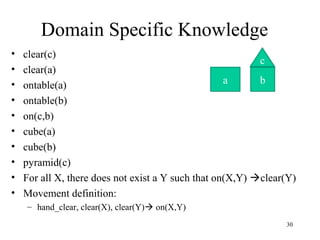
Domain Specific Knowledge
• clear(c)
• clear(a)
• ontable(a)
• ontable(b)
• on(c,b)
• cube(a)
• cube(b)
• pyramid(c)
• For all X, there does not exist a Y such that on(X,Y) clear(Y)
• Movement definition:
– hand_clear, clear(X), clear(Y) on(X,Y)
a b
c
30
Features of AI Programs
• Knowledge representation:
– Knowledge is represented explicitly in AI using knowledge
representation language e.g. Prolog.
– Knowledge acquisition methods such as Machine Learning.
• Search Algorithm.
• Use heuristics: may reach a suboptimal solution.
• Symbolic Reasoning such as LISP and Prolog.
31

AI chap1

  • 1.
    George F Luger ARTIFICIALINTELLIGENCE 5th edition Structures and Strategies for Complex Problem Solving Artificial Intelligence: Its Roots and Scope Luger: Artificial Intelligence, 5th edition. © Pearson Education Limited, 2005 1.1 From Eden to ENIAC: Attitudes toward intelligence, Knowledge, and Human Artifice 1.2 Overview of AI Application Areas 1.3 Artificial Intelligence – A Summary 1.4 Epilogue and References 1.5 Exercises 1
  • 2.
    Definition of AI –intelligent: Ability to solve a problem and ability to memorise and access the information. • AI: The branch of computer science that is concerned with the automation of intelligent behaviour. • AI: The collection of problems and methodologies studied by artificial intelligence researchers. 2
  • 3.
    Questions • What isintelligence? • Is intelligence a single faculty or a collection of distinct and unrelated abilities? • What is creativity? • Can intelligence observed from behaviour or does it require evidence from an internal mechanism. • How knowledge is represented in the nerve tissue or living being? • Can computers be intelligent or does intelligence require the richness of sensation and experience of biological existence? • What does happen when learning occurs? 3
  • 4.
    What is AI? •The goal of (weak) artificial intelligence is: Build intelligent entities (model intelligence). • Understand intelligent entities, and understand and engineer human intelligence (strong AI). 4
  • 5.
    What is Intelligententity Four possible definitions (Russel and Norvig): 1.Systems that act like humans. Strong 2.Systems that think like humans. Strong 3.Systems that think rationally, according to logic laws. Weak 4.Systems that act rationally, or do the right thing. Weak 5
  • 6.
    Figure 1.1 TuringTest: Objective measurement Turing: An entity deemed intelligent if it demonstrates an ability to achieve human-level performance in all cognitive tasks, sufficient to fool an interrogator 6
  • 7.
    Requirements of acomputer to Pass Turing test • Natural Language Processing capabilities. • Knowledge representation to store information provided before or during the interrogation. • Automated reasoning to use stored information to answer questions and draw new conclusions. • Learning capabilities. 9
  • 8.
    ELIZA (Therapist system) •PERSON: My Wife says I’m often depressed. • ELIZA: I’m sorry to hear you are depressed. • PERSON: The Truth that I am quite unhappy. • ELIZA: Do you think coming here will help you not to be unhappy. • PERSON: Well, perhaps by talking to you I will find out why I hate my brother. • ELIZA: Tell me more about your family. 10
  • 9.
    Eliza • ELIZA failedTuring test ! 11
  • 10.
    1.1.5 Biological andSocial Models of Intelligence: Agents Theories So far, we have approached the problem of building intelligent machines from the viewpoint of mathematics, with the implicit belief of logical reasoning as paradigmatic of intelligence itself, as well as with a commitment to “objective” foundations for logical reasoning. It also reflects the underlying assumptions of the Turing test, particularly its emphasis on symbolic reasoning as a test of intelligence, and the belief that a straightforward comparison with human behavior was adequate to confirming machine intelligence. The reliance on logic as a way of representing knowledge and on logical inference as the primary mechanism for intelligent reasoning are so dominant in Western philosophy that their “truth” often seems obvious and unassailable. It is no surprise, then, that approaches based on these assumptions have dominated the science of artificial intelligence from its inception almost through to the present day. The latter half of the twentieth century has, however, seen numerous challenges to rationalist philosophy. Various forms of philosophical relativism question the objective basis of language, science, society, and thought itself. Ludwig Wittgenstein's later philosophy (Wittgenstein 1953), has forced us to reconsider the basis on meaning in both natural and formal languages. The work of Godel (1958) and Turing has cast doubt on the very foundations of mathematics itself. Post-modern thought has changed our understanding of meaning and value in the arts and society. Artificial intelligence has not been immune to these criticisms; indeed, the difficulties that AI has encountered in achieving its goals are often taken as evidence of the failure of the rationalist viewpoint . 12
  • 11.
    Eliza • ELIZA failedTuring test ! 13
  • 12.
    Specific Area • Itis difficult to learn everything, intelligent entities should concentrate on a specific domain. • We need a domain expert 14
  • 13.
    Important Research andApplication Areas 1.2.1 Game Playing 1.2.2 Automated Reasoning and Theorem Proving 1.2.3 Expert Systems 1.2.4 Natural Language Understanding and Semantic Modeling 1.2.5 Modeling Human Performance 1.2.6 Planning and Robotics 1.2.7 Languages and Environments for AI 1.2.8 Machine Learning 1.2.9 Alternative Representations: Neural Nets and Genetic Algorithms 1.2.10 AI and Philosophy Other areas 15
  • 14.
    Important Research andApplication Areas (Continued) 1.2.1 Game Playing: Uses Heuristics (chapter 4), it searches a state space Board games (played using well-defined rules): e.g. Chess, 8-tile puzzle, 16-tile puzzle. 1 5 2 4 3 7 8 6 Initial state 1 2 4 5 3 7 8 6 1 5 2 4 8 3 7 6 16
  • 15.
    Important Research andApplication Areas (Continued) 1.2.2 Automated Reasoning and Theorem Proving (more in Chapter 13) E.g. Answering questions R1 If I have enough time I will study R2 If I study I will pass R3 I have no time (fact) Q: Shall I pass? Answer: No Why: You have no time. How: Explanation (Justification) e.g. Mathematical reasoning, Program analysis, state transformation problem (liquid to solid) Note: Theorem proving helped in formalizing search algorithms and the development of predicate calculus and Prolog 17
  • 16.
    Important Research andApplication Areas (Continued) 1.2.3 Expert Systems (more in chapter 8) Programs to do reasoning and to solve problems, diagnosis Modelling an expert: Doctor (diagnose illness), Geologist (discover minerals) We need domain-specific knowledge from a domain expert obtained from an AI specialist (knowledge engineer). e.g. Dendral (Stanford University late 1960s). Infer the structure of organic molecular from their chemical formulas and other information. e.g. MYCIN : Medical system developed in mid 1970s by the medical school at Stanford university. Discover bacterial infections with uncertain or incomplete information. e.g. PROSPECTOR: Decides the probable location of minerals based on geological info. e.g. INRWENIST, Dipmeter advisor, XCON (VAX configuration). +ve: Save time, save money, replace the expert in rural areas or when not available, acquire experience from experts 18
  • 17.
    Important Research andApplication Areas (Continued) 1.2.3 Expert Systems: example to solve a second order equations ax2 +bx + c = 0 Expert: mathematician User: Student Knowledge base: Rule 1: If a<> 0 and b2 – 4ac>0 then , Rule 2: If a<> 0 and b2 – 4ac=0 then Rule 3: If a<> 0 and b2 – 4ac<0 then no solution e.g. a=2,b=-3, c=1  x1=1, x2=1/2 a acbb x 2 4 1 2 −+− = a acbb x 2 4 2 2 −−− = a b xx 2 21 − == 19
  • 18.
    Important Research andApplication Areas (Continued) 1.2.3 Deficiencies of Expert Systems 1.Difficulty in obtaining deep knowledge 2.Lack of robustness and flexibility: Lack the ability of going around the problem. 3.Inability to provide deep explanation 4.Difficulty in verification. 5.Little learning from experience. 20
  • 19.
    Important Research andApplication Areas (Continued) 1.2.4 Natural Language Understanding and Semantic Modelling (more in chapters 7, 14) Programs capable of understanding and generating human language. It is part of human intelligence. 1.2.5 Modelling Human Performance (more in chapter 17) Design of systems explicitly model the organization of the human mind 21
  • 20.
    Important Research andApplication Areas (Continued) 1.2.6 Planning and Robotics Breaking the problem into smaller parts. e.g. Going from Amman to Cairo Go to Amman Airport through either taxi or bus Go from Amman airport to Cairo airport using either Royal Jordanian plan or Egypt airways Going to a hotel from Cairo airport through either a taxi or a shuttle bus. 22
  • 21.
    Important Research andApplication Areas (Continued) 1.2.7 Languages and Environments for AI (LISP, Prolog) (more in chapters 15 and 16) Prolog: Programmation en Logique (Logic Programming). Alain Colmerauer 1973 LISP: List Programming. Programming languages to help programming AI applications. Characteristics of such languages: Knowledge representation Search (e.g. Unification technique) 23
  • 22.
    Important Research andApplication Areas (Continued) 1.2.7 Languages and Environments for AI (LISP, Prolog) (more in chapters 15 and 16) Programming environments include knowledge-structuring techniques such as object-oriented programming. High-level languages, such as Lisp and Prolog, which support modular development, help manage program size and complexity. Trace packages allow a programmer to reconstruct the execution of a complex algorithm and make it possible to unravel the complexities of heuristic search. Without such tools and techniques, it is doubtful that many significant AI systems could have been built. Many of these techniques are now standard tools for software engineering and have little relationship to the core of AI theory. Others, such as object-oriented programming, are of significant theoretical and practical interest. Finally, many AI algorithms are also now built in more traditional computing languages, such as C++ and Java. The languages developed for artificial intelligence programming are intimately bound to the theoretical structure of the field. We have built many of the representational structures presneted in this book in Prolog, Lisp and Java and make them available in Luger 24
  • 23.
    Important Research andApplication Areas (Continued) 1.2.8 Machine Learning: (more in chapters 11 and 12) Learning from previous experience Expert system performs the same computations once and once again without remembering the solution it reached the first time. Solution: Programs learn on their own from experience, analogy, examples or by being “told” what to do. e.g. Techniques: Case Based Reasoning (CBR), Instance-Based Learning (IBL), exampler-based learning, ID3 trees. e.g. Systems: Automated Mathematician, meta-DENDRAL, Teiresias, 25
  • 24.
    Important Research andApplication Areas (Continued) 1.2.9 Alternative Representations: Neural Nets and Genetic Algorithms Alternative: Knowledge is not represented explicitly. Artificial Neural Networks: Parallel Distributed Processing. Genetic Algorithms: Natural selection and evolution. Fuzzy Logic: Things are not black and white, there is a grey too. MATLAB® : ANNs, GAs, Fuzzy Logic toolboxes. 26
  • 25.
    A simple Neuron(Crick and Asanuma, 1986) AxonSynapse Dendrite Cell Body 27
  • 26.
    Important Research andApplication Areas (Continued) 1.2.10 AI and Philosophy Philosophy and AI. Philosophy contributed in the development of AI. Now, AI is affecting philosophy. AI opens some deep philosophical questions about thinking and natural language understanding. Other areas: Perception: Voice recognition, Pattern recognition, image processing, character recognition Vision: Surveillance, CCTV 28
  • 27.
    Important Features ofArtificial Intelligence 1. The use of computers to do reasoning, pattern recognition, learning, or some other form of inference. 2. A focus on problems that do not respond to algorithmic solutions. This underlies the reliance on heuristic search as an AI problem-solving technique. 3. A concern with problem-solving using inexact, missing, or poorly defined information and the use of representational formalisms that enable the programmer to compensate for these problems. 4. Reasoning about the significant qualitative features of a situation. 5. An attempt to deal with issues of semantic meaning as well as syntactic form. 6. Answers that are neither exact nor optimal, but are in some sense “sufficient”. This is a result of the essential reliance on heuristic problem-solving methods in situations where optimal or exact results are either too expensive or not possible. 7. The use of large amounts of domain-specific knowledge in solving problems. This is the basis of expert systems. 8. The use of meta-level (knowledge about knowledge) to affect more sophisticated control of problem-solving strategies. Although this is a very difficult problem, addressed in relatively few current systems, it is emerging as an essential area of research. 29
  • 28.
    Domain Specific Knowledge •clear(c) • clear(a) • ontable(a) • ontable(b) • on(c,b) • cube(a) • cube(b) • pyramid(c) • For all X, there does not exist a Y such that on(X,Y) clear(Y) • Movement definition: – hand_clear, clear(X), clear(Y) on(X,Y) a b c 30
  • 29.
    Features of AIPrograms • Knowledge representation: – Knowledge is represented explicitly in AI using knowledge representation language e.g. Prolog. – Knowledge acquisition methods such as Machine Learning. • Search Algorithm. • Use heuristics: may reach a suboptimal solution. • Symbolic Reasoning such as LISP and Prolog. 31

Editor's Notes

  • #2 OWEN: Insert chapter number