ARTIFICIAL
INTELLIGENCE
WHAT IS INTELLIGENCE?
• Intelligence can be simply defined as a set of properties of the mind. These
properties include the ability to plan, solve problems, and in general, reason.
• A simpler definition could be that intelligence is the ability to make the right
decision given a set of inputs and a variety of possible actions.
• Using this simple definition of intelligence (making the right decision),
we can apply this not only to humans, but also to animals that exhibit rational
behavior.
• But the intelligence that is exhibited by human beings is much more complex than that
of animals.
• For example, humans have the ability to communicate with language, but so do some
animals.
• Humans can also solve problems, but the same can be said of some animals.
• One difference then is that humans embody many aspects of intelligence (the ability to
communicate, solve problems, learn and adapt) where animals typically embody a small
number of intelligent characteristics, and usually at a much lower level than humans.
WHAT IS AI?
• We can use the same analogy on AI applied to computer systems. For
example, it’s possible to build an application that plays a world-class game of
Chess, but this program knows nothing of the game of Checkers, nor how to
make a good cup of tea.
• It is the science and engineering of making intelligent machines, especially
intelligent computer programs. It is related to the similar task of using computers to
understand human intelligence, but AI does not have to confine itself to methods
that are biologically observable.
WHAT IS AI?
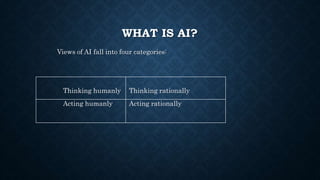
Views of AI fall into four categories:
Thinking humanly Thinking rationally
Acting humanly Acting rationally
WHAT IS ARTIFICIAL INTELLIGENCE?
• Human-like (“How to simulate humans intellect and behavior on by a machine.)
• Mathematical problems (puzzles, games, theorems)
• Common-sense reasoning (if there is parking-space, probably illegal to park)
• Expert knowledge: lawyers, medicine, diagnosis
• Social behavior
• Rational-like:
• achieve goals, have performance measure
WHAT IS ARTIFICIAL INTELLIGENCE
• Thought processes
• “The exciting new effort to make computers think .. Machines with
minds, in the full and literal sense” (Haugeland, 1985)
• Behavior
• “The study of how to make computers do things at which, at the
moment, people are better.” (Rich, and Knight, 1991)
HISTORY OF AI
• In 1950 it was Alan Turing who asked whether a machine could think. Turing not long
before had introduced the concept of his universal abstract machine (called the Turing
Machine) that was simple and could solve any mathematical problem (albiet with some
complexity).
• Building on this idea, Turing wondered that if a computer’s response were
indistinguishable from a human, then the computer could be considered a thinking
machine. The result of this experiment is called the Turing Test.
• In the Turing test, if the machine could fool a human into thinking that it was also
human, then it passed the intelligence test.
HISTORY OF AI
• One way to think of the Turing test is by communicating to the other agent through a keyboard.
• Questions are asked of the peer through written text, and responses are
provided through the terminal.
• This test provides a way to determine if intelligence was created
• An important realization of Turing during this period was the need to start small and grow intelligence,
rather than expecting it to materialize.
• Turing proposed what he called the Child Machine in which a lesser intelligent agent would be created and
then subjected to a course of education.
• Rather than assume that we could build an adult intelligence,
we would build a child intelligence first and then inject it with knowledge.
• Turing called this the blank sheets argument. A child is like a notebook that’s full of
blank sheets, but is a mechanism by which knowledge is stored.
• Alan Turing’s life ended at a young age, but he’s considered the founder
of the field of AI (even though the moniker would not be applied for another
six years).
AI, PROBLEM SOLVING, AND GAMES
• Some of the earliest applications of AI focused on games and general problem solving. At this time,
creating an intelligent machine was based on the belief that the machine would be intelligent if it
could do something that people do (and perhaps find difficult).
• The first AI program written for a computer was called “The Logic Theorist.” It was developed in
1956 by Allen Newell, Herbert Simon, and J. C. Shaw to find proofs for equations. [Newell 1956]
• What was most unique about this program is that it found a better proof than had existed before for
a given equation.
• Like complex math, early AI researchers believed that if a computer could solve problems that they
thought were complex, then they could build intelligent machines. Similarly, games provided an
interesting testbed for the development of algorithms and techniques for intelligent decision
making.
• In the UK at Oxford University in the early 1950s, researchers developed
game-playing programs for two complex games.
• Christopher Strachey developed a Checkers playing program on the Ferranti Mark I. By
1952, his program could play a reasonable game of Checkers. Dietrich Prinz developed a
program, again for the Ferranti Mark I, that could play Chess (mate-in-two variety).
• His program could search a thousand possible moves, but on this early computer, it
required significant time and played very slowly
• In 1952, Arthur Samuel raised the bar for AI programs. His Checkers
playing program, which ran on the IBM 701, included learning and
generalization.
• What Samuel did with his learning Checkers program was unique in that he
allowed two copies of his program to play one another, and therefore learn from each
other. The result was a program that could defeat its creator. By 1962, Samuel’s
Checkers program defeated the former Connecticut Checkers champion.
ARTIFICIAL INTELLIGENCE EMERGES AS A
FIELD
• By the mid 1950s, AI began to solidify as a field of study. At this point in AI’s life,
much of the focus was on what is called Strong AI Strong AI is focused on building
AI that mimics the mind.
• The result is an intelligent entity with human-like intelligence, self-awareness, and
consciousness.
THE DARTMOUTH AI SUMMER RESEARCH
PROJECT
• In 1956, the Dartmouth AI Conference brought about those involved in research in
AI: John McCarthy (Dartmouth), Marvin Minsky (Harvard), Nathaniel Rochester
(IBM), and Claude Shannon (Bell Telephone Laboratories) brought together
researchers in computers, natural language processing, and neuron nets to
Dartmouth College for a month-long session of AI discussions and research.
• The Summer research project on AI began: “We propose that a 2 month, 10 man
study of artificial intelligence be carried out during the summer of 1956 at
Dartmouth College in Hanover, New Hampshire.”
BUILDING TOOLS FOR AI
• In addition to coining the term artificial intelligence, and bringing together major
researchers in AI in his 1956 Dartmouth conference, John McCarthy designed the first
AI programming language.
• LISP was first described by McCarthy in his paper titled “Recursive Functions of
Symbolic Expressions and their Computation by Machine, Part I.” The first LISP
compiler was also implemented in LISP, by Tim Hart and Mike Levin at MIT in 1962
for
the IBM 704.
• This compiler introduced many advanced features, such as incremental compilation.
[LISP 2007] McCarthy’s LISP also pioneered many advanced concepts now familiar in
computer science, such as trees (data structures), dynamic typing, object-oriented
programming, and compiler self-hosting
THE FOCUS ON STRONG AI
• In 1966, Joseph Weizenbaum of MIT developed a program that parodied
a psychologist and could hold an interesting dialogue with a patient.
• The design of Eliza would be considered simple by today’s standards, but its
pattern-matching abilities, which provided reasonable responses to patient
statements was real to many people.
• This quality of the program was troubling to Weizenbaum who later became a critic
of AI because of its lack of compassion.
CONSTRAINED APPLICATIONS
• While much of early AI was Strong-focused, there were numerous applications
that focused on solving practical problems.
• One such application was called the “Dendral Project,” emerging in 1965 at Stanford
University.
• Dendral was developed to help organic chemists understand the organization of
unknown organic molecules.
• It used as its inputs mass spectrometry graphs and a knowledge base of chemistry,
making it the first known expert system.
BOTTOM-UP APPROACHES EMERGE
• Early AI focused on a top-down approach to AI, attempting to simulate or mimic the higher
level concepts of the brain (planning, reasoning, language understanding, etc.).
• But bottom-up approaches began to gain favor in the 1960s, primarily modeling lower-level
concepts, such as neurons and learning at a much lower level.
• In 1949, Donald Hebb introduced his rule that describes how neurons can associate with
one another if they are repeatedly active at the same time.
• But in 1957, the perceptron was created by Frank Rosenblatt at the Cornell Aeronautical
Laboratory.
• The perceptron is a simple linear classifier that can classify data into two classes using an
unsupervised learning algorithm.
• The perceptron created considerable interest in neural network architectures, but change
was not far away.
AI’S WINTER
• Prior to the 1970s, AI had generated considerable interest, and also considerable
hype from the research community. new techniques such as neural networks
breathed
new life into this evolving field, providing additional ways for classification and
learning. But the excitement of neural networks came to an end in 1969 with
the publication of the mongraph titled “Perceptrons.
• The result was a steep decline of
funding into neural network research, and in general, research in AI as a field.
RESULTS-ORIENTED APPLICATIONS
• While there was a reduction in focus and spending in AI research in the
1970s, AI development continued but in a more focused arena.
Applications
that showed promise, such as expert systems, rose as one of the key
developments in this era.
One of the first expert systems to demonstrate the power of rules-based
architectures was called MYCIN, and was developed by Ted Shortliffe
following his dissertation on the subject while at Stanford (1974). MYCIN
operated in the field of medical diagnosis, and demonstrated knowledge
representation and inference.
ADDITIONAL AI TOOLS EMERGE
• Prolog was a language built for AI, created in 1972 by Alain Colmeraur and Phillipe
Roussel
• Prolog is a declarative high-level
language based on formal logic. Programs written in Prolog consist of facts and
rules that reason over those facts.
NEAT VS SCRUFFY APPROACHES
• Traditional, or top-down AI (also called Good-Old-Fashioned-AI, or GOFAI for short) continued during
this period but new approaches began to emerge that looked at AI from the bottom-up.
• These approaches were also labeled Neat and Scruffy approaches segregating them into their
representative camps.
• Those in the neat camp favored formal approaches to AI that were pure and provable. But those in the
scruffy camp used methods less provable but still yielding useful and significant results.
• A number of scruffy approaches to AI that became popular during this period included
genetic algorithms (modeling natural selection for optimization) and neural
networks (modeling brain behavior from the neuron up).
AI RE-EMERGES
• Just as spring always follows the winter, AI’s winter would eventually end
and bring new life into the field (starting in the mid to late 1980s).
The
re-emergence of AI had significant differences from the early days.
• Firstly, the wild predictions of creating intelligent machines were for the most part
over.
• Instead, researchers and AI practitioners focused on specific goals primarily in the weak aspects of AI
(as opposed to Strong AI).
• Weak AI focused on solving specific problems, compared to Strong AI, whose goal was to emulate the
full range of human cognitive capabilities.
• Secondly, the field of AI broadened to include many new types of approaches, for example, the
biologically inspired approaches such as Ant Colony Optimization (ACO).
THE SILENT RETURN
• The silent return follows what Rodney Brooks calls the “AI effect.”
• AI algorithms and methods transition from being “AI” to standard algorithms
and methods once they become practically useful.
• The methods described above are one example, another is speech recognition. The
algorithms behind recognizing the sounds of speech and translating them into
symbols were once described within the confines of AI.
• Now these algorithms are commonplace, and the AI moniker has long since passed.
MESSY AND SCRUFFY APPROACHES TAKE
HOLD
• With AI’s resurgence came different views and approaches to AI and problem
solving with AI algorithms.
• In particular, the scruffy approaches became more widespread and the algorithms
became more applicable to real-world problems.
• Neural networks continued to be researched and applied, and new algorithms and
architectures resulted. Neural networks and genetic algorithms combined to
provide new ways to create neural network architectures that not only solved
problems, but did so in the most efficient ways.
• Also emerging out of the messy approaches to AI was a new field called Artificial Life.
• Artificial Life research studies the processes of life and systems related to life through
a variety of simulations and models. In addition to modeling singular life, ALife also
simulates populations of lifeforms to help understand not only evolution, but also the
evolution of characteristics such as language. Swarm intelligence is another aspect of
this that grew from ALife research.
• ALife is interesting in the context of AI because it can use a number of AI methods
such as neural networks (as the neuro-controller of the individuals in the population)
as well as the genetic algorithm to provide the basis for evolution.
• Another bottom-up approach that evolved during AI’s re-emergence used
the human immune system as inspiration.
Artificial Immune Systems (or AIS)
use principles of the immune system and the characteristics that it exhibits
for problem solving in the domains of optimization, pattern recognition, and
data mining. A very novel application of AIS is in computational security.
The human body reacts to the presence of infections through the release of
antibodies which destroy those infectious substances. Networks of computers
can perform the same function, for example, in the domain of network
security. If a software virus is found on a computer within a given network,
other “antibody” programs can be dispatched to contain and destroy those
viruses. Biology continues to be a major source of inspiration for solutions
to many types of problems.
AGENT SYSTEMS
• Agents, which are also referred to as intelligent agents or software agents, are
a very important element of modern-day AI.
• Agents are applications that exhibit characteristics of intelligent behavior (such as
learning or classification), but are not in themselves AI techniques.
• An example includes a scheduling application. Agents representing users
intelligently negotiate with one another to schedule activities given a set of
constraints for each user.
• In 1999 NASA integrated what was called the “Remote Agent” into the Deep Space 1
spacecraft. Deep Space 1’s goal was to test a number of high-risk technologies, one of which
was an agent that was used to provide autonomy to the spacecraft for limited durations of
time.
• The Remote Agent employed planning techniques to autonomously schedule experiments
based on goals defined by ground operators.
• Mobile agents are independent agents that include autonomy and the ability
to travel amongst nodes of a network in order to perform their processing.
• Instead of the agent communicating with another agent remotely, the mobile
agent can travel to the other agent’s location and communicate with it directly

Artificial intelligence.pptx

  • 1.
  • 2.
    WHAT IS INTELLIGENCE? •Intelligence can be simply defined as a set of properties of the mind. These properties include the ability to plan, solve problems, and in general, reason. • A simpler definition could be that intelligence is the ability to make the right decision given a set of inputs and a variety of possible actions. • Using this simple definition of intelligence (making the right decision), we can apply this not only to humans, but also to animals that exhibit rational behavior.
  • 3.
    • But theintelligence that is exhibited by human beings is much more complex than that of animals. • For example, humans have the ability to communicate with language, but so do some animals. • Humans can also solve problems, but the same can be said of some animals. • One difference then is that humans embody many aspects of intelligence (the ability to communicate, solve problems, learn and adapt) where animals typically embody a small number of intelligent characteristics, and usually at a much lower level than humans.
  • 4.
    WHAT IS AI? •We can use the same analogy on AI applied to computer systems. For example, it’s possible to build an application that plays a world-class game of Chess, but this program knows nothing of the game of Checkers, nor how to make a good cup of tea. • It is the science and engineering of making intelligent machines, especially intelligent computer programs. It is related to the similar task of using computers to understand human intelligence, but AI does not have to confine itself to methods that are biologically observable.
  • 5.
    WHAT IS AI? Viewsof AI fall into four categories: Thinking humanly Thinking rationally Acting humanly Acting rationally
  • 6.
    WHAT IS ARTIFICIALINTELLIGENCE? • Human-like (“How to simulate humans intellect and behavior on by a machine.) • Mathematical problems (puzzles, games, theorems) • Common-sense reasoning (if there is parking-space, probably illegal to park) • Expert knowledge: lawyers, medicine, diagnosis • Social behavior • Rational-like: • achieve goals, have performance measure
  • 7.
    WHAT IS ARTIFICIALINTELLIGENCE • Thought processes • “The exciting new effort to make computers think .. Machines with minds, in the full and literal sense” (Haugeland, 1985) • Behavior • “The study of how to make computers do things at which, at the moment, people are better.” (Rich, and Knight, 1991)
  • 8.
    HISTORY OF AI •In 1950 it was Alan Turing who asked whether a machine could think. Turing not long before had introduced the concept of his universal abstract machine (called the Turing Machine) that was simple and could solve any mathematical problem (albiet with some complexity). • Building on this idea, Turing wondered that if a computer’s response were indistinguishable from a human, then the computer could be considered a thinking machine. The result of this experiment is called the Turing Test. • In the Turing test, if the machine could fool a human into thinking that it was also human, then it passed the intelligence test.
  • 9.
    HISTORY OF AI •One way to think of the Turing test is by communicating to the other agent through a keyboard. • Questions are asked of the peer through written text, and responses are provided through the terminal. • This test provides a way to determine if intelligence was created • An important realization of Turing during this period was the need to start small and grow intelligence, rather than expecting it to materialize. • Turing proposed what he called the Child Machine in which a lesser intelligent agent would be created and then subjected to a course of education. • Rather than assume that we could build an adult intelligence, we would build a child intelligence first and then inject it with knowledge.
  • 10.
    • Turing calledthis the blank sheets argument. A child is like a notebook that’s full of blank sheets, but is a mechanism by which knowledge is stored. • Alan Turing’s life ended at a young age, but he’s considered the founder of the field of AI (even though the moniker would not be applied for another six years).
  • 11.
    AI, PROBLEM SOLVING,AND GAMES • Some of the earliest applications of AI focused on games and general problem solving. At this time, creating an intelligent machine was based on the belief that the machine would be intelligent if it could do something that people do (and perhaps find difficult). • The first AI program written for a computer was called “The Logic Theorist.” It was developed in 1956 by Allen Newell, Herbert Simon, and J. C. Shaw to find proofs for equations. [Newell 1956] • What was most unique about this program is that it found a better proof than had existed before for a given equation. • Like complex math, early AI researchers believed that if a computer could solve problems that they thought were complex, then they could build intelligent machines. Similarly, games provided an interesting testbed for the development of algorithms and techniques for intelligent decision making.
  • 12.
    • In theUK at Oxford University in the early 1950s, researchers developed game-playing programs for two complex games. • Christopher Strachey developed a Checkers playing program on the Ferranti Mark I. By 1952, his program could play a reasonable game of Checkers. Dietrich Prinz developed a program, again for the Ferranti Mark I, that could play Chess (mate-in-two variety). • His program could search a thousand possible moves, but on this early computer, it required significant time and played very slowly
  • 13.
    • In 1952,Arthur Samuel raised the bar for AI programs. His Checkers playing program, which ran on the IBM 701, included learning and generalization. • What Samuel did with his learning Checkers program was unique in that he allowed two copies of his program to play one another, and therefore learn from each other. The result was a program that could defeat its creator. By 1962, Samuel’s Checkers program defeated the former Connecticut Checkers champion.
  • 14.
    ARTIFICIAL INTELLIGENCE EMERGESAS A FIELD • By the mid 1950s, AI began to solidify as a field of study. At this point in AI’s life, much of the focus was on what is called Strong AI Strong AI is focused on building AI that mimics the mind. • The result is an intelligent entity with human-like intelligence, self-awareness, and consciousness.
  • 15.
    THE DARTMOUTH AISUMMER RESEARCH PROJECT • In 1956, the Dartmouth AI Conference brought about those involved in research in AI: John McCarthy (Dartmouth), Marvin Minsky (Harvard), Nathaniel Rochester (IBM), and Claude Shannon (Bell Telephone Laboratories) brought together researchers in computers, natural language processing, and neuron nets to Dartmouth College for a month-long session of AI discussions and research. • The Summer research project on AI began: “We propose that a 2 month, 10 man study of artificial intelligence be carried out during the summer of 1956 at Dartmouth College in Hanover, New Hampshire.”
  • 16.
    BUILDING TOOLS FORAI • In addition to coining the term artificial intelligence, and bringing together major researchers in AI in his 1956 Dartmouth conference, John McCarthy designed the first AI programming language. • LISP was first described by McCarthy in his paper titled “Recursive Functions of Symbolic Expressions and their Computation by Machine, Part I.” The first LISP compiler was also implemented in LISP, by Tim Hart and Mike Levin at MIT in 1962 for the IBM 704. • This compiler introduced many advanced features, such as incremental compilation. [LISP 2007] McCarthy’s LISP also pioneered many advanced concepts now familiar in computer science, such as trees (data structures), dynamic typing, object-oriented programming, and compiler self-hosting
  • 17.
    THE FOCUS ONSTRONG AI • In 1966, Joseph Weizenbaum of MIT developed a program that parodied a psychologist and could hold an interesting dialogue with a patient. • The design of Eliza would be considered simple by today’s standards, but its pattern-matching abilities, which provided reasonable responses to patient statements was real to many people. • This quality of the program was troubling to Weizenbaum who later became a critic of AI because of its lack of compassion.
  • 18.
    CONSTRAINED APPLICATIONS • Whilemuch of early AI was Strong-focused, there were numerous applications that focused on solving practical problems. • One such application was called the “Dendral Project,” emerging in 1965 at Stanford University. • Dendral was developed to help organic chemists understand the organization of unknown organic molecules. • It used as its inputs mass spectrometry graphs and a knowledge base of chemistry, making it the first known expert system.
  • 19.
    BOTTOM-UP APPROACHES EMERGE •Early AI focused on a top-down approach to AI, attempting to simulate or mimic the higher level concepts of the brain (planning, reasoning, language understanding, etc.). • But bottom-up approaches began to gain favor in the 1960s, primarily modeling lower-level concepts, such as neurons and learning at a much lower level. • In 1949, Donald Hebb introduced his rule that describes how neurons can associate with one another if they are repeatedly active at the same time. • But in 1957, the perceptron was created by Frank Rosenblatt at the Cornell Aeronautical Laboratory. • The perceptron is a simple linear classifier that can classify data into two classes using an unsupervised learning algorithm. • The perceptron created considerable interest in neural network architectures, but change was not far away.
  • 20.
    AI’S WINTER • Priorto the 1970s, AI had generated considerable interest, and also considerable hype from the research community. new techniques such as neural networks breathed new life into this evolving field, providing additional ways for classification and learning. But the excitement of neural networks came to an end in 1969 with the publication of the mongraph titled “Perceptrons. • The result was a steep decline of funding into neural network research, and in general, research in AI as a field.
  • 21.
    RESULTS-ORIENTED APPLICATIONS • Whilethere was a reduction in focus and spending in AI research in the 1970s, AI development continued but in a more focused arena. Applications that showed promise, such as expert systems, rose as one of the key developments in this era. One of the first expert systems to demonstrate the power of rules-based architectures was called MYCIN, and was developed by Ted Shortliffe following his dissertation on the subject while at Stanford (1974). MYCIN operated in the field of medical diagnosis, and demonstrated knowledge representation and inference.
  • 22.
    ADDITIONAL AI TOOLSEMERGE • Prolog was a language built for AI, created in 1972 by Alain Colmeraur and Phillipe Roussel • Prolog is a declarative high-level language based on formal logic. Programs written in Prolog consist of facts and rules that reason over those facts.
  • 23.
    NEAT VS SCRUFFYAPPROACHES • Traditional, or top-down AI (also called Good-Old-Fashioned-AI, or GOFAI for short) continued during this period but new approaches began to emerge that looked at AI from the bottom-up. • These approaches were also labeled Neat and Scruffy approaches segregating them into their representative camps. • Those in the neat camp favored formal approaches to AI that were pure and provable. But those in the scruffy camp used methods less provable but still yielding useful and significant results. • A number of scruffy approaches to AI that became popular during this period included genetic algorithms (modeling natural selection for optimization) and neural networks (modeling brain behavior from the neuron up).
  • 24.
    AI RE-EMERGES • Justas spring always follows the winter, AI’s winter would eventually end and bring new life into the field (starting in the mid to late 1980s). The re-emergence of AI had significant differences from the early days. • Firstly, the wild predictions of creating intelligent machines were for the most part over. • Instead, researchers and AI practitioners focused on specific goals primarily in the weak aspects of AI (as opposed to Strong AI). • Weak AI focused on solving specific problems, compared to Strong AI, whose goal was to emulate the full range of human cognitive capabilities. • Secondly, the field of AI broadened to include many new types of approaches, for example, the biologically inspired approaches such as Ant Colony Optimization (ACO).
  • 25.
    THE SILENT RETURN •The silent return follows what Rodney Brooks calls the “AI effect.” • AI algorithms and methods transition from being “AI” to standard algorithms and methods once they become practically useful. • The methods described above are one example, another is speech recognition. The algorithms behind recognizing the sounds of speech and translating them into symbols were once described within the confines of AI. • Now these algorithms are commonplace, and the AI moniker has long since passed.
  • 26.
    MESSY AND SCRUFFYAPPROACHES TAKE HOLD • With AI’s resurgence came different views and approaches to AI and problem solving with AI algorithms. • In particular, the scruffy approaches became more widespread and the algorithms became more applicable to real-world problems. • Neural networks continued to be researched and applied, and new algorithms and architectures resulted. Neural networks and genetic algorithms combined to provide new ways to create neural network architectures that not only solved problems, but did so in the most efficient ways.
  • 27.
    • Also emergingout of the messy approaches to AI was a new field called Artificial Life. • Artificial Life research studies the processes of life and systems related to life through a variety of simulations and models. In addition to modeling singular life, ALife also simulates populations of lifeforms to help understand not only evolution, but also the evolution of characteristics such as language. Swarm intelligence is another aspect of this that grew from ALife research. • ALife is interesting in the context of AI because it can use a number of AI methods such as neural networks (as the neuro-controller of the individuals in the population) as well as the genetic algorithm to provide the basis for evolution.
  • 28.
    • Another bottom-upapproach that evolved during AI’s re-emergence used the human immune system as inspiration. Artificial Immune Systems (or AIS) use principles of the immune system and the characteristics that it exhibits for problem solving in the domains of optimization, pattern recognition, and data mining. A very novel application of AIS is in computational security. The human body reacts to the presence of infections through the release of antibodies which destroy those infectious substances. Networks of computers can perform the same function, for example, in the domain of network security. If a software virus is found on a computer within a given network, other “antibody” programs can be dispatched to contain and destroy those viruses. Biology continues to be a major source of inspiration for solutions to many types of problems.
  • 29.
    AGENT SYSTEMS • Agents,which are also referred to as intelligent agents or software agents, are a very important element of modern-day AI. • Agents are applications that exhibit characteristics of intelligent behavior (such as learning or classification), but are not in themselves AI techniques. • An example includes a scheduling application. Agents representing users intelligently negotiate with one another to schedule activities given a set of constraints for each user.
  • 30.
    • In 1999NASA integrated what was called the “Remote Agent” into the Deep Space 1 spacecraft. Deep Space 1’s goal was to test a number of high-risk technologies, one of which was an agent that was used to provide autonomy to the spacecraft for limited durations of time. • The Remote Agent employed planning techniques to autonomously schedule experiments based on goals defined by ground operators. • Mobile agents are independent agents that include autonomy and the ability to travel amongst nodes of a network in order to perform their processing. • Instead of the agent communicating with another agent remotely, the mobile agent can travel to the other agent’s location and communicate with it directly