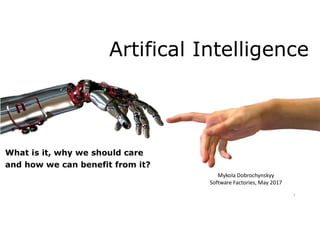
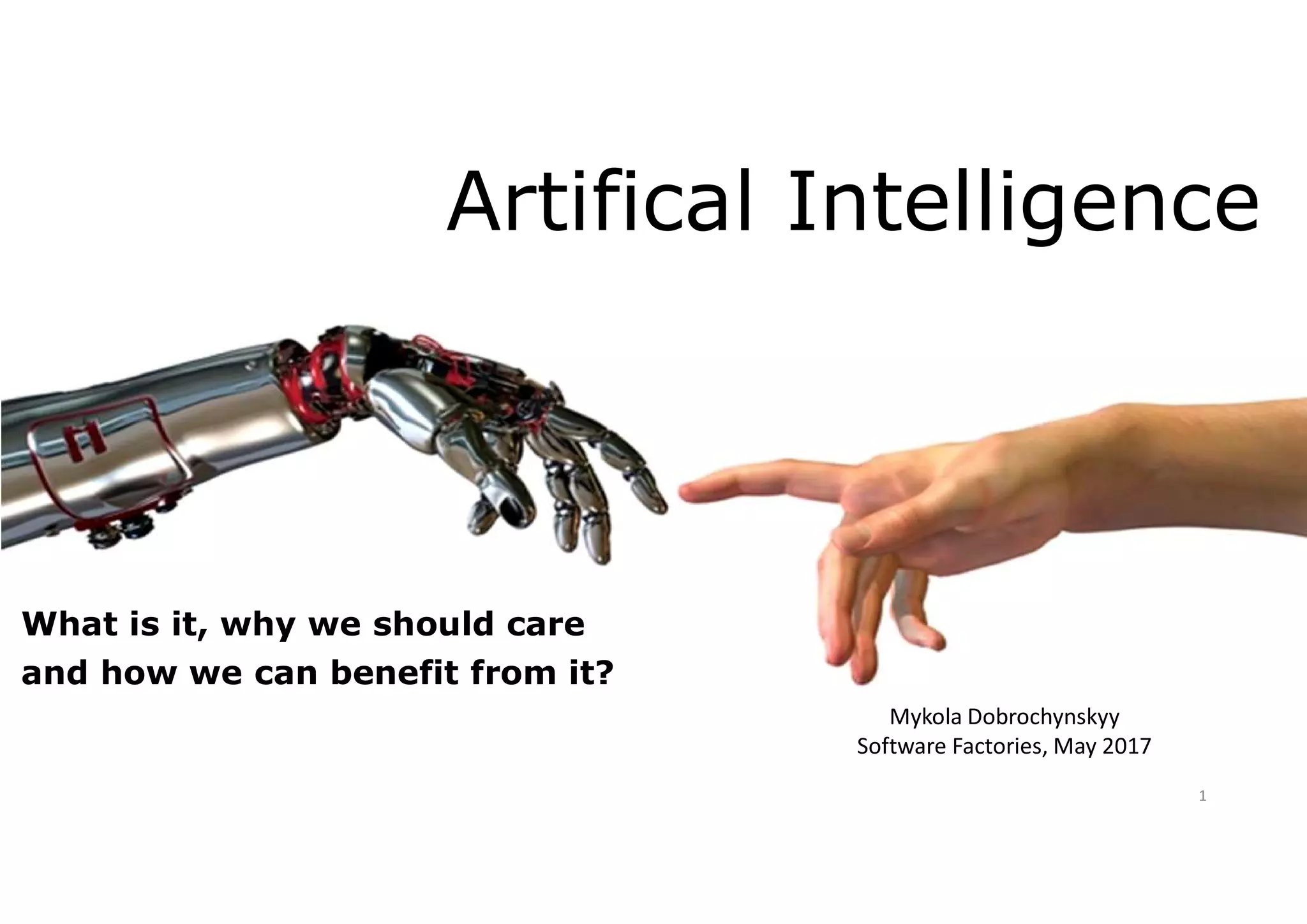
Artifical Intelligence
What is it, why we should care
and how we can benefit from it?
Mykola Dobrochynskyy
Software Factories, May 2017
1
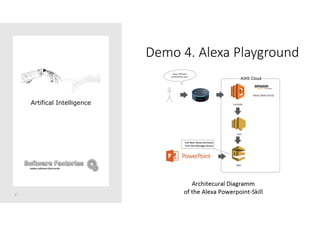
Demo 4. Alexa Playground
2
Artifical Intelligence
Agenda
• Motivation
• Overview of the AI and ML
• Cloud and the Intelligent APIs
• Demo 1. Cognitive Race AWS vs. Azure
• Demo 2. AWS Bot with Lex (optional)
• Demo 3. Azure ML Studio
• Demo 4. Alexa Playground
• Mind-Factories Event
• Conclusion
• Q & A
3
Artifical Intelligence
AI – why we should care?
• According to McKinzey “Automation of knowledge
work” – AI, ML, Natural User Interfaces and BigData
– could have economic impact of $5 - $7 trillion or
110-140 Mio. full-time workers in the next decade.
• According to IDC Big Data will generate about $187
Mio. By 2019 (or +50% vs. 2015). Without ML/AI
most of the Data especially unstructured and short-
living would be lost.
• By 2018 about 50% of developers will embed ML/AI-
Features in their application.
• With democratized Cloud AI-APIs the lean Start-ups
will compete with established companies on the
emerging AI-Markets.
• AI already transforms IT, Communication, Energy,
Financial and Healthcare and soon will transform or
impact almost every industry
4
Artifical Intelligence
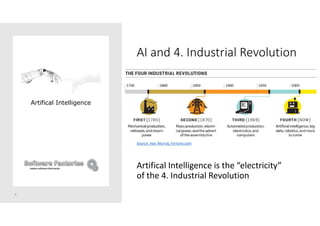
AI and 4. Industrial Revolution
Artifical Intelligence is the “electricity”
of the 4. Industrial Revolution
5
Artifical Intelligence
Source: Alan Murray. Fortune.com
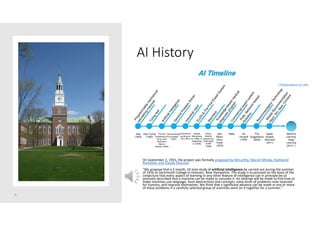
AI History
6
Artifical Intelligence
On September 2, 1955, the project was formally proposed by McCarthy, Marvin Minsky, Nathaniel
Rochester and Claude Shannon.
“We propose that a 2 month, 10 man study of artificial intelligence be carried out during the summer
of 1956 at Dartmouth College in Hanover, New Hampshire. The study is to proceed on the basis of the
conjecture that every aspect of learning or any other feature of intelligence can in principle be so
precisely described that a machine can be made to simulate it. An attempt will be made to find how to
make machines use language, form abstractions and concepts, solve kinds of problems now reserved
for humans, and improve themselves. We think that a significant advance can be made in one or more
of these problems if a carefully selected group of scientists work on it together for a summer.”
* Timeline-Source: K.E. Park
AI Applications
• Computer vision (Security, healthcare, IoT,
science …)
• Machine translation
• Natural Language Processing & Speech (i.e.
Alexa, Siri etc.)
• Search / Suggestions / Analytics (Google,
Amazon, financials …)
• Robotics & control (industry, aero-space,
public sector…)
• Autonomous vehicles (Mars-Rover, Self-
driving cars …)
7
Artifical Intelligence
Objective reasons
for the AI-Revolution
• Exponential data growth – the companies
recognized the value of the gathered Big Data
and don’t want to delete or “forget” it (just like
human brain it does).
• Lots of unstructured data – many sensors, IoT
etc. gather tons of unstructured data like audio,
video, environment measurements etc. This
“dark matter” data has to be processed
(visualized) by AI in a meaningful way.
• Lots of short-time living data – i.e. sensor data
used to exchange-prediction of a technical part
becomes useless, when this part is broken.
8
Artifical Intelligence
AI “take-off” essential exponents
Besides of profound academic AI theory since mid
50th and objective reasons in field there are 4
essential exponent factors, that make rise of AI
possible:
1. Moor’s Law (CPU / GPU / HPC / Cloud )
2. Big Data (Training-Input & Subject-Goal)
3. Sinking Error-Rate (i.e. IMAGE-Net)
4. AI Investments / Revenues
9
Artifical Intelligence
AI Definition
According to John McCarthy, Artificial Intelligence (AI) is an
information and engineering science dedicated to the
production of "intelligent" machines and especially
"intelligent" computer programs.
The research area wants to use computer intelligence to
understand human intelligence, but does not have to limit
itself to the methods that are observed biologically in
human intelligence. In humans, many animals, and in some
machines, different types and degrees of intelligence occur.
According to McCarthy, the computational part of the
intelligence is the ability to achieve the goals in the world. In
other words, a computer is built and / or programmed
(trained) in such a way that it can independently solve
problems, learn from the mistakes, make decisions, perceive
its surroundings, and communicate with people in a natural
way (for example, linguistically).
10
Artifical Intelligence
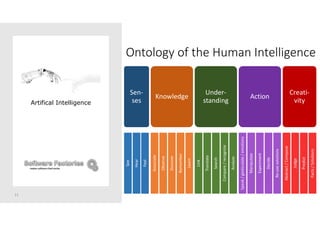
Ontology of the Human Intelligence
11
Artifical Intelligence
Creati-
vity
Facts/Solutions
Predict
Judge
Abstract/Compose
Action
Re-usesolutions
Decide
Experiment
Manipulate
Speak/gesticulate/emotions
Under-
standing
Analyze
Compare/recognize
Search
Translate
Link
Knowledge
Learn
Remember
Discover
Observe
Associate
Sen-
ses
Feel
Hear
See
AWI - Artificial weak Intelligence
Artifical weak (or narrow) Intelligence does not solve all, but
only a given narrow range of the human intelligence
ontology. In the case of a narrow AI, the simulation of a
certain range of intelligent behavior with the aid of
mathematics and computer science is concerned.
12
Artifical Intelligence
AHI - Artificial hybrid Intelligence
13
Artifical Intelligence
Hybrid artificial intelligence does not solve all but several of
the AI domains in parallel that are crucial for the problem
domain and can be combined with human intelligence and
interaction. This is a combination of several simulations of
intelligent behavior with one another and (in some cases)
with human intelligence.
ASI - Artificial strong Intelligence
Artificial strong intelligence aka AI-Singularity has as its goal
to create an artificial intelligence that "mechanizes" human
thinking, consciousness and emotions. Even after decades
of research, the questions of the strong AI are not fully
understood philosophically and the objectives remain
largely visionary.
According to some predictions however AI-Singularity could
be reached in a few decades or even sooner.
As a powerful technology ASI could be very good or very
bad thing for human beings.
14
Artifical Intelligence
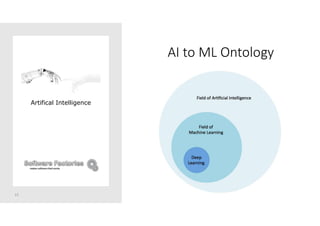
AI to ML Ontology
15
Artifical Intelligence
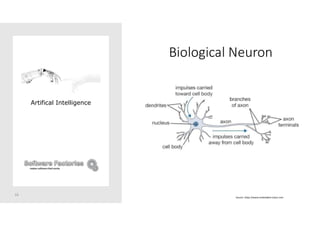
Biological Neuron
16
Artifical Intelligence
Source: https://www.embedded-vision.com
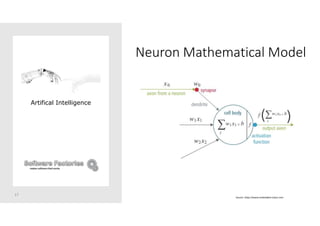
Neuron Mathematical Model
17
Artifical Intelligence
Source: https://www.embedded-vision.com
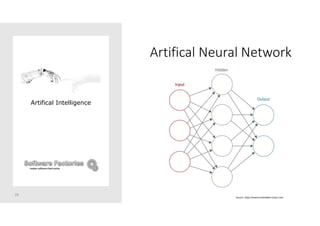
Artifical Neural Network
18
Artifical Intelligence
Source: https://www.embedded-vision.com
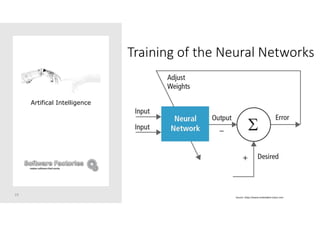
Training of the Neural Networks
19
Artifical Intelligence
Source: https://www.embedded-vision.com
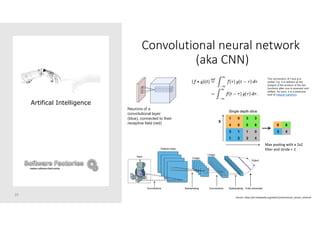
Convolutional neural network
(aka CNN)
20
Artifical Intelligence
Neurons of a
convolutional layer
(blue), connected to their
receptive field (red)
Max pooling with a 2x2
filter and stride = 2
Source: https://en.wikipedia.org/wiki/Convolutional_neural_network
The convolution of f and g is
written f∗g. It is defined as the
integral of the product of the two
functions after one is reversed and
shifted. As such, it is a particular
kind of integral transform
Progress in Deep Learning
• Speech recognition
• Computer vision
• Machine translation
• Reasoning, attention and memory
• Reinforcement learning (Games, Go etc.)
• Robotics & control
• Long-term dependencies, very deep nets
21
Artifical Intelligence
ML to AI - Success-Factors
• Lots and lots of data
• Very flexible ML models
• Enough computing power
• Computationally efficient inference
• Powerful predecessors that can beat
dimensionality problem through
compositions (like human abstractions)
• Deep ML Architectures with multiple
levels
22
Artifical Intelligence
From AI to AGI / ASI
• Exponential data growth: big data, weather, science,
entertainment, unstructured and short-living data
• Complexity: climate, energy, resources, economics,
physics etc.
• Solving Al as Artificial General Intelligence (AGI) is
potentially the meta-solution to all these problems
• The goal is to make Al science and/or Al-assisted
science come true
• Artificial Strong Intelligence (ASI) aka AI-Singularity
with human-level and beyond could be a big Meta-
AI-Network of the AI-/AGI-Domains.
• ASI could come faster as we could think! It could be
very powerful and useful (and scary!). So it should be
used ethically and responsibly.
• Philosophical problems of the ASI
23
Artifical Intelligence
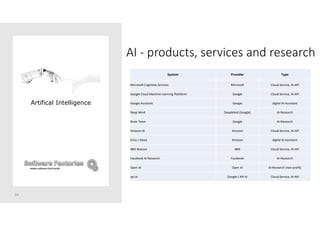
AI - products, services and research
24
Artifical Intelligence
System Provider Type
Microsoft Cognitive Services Microsoft Cloud-Service, AI-API
Google Cloud Machine Learning Plattform Google Cloud-Service, AI-API
Google Assistant Google digital AI-Assistant
Deep Mind DeepMind (Google) AI-Research
Brain Team Google AI-Research
Amazon AI Amazon Cloud-Service, AI-API
Echo / Alexa Amazon digital AI-Assistant
IBM Watson IBM Cloud-Service, AI-API
Facebook AI Research Facebook AI-Research
Open AI Open AI AI-Research (non-profit)
api.ai Google / API AI Cloud-Service, AI-API
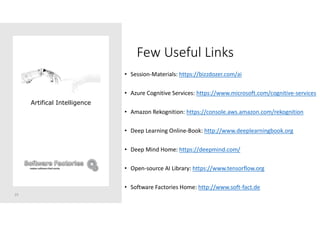
Few Useful Links
• Session-Materials: https://bizzdozer.com/ai
• Azure Cognitive Services: https://www.microsoft.com/cognitive-services
• Amazon Rekognition: https://console.aws.amazon.com/rekognition
• Deep Learning Online-Book: http://www.deeplearningbook.org
• Deep Mind Home: https://deepmind.com/
• Open-source AI Library: https://www.tensorflow.org
• Software Factories Home: http://www.soft-fact.de
25
Artifical Intelligence
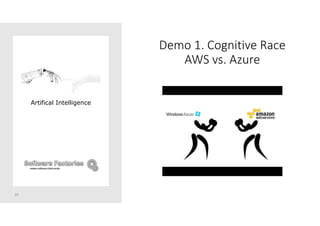
Demo 1. Cognitive Race
AWS vs. Azure
26
Artifical Intelligence
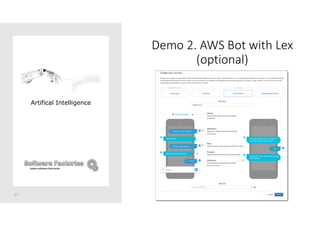
Demo 2. AWS Bot with Lex
(optional)
27
Artifical Intelligence
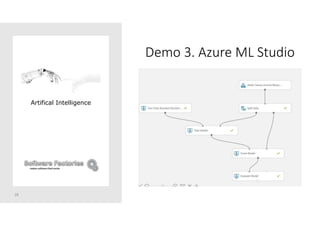
Demo 3. Azure ML Studio
28
Artifical Intelligence
Conclusion
• You need concrete AI-Plan / Strategy (like for Mobile
in the past decade “Mobile first” goes to “AI First”) in
order to keep pace with competitors.
• AI converts Information into Knowledge and
programmers into data scientists.
• AI learns differently as a human – AI with training on
the Big-Data an the human with small chunks of
data, learned experiences and abstractions as well as
from genome derived information.
• Most of the value (by now) is generated by
supervised learning models (i.e. cognitive services)
• AI-Singularity is not expected in the near feature, but
things could change quickly (i.e. winning machine-
algorithm for the Go-game was expected at least in
10-15 years, but the big sensation was happened in
Sep. 2016, as AlphaGo-program won)
29
Artifical Intelligence
Thank you! Questions?
30
Mykola Dobrochynskyy is Managing Director of Software
Factories. His focus and interests are Model-driven Software
Development, Code Generation, Artificial Intelligence (AI) and
Machine Learning, as well as Cloud and Service-oriented
Software Architectures.
Artifical Intelligence

Artificial Intelligence and Machine Learning

  • 1.
    Artifical Intelligence What isit, why we should care and how we can benefit from it? Mykola Dobrochynskyy Software Factories, May 2017 1
  • 2.
    Demo 4. AlexaPlayground 2 Artifical Intelligence
  • 3.
    Agenda • Motivation • Overviewof the AI and ML • Cloud and the Intelligent APIs • Demo 1. Cognitive Race AWS vs. Azure • Demo 2. AWS Bot with Lex (optional) • Demo 3. Azure ML Studio • Demo 4. Alexa Playground • Mind-Factories Event • Conclusion • Q & A 3 Artifical Intelligence
  • 4.
    AI – whywe should care? • According to McKinzey “Automation of knowledge work” – AI, ML, Natural User Interfaces and BigData – could have economic impact of $5 - $7 trillion or 110-140 Mio. full-time workers in the next decade. • According to IDC Big Data will generate about $187 Mio. By 2019 (or +50% vs. 2015). Without ML/AI most of the Data especially unstructured and short- living would be lost. • By 2018 about 50% of developers will embed ML/AI- Features in their application. • With democratized Cloud AI-APIs the lean Start-ups will compete with established companies on the emerging AI-Markets. • AI already transforms IT, Communication, Energy, Financial and Healthcare and soon will transform or impact almost every industry 4 Artifical Intelligence
  • 5.
    AI and 4.Industrial Revolution Artifical Intelligence is the “electricity” of the 4. Industrial Revolution 5 Artifical Intelligence Source: Alan Murray. Fortune.com
  • 6.
    AI History 6 Artifical Intelligence OnSeptember 2, 1955, the project was formally proposed by McCarthy, Marvin Minsky, Nathaniel Rochester and Claude Shannon. “We propose that a 2 month, 10 man study of artificial intelligence be carried out during the summer of 1956 at Dartmouth College in Hanover, New Hampshire. The study is to proceed on the basis of the conjecture that every aspect of learning or any other feature of intelligence can in principle be so precisely described that a machine can be made to simulate it. An attempt will be made to find how to make machines use language, form abstractions and concepts, solve kinds of problems now reserved for humans, and improve themselves. We think that a significant advance can be made in one or more of these problems if a carefully selected group of scientists work on it together for a summer.” * Timeline-Source: K.E. Park
  • 7.
    AI Applications • Computervision (Security, healthcare, IoT, science …) • Machine translation • Natural Language Processing & Speech (i.e. Alexa, Siri etc.) • Search / Suggestions / Analytics (Google, Amazon, financials …) • Robotics & control (industry, aero-space, public sector…) • Autonomous vehicles (Mars-Rover, Self- driving cars …) 7 Artifical Intelligence
  • 8.
    Objective reasons for theAI-Revolution • Exponential data growth – the companies recognized the value of the gathered Big Data and don’t want to delete or “forget” it (just like human brain it does). • Lots of unstructured data – many sensors, IoT etc. gather tons of unstructured data like audio, video, environment measurements etc. This “dark matter” data has to be processed (visualized) by AI in a meaningful way. • Lots of short-time living data – i.e. sensor data used to exchange-prediction of a technical part becomes useless, when this part is broken. 8 Artifical Intelligence
  • 9.
    AI “take-off” essentialexponents Besides of profound academic AI theory since mid 50th and objective reasons in field there are 4 essential exponent factors, that make rise of AI possible: 1. Moor’s Law (CPU / GPU / HPC / Cloud ) 2. Big Data (Training-Input & Subject-Goal) 3. Sinking Error-Rate (i.e. IMAGE-Net) 4. AI Investments / Revenues 9 Artifical Intelligence
  • 10.
    AI Definition According toJohn McCarthy, Artificial Intelligence (AI) is an information and engineering science dedicated to the production of "intelligent" machines and especially "intelligent" computer programs. The research area wants to use computer intelligence to understand human intelligence, but does not have to limit itself to the methods that are observed biologically in human intelligence. In humans, many animals, and in some machines, different types and degrees of intelligence occur. According to McCarthy, the computational part of the intelligence is the ability to achieve the goals in the world. In other words, a computer is built and / or programmed (trained) in such a way that it can independently solve problems, learn from the mistakes, make decisions, perceive its surroundings, and communicate with people in a natural way (for example, linguistically). 10 Artifical Intelligence
  • 11.
    Ontology of theHuman Intelligence 11 Artifical Intelligence Creati- vity Facts/Solutions Predict Judge Abstract/Compose Action Re-usesolutions Decide Experiment Manipulate Speak/gesticulate/emotions Under- standing Analyze Compare/recognize Search Translate Link Knowledge Learn Remember Discover Observe Associate Sen- ses Feel Hear See
  • 12.
    AWI - Artificialweak Intelligence Artifical weak (or narrow) Intelligence does not solve all, but only a given narrow range of the human intelligence ontology. In the case of a narrow AI, the simulation of a certain range of intelligent behavior with the aid of mathematics and computer science is concerned. 12 Artifical Intelligence
  • 13.
    AHI - Artificialhybrid Intelligence 13 Artifical Intelligence Hybrid artificial intelligence does not solve all but several of the AI domains in parallel that are crucial for the problem domain and can be combined with human intelligence and interaction. This is a combination of several simulations of intelligent behavior with one another and (in some cases) with human intelligence.
  • 14.
    ASI - Artificialstrong Intelligence Artificial strong intelligence aka AI-Singularity has as its goal to create an artificial intelligence that "mechanizes" human thinking, consciousness and emotions. Even after decades of research, the questions of the strong AI are not fully understood philosophically and the objectives remain largely visionary. According to some predictions however AI-Singularity could be reached in a few decades or even sooner. As a powerful technology ASI could be very good or very bad thing for human beings. 14 Artifical Intelligence
  • 15.
    AI to MLOntology 15 Artifical Intelligence
  • 16.
  • 17.
    Neuron Mathematical Model 17 ArtificalIntelligence Source: https://www.embedded-vision.com
  • 18.
    Artifical Neural Network 18 ArtificalIntelligence Source: https://www.embedded-vision.com
  • 19.
    Training of theNeural Networks 19 Artifical Intelligence Source: https://www.embedded-vision.com
  • 20.
    Convolutional neural network (akaCNN) 20 Artifical Intelligence Neurons of a convolutional layer (blue), connected to their receptive field (red) Max pooling with a 2x2 filter and stride = 2 Source: https://en.wikipedia.org/wiki/Convolutional_neural_network The convolution of f and g is written f∗g. It is defined as the integral of the product of the two functions after one is reversed and shifted. As such, it is a particular kind of integral transform
  • 21.
    Progress in DeepLearning • Speech recognition • Computer vision • Machine translation • Reasoning, attention and memory • Reinforcement learning (Games, Go etc.) • Robotics & control • Long-term dependencies, very deep nets 21 Artifical Intelligence
  • 22.
    ML to AI- Success-Factors • Lots and lots of data • Very flexible ML models • Enough computing power • Computationally efficient inference • Powerful predecessors that can beat dimensionality problem through compositions (like human abstractions) • Deep ML Architectures with multiple levels 22 Artifical Intelligence
  • 23.
    From AI toAGI / ASI • Exponential data growth: big data, weather, science, entertainment, unstructured and short-living data • Complexity: climate, energy, resources, economics, physics etc. • Solving Al as Artificial General Intelligence (AGI) is potentially the meta-solution to all these problems • The goal is to make Al science and/or Al-assisted science come true • Artificial Strong Intelligence (ASI) aka AI-Singularity with human-level and beyond could be a big Meta- AI-Network of the AI-/AGI-Domains. • ASI could come faster as we could think! It could be very powerful and useful (and scary!). So it should be used ethically and responsibly. • Philosophical problems of the ASI 23 Artifical Intelligence
  • 24.
    AI - products,services and research 24 Artifical Intelligence System Provider Type Microsoft Cognitive Services Microsoft Cloud-Service, AI-API Google Cloud Machine Learning Plattform Google Cloud-Service, AI-API Google Assistant Google digital AI-Assistant Deep Mind DeepMind (Google) AI-Research Brain Team Google AI-Research Amazon AI Amazon Cloud-Service, AI-API Echo / Alexa Amazon digital AI-Assistant IBM Watson IBM Cloud-Service, AI-API Facebook AI Research Facebook AI-Research Open AI Open AI AI-Research (non-profit) api.ai Google / API AI Cloud-Service, AI-API
  • 25.
    Few Useful Links •Session-Materials: https://bizzdozer.com/ai • Azure Cognitive Services: https://www.microsoft.com/cognitive-services • Amazon Rekognition: https://console.aws.amazon.com/rekognition • Deep Learning Online-Book: http://www.deeplearningbook.org • Deep Mind Home: https://deepmind.com/ • Open-source AI Library: https://www.tensorflow.org • Software Factories Home: http://www.soft-fact.de 25 Artifical Intelligence
  • 26.
    Demo 1. CognitiveRace AWS vs. Azure 26 Artifical Intelligence
  • 27.
    Demo 2. AWSBot with Lex (optional) 27 Artifical Intelligence
  • 28.
    Demo 3. AzureML Studio 28 Artifical Intelligence
  • 29.
    Conclusion • You needconcrete AI-Plan / Strategy (like for Mobile in the past decade “Mobile first” goes to “AI First”) in order to keep pace with competitors. • AI converts Information into Knowledge and programmers into data scientists. • AI learns differently as a human – AI with training on the Big-Data an the human with small chunks of data, learned experiences and abstractions as well as from genome derived information. • Most of the value (by now) is generated by supervised learning models (i.e. cognitive services) • AI-Singularity is not expected in the near feature, but things could change quickly (i.e. winning machine- algorithm for the Go-game was expected at least in 10-15 years, but the big sensation was happened in Sep. 2016, as AlphaGo-program won) 29 Artifical Intelligence
  • 30.
    Thank you! Questions? 30 MykolaDobrochynskyy is Managing Director of Software Factories. His focus and interests are Model-driven Software Development, Code Generation, Artificial Intelligence (AI) and Machine Learning, as well as Cloud and Service-oriented Software Architectures. Artifical Intelligence