Intelligent Agents Chapter 2
Outline Agents and environments Rationality PEAS (Performance measure, Environment, Actuators, Sensors) Environment types Agent types
Agents An  agent  is anything that can be viewed as  perceiving  its  environment  through  sensors  and  acting  upon that environment through  actuators Human agent: eyes, ears, and other organs for sensors; hands, legs, mouth, and other body parts for actuators Robotic agent: cameras and infrared range finders for sensors; various motors for actuators
Agents and environments The  agent   function  maps from percept histories to actions: [ f :  P*      A ] The  agent   program  runs on the physical  architecture  to produce  f agent = architecture + program
Vacuum-cleaner world Percepts: location and contents, e.g., [A,Dirty] Actions:  Left ,  Right ,  Suck ,  NoOp
A vacuum-cleaner agent \input{tables/vacuum-agent-function-table}
Rational agents An agent should strive to "do the right thing", based on what it can perceive and the actions it can perform. The right action is the one that will cause the agent to be most successful Performance measure: An objective criterion for success of an agent's behavior E.g., performance measure of a vacuum-cleaner agent could be amount of dirt cleaned up, amount of time taken, amount of electricity consumed, amount of noise generated, etc.
Rational agents Rational   Agent : For each possible percept sequence, a rational agent should select an action that is expected to maximize its performance measure, given the evidence provided by the percept sequence and whatever built-in knowledge the agent has.
Rational agents Rationality is distinct from omniscience (all-knowing with infinite knowledge) Agents can perform actions in order to modify future percepts so as to obtain useful information (information gathering, exploration) An agent is  autonomous  if its behavior is determined by its own experience (with ability to learn and adapt)
PEAS PEAS: Performance measure, Environment, Actuators, Sensors Must first specify the setting for intelligent agent design Consider, e.g., the task of designing an automated taxi driver: Performance measure Environment Actuators Sensors
PEAS Must first specify the setting for intelligent agent design Consider, e.g., the task of designing an automated taxi driver: Performance measure: Safe, fast, legal, comfortable trip, maximize profits Environment: Roads, other traffic, pedestrians, customers Actuators: Steering wheel, accelerator, brake, signal, horn Sensors: Cameras, sonar, speedometer, GPS, odometer, engine sensors, keyboard
PEAS Agent: Medical diagnosis system Performance measure: Healthy patient, minimize costs, lawsuits Environment: Patient, hospital, staff Actuators: Screen display (questions, tests, diagnoses, treatments, referrals) Sensors: Keyboard (entry of symptoms, findings, patient's answers)
PEAS Agent: Part-picking robot Performance measure: Percentage of parts in correct bins Environment: Conveyor belt with parts, bins Actuators: Jointed arm and hand Sensors: Camera, joint angle sensors
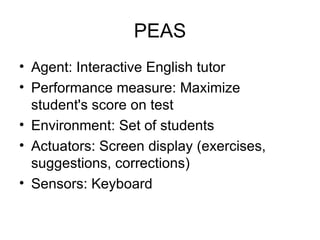
PEAS Agent: Interactive English tutor Performance measure: Maximize student's score on test Environment: Set of students Actuators: Screen display (exercises, suggestions, corrections) Sensors: Keyboard
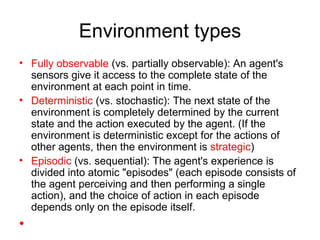
Environment types Fully observable  (vs. partially observable): An agent's sensors give it access to the complete state of the environment at each point in time. Deterministic  (vs. stochastic): The next state of the environment is completely determined by the current state and the action executed by the agent. (If the environment is deterministic except for the actions of other agents, then the environment is  strategic ) Episodic  (vs. sequential): The agent's experience is divided into atomic "episodes" (each episode consists of the agent perceiving and then performing a single action), and the choice of action in each episode depends only on the episode itself.
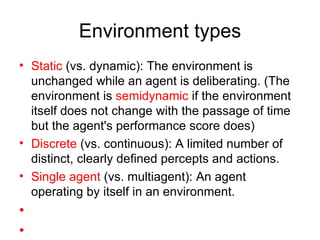
Environment types Static  (vs. dynamic): The environment is unchanged while an agent is deliberating. (The environment is  semidynamic  if the environment itself does not change with the passage of time but the agent's performance score does) Discrete  (vs. continuous): A limited number of distinct, clearly defined percepts and actions. Single agent  (vs. multiagent): An agent operating by itself in an environment.
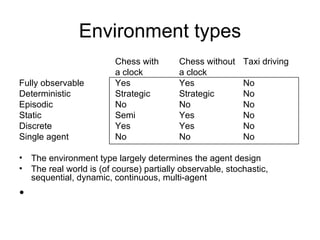
Environment types Chess with  Chess without  Taxi driving  a clock a clock Fully observable Yes Yes No  Deterministic Strategic Strategic No  Episodic  No No No  Static  Semi Yes  No  Discrete Yes  Yes No Single agent No No No  The environment type largely determines the agent design The real world is (of course) partially observable, stochastic, sequential, dynamic, continuous, multi-agent
Agent functions and programs An agent is completely specified by the  agent function  mapping percept sequences to actions One agent function (or a small equivalence class) is  rational Aim: find a way to implement the rational agent function concisely
Table-lookup agent \input{algorithms/table-agent-algorithm} Drawbacks: Huge table Take a long time to build the table No autonomy Even with learning, need a long time to learn the table entries
Agent program for a vacuum-cleaner agent \input{algorithms/reflex-vacuum-agent-algorithm}
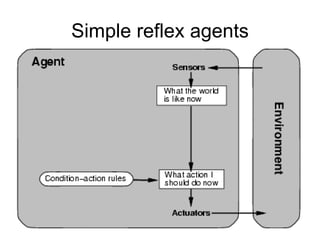
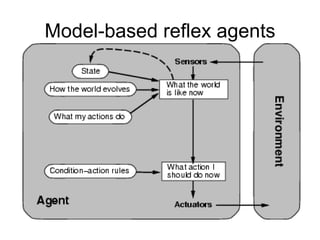
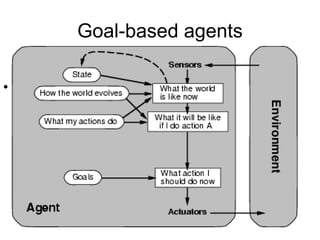
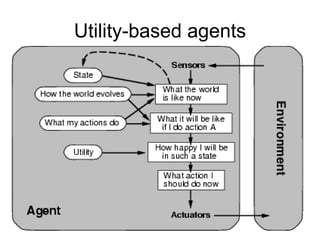
Agent types Four basic types in order of increasing generality: Simple reflex agents Model-based reflex agents Goal-based agents Utility-based agents
Simple reflex agents
Simple reflex agents \input{algorithms/d-agent-algorithm}
Model-based reflex agents
Model-based reflex agents \input{algorithms/d+-agent-algorithm}
Goal-based agents
Utility-based agents
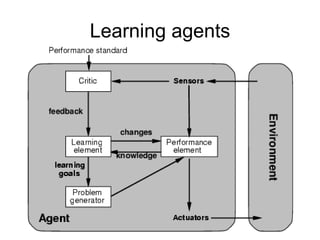
Learning agents

Artificial Intelligence Chapter two agents

  • 1.
  • 2.
    Outline Agents andenvironments Rationality PEAS (Performance measure, Environment, Actuators, Sensors) Environment types Agent types
  • 3.
    Agents An agent is anything that can be viewed as perceiving its environment through sensors and acting upon that environment through actuators Human agent: eyes, ears, and other organs for sensors; hands, legs, mouth, and other body parts for actuators Robotic agent: cameras and infrared range finders for sensors; various motors for actuators
  • 4.
    Agents and environmentsThe agent function maps from percept histories to actions: [ f : P*  A ] The agent program runs on the physical architecture to produce f agent = architecture + program
  • 5.
    Vacuum-cleaner world Percepts:location and contents, e.g., [A,Dirty] Actions: Left , Right , Suck , NoOp
  • 6.
    A vacuum-cleaner agent\input{tables/vacuum-agent-function-table}
  • 7.
    Rational agents Anagent should strive to "do the right thing", based on what it can perceive and the actions it can perform. The right action is the one that will cause the agent to be most successful Performance measure: An objective criterion for success of an agent's behavior E.g., performance measure of a vacuum-cleaner agent could be amount of dirt cleaned up, amount of time taken, amount of electricity consumed, amount of noise generated, etc.
  • 8.
    Rational agents Rational Agent : For each possible percept sequence, a rational agent should select an action that is expected to maximize its performance measure, given the evidence provided by the percept sequence and whatever built-in knowledge the agent has.
  • 9.
    Rational agents Rationalityis distinct from omniscience (all-knowing with infinite knowledge) Agents can perform actions in order to modify future percepts so as to obtain useful information (information gathering, exploration) An agent is autonomous if its behavior is determined by its own experience (with ability to learn and adapt)
  • 10.
    PEAS PEAS: Performancemeasure, Environment, Actuators, Sensors Must first specify the setting for intelligent agent design Consider, e.g., the task of designing an automated taxi driver: Performance measure Environment Actuators Sensors
  • 11.
    PEAS Must firstspecify the setting for intelligent agent design Consider, e.g., the task of designing an automated taxi driver: Performance measure: Safe, fast, legal, comfortable trip, maximize profits Environment: Roads, other traffic, pedestrians, customers Actuators: Steering wheel, accelerator, brake, signal, horn Sensors: Cameras, sonar, speedometer, GPS, odometer, engine sensors, keyboard
  • 12.
    PEAS Agent: Medicaldiagnosis system Performance measure: Healthy patient, minimize costs, lawsuits Environment: Patient, hospital, staff Actuators: Screen display (questions, tests, diagnoses, treatments, referrals) Sensors: Keyboard (entry of symptoms, findings, patient's answers)
  • 13.
    PEAS Agent: Part-pickingrobot Performance measure: Percentage of parts in correct bins Environment: Conveyor belt with parts, bins Actuators: Jointed arm and hand Sensors: Camera, joint angle sensors
  • 14.
    PEAS Agent: InteractiveEnglish tutor Performance measure: Maximize student's score on test Environment: Set of students Actuators: Screen display (exercises, suggestions, corrections) Sensors: Keyboard
  • 15.
    Environment types Fullyobservable (vs. partially observable): An agent's sensors give it access to the complete state of the environment at each point in time. Deterministic (vs. stochastic): The next state of the environment is completely determined by the current state and the action executed by the agent. (If the environment is deterministic except for the actions of other agents, then the environment is strategic ) Episodic (vs. sequential): The agent's experience is divided into atomic "episodes" (each episode consists of the agent perceiving and then performing a single action), and the choice of action in each episode depends only on the episode itself.
  • 16.
    Environment types Static (vs. dynamic): The environment is unchanged while an agent is deliberating. (The environment is semidynamic if the environment itself does not change with the passage of time but the agent's performance score does) Discrete (vs. continuous): A limited number of distinct, clearly defined percepts and actions. Single agent (vs. multiagent): An agent operating by itself in an environment.
  • 17.
    Environment types Chesswith Chess without Taxi driving a clock a clock Fully observable Yes Yes No Deterministic Strategic Strategic No Episodic No No No Static Semi Yes No Discrete Yes Yes No Single agent No No No The environment type largely determines the agent design The real world is (of course) partially observable, stochastic, sequential, dynamic, continuous, multi-agent
  • 18.
    Agent functions andprograms An agent is completely specified by the agent function mapping percept sequences to actions One agent function (or a small equivalence class) is rational Aim: find a way to implement the rational agent function concisely
  • 19.
    Table-lookup agent \input{algorithms/table-agent-algorithm}Drawbacks: Huge table Take a long time to build the table No autonomy Even with learning, need a long time to learn the table entries
  • 20.
    Agent program fora vacuum-cleaner agent \input{algorithms/reflex-vacuum-agent-algorithm}
  • 21.
    Agent types Fourbasic types in order of increasing generality: Simple reflex agents Model-based reflex agents Goal-based agents Utility-based agents
  • 22.
  • 23.
    Simple reflex agents\input{algorithms/d-agent-algorithm}
  • 24.
  • 25.
    Model-based reflex agents\input{algorithms/d+-agent-algorithm}
  • 26.
  • 27.
  • 28.