Chapter 1
THE ORIGINS
OF MODERN
ART
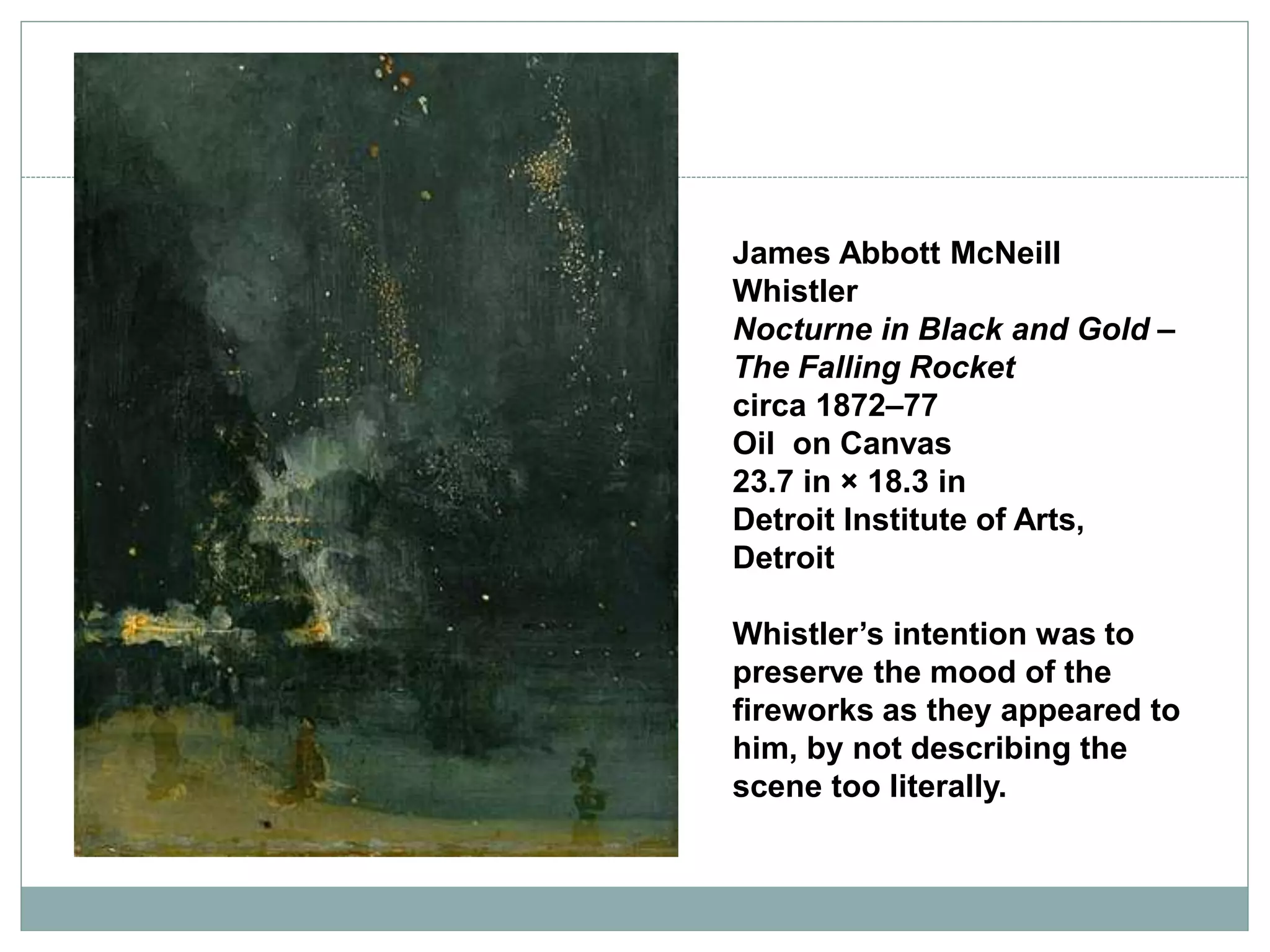
James Abbott McNeill
Whistler
Nocturne in Black and Gold –
The Falling Rocket
circa 1872–77
Oil on Canvas
23.7 in × 18.3 in
Detroit Institute of Arts,
Detroit
Whistler’s intention was to
preserve the mood of the
fireworks as they appeared to
him, by not describing the
scene too literally.
Critic John Ruskin (1819-1900) and James Abbott McNeill Whistler
held opposing views. Whistler opposed accessibility of art by the
masses. He believed in “Art for Art’s Sake.
In his Nocturnes, Whistler declared modernism's affinity for the
abstract. In 1877, Ruskin published a letter regarding Nocturne in
Black and Gold: The Falling Rocket, a painting by Whistler which
was included in the exhibition at the Grosvenor Gallery.
Whistler sued Ruskin for libel. Whistler won but was devastated
financially. Ruskin resigned his professorship at Oxford. T
he trial was a debate between those who considered art to be vital
to social progress, and those who declared that art transcended
social concerns.
Art criticism emerged in the eighteen century in response to art
becoming more accessible through public exhibitions.
In France such exhibitions were called Salons. The Paris Salon was
held every two years and featured hundreds of artworks by mostly
members of France’s Royal Academy of Painting and Sculpture.
Critics began writing reviews about the aesthetic quality of the
artworks on display. Within a short period of time they started to
influence the public’s taste.
A MARKETPLACE FOR ART
The earliest exhibitions were organized by dealers and auctioneers.
Economic developments contributed to the creation of a new class: the
bourgeoisie who adopted the habits of nobility, to acquire art and other
luxuries.
Whistler vs. Ruskin trial coincides with the expansion of the art market.
MAKING ART AND ARTISTS:
THE ROLE OF THE CRITIC
The trial bankrupted Whistler but he established one of the
modernism’s central tenets: that art was the manifestation of the
artist’s emotional and intellectual will.
THE MODERN ARTIST
Until eighteenth century artists worked with the confines of
tradition. They were allowed to be inventive with the limits of the
tradition in which they worked.
The Oath of the Horatii is a large painting by the French artist
Jacques-Louis David painted in 1784.
David's stylistic simplicity eliminates the distraction from the
central moral of the story.
David even invented this scene to convey the essence of the
narrative.
Jaques-Louis
David.
The Oath of the
Horatii. 1784
Oil on canvas,
Musée du Louvre,
Paris, France.
By the end of the eighteenth century the focus on emulation was
replaced by artistic invention which was linked the artist’s unique
vision.
In this context Romanticism emphasized individualism,
imagination, and free expression.
Romanticism promoted the artist as a “visionary genius” that
possessed the ultimate insight into fundamental reality and reveled
it though art.
Genius, for the Romantics, was something one was born with. It
could not be acquired through learning or other means..
Neoclassicism and Romanticism, the influence of art criticism, a
growing number of exhibitions, and a growing class of collectors
created the foundation of modern art.
WHAT DOES IT MEAN TO BE AN ARTIST?: FROM ACADEMIC
EMULATION TOWARD ROMANTIC ORIGINALITY
William Blake
Nebuchadnezzar, 1795.
Color monotype print finished in ink
and watercolor on paper.
21 x 28 inches. Tate, London.
William Blake (1757 – 1827), British painter and printmaker, is an
example of the artist as a genius. His art consists of depictions of
biblical characters placed in a new unconventional context that
crosses into an unsettling realm.
The print depicts portraying the Old Testament Babylonian king
Nebuchadnezzar II who through hubris lost his mind and was
reduced to eating "grass as oxen“.
Neoclassicism opposed the tradition of
linear and atmospheric perspective as a
way to organize the pictorial space.
David and his followers didn’t abandon
the classical tradition. They altered it by
reducing the depth and details necessary
to create it.
David, in The Oath of the Horatii, kept the
viewer’s focus on the action of the two
groups: the men and the women.
Romantic artists relied on diagonals and
indefinite atmospheric perspective to
match their imagination. Romantic artists
wore more experimental and innovating.
MAKING SENSE OF A TURBULENT WORLD: THE LEGACY OF
NEOCLASSICISM AND ROMANTICISM
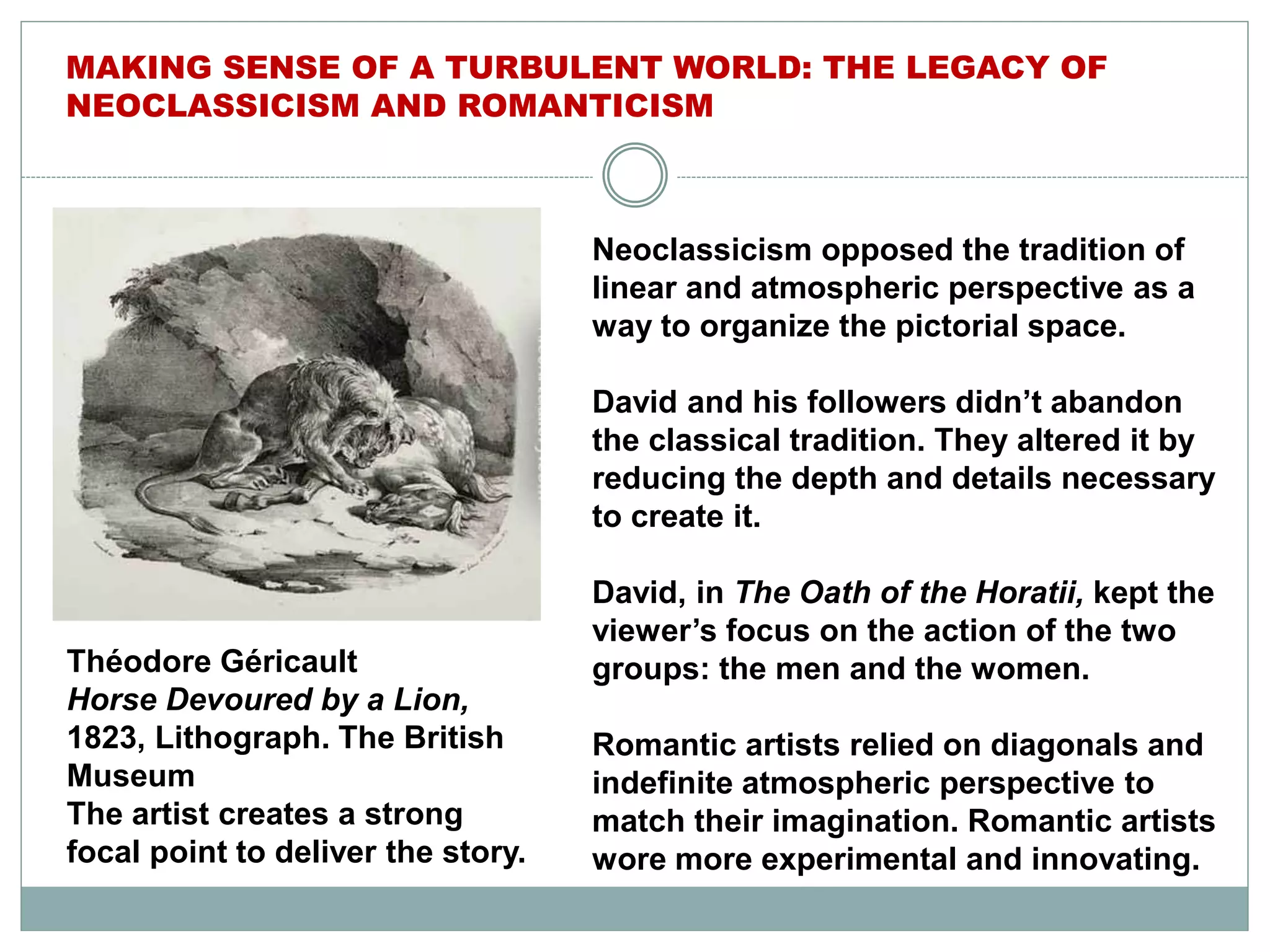
Théodore Géricault
Horse Devoured by a Lion,
1823, Lithograph. The British
Museum
The artist creates a strong
focal point to deliver the story.
HISTORY PAINTING
Neoclassical painters embraced
history painting, and the
philosophic ideals of the French
Revolution. However, they realized
they were limited by the lack of
painting models from early Rome,
As a result they focused on
sculpture of early Rome to draw
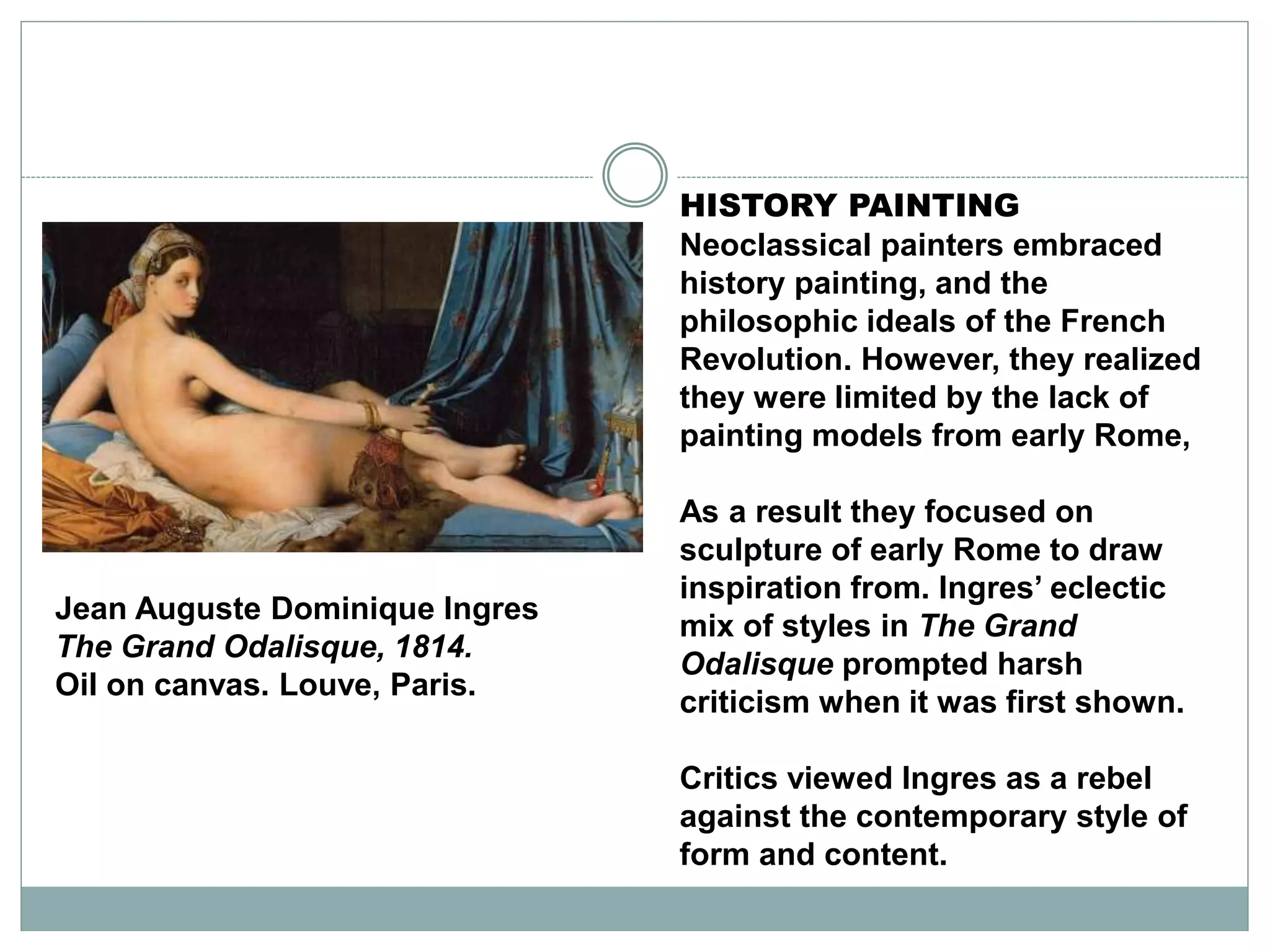
inspiration from. Ingres’ eclectic
mix of styles in The Grand
Odalisque prompted harsh
criticism when it was first shown.
Critics viewed Ingres as a rebel
against the contemporary style of
form and content.
Jean Auguste Dominique Ingres
The Grand Odalisque, 1814.
Oil on canvas. Louve, Paris.
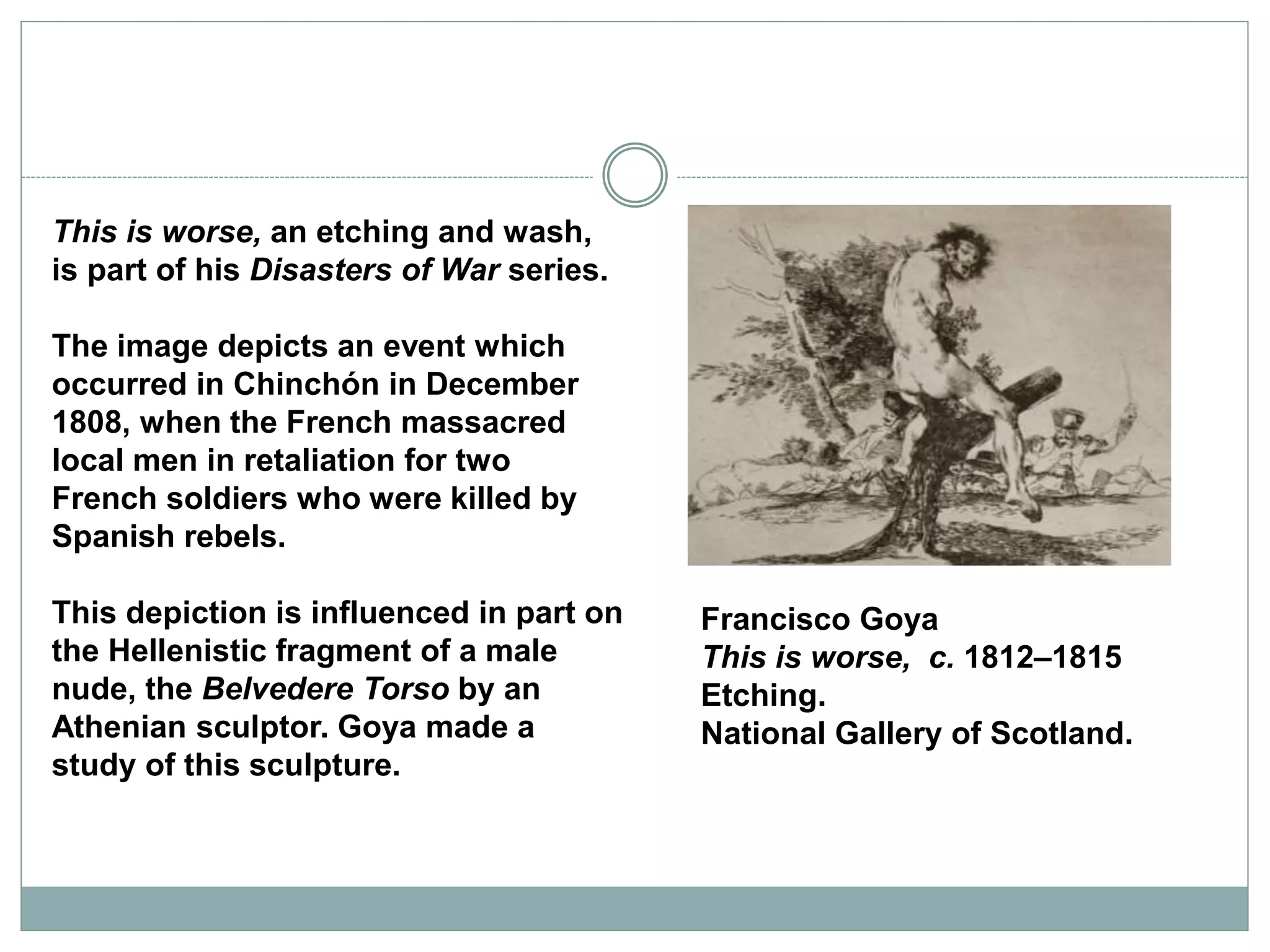
This is worse, an etching and wash,
is part of his Disasters of War series.
The image depicts an event which
occurred in Chinchón in December
1808, when the French massacred
local men in retaliation for two
French soldiers who were killed by
Spanish rebels.
This depiction is influenced in part on
the Hellenistic fragment of a male
nude, the Belvedere Torso by an
Athenian sculptor. Goya made a
study of this sculpture.
Francisco Goya
This is worse, c. 1812–1815
Etching.
National Gallery of Scotland.
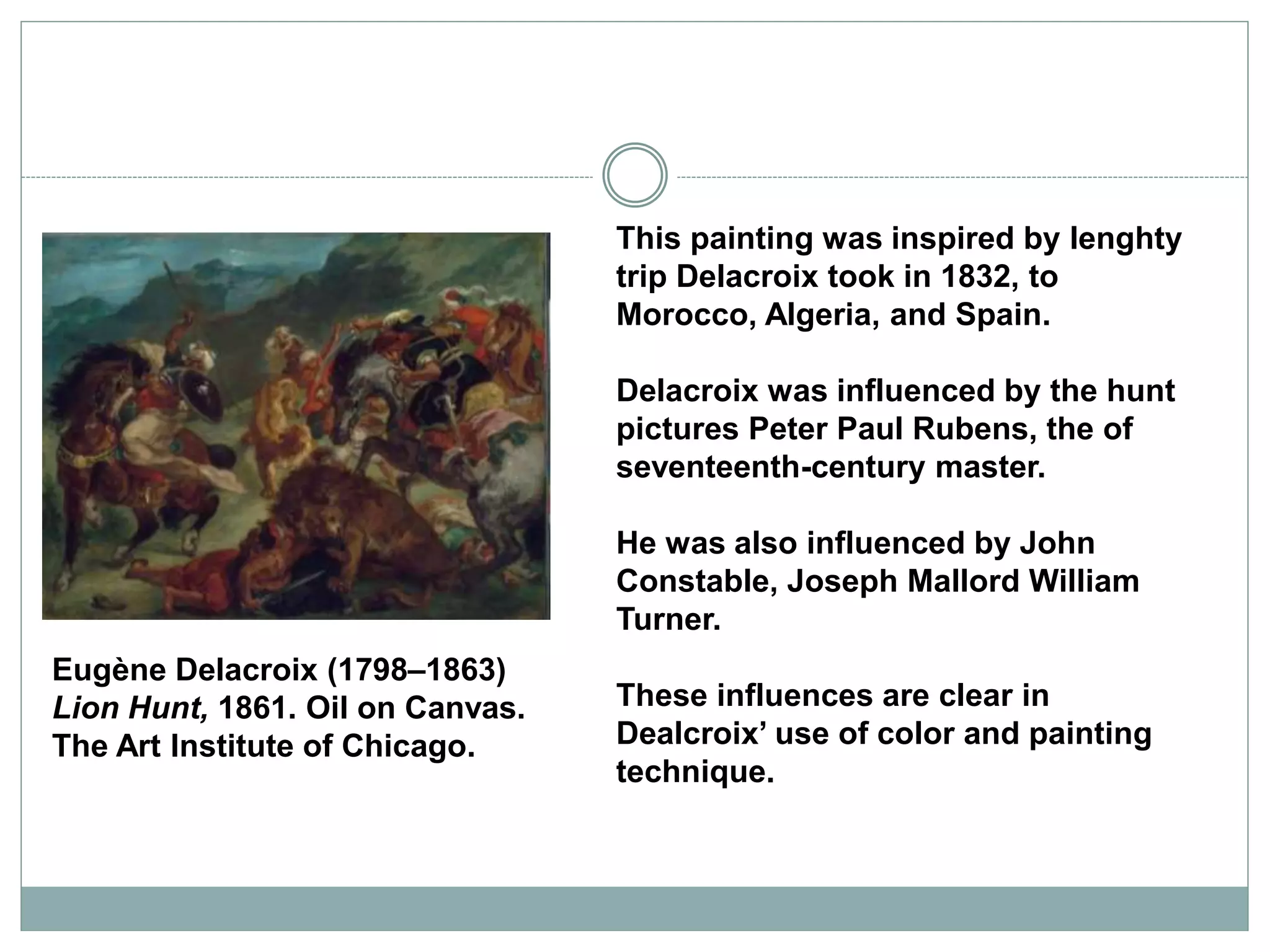
Eugène Delacroix (1798–1863)
Lion Hunt, 1861. Oil on Canvas.
The Art Institute of Chicago.
This painting was inspired by lenghty
trip Delacroix took in 1832, to
Morocco, Algeria, and Spain.
Delacroix was influenced by the hunt
pictures Peter Paul Rubens, the of
seventeenth-century master.
He was also influenced by John
Constable, Joseph Mallord William
Turner.
These influences are clear in
Dealcroix’ use of color and painting
technique.
LANDSCAPE PAINTING
In Romantic art, nature with its
power and unpredictability, recall
the eighteenth-century aesthetic of
the Sublime.
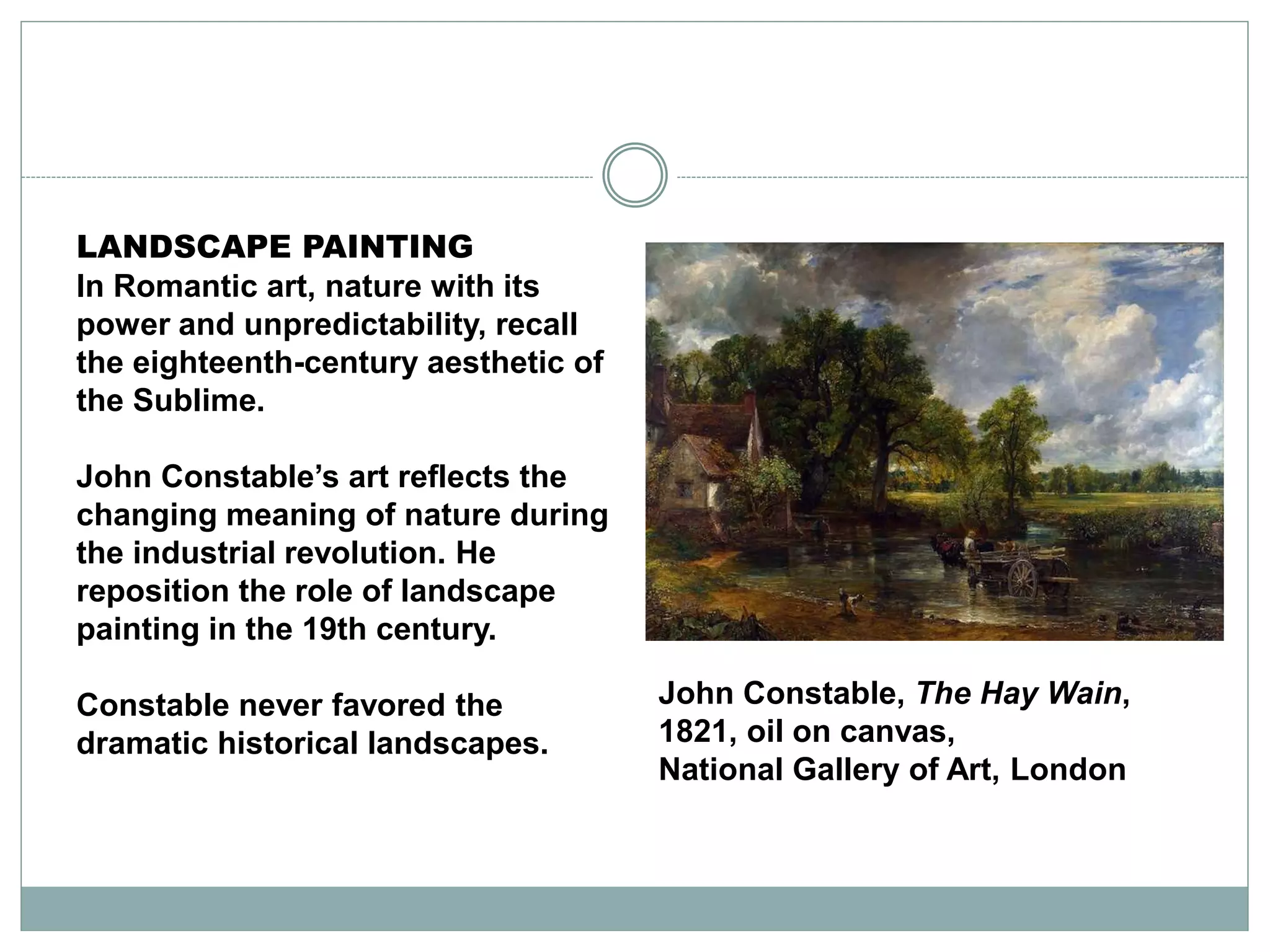
John Constable’s art reflects the
changing meaning of nature during
the industrial revolution. He
reposition the role of landscape
painting in the 19th century.
Constable never favored the
dramatic historical landscapes.
John Constable, The Hay Wain,
1821, oil on canvas,
National Gallery of Art, London
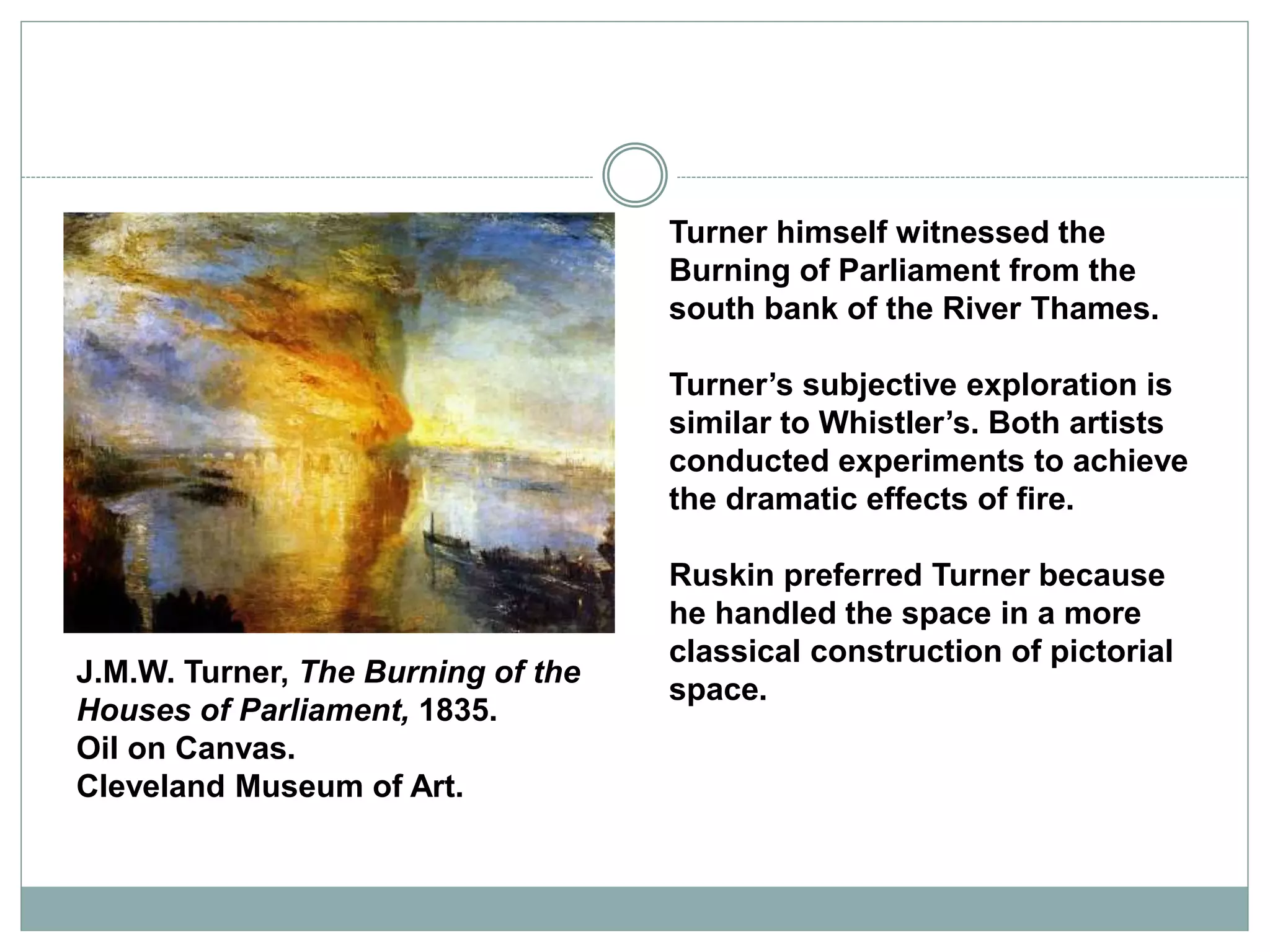
Turner himself witnessed the
Burning of Parliament from the
south bank of the River Thames.
Turner’s subjective exploration is
similar to Whistler’s. Both artists
conducted experiments to achieve
the dramatic effects of fire.
Ruskin preferred Turner because
he handled the space in a more
classical construction of pictorial
space.
J.M.W. Turner, The Burning of the
Houses of Parliament, 1835.
Oil on Canvas.
Cleveland Museum of Art.
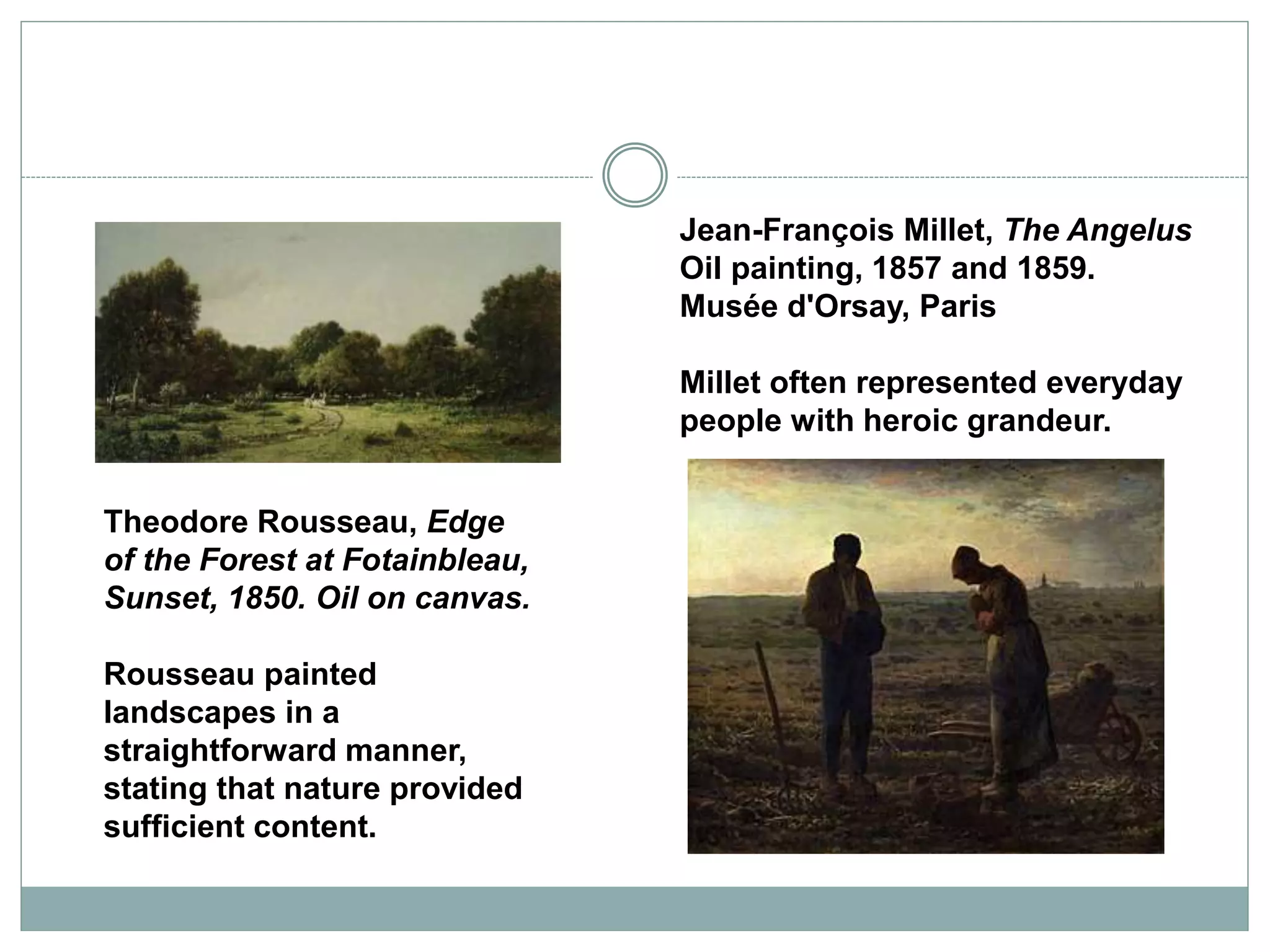
Jean-François Millet, The Angelus
Oil painting, 1857 and 1859.
Musée d'Orsay, Paris
Millet often represented everyday
people with heroic grandeur.
Theodore Rousseau, Edge
of the Forest at Fotainbleau,
Sunset, 1850. Oil on canvas.
Rousseau painted
landscapes in a
straightforward manner,
stating that nature provided
sufficient content.

Chapter 1 the origins of modern art

  • 1.
  • 2.
    James Abbott McNeill Whistler Nocturnein Black and Gold – The Falling Rocket circa 1872–77 Oil on Canvas 23.7 in × 18.3 in Detroit Institute of Arts, Detroit Whistler’s intention was to preserve the mood of the fireworks as they appeared to him, by not describing the scene too literally.
  • 3.
    Critic John Ruskin(1819-1900) and James Abbott McNeill Whistler held opposing views. Whistler opposed accessibility of art by the masses. He believed in “Art for Art’s Sake. In his Nocturnes, Whistler declared modernism's affinity for the abstract. In 1877, Ruskin published a letter regarding Nocturne in Black and Gold: The Falling Rocket, a painting by Whistler which was included in the exhibition at the Grosvenor Gallery. Whistler sued Ruskin for libel. Whistler won but was devastated financially. Ruskin resigned his professorship at Oxford. T he trial was a debate between those who considered art to be vital to social progress, and those who declared that art transcended social concerns.
  • 4.
    Art criticism emergedin the eighteen century in response to art becoming more accessible through public exhibitions. In France such exhibitions were called Salons. The Paris Salon was held every two years and featured hundreds of artworks by mostly members of France’s Royal Academy of Painting and Sculpture. Critics began writing reviews about the aesthetic quality of the artworks on display. Within a short period of time they started to influence the public’s taste. A MARKETPLACE FOR ART The earliest exhibitions were organized by dealers and auctioneers. Economic developments contributed to the creation of a new class: the bourgeoisie who adopted the habits of nobility, to acquire art and other luxuries. Whistler vs. Ruskin trial coincides with the expansion of the art market. MAKING ART AND ARTISTS: THE ROLE OF THE CRITIC
  • 5.
    The trial bankruptedWhistler but he established one of the modernism’s central tenets: that art was the manifestation of the artist’s emotional and intellectual will. THE MODERN ARTIST Until eighteenth century artists worked with the confines of tradition. They were allowed to be inventive with the limits of the tradition in which they worked. The Oath of the Horatii is a large painting by the French artist Jacques-Louis David painted in 1784. David's stylistic simplicity eliminates the distraction from the central moral of the story. David even invented this scene to convey the essence of the narrative.
  • 6.
    Jaques-Louis David. The Oath ofthe Horatii. 1784 Oil on canvas, Musée du Louvre, Paris, France.
  • 7.
    By the endof the eighteenth century the focus on emulation was replaced by artistic invention which was linked the artist’s unique vision. In this context Romanticism emphasized individualism, imagination, and free expression. Romanticism promoted the artist as a “visionary genius” that possessed the ultimate insight into fundamental reality and reveled it though art. Genius, for the Romantics, was something one was born with. It could not be acquired through learning or other means.. Neoclassicism and Romanticism, the influence of art criticism, a growing number of exhibitions, and a growing class of collectors created the foundation of modern art. WHAT DOES IT MEAN TO BE AN ARTIST?: FROM ACADEMIC EMULATION TOWARD ROMANTIC ORIGINALITY
  • 8.
    William Blake Nebuchadnezzar, 1795. Colormonotype print finished in ink and watercolor on paper. 21 x 28 inches. Tate, London. William Blake (1757 – 1827), British painter and printmaker, is an example of the artist as a genius. His art consists of depictions of biblical characters placed in a new unconventional context that crosses into an unsettling realm. The print depicts portraying the Old Testament Babylonian king Nebuchadnezzar II who through hubris lost his mind and was reduced to eating "grass as oxen“.
  • 9.
    Neoclassicism opposed thetradition of linear and atmospheric perspective as a way to organize the pictorial space. David and his followers didn’t abandon the classical tradition. They altered it by reducing the depth and details necessary to create it. David, in The Oath of the Horatii, kept the viewer’s focus on the action of the two groups: the men and the women. Romantic artists relied on diagonals and indefinite atmospheric perspective to match their imagination. Romantic artists wore more experimental and innovating. MAKING SENSE OF A TURBULENT WORLD: THE LEGACY OF NEOCLASSICISM AND ROMANTICISM Théodore Géricault Horse Devoured by a Lion, 1823, Lithograph. The British Museum The artist creates a strong focal point to deliver the story.
  • 10.
    HISTORY PAINTING Neoclassical paintersembraced history painting, and the philosophic ideals of the French Revolution. However, they realized they were limited by the lack of painting models from early Rome, As a result they focused on sculpture of early Rome to draw inspiration from. Ingres’ eclectic mix of styles in The Grand Odalisque prompted harsh criticism when it was first shown. Critics viewed Ingres as a rebel against the contemporary style of form and content. Jean Auguste Dominique Ingres The Grand Odalisque, 1814. Oil on canvas. Louve, Paris.
  • 11.
    This is worse,an etching and wash, is part of his Disasters of War series. The image depicts an event which occurred in Chinchón in December 1808, when the French massacred local men in retaliation for two French soldiers who were killed by Spanish rebels. This depiction is influenced in part on the Hellenistic fragment of a male nude, the Belvedere Torso by an Athenian sculptor. Goya made a study of this sculpture. Francisco Goya This is worse, c. 1812–1815 Etching. National Gallery of Scotland.
  • 12.
    Eugène Delacroix (1798–1863) LionHunt, 1861. Oil on Canvas. The Art Institute of Chicago. This painting was inspired by lenghty trip Delacroix took in 1832, to Morocco, Algeria, and Spain. Delacroix was influenced by the hunt pictures Peter Paul Rubens, the of seventeenth-century master. He was also influenced by John Constable, Joseph Mallord William Turner. These influences are clear in Dealcroix’ use of color and painting technique.
  • 13.
    LANDSCAPE PAINTING In Romanticart, nature with its power and unpredictability, recall the eighteenth-century aesthetic of the Sublime. John Constable’s art reflects the changing meaning of nature during the industrial revolution. He reposition the role of landscape painting in the 19th century. Constable never favored the dramatic historical landscapes. John Constable, The Hay Wain, 1821, oil on canvas, National Gallery of Art, London
  • 14.
    Turner himself witnessedthe Burning of Parliament from the south bank of the River Thames. Turner’s subjective exploration is similar to Whistler’s. Both artists conducted experiments to achieve the dramatic effects of fire. Ruskin preferred Turner because he handled the space in a more classical construction of pictorial space. J.M.W. Turner, The Burning of the Houses of Parliament, 1835. Oil on Canvas. Cleveland Museum of Art.
  • 15.
    Jean-François Millet, TheAngelus Oil painting, 1857 and 1859. Musée d'Orsay, Paris Millet often represented everyday people with heroic grandeur. Theodore Rousseau, Edge of the Forest at Fotainbleau, Sunset, 1850. Oil on canvas. Rousseau painted landscapes in a straightforward manner, stating that nature provided sufficient content.