

Executive Introductory Overview on Agile
By: Joe Little, CST (certified scrum trainer) and MBA

April 2014
Caveat:
• These slides are prompts for multi-lateral discussion.
They do not contain the whole story (which is conveyed
via voice and body language). They might be read as
overly-simplistic. Reading them in isolation can be
misleading.
Goals for this discussion
• This is a first (second) introduction to Agile. We want you
to start to get a flavor for it. It is simple, and yet also
complex.
• This is from an Executive perspective. So, for example, it
will not enable you to start to be a Scrum team member.
• To really be effective as a manager of Agile teams, you
will need more. This is just an introduction.
• This is a 1-hour briefing. We WANT you to ask questions.
Agile is… easy and difficult


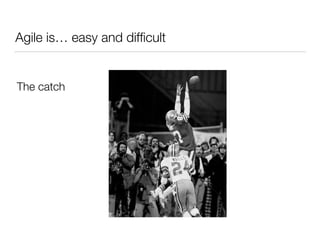
The catch
What is ‘Agile’?
• It is hard to define and some people disagree.
• First try: “Agile is a more successful way of innovating
new products so that customers are happier. Scrum is a
disciplined approach to doing knowledge work in Teams.
An approach that has proven to be much more
successful than the traditional ‘waterfall’ [Royce defined it
in 1970].”
• It is meant to meet business needs to be adaptive to
change, and iterative and incremental in delivery.
Scrum
• Scrum is a ‘flavor’ of Agile.
• Scrum is the most widely used. (Others include: Extreme
Programming, Lean Software Development, Kanban,
DSDM, etc, etc, etc.)
• Scrum was ‘invented’ in the early 1990’s. It has been
used by all types of organizations around the world.
Top Top Goals
• Become the most admired credit union in the country*
• Provide an amazing experience for our members and
staff*
• Firm more successful (by usual metrics)
Keys Goals for ‘delivery’
• More adaptive to change
• Deliver faster*
• More delivered in a given quarter (eg, more Business
Value)
• Employees are more motivated (eg, retention)
Related Goals
• Deliver better quality*
• More visibility or transparency
• More accountability
• Easier to manage
• We need to learn faster.
• Make decisions based on analytics*
What are your goals?
• How do you articulate your goals for Scrum?
!
• Key point: Always connect Scrum to helping you achieve
some of your top goals. We are not ‘doing Scrum’ just to
say ‘we are doing Scrum’.
What is Scrum?
• I want to level-set some of you. And remind all of you.
• And this section, for most of you, makes Scrum
something practical instead of just a vague abstraction.
© Joe Little 2013
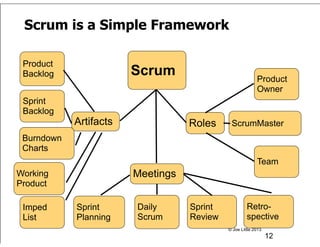
Scrum is a Simple Framework
Scrum
Meetings
Sprint
Planning
Daily
Scrum
Roles
Team
Product
Owner
ScrumMasterArtifacts
Burndown
Charts
Sprint
Backlog
Product
Backlog
Sprint
Review
Retro-
spective
Imped
List
!12
Working
Product
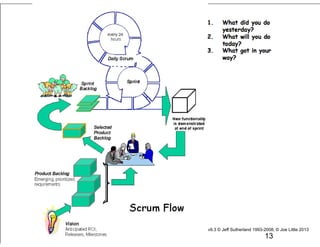
CSM v9.3 © Jeff Sutherland 1993-2008; © Joe Little 2013
!13
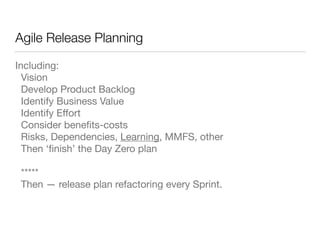
Agile Release Planning
Including:

Vision

Develop Product Backlog

Identify Business Value

Identify Effort

Consider benefits-costs

Risks, Dependencies, Learning, MMFS, other

Then ‘finish’ the Day Zero plan

!
*****

Then — release plan refactoring every Sprint.
Key Issues
• Let’s discuss some key issues for management.
• These are:
• Things you need to know
• How it works
• Things you must take action on
• Typical problem areas
8 Key Issues or Ideas
1. We have knowledge workers
2. Minimize WIP
3. A Team learns
4. Self-organization
5. “Random carbon units”
6. Subtle control
7. “Failure is good”
8. “The bad news does not get better with age”
1. We have ‘knowledge workers’
• We have to enable ‘motivation’ to happen differently
• Daniel Pink (Drive): Autonomy, Mastery, Purpose.
• We have to help them learn.
• It is all about knowledge creation, and, almost surely, in
a Team.
2. Minimize WIP
• Minimize work-in-process. Related: Single-piece flow.
• Why?
• Makes people more productive
• Faster delivery
• Less ‘task-switching’
• FEWER ‘projects’ IN-FLIGHT, but more delivered and
quicker.
!
!
Agile is a paradigm shift.
© Joe Little 2013
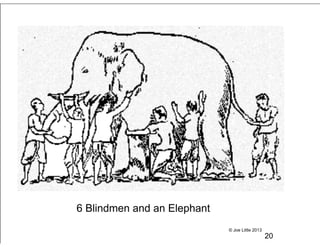
6 Blindmen and an Elephant
!20
3. A Team Learns
• Scrum is a Team sport. BIG IDEA!
• A strong, dedicated, multi-capable, real Team.
• Problems: People don't understand the value of a Team,
Silos, lack of dedication, not fully capable, etc, etc.
Why is a Team important?
• The Team does knowledge creation
• Only the output of the Team is meaningful
• “We must all stand together, or assuredly we shall all
hang separately.” B. Franklin
4. Self-organization
• We establish some basic structures and constraints (few),
and then we let the Team self-organize, self-manage,
self-direct to achieve the mission.
• Wow!
• “We expect them to act like adults. And, usually, they
rise to the occasion.”
• We tell them: “Figure it out.”
5. “Random Carbon Units”
• People: can’t live with ‘em, can’t live without them.
• Two sides to the same coin.
• We want innovation, creativity, learning, the unexpected,
inventiveness, clever solutions to hard problems, the magic of the
Mona Lisa smile.
• We have to accept their ‘individuality’, their uniqueness. (Well, we
have to accept our own uniqueness too.)
• We have to accept that they can be ‘random’ and ‘make mistakes’.
• They are not ‘plug-replaceable’ resources, and they are not ‘reliable’.
6. Subtle control
“Management establishes enough checkpoints to prevent
instability, ambiguity, and tension from turning into chaos.”
“At the same time, management avoids the kinds of rigid
control that impairs creativity and spontaneity.”
“Instead, the emphasis is on ‘self-control’, ‘control through
peer pressure’, and ‘control by love’, which collectively we
call ‘subtle control.’”
7. “Failure is good”
• As managers, we hear these words, and it makes us
uncomfortable. Some of us very uncomfortable. So, let’s
discuss…
• “Day Zero is the dumbest day of the project.”
• “We learn fastest by making small mistakes.”
CSM v9.3 © Jeff Sutherland 1993-2008; © Joe Little 2013
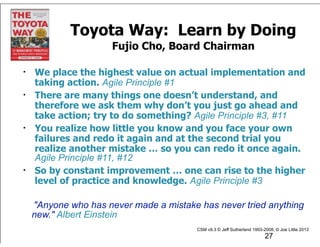
Toyota Way: Learn by Doing

Fujio Cho, Board Chairman
• We place the highest value on actual implementation and
taking action. Agile Principle #1
• There are many things one doesn’t understand, and
therefore we ask them why don’t you just go ahead and
take action; try to do something? Agile Principle #3, #11
• You realize how little you know and you face your own
failures and redo it again and at the second trial you
realize another mistake … so you can redo it once again.
Agile Principle #11, #12
• So by constant improvement … one can rise to the higher
level of practice and knowledge. Agile Principle #3
!
"Anyone who has never made a mistake has never tried anything
new." Albert Einstein
!27
Failure
• “Everything changes, nothing remains the same.” Buddha
• So, in innovation work, in knowledge creation, we have to
accept ‘failure’ or mistakes.
• And, if they learn faster, we can and will actually win ‘in
the end’.
• “Fail fast” - a key Agile phrase.
• BUT: “We made too many wrong mistakes.” (Yogi Berra.)
So, don’t let them do that.
8. “The bad news doesn’t get better with age.”
• While we ‘accept failure as good’ yet we relentlessly and immediately
fix all problems (eg, defects). Seems paradoxical?
• Three reasons:
• It is much cheaper to fix it immediately (while the knowledge is
fresh).
• Motivation: He does not like to write good code on top of bad
code.
• To measure progress better, we need to know it is ‘done’.
• “You have to slow down to go fast” is the saying.
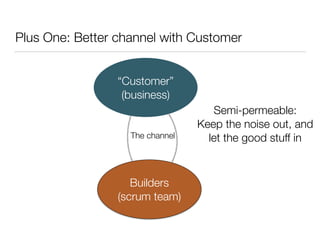
Plus One: Better channel with Customer
“Customer”
(business)
Builders
(scrum team)
The channel
Semi-permeable:
Keep the noise out, and
let the good stuff in
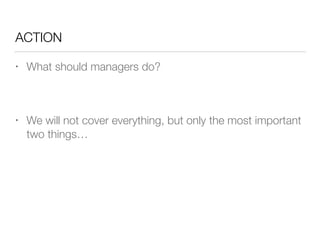
ACTION
• What should managers do?
!
• We will not cover everything, but only the most important
two things…
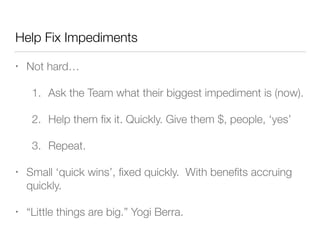
Help Fix Impediments
• Not hard…
1. Ask the Team what their biggest impediment is (now).
2. Help them fix it. Quickly. Give them $, people, ‘yes’
3. Repeat.
• Small ‘quick wins’, fixed quickly. With benefits accruing
quickly.
• “Little things are big.” Yogi Berra.
What are your biggest impediments?
• For one or more teams, if you know.
• Or, take your best guess … for a Scrum team …

or the biggest impediment for adopting Scrum at [firm].
• Anything (anything!) slowing the Team down is an
impediment. (Anything!) Imagine that everything could
change.
• 1 Minute.
ACTION: Learn More
• For example, see the next two articles
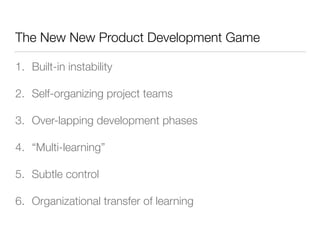
The New New Product Development Game
1. Built-in instability
2. Self-organizing project teams
3. Over-lapping development phases
4. “Multi-learning”
5. Subtle control
6. Organizational transfer of learning
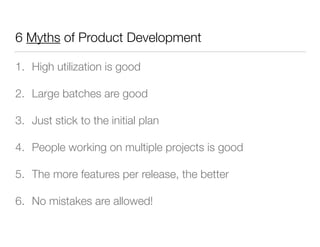
6 Myths of Product Development
1. High utilization is good
2. Large batches are good
3. Just stick to the initial plan
4. People working on multiple projects is good
5. The more features per release, the better
6. No mistakes are allowed!
APPENDIX

Exec Overview to Agile-Scrum

  • 1.
    Executive Introductory Overviewon Agile By: Joe Little, CST (certified scrum trainer) and MBA April 2014
  • 2.
    Caveat: • These slidesare prompts for multi-lateral discussion. They do not contain the whole story (which is conveyed via voice and body language). They might be read as overly-simplistic. Reading them in isolation can be misleading.
  • 3.
    Goals for thisdiscussion • This is a first (second) introduction to Agile. We want you to start to get a flavor for it. It is simple, and yet also complex. • This is from an Executive perspective. So, for example, it will not enable you to start to be a Scrum team member. • To really be effective as a manager of Agile teams, you will need more. This is just an introduction. • This is a 1-hour briefing. We WANT you to ask questions.
  • 4.
    Agile is… easyand difficult 
 The catch
  • 5.
    What is ‘Agile’? •It is hard to define and some people disagree. • First try: “Agile is a more successful way of innovating new products so that customers are happier. Scrum is a disciplined approach to doing knowledge work in Teams. An approach that has proven to be much more successful than the traditional ‘waterfall’ [Royce defined it in 1970].” • It is meant to meet business needs to be adaptive to change, and iterative and incremental in delivery.
  • 6.
    Scrum • Scrum isa ‘flavor’ of Agile. • Scrum is the most widely used. (Others include: Extreme Programming, Lean Software Development, Kanban, DSDM, etc, etc, etc.) • Scrum was ‘invented’ in the early 1990’s. It has been used by all types of organizations around the world.
  • 7.
    Top Top Goals •Become the most admired credit union in the country* • Provide an amazing experience for our members and staff* • Firm more successful (by usual metrics)
  • 8.
    Keys Goals for‘delivery’ • More adaptive to change • Deliver faster* • More delivered in a given quarter (eg, more Business Value) • Employees are more motivated (eg, retention)
  • 9.
    Related Goals • Deliverbetter quality* • More visibility or transparency • More accountability • Easier to manage • We need to learn faster. • Make decisions based on analytics*
  • 10.
    What are yourgoals? • How do you articulate your goals for Scrum? ! • Key point: Always connect Scrum to helping you achieve some of your top goals. We are not ‘doing Scrum’ just to say ‘we are doing Scrum’.
  • 11.
    What is Scrum? •I want to level-set some of you. And remind all of you. • And this section, for most of you, makes Scrum something practical instead of just a vague abstraction.
  • 12.
    © Joe Little2013 Scrum is a Simple Framework Scrum Meetings Sprint Planning Daily Scrum Roles Team Product Owner ScrumMasterArtifacts Burndown Charts Sprint Backlog Product Backlog Sprint Review Retro- spective Imped List !12 Working Product
  • 13.
    CSM v9.3 ©Jeff Sutherland 1993-2008; © Joe Little 2013 !13
  • 14.
    Agile Release Planning Including: Vision DevelopProduct Backlog Identify Business Value Identify Effort Consider benefits-costs Risks, Dependencies, Learning, MMFS, other Then ‘finish’ the Day Zero plan ! ***** Then — release plan refactoring every Sprint.
  • 15.
    Key Issues • Let’sdiscuss some key issues for management. • These are: • Things you need to know • How it works • Things you must take action on • Typical problem areas
  • 16.
    8 Key Issuesor Ideas 1. We have knowledge workers 2. Minimize WIP 3. A Team learns 4. Self-organization 5. “Random carbon units” 6. Subtle control 7. “Failure is good” 8. “The bad news does not get better with age”
  • 17.
    1. We have‘knowledge workers’ • We have to enable ‘motivation’ to happen differently • Daniel Pink (Drive): Autonomy, Mastery, Purpose. • We have to help them learn. • It is all about knowledge creation, and, almost surely, in a Team.
  • 18.
    2. Minimize WIP •Minimize work-in-process. Related: Single-piece flow. • Why? • Makes people more productive • Faster delivery • Less ‘task-switching’ • FEWER ‘projects’ IN-FLIGHT, but more delivered and quicker.
  • 19.
    ! ! Agile is aparadigm shift.
  • 20.
    © Joe Little2013 6 Blindmen and an Elephant !20
  • 21.
    3. A TeamLearns • Scrum is a Team sport. BIG IDEA! • A strong, dedicated, multi-capable, real Team. • Problems: People don't understand the value of a Team, Silos, lack of dedication, not fully capable, etc, etc.
  • 22.
    Why is aTeam important? • The Team does knowledge creation • Only the output of the Team is meaningful • “We must all stand together, or assuredly we shall all hang separately.” B. Franklin
  • 23.
    4. Self-organization • Weestablish some basic structures and constraints (few), and then we let the Team self-organize, self-manage, self-direct to achieve the mission. • Wow! • “We expect them to act like adults. And, usually, they rise to the occasion.” • We tell them: “Figure it out.”
  • 24.
    5. “Random CarbonUnits” • People: can’t live with ‘em, can’t live without them. • Two sides to the same coin. • We want innovation, creativity, learning, the unexpected, inventiveness, clever solutions to hard problems, the magic of the Mona Lisa smile. • We have to accept their ‘individuality’, their uniqueness. (Well, we have to accept our own uniqueness too.) • We have to accept that they can be ‘random’ and ‘make mistakes’. • They are not ‘plug-replaceable’ resources, and they are not ‘reliable’.
  • 25.
    6. Subtle control “Managementestablishes enough checkpoints to prevent instability, ambiguity, and tension from turning into chaos.” “At the same time, management avoids the kinds of rigid control that impairs creativity and spontaneity.” “Instead, the emphasis is on ‘self-control’, ‘control through peer pressure’, and ‘control by love’, which collectively we call ‘subtle control.’”
  • 26.
    7. “Failure isgood” • As managers, we hear these words, and it makes us uncomfortable. Some of us very uncomfortable. So, let’s discuss… • “Day Zero is the dumbest day of the project.” • “We learn fastest by making small mistakes.”
  • 27.
    CSM v9.3 ©Jeff Sutherland 1993-2008; © Joe Little 2013 Toyota Way: Learn by Doing
 Fujio Cho, Board Chairman • We place the highest value on actual implementation and taking action. Agile Principle #1 • There are many things one doesn’t understand, and therefore we ask them why don’t you just go ahead and take action; try to do something? Agile Principle #3, #11 • You realize how little you know and you face your own failures and redo it again and at the second trial you realize another mistake … so you can redo it once again. Agile Principle #11, #12 • So by constant improvement … one can rise to the higher level of practice and knowledge. Agile Principle #3 ! "Anyone who has never made a mistake has never tried anything new." Albert Einstein !27
  • 28.
    Failure • “Everything changes,nothing remains the same.” Buddha • So, in innovation work, in knowledge creation, we have to accept ‘failure’ or mistakes. • And, if they learn faster, we can and will actually win ‘in the end’. • “Fail fast” - a key Agile phrase. • BUT: “We made too many wrong mistakes.” (Yogi Berra.) So, don’t let them do that.
  • 29.
    8. “The badnews doesn’t get better with age.” • While we ‘accept failure as good’ yet we relentlessly and immediately fix all problems (eg, defects). Seems paradoxical? • Three reasons: • It is much cheaper to fix it immediately (while the knowledge is fresh). • Motivation: He does not like to write good code on top of bad code. • To measure progress better, we need to know it is ‘done’. • “You have to slow down to go fast” is the saying.
  • 30.
    Plus One: Betterchannel with Customer “Customer” (business) Builders (scrum team) The channel Semi-permeable: Keep the noise out, and let the good stuff in
  • 31.
    ACTION • What shouldmanagers do? ! • We will not cover everything, but only the most important two things…
  • 32.
    Help Fix Impediments •Not hard… 1. Ask the Team what their biggest impediment is (now). 2. Help them fix it. Quickly. Give them $, people, ‘yes’ 3. Repeat. • Small ‘quick wins’, fixed quickly. With benefits accruing quickly. • “Little things are big.” Yogi Berra.
  • 33.
    What are yourbiggest impediments? • For one or more teams, if you know. • Or, take your best guess … for a Scrum team …
 or the biggest impediment for adopting Scrum at [firm]. • Anything (anything!) slowing the Team down is an impediment. (Anything!) Imagine that everything could change. • 1 Minute.
  • 34.
    ACTION: Learn More •For example, see the next two articles
  • 35.
    The New NewProduct Development Game 1. Built-in instability 2. Self-organizing project teams 3. Over-lapping development phases 4. “Multi-learning” 5. Subtle control 6. Organizational transfer of learning
  • 36.
    6 Myths ofProduct Development 1. High utilization is good 2. Large batches are good 3. Just stick to the initial plan 4. People working on multiple projects is good 5. The more features per release, the better 6. No mistakes are allowed!
  • 37.