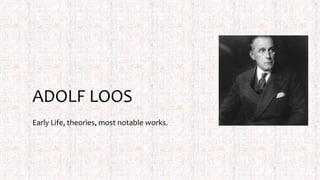
ADOLF LOOS
Early Life, theories, most notable works.
Early Life
-Background
 Adolf Franz Karl Viktor Maria Loos
Born - 10TH December1870
 Born with a hearing impairment and was significantly handicapped
by it throughout his life.
 His father was a stonemason and died when he was nine.
Career
 Travelled to U.S when he was 23, supported himself doing odd jobs
initially, for visiting other cities like Chicago, St. Louis, New York.
(1893-1896)
 Returned to Vienna in 1896.
 Was a prominent figure in Vienna and was a friend of Karl Cross
(writer) and Ludwig Wittigenstien (Philosopher).
 Inspired by his years in New World (America) he devoted his entire
life to architecture.
 Briefly associated with the “Vienna Secession” (the union of
Austrian artists which included painters, sculptors and architects)
in 1896.
 He then rejected the style to form a new, plain, unadorned style.
 Early commissions- interior designs for shops and cafes in Vienna.
Architectural theory
 Was the author of several polemical (strongly critical) works.
 In his “Spoken into the void”(a collection of essays)
He attacked the Vienna Seccession at the time when the movement
was at its peak.
 Noted for the essay- “ornament and crime”, 1913.
 Explored the idea of progress of culture being associated with
deletion of ornament from everyday objects.
 Believed that it was a crime forcing craftsmen or builders, for
wasting time on ornamentation.
 His stripped down buildings influenced modern architecture and
stirred controversy.
 lack of ornamentation was noticed on the exteriors, but the
interiors were finished with rich and expensive materials like stone
marble and wood, displaying natural patterns and textures,
executed with high quality craftsmanship.
 In 1904 he visited the island of Skyros and was influenced by the
cubic architecture of Greek islands.
 He had an admiration for classical architecture, reflected in his
writings for “The Chicago Tribune” competition,about doric
column.
Prominent Works
Steiner house, Rufer house, Villa Mueller
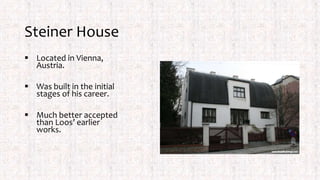
Steiner House
 Located in Vienna,
Austria.
 Was built in the initial
stages of his career.
 Much better accepted
than Loos’ earlier
works.
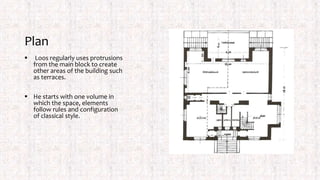
Plan
 Loos regularly uses protrusions
from the main block to create
other areas of the building such
as terraces.
 He starts with one volume in
which the space, elements
follow rules and configuration
of classical style.
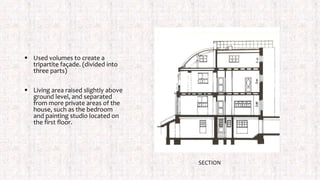
 Used volumes to create a
tripartite façade. (divided into
three parts)
 Living area raised slightly above
ground level, and separated
from more private areas of the
house, such as the bedroom
and painting studio located on
the first floor.
SECTION
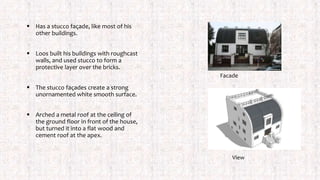
 Has a stucco façade, like most of his
other buildings.
 Loos built his buildings with roughcast
walls, and used stucco to form a
protective layer over the bricks.
 The stucco façades create a strong
unornamented white smooth surface.
 Arched a metal roof at the ceiling of
the ground floor in front of the house,
but turned it into a flat wood and
cement roof at the apex.
Facade
View
Rufer House
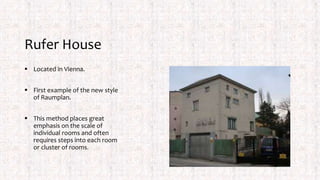
 Located in Vienna.
 First example of the new style
of Raumplan.
 This method places great
emphasis on the scale of
individual rooms and often
requires steps into each room
or cluster of rooms.
Plan
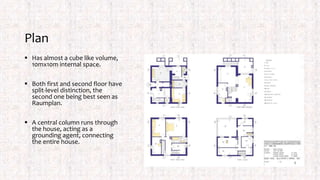
 Has almost a cube like volume,
10mx10m internal space.
 Both first and second floor have
split-level distinction, the
second one being best seen as
Raumplan.
 A central column runs through
the house, acting as a
grounding agent, connecting
the entire house.
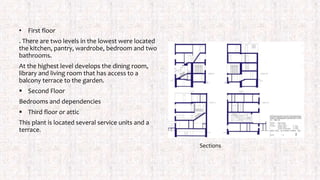
• First floor
. There are two levels in the lowest were located
the kitchen, pantry, wardrobe, bedroom and two
bathrooms.
At the highest level develops the dining room,
library and living room that has access to a
balcony terrace to the garden.
 Second Floor
Bedrooms and dependencies
 Third floor or attic
This plant is located several service units and a
terrace.
Sections
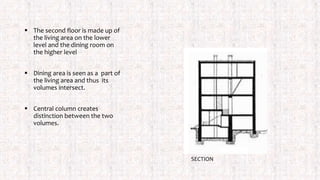
 The second floor is made up of
the living area on the lower
level and the dining room on
the higher level
 Dining area is seen as a part of
the living area and thus its
volumes intersect.
 Central column creates
distinction between the two
volumes.
SECTION
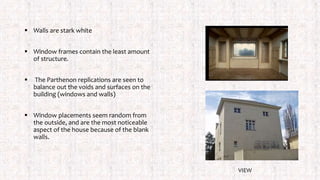
 Walls are stark white
 Window frames contain the least amount
of structure.
 The Parthenon replications are seen to
balance out the voids and surfaces on the
building (windows and walls)
 Window placements seem random from
the outside, and are the most noticeable
aspect of the house because of the blank
walls.
VIEW
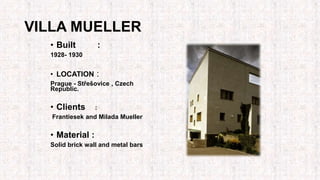
VILLA MUELLER
• Built :
1928- 1930
• LOCATION :
Prague - Střešovice , Czech
Republic.
• Clients :
Frantiesek and Milada Mueller
• Material :
Solid brick wall and metal bars
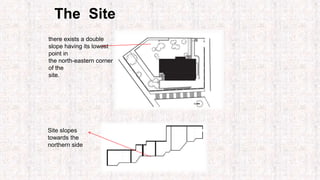
The Site
there exists a double
slope having its lowest
point in
the north-eastern corner
of the
site.
Site slopes
towards the
northern side
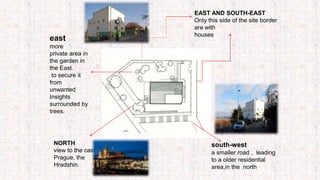
NORTH
view to the castle of
Prague, the
Hradshin.
EAST AND SOUTH-EAST
Only this side of the site border
are with
houses
south-west
a smaller road , leading
to a older residential
area,in the north
east
more
private area in
the garden in
the East.
to secure it
from
unwanted
Insights
surrounded by
trees.
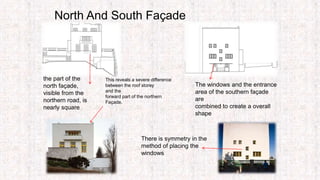
North And South Façade
This reveals a severe difference
between the roof storey
and the
forward part of the northern
Façade.
There is symmetry in the
method of placing the
windows
The windows and the entrance
area of the southern façade
are
combined to create a overall
shape
the part of the
north façade,
visible from the
northern road, is
nearly square
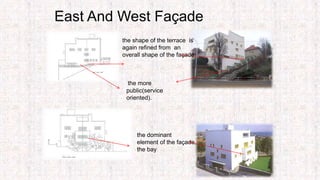
East And West Façade
the more
public(service
oriented).
the shape of the terrace is
again refined from an
overall shape of the façade
the dominant
element of the façade,
the bay
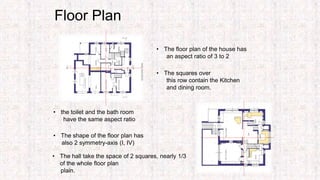
Floor Plan
• The floor plan of the house has
an aspect ratio of 3 to 2
• The shape of the floor plan has
also 2 symmetry-axis (I, IV)
• The squares over
this row contain the Kitchen
and dining room.
• The hall take the space of 2 squares, nearly 1/3
of the whole floor plan
plain.
• the toilet and the bath room
have the same aspect ratio
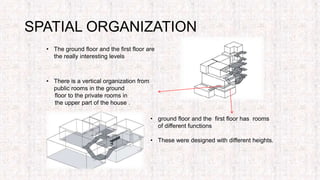
SPATIAL ORGANIZATION
• The ground floor and the first floor are
the really interesting levels
• There is a vertical organization from
public rooms in the ground
floor to the private rooms in
the upper part of the house .
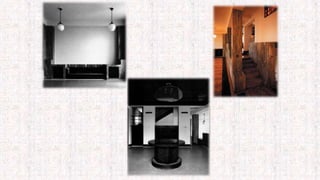
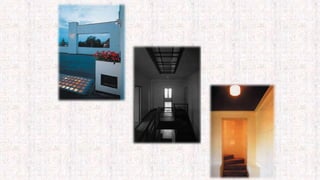
• ground floor and the first floor has rooms
of different functions
• These were designed with different heights.
https://en.wikiarquitectura.com/index.php/Rufer_House
https://en.wikipedia.org/wiki/Rufer_House
https://en.wikipedia.org/wiki/Steiner_House
Adolf_Loos-The_Life-The_Theories-Villa_Mueller.pdf
wikipedia. org/wiki/Villa_Muller
Google images
BIBLIOGRAPHY

Adolf loos

  • 1.
    ADOLF LOOS Early Life,theories, most notable works.
  • 2.
    Early Life -Background  AdolfFranz Karl Viktor Maria Loos Born - 10TH December1870  Born with a hearing impairment and was significantly handicapped by it throughout his life.  His father was a stonemason and died when he was nine.
  • 3.
    Career  Travelled toU.S when he was 23, supported himself doing odd jobs initially, for visiting other cities like Chicago, St. Louis, New York. (1893-1896)  Returned to Vienna in 1896.  Was a prominent figure in Vienna and was a friend of Karl Cross (writer) and Ludwig Wittigenstien (Philosopher).
  • 4.
     Inspired byhis years in New World (America) he devoted his entire life to architecture.  Briefly associated with the “Vienna Secession” (the union of Austrian artists which included painters, sculptors and architects) in 1896.  He then rejected the style to form a new, plain, unadorned style.  Early commissions- interior designs for shops and cafes in Vienna.
  • 5.
    Architectural theory  Wasthe author of several polemical (strongly critical) works.  In his “Spoken into the void”(a collection of essays) He attacked the Vienna Seccession at the time when the movement was at its peak.  Noted for the essay- “ornament and crime”, 1913.
  • 6.
     Explored theidea of progress of culture being associated with deletion of ornament from everyday objects.  Believed that it was a crime forcing craftsmen or builders, for wasting time on ornamentation.  His stripped down buildings influenced modern architecture and stirred controversy.
  • 7.
     lack ofornamentation was noticed on the exteriors, but the interiors were finished with rich and expensive materials like stone marble and wood, displaying natural patterns and textures, executed with high quality craftsmanship.  In 1904 he visited the island of Skyros and was influenced by the cubic architecture of Greek islands.  He had an admiration for classical architecture, reflected in his writings for “The Chicago Tribune” competition,about doric column.
  • 8.
    Prominent Works Steiner house,Rufer house, Villa Mueller
  • 9.
    Steiner House  Locatedin Vienna, Austria.  Was built in the initial stages of his career.  Much better accepted than Loos’ earlier works.
  • 10.
    Plan  Loos regularlyuses protrusions from the main block to create other areas of the building such as terraces.  He starts with one volume in which the space, elements follow rules and configuration of classical style.
  • 11.
     Used volumesto create a tripartite façade. (divided into three parts)  Living area raised slightly above ground level, and separated from more private areas of the house, such as the bedroom and painting studio located on the first floor. SECTION
  • 12.
     Has astucco façade, like most of his other buildings.  Loos built his buildings with roughcast walls, and used stucco to form a protective layer over the bricks.  The stucco façades create a strong unornamented white smooth surface.  Arched a metal roof at the ceiling of the ground floor in front of the house, but turned it into a flat wood and cement roof at the apex. Facade View
  • 13.
    Rufer House  Locatedin Vienna.  First example of the new style of Raumplan.  This method places great emphasis on the scale of individual rooms and often requires steps into each room or cluster of rooms.
  • 14.
    Plan  Has almosta cube like volume, 10mx10m internal space.  Both first and second floor have split-level distinction, the second one being best seen as Raumplan.  A central column runs through the house, acting as a grounding agent, connecting the entire house.
  • 15.
    • First floor .There are two levels in the lowest were located the kitchen, pantry, wardrobe, bedroom and two bathrooms. At the highest level develops the dining room, library and living room that has access to a balcony terrace to the garden.  Second Floor Bedrooms and dependencies  Third floor or attic This plant is located several service units and a terrace. Sections
  • 16.
     The secondfloor is made up of the living area on the lower level and the dining room on the higher level  Dining area is seen as a part of the living area and thus its volumes intersect.  Central column creates distinction between the two volumes. SECTION
  • 17.
     Walls arestark white  Window frames contain the least amount of structure.  The Parthenon replications are seen to balance out the voids and surfaces on the building (windows and walls)  Window placements seem random from the outside, and are the most noticeable aspect of the house because of the blank walls. VIEW
  • 18.
    VILLA MUELLER • Built: 1928- 1930 • LOCATION : Prague - Střešovice , Czech Republic. • Clients : Frantiesek and Milada Mueller • Material : Solid brick wall and metal bars
  • 19.
    The Site there existsa double slope having its lowest point in the north-eastern corner of the site. Site slopes towards the northern side
  • 20.
    NORTH view to thecastle of Prague, the Hradshin. EAST AND SOUTH-EAST Only this side of the site border are with houses south-west a smaller road , leading to a older residential area,in the north east more private area in the garden in the East. to secure it from unwanted Insights surrounded by trees.
  • 21.
    North And SouthFaçade This reveals a severe difference between the roof storey and the forward part of the northern Façade. There is symmetry in the method of placing the windows The windows and the entrance area of the southern façade are combined to create a overall shape the part of the north façade, visible from the northern road, is nearly square
  • 22.
    East And WestFaçade the more public(service oriented). the shape of the terrace is again refined from an overall shape of the façade the dominant element of the façade, the bay
  • 23.
    Floor Plan • Thefloor plan of the house has an aspect ratio of 3 to 2 • The shape of the floor plan has also 2 symmetry-axis (I, IV) • The squares over this row contain the Kitchen and dining room. • The hall take the space of 2 squares, nearly 1/3 of the whole floor plan plain. • the toilet and the bath room have the same aspect ratio
  • 24.
    SPATIAL ORGANIZATION • Theground floor and the first floor are the really interesting levels • There is a vertical organization from public rooms in the ground floor to the private rooms in the upper part of the house . • ground floor and the first floor has rooms of different functions • These were designed with different heights.
  • 27.