Bangalore , is the capital of the Indian state of Karnataka. Located on the Deccan Plateau in the
south-eastern part of Karnataka, Bangalore is India's third most populous city and fifth-most
populous urban agglomeration. Bangalore is well known as a hub for India's information technology
sector. It is among the top 10 preferred entrepreneurial locations in the world.
•Bangalore experiences with distinct wet and dry seasons.
• Due to its high elevation, Bangalore usually enjoys a more moderate climate throughout the year,
although occasional heat waves can make things very uncomfortable in the summer.
•The coolest month is December with an average low temperature of 15.4 °C and the hottest month is
April with an average high temperature of 32.8 °C.
• The highest temperature ever recorded in Bangalore is 38.9 ° and the lowest ever is 7.8 °C . Winter
temperatures rarely drop below 12 °C (54 °F), and summer temperatures seldom exceed 34–35 °C
(<100 °F).

• Bangalore receives rainfall from both the northeast and the southwest monsoons and the wettest
months are September, October and August, in that order. The summer heat is moderated by fairly
frequent thunderstorms, which occasionally cause power outages and local flooding.
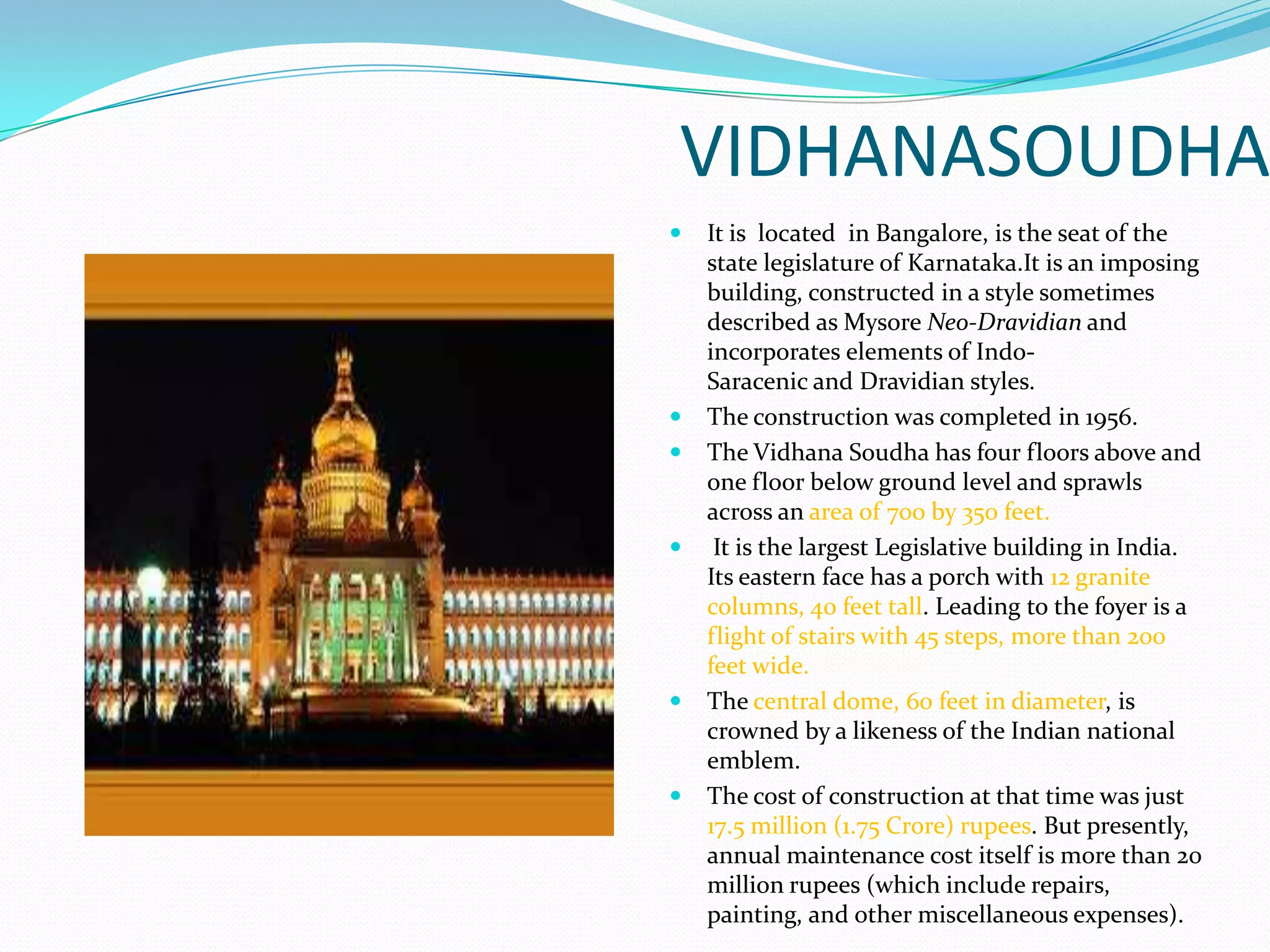
VIDHANASOUDHA
   It is located in Bangalore, is the seat of the
    state legislature of Karnataka.It is an imposing
    building, constructed in a style sometimes
    described as Mysore Neo-Dravidian and
    incorporates elements of Indo-
    Saracenic and Dravidian styles.
   The construction was completed in 1956.
   The Vidhana Soudha has four floors above and
    one floor below ground level and sprawls
    across an area of 700 by 350 feet.
    It is the largest Legislative building in India.
    Its eastern face has a porch with 12 granite
    columns, 40 feet tall. Leading to the foyer is a
    flight of stairs with 45 steps, more than 200
    feet wide.
   The central dome, 60 feet in diameter, is
    crowned by a likeness of the Indian national
    emblem.
   The cost of construction at that time was just
    17.5 million (1.75 Crore) rupees. But presently,
    annual maintenance cost itself is more than 20
    million rupees (which include repairs,
    painting, and other miscellaneous expenses).
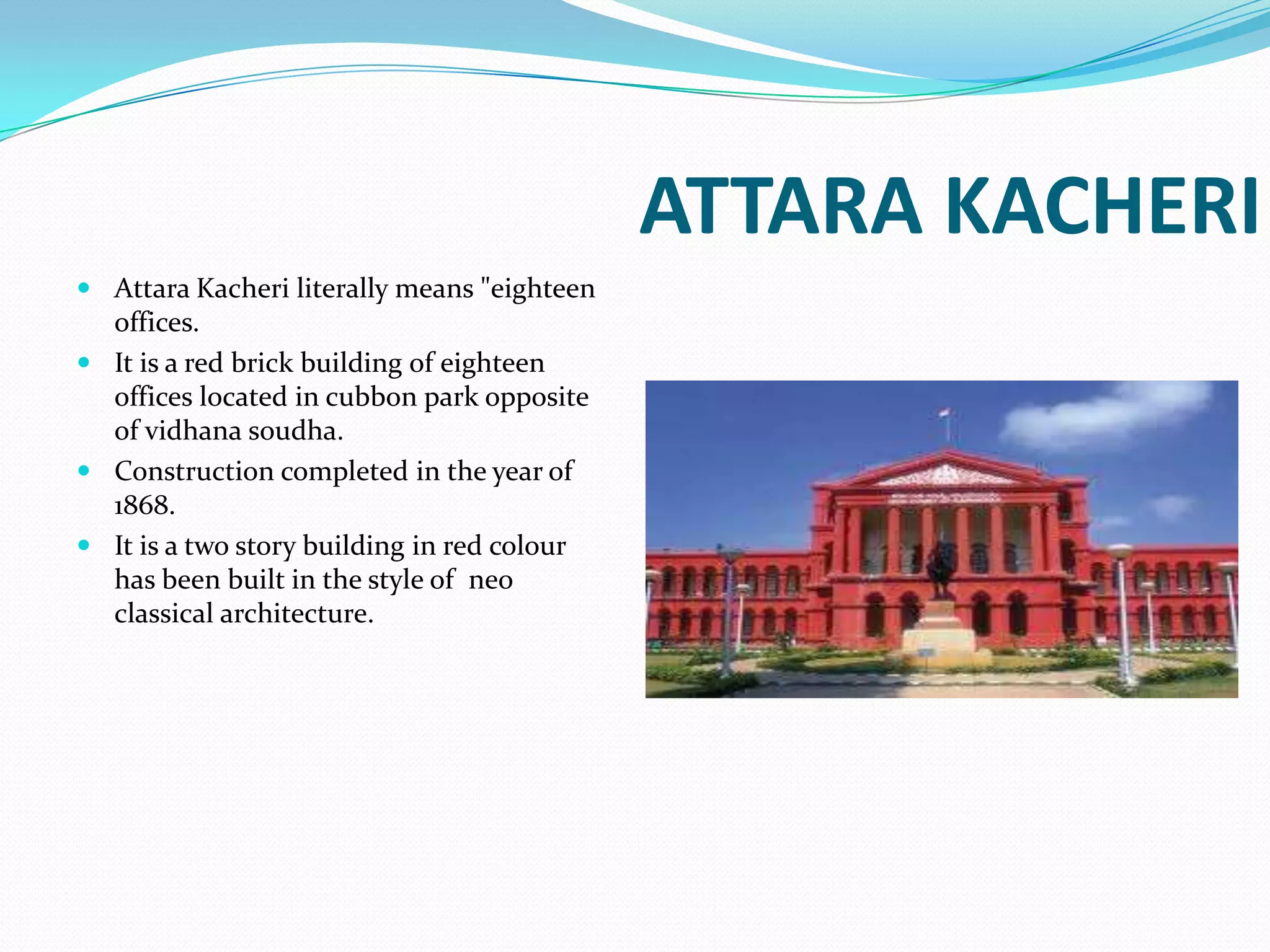
ATTARA KACHERI
 Attara Kacheri literally means "eighteen
  offices.
 It is a red brick building of eighteen
  offices located in cubbon park opposite
  of vidhana soudha.
 Construction completed in the year of
  1868.
 It is a two story building in red colour
  has been built in the style of neo
  classical architecture.
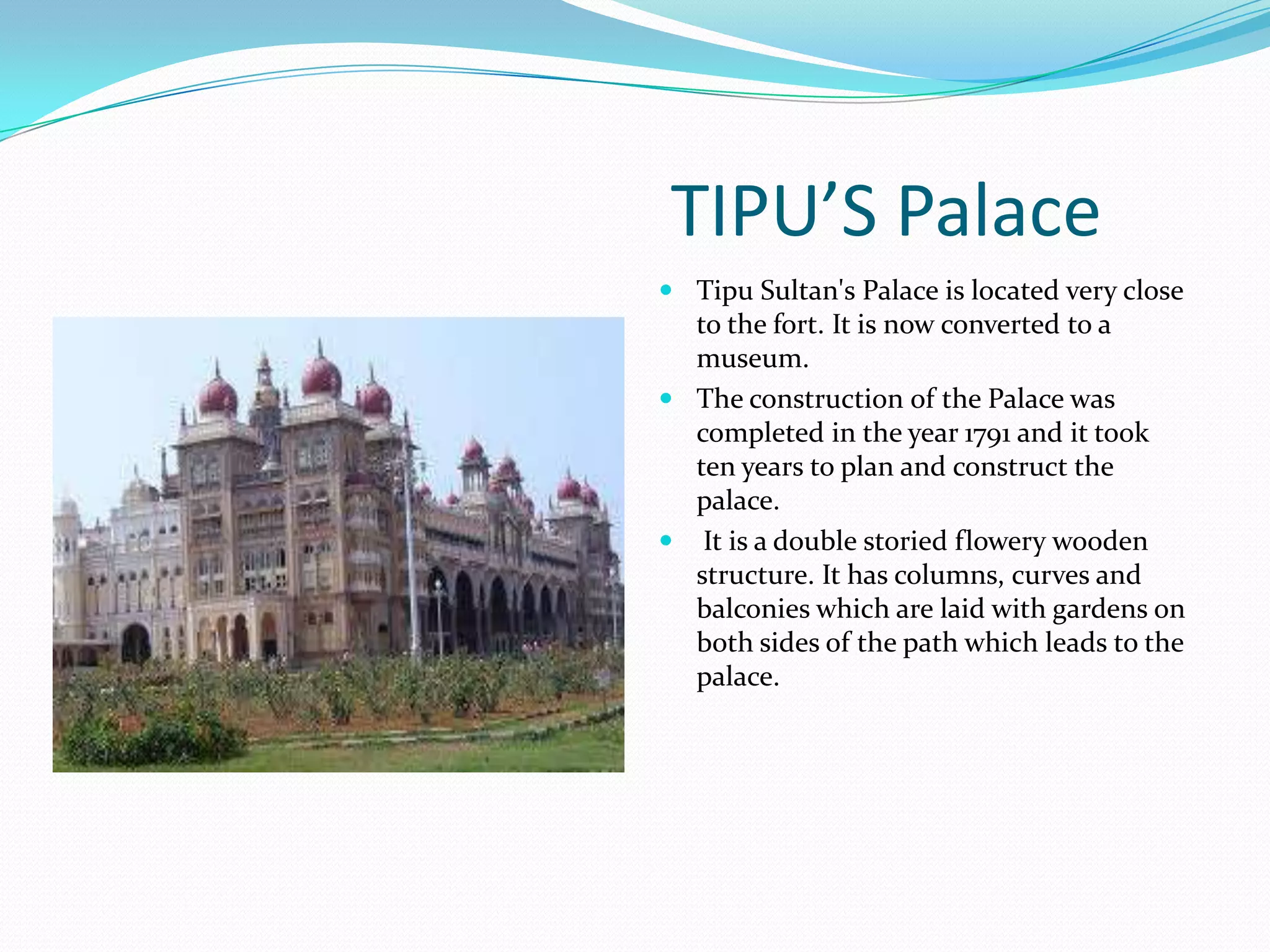
TIPU’S Palace
 Tipu Sultan's Palace is located very close
  to the fort. It is now converted to a
  museum.
 The construction of the Palace was
  completed in the year 1791 and it took
  ten years to plan and construct the
  palace.
    It is a double storied flowery wooden
    structure. It has columns, curves and
    balconies which are laid with gardens on
    both sides of the path which leads to the
    palace.
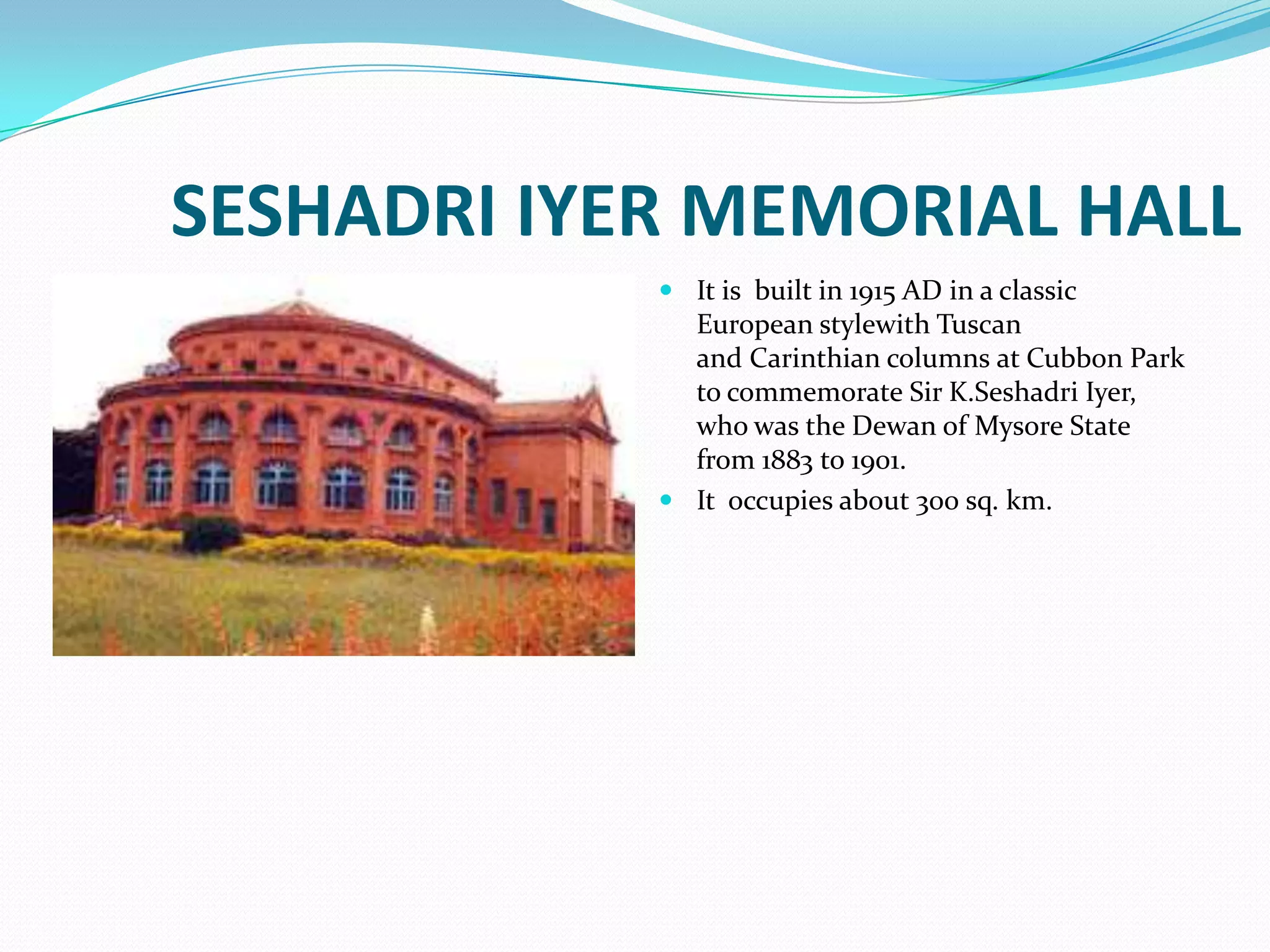
SESHADRI IYER MEMORIAL HALL
             It is built in 1915 AD in a classic
              European stylewith Tuscan
              and Carinthian columns at Cubbon Park
              to commemorate Sir K.Seshadri Iyer,
              who was the Dewan of Mysore State
              from 1883 to 1901.
             It occupies about 300 sq. km.
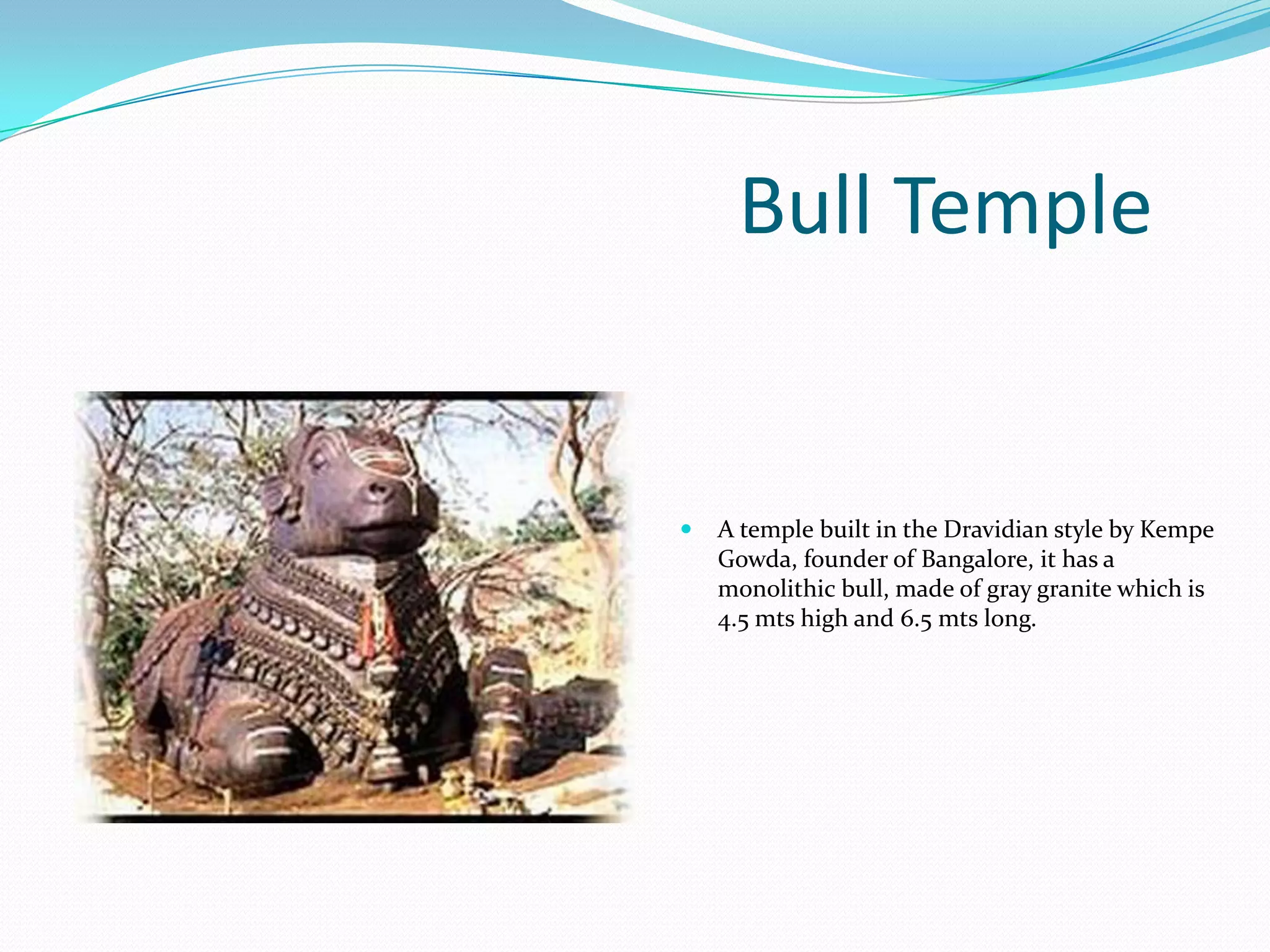
Bull Temple


   A temple built in the Dravidian style by Kempe
    Gowda, founder of Bangalore, it has a
    monolithic bull, made of gray granite which is
    4.5 mts high and 6.5 mts long.
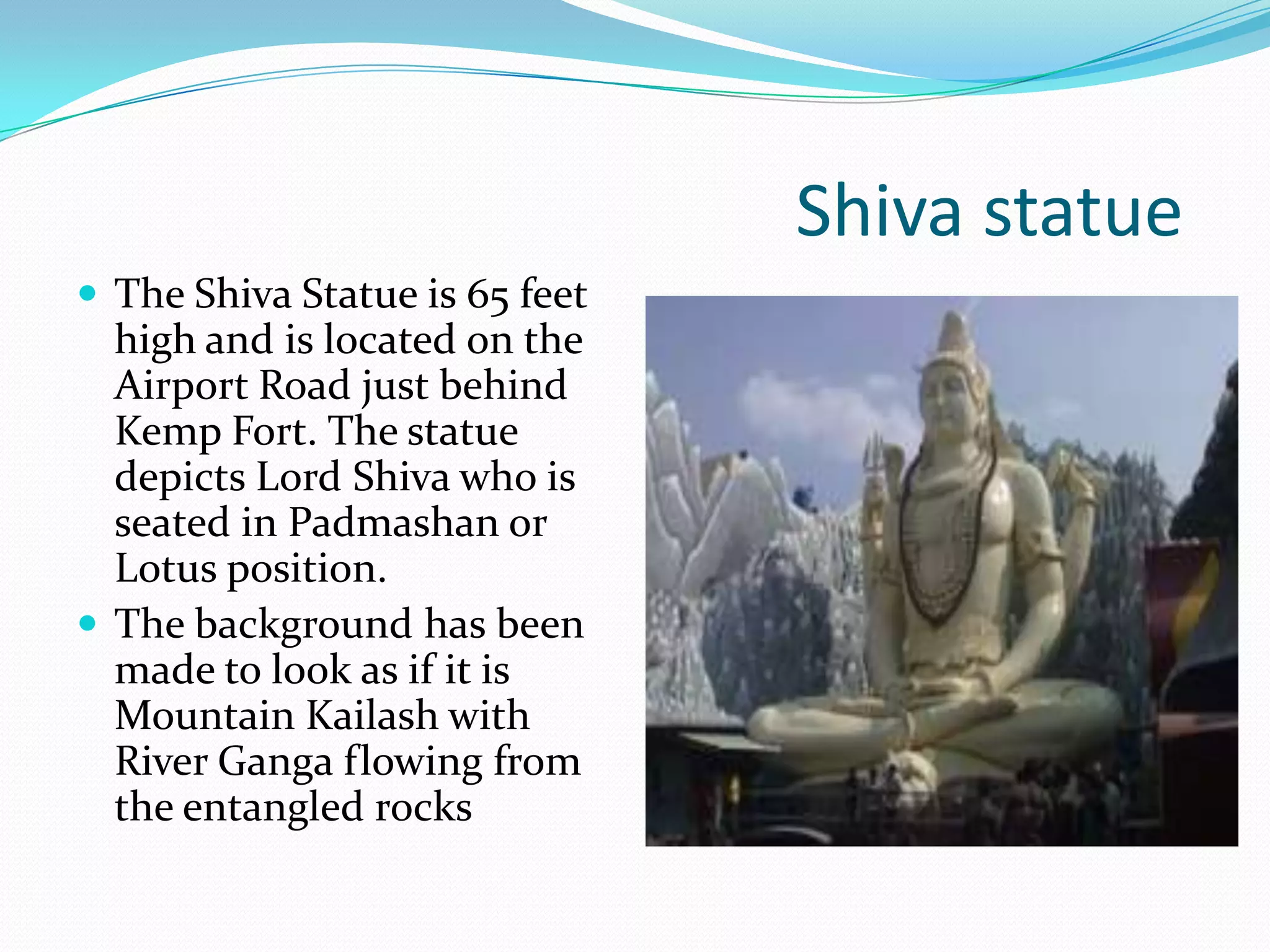
Shiva statue
 The Shiva Statue is 65 feet
  high and is located on the
  Airport Road just behind
  Kemp Fort. The statue
  depicts Lord Shiva who is
  seated in Padmashan or
  Lotus position.
 The background has been
  made to look as if it is
  Mountain Kailash with
  River Ganga flowing from
  the entangled rocks
•Hoysala architecture is the building style developed under the rule
of the Hoysala Empire between the 11th and 14th centuries.
•It influence was at its peak in the 13th century, when it dominated
the Southern Deccan Plateau region.
•Some example of Hoysala architectural style, including
the Chennakesava Temple at Belur, the Hoysaleswara
Temple at Halebidu, and the Kesava Temple atSomanathapura.
• Study of the Hoysala architectural style has revealed a
negligible Indo-Aryan influence while the impact of Southern
Indian style is more distinct.
ARCHITECTURAL ELEMENTS
VIMANA ,MANDAPA,JAGATII
 Vimana:- A typical Hindu temple in Dravidian style may have multiple gopurams, typically
   constructed into multiple walls in tiers around the main shrine. The temple's walls are typically
   square with the outer most wall having four gopuras, one each on every side, situated exactly in the
   center of each wall. The sanctum sanctorum and its towering roof (the central deity's shrine) are also
   called the Vimana. Generally, these do not assume as much significance as the outer gopurams, with
   the exception of a few temples where the sanctum sanctorum's roofs are as famous as the temple
   complex itself.
 Mandapa:- A mandapa              is a pillared outdoor hall or pavilion for public rituals. In
   the Hindu temple the mandapa is a porch-like structure through the leading to the temple. It
   is used for religious dancing and music and is part of the basic temple compound. The prayer
   hall was generally built in front of the temple's sanctum sanctorum .
 Jagati:- It is a raised surface, platform or terrace upon which some buddhist or hindu
  temples are built.This feature is seen in isolated temples such as the temples of Khajuraho. It is
  usually not seen in temples enclosed by walls.
 It lies on a base which adds height to structure.

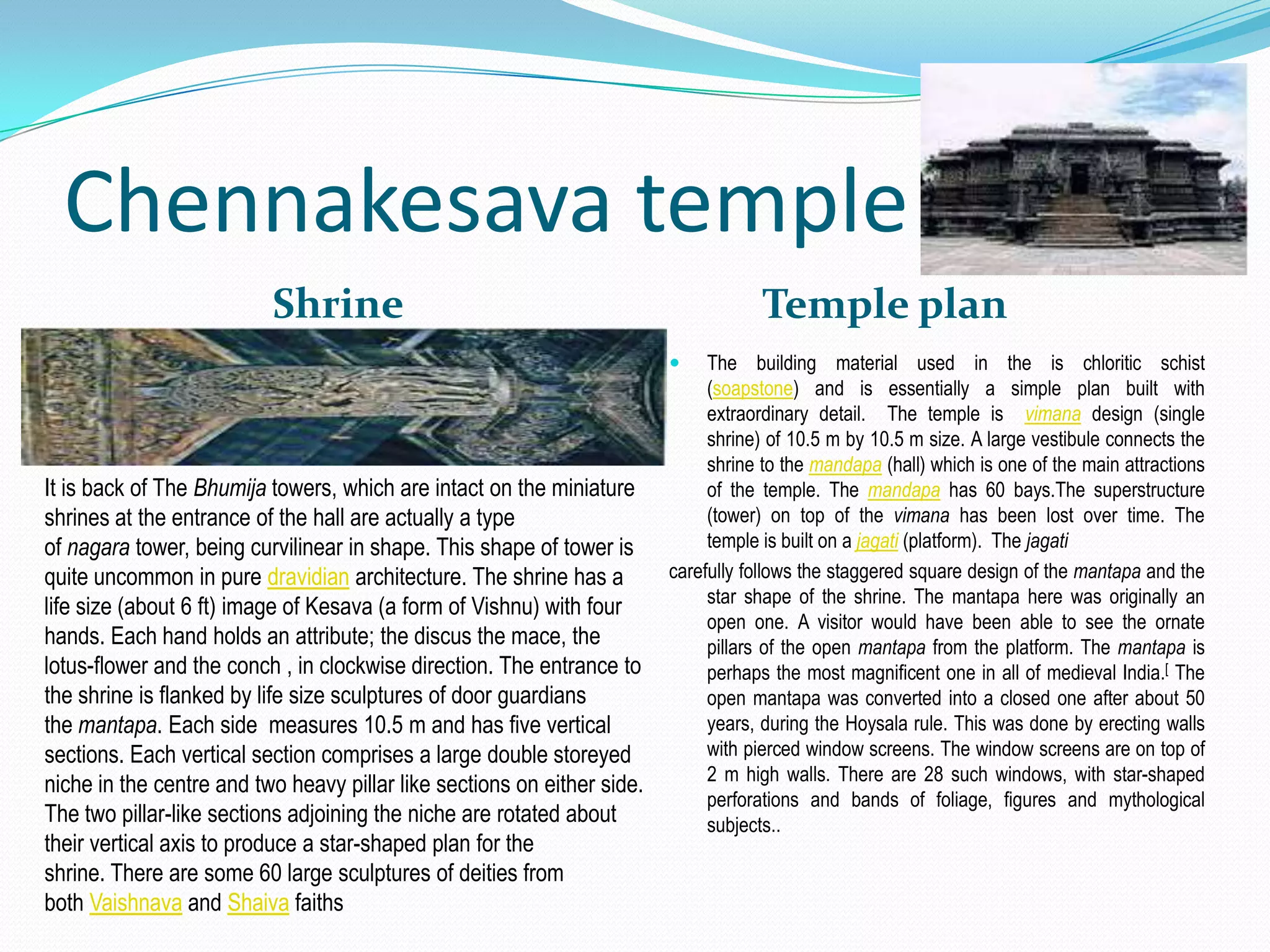
Chennakesava temple
                          Shrine                                                     Temple plan
                                                                             The building material used in the is chloritic schist
                                                                              (soapstone) and is essentially a simple plan built with
                                                                              extraordinary detail. The temple is vimana design (single
                                                                              shrine) of 10.5 m by 10.5 m size. A large vestibule connects the
                                                                              shrine to the mandapa (hall) which is one of the main attractions
It is back of The Bhumija towers, which are intact on the miniature           of the temple. The mandapa has 60 bays.The superstructure
shrines at the entrance of the hall are actually a type                       (tower) on top of the vimana has been lost over time. The
of nagara tower, being curvilinear in shape. This shape of tower is           temple is built on a jagati (platform). The jagati
quite uncommon in pure dravidian architecture. The shrine has a          carefully follows the staggered square design of the mantapa and the
                                                                              star shape of the shrine. The mantapa here was originally an
life size (about 6 ft) image of Kesava (a form of Vishnu) with four
                                                                              open one. A visitor would have been able to see the ornate
hands. Each hand holds an attribute; the discus the mace, the                 pillars of the open mantapa from the platform. The mantapa is
lotus-flower and the conch , in clockwise direction. The entrance to          perhaps the most magnificent one in all of medieval India.[ The
the shrine is flanked by life size sculptures of door guardians               open mantapa was converted into a closed one after about 50
the mantapa. Each side measures 10.5 m and has five vertical                  years, during the Hoysala rule. This was done by erecting walls
sections. Each vertical section comprises a large double storeyed             with pierced window screens. The window screens are on top of
                                                                              2 m high walls. There are 28 such windows, with star-shaped
niche in the centre and two heavy pillar like sections on either side.
                                                                              perforations and bands of foliage, figures and mythological
The two pillar-like sections adjoining the niche are rotated about            subjects..
their vertical axis to produce a star-shaped plan for the
shrine. There are some 60 large sculptures of deities from
both Vaishnava and Shaiva faiths
UB City is the biggest commercial property project in Bangalore, India. Pioneered by
the chairman of UB Group, Dr.Vijay Mallya, in Joint Venture with Prestige Group [1], it
is built on 13 acres (53,000 m2) of land and hosts 1,000,000 sq ft (93,000 m2) of high-
end commercial, retail and service apartment space. It has four towers namely, UB
Tower (19 Floors), Comet (11 Floors), Canberra (17 Floors) and Concorde (19 Floors).
An elevated roof top helipad will provide a five minute aerial commute to the airport.
Four storeys of multi level parking, in addition to one common basement for the entire
UB City and extensive surface level car parks, will provide UB City the remarkable
prospect of offering virtually unlimited car parking space.
This is presented by Vatsal.

Architecture of bangalore

  • 2.
    Bangalore , isthe capital of the Indian state of Karnataka. Located on the Deccan Plateau in the south-eastern part of Karnataka, Bangalore is India's third most populous city and fifth-most populous urban agglomeration. Bangalore is well known as a hub for India's information technology sector. It is among the top 10 preferred entrepreneurial locations in the world.
  • 3.
    •Bangalore experiences withdistinct wet and dry seasons. • Due to its high elevation, Bangalore usually enjoys a more moderate climate throughout the year, although occasional heat waves can make things very uncomfortable in the summer. •The coolest month is December with an average low temperature of 15.4 °C and the hottest month is April with an average high temperature of 32.8 °C. • The highest temperature ever recorded in Bangalore is 38.9 ° and the lowest ever is 7.8 °C . Winter temperatures rarely drop below 12 °C (54 °F), and summer temperatures seldom exceed 34–35 °C (<100 °F). • Bangalore receives rainfall from both the northeast and the southwest monsoons and the wettest months are September, October and August, in that order. The summer heat is moderated by fairly frequent thunderstorms, which occasionally cause power outages and local flooding.
  • 4.
    VIDHANASOUDHA  It is located in Bangalore, is the seat of the state legislature of Karnataka.It is an imposing building, constructed in a style sometimes described as Mysore Neo-Dravidian and incorporates elements of Indo- Saracenic and Dravidian styles.  The construction was completed in 1956.  The Vidhana Soudha has four floors above and one floor below ground level and sprawls across an area of 700 by 350 feet.  It is the largest Legislative building in India. Its eastern face has a porch with 12 granite columns, 40 feet tall. Leading to the foyer is a flight of stairs with 45 steps, more than 200 feet wide.  The central dome, 60 feet in diameter, is crowned by a likeness of the Indian national emblem.  The cost of construction at that time was just 17.5 million (1.75 Crore) rupees. But presently, annual maintenance cost itself is more than 20 million rupees (which include repairs, painting, and other miscellaneous expenses).
  • 5.
    ATTARA KACHERI  AttaraKacheri literally means "eighteen offices.  It is a red brick building of eighteen offices located in cubbon park opposite of vidhana soudha.  Construction completed in the year of 1868.  It is a two story building in red colour has been built in the style of neo classical architecture.
  • 6.
    TIPU’S Palace  TipuSultan's Palace is located very close to the fort. It is now converted to a museum.  The construction of the Palace was completed in the year 1791 and it took ten years to plan and construct the palace.  It is a double storied flowery wooden structure. It has columns, curves and balconies which are laid with gardens on both sides of the path which leads to the palace.
  • 7.
    SESHADRI IYER MEMORIALHALL  It is built in 1915 AD in a classic European stylewith Tuscan and Carinthian columns at Cubbon Park to commemorate Sir K.Seshadri Iyer, who was the Dewan of Mysore State from 1883 to 1901.  It occupies about 300 sq. km.
  • 8.
    Bull Temple  A temple built in the Dravidian style by Kempe Gowda, founder of Bangalore, it has a monolithic bull, made of gray granite which is 4.5 mts high and 6.5 mts long.
  • 9.
    Shiva statue  TheShiva Statue is 65 feet high and is located on the Airport Road just behind Kemp Fort. The statue depicts Lord Shiva who is seated in Padmashan or Lotus position.  The background has been made to look as if it is Mountain Kailash with River Ganga flowing from the entangled rocks
  • 10.
    •Hoysala architecture isthe building style developed under the rule of the Hoysala Empire between the 11th and 14th centuries. •It influence was at its peak in the 13th century, when it dominated the Southern Deccan Plateau region. •Some example of Hoysala architectural style, including the Chennakesava Temple at Belur, the Hoysaleswara Temple at Halebidu, and the Kesava Temple atSomanathapura. • Study of the Hoysala architectural style has revealed a negligible Indo-Aryan influence while the impact of Southern Indian style is more distinct.
  • 11.
  • 12.
     Vimana:- Atypical Hindu temple in Dravidian style may have multiple gopurams, typically constructed into multiple walls in tiers around the main shrine. The temple's walls are typically square with the outer most wall having four gopuras, one each on every side, situated exactly in the center of each wall. The sanctum sanctorum and its towering roof (the central deity's shrine) are also called the Vimana. Generally, these do not assume as much significance as the outer gopurams, with the exception of a few temples where the sanctum sanctorum's roofs are as famous as the temple complex itself.  Mandapa:- A mandapa is a pillared outdoor hall or pavilion for public rituals. In the Hindu temple the mandapa is a porch-like structure through the leading to the temple. It is used for religious dancing and music and is part of the basic temple compound. The prayer hall was generally built in front of the temple's sanctum sanctorum .  Jagati:- It is a raised surface, platform or terrace upon which some buddhist or hindu temples are built.This feature is seen in isolated temples such as the temples of Khajuraho. It is usually not seen in temples enclosed by walls.  It lies on a base which adds height to structure. 
  • 13.
    Chennakesava temple Shrine Temple plan  The building material used in the is chloritic schist (soapstone) and is essentially a simple plan built with extraordinary detail. The temple is vimana design (single shrine) of 10.5 m by 10.5 m size. A large vestibule connects the shrine to the mandapa (hall) which is one of the main attractions It is back of The Bhumija towers, which are intact on the miniature of the temple. The mandapa has 60 bays.The superstructure shrines at the entrance of the hall are actually a type (tower) on top of the vimana has been lost over time. The of nagara tower, being curvilinear in shape. This shape of tower is temple is built on a jagati (platform). The jagati quite uncommon in pure dravidian architecture. The shrine has a carefully follows the staggered square design of the mantapa and the star shape of the shrine. The mantapa here was originally an life size (about 6 ft) image of Kesava (a form of Vishnu) with four open one. A visitor would have been able to see the ornate hands. Each hand holds an attribute; the discus the mace, the pillars of the open mantapa from the platform. The mantapa is lotus-flower and the conch , in clockwise direction. The entrance to perhaps the most magnificent one in all of medieval India.[ The the shrine is flanked by life size sculptures of door guardians open mantapa was converted into a closed one after about 50 the mantapa. Each side measures 10.5 m and has five vertical years, during the Hoysala rule. This was done by erecting walls sections. Each vertical section comprises a large double storeyed with pierced window screens. The window screens are on top of 2 m high walls. There are 28 such windows, with star-shaped niche in the centre and two heavy pillar like sections on either side. perforations and bands of foliage, figures and mythological The two pillar-like sections adjoining the niche are rotated about subjects.. their vertical axis to produce a star-shaped plan for the shrine. There are some 60 large sculptures of deities from both Vaishnava and Shaiva faiths
  • 15.
    UB City isthe biggest commercial property project in Bangalore, India. Pioneered by the chairman of UB Group, Dr.Vijay Mallya, in Joint Venture with Prestige Group [1], it is built on 13 acres (53,000 m2) of land and hosts 1,000,000 sq ft (93,000 m2) of high- end commercial, retail and service apartment space. It has four towers namely, UB Tower (19 Floors), Comet (11 Floors), Canberra (17 Floors) and Concorde (19 Floors). An elevated roof top helipad will provide a five minute aerial commute to the airport. Four storeys of multi level parking, in addition to one common basement for the entire UB City and extensive surface level car parks, will provide UB City the remarkable prospect of offering virtually unlimited car parking space.
  • 16.