HERITAGE
MANAGEMENT
ORGANISATIONS
- UNESCO
ASHITA KHANDELWAL
EAST AFRICA MAP
WILDBEESTS NEAR THE GOL MOUNTAINS ON
THE EDGE OF THE SERENGETI
SERENGETI PARK SERENGETI SERENA SAFARI LODGE
A view of the pyramids at Giza from the
plateau to the south of the complex
the-sphinx-at-giza cairo-in-egypt-with-the-
pyramid-of-chephren-khafre-in-the-background
aerial-photography-taken-from-eduard-
spelterini-balloon-on-november-21-1904
pyramids-at-giza-from-pizza-hut-on-top-
of-kfc
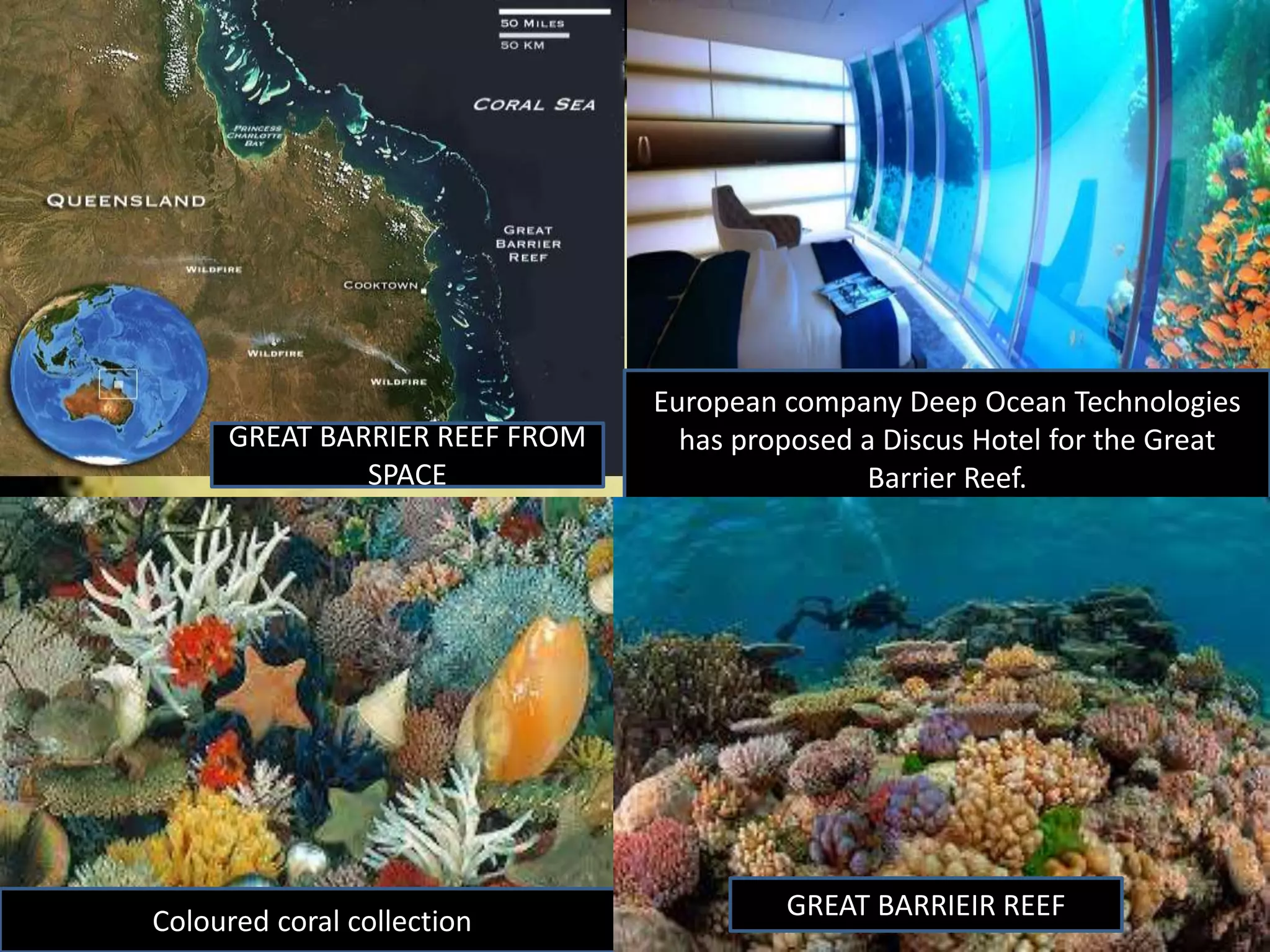
GREAT BARRIER REEF FROM
SPACE
European company Deep Ocean Technologies
has proposed a Discus Hotel for the Great
Barrier Reef.
Coloured coral collection
GREAT BARRIEIR REEF
Metropolitan Cathedral-LATIN AMERICA
Known as La Compañía de Jesús, this Jesuit
shrine is one of the best examples of
Baroque architecture in the Americas.
Baroque cathedral Baroque facade of Santiago's Cathedral.
CONTENT
INTRODUCTION
 HISTORY
 WORLDHERITAGE CONVENTION
THE WORLDHERITAGE COMMITTEE
 MISSION
 PARTNERS
 MAJOR ACTIVITIES
 LISTOF WORLDHERITAGE SITES
LISTOF WORLDHERITAGE SITES IN INDIA
INTRODUCTION
World Heritage Site
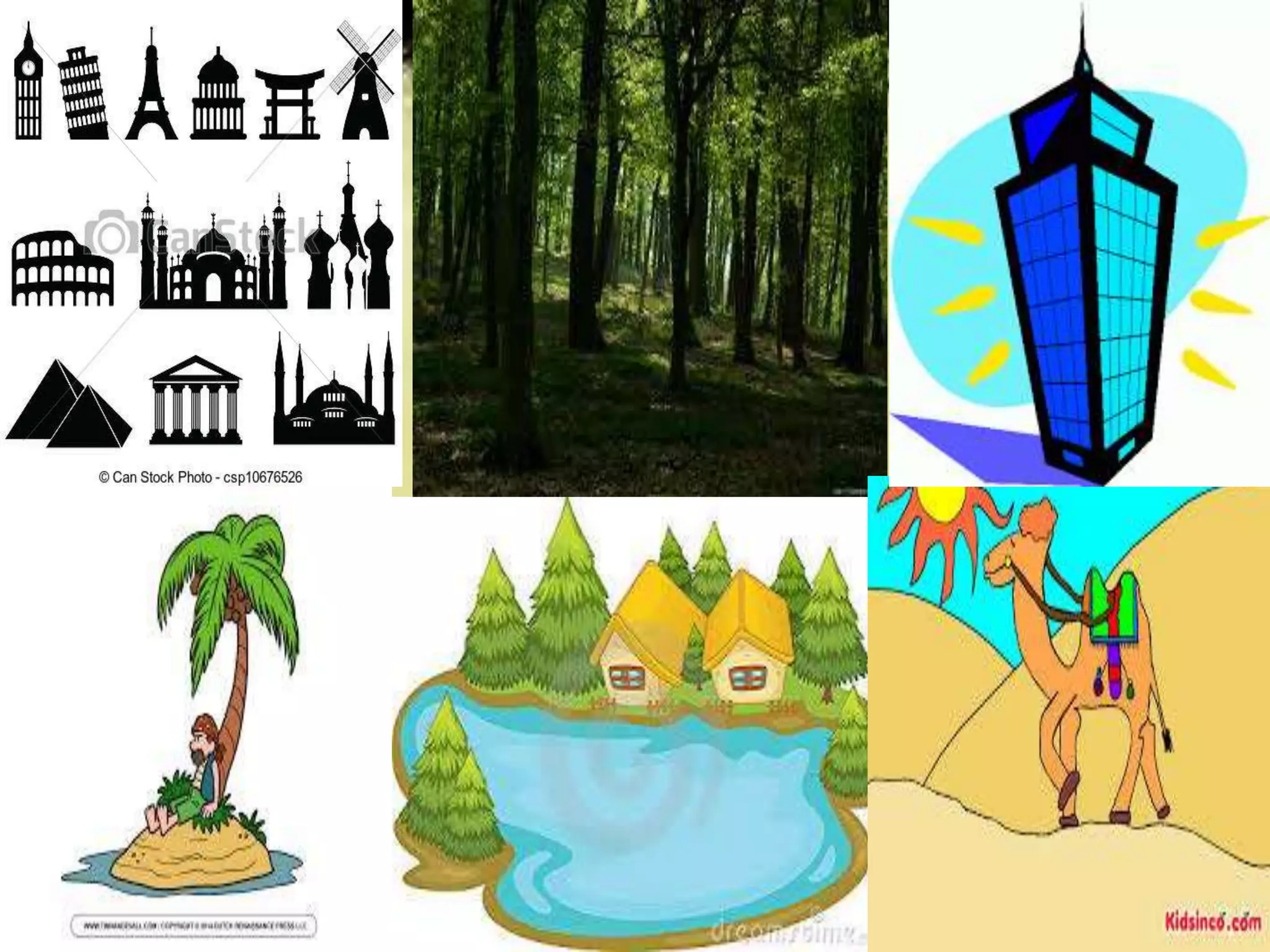
A UNESCOWorldHeritage Site is a place such as:
 a forest,
 mountain,
 lake,
 island,
 desert,
 monument,
 building,
 complex,
 or city
 that is listedby the United Nations
Educational, Scientific and
Cultural Organization
(UNESCO) as of specialcultural or physical
significance .
The mammoth temple complex of Abu Simbel,
Egypt, was moved block by block and
reconstructed. It’s the first project that helped
found the UNESCO World Heritage Convention
Abu Simbel, Temple of Hathor, interior
The hypostyle hall of the Great Temple, with
eight Osiris pillars ABU SIMBEL TEMPLE
BRIEF HISTORY
The idea of creatingan international movement for protecting
heritage emerged after World War I.
The 1972 Convention concerning the Protection of the World
Cultural and Natural Heritagedeveloped fromthe mergingof two
separate movements:
the first focusingon the preservation of cultural sites,
and the otherdealingwith the conservation of nature.
Linking the protection of cultural
and natural heritage
• The idea of combining conservation of
cultural sites with those of nature comes
from the United States of America.
• A White House Conference in
Washington, D.C., in 1965 called for a
‘World Heritage Trust’ that would
stimulate international cooperation to
protect ‘the world's superb natural and
scenic areas and historic sites for the
present and the future of the entire world
citizenry’.
• In 1968, the International Union for
Conservation of Nature (IUCN) developed
similar proposals for its members. These
proposals were presented to the 1972
United Nations conference on Human
Environment in Stockholm.
• Eventually, a single text was agreed
upon by all parties concerned. The
Convention concerning the Protection of
World Cultural and Natural Heritage
was adopted by the General Conference
of UNESCO on 16 November 1972.
• The same General Conference adopted
on 16 November 1972
the Recommendation concerning the
Protection, at National Level, of the
Cultural and Natural Heritage.
TAJ MAHAL AGRA
Seongsan Ilchulbong, also called
‘Sunrise Peak’-JEJU ISLAND-KOREA
WORLD HERITAGE
CONVENTION
 The most significant feature of the 1972World Heritage Conventionis that
• it links together in a singledocument the concepts of natureconservationand
• the preservation of cultural properties.
 The Conventionrecognizes the way in which peopleinteract with nature, andthe
fundamental needto preservethe balance betweenthe two.
What the Convention contains
 The Conventiondefinesthe kindof natural or cultural sites which can be
consideredfor inscriptionon the World HeritageList.
WORLD HERITAGE
COMMITTEE
The WorldHeritage Committee
• meets once a year, And
• consists of representatives from21 of the States Parties to the
Convention elected by their General Assembly.
• At its first session, the Committee adopted its Rules of
Procedure of the WorldHeritage Committee .
36th session of the Committee-
Saint Petersburg, Russian Federation
Delegates attend the 37th session of the
World Heritage Committee in Phnom Penh,
Cambodia, June 22, 2013.
28th Session held in June, 2004 in Suzhou
(China)
Seville, SPAIN 29 September 2009- The
Unesco World Heritage Committee met for
its 33rd session
Bureau of the World Heritage
Committee
 The Bureau consists of seven States
Parties elected annually by the
Committee:
• a Chairperson,
• fiveVice-Chairpersons, and
• a Rapporteur.
 The Bureau of the Committee
coordinates the work of the
Committee and fixes the dates,
hours and order of business of
meetings.
 The election of the new Bureau will
take place at the end of the next
session of the World Heritage
Committee.
 Chairperson: Prof Maria
Böhmer (Germany)

Rapporteur : M. Hicham Cheaib
(Liban)

Vice-
Chairpersons: Croatia, India, J
amaica, Qatar, Senegal
World Heritage Committee Members
 According to the World Heritage Convention , a
Committee member's term of office is for six
years, but most States Parties choose voluntarily
to be Members of the Committee for only four
years, in order to give other States Parties an
opportunity to be on the Committee.
 All Members elected during the two last General
Assemblies (2009 and 2011) have voluntarily
decided to reduce their period of term of office
from six to four years.
 The21 StatesPartiesofthecurrentWorldHeritageCommitteearethe
following:
• Algeria,
• Colombia,
• Croatia,
• Finland,
• Germany,
• India,
• Jamaica,
• Japan,
• Kazakhstan,
• Lebanon,
• Malaysia,
• Peru,
• Philippines,
• Poland,
• Portugal,
• Qatar,
• Republic of Korea,
• Senegal,
• Serbia,
• Turkey,
• Viet Nam
MISSION
• Encouragecountriesto signtheWorld
HeritageConventionandto ensurethe
protectionof theirnaturalandcultural
heritage;
• ProvideemergencyassistanceforWorld
Heritagesitesinimmediatedanger;
• Encourageparticipationof thelocal
populationinthepreservationof theircultural
andnaturalheritage;
• HelpStatesPartiessafeguardWorld
Heritageproperties by providing
technical assistanceand professional
training;
• Support StatesParties' public awareness-
building activitiesfor WorldHeritage
conservation;
• Encourage internationalcooperationin
the conservationof our world's cultural
and natural heritage.
UNESCO's World Heritage mission is to
PARTNERS
• Mobilizing additional resourcesfromdonorsand partnershelpsUNESCO
strengthenthe outreach and the impact of its programmes.
• Since its creation, the WorldHeritage Centre has established successful
partnershipswith a diverse range of stakeholders, governmentsand
international governmental organizations, civilsociety and the private
sector, interested in WorldHeritage Conservation.
• Thesealliances reflect a commitment to long-termmanagementof sites
inscribed on theWorldHeritage List.
Beijing Zhongkun
Investment Group
Nippon Hoso
Kyokai
Evergreen Digital Contents
Inc.
Publishing for Development
Smithsonian Institution Tokyo Broadcasting System (TBS)
PRIVATE SECTORS
Biodiversity Liaison
Group
Central Africa
Forests Commission
Flanders
Funds-in-Trust
France-UNESCO Cooperation
Agreement (CFU)
Spanish Funds-in-Trust
International Centre for the Study of the Preservation and Restoration of Cultural Property
PUBLIC SECTORS
WORLD HERITAGE MARINE
PROGRAMME
FIVE FOCUS AREA
Conservation
Our core task: ensuring
the long-term
conservation of World
Heritage marine sites
through state of
conservation reporting
Training
Training site
managers to use
ecosystem-based
marine spatial
planning as a tool to
optimize marine
World Heritage site
conservation.
Network
Building a network of
World Heritage
marine site managers
who share
management
solutions and best
practices across 47
sites
Exploring
Exploring the
potential of the
1972 World
Heritage
Convention in the
High Seas, an area
covering nearly
60% of our ocean
Safegaurding
World Heritage marine
sites cover about 20% of
all marine protected areas
by surface area. The World
Heritage Convention works
together with nations to
ensure these iconic ocean
places will be maintained
for future generation.
World Heritage and Sustainable
Tourism Programme
 Forthepast40 yearstheUNESCOWorld
HeritageConventionhasconserved, protected
andpresentedtheOutstandingUniversal
Valueof oursharedheritage.WorldHeritage
propertiesareimportanttraveldestinations,
thatif managedproperly,havegreatpotential
impactforlocaleconomicdevelopmentand
long-termsustainability.
 TheUNESCOWorldHeritageand
SustainableTourismProgrammerepresentsa
newapproachbasedondialogueand
stakeholdercooperationwhereplanningfor
tourismandheritagemanagementis
integratedat a destinationlevel,thenatural
andculturalassetsarevaluedandprotected,
andappropriatetourismdeveloped.
Vision
• World Heritage and tourism
stakeholders share responsibility
for conservation of our common
cultural and natural heritage of
Outstanding Universal Value
and for sustainable development
through appropriate tourism
management.
Mission
Facilitate the management and development of
sustainable tourism at World Heritage
properties through fostering increased
awareness, capacity and balanced participation
of all stakeholders in order to protect the
properties and their Outstanding Universal
Value whilst ensuring that tourism delivers
benefits for conservation of the properties’
sustainable development for local communities
as well as a quality experience for visitors
World Heritage Forest
Programme
Ranging in size from 18
hectares (Vallée de Mai,
Seychelles), to 8.8 million
hectares (Lake Baikal,
Russian Federation), World
Heritage forest sites now
have a total surface area
of over 75 million hectares
(1.5 times the surface area
of France) and represent
over 13% of all IUCN
category I-IV protected
forests worldwide.
Given these figures, it is clear that the World Heritage Convention is uniquely
positioned amongst international conventions, programmes and agencies to
play a leading role for in-situ conservation of forest biodiversity. In recognition
of this solemn responsibility, the World Heritage Committee in its 25 th session
(2001), agreed that forests warranted a particular focus, and approved the
creation of the World Heritage Forest programme to ensure that the World
Heritage Convention be leveraged as much as possible to further forest
conservation on a global scale.
One new World
Heritage site with
important forest
components was
inscribed at the
37th World
Heritage
Committee
meeting in June,
2013.
Xinjiang Tianshan, a four part serial
property in China was recognized in
part due to its forest ecosystems.
This new inscription brings the
number of World Heritage sites
inscribed for reasons related to their
forest ecosystems to 107.
World Heritage Education
Programme
 TheUNESCOWorldHeritageEducationProgramme,
initiatedas a UNESCOspecialprojectin1994,givesyoung
peoplea chancetovoicetheirconcernsandtobecome
involvedintheprotectionofourcommonculturaland
naturalheritage.
 Itseeksto encourageandenabletomorrow’sdecision-makers
toparticipateinheritageconservationandtorespondtothe
continuingthreatsfacingourWorldHeritage.
 YoungpeoplelearnaboutWorldHeritagesites,aboutthe
historyandtraditionsoftheirownandothercultures,about
ecologyandtheimportanceofprotectingbiodiversity.
 Theybecomeawareofthethreatsfacingthesitesandlearn
howtheinternationalcommunityas a wholeunitestosave
ourcommonheritage.Mostimportantly,theydiscoverhow
theycancontributetoheritageconservationandmake
themselvesheard.
TheWorld
Heritagein
YoungHands
Kithasbeen
testedand
adaptedto
nationalneeds
andpresently
existsin39
national
languages.
To date, 12
animated
short film
episodes of
“Patrimonito’
s World
Heritage
Adventures”
havebeen
produced.
About32
international
and
regionalYouth
Forumshave
beenheldwith
anestimated
1560young
people
participating.
Nearly1250
teachersand
educatorshave
beentrained
through about
40 seminars
and workshops
at national,
sub-regional,
regionaland
international
level.
Since the
launchof
the World
Heritage
Volunteersproj
ects,
around 1837
volunteershave
takenpart in
126 youth
camps
in 29 count-
ries.
Lists of World Heritage
Sites
AFRICA
ASIA
EUROPEOCEANIA
AMERICA
As of 2014, 1007 sites are listed:
 779cultural,
 197natural,and
 31 mixedproperties,in161statesparties.
By sites rankedby country :
 Italyishometo thegreatestnumberof World
HeritageSiteswith50 sites,
 followedby China(47),
 Spain(44),
 France(39),
 Germany(39),
 Mexico(32)and
 India(32).
TOP 10 WORLD HERITAGE
SITES IN INDIA
AJANTA CAVES-
MAHARASHTRA
QUTUB MINAR-DELHI
TAJ MAHAL AGRA
MOUNTAIN RAILWAYS OF INDIA
MONUMENTS OF
KHAJURAHO-MP
SUN TEMPLE-ODHISA
KAZIRANGA NATIONAL PARK-
ASSAM
FATEHPUR SIKRI-AGRA
CHOLA TEMPLE- TAMIL
RED FORT- DELHI
World Heritage Sites in
India Thereare 32 World HeritageSites in India that are recognizedby the UnitedNations
Educational, Scientific andCulturalOrganization(UNESCO) as of 2014..
 Theseare placesof importance of cultural or naturalheritage as describedin the UNESCO
WorldHeritageConvention,establishedin 1972.
 India’sfirst two sitesinscribedon the list at the SeventhSessionof theWorldHeritage heldin
1983 were:
 the AgraFort and
 the AjantaCaves.
 Overthe years,30 more siteshave been inscribed, the latest being the Great HimalayanNational
Parkin 2014..
 Of these32 sites:
 25 are culturalsites
 the other sevenare natural sites.
Heritage management organisations(unesco)

Heritage management organisations(unesco)

  • 1.
  • 2.
    EAST AFRICA MAP WILDBEESTSNEAR THE GOL MOUNTAINS ON THE EDGE OF THE SERENGETI SERENGETI PARK SERENGETI SERENA SAFARI LODGE
  • 3.
    A view ofthe pyramids at Giza from the plateau to the south of the complex the-sphinx-at-giza cairo-in-egypt-with-the- pyramid-of-chephren-khafre-in-the-background aerial-photography-taken-from-eduard- spelterini-balloon-on-november-21-1904 pyramids-at-giza-from-pizza-hut-on-top- of-kfc
  • 4.
    GREAT BARRIER REEFFROM SPACE European company Deep Ocean Technologies has proposed a Discus Hotel for the Great Barrier Reef. Coloured coral collection GREAT BARRIEIR REEF
  • 5.
    Metropolitan Cathedral-LATIN AMERICA Knownas La Compañía de Jesús, this Jesuit shrine is one of the best examples of Baroque architecture in the Americas. Baroque cathedral Baroque facade of Santiago's Cathedral.
  • 6.
    CONTENT INTRODUCTION  HISTORY  WORLDHERITAGECONVENTION THE WORLDHERITAGE COMMITTEE  MISSION  PARTNERS  MAJOR ACTIVITIES  LISTOF WORLDHERITAGE SITES LISTOF WORLDHERITAGE SITES IN INDIA
  • 8.
    INTRODUCTION World Heritage Site AUNESCOWorldHeritage Site is a place such as:  a forest,  mountain,  lake,  island,  desert,  monument,  building,  complex,  or city  that is listedby the United Nations Educational, Scientific and Cultural Organization (UNESCO) as of specialcultural or physical significance .
  • 9.
    The mammoth templecomplex of Abu Simbel, Egypt, was moved block by block and reconstructed. It’s the first project that helped found the UNESCO World Heritage Convention Abu Simbel, Temple of Hathor, interior The hypostyle hall of the Great Temple, with eight Osiris pillars ABU SIMBEL TEMPLE
  • 10.
    BRIEF HISTORY The ideaof creatingan international movement for protecting heritage emerged after World War I. The 1972 Convention concerning the Protection of the World Cultural and Natural Heritagedeveloped fromthe mergingof two separate movements: the first focusingon the preservation of cultural sites, and the otherdealingwith the conservation of nature.
  • 11.
    Linking the protectionof cultural and natural heritage • The idea of combining conservation of cultural sites with those of nature comes from the United States of America. • A White House Conference in Washington, D.C., in 1965 called for a ‘World Heritage Trust’ that would stimulate international cooperation to protect ‘the world's superb natural and scenic areas and historic sites for the present and the future of the entire world citizenry’. • In 1968, the International Union for Conservation of Nature (IUCN) developed similar proposals for its members. These proposals were presented to the 1972 United Nations conference on Human Environment in Stockholm. • Eventually, a single text was agreed upon by all parties concerned. The Convention concerning the Protection of World Cultural and Natural Heritage was adopted by the General Conference of UNESCO on 16 November 1972. • The same General Conference adopted on 16 November 1972 the Recommendation concerning the Protection, at National Level, of the Cultural and Natural Heritage. TAJ MAHAL AGRA Seongsan Ilchulbong, also called ‘Sunrise Peak’-JEJU ISLAND-KOREA
  • 12.
    WORLD HERITAGE CONVENTION  Themost significant feature of the 1972World Heritage Conventionis that • it links together in a singledocument the concepts of natureconservationand • the preservation of cultural properties.  The Conventionrecognizes the way in which peopleinteract with nature, andthe fundamental needto preservethe balance betweenthe two. What the Convention contains  The Conventiondefinesthe kindof natural or cultural sites which can be consideredfor inscriptionon the World HeritageList.
  • 13.
    WORLD HERITAGE COMMITTEE The WorldHeritageCommittee • meets once a year, And • consists of representatives from21 of the States Parties to the Convention elected by their General Assembly. • At its first session, the Committee adopted its Rules of Procedure of the WorldHeritage Committee .
  • 14.
    36th session ofthe Committee- Saint Petersburg, Russian Federation Delegates attend the 37th session of the World Heritage Committee in Phnom Penh, Cambodia, June 22, 2013. 28th Session held in June, 2004 in Suzhou (China) Seville, SPAIN 29 September 2009- The Unesco World Heritage Committee met for its 33rd session
  • 15.
    Bureau of theWorld Heritage Committee  The Bureau consists of seven States Parties elected annually by the Committee: • a Chairperson, • fiveVice-Chairpersons, and • a Rapporteur.  The Bureau of the Committee coordinates the work of the Committee and fixes the dates, hours and order of business of meetings.  The election of the new Bureau will take place at the end of the next session of the World Heritage Committee.  Chairperson: Prof Maria Böhmer (Germany)  Rapporteur : M. Hicham Cheaib (Liban)  Vice- Chairpersons: Croatia, India, J amaica, Qatar, Senegal World Heritage Committee Members  According to the World Heritage Convention , a Committee member's term of office is for six years, but most States Parties choose voluntarily to be Members of the Committee for only four years, in order to give other States Parties an opportunity to be on the Committee.  All Members elected during the two last General Assemblies (2009 and 2011) have voluntarily decided to reduce their period of term of office from six to four years.  The21 StatesPartiesofthecurrentWorldHeritageCommitteearethe following: • Algeria, • Colombia, • Croatia, • Finland, • Germany, • India, • Jamaica, • Japan, • Kazakhstan, • Lebanon, • Malaysia, • Peru, • Philippines, • Poland, • Portugal, • Qatar, • Republic of Korea, • Senegal, • Serbia, • Turkey, • Viet Nam
  • 16.
    MISSION • Encouragecountriesto signtheWorld HeritageConventionandtoensurethe protectionof theirnaturalandcultural heritage; • ProvideemergencyassistanceforWorld Heritagesitesinimmediatedanger; • Encourageparticipationof thelocal populationinthepreservationof theircultural andnaturalheritage; • HelpStatesPartiessafeguardWorld Heritageproperties by providing technical assistanceand professional training; • Support StatesParties' public awareness- building activitiesfor WorldHeritage conservation; • Encourage internationalcooperationin the conservationof our world's cultural and natural heritage. UNESCO's World Heritage mission is to
  • 17.
    PARTNERS • Mobilizing additionalresourcesfromdonorsand partnershelpsUNESCO strengthenthe outreach and the impact of its programmes. • Since its creation, the WorldHeritage Centre has established successful partnershipswith a diverse range of stakeholders, governmentsand international governmental organizations, civilsociety and the private sector, interested in WorldHeritage Conservation. • Thesealliances reflect a commitment to long-termmanagementof sites inscribed on theWorldHeritage List.
  • 18.
    Beijing Zhongkun Investment Group NipponHoso Kyokai Evergreen Digital Contents Inc. Publishing for Development Smithsonian Institution Tokyo Broadcasting System (TBS) PRIVATE SECTORS
  • 19.
    Biodiversity Liaison Group Central Africa ForestsCommission Flanders Funds-in-Trust France-UNESCO Cooperation Agreement (CFU) Spanish Funds-in-Trust International Centre for the Study of the Preservation and Restoration of Cultural Property PUBLIC SECTORS
  • 20.
    WORLD HERITAGE MARINE PROGRAMME FIVEFOCUS AREA Conservation Our core task: ensuring the long-term conservation of World Heritage marine sites through state of conservation reporting Training Training site managers to use ecosystem-based marine spatial planning as a tool to optimize marine World Heritage site conservation. Network Building a network of World Heritage marine site managers who share management solutions and best practices across 47 sites Exploring Exploring the potential of the 1972 World Heritage Convention in the High Seas, an area covering nearly 60% of our ocean Safegaurding World Heritage marine sites cover about 20% of all marine protected areas by surface area. The World Heritage Convention works together with nations to ensure these iconic ocean places will be maintained for future generation.
  • 21.
    World Heritage andSustainable Tourism Programme  Forthepast40 yearstheUNESCOWorld HeritageConventionhasconserved, protected andpresentedtheOutstandingUniversal Valueof oursharedheritage.WorldHeritage propertiesareimportanttraveldestinations, thatif managedproperly,havegreatpotential impactforlocaleconomicdevelopmentand long-termsustainability.  TheUNESCOWorldHeritageand SustainableTourismProgrammerepresentsa newapproachbasedondialogueand stakeholdercooperationwhereplanningfor tourismandheritagemanagementis integratedat a destinationlevel,thenatural andculturalassetsarevaluedandprotected, andappropriatetourismdeveloped.
  • 22.
    Vision • World Heritageand tourism stakeholders share responsibility for conservation of our common cultural and natural heritage of Outstanding Universal Value and for sustainable development through appropriate tourism management. Mission Facilitate the management and development of sustainable tourism at World Heritage properties through fostering increased awareness, capacity and balanced participation of all stakeholders in order to protect the properties and their Outstanding Universal Value whilst ensuring that tourism delivers benefits for conservation of the properties’ sustainable development for local communities as well as a quality experience for visitors
  • 23.
    World Heritage Forest Programme Rangingin size from 18 hectares (Vallée de Mai, Seychelles), to 8.8 million hectares (Lake Baikal, Russian Federation), World Heritage forest sites now have a total surface area of over 75 million hectares (1.5 times the surface area of France) and represent over 13% of all IUCN category I-IV protected forests worldwide. Given these figures, it is clear that the World Heritage Convention is uniquely positioned amongst international conventions, programmes and agencies to play a leading role for in-situ conservation of forest biodiversity. In recognition of this solemn responsibility, the World Heritage Committee in its 25 th session (2001), agreed that forests warranted a particular focus, and approved the creation of the World Heritage Forest programme to ensure that the World Heritage Convention be leveraged as much as possible to further forest conservation on a global scale. One new World Heritage site with important forest components was inscribed at the 37th World Heritage Committee meeting in June, 2013. Xinjiang Tianshan, a four part serial property in China was recognized in part due to its forest ecosystems. This new inscription brings the number of World Heritage sites inscribed for reasons related to their forest ecosystems to 107.
  • 24.
    World Heritage Education Programme TheUNESCOWorldHeritageEducationProgramme, initiatedas a UNESCOspecialprojectin1994,givesyoung peoplea chancetovoicetheirconcernsandtobecome involvedintheprotectionofourcommonculturaland naturalheritage.  Itseeksto encourageandenabletomorrow’sdecision-makers toparticipateinheritageconservationandtorespondtothe continuingthreatsfacingourWorldHeritage.  YoungpeoplelearnaboutWorldHeritagesites,aboutthe historyandtraditionsoftheirownandothercultures,about ecologyandtheimportanceofprotectingbiodiversity.  Theybecomeawareofthethreatsfacingthesitesandlearn howtheinternationalcommunityas a wholeunitestosave ourcommonheritage.Mostimportantly,theydiscoverhow theycancontributetoheritageconservationandmake themselvesheard.
  • 25.
    TheWorld Heritagein YoungHands Kithasbeen testedand adaptedto nationalneeds andpresently existsin39 national languages. To date, 12 animated shortfilm episodes of “Patrimonito’ s World Heritage Adventures” havebeen produced. About32 international and regionalYouth Forumshave beenheldwith anestimated 1560young people participating. Nearly1250 teachersand educatorshave beentrained through about 40 seminars and workshops at national, sub-regional, regionaland international level. Since the launchof the World Heritage Volunteersproj ects, around 1837 volunteershave takenpart in 126 youth camps in 29 count- ries.
  • 26.
    Lists of WorldHeritage Sites AFRICA ASIA EUROPEOCEANIA AMERICA As of 2014, 1007 sites are listed:  779cultural,  197natural,and  31 mixedproperties,in161statesparties. By sites rankedby country :  Italyishometo thegreatestnumberof World HeritageSiteswith50 sites,  followedby China(47),  Spain(44),  France(39),  Germany(39),  Mexico(32)and  India(32).
  • 27.
    TOP 10 WORLDHERITAGE SITES IN INDIA AJANTA CAVES- MAHARASHTRA QUTUB MINAR-DELHI TAJ MAHAL AGRA MOUNTAIN RAILWAYS OF INDIA MONUMENTS OF KHAJURAHO-MP SUN TEMPLE-ODHISA KAZIRANGA NATIONAL PARK- ASSAM FATEHPUR SIKRI-AGRA CHOLA TEMPLE- TAMIL RED FORT- DELHI
  • 28.
    World Heritage Sitesin India Thereare 32 World HeritageSites in India that are recognizedby the UnitedNations Educational, Scientific andCulturalOrganization(UNESCO) as of 2014..  Theseare placesof importance of cultural or naturalheritage as describedin the UNESCO WorldHeritageConvention,establishedin 1972.  India’sfirst two sitesinscribedon the list at the SeventhSessionof theWorldHeritage heldin 1983 were:  the AgraFort and  the AjantaCaves.  Overthe years,30 more siteshave been inscribed, the latest being the Great HimalayanNational Parkin 2014..  Of these32 sites:  25 are culturalsites  the other sevenare natural sites.