By Aanchal Nejhavan 
B.A. (Hons) International Journalism
Brief Introduction to Brazil 
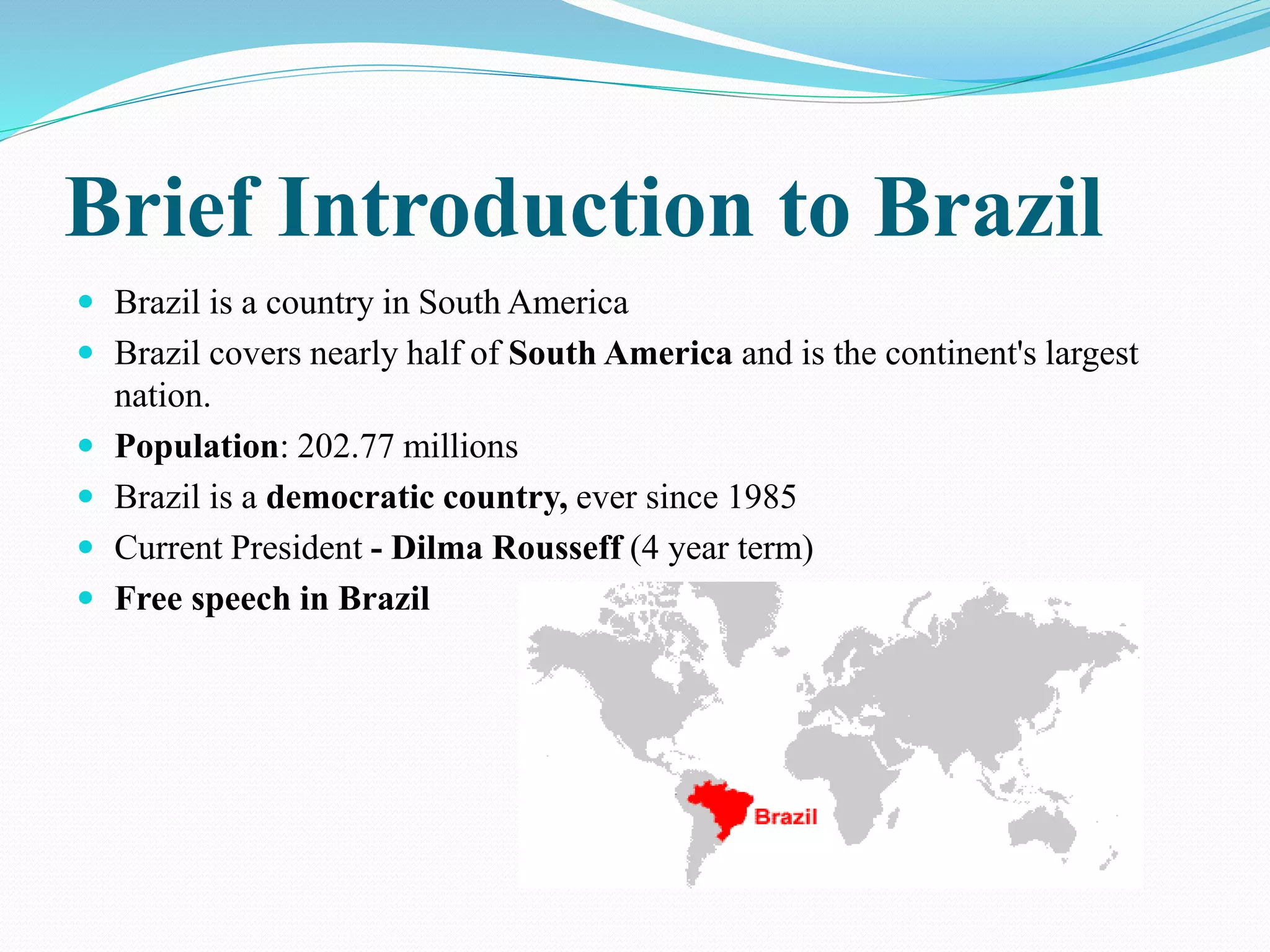
 Brazil is a country in South America 
 Brazil covers nearly half of South America and is the continent's largest 
nation. 
 Population: 202.77 millions 
 Brazil is a democratic country, ever since 1985 
 Current President - Dilma Rousseff (4 year term) 
 Free speech in Brazil
Government of Brazil 
PRESIDENTIAL CONGRESS 
FEDERAL JUDICIARY 
 Since the end of military rule in 1985, unionization, collective bargaining, 
and frequent strikes have become commonplace among federal employees 
in all the three branches of government.
Media Development Brazil 
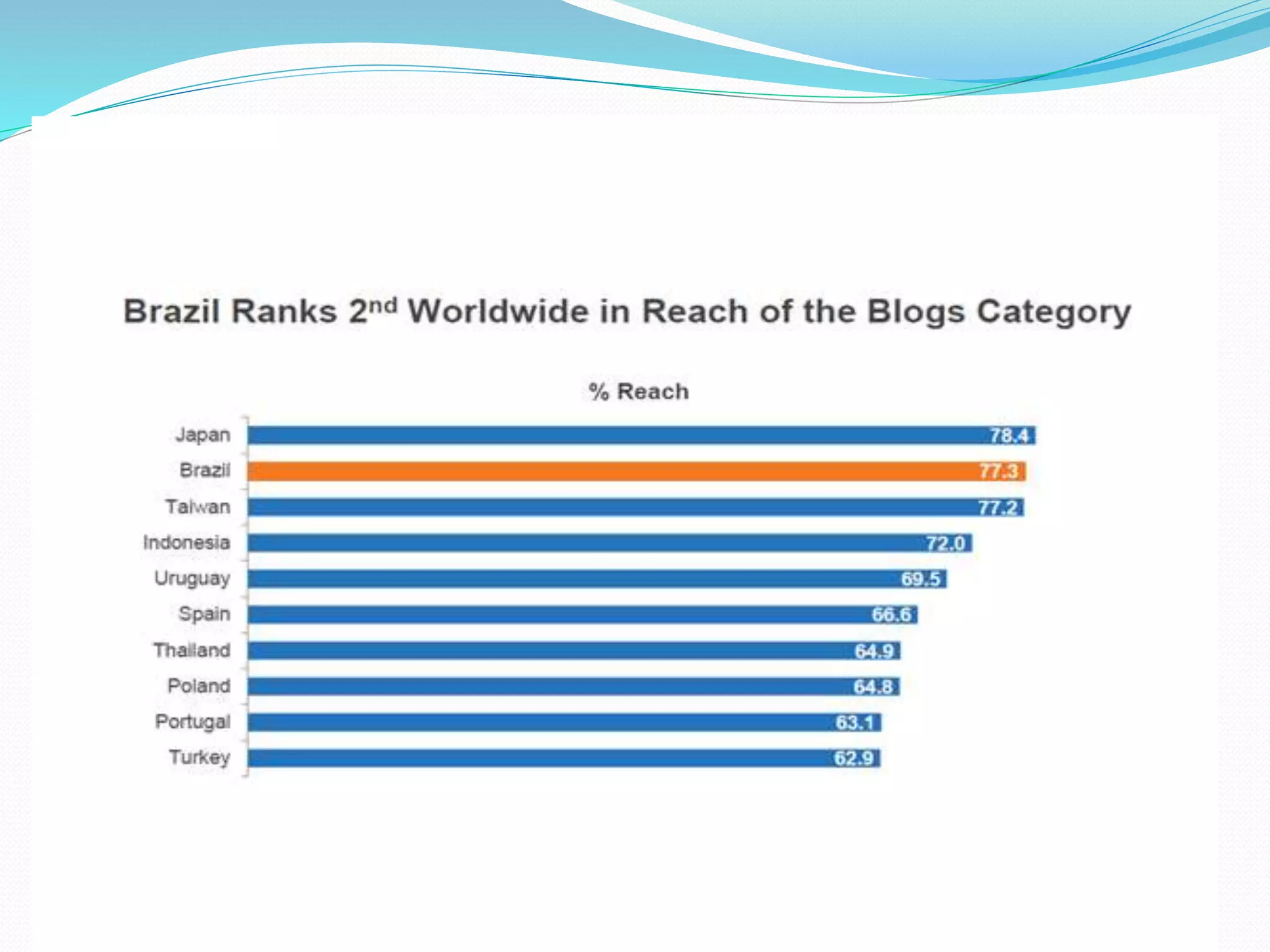
 It is South America’s largest media market, with thousands of commercial 
radio and TV broadcasting channels and a strong press. 
 Social Media continue to influence the Purchase Decisions of Brazilian 
Internautas 
 Brazilians prefer brands that interact with them on Social Networks 
 Many Brazilians combine Social Media with 
watching TV 
 Social Media play a significant role in Job 
Recruitment
Brazilian Journalism 
 Brazilian journalism is experiencing a crisis that has affected journalism 
worldwide due to a combination of factors, including : 
- the competition with new technologies and Internet, 
- economic pressures to cut costs and do more with less of journalists 
and other costly reporting.
World Press Freedom 
 Investigative journalism is under threat in the United States, day-to-day 
reporting exposes journalists to physical danger in Brazil. 
 With five journalists killed in 2013, Brazil has become the western 
hemisphere’s deadliest country for media personnel. 
 These tragic deaths in Brazil are obviously also due to a high level of 
violence. Organized crime’s hold on certain regions makes covering 
subjects such as corruption, drugs or illegal trafficking in raw materials 
very risky.
Brazil – Noticeable Problems
Brazil - not so sunny spring 
 The large-scale protests that erupted in São Paulo in June in response to 
public transport fare hikes spread to the rest of the country, fuelled by 
discontent about the massive spending on the 2014 Football World Cup 
and the 2016 Olympics. 
 The “Brazilian spring” protests raised questions about the dominant media 
model and highlighted the appalling methods still used by the state military 
police since the time of the dictatorship. 
 In the course of the protests, around 100 journalists were the victims of acts 
of violence, of which more than two thirds were blamed on the police.
Voice of Brazilian People
2014 SCORES 
 PRESS STATUS 
-Partly Free 
 PRESS FREEDOM SCORE(0 = BEST, 100 = WORST) 
-45 
 LEGAL ENVIRONMENT(0 = BEST, 30 = WORST) 
-13 
 POLITICAL ENVIRONMENT(0 = BEST, 40 = WORST) 
-21 
 ECONOMIC ENVIRONMENT(0 = BEST, 30 = WORST) 
-11 
FREEDOM HOUSE
The Future 
 Today four out of five internet users in the Latin America are plugged into 
social networks; Facebook boasts almost 40 million users in Mexico, 
Argentina, and Brazil alone. Interestingly, journalistic integrity and trust 
in the media have changed as social media use has increased. 
 It is pretty straightforward: people are starting to doubt seriously what they 
are being told by both politicians and journalists. 
 In the era of citizen journalism, online news—meaning both the published 
articles and user-generated comments—has an appearance of truthfulness, 
depth, and persuasiveness that can leave the old newspaper model looking 
archaic and obsolete.
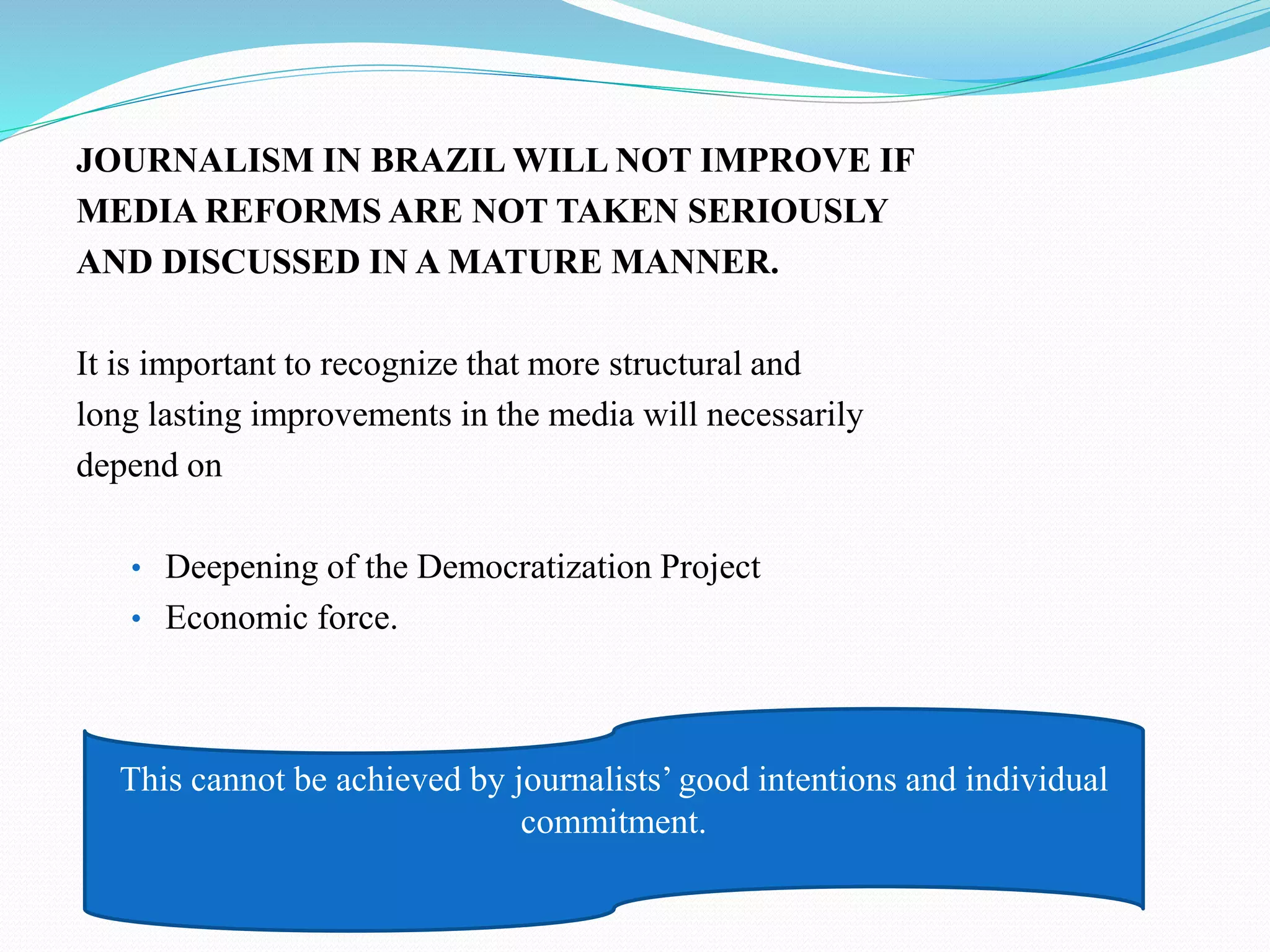
JOURNALISM IN BRAZIL WILL NOT IMPROVE IF 
MEDIA REFORMS ARE NOT TAKEN SERIOUSLY 
AND DISCUSSED IN A MATURE MANNER. 
It is important to recognize that more structural and 
long lasting improvements in the media will necessarily 
depend on 
• Deepening of the Democratization Project 
• Economic force. 
This cannot be achieved by journalists’ good intentions and individual 
commitment.
Some Questions to ponder? 
How will the media industry protect their 
institution? 
How will they retain positive public 
perception of their journalistic integrity and 
regain the trust of their readers?
Thanks
Bibliography 
 http://worldpopulationreview.com/countries/brazil-population/ 
 http://latinlink.usmediaconsulting.com/2012/12/8-of-the-latest-social-media- 
trends-in-brazil/ 
 https://freespeechfreepress.wordpress.com/south-america/brazil/ 
 https://freedomhouse.org/report/freedom-press/2013/brazil#.VG3So2d_tRU 
 http://www.meltwater.com/public-relations-blog/the-future-of-media-in-latin- 
america/ 
 http://www.academia.edu/3506809/The_crisis_of_public_communicat 
ions_and_quality_journalism_in_comparative_perspective 
 http://www.photius.com/countries/brazil/government/brazil_govern 
ment_structure_of_governm~236.html

Media in brazil (2)

  • 1.
    By Aanchal Nejhavan B.A. (Hons) International Journalism
  • 2.
    Brief Introduction toBrazil  Brazil is a country in South America  Brazil covers nearly half of South America and is the continent's largest nation.  Population: 202.77 millions  Brazil is a democratic country, ever since 1985  Current President - Dilma Rousseff (4 year term)  Free speech in Brazil
  • 3.
    Government of Brazil PRESIDENTIAL CONGRESS FEDERAL JUDICIARY  Since the end of military rule in 1985, unionization, collective bargaining, and frequent strikes have become commonplace among federal employees in all the three branches of government.
  • 4.
    Media Development Brazil  It is South America’s largest media market, with thousands of commercial radio and TV broadcasting channels and a strong press.  Social Media continue to influence the Purchase Decisions of Brazilian Internautas  Brazilians prefer brands that interact with them on Social Networks  Many Brazilians combine Social Media with watching TV  Social Media play a significant role in Job Recruitment
  • 5.
    Brazilian Journalism Brazilian journalism is experiencing a crisis that has affected journalism worldwide due to a combination of factors, including : - the competition with new technologies and Internet, - economic pressures to cut costs and do more with less of journalists and other costly reporting.
  • 6.
    World Press Freedom  Investigative journalism is under threat in the United States, day-to-day reporting exposes journalists to physical danger in Brazil.  With five journalists killed in 2013, Brazil has become the western hemisphere’s deadliest country for media personnel.  These tragic deaths in Brazil are obviously also due to a high level of violence. Organized crime’s hold on certain regions makes covering subjects such as corruption, drugs or illegal trafficking in raw materials very risky.
  • 7.
  • 8.
    Brazil - notso sunny spring  The large-scale protests that erupted in São Paulo in June in response to public transport fare hikes spread to the rest of the country, fuelled by discontent about the massive spending on the 2014 Football World Cup and the 2016 Olympics.  The “Brazilian spring” protests raised questions about the dominant media model and highlighted the appalling methods still used by the state military police since the time of the dictatorship.  In the course of the protests, around 100 journalists were the victims of acts of violence, of which more than two thirds were blamed on the police.
  • 9.
  • 10.
    2014 SCORES PRESS STATUS -Partly Free  PRESS FREEDOM SCORE(0 = BEST, 100 = WORST) -45  LEGAL ENVIRONMENT(0 = BEST, 30 = WORST) -13  POLITICAL ENVIRONMENT(0 = BEST, 40 = WORST) -21  ECONOMIC ENVIRONMENT(0 = BEST, 30 = WORST) -11 FREEDOM HOUSE
  • 11.
    The Future Today four out of five internet users in the Latin America are plugged into social networks; Facebook boasts almost 40 million users in Mexico, Argentina, and Brazil alone. Interestingly, journalistic integrity and trust in the media have changed as social media use has increased.  It is pretty straightforward: people are starting to doubt seriously what they are being told by both politicians and journalists.  In the era of citizen journalism, online news—meaning both the published articles and user-generated comments—has an appearance of truthfulness, depth, and persuasiveness that can leave the old newspaper model looking archaic and obsolete.
  • 13.
    JOURNALISM IN BRAZILWILL NOT IMPROVE IF MEDIA REFORMS ARE NOT TAKEN SERIOUSLY AND DISCUSSED IN A MATURE MANNER. It is important to recognize that more structural and long lasting improvements in the media will necessarily depend on • Deepening of the Democratization Project • Economic force. This cannot be achieved by journalists’ good intentions and individual commitment.
  • 14.
    Some Questions toponder? How will the media industry protect their institution? How will they retain positive public perception of their journalistic integrity and regain the trust of their readers?
  • 15.
  • 16.
    Bibliography  http://worldpopulationreview.com/countries/brazil-population/  http://latinlink.usmediaconsulting.com/2012/12/8-of-the-latest-social-media- trends-in-brazil/  https://freespeechfreepress.wordpress.com/south-america/brazil/  https://freedomhouse.org/report/freedom-press/2013/brazil#.VG3So2d_tRU  http://www.meltwater.com/public-relations-blog/the-future-of-media-in-latin- america/  http://www.academia.edu/3506809/The_crisis_of_public_communicat ions_and_quality_journalism_in_comparative_perspective  http://www.photius.com/countries/brazil/government/brazil_govern ment_structure_of_governm~236.html

Editor's Notes

  • #3 Free speech in Brazil has never been more restricted than it was during the military regime, article 151 to the constitution, various laws were passed limiting the liberties of citizens This restricted right to free speech was made more restrictive in 1967, when article 151 was added to the constitution, making “undermining the democratic order” an offense punishable by “the suspension of [free speech] rights…for a period of two to ten years.”[4] It was during this period when several laws were passed that systematically and unconstitutionally restricted the rights of citizens until Brazil became a democracy in 1985.
  • #7 About murder case
  • #11  In a positive step, a public information access law went into effect in 2012. However, journalists also experienced frequent violence, harassment, and censorship during the year. Incidents of judicial censorship were particularly troubling.