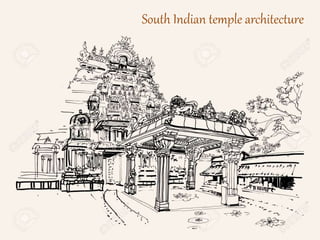
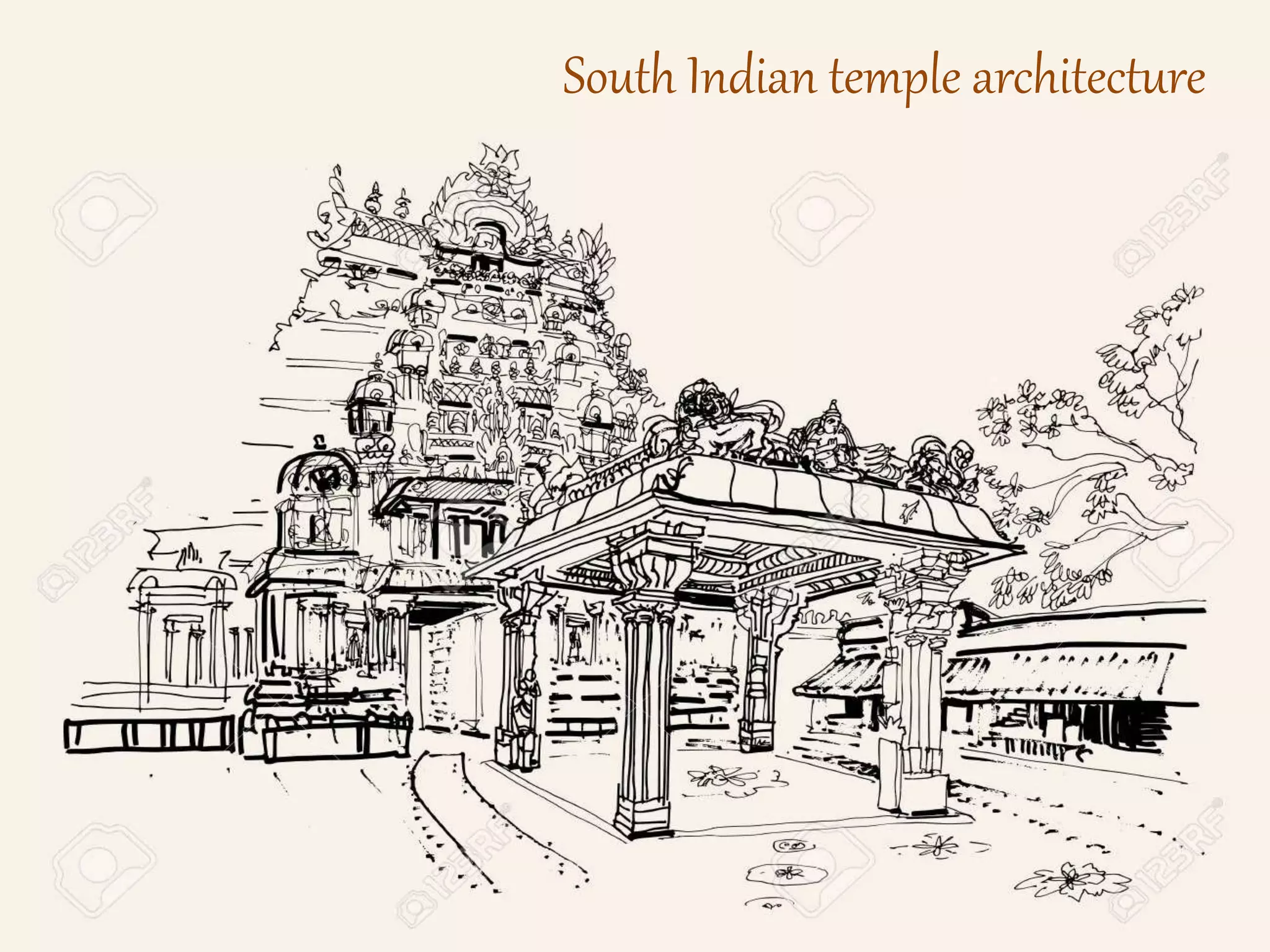
South Indian temple architecture
Introduction
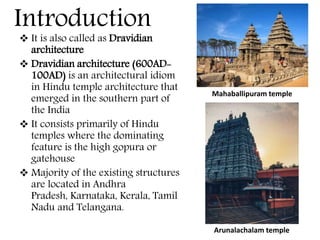
 It is also called as Dravidian
architecture
 Dravidian architecture (600AD-
100AD) is an architectural idiom
in Hindu temple architecture that
emerged in the southern part of
the India
 It consists primarily of Hindu
temples where the dominating
feature is the high gopura or
gatehouse
 Majority of the existing structures
are located in Andhra
Pradesh, Karnataka, Kerala, Tamil
Nadu and Telangana.
Mahaballipuram temple
Arunalachalam temple
A temple consisted of --
Vimanas, Gopurams, Mantapams
and Chaultries.
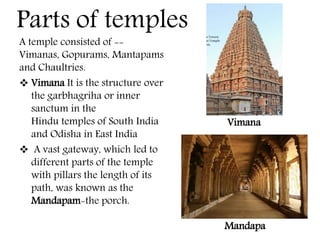
 Vimana It is the structure over
the garbhagriha or inner
sanctum in the
Hindu temples of South India
and Odisha in East India
 A vast gateway, which led to
different parts of the temple
with pillars the length of its
path, was known as the
Mandapam-the porch.
Mandapa
Parts of temples
Vimana
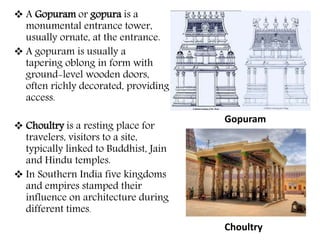
 A Gopuram or gopura is a
monumental entrance tower,
usually ornate, at the entrance.
 A gopuram is usually a
tapering oblong in form with
ground-level wooden doors,
often richly decorated, providing
access.
 Choultry is a resting place for
travelers, visitors to a site,
typically linked to Buddhist, Jain
and Hindu temples.
 In Southern India five kingdoms
and empires stamped their
influence on architecture during
different times.
Gopuram
Choultry
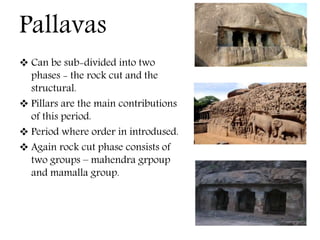
 Can be sub-divided into two
phases - the rock cut and the
structural.
 Pillars are the main contributions
of this period.
 Period where order in introdused.
 Again rock cut phase consists of
two groups – mahendra grpoup
and mamalla group.
Pallavas
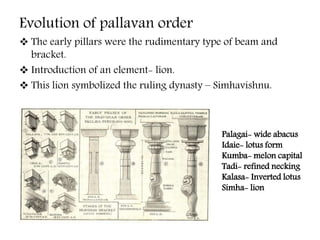
Evolution of pallavan order
 The early pillars were the rudimentary type of beam and
bracket.
 Introduction of an element- lion.
 This lion symbolized the ruling dynasty – Simhavishnu.
Palagai- wide abacus
Idaie- lotus form
Kumba- melon capital
Tadi- refined necking
Kalasa- Inverted lotus
Simha- lion
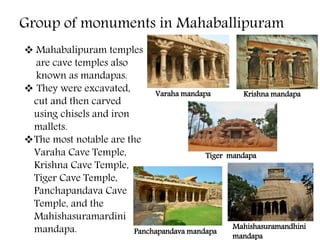
Group of monuments in Mahaballipuram
 Mahabalipuram temples
are cave temples also
known as mandapas.
 They were excavated,
cut and then carved
using chisels and iron
mallets.
The most notable are the
Varaha Cave Temple,
Krishna Cave Temple,
Tiger Cave Temple,
Panchapandava Cave
Temple, and the
Mahishasuramardini
mandapa.
Varaha mandapa Krishna mandapa
Tiger mandapa
Panchapandava mandapa
Mahishasuramandhini
mandapa
Rathas and Mantapas
 RATHAS are small shrines carved out of a monolithic rock.
 Generally Ratha is known as chariot used for carrying the
image of the deity during religious procession.
 But here in pallava style it commonly refers to a monolithic
shrine which has all the essential features of a temple
including domed storey to shikhara.
 Mahaballipuram has the preminent rathas.
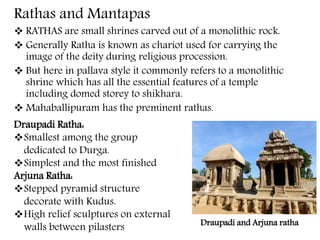
Draupadi Ratha:
Smallest among the group
dedicated to Durga.
Simplest and the most finished
Arjuna Ratha:
Stepped pyramid structure
decorate with Kudus.
High relief sculptures on external
walls between pilasters Draupadi and Arjuna ratha
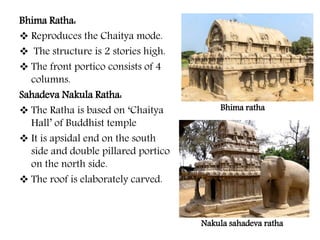
Bhima Ratha:
 Reproduces the Chaitya mode.
 The structure is 2 stories high.
 The front portico consists of 4
columns.
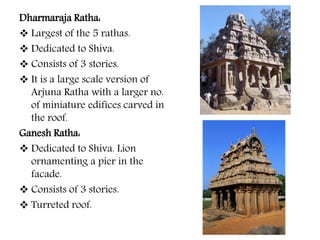
Sahadeva Nakula Ratha:
 The Ratha is based on ‘Chaitya
Hall’ of Buddhist temple
 It is apsidal end on the south
side and double pillared portico
on the north side.
 The roof is elaborately carved.
Bhima ratha
Nakula sahadeva ratha
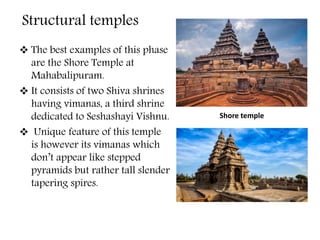
Dharmaraja Ratha:
 Largest of the 5 rathas.
 Dedicated to Shiva.
 Consists of 3 stories.
 It is a large scale version of
Arjuna Ratha with a larger no.
of miniature edifices carved in
the roof.
Ganesh Ratha:
 Dedicated to Shiva. Lion
ornamenting a pier in the
facade.
 Consists of 3 stories.
 Turreted roof.
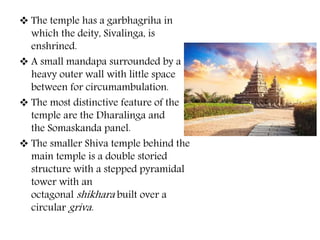
 The best examples of this phase
are the Shore Temple at
Mahabalipuram.
 It consists of two Shiva shrines
having vimanas, a third shrine
dedicated to Seshashayi Vishnu.
 Unique feature of this temple
is however its vimanas which
don’t appear like stepped
pyramids but rather tall slender
tapering spires.
Shore temple
Structural temples
 The temple has a garbhagriha in
which the deity, Sivalinga, is
enshrined.
 A small mandapa surrounded by a
heavy outer wall with little space
between for circumambulation.
 The most distinctive feature of the
temple are the Dharalinga and
the Somaskanda panel.
 The smaller Shiva temple behind the
main temple is a double storied
structure with a stepped pyramidal
tower with an
octagonal shikhara built over a
circular griva.
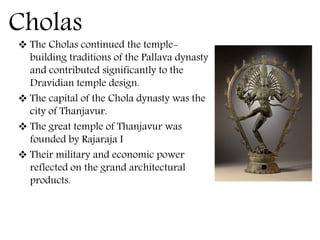
Cholas
 The Cholas continued the temple-
building traditions of the Pallava dynasty
and contributed significantly to the
Dravidian temple design.
 The capital of the Chola dynasty was the
city of Thanjavur.
 The great temple of Thanjavur was
founded by Rajaraja I
 Their military and economic power
reflected on the grand architectural
products.
Early cholas
 Built entirely of stone
 Use of well dressed granite.
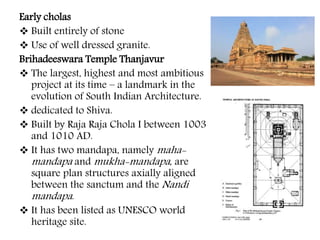
Brihadeeswara Temple Thanjavur
 The largest, highest and most ambitious
project at its time – a landmark in the
evolution of South Indian Architecture.
 dedicated to Shiva.
 Built by Raja Raja Chola I between 1003
and 1010 AD.
 It has two mandapa, namely maha-
mandapa and mukha-mandapa, are
square plan structures axially aligned
between the sanctum and the Nandi
mandapa.
 It has been listed as UNESCO world
heritage site.
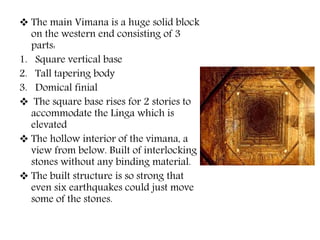
 The main Vimana is a huge solid block
on the western end consisting of 3
parts:
1. Square vertical base
2. Tall tapering body
3. Domical finial
 The square base rises for 2 stories to
accommodate the Linga which is
elevated
 The hollow interior of the vimana, a
view from below. Built of interlocking
stones without any binding material.
 The built structure is so strong that
even six earthquakes could just move
some of the stones.
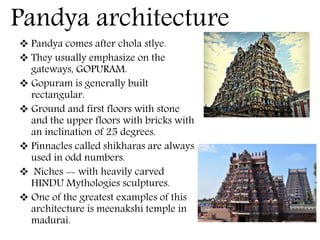
Pandya architecture
 Pandya comes after chola stlye.
 They usually emphasize on the
gateways, GOPURAM.
 Gopuram is generally built
rectangular.
 Ground and first floors with stone
and the upper floors with bricks with
an inclination of 25 degrees.
 Pinnacles called shikharas are always
used in odd numbers.
 Niches -- with heavily carved
HINDU Mythologies sculptures.
 One of the greatest examples of this
architecture is meenakshi temple in
madurai.
Meenakshi amman temple, Madurai
 The temple complex is the center of the
old city of Madurai.

South Indian Temple Architecture

  • 1.
    South Indian templearchitecture
  • 2.
    Introduction  It isalso called as Dravidian architecture  Dravidian architecture (600AD- 100AD) is an architectural idiom in Hindu temple architecture that emerged in the southern part of the India  It consists primarily of Hindu temples where the dominating feature is the high gopura or gatehouse  Majority of the existing structures are located in Andhra Pradesh, Karnataka, Kerala, Tamil Nadu and Telangana. Mahaballipuram temple Arunalachalam temple
  • 3.
    A temple consistedof -- Vimanas, Gopurams, Mantapams and Chaultries.  Vimana It is the structure over the garbhagriha or inner sanctum in the Hindu temples of South India and Odisha in East India  A vast gateway, which led to different parts of the temple with pillars the length of its path, was known as the Mandapam-the porch. Mandapa Parts of temples Vimana
  • 4.
     A Gopuramor gopura is a monumental entrance tower, usually ornate, at the entrance.  A gopuram is usually a tapering oblong in form with ground-level wooden doors, often richly decorated, providing access.  Choultry is a resting place for travelers, visitors to a site, typically linked to Buddhist, Jain and Hindu temples.  In Southern India five kingdoms and empires stamped their influence on architecture during different times. Gopuram Choultry
  • 5.
     Can besub-divided into two phases - the rock cut and the structural.  Pillars are the main contributions of this period.  Period where order in introdused.  Again rock cut phase consists of two groups – mahendra grpoup and mamalla group. Pallavas
  • 6.
    Evolution of pallavanorder  The early pillars were the rudimentary type of beam and bracket.  Introduction of an element- lion.  This lion symbolized the ruling dynasty – Simhavishnu. Palagai- wide abacus Idaie- lotus form Kumba- melon capital Tadi- refined necking Kalasa- Inverted lotus Simha- lion
  • 7.
    Group of monumentsin Mahaballipuram  Mahabalipuram temples are cave temples also known as mandapas.  They were excavated, cut and then carved using chisels and iron mallets. The most notable are the Varaha Cave Temple, Krishna Cave Temple, Tiger Cave Temple, Panchapandava Cave Temple, and the Mahishasuramardini mandapa. Varaha mandapa Krishna mandapa Tiger mandapa Panchapandava mandapa Mahishasuramandhini mandapa
  • 8.
    Rathas and Mantapas RATHAS are small shrines carved out of a monolithic rock.  Generally Ratha is known as chariot used for carrying the image of the deity during religious procession.  But here in pallava style it commonly refers to a monolithic shrine which has all the essential features of a temple including domed storey to shikhara.  Mahaballipuram has the preminent rathas. Draupadi Ratha: Smallest among the group dedicated to Durga. Simplest and the most finished Arjuna Ratha: Stepped pyramid structure decorate with Kudus. High relief sculptures on external walls between pilasters Draupadi and Arjuna ratha
  • 9.
    Bhima Ratha:  Reproducesthe Chaitya mode.  The structure is 2 stories high.  The front portico consists of 4 columns. Sahadeva Nakula Ratha:  The Ratha is based on ‘Chaitya Hall’ of Buddhist temple  It is apsidal end on the south side and double pillared portico on the north side.  The roof is elaborately carved. Bhima ratha Nakula sahadeva ratha
  • 10.
    Dharmaraja Ratha:  Largestof the 5 rathas.  Dedicated to Shiva.  Consists of 3 stories.  It is a large scale version of Arjuna Ratha with a larger no. of miniature edifices carved in the roof. Ganesh Ratha:  Dedicated to Shiva. Lion ornamenting a pier in the facade.  Consists of 3 stories.  Turreted roof.
  • 11.
     The bestexamples of this phase are the Shore Temple at Mahabalipuram.  It consists of two Shiva shrines having vimanas, a third shrine dedicated to Seshashayi Vishnu.  Unique feature of this temple is however its vimanas which don’t appear like stepped pyramids but rather tall slender tapering spires. Shore temple Structural temples
  • 12.
     The templehas a garbhagriha in which the deity, Sivalinga, is enshrined.  A small mandapa surrounded by a heavy outer wall with little space between for circumambulation.  The most distinctive feature of the temple are the Dharalinga and the Somaskanda panel.  The smaller Shiva temple behind the main temple is a double storied structure with a stepped pyramidal tower with an octagonal shikhara built over a circular griva.
  • 13.
    Cholas  The Cholascontinued the temple- building traditions of the Pallava dynasty and contributed significantly to the Dravidian temple design.  The capital of the Chola dynasty was the city of Thanjavur.  The great temple of Thanjavur was founded by Rajaraja I  Their military and economic power reflected on the grand architectural products.
  • 14.
    Early cholas  Builtentirely of stone  Use of well dressed granite. Brihadeeswara Temple Thanjavur  The largest, highest and most ambitious project at its time – a landmark in the evolution of South Indian Architecture.  dedicated to Shiva.  Built by Raja Raja Chola I between 1003 and 1010 AD.  It has two mandapa, namely maha- mandapa and mukha-mandapa, are square plan structures axially aligned between the sanctum and the Nandi mandapa.  It has been listed as UNESCO world heritage site.
  • 15.
     The mainVimana is a huge solid block on the western end consisting of 3 parts: 1. Square vertical base 2. Tall tapering body 3. Domical finial  The square base rises for 2 stories to accommodate the Linga which is elevated  The hollow interior of the vimana, a view from below. Built of interlocking stones without any binding material.  The built structure is so strong that even six earthquakes could just move some of the stones.
  • 16.
    Pandya architecture  Pandyacomes after chola stlye.  They usually emphasize on the gateways, GOPURAM.  Gopuram is generally built rectangular.  Ground and first floors with stone and the upper floors with bricks with an inclination of 25 degrees.  Pinnacles called shikharas are always used in odd numbers.  Niches -- with heavily carved HINDU Mythologies sculptures.  One of the greatest examples of this architecture is meenakshi temple in madurai.
  • 17.
    Meenakshi amman temple,Madurai  The temple complex is the center of the old city of Madurai.