Report on 

Arches

Submitted by:-

Jeet K Patel, 01

Abhishek M Chavan, 04

Aditya B koli, 14

B.Tech Second Year

Civil Dept

Under the Guidance of

:-Prof Tushar Somvanshi

Sunday, 12 April 2020 Page of1 31
Index
1.Abstract

2.Introduction

3.Literature study

4.Evolution of Arch

5.Historic Arch

•Greek & Romans

•Medical Period

•Geometric forms of Arch

6.Elastic Arch Theory

•Development

7.Modern Arch

•Geometry of Arch

•Types of Modern Arch

8.Conclusion

Sunday, 12 April 2020 Page of2 31
Abstract

The purpose of this thesis is to develop a preliminary guide
for the analysis and design of symmetrical circular arches.

In the context of the graduate curriculum that typically limits
itself to rectilinear structures, this thesis makes an effort to
apply basic principles (virtual work and the flexibility
method) towards deriving analytic solutions for different
types of elastic arches (reactions and internal forces). To the
best of our knowledge, this is the most comprehensive
repository of such closed formed solutions. To illustrate
their application, the preliminary design of a concrete arch
is reported. Furthermore, analytical results are assessed to
assist engineers gain a feel for arch behavior.

The study broadly covers semicircular arches. The analysis
includes different loading as well as support conditions that
lead to statically determinate or indeterminate structural
design cases. Effects of unsymmetrical loading conditions
on these structures are also briefly covered in their analysis.
The analytical solutions are derived with Mathematica,
compared with reported analytical solutions (when
available),validated with SAP 2000 models and used
through Matlab for the design example.

Further, this design guide helps relate structural behavior of
semicircular arches with their geometry. Influence of
aspects like span to - rise ratio on horizontal thrust, support
reactions, and forces across the span provides intuitive

Sunday, 12 April 2020 Page of3 31
Introduction

Arches have significant presence in architecture from pre-historic
period to modern time. With its curvilinear form, an arch creates most
intriguing connection with its surroundings. It is aesthetically appealing
as well as structurally efficient and therefore its application is seen in
some challenging projects.

As a student I was always fascinated by long spanned arch structures
and I was interested in understanding their structural behavior. I found
that, while structural engineering curriculum covered various methods
of analysis and design, it primarily focused on their application towards
rectilinear structures. Furthermore, no standard structural mechanics,
analysis and design text- books provided any guidance on how
variations in arch geometry influence its structural behaviour.

My curiosity to learn more about arches motivated me to apply the
simple methods that I have learned, towards analysis and preliminary
design of arches. With this thesis I made an effort to develop a set of
analytical equations for different type of circular arches. Further, I used
these equations to study behaviour of arches under different loading
conditions as well as to analyse effect of arch’s geometry on its internal
stresses. While this thesis work only covers some areas of the vast
topic of arches, it provides the information needed to understand the
primary structural behaviour of arches.

Sunday, 12 April 2020 Page of4 31
Literature Study
The literature study involved scientific papers and books published on
the topic of arches including development of their form from pre-
historic time to modern period, their application in modern structures,
advancement in their theory of analysis, common methods that are
currently used for analysis, and their limited coverage in the most
popular textbooks of civil engineering education. Following is the brief
information on multiple resources used for this literature study.

Godoy (2007) claims that most popular textbooks have limited
coverage considering the number of pages dedicated to arches. It also
describes the significance of arches in modern structures and therefore
emphasizes on the importance of including analysis of arches in civil
engineering curricula. The Table 1.2 shown below is taken from the
paper and it review 20 books on structural analysis.

The scientific paper by Clive L. Dym and Harry E. Williams (?) on the
behavior exhibited by curved, arch like structures under radially
directed and gravitational line loads provides estimates of the
displacements and stress resultants in the arch. The paper also uses
the results to offer insight into the assumptions underlying Robert
Maillarts arch designs. The primary difference between this paper and
the work presented in this thesis is that the paper provides estimates
where as the thesis work provides exact solutions for internal stresses
and deflection in the arch.

Huerta (2006) discusses method used by Antonio Gaudi to determine
the parabolic shape of the arch that is commonly seen in the structure
designed by him.

Acocella (2006) describes ancient and modern construction skills and
the development of masonry arches from pre-historic time to modern
period. It uses sketches and pictures to illustrate the various forms of
the arch.

Sunday, 12 April 2020 Page of5 31
Salvadori and Heller (1986) focuses on the importance on structural
engineering knowledge in architectural professional practice. It also
briefly discuses different types of modern and historic arches and the
rational behind their form and applications.

Thandavamoothy (2011) includes historic development in the form of
arches and their applications. It illustrates the application of elastic
theory towards analysis of modern arches using multiple examples.

Timoshenko (1953) gives a brief account of the history of theory of
elasticity and theory of structure. Further, it describes influential work of
some of mathematicians and physicist in detail. Ruddock (2000)
includes information on historic masonry bridges, viaducts and
aqueducts and it provides critical analysis of their failure. It also
describes the studies conducted to preserve

historic masonry structures.

West (1989) integrates the classical and modern methods of structural
analysis. It illustrates

the applications of these methods through examples.

Kinney (1957) presents methods of analysis for statically indeterminate
arches. It illustrates

their applications through various examples.

Sunday, 12 April 2020 Page of6 31
Evolution of Arch
Through out the history of architecture, arches have been
used as a main structural component. With their unique
compressive mechanism of resisting load, arches can be
categorised as special class of structural systems. They are
capable of spanning long distances while support- ing
significant weight, which makes them highly efficient and
visually powerful structural systems. Unlike modern
concrete or steel arches in which the members are
continuous and monolithic, historically arches were built
with masonry and were commonly used to span small
distance. As stone is quite durable material under
compression, many impressive examples of early masonry
arches exist to this day (Thandavamoothy, 2011,
pg1017-1019).

This chapter focuses on the development of an arch form,
all the way from the prehistoric period to the modern
period. It discusses the development in the theory of
analysis of an arch and its influence on the modern arch
design.

Sunday, 12 April 2020 Page of7 31
Historic of Arches
The arch in its most primitive form was first used by
Mesopotamian, Persian and Egyptian civilisations. Ancient
builders accomplished the challenge of creating the doors
and passageways the targeted style architraves, commonly
known in today’s date as a lintel. It is a horizontal strutural
element that carries the weight of the overlying elements by
transferring it to the abutments or piers. With this
configuration, the longest available beam restricted the
opening size. Even though the stone architraves were
simple in nature, they were considered progression of the
ancient wooden framework that was subject to decay with
time. From a static point of view this system involves all
structural configurations that transfer weight in a vertical
direction. Vertical elements like pilasters, columns and
abutments are subjected to compressive stresses, while
horizontal one like lintels or beams are subjected to both
compressive and tensile stresses.

Sunday, 12 April 2020 Page of8 31
1.	 Corbelled Arch
In terms of execution, the Architrave structures with
considerable depth that can span large openings were
extremely laborious technical solution. New structural
configuration was adopted due to lack of readily available
large stone elements, which initiated future developments
towards a more rational use of rigid material that is not
resistant to tensile stress. The earlier examples are
consisted of two stone slabs, laid diagonally against each
other, which would transfer the applied load to the masonry
abutments through diagonal thrust. In this configuration, the
diagonal thrust tend to widen the structure itself in the
absence of adequate abutments. This structural solution is
Sunday, 12 April 2020 Page of9 31
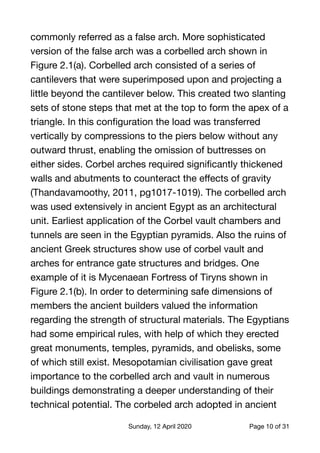
commonly referred as a false arch. More sophisticated
version of the false arch was a corbelled arch shown in
Figure 2.1(a). Corbelled arch consisted of a series of
cantilevers that were superimposed upon and projecting a
little beyond the cantilever below. This created two slanting
sets of stone steps that met at the top to form the apex of a
triangle. In this configuration the load was transferred
vertically by compressions to the piers below without any
outward thrust, enabling the omission of buttresses on
either sides. Corbel arches required significantly thickened
walls and abutments to counteract the effects of gravity
(Thandavamoothy, 2011, pg1017-1019). The corbelled arch
was used extensively in ancient Egypt as an architectural
unit. Earliest application of the Corbel vault chambers and
tunnels are seen in the Egyptian pyramids. Also the ruins of
ancient Greek structures show use of corbel vault and
arches for entrance gate structures and bridges. One
example of it is Mycenaean Fortress of Tiryns shown in
Figure 2.1(b). In order to determining safe dimensions of
members the ancient builders valued the information
regarding the strength of structural materials. The Egyptians
had some empirical rules, with help of which they erected
great monuments, temples, pyramids, and obelisks, some
of which still exist. Mesopotamian civilisation gave great
importance to the corbelled arch and vault in numerous
buildings demonstrating a deeper understanding of their
technical potential. The corbeled arch adopted in ancient
Sunday, 12 April 2020 Page of10 31
time was in some respect a transitional stage between the
architrave structures and the more sophisticated arcuate
system commonly called as true arch 

Sunday, 12 April 2020 Page of11 31
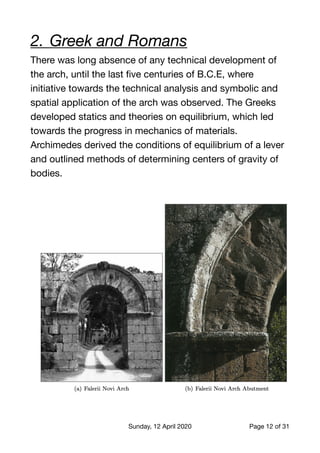
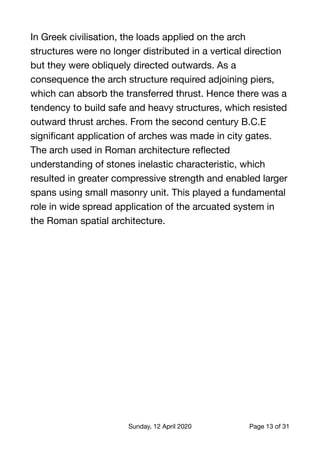
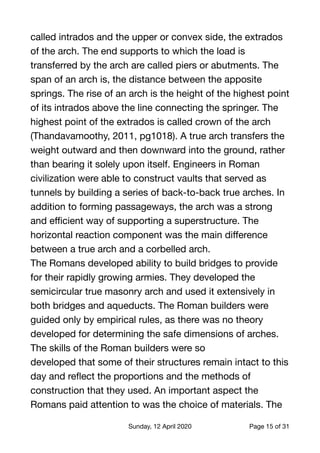
2.	Greek and Romans
There was long absence of any technical development of
the arch, until the last five centuries of B.C.E, where
initiative towards the technical analysis and symbolic and
spatial application of the arch was observed. The Greeks
developed statics and theories on equilibrium, which led
towards the progress in mechanics of materials.
Archimedes derived the conditions of equilibrium of a lever
and outlined methods of determining centers of gravity of
bodies.

Sunday, 12 April 2020 Page of12 31
In Greek civilisation, the loads applied on the arch
structures were no longer distributed in a vertical direction
but they were obliquely directed outwards. As a
consequence the arch structure required adjoining piers,
which can absorb the transferred thrust. Hence there was a
tendency to build safe and heavy structures, which resisted
outward thrust arches. From the second century B.C.E
significant application of arches was made in city gates.
The arch used in Roman architecture reflected
understanding of stones inelastic characteristic, which
resulted in greater compressive strength and enabled larger
spans using small masonry unit. This played a fundamental
role in wide spread application of the arcuated system in
the Roman spatial architecture.

Sunday, 12 April 2020 Page of13 31
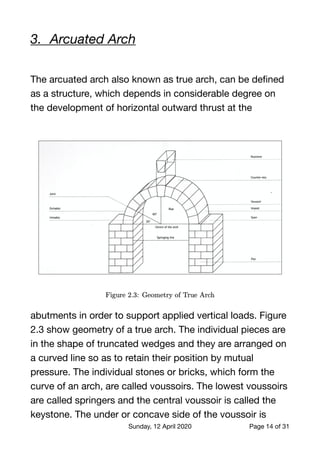
3.	 Arcuated Arch
The arcuated arch also known as true arch, can be defined
as a structure, which depends in considerable degree on
the development of horizontal outward thrust at the
abutments in order to support applied vertical loads. Figure
2.3 show geometry of a true arch. The individual pieces are
in the shape of truncated wedges and they are arranged on
a curved line so as to retain their position by mutual
pressure. The individual stones or bricks, which form the
curve of an arch, are called voussoirs. The lowest voussoirs
are called springers and the central voussoir is called the
keystone. The under or concave side of the voussoir is
Sunday, 12 April 2020 Page of14 31
called intrados and the upper or convex side, the extrados
of the arch. The end supports to which the load is
transferred by the arch are called piers or abutments. The
span of an arch is, the distance between the apposite
springs. The rise of an arch is the height of the highest point
of its intrados above the line connecting the springer. The
highest point of the extrados is called crown of the arch
(Thandavamoothy, 2011, pg1018). A true arch transfers the
weight outward and then downward into the ground, rather
than bearing it solely upon itself. Engineers in Roman
civilization were able to construct vaults that served as
tunnels by building a series of back-to-back true arches. In
addition to forming passageways, the arch was a strong
and efficient way of supporting a superstructure. The
horizontal reaction component was the main difference
between a true arch and a corbelled arch.

The Romans developed ability to build bridges to provide
for their rapidly growing armies. They developed the
semicircular true masonry arch and used it extensively in
both bridges and aqueducts. The Roman builders were
guided only by empirical rules, as there was no theory
developed for determining the safe dimensions of arches.
The skills of the Roman builders were so

developed that some of their structures remain intact to this
day and reflect the proportions and the methods of
construction that they used. An important aspect the
Romans paid attention to was the choice of materials. The
Sunday, 12 April 2020 Page of15 31
Romans invented concrete for greater economy of material
as well as for convenient construct ability. Their masonry
bridges rested mostly on semi-circular arches or on
segmental circular arches

Sunday, 12 April 2020 Page of16 31
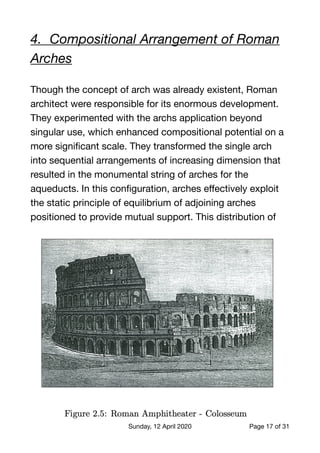
4.	 Compositional Arrangement of Roman
Arches
Though the concept of arch was already existent, Roman
architect were responsible for its enormous development.
They experimented with the archs application beyond
singular use, which enhanced compositional potential on a
more significant scale. They transformed the single arch
into sequential arrangements of increasing dimension that
resulted in the monumental string of arches for the
aqueducts. In this configuration, arches effectively exploit
the static principle of equilibrium of adjoining arches
positioned to provide mutual support. This distribution of
Sunday, 12 April 2020 Page of17 31
thrust caused excessive stress on element that open and
close the sequence and, as a consequence, it was
structurally the most elaborate part of the construction. In
order to widen the span between the supporting piers of
bridges, Roman engineers pushed the construction limits of
the arch with a radial configuration of stones. This
challenge was met by the constructing a series of daring
arched structures with gradually increasing spans,
particularly those at the bottom playing the crucial role of
supporting buttresses while resisting the water pressure 

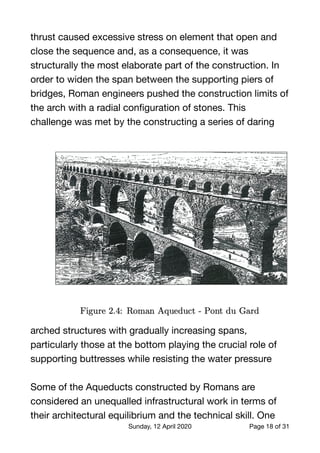
Some of the Aqueducts constructed by Romans are
considered an unequalled infrastructural work in terms of
their architectural equilibrium and the technical skill. One
Sunday, 12 April 2020 Page of18 31
such example is the Pont du Gard shown Figure 2.4, where
the structural section of the bridge gets slimmer as it rises
and it features two enormous superimposed orders of
circular arches, on top of which is a more close-knit series
of smaller arches supporting the actual conduit of the
aqueduct. Roman structures reflected innovative building
methods, cement-based technique, and fresh
compositional design based on multiple arches. With the
ever-growing demand of the bridge construction, the
circular arch was a deliberate choice over the drop arch,
which cause greater outwards thrust and impose problem
in the presence of considerable span (Acocella, 2006).

The construction of curved masonry walls is combination
with the curvilinear arches and vaults widened the ranges of
experiments carried out into Roman building types. Some
of the Examples are found in traditional Roman theatres
and amphitheaters. Innovation consisted of curving
masonry walls and arches and laying two or three orders of
arches on top of one another

absorbing the thrust of the internal vaults and terrace of the
theatre. It almost took two centuries to classify the typology
of the Roman amphitheater and achieve unique models
such as the Colosseum shown in Figure 2.5. This
horseshoe-shaped auditorium is supported by a sequence
of radial-vaulted structures capable of incorporating flights
of steps for the incoming and outgoing flow of spectators.

Sunday, 12 April 2020 Page of19 31
Arabic Arch
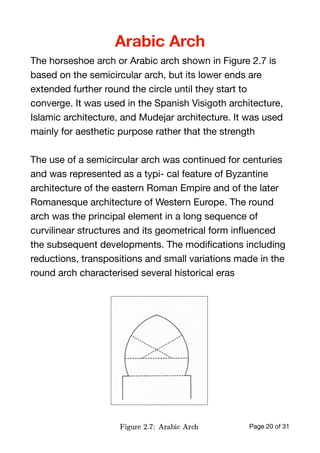
The horseshoe arch or Arabic arch shown in Figure 2.7 is
based on the semicircular arch, but its lower ends are
extended further round the circle until they start to
converge. It was used in the Spanish Visigoth architecture,
Islamic architecture, and Mudejar architecture. It was used
mainly for aesthetic purpose rather that the strength 

The use of a semicircular arch was continued for centuries
and was represented as a typi- cal feature of Byzantine
architecture of the eastern Roman Empire and of the later
Romanesque architecture of Western Europe. The round
arch was the principal element in a long sequence of
curvilinear structures and its geometrical form influenced
the subsequent developments. The modifications including
reductions, transpositions and small variations made in the
round arch characterised several historical eras

Sunday, 12 April 2020 Page of20 31
Geometric Forms of An Arch
With the introduction of efficient construction materials and
advancement in construction techniques, arches were used
in numerous geometrical forms. Such as: 1) Rounded or
Semicircular, 2) Stilted; 3) Segmental; 4) Horseshoe;5)
Pointed; 6) Three centered or Elliptical; 7) Four- Centered or
Tudor; 8) Ogee; 9) Foiled Cusped; 10) Shoulder; and 11)
Flat.

Broadly the arches are categorized in four classes based on
the way they are formed. The first class of arches is struck
from single center, where the center is located in middle of
the diameter. In the case where the center is at a point
above the diameter, it is called a stilted arch. When the arch
is formed of curve that is less than a semicircle it is called
Sunday, 12 April 2020 Page of21 31
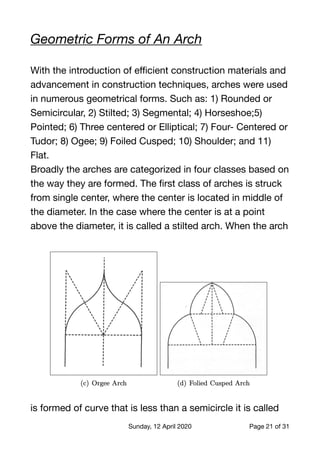
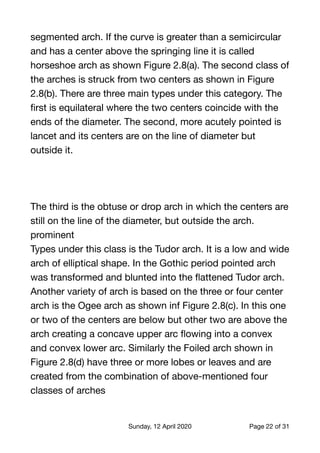
segmented arch. If the curve is greater than a semicircular
and has a center above the springing line it is called
horseshoe arch as shown Figure 2.8(a). The second class of
the arches is struck from two centers as shown in Figure
2.8(b). There are three main types under this category. The
first is equilateral where the two centers coincide with the
ends of the diameter. The second, more acutely pointed is
lancet and its centers are on the line of diameter but
outside it. 

The third is the obtuse or drop arch in which the centers are
still on the line of the diameter, but outside the arch.

prominent

Types under this class is the Tudor arch. It is a low and wide
arch of elliptical shape. In the Gothic period pointed arch
was transformed and blunted into the flattened Tudor arch.
Another variety of arch is based on the three or four center
arch is the Ogee arch as shown inf Figure 2.8(c). In this one
or two of the centers are below but other two are above the
arch creating a concave upper arc flowing into a convex
and convex lower arc. Similarly the Foiled arch shown in
Figure 2.8(d) have three or more lobes or leaves and are
created from the combination of above-mentioned four
classes of arches

Sunday, 12 April 2020 Page of22 31
Keeping in consideration the original compressive
mechanism of the arch, geometrical varia- tions were made,
which broaden the family of curvilinear forms. It led to the
development of the pointed arch in the medieval times, the
elliptical and mixed arches in the Renaissance and Baroque
eras, and to the parabolic arch between the late nineteenth
and early twentieth century

Sunday, 12 April 2020 Page of23 31
Modern Arches
The period of 1800-1900 century is considered to be a
golden age of structural engineering as during this period
most of the present day theories of mechanics of material
and structural analysis were developed. These
developments were accompanied by the advancement in
construction techniques and building material. As steel and
reinforced concrete exhibited elastic properties much better
than those of wood and stone, their arrival declining the
popularity of masonry arches towards early 20th century.
New theories were applied to enable more daring steel and
concrete.arch forms. New advancement in structural forms
included the perfection of long-span arch bridges of various
configuration

Sunday, 12 April 2020 Page of24 31
Geometry of Modern Arches
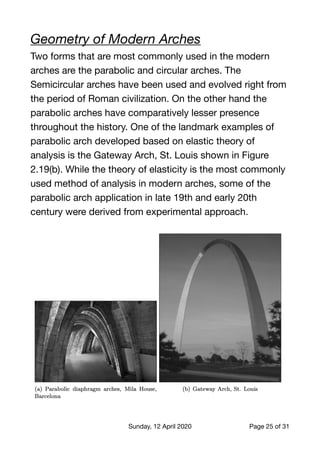
Two forms that are most commonly used in the modern
arches are the parabolic and circular arches. The
Semicircular arches have been used and evolved right from
the period of Roman civilization. On the other hand the
parabolic arches have comparatively lesser presence
throughout the history. One of the landmark examples of
parabolic arch developed based on elastic theory of
analysis is the Gateway Arch, St. Louis shown in Figure
2.19(b). While the theory of elasticity is the most commonly
used method of analysis in modern arches, some of the
parabolic arch application in late 19th and early 20th
century were derived from experimental approach.

Sunday, 12 April 2020 Page of25 31
Antonio Gaudis parabolic or Catenary masonry arches
show originality and independence, particularly with their
integration in the process of architectural design. He
resolved the equilibrium problem of the arch by comparing
it with the behavior of hanging cable. The challenge was to
find the shape of a cable that supports a load proportional
to the vertical distance between its directrix and a
horizontal extrados. To use a symmetric catenary to
support an asymmetric load, it needed transformation for
which Gaudi used iterative graphic method. He first hung a
cable and measure the vertical distances of various point
across the cable under it own weight. To this cable he
added the corresponding weight of the floor, which caused
change in shape of the cable. Vertical distances were
measured again and accordingly the self-weight was
modified. The cable under these loads adopted a shape
that was very close to the exact mathematical shape.
Application of this method can be seen in the design of
diaphragm arches in the Mila house in Barcelona shown in
Figure 2.19(a) (Huerta, 2006).

Sunday, 12 April 2020 Page of26 31
Types of Modern Arches
From 19th century on wards the theory of elasticity was
commonly used for the analysis of arches and on the basis
of requirements and limitations, certain types of arches
were put in to design application. Based on the material of
construction, arches are classified as steel, concrete,
timber, brick or stone. In the standpoint of support
conditions and structural behavior they are classified as
follows,

(1) Three-Hinged - Hinges at the crown and abutment (2)
Two-Hinged – Hinges at the abutments only

(3) Hingeless – No hinges at all

Sunday, 12 April 2020 Page of27 31
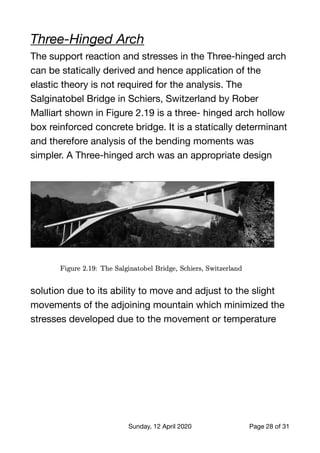
Three-Hinged Arch
The support reaction and stresses in the Three-hinged arch
can be statically derived and hence application of the
elastic theory is not required for the analysis. The
Salginatobel Bridge in Schiers, Switzerland by Rober
Malliart shown in Figure 2.19 is a three- hinged arch hollow
box reinforced concrete bridge. It is a statically determinant
and therefore analysis of the bending moments was
simpler. A Three-hinged arch was an appropriate design
solution due to its ability to move and adjust to the slight
movements of the adjoining mountain which minimized the
stresses developed due to the movement or temperature

Sunday, 12 April 2020 Page of28 31
Two-Hinged Arch and Hinge Less Arch
These two classes of arches belongs to the classes of
structures whose stresses cannot be computed by the
ordinary method of statics alone as the equilibrium between
the exterior forces and interior stresses in the arch is
dependent in part on its change of form. The rainbow Arch
at Niagara Falls Spanning 950 feet is a hinge less arch. For
the purpose of preliminary study of the Rainbow arch a two
hinge arch design was considered and it was found that the
deflection of the rib increased the stress at the critical
location by about four times as compared to the hinge less
arch which was actually erected. Thus the greater stiffness
of the hinge less arch is a distinct advantage in long span
arches

Sunday, 12 April 2020 Page of29 31
Conclusion
The rational behind the structural behavior of an arch was
not completely understood by the ancient builders and they
used the intuitive understanding to develop the empirical
rules to erected great monuments. Structural engineering
existed as an art down through the ancient and medieval
period. During this period circular arches were primarily
used to span moderated distances. Some of the important
developments in the application of an arch form were seen
the

33


Roman and Gothic periods. The Romans explored
compositional potential of a circular arch by using it in a
sequential arrangement and there by effectively used the
static principal of equilibrium of the adjoining arches. The
Greek on other hand transformed the circular arch into a
pointed arch and used flying buttresses to resist the
outward thrust.

Renewal of interest in the filed of science and its application
towards understanding the behavior of structures was seen
from 14th century onward. From 14th century to 19th
century many mathematicians and physicist developed
theories based on their understanding of elastic properties
of the materials. Even though the elastic theory of analysis
progressed during this period, the practicing structural
engineers continued relying on their experience and
Sunday, 12 April 2020 Page of30 31
judgment to design arch structures. By 18th century the
elastic theory of analysis was fully accepted and was used
towards analysis of the arches.

The development in the theory of analysis was paralleled by
the advancement in building material and construction
techniques. Arrival of steel and reinforced concrete had
revolutionary impact on application of arch structures. In
contemporary world arches have gained a special
importance and are primarily used in ambitious projects like
long span bridges.
Sunday, 12 April 2020 Page of31 31

Report on Arches

  • 1.
    Report on Arches Submittedby:- Jeet K Patel, 01 Abhishek M Chavan, 04 Aditya B koli, 14 B.Tech Second Year Civil Dept Under the Guidance of :-Prof Tushar Somvanshi
 Sunday, 12 April 2020 Page of1 31
  • 2.
    Index 1.Abstract 2.Introduction 3.Literature study 4.Evolution ofArch 5.Historic Arch •Greek & Romans •Medical Period •Geometric forms of Arch 6.Elastic Arch Theory •Development 7.Modern Arch •Geometry of Arch •Types of Modern Arch 8.Conclusion Sunday, 12 April 2020 Page of2 31
  • 3.
    Abstract The purpose ofthis thesis is to develop a preliminary guide for the analysis and design of symmetrical circular arches. In the context of the graduate curriculum that typically limits itself to rectilinear structures, this thesis makes an effort to apply basic principles (virtual work and the flexibility method) towards deriving analytic solutions for different types of elastic arches (reactions and internal forces). To the best of our knowledge, this is the most comprehensive repository of such closed formed solutions. To illustrate their application, the preliminary design of a concrete arch is reported. Furthermore, analytical results are assessed to assist engineers gain a feel for arch behavior. The study broadly covers semicircular arches. The analysis includes different loading as well as support conditions that lead to statically determinate or indeterminate structural design cases. Effects of unsymmetrical loading conditions on these structures are also briefly covered in their analysis. The analytical solutions are derived with Mathematica, compared with reported analytical solutions (when available),validated with SAP 2000 models and used through Matlab for the design example. Further, this design guide helps relate structural behavior of semicircular arches with their geometry. Influence of aspects like span to - rise ratio on horizontal thrust, support reactions, and forces across the span provides intuitive Sunday, 12 April 2020 Page of3 31
  • 4.
    Introduction Arches have significantpresence in architecture from pre-historic period to modern time. With its curvilinear form, an arch creates most intriguing connection with its surroundings. It is aesthetically appealing as well as structurally efficient and therefore its application is seen in some challenging projects. As a student I was always fascinated by long spanned arch structures and I was interested in understanding their structural behavior. I found that, while structural engineering curriculum covered various methods of analysis and design, it primarily focused on their application towards rectilinear structures. Furthermore, no standard structural mechanics, analysis and design text- books provided any guidance on how variations in arch geometry influence its structural behaviour. My curiosity to learn more about arches motivated me to apply the simple methods that I have learned, towards analysis and preliminary design of arches. With this thesis I made an effort to develop a set of analytical equations for different type of circular arches. Further, I used these equations to study behaviour of arches under different loading conditions as well as to analyse effect of arch’s geometry on its internal stresses. While this thesis work only covers some areas of the vast topic of arches, it provides the information needed to understand the primary structural behaviour of arches. Sunday, 12 April 2020 Page of4 31
  • 5.
    Literature Study The literaturestudy involved scientific papers and books published on the topic of arches including development of their form from pre- historic time to modern period, their application in modern structures, advancement in their theory of analysis, common methods that are currently used for analysis, and their limited coverage in the most popular textbooks of civil engineering education. Following is the brief information on multiple resources used for this literature study. Godoy (2007) claims that most popular textbooks have limited coverage considering the number of pages dedicated to arches. It also describes the significance of arches in modern structures and therefore emphasizes on the importance of including analysis of arches in civil engineering curricula. The Table 1.2 shown below is taken from the paper and it review 20 books on structural analysis. The scientific paper by Clive L. Dym and Harry E. Williams (?) on the behavior exhibited by curved, arch like structures under radially directed and gravitational line loads provides estimates of the displacements and stress resultants in the arch. The paper also uses the results to offer insight into the assumptions underlying Robert Maillarts arch designs. The primary difference between this paper and the work presented in this thesis is that the paper provides estimates where as the thesis work provides exact solutions for internal stresses and deflection in the arch. Huerta (2006) discusses method used by Antonio Gaudi to determine the parabolic shape of the arch that is commonly seen in the structure designed by him. Acocella (2006) describes ancient and modern construction skills and the development of masonry arches from pre-historic time to modern period. It uses sketches and pictures to illustrate the various forms of the arch. Sunday, 12 April 2020 Page of5 31
  • 6.
    Salvadori and Heller(1986) focuses on the importance on structural engineering knowledge in architectural professional practice. It also briefly discuses different types of modern and historic arches and the rational behind their form and applications. Thandavamoothy (2011) includes historic development in the form of arches and their applications. It illustrates the application of elastic theory towards analysis of modern arches using multiple examples. Timoshenko (1953) gives a brief account of the history of theory of elasticity and theory of structure. Further, it describes influential work of some of mathematicians and physicist in detail. Ruddock (2000) includes information on historic masonry bridges, viaducts and aqueducts and it provides critical analysis of their failure. It also describes the studies conducted to preserve historic masonry structures. West (1989) integrates the classical and modern methods of structural analysis. It illustrates the applications of these methods through examples. Kinney (1957) presents methods of analysis for statically indeterminate arches. It illustrates their applications through various examples.
 Sunday, 12 April 2020 Page of6 31
  • 7.
    Evolution of Arch Throughout the history of architecture, arches have been used as a main structural component. With their unique compressive mechanism of resisting load, arches can be categorised as special class of structural systems. They are capable of spanning long distances while support- ing significant weight, which makes them highly efficient and visually powerful structural systems. Unlike modern concrete or steel arches in which the members are continuous and monolithic, historically arches were built with masonry and were commonly used to span small distance. As stone is quite durable material under compression, many impressive examples of early masonry arches exist to this day (Thandavamoothy, 2011, pg1017-1019). This chapter focuses on the development of an arch form, all the way from the prehistoric period to the modern period. It discusses the development in the theory of analysis of an arch and its influence on the modern arch design.
 Sunday, 12 April 2020 Page of7 31
  • 8.
    Historic of Arches Thearch in its most primitive form was first used by Mesopotamian, Persian and Egyptian civilisations. Ancient builders accomplished the challenge of creating the doors and passageways the targeted style architraves, commonly known in today’s date as a lintel. It is a horizontal strutural element that carries the weight of the overlying elements by transferring it to the abutments or piers. With this configuration, the longest available beam restricted the opening size. Even though the stone architraves were simple in nature, they were considered progression of the ancient wooden framework that was subject to decay with time. From a static point of view this system involves all structural configurations that transfer weight in a vertical direction. Vertical elements like pilasters, columns and abutments are subjected to compressive stresses, while horizontal one like lintels or beams are subjected to both compressive and tensile stresses. Sunday, 12 April 2020 Page of8 31
  • 9.
    1. Corbelled Arch Interms of execution, the Architrave structures with considerable depth that can span large openings were extremely laborious technical solution. New structural configuration was adopted due to lack of readily available large stone elements, which initiated future developments towards a more rational use of rigid material that is not resistant to tensile stress. The earlier examples are consisted of two stone slabs, laid diagonally against each other, which would transfer the applied load to the masonry abutments through diagonal thrust. In this configuration, the diagonal thrust tend to widen the structure itself in the absence of adequate abutments. This structural solution is Sunday, 12 April 2020 Page of9 31
  • 10.
    commonly referred asa false arch. More sophisticated version of the false arch was a corbelled arch shown in Figure 2.1(a). Corbelled arch consisted of a series of cantilevers that were superimposed upon and projecting a little beyond the cantilever below. This created two slanting sets of stone steps that met at the top to form the apex of a triangle. In this configuration the load was transferred vertically by compressions to the piers below without any outward thrust, enabling the omission of buttresses on either sides. Corbel arches required significantly thickened walls and abutments to counteract the effects of gravity (Thandavamoothy, 2011, pg1017-1019). The corbelled arch was used extensively in ancient Egypt as an architectural unit. Earliest application of the Corbel vault chambers and tunnels are seen in the Egyptian pyramids. Also the ruins of ancient Greek structures show use of corbel vault and arches for entrance gate structures and bridges. One example of it is Mycenaean Fortress of Tiryns shown in Figure 2.1(b). In order to determining safe dimensions of members the ancient builders valued the information regarding the strength of structural materials. The Egyptians had some empirical rules, with help of which they erected great monuments, temples, pyramids, and obelisks, some of which still exist. Mesopotamian civilisation gave great importance to the corbelled arch and vault in numerous buildings demonstrating a deeper understanding of their technical potential. The corbeled arch adopted in ancient Sunday, 12 April 2020 Page of10 31
  • 11.
    time was insome respect a transitional stage between the architrave structures and the more sophisticated arcuate system commonly called as true arch Sunday, 12 April 2020 Page of11 31
  • 12.
    2. Greek and Romans Therewas long absence of any technical development of the arch, until the last five centuries of B.C.E, where initiative towards the technical analysis and symbolic and spatial application of the arch was observed. The Greeks developed statics and theories on equilibrium, which led towards the progress in mechanics of materials. Archimedes derived the conditions of equilibrium of a lever and outlined methods of determining centers of gravity of bodies. Sunday, 12 April 2020 Page of12 31
  • 13.
    In Greek civilisation,the loads applied on the arch structures were no longer distributed in a vertical direction but they were obliquely directed outwards. As a consequence the arch structure required adjoining piers, which can absorb the transferred thrust. Hence there was a tendency to build safe and heavy structures, which resisted outward thrust arches. From the second century B.C.E significant application of arches was made in city gates. The arch used in Roman architecture reflected understanding of stones inelastic characteristic, which resulted in greater compressive strength and enabled larger spans using small masonry unit. This played a fundamental role in wide spread application of the arcuated system in the Roman spatial architecture.
 Sunday, 12 April 2020 Page of13 31
  • 14.
    3. Arcuated Arch Thearcuated arch also known as true arch, can be defined as a structure, which depends in considerable degree on the development of horizontal outward thrust at the abutments in order to support applied vertical loads. Figure 2.3 show geometry of a true arch. The individual pieces are in the shape of truncated wedges and they are arranged on a curved line so as to retain their position by mutual pressure. The individual stones or bricks, which form the curve of an arch, are called voussoirs. The lowest voussoirs are called springers and the central voussoir is called the keystone. The under or concave side of the voussoir is Sunday, 12 April 2020 Page of14 31
  • 15.
    called intrados andthe upper or convex side, the extrados of the arch. The end supports to which the load is transferred by the arch are called piers or abutments. The span of an arch is, the distance between the apposite springs. The rise of an arch is the height of the highest point of its intrados above the line connecting the springer. The highest point of the extrados is called crown of the arch (Thandavamoothy, 2011, pg1018). A true arch transfers the weight outward and then downward into the ground, rather than bearing it solely upon itself. Engineers in Roman civilization were able to construct vaults that served as tunnels by building a series of back-to-back true arches. In addition to forming passageways, the arch was a strong and efficient way of supporting a superstructure. The horizontal reaction component was the main difference between a true arch and a corbelled arch. The Romans developed ability to build bridges to provide for their rapidly growing armies. They developed the semicircular true masonry arch and used it extensively in both bridges and aqueducts. The Roman builders were guided only by empirical rules, as there was no theory developed for determining the safe dimensions of arches. The skills of the Roman builders were so developed that some of their structures remain intact to this day and reflect the proportions and the methods of construction that they used. An important aspect the Romans paid attention to was the choice of materials. The Sunday, 12 April 2020 Page of15 31
  • 16.
    Romans invented concretefor greater economy of material as well as for convenient construct ability. Their masonry bridges rested mostly on semi-circular arches or on segmental circular arches Sunday, 12 April 2020 Page of16 31
  • 17.
    4. Compositional Arrangementof Roman Arches Though the concept of arch was already existent, Roman architect were responsible for its enormous development. They experimented with the archs application beyond singular use, which enhanced compositional potential on a more significant scale. They transformed the single arch into sequential arrangements of increasing dimension that resulted in the monumental string of arches for the aqueducts. In this configuration, arches effectively exploit the static principle of equilibrium of adjoining arches positioned to provide mutual support. This distribution of Sunday, 12 April 2020 Page of17 31
  • 18.
    thrust caused excessivestress on element that open and close the sequence and, as a consequence, it was structurally the most elaborate part of the construction. In order to widen the span between the supporting piers of bridges, Roman engineers pushed the construction limits of the arch with a radial configuration of stones. This challenge was met by the constructing a series of daring arched structures with gradually increasing spans, particularly those at the bottom playing the crucial role of supporting buttresses while resisting the water pressure Some of the Aqueducts constructed by Romans are considered an unequalled infrastructural work in terms of their architectural equilibrium and the technical skill. One Sunday, 12 April 2020 Page of18 31
  • 19.
    such example isthe Pont du Gard shown Figure 2.4, where the structural section of the bridge gets slimmer as it rises and it features two enormous superimposed orders of circular arches, on top of which is a more close-knit series of smaller arches supporting the actual conduit of the aqueduct. Roman structures reflected innovative building methods, cement-based technique, and fresh compositional design based on multiple arches. With the ever-growing demand of the bridge construction, the circular arch was a deliberate choice over the drop arch, which cause greater outwards thrust and impose problem in the presence of considerable span (Acocella, 2006). The construction of curved masonry walls is combination with the curvilinear arches and vaults widened the ranges of experiments carried out into Roman building types. Some of the Examples are found in traditional Roman theatres and amphitheaters. Innovation consisted of curving masonry walls and arches and laying two or three orders of arches on top of one another absorbing the thrust of the internal vaults and terrace of the theatre. It almost took two centuries to classify the typology of the Roman amphitheater and achieve unique models such as the Colosseum shown in Figure 2.5. This horseshoe-shaped auditorium is supported by a sequence of radial-vaulted structures capable of incorporating flights of steps for the incoming and outgoing flow of spectators. Sunday, 12 April 2020 Page of19 31
  • 20.
    Arabic Arch The horseshoearch or Arabic arch shown in Figure 2.7 is based on the semicircular arch, but its lower ends are extended further round the circle until they start to converge. It was used in the Spanish Visigoth architecture, Islamic architecture, and Mudejar architecture. It was used mainly for aesthetic purpose rather that the strength The use of a semicircular arch was continued for centuries and was represented as a typi- cal feature of Byzantine architecture of the eastern Roman Empire and of the later Romanesque architecture of Western Europe. The round arch was the principal element in a long sequence of curvilinear structures and its geometrical form influenced the subsequent developments. The modifications including reductions, transpositions and small variations made in the round arch characterised several historical eras Sunday, 12 April 2020 Page of20 31
  • 21.
    Geometric Forms ofAn Arch With the introduction of efficient construction materials and advancement in construction techniques, arches were used in numerous geometrical forms. Such as: 1) Rounded or Semicircular, 2) Stilted; 3) Segmental; 4) Horseshoe;5) Pointed; 6) Three centered or Elliptical; 7) Four- Centered or Tudor; 8) Ogee; 9) Foiled Cusped; 10) Shoulder; and 11) Flat. Broadly the arches are categorized in four classes based on the way they are formed. The first class of arches is struck from single center, where the center is located in middle of the diameter. In the case where the center is at a point above the diameter, it is called a stilted arch. When the arch is formed of curve that is less than a semicircle it is called Sunday, 12 April 2020 Page of21 31
  • 22.
    segmented arch. Ifthe curve is greater than a semicircular and has a center above the springing line it is called horseshoe arch as shown Figure 2.8(a). The second class of the arches is struck from two centers as shown in Figure 2.8(b). There are three main types under this category. The first is equilateral where the two centers coincide with the ends of the diameter. The second, more acutely pointed is lancet and its centers are on the line of diameter but outside it. The third is the obtuse or drop arch in which the centers are still on the line of the diameter, but outside the arch. prominent Types under this class is the Tudor arch. It is a low and wide arch of elliptical shape. In the Gothic period pointed arch was transformed and blunted into the flattened Tudor arch. Another variety of arch is based on the three or four center arch is the Ogee arch as shown inf Figure 2.8(c). In this one or two of the centers are below but other two are above the arch creating a concave upper arc flowing into a convex and convex lower arc. Similarly the Foiled arch shown in Figure 2.8(d) have three or more lobes or leaves and are created from the combination of above-mentioned four classes of arches
 Sunday, 12 April 2020 Page of22 31
  • 23.
    Keeping in considerationthe original compressive mechanism of the arch, geometrical varia- tions were made, which broaden the family of curvilinear forms. It led to the development of the pointed arch in the medieval times, the elliptical and mixed arches in the Renaissance and Baroque eras, and to the parabolic arch between the late nineteenth and early twentieth century
 Sunday, 12 April 2020 Page of23 31
  • 24.
    Modern Arches The periodof 1800-1900 century is considered to be a golden age of structural engineering as during this period most of the present day theories of mechanics of material and structural analysis were developed. These developments were accompanied by the advancement in construction techniques and building material. As steel and reinforced concrete exhibited elastic properties much better than those of wood and stone, their arrival declining the popularity of masonry arches towards early 20th century. New theories were applied to enable more daring steel and concrete.arch forms. New advancement in structural forms included the perfection of long-span arch bridges of various configuration Sunday, 12 April 2020 Page of24 31
  • 25.
    Geometry of ModernArches Two forms that are most commonly used in the modern arches are the parabolic and circular arches. The Semicircular arches have been used and evolved right from the period of Roman civilization. On the other hand the parabolic arches have comparatively lesser presence throughout the history. One of the landmark examples of parabolic arch developed based on elastic theory of analysis is the Gateway Arch, St. Louis shown in Figure 2.19(b). While the theory of elasticity is the most commonly used method of analysis in modern arches, some of the parabolic arch application in late 19th and early 20th century were derived from experimental approach. Sunday, 12 April 2020 Page of25 31
  • 26.
    Antonio Gaudis parabolicor Catenary masonry arches show originality and independence, particularly with their integration in the process of architectural design. He resolved the equilibrium problem of the arch by comparing it with the behavior of hanging cable. The challenge was to find the shape of a cable that supports a load proportional to the vertical distance between its directrix and a horizontal extrados. To use a symmetric catenary to support an asymmetric load, it needed transformation for which Gaudi used iterative graphic method. He first hung a cable and measure the vertical distances of various point across the cable under it own weight. To this cable he added the corresponding weight of the floor, which caused change in shape of the cable. Vertical distances were measured again and accordingly the self-weight was modified. The cable under these loads adopted a shape that was very close to the exact mathematical shape. Application of this method can be seen in the design of diaphragm arches in the Mila house in Barcelona shown in Figure 2.19(a) (Huerta, 2006).
 Sunday, 12 April 2020 Page of26 31
  • 27.
    Types of ModernArches From 19th century on wards the theory of elasticity was commonly used for the analysis of arches and on the basis of requirements and limitations, certain types of arches were put in to design application. Based on the material of construction, arches are classified as steel, concrete, timber, brick or stone. In the standpoint of support conditions and structural behavior they are classified as follows, (1) Three-Hinged - Hinges at the crown and abutment (2) Two-Hinged – Hinges at the abutments only (3) Hingeless – No hinges at all Sunday, 12 April 2020 Page of27 31
  • 28.
    Three-Hinged Arch The supportreaction and stresses in the Three-hinged arch can be statically derived and hence application of the elastic theory is not required for the analysis. The Salginatobel Bridge in Schiers, Switzerland by Rober Malliart shown in Figure 2.19 is a three- hinged arch hollow box reinforced concrete bridge. It is a statically determinant and therefore analysis of the bending moments was simpler. A Three-hinged arch was an appropriate design solution due to its ability to move and adjust to the slight movements of the adjoining mountain which minimized the stresses developed due to the movement or temperature
 Sunday, 12 April 2020 Page of28 31
  • 29.
    Two-Hinged Arch andHinge Less Arch These two classes of arches belongs to the classes of structures whose stresses cannot be computed by the ordinary method of statics alone as the equilibrium between the exterior forces and interior stresses in the arch is dependent in part on its change of form. The rainbow Arch at Niagara Falls Spanning 950 feet is a hinge less arch. For the purpose of preliminary study of the Rainbow arch a two hinge arch design was considered and it was found that the deflection of the rib increased the stress at the critical location by about four times as compared to the hinge less arch which was actually erected. Thus the greater stiffness of the hinge less arch is a distinct advantage in long span arches Sunday, 12 April 2020 Page of29 31
  • 30.
    Conclusion The rational behindthe structural behavior of an arch was not completely understood by the ancient builders and they used the intuitive understanding to develop the empirical rules to erected great monuments. Structural engineering existed as an art down through the ancient and medieval period. During this period circular arches were primarily used to span moderated distances. Some of the important developments in the application of an arch form were seen the 33 Roman and Gothic periods. The Romans explored compositional potential of a circular arch by using it in a sequential arrangement and there by effectively used the static principal of equilibrium of the adjoining arches. The Greek on other hand transformed the circular arch into a pointed arch and used flying buttresses to resist the outward thrust. Renewal of interest in the filed of science and its application towards understanding the behavior of structures was seen from 14th century onward. From 14th century to 19th century many mathematicians and physicist developed theories based on their understanding of elastic properties of the materials. Even though the elastic theory of analysis progressed during this period, the practicing structural engineers continued relying on their experience and Sunday, 12 April 2020 Page of30 31
  • 31.
    judgment to designarch structures. By 18th century the elastic theory of analysis was fully accepted and was used towards analysis of the arches. The development in the theory of analysis was paralleled by the advancement in building material and construction techniques. Arrival of steel and reinforced concrete had revolutionary impact on application of arch structures. In contemporary world arches have gained a special importance and are primarily used in ambitious projects like long span bridges. Sunday, 12 April 2020 Page of31 31