LUDWIG MIES VAN
DER ROHE
SUBMITTEDTO: SUBMITTEDBY:
MS.MEENAL SEKHON SEHAJSEKHRI
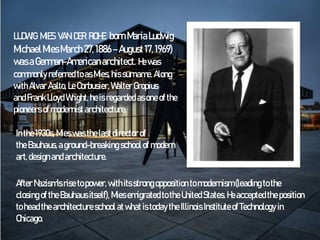
LUDWIG MIES VAN DER ROHE bornMariaLudwig
MichaelMiesMarch27,1886–August17, 1969)
wasaGerman-Americanarchitect. He was
commonly referred toas Mies,his surname.Along
withAlvar Aalto, LeCorbusier, Walter Gropius
and Frank Lloyd Wright,heisregarded asone of the
pioneers of modernistarchitecture.
Inthe1930s,Mieswasthelastdirector of
theBauhaus,aground-breaking school of modern
art,designand architecture.
After Nazism'srisetopower, withitsstrong opposition tomodernism(leading tothe
closing of theBauhausitself), Miesemigrated to theUnitedStates.Heacceptedtheposition
toheadthearchitectureschool atwhatistoday the Illinois Instituteof Technology in
Chicago.
Miessought toestablishhisownparticular architectural stylethatcould
representmoderntimesjustas Classical and Gothic did for theirown eras.Thestylehe
createdmadeastatementwithitsextremeclarity andsimplicity. His maturebuildings
madeuseof modernmaterials suchasindustrial steeland plateglass todefine interior
spaces,asalso conductedbyother modernist architectsin the1920sand1930ssuch
asRichardNeutra.Miesstrove toward anarchitecturewithaminimal framework of
structural orderbalancedagainsttheimplied freedom ofunobstructed free-flowing open
space.He called hisbuildings "skinandbones" architecture.Hesought anobjective
approach thatwould guidethecreativeprocessof architectural design,butwasalways
concernedwithexpressingthespiritofthemodernera.Heisoften associatedwithhis
fondness for theaphorisms, "lessis more"and"God isinthedetails".
MieswasbornMarch27,1886,in Aachen,Germany.Heworked inhisfather's stonecarving
shopandatseveral local designfirmsbefore hemoved to Berlin, wherehejoined the
office of interior designer BrunoPaul.Hebeganhisarchitectural careeras
anapprentice atthestudioof PeterBehrensfrom 1908to1912,where hewasexposed to
thecurrentdesigntheories andtoprogressive Germanculture. Heworked alongside Le
Corbusier and Walter Gropius, whowaslater also involved inthedevelopment of
theBauhaus.Miesservedasconstruction managerofthe EmbassyoftheGermanEmpire
in SaintPetersburg under Behrens.
In1913,Mies marriedAdele Auguste (Ada) Bruhn (1885–1951), thedaughterof awealthy
industrialist.The couple separated in1918,after having threedaughters:Dorothea (1914–
2008),anactressanddancerwho wasknownasGeorgia, Marianne(1915–2003), and
Waltraut (1917–1959),whowasa researchscholar andcuratoratthe ArtInstitute of
Chicago. During his military servicein1917,Miesfathered asonoutof wedlock.
In1925Miesbeganarelationship withdesignerLilly Reichthatendedwhenhemoved to
theUnitedStates;from 1940until hisdeath,artist Lora Marx (1900–1989) washisprimary
companion. Miescarried ona romanticrelationship withsculptor and artcollectorMary
Callery for whomhedesignedanartist'sstudioin Huntington, Long Island, NewYork.He
had abrief romantic relationship withNelly vanDoesburg. After having metinEurope
manyyearsprior, theymetagain inNew York in1947during adinner withJosepLluís
Sertwhere hepromisedher hewould help organize anexhibition inChicago featuring the
work of herlate husbandTheovanDoesburg. This exhibition took placefrom the15thof
October untilthe8thof November1947,with their romanceofficially endingnot much
later. Neverthelesstheyremainedon good terms,spendingEastertogether in1948ata
modern farmhouse renovated byMieson Long Island, as wellas meetingseveralmore
timesthatyear.Healso wasrumored tohaveabrief relationship withEdithFarnsworth,
who commissioned hiswork for theFarnsworth House. HisdaughterMarianne's son, Dirk
Lohan (b. 1938),studiedunder,and laterworked for, Mies.
Miesworked from hisstudio indowntownChicago for hisentire31-yearperiod inAmerica.
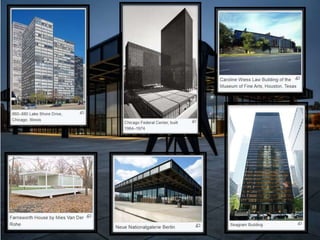
Hissignificant projects intheU.S. include inChicago andthearea:theresidentialtowers
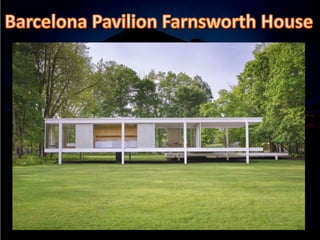
of 860–880LakeShore Dr,theChicago Federal Center complex, the Farnsworth
House, Crown Hall andother structuresatIIT; andthe SeagramBuilding inNewYork. These
iconicworks becametheprototypes for his other projects. Healso builthomesfor wealthy
clients.
 Chicago Federal Complex
Chicago Federal CenterPlaza, alsoknownasChicago FederalPlaza, unified three
buildings of varyingscales:themid-rise Everett McKinley DirksenUnitedStates
Courthouse, thehigh-rise JohnC.KluczynskiBuilding, andthesingle-story PostOffice
building. Thecomplex's plotareaextendsovertwoblocks; a one-block site,bounded by
Jackson,Clark, Adams,andDearborn streets,contains theKluczynskiFederal Building and
U.S.PostOffice Loop Station,while aparcelonanadjacentblock totheeastcontains the
DirksenU.S. Courthouse.
The structuralframing ofthebuildings is formed of high-tensile bolted steelandconcrete.
The exteriorcurtain walls aredefined byprojecting steelI-beammullions covered withflat
blackgraphite paint, characteristicof Mies'sdesigns.The balanceof thecurtainwalls areof
bronze-tinted glasspanes,framed inshinyaluminum, andseparatedbysteelspandrels,
also covered withflat blackgraphite paint.The entirecomplex isorganized ona28-foot grid
patternsubdividedinto six4-foot, 8-inchmodules. This patternextendsfrom thegranite-
pavedplazaintotheground-floor lobbies of thetwo tower buildings withthegridlines
continuing vertically upthebuildings andintegrating eachcomponentof thecomplex.
Associatedarchitectsthathaveplayedarole inthecomplex'slong history from 1959to1974
include Schmidt,Garden &Erickson; C.F. Murphy Associates;andA.Epstein &Sons.
 Museum of Fine Arts, Houston
Miesdesignedtwobuildings for the Museumof Fine Arts, Houston (MFAH) asadditions tothe
Caroline WiessLaw Building. In1953,theMFAH commissionedMiesvander Rohetocreatea
masterplan for theinstitution. Hedesignedtwo additions tothebuilding—Cullinan Hall,
completedin 1958,andtheBrown Pavilion, completed in1974. Arenowned exampleofthe
International Style,theseportions oftheCaroline WiessLaw Building comprise oneof only
twoMies-designedmuseumsintheworld.
 Two buildings in Baltimore, MD
The OneCharles Center, builtin1962,is a23-story aluminumandglassbuilding that
heralded thebeginning ofBaltimore's downtown modernbuildings.The Highfield House,just
tothenortheastof the JohnsHopkins Homewood campus,wasbuilt in1964asarental
apartmentbuilding.The 15-story concretetower becamearesidential condominium
building in1979.Bothbuildings arenow ontheNational Registerof Historic Places.
 National Gallery, Berlin
Mies'slastwork wasthe NeueNationalgalerie artmuseum,theNewNational Gallery for
theBerlinNational Gallery. Considered oneof themostperfect statementsof his
architectural approach, theupperpavilion isaprecisecomposition of monumentalsteel
columns andacantilevered(overhanging) roof plane withaglassenclosure. Thesimple
squareglasspavilion isapowerful expressionofhis ideasaboutflexible interior space,
defined bytransparentwalls andsupported byanexternalstructural frame. Art
installations by Ulrich Rückriem(1998)or JennyHolzer, as muchas exhibitions on thework
of RenzoPiano or RemKoolhaas havedemonstrated theexceptional possibilities of this
space.
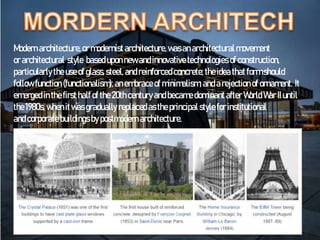
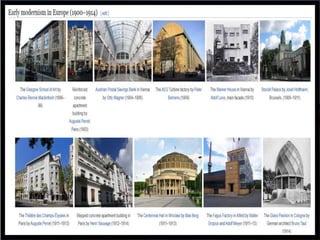
Modernarchitecture, or modernistarchitecture, wasanarchitectural movement
or architectural style basedupon newandinnovative technologies of construction,
particularly theuseof glass,steel,and reinforced concrete;theidea that form should
follow function (functionalism); anembraceof minimalism; andarejection of ornament. It
emergedinthefirst half of the20thcenturyandbecamedominantafter World War II until
the1980s,whenitwasgradually replacedastheprincipal stylefor institutional
and corporate buildings by postmodernarchitecture.
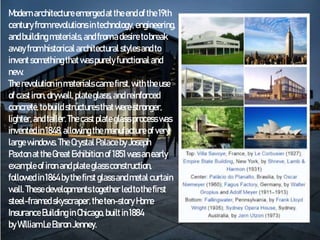
Modernarchitectureemergedattheendof the19th
centuryfrom revolutions intechnology, engineering,
andbuilding materials,and from adesiretobreak
awayfrom historical architectural stylesand to
inventsomething thatwaspurely functional and
new.
The revolution inmaterialscamefirst, withtheuse
of castiron, drywall, plateglass, and reinforced
concrete, tobuild structuresthatwerestronger,
lighter,and taller.The castplate glass processwas
inventedin1848,allowing themanufactureof very
large windows. The Crystal PalacebyJoseph
Paxton attheGreatExhibition of 1851wasanearly
exampleof ironandplate glassconstruction,
followed in1864bythefirst glassandmetal curtain
wall. Thesedevelopmentstogether ledtothefirst
steel-framed skyscraper,theten-story Home
InsuranceBuilding inChicago, builtin1884
byWilliam Le BaronJenney.
Frenchindustrialist François Coignet wasthefirst to useiron-reinforced concrete, thatis,
concretestrengthenedwithironbars,asatechniquefor constructing buildings.In1853
Coagent built thefirstiron reinforced concretestructure,afour-story house inthesuburbsof
Paris.A furtherimportantstepforward wastheinvention of thesafety elevator byElisha Otis,
first demonstratedatthe New York Crystal Palace exposition in1854,whichmadetall office
andapartmentbuildings practical.Another important technology for thenewarchitecture
waselectriclight,whichgreatly reducedtheinherentdanger offires causedbygasinthe
19thcentury.
The debutof newmaterials andtechniquesinspiredarchitectsto breakawayfrom the
neoclassical and eclecticmodelsthatdominated European andAmericanarchitectureinthe
late 19thcentury,mostnotably eclecticism,Victorian and Edwardian architecture,and
theBeaux-Artsarchitectural style.This breakwiththepastwasparticularly urgedbythe
architectural theorist andhistorian Eugène Viollet-le-Duc. Inhis 1872book Entretienssur
L'Architecture, heurged: "usethemeansandknowledge givento usbyour times,without the
intervening traditions whicharenolonger viable today,and inthatwaywecaninaugurate a
newarchitecture. Foreachfunction itsmaterial; for eachmaterial itsform andits
ornament."This book influenced agenerationof architects,including Louis Sullivan, Victor
Horta, Hector Guimard, and Antoni Gaudí.
T H A N K Y O
U

LUDWIG%20%20MIES%20%20VAN%20DER%20ROHE.pptx

  • 1.
    LUDWIG MIES VAN DERROHE SUBMITTEDTO: SUBMITTEDBY: MS.MEENAL SEKHON SEHAJSEKHRI
  • 2.
    LUDWIG MIES VANDER ROHE bornMariaLudwig MichaelMiesMarch27,1886–August17, 1969) wasaGerman-Americanarchitect. He was commonly referred toas Mies,his surname.Along withAlvar Aalto, LeCorbusier, Walter Gropius and Frank Lloyd Wright,heisregarded asone of the pioneers of modernistarchitecture. Inthe1930s,Mieswasthelastdirector of theBauhaus,aground-breaking school of modern art,designand architecture. After Nazism'srisetopower, withitsstrong opposition tomodernism(leading tothe closing of theBauhausitself), Miesemigrated to theUnitedStates.Heacceptedtheposition toheadthearchitectureschool atwhatistoday the Illinois Instituteof Technology in Chicago.
  • 4.
    Miessought toestablishhisownparticular architecturalstylethatcould representmoderntimesjustas Classical and Gothic did for theirown eras.Thestylehe createdmadeastatementwithitsextremeclarity andsimplicity. His maturebuildings madeuseof modernmaterials suchasindustrial steeland plateglass todefine interior spaces,asalso conductedbyother modernist architectsin the1920sand1930ssuch asRichardNeutra.Miesstrove toward anarchitecturewithaminimal framework of structural orderbalancedagainsttheimplied freedom ofunobstructed free-flowing open space.He called hisbuildings "skinandbones" architecture.Hesought anobjective approach thatwould guidethecreativeprocessof architectural design,butwasalways concernedwithexpressingthespiritofthemodernera.Heisoften associatedwithhis fondness for theaphorisms, "lessis more"and"God isinthedetails". MieswasbornMarch27,1886,in Aachen,Germany.Heworked inhisfather's stonecarving shopandatseveral local designfirmsbefore hemoved to Berlin, wherehejoined the office of interior designer BrunoPaul.Hebeganhisarchitectural careeras anapprentice atthestudioof PeterBehrensfrom 1908to1912,where hewasexposed to thecurrentdesigntheories andtoprogressive Germanculture. Heworked alongside Le Corbusier and Walter Gropius, whowaslater also involved inthedevelopment of theBauhaus.Miesservedasconstruction managerofthe EmbassyoftheGermanEmpire in SaintPetersburg under Behrens.
  • 5.
    In1913,Mies marriedAdele Auguste(Ada) Bruhn (1885–1951), thedaughterof awealthy industrialist.The couple separated in1918,after having threedaughters:Dorothea (1914– 2008),anactressanddancerwho wasknownasGeorgia, Marianne(1915–2003), and Waltraut (1917–1959),whowasa researchscholar andcuratoratthe ArtInstitute of Chicago. During his military servicein1917,Miesfathered asonoutof wedlock. In1925Miesbeganarelationship withdesignerLilly Reichthatendedwhenhemoved to theUnitedStates;from 1940until hisdeath,artist Lora Marx (1900–1989) washisprimary companion. Miescarried ona romanticrelationship withsculptor and artcollectorMary Callery for whomhedesignedanartist'sstudioin Huntington, Long Island, NewYork.He had abrief romantic relationship withNelly vanDoesburg. After having metinEurope manyyearsprior, theymetagain inNew York in1947during adinner withJosepLluís Sertwhere hepromisedher hewould help organize anexhibition inChicago featuring the work of herlate husbandTheovanDoesburg. This exhibition took placefrom the15thof October untilthe8thof November1947,with their romanceofficially endingnot much later. Neverthelesstheyremainedon good terms,spendingEastertogether in1948ata modern farmhouse renovated byMieson Long Island, as wellas meetingseveralmore timesthatyear.Healso wasrumored tohaveabrief relationship withEdithFarnsworth, who commissioned hiswork for theFarnsworth House. HisdaughterMarianne's son, Dirk Lohan (b. 1938),studiedunder,and laterworked for, Mies.
  • 6.
    Miesworked from hisstudioindowntownChicago for hisentire31-yearperiod inAmerica. Hissignificant projects intheU.S. include inChicago andthearea:theresidentialtowers of 860–880LakeShore Dr,theChicago Federal Center complex, the Farnsworth House, Crown Hall andother structuresatIIT; andthe SeagramBuilding inNewYork. These iconicworks becametheprototypes for his other projects. Healso builthomesfor wealthy clients.  Chicago Federal Complex Chicago Federal CenterPlaza, alsoknownasChicago FederalPlaza, unified three buildings of varyingscales:themid-rise Everett McKinley DirksenUnitedStates Courthouse, thehigh-rise JohnC.KluczynskiBuilding, andthesingle-story PostOffice building. Thecomplex's plotareaextendsovertwoblocks; a one-block site,bounded by Jackson,Clark, Adams,andDearborn streets,contains theKluczynskiFederal Building and U.S.PostOffice Loop Station,while aparcelonanadjacentblock totheeastcontains the DirksenU.S. Courthouse.
  • 7.
    The structuralframing ofthebuildingsis formed of high-tensile bolted steelandconcrete. The exteriorcurtain walls aredefined byprojecting steelI-beammullions covered withflat blackgraphite paint, characteristicof Mies'sdesigns.The balanceof thecurtainwalls areof bronze-tinted glasspanes,framed inshinyaluminum, andseparatedbysteelspandrels, also covered withflat blackgraphite paint.The entirecomplex isorganized ona28-foot grid patternsubdividedinto six4-foot, 8-inchmodules. This patternextendsfrom thegranite- pavedplazaintotheground-floor lobbies of thetwo tower buildings withthegridlines continuing vertically upthebuildings andintegrating eachcomponentof thecomplex. Associatedarchitectsthathaveplayedarole inthecomplex'slong history from 1959to1974 include Schmidt,Garden &Erickson; C.F. Murphy Associates;andA.Epstein &Sons.  Museum of Fine Arts, Houston Miesdesignedtwobuildings for the Museumof Fine Arts, Houston (MFAH) asadditions tothe Caroline WiessLaw Building. In1953,theMFAH commissionedMiesvander Rohetocreatea masterplan for theinstitution. Hedesignedtwo additions tothebuilding—Cullinan Hall, completedin 1958,andtheBrown Pavilion, completed in1974. Arenowned exampleofthe International Style,theseportions oftheCaroline WiessLaw Building comprise oneof only twoMies-designedmuseumsintheworld.
  • 8.
     Two buildingsin Baltimore, MD The OneCharles Center, builtin1962,is a23-story aluminumandglassbuilding that heralded thebeginning ofBaltimore's downtown modernbuildings.The Highfield House,just tothenortheastof the JohnsHopkins Homewood campus,wasbuilt in1964asarental apartmentbuilding.The 15-story concretetower becamearesidential condominium building in1979.Bothbuildings arenow ontheNational Registerof Historic Places.  National Gallery, Berlin Mies'slastwork wasthe NeueNationalgalerie artmuseum,theNewNational Gallery for theBerlinNational Gallery. Considered oneof themostperfect statementsof his architectural approach, theupperpavilion isaprecisecomposition of monumentalsteel columns andacantilevered(overhanging) roof plane withaglassenclosure. Thesimple squareglasspavilion isapowerful expressionofhis ideasaboutflexible interior space, defined bytransparentwalls andsupported byanexternalstructural frame. Art installations by Ulrich Rückriem(1998)or JennyHolzer, as muchas exhibitions on thework of RenzoPiano or RemKoolhaas havedemonstrated theexceptional possibilities of this space.
  • 10.
    Modernarchitecture, or modernistarchitecture,wasanarchitectural movement or architectural style basedupon newandinnovative technologies of construction, particularly theuseof glass,steel,and reinforced concrete;theidea that form should follow function (functionalism); anembraceof minimalism; andarejection of ornament. It emergedinthefirst half of the20thcenturyandbecamedominantafter World War II until the1980s,whenitwasgradually replacedastheprincipal stylefor institutional and corporate buildings by postmodernarchitecture.
  • 11.
    Modernarchitectureemergedattheendof the19th centuryfrom revolutionsintechnology, engineering, andbuilding materials,and from adesiretobreak awayfrom historical architectural stylesand to inventsomething thatwaspurely functional and new. The revolution inmaterialscamefirst, withtheuse of castiron, drywall, plateglass, and reinforced concrete, tobuild structuresthatwerestronger, lighter,and taller.The castplate glass processwas inventedin1848,allowing themanufactureof very large windows. The Crystal PalacebyJoseph Paxton attheGreatExhibition of 1851wasanearly exampleof ironandplate glassconstruction, followed in1864bythefirst glassandmetal curtain wall. Thesedevelopmentstogether ledtothefirst steel-framed skyscraper,theten-story Home InsuranceBuilding inChicago, builtin1884 byWilliam Le BaronJenney.
  • 12.
    Frenchindustrialist François Coignetwasthefirst to useiron-reinforced concrete, thatis, concretestrengthenedwithironbars,asatechniquefor constructing buildings.In1853 Coagent built thefirstiron reinforced concretestructure,afour-story house inthesuburbsof Paris.A furtherimportantstepforward wastheinvention of thesafety elevator byElisha Otis, first demonstratedatthe New York Crystal Palace exposition in1854,whichmadetall office andapartmentbuildings practical.Another important technology for thenewarchitecture waselectriclight,whichgreatly reducedtheinherentdanger offires causedbygasinthe 19thcentury. The debutof newmaterials andtechniquesinspiredarchitectsto breakawayfrom the neoclassical and eclecticmodelsthatdominated European andAmericanarchitectureinthe late 19thcentury,mostnotably eclecticism,Victorian and Edwardian architecture,and theBeaux-Artsarchitectural style.This breakwiththepastwasparticularly urgedbythe architectural theorist andhistorian Eugène Viollet-le-Duc. Inhis 1872book Entretienssur L'Architecture, heurged: "usethemeansandknowledge givento usbyour times,without the intervening traditions whicharenolonger viable today,and inthatwaywecaninaugurate a newarchitecture. Foreachfunction itsmaterial; for eachmaterial itsform andits ornament."This book influenced agenerationof architects,including Louis Sullivan, Victor Horta, Hector Guimard, and Antoni Gaudí.
  • 14.
    T H AN K Y O U