Farnsworth House
 -Ludwig Mies van der Rohe


            Presentation by Huzefa Patheria
Ludwig Mies van der Rohe
(1886- 1969)

• German Architect
• No formal training in architecture
• Worked under Peter Behrens
• Succeeded Gropius as Bauhaus Director
• Migrated to the US and taught architecture
  at the Illinois Institute of Technology
• Designed SKYSCRAPERS OF STEEL AND GLASS
  which became models of skyscraper design
  throughout the world
“Less is more.”
                     -van der Rohe


CHARACTER OF WORKS:
• Simple rectangular forms
• Open, flexible plans and multi-functional spaces
• Widespread use of glass to bring the outside in
• Mastered steel and glass construction
• Exposed and very refined structural details
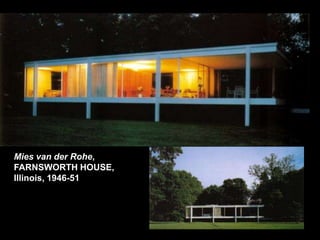
Mies van der Rohe,
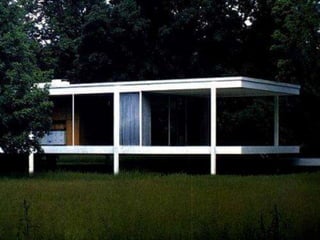
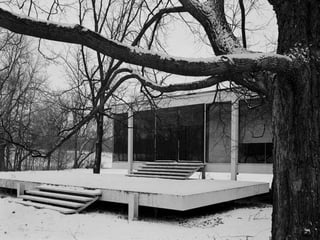
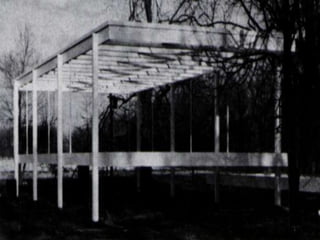
FARNSWORTH HOUSE,
Illinois, 1946-51
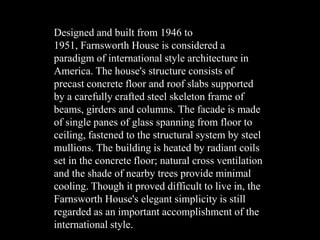
Designed and built from 1946 to
1951, Farnsworth House is considered a
paradigm of international style architecture in
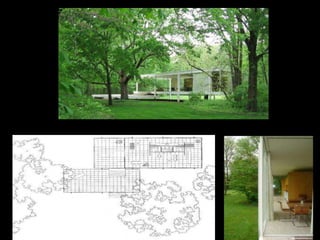
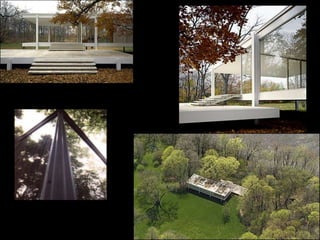
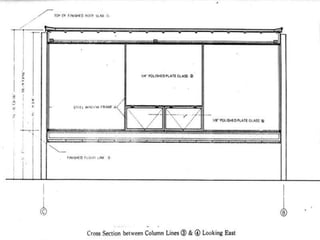
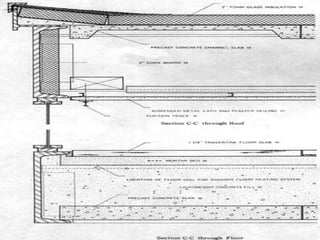
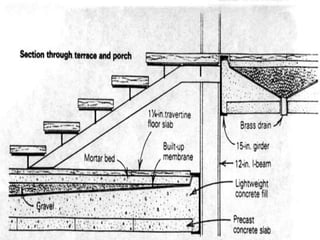
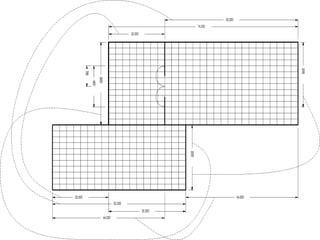
America. The house's structure consists of
precast concrete floor and roof slabs supported
by a carefully crafted steel skeleton frame of
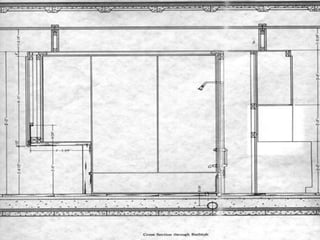
beams, girders and columns. The facade is made
of single panes of glass spanning from floor to
ceiling, fastened to the structural system by steel
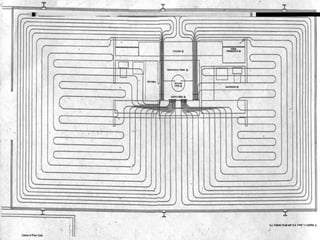
mullions. The building is heated by radiant coils
set in the concrete floor; natural cross ventilation
and the shade of nearby trees provide minimal
cooling. Though it proved difficult to live in, the
Farnsworth House's elegant simplicity is still
regarded as an important accomplishment of the
international style.
•   Between 1931 and
    1935 (and after WW2)
    a series of houses
    which adapt the
    Barcelona Pavilion
    plan-type to domestic
    use; plans increasingly
    introverted
•   Nature still dominant in
    his sketches – the house
    frames a view in which
    nature is idealised
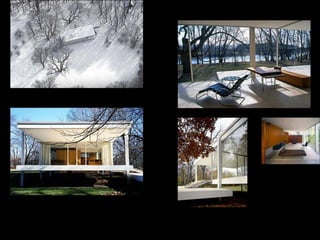
Farnsworth House, 1946-50, Plano (IL)
•   Often assumed that the minimalist
    distillation in Mies has to do with
    commitment to the craft of
    building, but he appears more engaged
    with idealising and mediating
    techniques of graphic representation
•   His criteria ideal and visual to a great
    degree – not constructional
•   He uses materiality but in a montage
    way

•   ‘Mies’s conception of architecture
    followed the dialectic tendency of
    German Idealism to think in terms of
    opposites. According to the
    Neoplatonic aesthetics that
    influenced his thinking, the
    transcendental world is reflected in
    the world of the senses.’ (Colquhoun)
Mies van der Rohe,
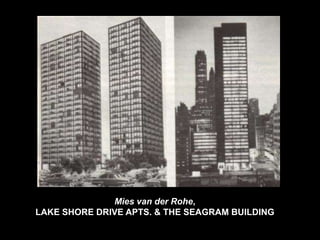
LAKE SHORE DRIVE APTS. & THE SEAGRAM BUILDING
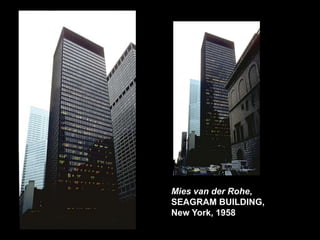
Mies van der Rohe,
SEAGRAM BUILDING,
New York, 1958
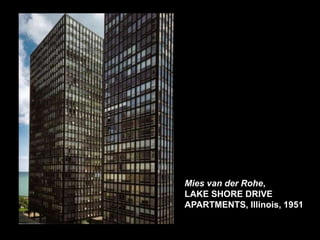
Mies van der Rohe,
LAKE SHORE DRIVE
APARTMENTS, Illinois, 1951
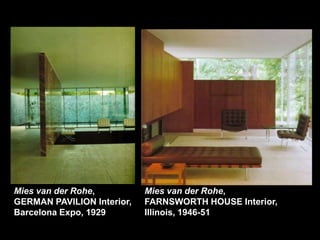
Mies van der Rohe,          Mies van der Rohe,
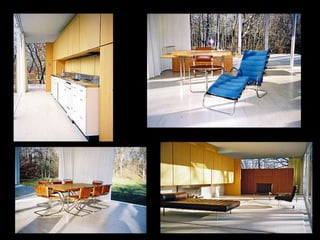
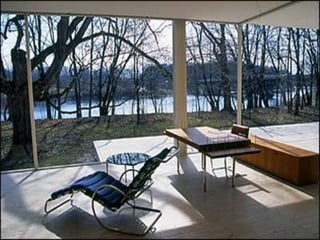
GERMAN PAVILION Interior,   FARNSWORTH HOUSE Interior,
Barcelona Expo, 1929        Illinois, 1946-51
End

Farnsworth house

  • 1.
    Farnsworth House -LudwigMies van der Rohe Presentation by Huzefa Patheria
  • 3.
    Ludwig Mies vander Rohe (1886- 1969) • German Architect • No formal training in architecture • Worked under Peter Behrens • Succeeded Gropius as Bauhaus Director • Migrated to the US and taught architecture at the Illinois Institute of Technology • Designed SKYSCRAPERS OF STEEL AND GLASS which became models of skyscraper design throughout the world
  • 4.
    “Less is more.” -van der Rohe CHARACTER OF WORKS: • Simple rectangular forms • Open, flexible plans and multi-functional spaces • Widespread use of glass to bring the outside in • Mastered steel and glass construction • Exposed and very refined structural details
  • 5.
    Mies van derRohe, FARNSWORTH HOUSE, Illinois, 1946-51
  • 6.
    Designed and builtfrom 1946 to 1951, Farnsworth House is considered a paradigm of international style architecture in America. The house's structure consists of precast concrete floor and roof slabs supported by a carefully crafted steel skeleton frame of beams, girders and columns. The facade is made of single panes of glass spanning from floor to ceiling, fastened to the structural system by steel mullions. The building is heated by radiant coils set in the concrete floor; natural cross ventilation and the shade of nearby trees provide minimal cooling. Though it proved difficult to live in, the Farnsworth House's elegant simplicity is still regarded as an important accomplishment of the international style.
  • 7.
    Between 1931 and 1935 (and after WW2) a series of houses which adapt the Barcelona Pavilion plan-type to domestic use; plans increasingly introverted • Nature still dominant in his sketches – the house frames a view in which nature is idealised
  • 10.
  • 20.
    Often assumed that the minimalist distillation in Mies has to do with commitment to the craft of building, but he appears more engaged with idealising and mediating techniques of graphic representation • His criteria ideal and visual to a great degree – not constructional • He uses materiality but in a montage way • ‘Mies’s conception of architecture followed the dialectic tendency of German Idealism to think in terms of opposites. According to the Neoplatonic aesthetics that influenced his thinking, the transcendental world is reflected in the world of the senses.’ (Colquhoun)
  • 21.
    Mies van derRohe, LAKE SHORE DRIVE APTS. & THE SEAGRAM BUILDING
  • 22.
    Mies van derRohe, SEAGRAM BUILDING, New York, 1958
  • 23.
    Mies van derRohe, LAKE SHORE DRIVE APARTMENTS, Illinois, 1951
  • 24.
    Mies van derRohe, Mies van der Rohe, GERMAN PAVILION Interior, FARNSWORTH HOUSE Interior, Barcelona Expo, 1929 Illinois, 1946-51
  • 25.