

Life in a tray
Bonsai is a Japanese word for bon meaning tray and sai
meaning plant. thus bonsai is a Japanese art of growing
miniature trees in containers.
Penzai literally meaning tray plant ,tray landscape or
miniature trees or rockery is an ancient Chinese art of
depicting artistically formed trees ,other plants and landscape
in miniature.
During kamakura period Japan adopted most of Chinas
cultural trademarks ,the art of growing trees in containers
was introduced in Japan
In venerable times the elite class in china practiced penzai
with native collective specimens and were spread throughout
china as luxurious gifts
Traditionally, bonsai are temperate climate trees grown outdoors in
containers. Kept in the artificial environment of a home, these trees
weaken and die.
Symbolism
Bonsai is an purpose of contemplation for the viewer and
exercise of effort and ingenuity for the grower.
the Chinese combined the tree with water and stone to create a scene
depicting certain aspects of life. The landscape may depict a view of a
forest, a pond, or large rocks along a stream bed.
Bonsai is an reduced scale of a larger world, such landscape is
created to give a panoramic view at a glance.
They are used to meditate and perfect way to fill spare
time and relieve stress
Requirements for bonsai to grow
Bonsai techniques
Leaf trimming
Pruning
Wiring
Clamping
Grafting
defoliation
Growing conditions for bonsai
Bonsai are temperate climate trees which can grow outdoors in contain
With exceptions for tropical and subtropical ,all bonsai should be
grown outdoor
Tropical bonsai are those which require average temperature of 13degree
Celsius to 23 degree Celsius year round
Tropical bonsai can not tolerate a open window or freezing point in cold
weather
Bonsai growing in indoors require additional humidification to grow .
Local humidity can be increased by placing bonsai containers over tray
of water or by placing them in abed of dampened sand
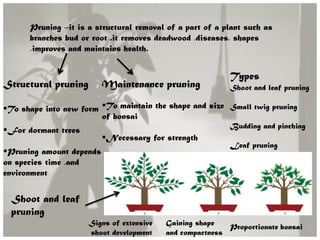
Pruning –it is a structural removal of a part of a plant such as
branches bud or root .it removes deadwood ,diseases, shapes
,improves and maintains health.
Structural pruning
To shape into new form
For dormant trees
Pruning amount depends
on species time ,and
environment
Maintenance pruning
To maintain the shape and size
of bonsai
Necessary for strength
Signs of extensive
shoot development
Gaining shape
and compactness
Proportionate bonsai
Types
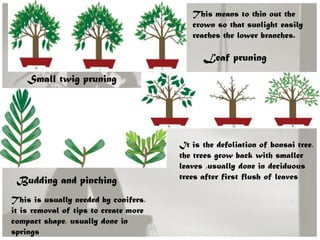
Shoot and leaf pruning
Small twig pruning
Budding and pinching
Leaf pruning
Shoot and leaf
pruning
Small twig pruning
Budding and pinching
This means to thin out the
crown so that sunlight easily
reaches the lower branches.
This is usually needed by conifers,
it is removal of tips to create more
compact shape, usually done in
springs
Leaf pruning
It is the defoliation of bonsai tree,
the trees grow back with smaller
leaves ,usually done in deciduous
trees after first flush of leaves
Bonsai style
There are several reasons for identifying a bonsai by a
named style:
1. Naming a style provides a graphic description of the
tree.
2. When one person is talking to another about a bonsai
and identifies its style, a mental-visual image of that
style is evoked in the mind of the listener.
3. A style provides a direction of purpose when
structuring a bonsai.
4. It is a shortcut to understanding.
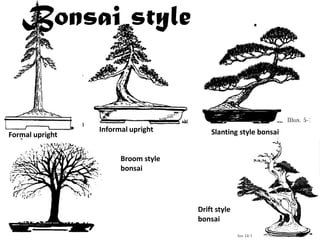
Formal upright
Informal upright Slanting style bonsai
Broom style
bonsai
Drift style
bonsai
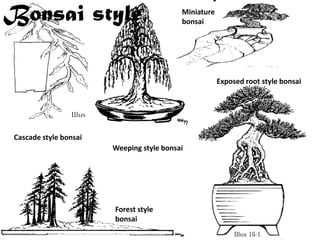
Bonsai style
Cascade style bonsai
Exposed root style bonsai
Forest style
bonsai
Weeping style bonsai
Miniature
bonsaiBonsai style
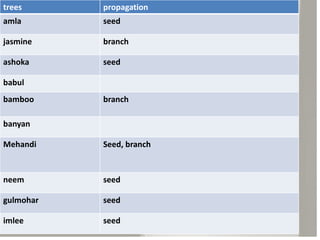
trees propagation
amla seed
jasmine branch
ashoka seed
babul
bamboo branch
banyan
Mehandi Seed, branch
neem seed
gulmohar seed
imlee seed
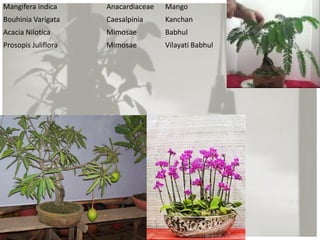
Mangifera indica Anacardiaceae Mango
Bouhinia Varigata Caesalpinia Kanchan
Acacia Nilotica Mimosae Babhul
Prosopis Juliflora Mimosae Vilayati Babhul
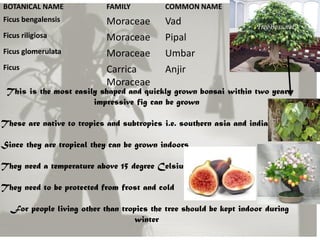
BOTANICAL NAME FAMILY COMMON NAME
Ficus bengalensis Moraceae Vad
Ficus riligiosa Moraceae Pipal
Ficus glomerulata Moraceae Umbar
Ficus Carrica
Moraceae
Anjir
This is the most easily shaped and quickly grown bonsai within two years
impressive fig can be grown
These are native to tropics and subtropics i.e. southern asia and india
Since they are tropical they can be grown indoors
They need a temperature above 15 degree Celsius
They need to be protected from frost and cold
For people living other than tropics the tree should be kept indoor during
winter

Landscape Element - Bonsai

  • 1.
  • 2.
    Bonsai is aJapanese word for bon meaning tray and sai meaning plant. thus bonsai is a Japanese art of growing miniature trees in containers. Penzai literally meaning tray plant ,tray landscape or miniature trees or rockery is an ancient Chinese art of depicting artistically formed trees ,other plants and landscape in miniature. During kamakura period Japan adopted most of Chinas cultural trademarks ,the art of growing trees in containers was introduced in Japan In venerable times the elite class in china practiced penzai with native collective specimens and were spread throughout china as luxurious gifts Traditionally, bonsai are temperate climate trees grown outdoors in containers. Kept in the artificial environment of a home, these trees weaken and die.
  • 3.
    Symbolism Bonsai is anpurpose of contemplation for the viewer and exercise of effort and ingenuity for the grower. the Chinese combined the tree with water and stone to create a scene depicting certain aspects of life. The landscape may depict a view of a forest, a pond, or large rocks along a stream bed. Bonsai is an reduced scale of a larger world, such landscape is created to give a panoramic view at a glance. They are used to meditate and perfect way to fill spare time and relieve stress
  • 4.
    Requirements for bonsaito grow Bonsai techniques Leaf trimming Pruning Wiring Clamping Grafting defoliation
  • 5.
    Growing conditions forbonsai Bonsai are temperate climate trees which can grow outdoors in contain With exceptions for tropical and subtropical ,all bonsai should be grown outdoor Tropical bonsai are those which require average temperature of 13degree Celsius to 23 degree Celsius year round Tropical bonsai can not tolerate a open window or freezing point in cold weather Bonsai growing in indoors require additional humidification to grow . Local humidity can be increased by placing bonsai containers over tray of water or by placing them in abed of dampened sand
  • 6.
    Pruning –it isa structural removal of a part of a plant such as branches bud or root .it removes deadwood ,diseases, shapes ,improves and maintains health. Structural pruning To shape into new form For dormant trees Pruning amount depends on species time ,and environment Maintenance pruning To maintain the shape and size of bonsai Necessary for strength Signs of extensive shoot development Gaining shape and compactness Proportionate bonsai Types Shoot and leaf pruning Small twig pruning Budding and pinching Leaf pruning Shoot and leaf pruning
  • 7.
    Small twig pruning Buddingand pinching This means to thin out the crown so that sunlight easily reaches the lower branches. This is usually needed by conifers, it is removal of tips to create more compact shape, usually done in springs Leaf pruning It is the defoliation of bonsai tree, the trees grow back with smaller leaves ,usually done in deciduous trees after first flush of leaves
  • 8.
    Bonsai style There areseveral reasons for identifying a bonsai by a named style: 1. Naming a style provides a graphic description of the tree. 2. When one person is talking to another about a bonsai and identifies its style, a mental-visual image of that style is evoked in the mind of the listener. 3. A style provides a direction of purpose when structuring a bonsai. 4. It is a shortcut to understanding.
  • 9.
    Formal upright Informal uprightSlanting style bonsai Broom style bonsai Drift style bonsai Bonsai style
  • 10.
    Cascade style bonsai Exposedroot style bonsai Forest style bonsai Weeping style bonsai Miniature bonsaiBonsai style
  • 11.
    trees propagation amla seed jasminebranch ashoka seed babul bamboo branch banyan Mehandi Seed, branch neem seed gulmohar seed imlee seed
  • 12.
    Mangifera indica AnacardiaceaeMango Bouhinia Varigata Caesalpinia Kanchan Acacia Nilotica Mimosae Babhul Prosopis Juliflora Mimosae Vilayati Babhul
  • 13.
    BOTANICAL NAME FAMILYCOMMON NAME Ficus bengalensis Moraceae Vad Ficus riligiosa Moraceae Pipal Ficus glomerulata Moraceae Umbar Ficus Carrica Moraceae Anjir This is the most easily shaped and quickly grown bonsai within two years impressive fig can be grown These are native to tropics and subtropics i.e. southern asia and india Since they are tropical they can be grown indoors They need a temperature above 15 degree Celsius They need to be protected from frost and cold For people living other than tropics the tree should be kept indoor during winter