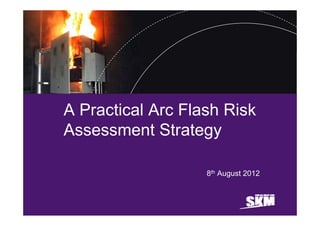
A Practical Arc Flash Risk
Assessment Strategy

                   8th August 2012
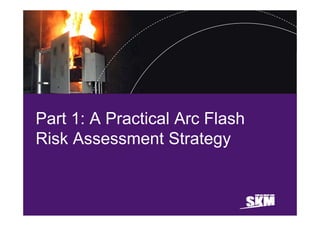
Part 1: A Practical Arc Flash
Risk Assessment Strategy
Overview
 1. Why Assess the Risk ?

 2.Condition Assessment Overview

 3. Assessment Tool Features

 4. Risk Assessment Outcomes
1. Why Assess the Risk ?
Where should I spend the money and effort ?
 PPE quick and easy but may not be effective for all faults
 New switchboards effective but costly, time consuming to 
  install
 Remote switching good but racking/charging still a danger
 Protection mods improve detection but degrade security 
  supply
 Protection mods still require fast and capable circuit breakers
1. Why Assess the Risk ?
  Arc faults present significant danger to man and machine
  OHS Regulations require risk assessment
  Aust Stds require arc flash consideration in design
  Available procedures target consequence and PPE
1. Why Assess the Risk ?
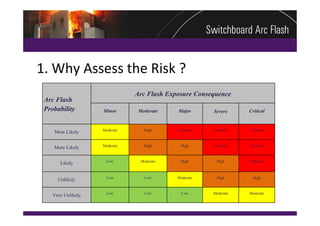
 Any assessment of risk must include both ‘likelihood’ and 
  ‘consequence’ factors
 Arc Flash Evaluation provides a measure for ‘consequence’ of 
  arcing faults
 A physical condition assessment of the switchgear can 
  provide a measure of ‘likelihood’ of arcing faults occurring
 Combining arc flash evaluation and physical condition 
  assessment can help determine overall risk.
1. Why Assess the Risk ?
                               Arc Flash Exposure Consequence
 Arc Flash
 Probability        Minor       Moderate    Major      Severe     Critical


                    Moderate      High      Extreme    Extreme    Extreme
    Most Likely

                    Moderate      High       High      Extreme    Extreme
    More Likely

                      Low       Moderate     High       High      Extreme
       Likely

                      Low         Low       Moderate    High        High
      Unlikely

                      Low         Low         Low      Moderate   Moderate
    Very Unlikely
2. Condition Assessment Overview
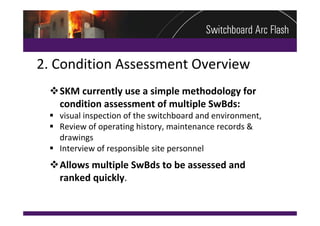
 SKM currently use a simple methodology for 
  condition assessment of multiple SwBds:
  visual inspection of the switchboard and environment, 
  Review of operating history, maintenance records & 
   drawings
  Interview of responsible site personnel
 Allows multiple SwBds to be assessed and 
  ranked quickly.
2. Condition Assessment Overview
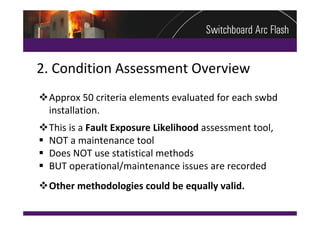
Approx 50 criteria elements evaluated for each swbd 
 installation.
This is a Fault Exposure Likelihood assessment tool, 
 NOT a maintenance tool
 Does NOT use statistical methods
 BUT operational/maintenance issues are recorded
Other methodologies could be equally valid.
3. Assessment Tool Features
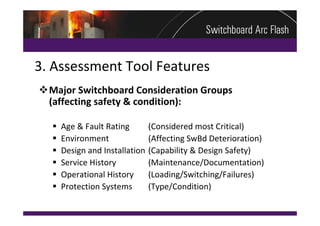
Major Switchboard Consideration Groups     
 (affecting safety & condition):

     Age & Fault Rating        (Considered most Critical)
     Environment               (Affecting SwBd Deterioration)
     Design and Installation   (Capability & Design Safety)
     Service History           (Maintenance/Documentation)
     Operational History       (Loading/Switching/Failures)
     Protection Systems        (Type/Condition)
3. Assessment Tool Features
   Desirable Protocol Considerations:
      Must allow for visual inspection only
      Simple identifiable checklist items
      Minimal interpretation confusion
      Easy criteria evaluation
      Simplified item scoring
      Score to include weighting for important items/elements.

     Note:  This is Not an exact science.  Can be Tailored
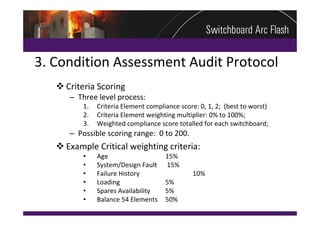
3. Condition Assessment Audit Protocol
    Criteria Scoring
      – Three level process:
          1.   Criteria Element compliance score: 0, 1, 2;  (best to worst)
          2.   Criteria Element weighting multiplier: 0% to 100%;
          3.   Weighted compliance score totalled for each switchboard;
      – Possible scoring range:  0 to 200.
    Example Critical weighting criteria:
          •    Age                    15%
          •    System/Design Fault    15%
          •    Failure History                  10%
          •    Loading                5%
          •    Spares Availability    5%
          •    Balance 54 Elements    50%
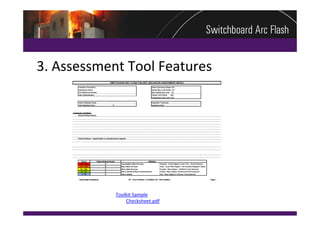
3. Assessment Tool Features


            Toolkit Sample 
                Checksheet.pdf
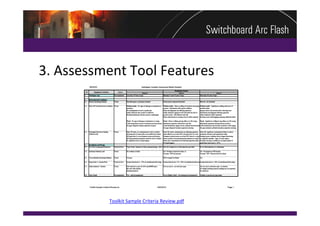
3. Assessment Tool Features


          Toolkit Sample Criteria Review.pdf
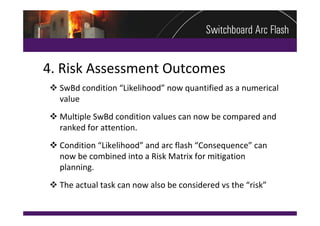
4. Risk Assessment Outcomes
 SwBd condition “Likelihood” now quantified as a numerical 
  value
 Multiple SwBd condition values can now be compared and 
  ranked for attention.
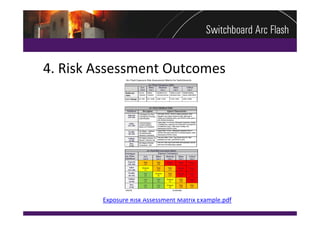
 Condition “Likelihood” and arc flash “Consequence” can 
  now be combined into a Risk Matrix for mitigation 
  planning.
 The actual task can now also be considered vs the “risk”
4. Risk Assessment Outcomes


        Exposure Risk Assessment Matrix Example.pdf
Questions and Discussion
Part 2: Recent WA Case Study
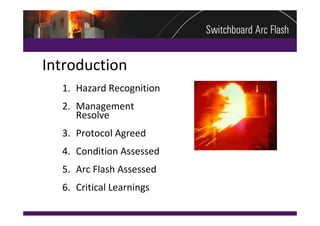
Introduction
  1. Hazard Recognition
  2. Management 
     Resolve 
  3. Protocol Agreed
  4. Condition Assessed
  5. Arc Flash Assessed
  6. Critical Learnings
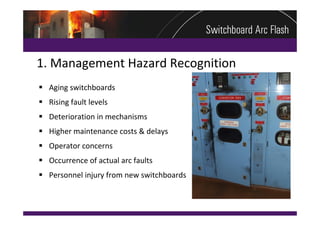
1. Management Hazard Recognition 
 Aging switchboards
 Rising fault levels
 Deterioration in mechanisms
 Higher maintenance costs & delays
 Operator concerns
 Occurrence of actual arc faults
 Personnel injury from new switchboards
2. Management Decision
    Progressive replacement or upgrade of all suspect swbds. 
    Highest risk boards to be identified for schedule & 
     finance
    Safety & Condition Assessments to be undertaken
          • Stage 1 ‐ Physical condition assessment  (Likelihood)
          • Stage 2 ‐ Arc Flash assessment                (Consequences)

    Assess for condition/safety/reliability NOT life extension
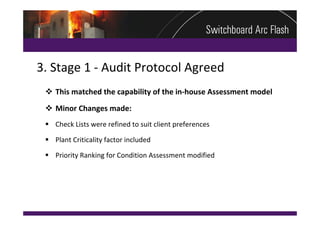
3. Stage 1 ‐ Audit Protocol Agreed
   Criteria and Checklists developed based on:
      Past experience of switchgear and minerals processing
      Recent condition audits for similar process site
      Knowledge of client requirements

   Main Protocol Considerations:
        150+ switchboards, 12 week time frame
        Multiple rotating inspection teams
        Must allow for visual inspection only
        Simple identifiable checklist items
        Minimal interpretation confusion
        Easy criteria evaluation with simplified scoring
        Weighted scoring for critical items/elements.
3. Stage 1 ‐ Audit Protocol Agreed
  This matched the capability of the in‐house Assessment model
  Minor Changes made:
  Check Lists were refined to suit client preferences

  Plant Criticality factor included

  Priority Ranking for Condition Assessment modified
3. Stage 1 ‐ Audit Protocol Agreed
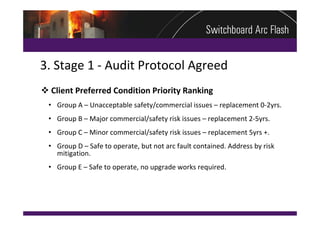
 Client Preferred Condition Priority Ranking
 • Group A – Unacceptable safety/commercial issues – replacement 0‐2yrs.
 • Group B – Major commercial/safety risk issues – replacement 2‐5yrs.
 • Group C – Minor commercial/safety risk issues – replacement 5yrs +.
 • Group D – Safe to operate, but not arc fault contained. Address by risk 
   mitigation.
 • Group E – Safe to operate, no upgrade works required.
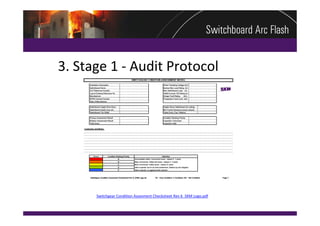
3. Stage 1 ‐ Audit Protocol 
          Agreed


      Switchgear Condition Assesment Checksheet Rev 6_SKM Logo.pdf
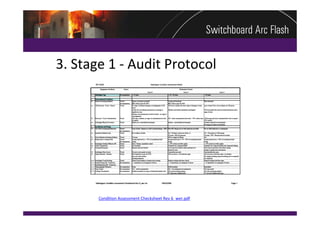
3. Stage 1 ‐ Audit Protocol 
          Agreed


       Condition Assessment Checksheet Rev 6_wer.pdf
3. Stage 1 ‐ Audit Completed
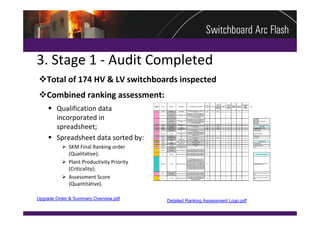
Total of 174 HV & LV switchboards inspected
Combined ranking assessment:
     Qualification data 
      incorporated in 
      spreadsheet;
     Spreadsheet data sorted by:
           SKM Final Ranking order 
            (Qualitative);
           Plant Productivity Priority 
            (Criticality);
           Assessment Score 
            (Quantitative).

Upgrade Order & Summary Overview.pdf       Detailed Ranking Assessment Logo.pdf
3. Stage 1 ‐ Audit Completed
What did we find ?
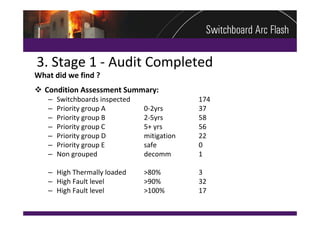
 Condition Assessment Summary:
   –   Switchboards inspected                174
   –   Priority group A         0‐2yrs       37
   –   Priority group B         2‐5yrs       58
   –   Priority group C         5+ yrs       56
   –   Priority group D         mitigation   22
   –   Priority group E         safe         0
   –   Non grouped              decomm       1

   – High Thermally loaded      >80%         3
   – High Fault level           >90%         32
   – High Fault level           >100%        17
4. Stage 2 ‐ Arc Flash Evaluation Results
Principal Findings of Arc Flash Assessment  – 173 swbds

 No definable relationship between voltage and arc flash “consequences”
  were observed but Very High (Cat4+) more common at HV
Sorted by Voltage


 Seven (7) switchboards initially required higher than Category 4 PPE (40 
  cal) at 0.5m – Reduced by modifying settings
4. Stage 2 ‐ Arc Flash Evaluation Results
  Safe working distance without PPE 6.0 m for 92% of switchboards
  13 Switchboards unsafe to approach at more than 10m without PPE. 
   (probable accuracy limitations)


 Note 1: Assumes primary protection operates correctly
 (Otherwise Double Jeopardy Rating Applies)
 Note 2: Assumes live bus work or power terminals are exposed.
 Note 3:  IEEE 1584 has accuracy limitations
5.  Arc Flash Critical Learning’s
 Critical Learning from Arc Flash studies for PPE Consideration:
  Category 3 (25 Cal) PPE adequate for approximately 80% of all 
   switchboards at 500mm.

  Specified ratings for some swbds assume normal operating configuration. 
   (but care required)
  Most  common personnel injury due to Arc Flash is to face, arms and 
   hands.
  LV arc faults are just as dangerous as HV faults
6. Risk Assessment Outcomes
  The following outcomes have been achieved to date:
      All Client swbds audited for condition & arc flash hazards.

      Prioritised upgrade list prepared for funding & scheduling.

      Dedicated Switchboards Project Team established

      Several high risk switchboards already replaced

      Others in process

      Five year plan in place with forward funding 
6. Risk Assessment Outcomes
  Short term mitigation for 11 Cat 4+ swbds implemented 
   to reduce arcing time or current:
  Enabled/adjusted high set element (instantaneous element) to trip 
   for the calculated Arcing current

  Changed out relays in some instances with relays having a ‘hi‐set’
   element.

  Modified system configuration to reduce parallel feeds

    Note: Protection setting mods for max arc flash protection 
    can reduce reliability of supply by limiting grading.
6.  Risk Assessment Outcomes
   Action profile raised with workforce.
   Increase control of unauthorised access
   Flame Resistant clothing trialled by volunteers
   PPE  Workshops undertaken 
     • Cat 2 FR clothing made standard for all EW’s
     • Arc flash records to be strictly maintained
     • Short form records to be located in subs
     • Isolations to be implemented in accordance to risk
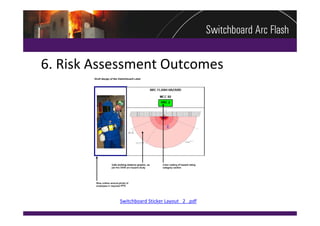
     • Preferred signage for swbds agreed
     • Training program was developed
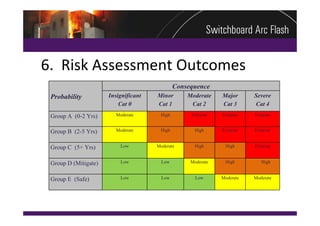
6.  Risk Assessment Outcomes
                                              Consequence
 Probability          Insignificant   Minor       Moderate    Major      Severe
                          Cat 0       Cat 1        Cat 2      Cat 3      Cat 4
 Group A (0-2 Yrs)      Moderate       High        Extreme    Extreme    Extreme


 Group B (2-5 Yrs)      Moderate       High         High      Extreme    Extreme


 Group C (5+ Yrs)         Low         Moderate      High       High      Extreme


 Group D (Mitigate)       Low           Low        Moderate    High         High


 Group E (Safe)           Low           Low          Low      Moderate   Moderate
6. Risk Assessment Outcomes


           Switchboard Sticker Layout _2_.pdf
WHERE TO FROM HERE ??
Case Discussion


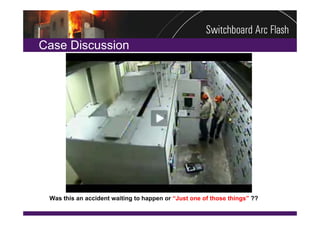
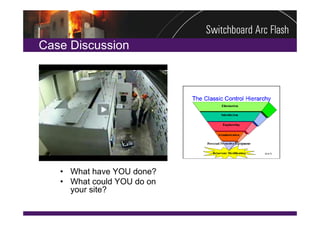
 Was this an accident waiting to happen or “Just one of those things” ??
Case Discussion


   • What have YOU done?
   • What could YOU do on
     your site?
Case Discussion
 Poor Capability                      Poor Regulatory Compliance
     Thermal and magnetic stresses         Arc fault containment design
     Containment of arcing fault           Safety interlocks
                                            Switchroom clearances
 Poor Operability (User                    Safe working environment
  Interface)
     Manual racking and/or spring 
      charging                         Residual Risk Uncommunicated
     Open panel access requirement       Was arc flash energy considered ?
                                          Was residual risk of containment 
                                           communicated ?
 Poor Maintenance
                                          Adequate PPE and signage
     What went wrong and why ?
                                          Procedures
     Why was breaker fault not 
      discovered and repaired ? 

Arc flash August 2012 IE Aust JEEP