Principles of Testing 1 Principles 2 Lifecycle 4 Dynamic test techniques 3 Static testing 5 Management 6 Tools Software Testing  ISEB Foundation Certificate Course
Contents Why testing is necessary Fundamental test process Psychology of testing Re-testing and regression testing Expected results Prioritisation of tests Principles 1 2 3 4 5 6 ISEB Foundation Certificate Course
Testing terminology No generally accepted set of testing definitions used world wide New standard BS 7925-1 Glossary of testing terms (emphasis on component testing) most recent developed by a working party of the BCS SIGIST adopted by the ISEB
What is a “bug”? Error:  a human action that produces an incorrect result  Fault:  a manifestation of an error in software also known as a defect or bug  if executed, a fault may cause a failure Failure:  deviation of the software from its expected delivery or service  (found defect) Failure is an event; fault is a state of the software, caused by an error
Error - Fault - Failure A person makes an error ... …  that creates a fault in the software ... …  that can cause a failure in operation
Reliability versus faults Reliability: the probability that software will not cause the failure of the system for a specified time under specified conditions Can a system be fault-free? (zero faults, right first time) Can a software system be reliable but still have faults? Is a “fault-free” software application always reliable?
Why do faults occur in software? software is written by human beings who know something, but not everything who have skills, but aren’t perfect who do make mistakes (errors) under increasing pressure to deliver to strict deadlines no time to check but assumptions may be wrong systems may be incomplete if you have ever written software ...
What do software faults cost? huge sums Ariane 5 ($7billion) Mariner space probe to Venus ($250m) American Airlines ($50m) very little or nothing at all minor inconvenience no visible or physical detrimental impact software is not “linear”:  small input may have very large effect
Safety-critical systems software faults can cause death or injury radiation treatment kills patients (Therac-25) train driver killed aircraft crashes (Airbus & Korean Airlines) bank system overdraft letters cause suicide
So why is testing necessary? because software is likely to have faults to learn about the reliability of the software to fill the time between delivery of the software and the release date to prove that the software has no faults because testing is included in the project plan because failures can be very expensive to avoid being sued by customers to stay in business
Why not just "test everything"? Total for 'exhaustive' testing: 20 x 4 x 3 x 10 x 2 x 100 =  480,000 tests If  1 second  per test, 8000 mins, 133 hrs,  17.7 days (not counting finger trouble, faults or retest) 10 secs = 34 wks, 1 min = 4 yrs, 10 min = 40 yrs system has 20 screens Average: 10 fields / screen 2 types input / field (date as Jan 3 or 3/1) (number as integer or decimal) Around 100 possible values Avr. 4 menus 3 options / menu
Exhaustive testing? What is exhaustive testing? when all the testers are exhausted when all the planned tests have been executed exercising all combinations of inputs and preconditions How much time will exhaustive testing take? infinite time not much time impractical amount of time
How much testing is enough? it’s never enough when you have done what you planned when your customer/user is happy when you have proved that the system works correctly when you are confident that the system works correctly it depends on the risks for your system
How much testing? It depends on  RISK risk  of missing important faults risk  of incurring failure costs risk  of releasing untested or under-tested software risk  of losing credibility and market share risk  of missing a market window risk  of over-testing, ineffective testing
So little time, so much to test .. test time will always be limited use  RISK  to determine: what to test first what to test most how thoroughly to test each item what not to test (this time) use  RISK  to allocate the time available for testing by  prioritising testing ... } i.e. where to place emphasis
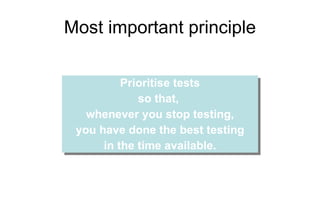
Most important principle Prioritise tests so that,  whenever you stop testing, you have done the best testing in the time available.
Testing and quality testing measures software quality testing can find faults; when they are removed, software quality (and possibly reliability) is improved what does testing test? system function, correctness of operation non-functional qualities: reliability, usability, maintainability, reusability, testability, etc.
Other factors that influence testing contractual requirements legal requirements industry-specific requirements e.g. pharmaceutical industry (FDA), compiler standard tests, safety-critical or safety-related such as railroad switching, air traffic control It is difficult to determine how much testing is enough but it is not impossible
Contents Why testing is necessary Fundamental test process Psychology of testing Re-testing and regression testing Expected results Prioritisation of tests ISEB Foundation Certificate Course Principles 1 2 3 4 5 6
Test Planning - different levels Test Policy Test Strategy Company level High Level Test Plan High Level Test Plan Project level (IEEE 829) (one for each project) Detailed Test Plan Detailed Test Plan Detailed Test Plan Detailed Test Plan Test stage level (IEEE 829) (one for each stage within a project, e.g. Component, System, etc.)
The test process specification execution recording check completion Planning (detailed level)
Test planning how the test strategy and project test plan apply to the software under test document any exceptions to the test strategy e.g. only one test case design technique needed for this functional area because it is less critical other software needed for the tests, such as stubs and drivers, and environment details set test completion criteria
Test specification specification execution recording check completion Identify conditions Design test cases Build tests Planning (detailed level)
A good test case effective exemplary evolvable economic Finds faults Represents others Easy to maintain Cheap to use
Test specification test specification can be broken down into three distinct tasks: 1.  identify: determine ‘what’ is to be tested (identify test conditions) and prioritise 2.  design: determine ‘how’ the ‘what’ is to be tested (i.e. design test cases) 3.  build: implement the tests (data, scripts, etc.)
Task 1: identify conditions list the conditions that we would like to test: use the test design techniques specified in the test plan there may be many conditions for each system function or attribute e.g. “life assurance for a winter sportsman” “number items ordered > 99” “date = 29-Feb-2004” prioritise the test conditions must ensure most important conditions are covered (determine ‘what’ is to be tested and prioritise)
Selecting test conditions   Importance Time Best set First set
Task 2: design test cases design test input and test data each test exercises one or more test conditions determine expected results predict the outcome of each test case, what is output, what is changed and what is not changed design sets of tests different test sets for different objectives such as regression, building confidence, and finding faults (determine ‘how’ the ‘what’ is to be tested)
Designing test cases Importance Time Most important test conditions Least important test conditions Test cases
Task 3: build test cases prepare test scripts less system knowledge tester has the more detailed the scripts will have to be scripts for tools have to specify every detail prepare test data data that must exist in files and databases at the start of the tests prepare expected results should be defined before the test is executed (implement the test cases)
Test execution specification execution recording check completion Planning (detailed level)
Execution Execute prescribed test cases most important ones first would not execute all test cases if testing only fault fixes too many faults found by early test cases time pressure  can be performed manually or automated
Test recording specification execution recording check completion Planning (detailed level)
Test recording 1 The test record contains: identities and versions (unambiguously) of software under test test specifications Follow the plan mark off progress on test script document actual outcomes from the test capture any other ideas you have for new test cases note that these records are used to establish that all test activities have been carried out as specified
Test recording 2 Compare actual outcome with expected outcome. Log discrepancies accordingly: software fault test fault (e.g. expected results wrong) environment or version fault test run incorrectly Log coverage levels achieved (for measures specified as test completion criteria) After the fault has been fixed, repeat the required test activities (execute, design, plan)
Check test completion specification execution recording check completion Planning (detailed level)
Check test completion Test completion criteria were specified in the test plan If not met, need to repeat test activities, e.g. test specification to design more tests specification execution recording check completion Coverage too low Coverage OK
Test completion criteria Completion or exit criteria apply to all levels of testing - to determine when to stop coverage, using a measurement technique, e.g. branch coverage for unit testing user requirements most frequently used transactions faults found (e.g. versus expected) cost or time
Comparison of tasks one-off activity activity repeated many times Governs the quality of tests Good to automate Clerical Intellectual Execute Recording Planning Specification
Contents Why testing is necessary Fundamental test process Psychology of testing Re-testing and regression testing Expected results Prioritisation of tests ISEB Foundation Certificate Course Principles 1 2 3 4 5 6
Why test? build confidence prove that the software is correct demonstrate conformance to requirements find faults reduce costs show system meets user needs assess the software quality
Confidence No faults found = confidence? Fault found Faults found Time Confidence
Assessing software quality Few Faults Many Faults Few Faults Few Faults Few Faults You may  be here You think you are here Test Quality Low High Software Quality Low High
A traditional testing approach Show that the system: does what it should doesn't do what it shouldn't Fastest achievement: easy test cases Goal:  show working Success: system works Result: faults left in
A better testing approach Show that the system: does what it shouldn't doesn't do what it should Fastest achievement: difficult test cases Goal:  find faults Success: system fails Result: fewer faults left in
The testing paradox Purpose of testing: to find faults The best way to build confidence is to try to destroy it Purpose of testing: build confidence Finding faults destroys confidence Purpose of testing: destroy confidence
Who wants to be a tester? A destructive process Bring bad news  (“your baby is ugly”) Under worst time pressure (at the end) Need to take a different view, a different mindset (“What if it isn’t?”, “What could go wrong?”) How should fault information be communicated (to authors and managers?)
Tester’s have the right to: accurate information about progress and changes insight from developers about areas of the software delivered code tested to an agreed standard be regarded as a professional (no abuse!) find faults! challenge specifications and test plans have reported faults taken seriously (unreproducible) make predictions about future fault levels improve your own testing process
Testers have responsibility to: follow the test plans, scripts etc. as documented  report faults objectively and factually (no abuse!) check tests are correct before reporting s/w faults remember it is the software, not the programmer, that you are testing assess risk objectively prioritise what you report  communicate the truth
Independence Test your own work? find 30% - 50% of your own faults same assumptions and thought processes see what you meant or want to see, not what is there emotional attachment  don’t want to find faults actively want NOT to find faults
Levels of independence None: tests designed by the person who wrote the software Tests designed by a different person Tests designed by someone from a different department or team  (e.g. test team) Tests designed by someone from a different organisation  (e.g. agency) Tests generated by a tool  (low quality tests?)
Contents Why testing is necessary Fundamental test process Psychology of testing Re-testing and regression testing Expected results Prioritisation of tests ISEB Foundation Certificate Course Principles 1 2 3 4 5 6
Re-testing after faults are fixed Run a test, it fails, fault reported New version of software with fault “fixed” Re-run the same test (i.e. re-test) must be exactly repeatable same environment, versions (except for the software which  has been intentionally changed!) same inputs and preconditions If test now passes, fault has been fixed correctly - or has it?
Re-testing  (re-running failed tests) x x x x New faults introduced by the first fault fix not found during re-testing Re-test to check Fault now fixed 
Regression test to look for any unexpected side-effects x x x x  Can’t guarantee to find them all
Regression testing 1 misnomer: "anti-regression" or "progression" standard set of tests - regression test pack at any level (unit, integration, system, acceptance) well worth automating a developing asset but needs to be maintained
Regression testing 2 Regression tests are performed after software changes, including faults fixed when the environment changes, even if application functionality stays the same for emergency fixes (possibly a subset) Regression test suites evolve over time are run often may become rather large
Regression testing 3 Maintenance of the regression test pack eliminate repetitive tests (tests which test the same test condition) combine test cases (e.g. if they are always run together) select a different subset of the full regression suite to run each time a regression test is needed eliminate tests which have not found a fault for a long time (e.g. old fault fix tests)
Regression testing and automation Test execution tools (e.g. capture replay) are regression testing tools - they re-execute tests which have already been executed Once automated, regression tests can be run as often as desired (e.g. every night) Automating tests is not trivial (generally takes 2 to 10 times longer to automate a test than to run it manually Don’t automate everything - plan what to automate first, only automate if worthwhile
Contents Why testing is necessary Fundamental test process Psychology of testing Re-testing and regression testing Expected results Prioritisation of tests ISEB Foundation Certificate Course Principles 1 2 3 4 5 6
Expected results Should be predicted in advance as part of the test design process ‘Oracle Assumption’ assumes that correct outcome can be predicted. Why not just look at what the software does and assess it at the time? subconscious desire for the test to pass - less work to do, no incident report to write up it looks plausible, so it must be OK - less rigorous than calculating in advance and comparing
A test A Program: Source: Carsten Jorgensen, Delta, Denmark 3 8 6? 10? Read A IF (A = 8) THEN PRINT (“10”) ELSE PRINT (2*A) inputs expected outputs
Contents Why testing is necessary Fundamental test process Psychology of testing Re-testing and regression testing Expected results Prioritisation of tests ISEB Foundation Certificate Course Principles 1 2 3 4 5 6
Prioritising tests We can’t test everything There is never enough time to do all the testing you would like So what testing should you do?
Most important principle Prioritise tests so that,  whenever you stop testing, you have done the best testing in the time available.
How to prioritise? Possible ranking criteria (all risk based) test where a failure would be most severe test where failures would be most visible test where failures are most likely ask the customer to prioritise the requirements what is most critical to the customer’s business areas changed most often areas with most problems in the past most complex areas, or technically critical
Summary: Key Points Testing is necessary because people make errors The test process: planning, specification, execution, recording, checking completion Independence & relationships are important in testing Re-test fixes; regression test for the unexpected Expected results from a specification in advance Prioritise to do the best testing in the time you have ISEB Foundation Certificate Course Principles 1 2 3 4 5 6

ISTQB, ISEB Lecture Notes

  • 1.
    Principles of Testing1 Principles 2 Lifecycle 4 Dynamic test techniques 3 Static testing 5 Management 6 Tools Software Testing ISEB Foundation Certificate Course
  • 2.
    Contents Why testingis necessary Fundamental test process Psychology of testing Re-testing and regression testing Expected results Prioritisation of tests Principles 1 2 3 4 5 6 ISEB Foundation Certificate Course
  • 3.
    Testing terminology Nogenerally accepted set of testing definitions used world wide New standard BS 7925-1 Glossary of testing terms (emphasis on component testing) most recent developed by a working party of the BCS SIGIST adopted by the ISEB
  • 4.
    What is a“bug”? Error: a human action that produces an incorrect result Fault: a manifestation of an error in software also known as a defect or bug if executed, a fault may cause a failure Failure: deviation of the software from its expected delivery or service (found defect) Failure is an event; fault is a state of the software, caused by an error
  • 5.
    Error - Fault- Failure A person makes an error ... … that creates a fault in the software ... … that can cause a failure in operation
  • 6.
    Reliability versus faultsReliability: the probability that software will not cause the failure of the system for a specified time under specified conditions Can a system be fault-free? (zero faults, right first time) Can a software system be reliable but still have faults? Is a “fault-free” software application always reliable?
  • 7.
    Why do faultsoccur in software? software is written by human beings who know something, but not everything who have skills, but aren’t perfect who do make mistakes (errors) under increasing pressure to deliver to strict deadlines no time to check but assumptions may be wrong systems may be incomplete if you have ever written software ...
  • 8.
    What do softwarefaults cost? huge sums Ariane 5 ($7billion) Mariner space probe to Venus ($250m) American Airlines ($50m) very little or nothing at all minor inconvenience no visible or physical detrimental impact software is not “linear”: small input may have very large effect
  • 9.
    Safety-critical systems softwarefaults can cause death or injury radiation treatment kills patients (Therac-25) train driver killed aircraft crashes (Airbus & Korean Airlines) bank system overdraft letters cause suicide
  • 10.
    So why istesting necessary? because software is likely to have faults to learn about the reliability of the software to fill the time between delivery of the software and the release date to prove that the software has no faults because testing is included in the project plan because failures can be very expensive to avoid being sued by customers to stay in business
  • 11.
    Why not just"test everything"? Total for 'exhaustive' testing: 20 x 4 x 3 x 10 x 2 x 100 = 480,000 tests If 1 second per test, 8000 mins, 133 hrs, 17.7 days (not counting finger trouble, faults or retest) 10 secs = 34 wks, 1 min = 4 yrs, 10 min = 40 yrs system has 20 screens Average: 10 fields / screen 2 types input / field (date as Jan 3 or 3/1) (number as integer or decimal) Around 100 possible values Avr. 4 menus 3 options / menu
  • 12.
    Exhaustive testing? Whatis exhaustive testing? when all the testers are exhausted when all the planned tests have been executed exercising all combinations of inputs and preconditions How much time will exhaustive testing take? infinite time not much time impractical amount of time
  • 13.
    How much testingis enough? it’s never enough when you have done what you planned when your customer/user is happy when you have proved that the system works correctly when you are confident that the system works correctly it depends on the risks for your system
  • 14.
    How much testing?It depends on RISK risk of missing important faults risk of incurring failure costs risk of releasing untested or under-tested software risk of losing credibility and market share risk of missing a market window risk of over-testing, ineffective testing
  • 15.
    So little time,so much to test .. test time will always be limited use RISK to determine: what to test first what to test most how thoroughly to test each item what not to test (this time) use RISK to allocate the time available for testing by prioritising testing ... } i.e. where to place emphasis
  • 16.
    Most important principlePrioritise tests so that, whenever you stop testing, you have done the best testing in the time available.
  • 17.
    Testing and qualitytesting measures software quality testing can find faults; when they are removed, software quality (and possibly reliability) is improved what does testing test? system function, correctness of operation non-functional qualities: reliability, usability, maintainability, reusability, testability, etc.
  • 18.
    Other factors thatinfluence testing contractual requirements legal requirements industry-specific requirements e.g. pharmaceutical industry (FDA), compiler standard tests, safety-critical or safety-related such as railroad switching, air traffic control It is difficult to determine how much testing is enough but it is not impossible
  • 19.
    Contents Why testingis necessary Fundamental test process Psychology of testing Re-testing and regression testing Expected results Prioritisation of tests ISEB Foundation Certificate Course Principles 1 2 3 4 5 6
  • 20.
    Test Planning -different levels Test Policy Test Strategy Company level High Level Test Plan High Level Test Plan Project level (IEEE 829) (one for each project) Detailed Test Plan Detailed Test Plan Detailed Test Plan Detailed Test Plan Test stage level (IEEE 829) (one for each stage within a project, e.g. Component, System, etc.)
  • 21.
    The test processspecification execution recording check completion Planning (detailed level)
  • 22.
    Test planning howthe test strategy and project test plan apply to the software under test document any exceptions to the test strategy e.g. only one test case design technique needed for this functional area because it is less critical other software needed for the tests, such as stubs and drivers, and environment details set test completion criteria
  • 23.
    Test specification specificationexecution recording check completion Identify conditions Design test cases Build tests Planning (detailed level)
  • 24.
    A good testcase effective exemplary evolvable economic Finds faults Represents others Easy to maintain Cheap to use
  • 25.
    Test specification testspecification can be broken down into three distinct tasks: 1. identify: determine ‘what’ is to be tested (identify test conditions) and prioritise 2. design: determine ‘how’ the ‘what’ is to be tested (i.e. design test cases) 3. build: implement the tests (data, scripts, etc.)
  • 26.
    Task 1: identifyconditions list the conditions that we would like to test: use the test design techniques specified in the test plan there may be many conditions for each system function or attribute e.g. “life assurance for a winter sportsman” “number items ordered > 99” “date = 29-Feb-2004” prioritise the test conditions must ensure most important conditions are covered (determine ‘what’ is to be tested and prioritise)
  • 27.
    Selecting test conditions  Importance Time Best set First set
  • 28.
    Task 2: designtest cases design test input and test data each test exercises one or more test conditions determine expected results predict the outcome of each test case, what is output, what is changed and what is not changed design sets of tests different test sets for different objectives such as regression, building confidence, and finding faults (determine ‘how’ the ‘what’ is to be tested)
  • 29.
    Designing test casesImportance Time Most important test conditions Least important test conditions Test cases
  • 30.
    Task 3: buildtest cases prepare test scripts less system knowledge tester has the more detailed the scripts will have to be scripts for tools have to specify every detail prepare test data data that must exist in files and databases at the start of the tests prepare expected results should be defined before the test is executed (implement the test cases)
  • 31.
    Test execution specificationexecution recording check completion Planning (detailed level)
  • 32.
    Execution Execute prescribedtest cases most important ones first would not execute all test cases if testing only fault fixes too many faults found by early test cases time pressure can be performed manually or automated
  • 33.
    Test recording specificationexecution recording check completion Planning (detailed level)
  • 34.
    Test recording 1The test record contains: identities and versions (unambiguously) of software under test test specifications Follow the plan mark off progress on test script document actual outcomes from the test capture any other ideas you have for new test cases note that these records are used to establish that all test activities have been carried out as specified
  • 35.
    Test recording 2Compare actual outcome with expected outcome. Log discrepancies accordingly: software fault test fault (e.g. expected results wrong) environment or version fault test run incorrectly Log coverage levels achieved (for measures specified as test completion criteria) After the fault has been fixed, repeat the required test activities (execute, design, plan)
  • 36.
    Check test completionspecification execution recording check completion Planning (detailed level)
  • 37.
    Check test completionTest completion criteria were specified in the test plan If not met, need to repeat test activities, e.g. test specification to design more tests specification execution recording check completion Coverage too low Coverage OK
  • 38.
    Test completion criteriaCompletion or exit criteria apply to all levels of testing - to determine when to stop coverage, using a measurement technique, e.g. branch coverage for unit testing user requirements most frequently used transactions faults found (e.g. versus expected) cost or time
  • 39.
    Comparison of tasksone-off activity activity repeated many times Governs the quality of tests Good to automate Clerical Intellectual Execute Recording Planning Specification
  • 40.
    Contents Why testingis necessary Fundamental test process Psychology of testing Re-testing and regression testing Expected results Prioritisation of tests ISEB Foundation Certificate Course Principles 1 2 3 4 5 6
  • 41.
    Why test? buildconfidence prove that the software is correct demonstrate conformance to requirements find faults reduce costs show system meets user needs assess the software quality
  • 42.
    Confidence No faultsfound = confidence? Fault found Faults found Time Confidence
  • 43.
    Assessing software qualityFew Faults Many Faults Few Faults Few Faults Few Faults You may be here You think you are here Test Quality Low High Software Quality Low High
  • 44.
    A traditional testingapproach Show that the system: does what it should doesn't do what it shouldn't Fastest achievement: easy test cases Goal: show working Success: system works Result: faults left in
  • 45.
    A better testingapproach Show that the system: does what it shouldn't doesn't do what it should Fastest achievement: difficult test cases Goal: find faults Success: system fails Result: fewer faults left in
  • 46.
    The testing paradoxPurpose of testing: to find faults The best way to build confidence is to try to destroy it Purpose of testing: build confidence Finding faults destroys confidence Purpose of testing: destroy confidence
  • 47.
    Who wants tobe a tester? A destructive process Bring bad news (“your baby is ugly”) Under worst time pressure (at the end) Need to take a different view, a different mindset (“What if it isn’t?”, “What could go wrong?”) How should fault information be communicated (to authors and managers?)
  • 48.
    Tester’s have theright to: accurate information about progress and changes insight from developers about areas of the software delivered code tested to an agreed standard be regarded as a professional (no abuse!) find faults! challenge specifications and test plans have reported faults taken seriously (unreproducible) make predictions about future fault levels improve your own testing process
  • 49.
    Testers have responsibilityto: follow the test plans, scripts etc. as documented report faults objectively and factually (no abuse!) check tests are correct before reporting s/w faults remember it is the software, not the programmer, that you are testing assess risk objectively prioritise what you report communicate the truth
  • 50.
    Independence Test yourown work? find 30% - 50% of your own faults same assumptions and thought processes see what you meant or want to see, not what is there emotional attachment don’t want to find faults actively want NOT to find faults
  • 51.
    Levels of independenceNone: tests designed by the person who wrote the software Tests designed by a different person Tests designed by someone from a different department or team (e.g. test team) Tests designed by someone from a different organisation (e.g. agency) Tests generated by a tool (low quality tests?)
  • 52.
    Contents Why testingis necessary Fundamental test process Psychology of testing Re-testing and regression testing Expected results Prioritisation of tests ISEB Foundation Certificate Course Principles 1 2 3 4 5 6
  • 53.
    Re-testing after faultsare fixed Run a test, it fails, fault reported New version of software with fault “fixed” Re-run the same test (i.e. re-test) must be exactly repeatable same environment, versions (except for the software which has been intentionally changed!) same inputs and preconditions If test now passes, fault has been fixed correctly - or has it?
  • 54.
    Re-testing (re-runningfailed tests) x x x x New faults introduced by the first fault fix not found during re-testing Re-test to check Fault now fixed 
  • 55.
    Regression test tolook for any unexpected side-effects x x x x  Can’t guarantee to find them all
  • 56.
    Regression testing 1misnomer: "anti-regression" or "progression" standard set of tests - regression test pack at any level (unit, integration, system, acceptance) well worth automating a developing asset but needs to be maintained
  • 57.
    Regression testing 2Regression tests are performed after software changes, including faults fixed when the environment changes, even if application functionality stays the same for emergency fixes (possibly a subset) Regression test suites evolve over time are run often may become rather large
  • 58.
    Regression testing 3Maintenance of the regression test pack eliminate repetitive tests (tests which test the same test condition) combine test cases (e.g. if they are always run together) select a different subset of the full regression suite to run each time a regression test is needed eliminate tests which have not found a fault for a long time (e.g. old fault fix tests)
  • 59.
    Regression testing andautomation Test execution tools (e.g. capture replay) are regression testing tools - they re-execute tests which have already been executed Once automated, regression tests can be run as often as desired (e.g. every night) Automating tests is not trivial (generally takes 2 to 10 times longer to automate a test than to run it manually Don’t automate everything - plan what to automate first, only automate if worthwhile
  • 60.
    Contents Why testingis necessary Fundamental test process Psychology of testing Re-testing and regression testing Expected results Prioritisation of tests ISEB Foundation Certificate Course Principles 1 2 3 4 5 6
  • 61.
    Expected results Shouldbe predicted in advance as part of the test design process ‘Oracle Assumption’ assumes that correct outcome can be predicted. Why not just look at what the software does and assess it at the time? subconscious desire for the test to pass - less work to do, no incident report to write up it looks plausible, so it must be OK - less rigorous than calculating in advance and comparing
  • 62.
    A test AProgram: Source: Carsten Jorgensen, Delta, Denmark 3 8 6? 10? Read A IF (A = 8) THEN PRINT (“10”) ELSE PRINT (2*A) inputs expected outputs
  • 63.
    Contents Why testingis necessary Fundamental test process Psychology of testing Re-testing and regression testing Expected results Prioritisation of tests ISEB Foundation Certificate Course Principles 1 2 3 4 5 6
  • 64.
    Prioritising tests Wecan’t test everything There is never enough time to do all the testing you would like So what testing should you do?
  • 65.
    Most important principlePrioritise tests so that, whenever you stop testing, you have done the best testing in the time available.
  • 66.
    How to prioritise?Possible ranking criteria (all risk based) test where a failure would be most severe test where failures would be most visible test where failures are most likely ask the customer to prioritise the requirements what is most critical to the customer’s business areas changed most often areas with most problems in the past most complex areas, or technically critical
  • 67.
    Summary: Key PointsTesting is necessary because people make errors The test process: planning, specification, execution, recording, checking completion Independence & relationships are important in testing Re-test fixes; regression test for the unexpected Expected results from a specification in advance Prioritise to do the best testing in the time you have ISEB Foundation Certificate Course Principles 1 2 3 4 5 6