BY DANIEL HALL 
HITECH ELECTRICAL AUTOMATION 
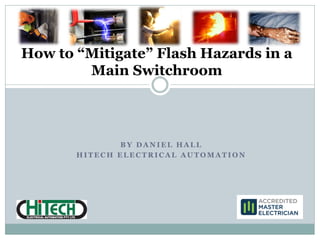
How to “Mitigate” Flash Hazards in a Main Switchroom
Objective for this presentation 
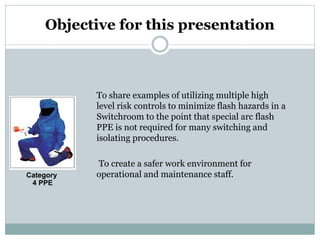
To share examples of utilizing multiple high level risk controls to minimize flash hazards in a Switchroom to the point that special arc flash PPE is not required for many switching and isolating procedures. 
To create a safer work environment for operational and maintenance staff. 
Category 
4 PPE
Topics to be discussed in this presentation 
1. 
The project 
2. 
The Hazards and Risks in the Main Electrical Switchroom to take into consideration 
3. 
Planning and engineering philosophy for minimizing the Hazards 
4. 
Outcomes achieved and summarized conclusion
The Project 
The Customer: 
Hanson Construction Materials 
Location: 
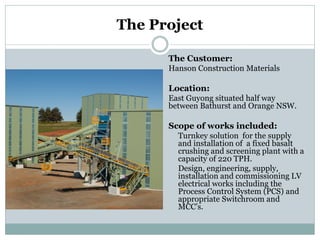
East Guyong situated half way between Bathurst and Orange NSW. 
Scope of works included: 
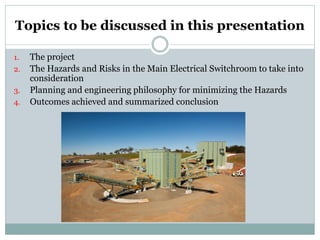
Turnkey solution for the supply and installation of a fixed basalt crushing and screening plant with a capacity of 220 TPH. 
Design, engineering, supply, installation and commissioning LV electrical works including the Process Control System (PCS) and appropriate Switchroom and MCC’s.
1. 
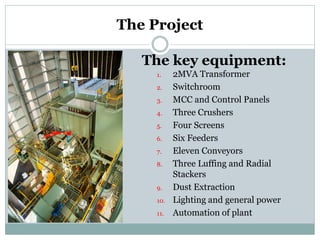
2MVA Transformer 
2. 
Switchroom 
3. 
MCC and Control Panels 
4. 
Three Crushers 
5. 
Four Screens 
6. 
Six Feeders 
7. 
Eleven Conveyors 
8. 
Three Luffing and Radial Stackers 
9. 
Dust Extraction 
10. 
Lighting and general power 
11. 
Automation of plant 
The Project 
The key equipment:
The Hazards and Risks 
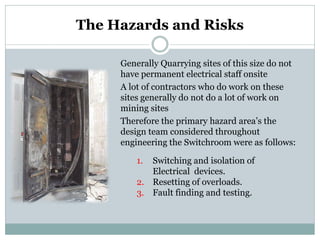
Generally Quarrying sites of this size do not have permanent electrical staff onsite 
A lot of contractors who do work on these sites generally do not do a lot of work on mining sites 
Therefore the primary hazard area’s the design team considered throughout engineering the Switchroom were as follows: 
1. 
Switching and isolation of Electrical devices. 
2. 
Resetting of overloads. 
3. 
Fault finding and testing.
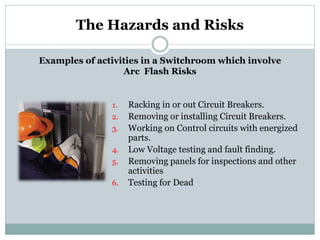
1.Racking in or out Circuit Breakers. 
2.Removing or installing Circuit Breakers. 
3.Working on Control circuits with energized parts. 
4.Low Voltage testing and fault finding. 
5.Removing panels for inspections and other activities 
6.Testing for Dead 
The Hazards and Risks 
Examples of activities in a Switchroom which involve Arc Flash Risks
1. 
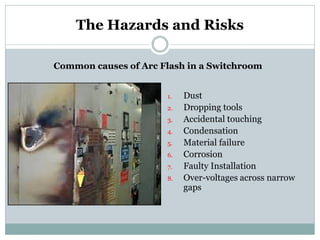
Dust 
2. 
Dropping tools 
3. 
Accidental touching 
4. 
Condensation 
5. 
Material failure 
6. 
Corrosion 
7. 
Faulty Installation 
8. 
Over-voltages across narrow gaps 
The Hazards and Risks 
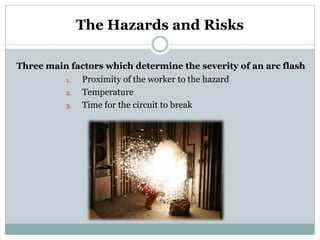
Common causes of Arc Flash in a Switchroom
1. 
Proximity of the worker to the hazard 
2. 
Temperature 
3. 
Time for the circuit to break 
The Hazards and Risks 
Three main factors which determine the severity of an arc flash
What are your Risks 
1. 
Compliance – Failing the standards and the rules can delay project startup and can result in significant fines 
2. 
Injury/Death – Yourself, your co-workers, outside contractors and other third parties. Between 5 and 10 arc flash incidents happen every day 
3. 
Equipment damage – Costly to repair or replace 
4. 
Plant shutdown – reduced productivity, lost revenues, lost costumers, lost jobs 
5. 
Liability – Lawsuits, higher insurance premiums, out of pocket costs if self insured – a single incident can easily run in excess of $10M
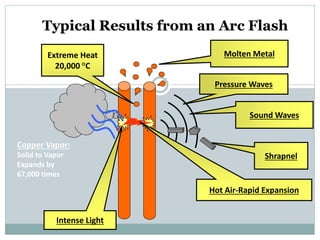
Typical Results from an Arc Flash 
Pressure Waves 
Copper Vapor: 
Solid to Vapor 
Expands by 
67,000 times 
Molten Metal 
Intense Light 
Hot Air-Rapid Expansion 
Extreme Heat 
20,000 °C 
Shrapnel 
Sound Waves
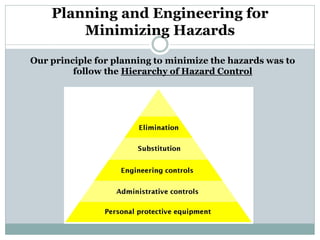
Planning and Engineering for Minimizing Hazards 
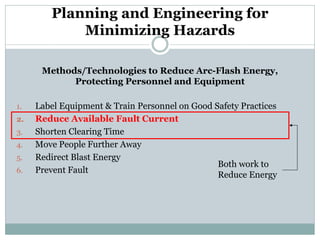
Our principle for planning to minimize the hazards was to follow the Hierarchy of Hazard Control
1. 
Label Equipment & Train Personnel on Good Safety Practices 
2. 
Reduce Available Fault Current 
3. 
Shorten Clearing Time 
4. 
Move People Further Away 
5. 
Redirect Blast Energy 
6. 
Prevent Fault 
Methods/Technologies to Reduce Arc-Flash Energy, Protecting Personnel and Equipment 
Planning and Engineering for Minimizing Hazards 
Both work to 
Reduce Energy
Planning and Engineering for Minimizing Hazards 
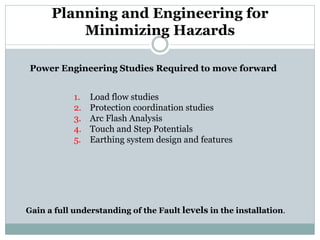
Power Engineering Studies Required to move forward 
1. 
Load flow studies 
2. 
Protection coordination studies 
3. 
Arc Flash Analysis 
4. 
Touch and Step Potentials 
5. 
Earthing system design and features 
Gain a full understanding of the Fault levels in the installation.
Planning and Engineering for Minimizing Hazards 
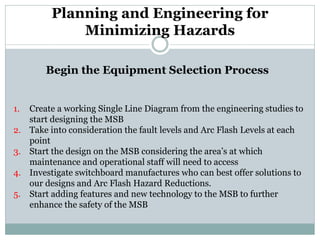
Begin the Equipment Selection Process 
1. 
Create a working Single Line Diagram from the engineering studies to start designing the MSB 
2. 
Take into consideration the fault levels and Arc Flash Levels at each point 
3. 
Start the design on the MSB considering the area’s at which maintenance and operational staff will need to access 
4. 
Investigate switchboard manufactures who can best offer solutions to our designs and Arc Flash Hazard Reductions. 
5. 
Start adding features and new technology to the MSB to further enhance the safety of the MSB
Planning and Engineering for Minimizing Hazards 
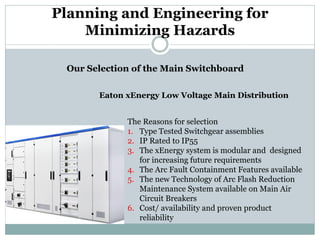
Our Selection of the Main Switchboard 
Eaton xEnergy Low Voltage Main Distribution 
The Reasons for selection 
1. 
Type Tested Switchgear assemblies 
2. 
IP Rated to IP55 
3. 
The xEnergy system is modular and designed for increasing future requirements 
4. 
The Arc Fault Containment Features available 
5. 
The new Technology of Arc Flash Reduction Maintenance System available on Main Air Circuit Breakers 
6. 
Cost/ availability and proven product reliability
Planning and Engineering for Minimizing Hazards 
Switchboard Features 
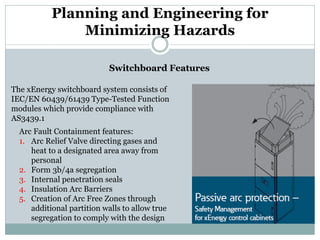
The xEnergy switchboard system consists of IEC/EN 60439/61439 Type-Tested Function modules which provide compliance with AS3439.1 
Arc Fault Containment features: 
1. 
Arc Relief Valve directing gases and heat to a designated area away from personal 
2. 
Form 3b/4a segregation 
3. 
Internal penetration seals 
4. 
Insulation Arc Barriers 
5. 
Creation of Arc Free Zones through additional partition walls to allow true segregation to comply with the design
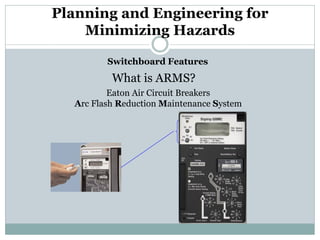
What is ARMS? 
Planning and Engineering for Minimizing Hazards 
Eaton Air Circuit Breakers Arc Flash Reduction Maintenance System 
Switchboard Features
Planning and Engineering for Minimizing Hazards 
Switchboard Features 
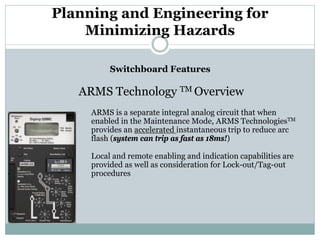
ARMS Technology TM Overview 
ARMS is a separate integral analog circuit that when enabled in the Maintenance Mode, ARMS TechnologiesTM provides an accelerated instantaneous trip to reduce arc flash (system can trip as fast as 18ms!) 
Local and remote enabling and indication capabilities are provided as well as consideration for Lock-out/Tag-out procedures
Planning and Engineering for Minimizing Hazards 
Benefits of the ARMS System 
Increased worker safety – when enabled, the Arc flash Reduction 
Maintenance System provides an accelerated instantaneous trip to reduce arc flash. 
Reduction in incident energy levels may allow reduced levels of 
PPE to be used, offering an improvement to worker comfort and 
mobility. 
When properly applied, the hazard risk category frequently can be 
lowered multiple categories permitting less PPE. 
PPE SHOULD ALWAYS BE THE LAST LINE OF DEFENCE
Planning and Engineering for Minimizing Hazards 
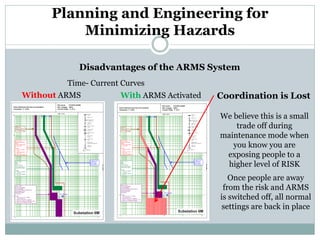
Disadvantages of the ARMS System 
Time- Current Curves 
Coordination is Lost 
Without ARMS 
With ARMS Activated 
We believe this is a small trade off during maintenance mode when you know you are exposing people to a higher level of RISK 
Once people are away from the risk and ARMS is switched off, all normal settings are back in place
Planning and Engineering for Minimizing Hazards 
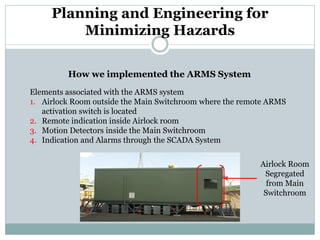
How we implemented the ARMS System 
Elements associated with the ARMS system 
1. 
Airlock Room outside the Main Switchroom where the remote ARMS activation switch is located 
2. 
Remote indication inside Airlock room 
3. 
Motion Detectors inside the Main Switchroom 
4. 
Indication and Alarms through the SCADA System 
Airlock Room Segregated from Main Switchroom
Planning and Engineering for Minimizing Hazards 
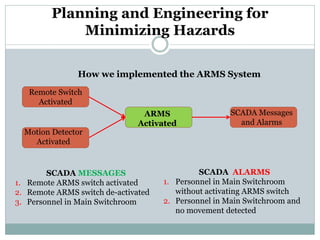
How we implemented the ARMS System 
Remote Switch Activated 
ARMS Activated 
SCADA Messages and Alarms 
Motion Detector Activated 
SCADA MESSAGES 
1. 
Remote ARMS switch activated 
2. 
Remote ARMS switch de-activated 
3. 
Personnel in Main Switchroom 
SCADA ALARMS 
1. 
Personnel in Main Switchroom without activating ARMS switch 
2. 
Personnel in Main Switchroom and no movement detected
Planning and Engineering for Minimizing Hazards 
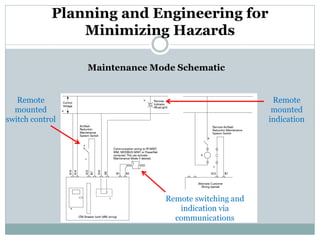
Maintenance Mode Schematic 
Remote mounted switch control 
Remote switching and indication via communications 
Remote mounted indication
Planning and Engineering for Minimizing Hazards 
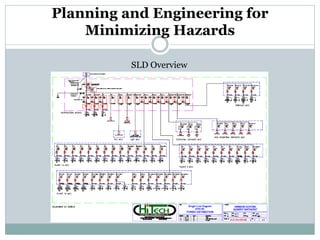
SLD Overview
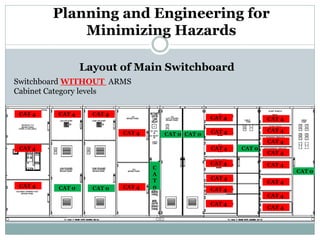
Layout of Main Switchboard 
Switchboard WITHOUT ARMS 
Cabinet Category levels 
Planning and Engineering for Minimizing Hazards 
CAT 0 
CAT 4 
CAT 4 
CAT 4 
CAT 4 
CAT 4 
CAT 4 
CAT 4 
CAT 4 
CAT 4 
CAT 4 
CAT 4 
CAT 4 
CAT 4 
CAT 4 
CAT 4 
CAT 4 
CAT 4 
CAT 4 
CAT 4 
CAT 4 
CAT 4 
CAT 4 
CAT 0 
CAT 0 
CA T 0 
CAT 0 
CAT 0 
CAT 0
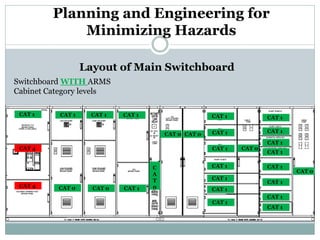
Layout of Main Switchboard 
Switchboard WITH ARMS Cabinet Category levels 
Planning and Engineering for Minimizing Hazards 
CAT 0 
CAT 4 
CAT 4 
CAT 0 
CAT 0 
CA T 0 
CAT 0 
CAT 0 
CAT 0 
CAT 1 
CAT 1 
CAT 1 
CAT 1 
CAT 1 
CAT 1 
CAT 1 
CAT 1 
CAT 1 
CAT 1 
CAT 1 
CAT 1 
CAT 1 
CAT 1 
CAT 1 
CAT 1 
CAT 1 
CAT 1 
CAT 1 
CAT 1
Planning and Engineering for Minimizing Hazards 
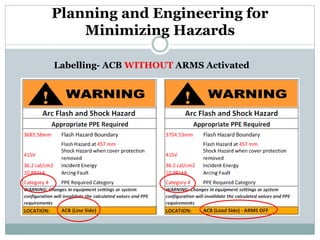
Labelling- ACB WITHOUT ARMS Activated
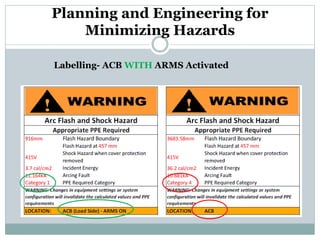
Labelling- ACB WITH ARMS Activated 
Planning and Engineering for Minimizing Hazards
Planning and Engineering for Minimizing Hazards 
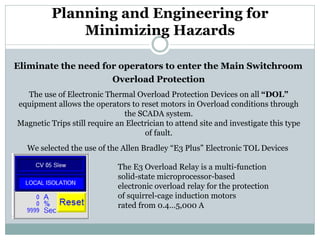
Eliminate the need for operators to enter the Main Switchroom 
The use of Electronic Thermal Overload Protection Devices on all “DOL” equipment allows the operators to reset motors in Overload conditions through the SCADA system. Magnetic Trips still require an Electrician to attend site and investigate this type of fault. 
We selected the use of the Allen Bradley “E3 Plus” Electronic TOL Devices 
The E3 Overload Relay is a multi-function solid-state microprocessor-based 
electronic overload relay for the protection of squirrel-cage induction motors 
rated from 0.4…5,000 A 
Overload Protection
Planning and Engineering for Minimizing Hazards 
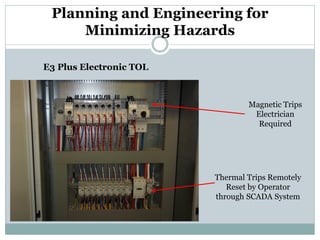
E3 Plus Electronic TOL 
Magnetic Trips Electrician Required 
Thermal Trips Remotely Reset by Operator through SCADA System
Planning and Engineering for Minimizing Hazards 
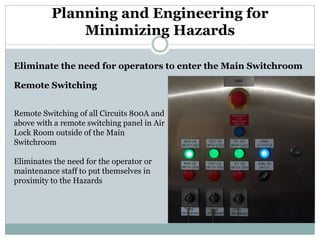
Eliminate the need for operators to enter the Main Switchroom 
Remote Switching of all Circuits 800A and above with a remote switching panel in Air Lock Room outside of the Main Switchroom 
Eliminates the need for the operator or maintenance staff to put themselves in proximity to the Hazards 
Remote Switching
Eliminate the need for operators to enter the Main Switchroom 
Planning and Engineering for Minimizing Hazards 
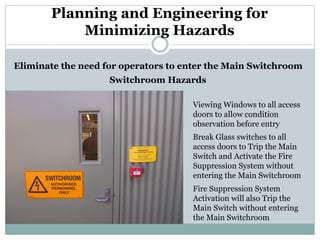
Viewing Windows to all access doors to allow condition observation before entry 
Break Glass switches to all access doors to Trip the Main Switch and Activate the Fire Suppression System without entering the Main Switchroom 
Fire Suppression System Activation will also Trip the Main Switch without entering the Main Switchroom 
Switchroom Hazards
Administration for Minimizing Hazards 
Protect your Protection settings by sealing them once they are set in accordance to the engineered studies 
Administration 
Create good maintenance schedules for Plant and Equipment 
Training and Education to all Staff 
Specific training in regards to reading and understanding Arc Flash Labelling. There are still a lot of Electrical Staff out there who do not understand Arc Flash Labelling and the potential energy levels they are about put themselves at Risk to. 
Display the Current SLD in the Switchroom showing all protective settings and Arc Flash Levels so that they are always accessible. 
Create a culture of safety and assessing Risks.
PPE The Last Defense 
Arc Flash PPE labelling installed at all area’s of Risk 
Educate staff on PPE requirements 
Ensure all PPE is accessible at all times for all locations 
Reducing the Hazards will Reduce the level of PPE 
The higher the level of PPE required the more Hazards maybe introduced such as Heat Stress, Poor Visibility and Limited Body Movement
Summary 
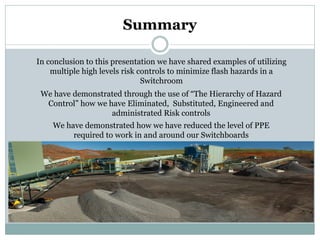
In conclusion to this presentation we have shared examples of utilizing multiple high levels risk controls to minimize flash hazards in a Switchroom 
We have demonstrated through the use of “The Hierarchy of Hazard Control” how we have Eliminated, Substituted, Engineered and administrated Risk controls 
We have demonstrated how we have reduced the level of PPE required to work in and around our Switchboards
Thank You 
www.hitechelec.com.au

Daniel Hall - How to mitigate flash hazards in a main switchroom

  • 1.
    BY DANIEL HALL HITECH ELECTRICAL AUTOMATION How to “Mitigate” Flash Hazards in a Main Switchroom
  • 2.
    Objective for thispresentation To share examples of utilizing multiple high level risk controls to minimize flash hazards in a Switchroom to the point that special arc flash PPE is not required for many switching and isolating procedures. To create a safer work environment for operational and maintenance staff. Category 4 PPE
  • 3.
    Topics to bediscussed in this presentation 1. The project 2. The Hazards and Risks in the Main Electrical Switchroom to take into consideration 3. Planning and engineering philosophy for minimizing the Hazards 4. Outcomes achieved and summarized conclusion
  • 4.
    The Project TheCustomer: Hanson Construction Materials Location: East Guyong situated half way between Bathurst and Orange NSW. Scope of works included: Turnkey solution for the supply and installation of a fixed basalt crushing and screening plant with a capacity of 220 TPH. Design, engineering, supply, installation and commissioning LV electrical works including the Process Control System (PCS) and appropriate Switchroom and MCC’s.
  • 5.
    1. 2MVA Transformer 2. Switchroom 3. MCC and Control Panels 4. Three Crushers 5. Four Screens 6. Six Feeders 7. Eleven Conveyors 8. Three Luffing and Radial Stackers 9. Dust Extraction 10. Lighting and general power 11. Automation of plant The Project The key equipment:
  • 6.
    The Hazards andRisks Generally Quarrying sites of this size do not have permanent electrical staff onsite A lot of contractors who do work on these sites generally do not do a lot of work on mining sites Therefore the primary hazard area’s the design team considered throughout engineering the Switchroom were as follows: 1. Switching and isolation of Electrical devices. 2. Resetting of overloads. 3. Fault finding and testing.
  • 7.
    1.Racking in orout Circuit Breakers. 2.Removing or installing Circuit Breakers. 3.Working on Control circuits with energized parts. 4.Low Voltage testing and fault finding. 5.Removing panels for inspections and other activities 6.Testing for Dead The Hazards and Risks Examples of activities in a Switchroom which involve Arc Flash Risks
  • 8.
    1. Dust 2. Dropping tools 3. Accidental touching 4. Condensation 5. Material failure 6. Corrosion 7. Faulty Installation 8. Over-voltages across narrow gaps The Hazards and Risks Common causes of Arc Flash in a Switchroom
  • 9.
    1. Proximity ofthe worker to the hazard 2. Temperature 3. Time for the circuit to break The Hazards and Risks Three main factors which determine the severity of an arc flash
  • 10.
    What are yourRisks 1. Compliance – Failing the standards and the rules can delay project startup and can result in significant fines 2. Injury/Death – Yourself, your co-workers, outside contractors and other third parties. Between 5 and 10 arc flash incidents happen every day 3. Equipment damage – Costly to repair or replace 4. Plant shutdown – reduced productivity, lost revenues, lost costumers, lost jobs 5. Liability – Lawsuits, higher insurance premiums, out of pocket costs if self insured – a single incident can easily run in excess of $10M
  • 11.
    Typical Results froman Arc Flash Pressure Waves Copper Vapor: Solid to Vapor Expands by 67,000 times Molten Metal Intense Light Hot Air-Rapid Expansion Extreme Heat 20,000 °C Shrapnel Sound Waves
  • 12.
    Planning and Engineeringfor Minimizing Hazards Our principle for planning to minimize the hazards was to follow the Hierarchy of Hazard Control
  • 13.
    1. Label Equipment& Train Personnel on Good Safety Practices 2. Reduce Available Fault Current 3. Shorten Clearing Time 4. Move People Further Away 5. Redirect Blast Energy 6. Prevent Fault Methods/Technologies to Reduce Arc-Flash Energy, Protecting Personnel and Equipment Planning and Engineering for Minimizing Hazards Both work to Reduce Energy
  • 14.
    Planning and Engineeringfor Minimizing Hazards Power Engineering Studies Required to move forward 1. Load flow studies 2. Protection coordination studies 3. Arc Flash Analysis 4. Touch and Step Potentials 5. Earthing system design and features Gain a full understanding of the Fault levels in the installation.
  • 15.
    Planning and Engineeringfor Minimizing Hazards Begin the Equipment Selection Process 1. Create a working Single Line Diagram from the engineering studies to start designing the MSB 2. Take into consideration the fault levels and Arc Flash Levels at each point 3. Start the design on the MSB considering the area’s at which maintenance and operational staff will need to access 4. Investigate switchboard manufactures who can best offer solutions to our designs and Arc Flash Hazard Reductions. 5. Start adding features and new technology to the MSB to further enhance the safety of the MSB
  • 16.
    Planning and Engineeringfor Minimizing Hazards Our Selection of the Main Switchboard Eaton xEnergy Low Voltage Main Distribution The Reasons for selection 1. Type Tested Switchgear assemblies 2. IP Rated to IP55 3. The xEnergy system is modular and designed for increasing future requirements 4. The Arc Fault Containment Features available 5. The new Technology of Arc Flash Reduction Maintenance System available on Main Air Circuit Breakers 6. Cost/ availability and proven product reliability
  • 17.
    Planning and Engineeringfor Minimizing Hazards Switchboard Features The xEnergy switchboard system consists of IEC/EN 60439/61439 Type-Tested Function modules which provide compliance with AS3439.1 Arc Fault Containment features: 1. Arc Relief Valve directing gases and heat to a designated area away from personal 2. Form 3b/4a segregation 3. Internal penetration seals 4. Insulation Arc Barriers 5. Creation of Arc Free Zones through additional partition walls to allow true segregation to comply with the design
  • 18.
    What is ARMS? Planning and Engineering for Minimizing Hazards Eaton Air Circuit Breakers Arc Flash Reduction Maintenance System Switchboard Features
  • 19.
    Planning and Engineeringfor Minimizing Hazards Switchboard Features ARMS Technology TM Overview ARMS is a separate integral analog circuit that when enabled in the Maintenance Mode, ARMS TechnologiesTM provides an accelerated instantaneous trip to reduce arc flash (system can trip as fast as 18ms!) Local and remote enabling and indication capabilities are provided as well as consideration for Lock-out/Tag-out procedures
  • 20.
    Planning and Engineeringfor Minimizing Hazards Benefits of the ARMS System Increased worker safety – when enabled, the Arc flash Reduction Maintenance System provides an accelerated instantaneous trip to reduce arc flash. Reduction in incident energy levels may allow reduced levels of PPE to be used, offering an improvement to worker comfort and mobility. When properly applied, the hazard risk category frequently can be lowered multiple categories permitting less PPE. PPE SHOULD ALWAYS BE THE LAST LINE OF DEFENCE
  • 21.
    Planning and Engineeringfor Minimizing Hazards Disadvantages of the ARMS System Time- Current Curves Coordination is Lost Without ARMS With ARMS Activated We believe this is a small trade off during maintenance mode when you know you are exposing people to a higher level of RISK Once people are away from the risk and ARMS is switched off, all normal settings are back in place
  • 22.
    Planning and Engineeringfor Minimizing Hazards How we implemented the ARMS System Elements associated with the ARMS system 1. Airlock Room outside the Main Switchroom where the remote ARMS activation switch is located 2. Remote indication inside Airlock room 3. Motion Detectors inside the Main Switchroom 4. Indication and Alarms through the SCADA System Airlock Room Segregated from Main Switchroom
  • 23.
    Planning and Engineeringfor Minimizing Hazards How we implemented the ARMS System Remote Switch Activated ARMS Activated SCADA Messages and Alarms Motion Detector Activated SCADA MESSAGES 1. Remote ARMS switch activated 2. Remote ARMS switch de-activated 3. Personnel in Main Switchroom SCADA ALARMS 1. Personnel in Main Switchroom without activating ARMS switch 2. Personnel in Main Switchroom and no movement detected
  • 24.
    Planning and Engineeringfor Minimizing Hazards Maintenance Mode Schematic Remote mounted switch control Remote switching and indication via communications Remote mounted indication
  • 25.
    Planning and Engineeringfor Minimizing Hazards SLD Overview
  • 26.
    Layout of MainSwitchboard Switchboard WITHOUT ARMS Cabinet Category levels Planning and Engineering for Minimizing Hazards CAT 0 CAT 4 CAT 4 CAT 4 CAT 4 CAT 4 CAT 4 CAT 4 CAT 4 CAT 4 CAT 4 CAT 4 CAT 4 CAT 4 CAT 4 CAT 4 CAT 4 CAT 4 CAT 4 CAT 4 CAT 4 CAT 4 CAT 4 CAT 0 CAT 0 CA T 0 CAT 0 CAT 0 CAT 0
  • 27.
    Layout of MainSwitchboard Switchboard WITH ARMS Cabinet Category levels Planning and Engineering for Minimizing Hazards CAT 0 CAT 4 CAT 4 CAT 0 CAT 0 CA T 0 CAT 0 CAT 0 CAT 0 CAT 1 CAT 1 CAT 1 CAT 1 CAT 1 CAT 1 CAT 1 CAT 1 CAT 1 CAT 1 CAT 1 CAT 1 CAT 1 CAT 1 CAT 1 CAT 1 CAT 1 CAT 1 CAT 1 CAT 1
  • 28.
    Planning and Engineeringfor Minimizing Hazards Labelling- ACB WITHOUT ARMS Activated
  • 29.
    Labelling- ACB WITHARMS Activated Planning and Engineering for Minimizing Hazards
  • 30.
    Planning and Engineeringfor Minimizing Hazards Eliminate the need for operators to enter the Main Switchroom The use of Electronic Thermal Overload Protection Devices on all “DOL” equipment allows the operators to reset motors in Overload conditions through the SCADA system. Magnetic Trips still require an Electrician to attend site and investigate this type of fault. We selected the use of the Allen Bradley “E3 Plus” Electronic TOL Devices The E3 Overload Relay is a multi-function solid-state microprocessor-based electronic overload relay for the protection of squirrel-cage induction motors rated from 0.4…5,000 A Overload Protection
  • 31.
    Planning and Engineeringfor Minimizing Hazards E3 Plus Electronic TOL Magnetic Trips Electrician Required Thermal Trips Remotely Reset by Operator through SCADA System
  • 32.
    Planning and Engineeringfor Minimizing Hazards Eliminate the need for operators to enter the Main Switchroom Remote Switching of all Circuits 800A and above with a remote switching panel in Air Lock Room outside of the Main Switchroom Eliminates the need for the operator or maintenance staff to put themselves in proximity to the Hazards Remote Switching
  • 33.
    Eliminate the needfor operators to enter the Main Switchroom Planning and Engineering for Minimizing Hazards Viewing Windows to all access doors to allow condition observation before entry Break Glass switches to all access doors to Trip the Main Switch and Activate the Fire Suppression System without entering the Main Switchroom Fire Suppression System Activation will also Trip the Main Switch without entering the Main Switchroom Switchroom Hazards
  • 34.
    Administration for MinimizingHazards Protect your Protection settings by sealing them once they are set in accordance to the engineered studies Administration Create good maintenance schedules for Plant and Equipment Training and Education to all Staff Specific training in regards to reading and understanding Arc Flash Labelling. There are still a lot of Electrical Staff out there who do not understand Arc Flash Labelling and the potential energy levels they are about put themselves at Risk to. Display the Current SLD in the Switchroom showing all protective settings and Arc Flash Levels so that they are always accessible. Create a culture of safety and assessing Risks.
  • 35.
    PPE The LastDefense Arc Flash PPE labelling installed at all area’s of Risk Educate staff on PPE requirements Ensure all PPE is accessible at all times for all locations Reducing the Hazards will Reduce the level of PPE The higher the level of PPE required the more Hazards maybe introduced such as Heat Stress, Poor Visibility and Limited Body Movement
  • 36.
    Summary In conclusionto this presentation we have shared examples of utilizing multiple high levels risk controls to minimize flash hazards in a Switchroom We have demonstrated through the use of “The Hierarchy of Hazard Control” how we have Eliminated, Substituted, Engineered and administrated Risk controls We have demonstrated how we have reduced the level of PPE required to work in and around our Switchboards
  • 37.