ARABIC SYLLABLE
STRUCTURE AND STRESS
Presentedby:
Fawzia Ammoura
Islamal Tamimi
Readings in Arabic and
English Languages
SYLLABLE STRUCTURE
Syllable Structure constitutes the component of
phonological words division focused on
pronounceable segments of words and how they are
composed, divided and distributed.
Syllable structure is also a subdivision of the study of
phonotactic, or the rules of sound distribution, the
specific sequences of sound that occur in a language.
And, third, the study of syllables in Arabic involves the
analysis of lexical stress.
ARABIC SYLLABLE CONSTRAINTS
Full-form pronunciation
 No syllable may start with a vowel
No syllable may start with a consonant cluster (two or more)
all Arabic syllables start with CV or CVV.
Syllables must nowhere contain a cluster of three or more
consonants.
CV : weak or light syllable
CVV/ CVC : strong or heavy syllable
CVVC: restricted circumstances, the result of gemination.
Pause-form pronunciation (Omitting Final short
vowels)
Phonotactic rules allow for a word-final syllable to be
either CVVC or CVCC. These syllables are considered
superstrong or “superheavy.”
FORMALIZATION OF SYLLABLE STRUCTURE
CV (V) C 0/1/2
Parentheses: enclose a potential increment of vowel length CV CVVC
CVC
zero: indicates the non-occurrence of a final consonant in the
structure of a syllable
CV
CVV
if C0 occurs then the syllable is open‫؛‬ otherwise, it is closed.
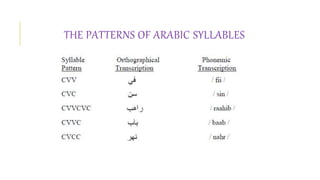
THE PATTERNS OF ARABIC SYLLABLES
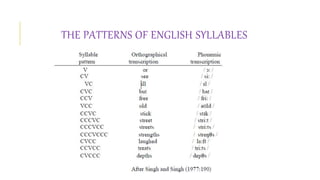
THE PATTERNS OF ENGLISH SYLLABLES
LEXICAL STRESS
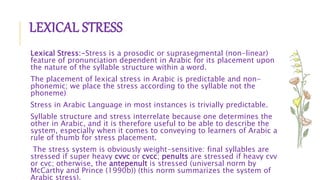
Lexical Stress:-Stress is a prosodic or suprasegmental (non-linear)
feature of pronunciation dependent in Arabic for its placement upon
the nature of the syllable structure within a word.
The placement of lexical stress in Arabic is predictable and non-
phonemic; we place the stress according to the syllable not the
phoneme)
Stress in Arabic Language in most instances is trivially predictable.
Syllable structure and stress interrelate because one determines the
other in Arabic, and it is therefore useful to be able to describe the
system, especially when it comes to conveying to learners of Arabic a
rule of thumb for stress placement.
The stress system is obviously weight-sensitive: final syllables are
stressed if super heavy cvvc or cvcc; penults are stressed if heavy cvv
or cvc; otherwise, the antepenult is stressed (universal norm by
McCarthy and Prince (1990b)) (this norm summarizes the system of
Arabic stress).
LEXICAL STRESS
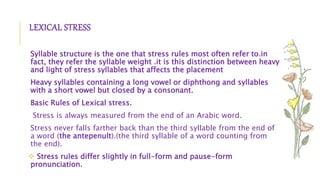
Syllable structure is the one that stress rules most often refer to.in
fact, they refer the syllable weight .it is this distinction between heavy
and light of stress syllables that affects the placement
Heavy syllables containing a long vowel or diphthong and syllables
with a short vowel but closed by a consonant.
Basic Rules of Lexical stress.
Stress is always measured from the end of an Arabic word.
Stress never falls farther back than the third syllable from the end of
a word (the antepenult).(the third syllable of a word counting from
the end).
 Stress rules differ slightly in full-form and pause-form
pronunciation.
FIRST: FULL-FORM STRESS
When Arabic is pronounced in "full form" i.e., including all desinential
inflection markers, there are three basic stress constraints.
Stress does not fall on a final syllable. In a word of two syllables, it
therefore falls on the first, no matter whether that first syllable is
strong or weak:
e.g. qab-la before
e.g. hu-naa here
e.g. hi-ya she
e.g. naħ-nu we
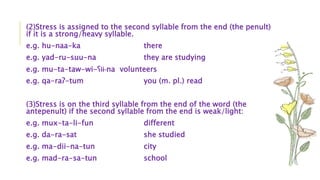
(2)Stress is assigned to the second syllable from the end (the penult)
if it is a strong/heavy syllable.
e.g. hu-naa-ka there
e.g. yad-ru-suu-na they are studying
e.g. mu-ta-taw-wi-ʕіі-na volunteers
e.g. qa-raʔ-tum you (m. pl.) read
(3)Stress is on the third syllable from the end of the word (the
antepenult) if the second syllable from the end is weak/light:
e.g. mux-ta-li-fun different
e.g. da-ra-sat she studied
e.g. ma-dii-na-tun city
e.g. mad-ra-sa-tun school
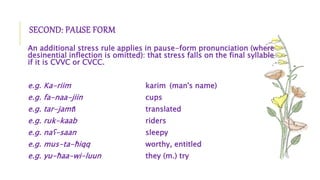
SECOND: PAUSE FORM
An additional stress rule applies in pause-form pronunciation (where
desinential inflection is omitted): that stress falls on the final syllable
if it is CVVC or CVCC.
e.g. Ka-riim karim (man's name)
e.g. fa-naa-jiin cups
e.g. tar-jamtI translated
e.g. ruk-kaab riders
e.g. naʕ-saan sleepy
e.g. mus-ta-ħiqq worthy, entitled
e.g. yu-ħaa-wi-luun they (m.) try
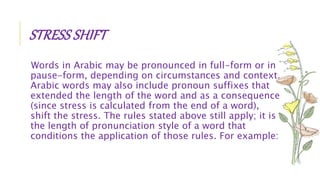
STRESS SHIFT
Words in Arabic may be pronounced in full-form or in
pause-form, depending on circumstances and context.
Arabic words may also include pronoun suffixes that
extended the length of the word and as a consequence
(since stress is calculated from the end of a word),
shift the stress. The rules stated above still apply; it is
the length of pronunciation style of a word that
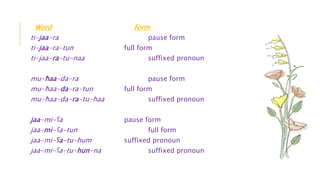
conditions the application of those rules. For example:
Word form
ti-jaa-ra pause form
ti-jaa-ra-tun full form
ti-jaa-ra-tu-naa suffixed pronoun
mu-ħaa-da-ra pause form
mu-ħaa-da-ra-tun full form
mu-ħaa-da-ra-tu-haa suffixed pronoun
jaa-mi-ʕa pause form
jaa-mi-ʕa-tun full form
jaa-mi-ʕa-tu-hum suffixed pronoun
jaa-mi-ʕa-tu-hun-na suffixed pronoun
THANK YOU!

Arabic syllable structure and stress

  • 1.
    ARABIC SYLLABLE STRUCTURE ANDSTRESS Presentedby: Fawzia Ammoura Islamal Tamimi Readings in Arabic and English Languages
  • 2.
    SYLLABLE STRUCTURE Syllable Structureconstitutes the component of phonological words division focused on pronounceable segments of words and how they are composed, divided and distributed. Syllable structure is also a subdivision of the study of phonotactic, or the rules of sound distribution, the specific sequences of sound that occur in a language. And, third, the study of syllables in Arabic involves the analysis of lexical stress.
  • 3.
    ARABIC SYLLABLE CONSTRAINTS Full-formpronunciation  No syllable may start with a vowel No syllable may start with a consonant cluster (two or more) all Arabic syllables start with CV or CVV. Syllables must nowhere contain a cluster of three or more consonants. CV : weak or light syllable CVV/ CVC : strong or heavy syllable CVVC: restricted circumstances, the result of gemination.
  • 4.
    Pause-form pronunciation (OmittingFinal short vowels) Phonotactic rules allow for a word-final syllable to be either CVVC or CVCC. These syllables are considered superstrong or “superheavy.”
  • 5.
    FORMALIZATION OF SYLLABLESTRUCTURE CV (V) C 0/1/2 Parentheses: enclose a potential increment of vowel length CV CVVC CVC zero: indicates the non-occurrence of a final consonant in the structure of a syllable CV CVV if C0 occurs then the syllable is open‫؛‬ otherwise, it is closed.
  • 6.
    THE PATTERNS OFARABIC SYLLABLES
  • 7.
    THE PATTERNS OFENGLISH SYLLABLES
  • 8.
    LEXICAL STRESS Lexical Stress:-Stressis a prosodic or suprasegmental (non-linear) feature of pronunciation dependent in Arabic for its placement upon the nature of the syllable structure within a word. The placement of lexical stress in Arabic is predictable and non- phonemic; we place the stress according to the syllable not the phoneme) Stress in Arabic Language in most instances is trivially predictable. Syllable structure and stress interrelate because one determines the other in Arabic, and it is therefore useful to be able to describe the system, especially when it comes to conveying to learners of Arabic a rule of thumb for stress placement. The stress system is obviously weight-sensitive: final syllables are stressed if super heavy cvvc or cvcc; penults are stressed if heavy cvv or cvc; otherwise, the antepenult is stressed (universal norm by McCarthy and Prince (1990b)) (this norm summarizes the system of Arabic stress).
  • 9.
    LEXICAL STRESS Syllable structureis the one that stress rules most often refer to.in fact, they refer the syllable weight .it is this distinction between heavy and light of stress syllables that affects the placement Heavy syllables containing a long vowel or diphthong and syllables with a short vowel but closed by a consonant. Basic Rules of Lexical stress. Stress is always measured from the end of an Arabic word. Stress never falls farther back than the third syllable from the end of a word (the antepenult).(the third syllable of a word counting from the end).  Stress rules differ slightly in full-form and pause-form pronunciation.
  • 10.
    FIRST: FULL-FORM STRESS WhenArabic is pronounced in "full form" i.e., including all desinential inflection markers, there are three basic stress constraints. Stress does not fall on a final syllable. In a word of two syllables, it therefore falls on the first, no matter whether that first syllable is strong or weak: e.g. qab-la before e.g. hu-naa here e.g. hi-ya she e.g. naħ-nu we
  • 11.
    (2)Stress is assignedto the second syllable from the end (the penult) if it is a strong/heavy syllable. e.g. hu-naa-ka there e.g. yad-ru-suu-na they are studying e.g. mu-ta-taw-wi-ʕіі-na volunteers e.g. qa-raʔ-tum you (m. pl.) read (3)Stress is on the third syllable from the end of the word (the antepenult) if the second syllable from the end is weak/light: e.g. mux-ta-li-fun different e.g. da-ra-sat she studied e.g. ma-dii-na-tun city e.g. mad-ra-sa-tun school
  • 12.
    SECOND: PAUSE FORM Anadditional stress rule applies in pause-form pronunciation (where desinential inflection is omitted): that stress falls on the final syllable if it is CVVC or CVCC. e.g. Ka-riim karim (man's name) e.g. fa-naa-jiin cups e.g. tar-jamtI translated e.g. ruk-kaab riders e.g. naʕ-saan sleepy e.g. mus-ta-ħiqq worthy, entitled e.g. yu-ħaa-wi-luun they (m.) try
  • 13.
    STRESS SHIFT Words inArabic may be pronounced in full-form or in pause-form, depending on circumstances and context. Arabic words may also include pronoun suffixes that extended the length of the word and as a consequence (since stress is calculated from the end of a word), shift the stress. The rules stated above still apply; it is the length of pronunciation style of a word that conditions the application of those rules. For example:
  • 14.
    Word form ti-jaa-ra pauseform ti-jaa-ra-tun full form ti-jaa-ra-tu-naa suffixed pronoun mu-ħaa-da-ra pause form mu-ħaa-da-ra-tun full form mu-ħaa-da-ra-tu-haa suffixed pronoun jaa-mi-ʕa pause form jaa-mi-ʕa-tun full form jaa-mi-ʕa-tu-hum suffixed pronoun jaa-mi-ʕa-tu-hun-na suffixed pronoun
  • 15.