Implementation of Quality by Design
principles to HPLC analytical method
Dimitris Papamatthaiakis
Pharma Life-cycle Consultancy
Step 1: Analytical Target Profile
Examples
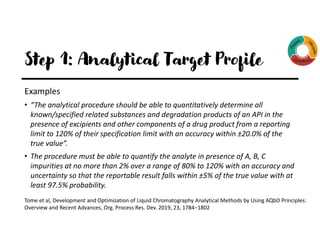
• “The analytical procedure should be able to quantitatively determine all
known/specified related substances and degradation products of an API in the
presence of excipients and other components of a drug product from a reporting
limit to 120% of their specification limit with an accuracy within ±20.0% of the
true value”.
• The procedure must be able to quantify the analyte in presence of A, B, C
impurities at no more than 2% over a range of 80% to 120% with an accuracy and
uncertainty so that the reportable result falls within ±5% of the true value with at
least 97.5% probability.
Tome et al, Development and Optimization of Liquid Chromatography Analytical Methods by Using AQbD Principles:
Overview and Recent Advances, Org. Process Res. Dev. 2019, 23, 1784−1802
Step 1: Analytical Target Profile
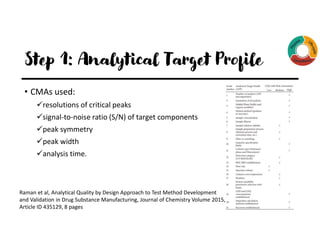
• CMAs used:
resolutions of critical peaks
signal-to-noise ratio (S/N) of target components
peak symmetry
peak width
analysis time.
Raman et al, Analytical Quality by Design Approach to Test Method Development
and Validation in Drug Substance Manufacturing, Journal of Chemistry Volume 2015,
Article ID 435129, 8 pages
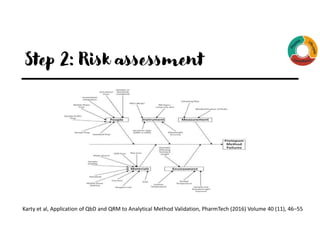
Step 2: Risk assessment
Karty et al, Application of QbD and QRM to Analytical Method Validation, PharmTech (2016) Volume 40 (11), 46–55
Step 3: Modeling
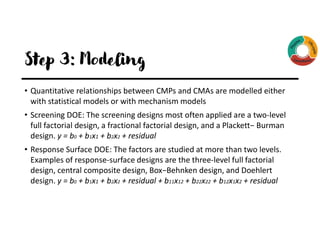
• Quantitative relationships between CMPs and CMAs are modelled either
with statistical models or with mechanism models
• Screening DOE: The screening designs most often applied are a two-level
full factorial design, a fractional factorial design, and a Plackett− Burman
design. y = b0 + b1x1 + b2x2 + residual
• Response Surface DOE: The factors are studied at more than two levels.
Examples of response-surface designs are the three-level full factorial
design, central composite design, Box−Behnken design, and Doehlert
design. y = b0 + b1x1 + b2x2 + residual + b11x12 + b22x22 + b12x1x2 + residual
Step 3: Modeling
Step 4: Design space
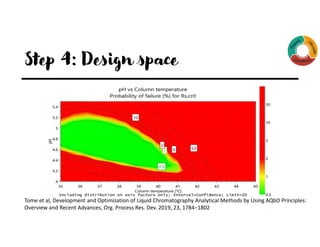
• As defined in the ICH guideline Q8 (R2): when analytical parameters vary within
the design space, the predetermined requirements for the method would still be
achieved.
• A combination of acceptable ranges of analytical parameters.
• Ensures robustness of the method.
Step 4: Design space
Tome et al, Development and Optimization of Liquid Chromatography Analytical Methods by Using AQbD Principles:
Overview and Recent Advances, Org. Process Res. Dev. 2019, 23, 1784−1802
Step 4: Design space
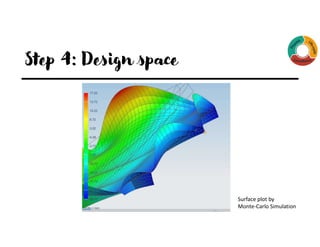
Surface plot by
Monte-Carlo Simulation
Step 4: Design space
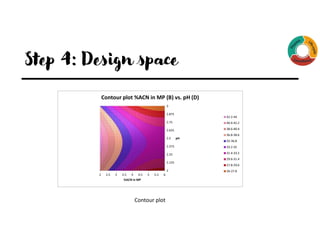
Contour plot
2
2.125
2.25
2.375
2.5
2.625
2.75
2.875
3
2 2.5 3 3.5 4 4.5 5 5.5 6
pH
%ACN in MP
Contour plot %ACN in MP (B) vs. pH (D)
42.2-44
40.4-42.2
38.6-40.4
36.8-38.6
35-36.8
33.2-35
31.4-33.2
29.6-31.4
27.8-29.6
26-27.8
Step 5: Analytical Control Strategy
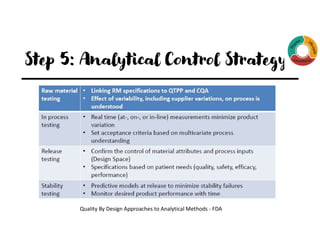
Quality By Design Approaches to Analytical Methods - FDA
Step 6: Procedure Qualification
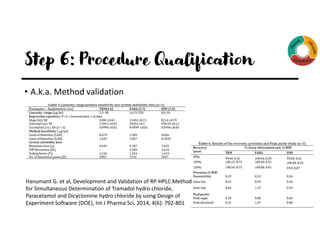
• A.k.a. Method validation
Hanumant G. et al, Development and Validation of RP-HPLC Method
for Simultaneous Determination of Tramadol hydro chloride,
Paracetamol and Dicyclomine hydro chloride by using Design of
Experiment Software (DOE), Int J Pharma Sci. 2014, 4(6): 792-801
Are you looking for a personalized solution towards your own needs?
Please contact us: https://pharmalifecycle.kartra.com/page/contactus

Aqbd HPLC method validation presentation

  • 1.
    Implementation of Qualityby Design principles to HPLC analytical method Dimitris Papamatthaiakis Pharma Life-cycle Consultancy
  • 2.
    Step 1: AnalyticalTarget Profile Examples • “The analytical procedure should be able to quantitatively determine all known/specified related substances and degradation products of an API in the presence of excipients and other components of a drug product from a reporting limit to 120% of their specification limit with an accuracy within ±20.0% of the true value”. • The procedure must be able to quantify the analyte in presence of A, B, C impurities at no more than 2% over a range of 80% to 120% with an accuracy and uncertainty so that the reportable result falls within ±5% of the true value with at least 97.5% probability. Tome et al, Development and Optimization of Liquid Chromatography Analytical Methods by Using AQbD Principles: Overview and Recent Advances, Org. Process Res. Dev. 2019, 23, 1784−1802
  • 3.
    Step 1: AnalyticalTarget Profile • CMAs used: resolutions of critical peaks signal-to-noise ratio (S/N) of target components peak symmetry peak width analysis time. Raman et al, Analytical Quality by Design Approach to Test Method Development and Validation in Drug Substance Manufacturing, Journal of Chemistry Volume 2015, Article ID 435129, 8 pages
  • 4.
    Step 2: Riskassessment Karty et al, Application of QbD and QRM to Analytical Method Validation, PharmTech (2016) Volume 40 (11), 46–55
  • 5.
    Step 3: Modeling •Quantitative relationships between CMPs and CMAs are modelled either with statistical models or with mechanism models • Screening DOE: The screening designs most often applied are a two-level full factorial design, a fractional factorial design, and a Plackett− Burman design. y = b0 + b1x1 + b2x2 + residual • Response Surface DOE: The factors are studied at more than two levels. Examples of response-surface designs are the three-level full factorial design, central composite design, Box−Behnken design, and Doehlert design. y = b0 + b1x1 + b2x2 + residual + b11x12 + b22x22 + b12x1x2 + residual
  • 6.
  • 7.
    Step 4: Designspace • As defined in the ICH guideline Q8 (R2): when analytical parameters vary within the design space, the predetermined requirements for the method would still be achieved. • A combination of acceptable ranges of analytical parameters. • Ensures robustness of the method.
  • 8.
    Step 4: Designspace Tome et al, Development and Optimization of Liquid Chromatography Analytical Methods by Using AQbD Principles: Overview and Recent Advances, Org. Process Res. Dev. 2019, 23, 1784−1802
  • 9.
    Step 4: Designspace Surface plot by Monte-Carlo Simulation
  • 10.
    Step 4: Designspace Contour plot 2 2.125 2.25 2.375 2.5 2.625 2.75 2.875 3 2 2.5 3 3.5 4 4.5 5 5.5 6 pH %ACN in MP Contour plot %ACN in MP (B) vs. pH (D) 42.2-44 40.4-42.2 38.6-40.4 36.8-38.6 35-36.8 33.2-35 31.4-33.2 29.6-31.4 27.8-29.6 26-27.8
  • 11.
    Step 5: AnalyticalControl Strategy Quality By Design Approaches to Analytical Methods - FDA
  • 12.
    Step 6: ProcedureQualification • A.k.a. Method validation Hanumant G. et al, Development and Validation of RP-HPLC Method for Simultaneous Determination of Tramadol hydro chloride, Paracetamol and Dicyclomine hydro chloride by using Design of Experiment Software (DOE), Int J Pharma Sci. 2014, 4(6): 792-801
  • 13.
    Are you lookingfor a personalized solution towards your own needs? Please contact us: https://pharmalifecycle.kartra.com/page/contactus