Analytical Development
Design of Experiment
Dimitris Papamatthaiakis
Pharma Life-cycle Consultancy
Outline
 DOE Basics
 Selection of design
 An Example
 Define DS and MODR
 Conformance to ATP
 Control strategy
AnalyticalDevelopment
DesignofExperiment
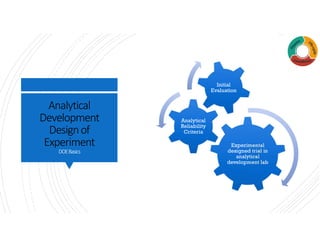
DOE Basics
Analytical
Development
Designof
Experiment
DOEBasics
Experimental
designed trial in
analytical
development lab
Analytical
Reliability
Criteria
Initial
Evaluation
Analytical
Development
Designof
Experiment
DOEBasics
 A systematic cost-efficient way to develop
inderstanding of your product or process
and use it for optimization.
 Establish cause and effect
 Study interactions between variables
 Analyze the results
 Build a mathematic model
Analytical
Development
Designof
Experiment
DOEBasics
 Historical data often hides lurking variables
30
40
50
60
The real maximum
The apparent maximum
factor A has been optimised
factor B has been optimised
Analytical
Development
Designof
Experiment
DOEBasics
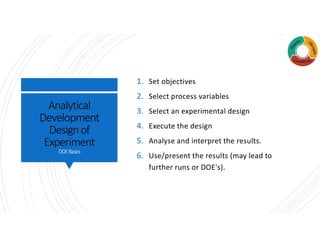
1. Set objectives
2. Select process variables
3. Select an experimental design
4. Execute the design
5. Analyse and interpret the results.
6. Use/present the results (may lead to
further runs or DOE's).
AnalyticalDevelopment
DesignofExperiment
Selection of design
Analytical
Development
Designof
Experiment
Selectionofdesign
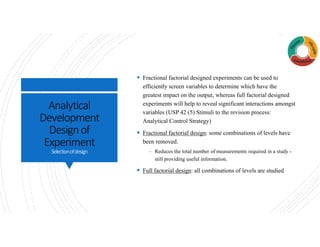
 Fractional factorial designed experiments can be used to
efficiently screen variables to determine which have the
greatest impact on the output, whereas full factorial designed
experiments will help to reveal significant interactions amongst
variables (USP 42 (5) Stimuli to the revision process:
Analytical Control Strategy)
 Fractional factorial design: some combinations of levels have
been removed.
– Reduces the total number of measurements required in a study -
still providing useful information.
 Full factorial design: all combinations of levels are studied
Analytical
Development
Designof
Experiment
Selectionofdesign
Analytical
Development
Designof
Experiment
Selectionofdesign
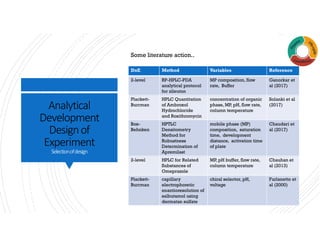
DoE Method Variables Reference
2-level RP-HPLC-PDA
analytical protocol
for zileuton
MP composition, flow
rate, Buffer
Ganorkar et
al (2017)
Plackett-
Burrman
HPLC Quantitation
of Ambroxol
Hydrochloride
and Roxithromycin
concentration of organic
phase, MP, pH, flow rate,
column temperature
Solanki et al
(2017)
Box-
Behnken
HPTLC
Densitometry
Method for
Robustness
Determination of
Apremilast
mobile phase (MP)
composition, saturation
time, development
distance, activation time
of plate
Chaudari et
al (2017)
2-level HPLC for Related
Substances of
Omeprazole
MP, pH buffer, flow rate,
column temperature
Chauhan et
al (2013)
Plackett-
Burrman
capillary
electrophoretic
enantioresolution of
salbutamol using
dermatan sulfate
chiral selector, pH,
voltage
Furlanetto et
al (2000)
Some literature action..
AnalyticalDevelopment
DesignofExperiment
Example: Application on HPLC method
Analytical
Development
Designof
Experiment
Example:ApplicationonHPLCmethod
1. Method values set
2. Define min-max values
3. Complete the matrix table
4. Randomize the order
5. Run trials (depending on your design)
6. ANOVA
7. Plot
8. Select fitting model
9. Interpretation
10.Simulate for MODR
Analytical
Development
Designof
Experiment
Example:ApplicationonHPLCmethod
 Examine the effects of the interactions of the following factors:
Factors Min (-1) Central (0) Max (+1)
pH (A) 2.2 2.3 2.4
%organic
in MP
55% 60% 65%
Column
temp
22°C 25°C 28°C
Analytical
Development
Designof
Experiment
Example:ApplicationonHPLCmethod
STEP 1: Matrix values and repsonses
TRIAL
RUN
ORDER A B C AB AC BC ABC RESPONSE (Y)
1 7 -1 -1 -1 1 1 1 -1 4537675
1 6 1 -1 -1 -1 -1 1 1 4561375
1 4 -1 1 -1 -1 1 -1 1 4537652
1 2 1 1 -1 1 -1 -1 -1 4561245
1 8 -1 -1 1 1 -1 -1 1 4596127
1 5 1 -1 1 -1 1 -1 -1 4637275
1 1 -1 1 1 -1 -1 1 -1 4437654
1 3 1 1 1 1 1 1 1 4537645
2 4 -1 -1 -1 1 1 1 -1 4521043
2 1 1 -1 -1 -1 -1 1 1 4602749
2 7 -1 1 -1 -1 1 -1 1 4636427
2 5 1 1 -1 1 -1 -1 -1 4523462
2 2 -1 -1 1 1 -1 -1 1 4467243
2 8 1 -1 1 -1 1 -1 -1 4537649
2 6 -1 1 1 -1 -1 1 -1 4467245
2 3 1 1 1 1 1 1 1 4567345
Analytical
Development
Designof
Experiment
Example:ApplicationonHPLCmethod
STEP 2: ANOVA
SUMMARY OUTPUT
Regression Statistics
Multiple R 0.757898
R Square 0.574409
Adjusted R
Square 0.202018
Standard
Error 50908.39
Observatio
ns 16
ANOVA
df SS MS F Significance F
Regression 7 2.8E+10 4E+09 1.542487 0.2776523
Residual 8 2.07E+10 2.59E+09
Total 15 4.87E+10
Coefficients
Standard
Error t Stat P-value Lower 95% Upper 95%
Lower
95.0%
Upper
95.0%
Intercept 4545613 12727.1 357.1602 4.23E-18 4516264.447 4574962 4516264 4574962
X Variable
1 20479.94 12727.1 1.60916 0.146248 -8868.802979 49828.68 -8868.8 49828.68
X Variable
2 -12028.8 12727.1 -0.94513 0.372257 -41377.55298 17319.93 -41377.6 17319.93
X Variable
3 -14590.3 12727.1 -1.1464 0.284761 -43939.05298 14758.43 -43939.1 14758.43
X Variable
4 -6640.06 12727.1 -0.52173 0.615993 -35988.80298 22708.68 -35988.8 22708.68
X Variable
5 18475.69 12727.1 1.451681 0.18465 -10873.05298 47824.43 -10873.1 47824.43
X Variable
6 -16521.8 12727.1 -1.29816 0.230405 -45870.55298 12826.93 -45870.6 12826.93
X Variable
7 17707.19 12727.1 1.391298 0.201604 -11641.55298 47055.93 -11641.6 47055.93
This is a free preview copy of the original training “Analytical Development Design of Experiment”
Are you looking for a personalized solution towards your own needs?
Please contact us: https://pharmalifecycle.kartra.com/page/contactus

Aqbd seminar DOE