Dr Nikrish S Hegde
• TUMOUR = MASS = NEOPLASM
• MALIGNANT TUMOUR / MALIGNANT NEOPLASM
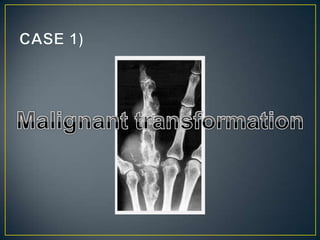
• BENIGN TUMOURS MAY SHOW MALIGNANT
PROPERTIES
The radiologic modalities most often used in analyzing
tumors and tumor-like lesions include:
• conventional radiography
• angiography (usually arteriography)
• computed tomography (CT)
• magnetic resonance imaging (MRI)
• scintigraphy (radionuclide bone scan) and
• fluoroscopy- or CT-guided percutaneous soft tissue and
bone biopsy.
• suffice to make a correct diagnosis .
• confirmed by biopsy and histopathologic examination.
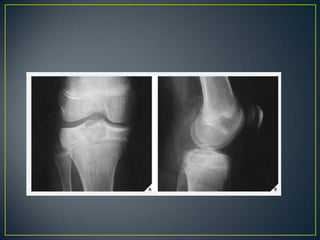
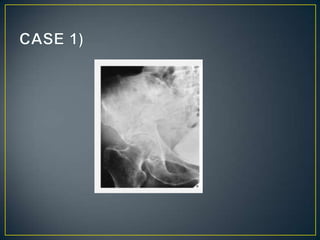
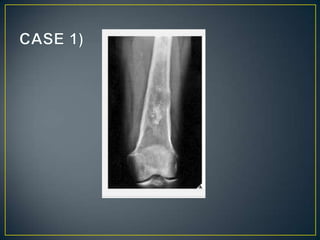
Conventional radiography yields the most useful
information about the location and morphology of a lesion,
• Location
• Calcification
• Ossification
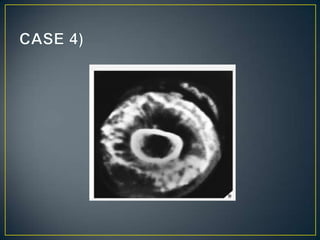
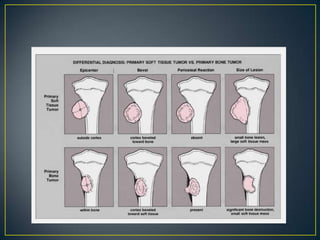
• Periosteal Reaction
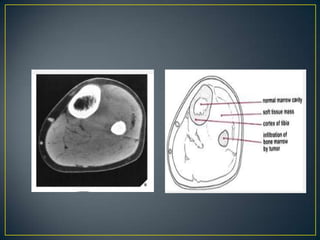
• Provide a precise evaluation of the extent of a bone
lesion .
• CT is moreover very helpful in delineating a bone tumor
having a complex anatomic structure.
• CT examination is crucial in determining the extent and
spread of a tumor in the bone if limb salvage is
contemplated, so that a safe margin of resection can be
planned .
• CT is also useful for monitoring the results of treatment.
• Evaluating the relationship between the tumor and the
surrounding soft tissues and neurovascular structures is
particularly important for planning limb-salvage surgery.
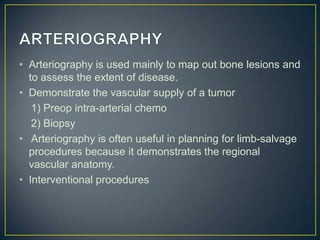
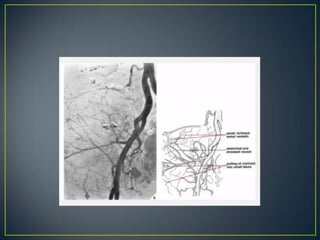
• Arteriography is used mainly to map out bone lesions and
to assess the extent of disease.
• Demonstrate the vascular supply of a tumor
1) Preop intra-arterial chemo
2) Biopsy
• Arteriography is often useful in planning for limb-salvage
procedures because it demonstrates the regional
vascular anatomy.
• Interventional procedures
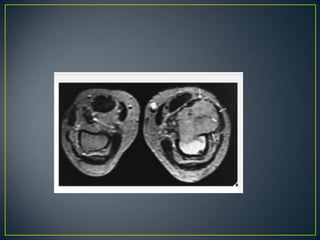
• MRI offers distinct advantages over CT.
• It has a few disadvantages as well.
• In the evaluation of intraosseous and extraosseous
extensions of a tumor, MRI is crucial because it can
determine with high accuracy the presence or absence of
soft-tissue invasion by a tumor .
• Assist in differentiation of intraarticular tumor extension
from joint effusion.
• Cant assess ossification and calcification.
• Indicator of mineral turnover.
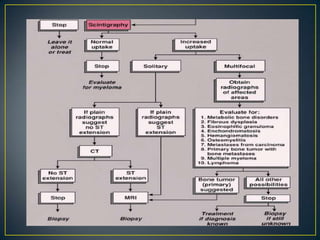
• A bone scan is useful in localizing tumors and tumor-like
lesions in the skeleton.
• In most instances a radionuclide bone scan cannot
distinguish benign lesions from malignant tumors.
• AGE
• DURATION
• RACE
• With so many imaging techniques available to diagnose
and characterize the bone tumor further, radiologists and
clinicians are frequently at a loss as to how to proceed in
a given case.

•
•
•
•
•

Clinical presentation
Effectiveness
Benefits
Cost
Restrictions
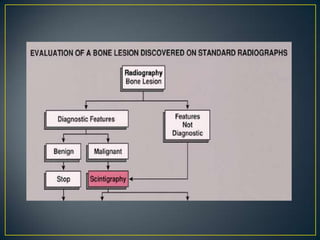
• In the evaluation of bone tumors, conventional
radiography are still the standard diagnostic procedures.
• It should always be done.
• Most of the time, the choice of further imaging technique
is dictated findings on radiograph.
• If osteoid osteoma is suspected based on the clinical
history conventional radiography followed by scintigraphy
and then it should be followed by CT.
• If radiographs are suggestive of a malignant bone tumor,
MRI or CT should be used next to evaluate both the
intraosseous extent of the tumor and the extraosseous
involvement of the soft tissues.
• If there is no definite evidence of soft-tissue extension,
then CT is superior to MRI.
• If the radiographs suggest cortical destruction and softtissue mass, then MRI would be the preferred modality .
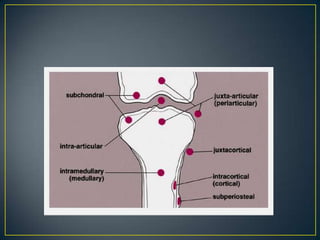
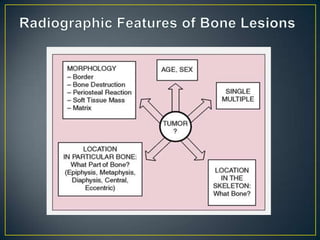
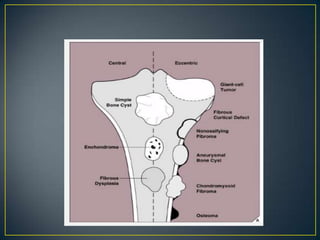
• The site of a bone lesion is an important feature, because
some tumors have a predilection for specific bones or
specific sites in the bone .The sites of some lesions are
so characteristic that a diagnosis can be suggested on
this basis alone, as in the case of parosteal
osteosarcoma or chondroblastoma . Moreover, certain
entities can be readily excluded from the differential
diagnosis on the basis of the lesion's location
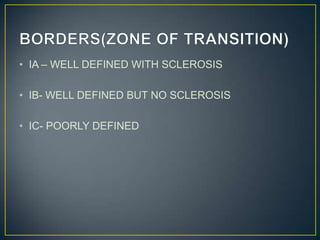
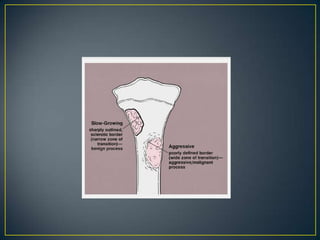
• IA – WELL DEFINED WITH SCLEROSIS
• IB- WELL DEFINED BUT NO SCLEROSIS
• IC- POORLY DEFINED
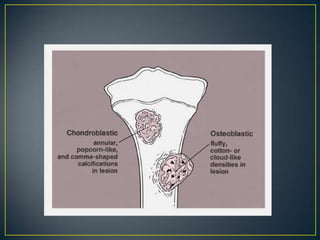
• Only two of these—osteoblastic and cartilaginous
tissue—can usually be clearly demonstrated
radiographically.
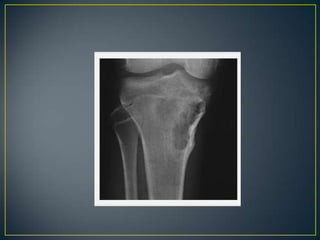
• Identification of tumor bone within or adjacent to the area
of destruction should alert the radiologist to the possibility
of osteosarcoma/reactive sclerosis.
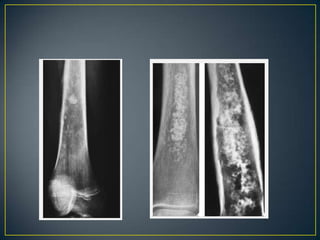
• Osteosarcoma-cloudy - cotton like fluffy deposits.
• Cartilage is identified by the presence of typically
popcorn-like, punctate, annular, or comma-shaped
calcifications in lobules.
• A completely radiolucent lesion may be either fibrous or
cartilaginous .
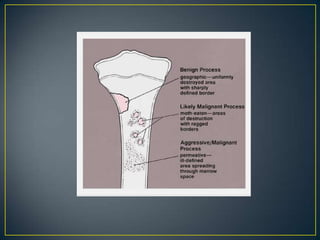
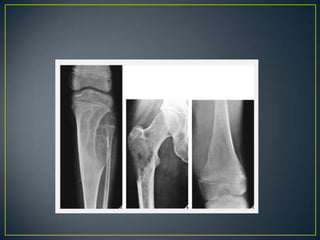
• The type of bone destruction caused by a tumor is
primarily related to the tumor growth rate.
• Not pathognomonic for any specific neoplasm.
• Geographic.
• Moth Eaten.
• Permeative.
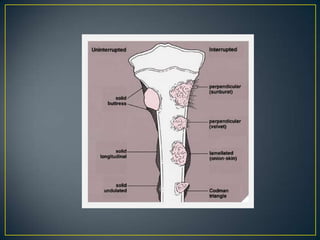
• Categorized as uninterrupted or interrupted .
• The first type of reaction is marked by solid layers of
periosteal density, indicating a long-standing benign
process.
• Also seen in nonneoplastic processes such as
Langerhans cell histiocytosis, osteomyelitis, bone
abscess or in fractures in the healing stage.
• The interrupted type of periosteal reaction suggests
malignancy or a highly aggressive nonmalignant process
and may present as a sunburst pattern, a lamellated
(onion-skin) pattern, a velvet pattern, or a Codman
triangle.
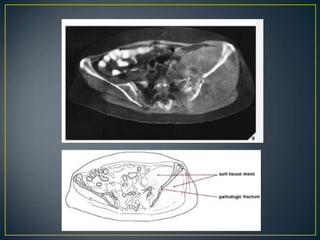
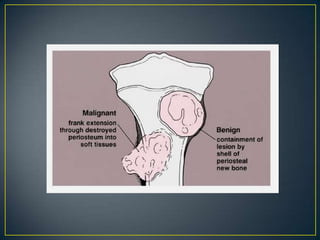
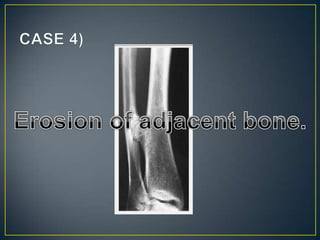
• Benign tumors and tumor-like bone lesions usually do not
exhibit soft-tissue extension; thus, almost invariably, a
soft-tissue mass indicates an aggressive lesion and one
that is in many instances malignant .
• With few exceptions—such as giant cell
tumors, aneurysmal bone cysts, osteoblastomas, or
desmoplastic fibromas.
• In the case of a bone lesion associated with a soft-tissue
mass, it is always helpful to determine which condition
arose first.
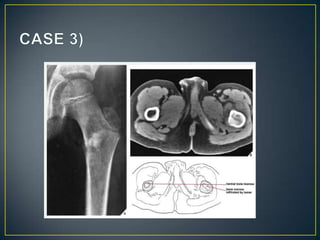
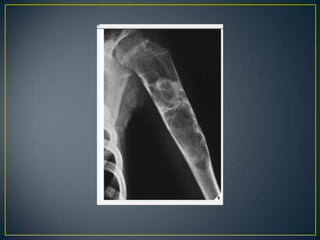
• A multiplicity of malignant lesions usually indicates
metastatic disease, multiple myeloma, or lymphoma.
Very rarely do primary malignant lesions, such as an
osteosarcoma or Ewing sarcoma, present as multifocal
disease. Benign lesions, however, tend to involve
multiple sites, as in polyostotic fibrous dysplasia multiple
osteochondromas, enchondromatosis, Langerhans cell
histiocytosis.
• Although it is sometimes very difficult to distinguish
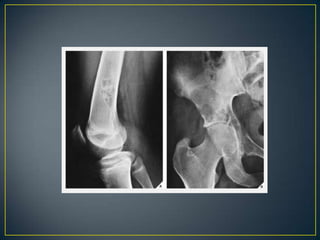
benign from malignant bone lesions on the basis of
radiography alone, certain characteristic features
favour one designation over the other.
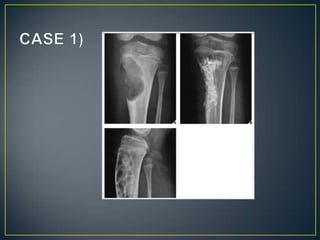
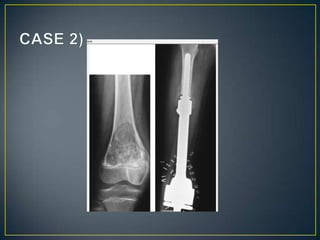
• Radiography is used mainly to document the results of
surgical resection of benign lesions such as osteoid
osteoma or to follow-up after curettage of benign tumors
or tumor-like lesions and application of bone gratfs. In the
case of malignant tumors, radiographic films permit one
to demonstrate the position of endoprostheses or bone
grafts in limb-salvage procedures.
• The effectiveness of chemotherapy is best CT and MRI.
• Recurrence or metastatic spread of a tumor can be
effectively shown at an early stage on scintigraphy, CT, or
MRI.
Aproach to bone   tumours

Aproach to bone tumours

  • 1.
  • 2.
    • TUMOUR =MASS = NEOPLASM • MALIGNANT TUMOUR / MALIGNANT NEOPLASM • BENIGN TUMOURS MAY SHOW MALIGNANT PROPERTIES
  • 7.
    The radiologic modalitiesmost often used in analyzing tumors and tumor-like lesions include: • conventional radiography • angiography (usually arteriography) • computed tomography (CT) • magnetic resonance imaging (MRI) • scintigraphy (radionuclide bone scan) and • fluoroscopy- or CT-guided percutaneous soft tissue and bone biopsy.
  • 8.
    • suffice tomake a correct diagnosis . • confirmed by biopsy and histopathologic examination. Conventional radiography yields the most useful information about the location and morphology of a lesion, • Location • Calcification • Ossification • Periosteal Reaction
  • 10.
    • Provide aprecise evaluation of the extent of a bone lesion . • CT is moreover very helpful in delineating a bone tumor having a complex anatomic structure. • CT examination is crucial in determining the extent and spread of a tumor in the bone if limb salvage is contemplated, so that a safe margin of resection can be planned . • CT is also useful for monitoring the results of treatment. • Evaluating the relationship between the tumor and the surrounding soft tissues and neurovascular structures is particularly important for planning limb-salvage surgery.
  • 17.
    • Arteriography isused mainly to map out bone lesions and to assess the extent of disease. • Demonstrate the vascular supply of a tumor 1) Preop intra-arterial chemo 2) Biopsy • Arteriography is often useful in planning for limb-salvage procedures because it demonstrates the regional vascular anatomy. • Interventional procedures
  • 20.
    • MRI offersdistinct advantages over CT. • It has a few disadvantages as well. • In the evaluation of intraosseous and extraosseous extensions of a tumor, MRI is crucial because it can determine with high accuracy the presence or absence of soft-tissue invasion by a tumor . • Assist in differentiation of intraarticular tumor extension from joint effusion. • Cant assess ossification and calcification.
  • 23.
    • Indicator ofmineral turnover. • A bone scan is useful in localizing tumors and tumor-like lesions in the skeleton. • In most instances a radionuclide bone scan cannot distinguish benign lesions from malignant tumors.
  • 24.
  • 25.
    • With somany imaging techniques available to diagnose and characterize the bone tumor further, radiologists and clinicians are frequently at a loss as to how to proceed in a given case. • • • • • Clinical presentation Effectiveness Benefits Cost Restrictions
  • 26.
    • In theevaluation of bone tumors, conventional radiography are still the standard diagnostic procedures. • It should always be done. • Most of the time, the choice of further imaging technique is dictated findings on radiograph. • If osteoid osteoma is suspected based on the clinical history conventional radiography followed by scintigraphy and then it should be followed by CT.
  • 27.
    • If radiographsare suggestive of a malignant bone tumor, MRI or CT should be used next to evaluate both the intraosseous extent of the tumor and the extraosseous involvement of the soft tissues. • If there is no definite evidence of soft-tissue extension, then CT is superior to MRI. • If the radiographs suggest cortical destruction and softtissue mass, then MRI would be the preferred modality .
  • 29.
    • The siteof a bone lesion is an important feature, because some tumors have a predilection for specific bones or specific sites in the bone .The sites of some lesions are so characteristic that a diagnosis can be suggested on this basis alone, as in the case of parosteal osteosarcoma or chondroblastoma . Moreover, certain entities can be readily excluded from the differential diagnosis on the basis of the lesion's location
  • 32.
    • IA –WELL DEFINED WITH SCLEROSIS • IB- WELL DEFINED BUT NO SCLEROSIS • IC- POORLY DEFINED
  • 36.
    • Only twoof these—osteoblastic and cartilaginous tissue—can usually be clearly demonstrated radiographically. • Identification of tumor bone within or adjacent to the area of destruction should alert the radiologist to the possibility of osteosarcoma/reactive sclerosis. • Osteosarcoma-cloudy - cotton like fluffy deposits. • Cartilage is identified by the presence of typically popcorn-like, punctate, annular, or comma-shaped calcifications in lobules. • A completely radiolucent lesion may be either fibrous or cartilaginous .
  • 39.
    • The typeof bone destruction caused by a tumor is primarily related to the tumor growth rate. • Not pathognomonic for any specific neoplasm. • Geographic. • Moth Eaten. • Permeative.
  • 42.
    • Categorized asuninterrupted or interrupted . • The first type of reaction is marked by solid layers of periosteal density, indicating a long-standing benign process. • Also seen in nonneoplastic processes such as Langerhans cell histiocytosis, osteomyelitis, bone abscess or in fractures in the healing stage. • The interrupted type of periosteal reaction suggests malignancy or a highly aggressive nonmalignant process and may present as a sunburst pattern, a lamellated (onion-skin) pattern, a velvet pattern, or a Codman triangle.
  • 46.
    • Benign tumorsand tumor-like bone lesions usually do not exhibit soft-tissue extension; thus, almost invariably, a soft-tissue mass indicates an aggressive lesion and one that is in many instances malignant . • With few exceptions—such as giant cell tumors, aneurysmal bone cysts, osteoblastomas, or desmoplastic fibromas. • In the case of a bone lesion associated with a soft-tissue mass, it is always helpful to determine which condition arose first.
  • 49.
    • A multiplicityof malignant lesions usually indicates metastatic disease, multiple myeloma, or lymphoma. Very rarely do primary malignant lesions, such as an osteosarcoma or Ewing sarcoma, present as multifocal disease. Benign lesions, however, tend to involve multiple sites, as in polyostotic fibrous dysplasia multiple osteochondromas, enchondromatosis, Langerhans cell histiocytosis.
  • 50.
    • Although itis sometimes very difficult to distinguish benign from malignant bone lesions on the basis of radiography alone, certain characteristic features favour one designation over the other.
  • 51.
    • Radiography isused mainly to document the results of surgical resection of benign lesions such as osteoid osteoma or to follow-up after curettage of benign tumors or tumor-like lesions and application of bone gratfs. In the case of malignant tumors, radiographic films permit one to demonstrate the position of endoprostheses or bone grafts in limb-salvage procedures. • The effectiveness of chemotherapy is best CT and MRI. • Recurrence or metastatic spread of a tumor can be effectively shown at an early stage on scintigraphy, CT, or MRI.