Advanced Product Quality Planning
APQP
ISO TS 16949:2002 Lead Auditor Course
2
Course Objectives
• By the end of the course the participant
should be able to;
– Audit APQP both internally and externally
– Understand the need for a APQP program
– Identify the 5 phases of APQP
– Develop and add value to an APQP
program
3
The 5 Phases of APQP
1.Plan and Define the Program
2.Product Design and Development
3.Process Design and Development
4.Product and Process Validation
5.Feedback, Assessment and
Corrective Action
4
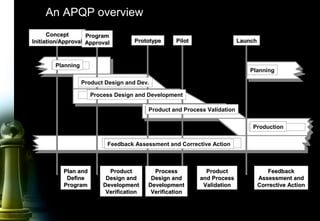
An APQP overview
ConceptConcept
Initiation/ApprovalInitiation/Approval
ProgramProgram
ApprovalApproval PrototypePrototype PilotPilot LaunchLaunch
Planning
Product Design and Dev.
Process Design and Development
Product and Process Validation
Production
Planning
Feedback Assessment and Corrective Action
Plan andPlan and
DefineDefine
ProgramProgram
ProductProduct
Design andDesign and
DevelopmentDevelopment
VerificationVerification
ProductProduct
and Processand Process
ValidationValidation
ProcessProcess
Design andDesign and
DevelopmentDevelopment
VerificationVerification
FeedbackFeedback
Assessment andAssessment and
Corrective ActionCorrective Action
5
1.0 Plan and Define Program
ConceptConcept
Initiation/ApprovalInitiation/Approval
ProgramProgram
ApprovalApproval PrototypePrototype PilotPilot LaunchLaunch
Planning
Feedback Assessment and Corrective Action
Plan andPlan and
DefineDefine
ProgramProgram
ProductProduct
Design andDesign and
DevelopmentDevelopment
VerificationVerification
ProductProduct
and Processand Process
ValidationValidation
ProcessProcess
Design andDesign and
DevelopmentDevelopment
VerificationVerification
FeedbackFeedback
Assessment andAssessment and
Corrective ActionCorrective Action
6
Phase 1
Plan and define the program
• Form a cross functional team
– The first step in planning the program is to define
who will make up the cross functional team. Cross
functional team does not mean one(1) person
doing everything!
– Typical members of a cross functional team may
include:
• Engineering, Production, Quality, Sales,Costing,
Manufacturing, Marketing, Purchasing etc..
7
Plan and define the program
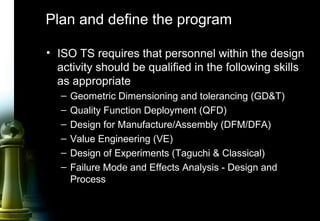
• ISO TS requires that personnel within the design
activity should be qualified in the following skills
as appropriate
– Geometric Dimensioning and tolerancing (GD&T)
– Quality Function Deployment (QFD)
– Design for Manufacture/Assembly (DFM/DFA)
– Value Engineering (VE)
– Design of Experiments (Taguchi & Classical)
– Failure Mode and Effects Analysis - Design and
Process
8
Plan and define the program
– Finite Element Methods (FEM)
– Solid Modelling
– Simulation techniques
– Computer Aided Design/Engineering
(CAD/CAE)
– Reliability Engineering plans
9
Plan and define the program
• Determine customer requirements
Customer requirements are typically determined by
any or all of the following;
– Market research
– Warranty history from similar products
– Supplier Quality Reports
– Team Experience
10
Plan and define the program
• Business plan
The Business plan is a formal requirement
of ISO TS. It is a strategic document which
may place some constraints on the
development of the proposed product.
Examples of Constraints:
Project timing, cost of investment in
technology, machinery and human resources,
quality requirements, manufacturing
capabilities, government regulations
11
Plan and define the program
• Benchmark data - Process & Product
At this stage of the program Benchmark data should be
obtained for the process and product as appropriate.
Benchmark data may be used to establish the “GAP”
between your current product or process and that of the
“World Best”.
Corrective action plans should be developed to close the
“GAP” with the focus on becoming “World Best”.
12
Plan and define the program
• Product and Process assumptions
List all of the current product and process assumptions.
Examples may be:
– Material Characteristics and Performance
– Reliability assessments
– Machine capabilities
– Management Structure
13
Plan and define the program
• Product Reliability studies
This area relates to identifying the frequency of repair or
replacement of components over periods of time.
Examples are:
– Service every 30,000 miles
– Replacement after 2 years
– Service after 1,000,000 cycles
14
Plan and define the program
• At the completion of this stage the
following aspects should be defined;
• Design goals
• Reliability goals
• Quality targets
15
Plan and define the program
• Preliminary Bill of Material (BOM)
• Preliminary process flow chart
• Preliminary listing of special characteristics
• Any governmental, environmental or safety
regulations
16
Example
(Typical output at completion of phase 1 - Plan and define the program)
Supplier Name: World Class Pty Ltd
Part Name: Boot Carpet trim
Part Number: 1234-1 Drawing date: 19 FEB ‘99
Brief description of part:
The Boot carpet trim is a carpet that is vacuum
formed onto a polypropylene substrate. It is then
trimmed by a water jet cutter into shape, followed
by an assembly operation where six (6) spacers
are located.
17
Example
(Typical output at completion of phase 1 - Plan and define the program)
• Design Goals
– Zero Carpet folds
– Acceptable color match between carpet and mating
components
– No peeling of carpet from polypropylene substrate
• Reliability Goals
– Zero customer returns for carpet wear
Note: reliability goals are typically set for mechanical
and/or electrical components.
18
Example
(Typical output at completion of phase 1 - Plan and define the program)
• Quality Targets
– PpK of all special characteristics >1.67
– Cpk of all special characteristics >1.33
– Reject rate < 0.5% for 1st 12 months
< 0.35% for 2nd 12 months
– Color tolerance for carpet Delta E <0.5 units
19
Example
(Typical output at completion of phase 1 - Plan and define the program)
• Preliminary Bill Of Material (BOM)
Name Location Name Location
Vacuum Former #4 Production Fixture 1234-1 Store F23
Steel frame 1800x1200 mm Store E24 Packaging 50/crate Store F10
Poly propylene 1850x1250 Store B16 Spacers 6/unit Store A17
Carpet 1850x1250 Store B21 Mounting Fixture 1234-2 Store F24
Water Jet cutter #1 Production Labels 1/unit Store F22
20
Example
(Typical output at completion of phase 1 - Plan and define the program)
• Preliminary
Process
Flow Chart
Receive material
and locate in store
1
Vacuum forming
operation
2
Trim carpet to
correct shape using
water jet cutter
3
Assemble 6
spacers to each
unit
4
Pack in
stillage
5
21
Example
(Typical output at completion of phase 1 - Plan and define the program)
• Preliminary Listing of Special characteristics
ie KPC
– Color of carpet - Delta E < 0.5 units
– Hole locations +/- 1.0 mm
– Hole Dimensions +/- 0.5mm
• Government, Safety or Environmental
regulations
– Substrate of Polypropylene to be identified for recycling
purposes
22
Plan & Define the program
Document a once sentence summary
23
2.0 Product Design & Development
ConceptConcept
Initiation/ApprovalInitiation/Approval
ProgramProgram
ApprovalApproval PrototypePrototype PilotPilot LaunchLaunch
Planning
Product Design and Dev.
Feedback Assessment and Corrective Action
Plan andPlan and
DefineDefine
ProgramProgram
ProductProduct
Design andDesign and
DevelopmentDevelopment
VerificationVerification
ProductProduct
and Processand Process
ValidationValidation
ProcessProcess
Design andDesign and
DevelopmentDevelopment
VerificationVerification
FeedbackFeedback
Assessment andAssessment and
Corrective ActionCorrective Action
24
Phase 2
Product Design and Development
The Product Design and Development phase
begins with the generation of a Design FMEA
• Design Failure Mode and Effects Analysis
25
Product Design and Development
• ISO TS requires that design output shall be the
result of a process that includes the following;
– Efforts to simplify, optimise, innovate and reduce waste
with methods such as;
• Quality Function Deployment (QFD)
• Design for Manufacture/Assembly
(DFM/DFA)
• Value Engineering (VE)
• Design of Experiment
• Tolerance studies (GD&T)
• Response surface methodology
26
Product Design and Development
• Analysis of costs/performance/risks trade
offs
• Use of feedback from testing, production
and the field
• Use of Design FMEA’s
27
Product Design and Development
• Design verification at appropriate stages of design
The purpose of the design verification is to ensure that the
design output is meeting the planned design input as
defined in phase 1, Plan and Define the program.
Example:
Phase 1: Design Input - Hole locations +/- 1.0 mm
Phase 2: Design Output - Engineering Drawings stipulating
the Hole locations at the tolerance of +/- 1.0 mm
28
Product Design and Development
• Design reviews (formal documented review)
Design reviews are conducted to monitor the
progress of the project relative to customer
requirements. The reviews are conducted by a
cross functional team and the results of each
review must be documented.
Typically, the Design reviews might cover; Design
FMEA’s, Design verification progress, reliability
tests and studies, computer simulation results,
benchmark data and overall progress relative to
time constraints
29
Product Design and Development
• Prototype build control plan
A prototype build control plan should be developed for a
product when required by the customer. This control plan
will detail the results from a dimensional analysis, material
and functional tests, engineering and reliability tests.
30
Product Design and Development
• Finalisation of;
– Engineering drawings including CAD data
– Engineering specifications
– Material specifications
At this stage the cross functional team should have
reviewed and approved all drawings, engineering
specifications and material specifications.
31
Product Design and Development
• New equipment, tooling and facilities
During the design review the cross functional
team may determine that new equipment, tooling
and facilities will be required. These details must
be addressed and included in the overall timing
plan. Emphasis must be placed on ensuring that
new equipment, tooling and facilities are
completed on time.
32
• Finalisation of special characteristics
At this stage the majority of technical information is known
and as a consequence the special characteristics should
be agreed upon by the cross functional team and finalised.
The Control Plan should denote the finalised special
characteristics.
Product Design and Development
33
• Any new inspection, measuring and test
equipment device
Based on all the information generated, in
particular, the characteristics which need to be
measured the cross functional team should
determine whether any new inspection, measuring
and test equipment is required.
If the equipment is required, this should be
recorded into the overall timing plan and progress
towards the acquisition be monitored.
Product Design and Development
34
• Team Feasibility statement (This is a compulsory
requirement of ISO TS 16949:2002
At this time the cross functional team must be satisfied
that the proposed design can be manufactured to the
customer’s requirements.
Once satisfied, the cross functional team members must
sign off the Team Feasibility Statement.
Product Design and Development
35
Product Design & Development
Document a once sentence summary
36
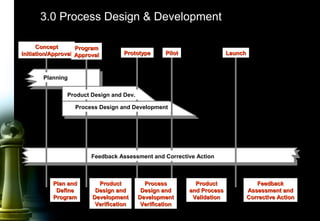
3.0 Process Design & Development
ConceptConcept
Initiation/ApprovalInitiation/Approval
ProgramProgram
ApprovalApproval PrototypePrototype PilotPilot LaunchLaunch
Planning
Product Design and Dev.
Process Design and Development
Feedback Assessment and Corrective Action
Plan andPlan and
DefineDefine
ProgramProgram
ProductProduct
Design andDesign and
DevelopmentDevelopment
VerificationVerification
ProductProduct
and Processand Process
ValidationValidation
ProcessProcess
Design andDesign and
DevelopmentDevelopment
VerificationVerification
FeedbackFeedback
Assessment andAssessment and
Corrective ActionCorrective Action
37
Phase 3
Process Design and Development
The Process Design and Development phase requires the
following aspects to be defined and/or documented;
• Customer packaging and labelling standards
Generally, the customer will provide documented packaging
and labelling guidelines. These documents should be
followed. When no guidelines are available, the cross
functional team is responsible for developing guidelines to
ensure integrity of the packaged product.
38
Process Design and Development
• Review of the current Quality
Management System to ensure its
suitability for the prospective product
and associated processes
The cross functional team should review the
manufacturing sites Quality Manual to ensure the
current Quality Management System addresses
all of the requirements to design and
manufacture the product under consideration.
Any additional controls and/or procedural
changes should be used to improve the Quality
Management System in operation
39
Process Design and Development
• Finalisation of the process flow chart
The finalized process flow chart is a schematic
representation of the process flow. This chart is used
to detect any potential bottlenecks, such as, material
flow problems and manpower.
This chart also serves as a starting point when
conducting the Process Failure Mode and Effects
Analysis.
40
Process Design and Development
• Floor plan layout with an emphasis on minimising
material travel
The floor plan should be developed to determine the
acceptability of inspection points, control chart
locations, visual aid locations, rework area(s) and
storage areas.
When developing the process and subsequent floor
plan an emphasis must be placed on utilising floor
space for value added activities.
41
Process Design and Development
• Completion of the Process Failure Mode and
Effects Analysis (FMEA)
The Process FMEA should be conducted prior to
production commencing.
The process FMEA is a structured and detailed
study performed by a cross functional team on a
process to determine how potential external and
internal factors could impact a process. Once
potential problems are established, preventive
actions are developed to control all such
problems.
42
Process Design and Development
• Completion of the Pre-launch Control Plan
The Pre-Launch control plan provides a description
of the dimensional measurements and functional
test that occur after prototype and prior to full
production. The pre-launch control plan typically
includes additional product/process controls until
the production process is validated.
43
Process Design and Development
• Measurement systems analysis plan to
encompass all of the inspection measuring and
test equipment designated on the control plan
All inspection, measuring and test equipment utilised
to measure product or process characteristics as
defined in the Control plan must under go a
Measurement Systems Analysis. The analysis
should not be just restricted to Gauge Repeatability
and Reproducibility but should also include studies
on, linearity, and accuracy, as appropriate.
44
Process Design and Development
• Process Monitoring and Operator
Instructions - these shall typically include or
reference as follows;
– Operation Name and number keyed to process flow
chart
– Part Name and Number
– Current Engineering level/date
– Required tools, gages and other equipment
– Material identification and disposition instructions
– Customer and supplier designated special
characteristics
– SPC requirements
– Relevant Engineering and manufacturing standards
45
Process Design and Development
– Inspection and test instructions
– Corrective action instructions
– Revision date and approvals
– Visual aids
– Tool change intervals and set up instructions
46
Process Design and Development
• Preventative maintenance
The cross functional should identify key process
equipment and develop an preventative maintenance
system. At a minimum the system must include;
– A procedure that describes planned maintenance
activities
– Scheduled maintenance activities
– Predictive maintenance methods
• Review of Manufacturers recommendations
• Tool wear
• Fluid Analysis
• Vibration Analysis
– Availability of replacement parts for key
manufacturing equipment
47
Process Design and Development
• Preliminary process capability requirements
If no requirements have been specified a Ppk value
greater than or equal to 1.67 should be achieved for
preliminary results (less than 30 production days)
• If process is unstable refer to customer
48
Process Design & Development
Document a once sentence summary
49
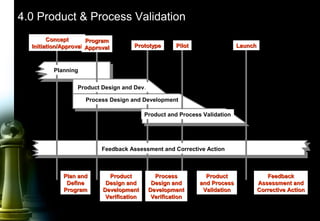
4.0 Product & Process Validation
ConceptConcept
Initiation/ApprovalInitiation/Approval
ProgramProgram
ApprovalApproval PrototypePrototype PilotPilot LaunchLaunch
Planning
Product Design and Dev.
Process Design and Development
Product and Process Validation
Feedback Assessment and Corrective Action
Plan andPlan and
DefineDefine
ProgramProgram
ProductProduct
Design andDesign and
DevelopmentDevelopment
VerificationVerification
ProductProduct
and Processand Process
ValidationValidation
ProcessProcess
Design andDesign and
DevelopmentDevelopment
VerificationVerification
FeedbackFeedback
Assessment andAssessment and
Corrective ActionCorrective Action
50
Product and Process Validation
The Product and Process validation phase requires the
following aspects to be defined and/or documented;
• Production trial run as stipulated in the Control Plan -
typically the results from this trial production run are
used for;
• Preliminary process capability studies
• Measurement systems analysis (Gauge R&R)
• Process review
• Product validation testing (Functional fit)
51
Product and Process Validation
• Production Part Approval
• Packing evaluation
• Quality Planning signoff
• Finalisation of Production Control Plan
52
Product and Process Validation
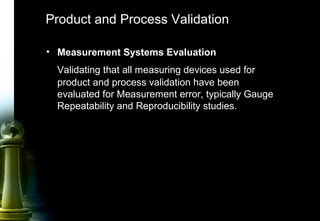
• Measurement Systems Evaluation
Validating that all measuring devices used for
product and process validation have been
evaluated for Measurement error, typically Gauge
Repeatability and Reproducibility studies.
53
Product and Process Validation
• Preliminary Process Capability study
Ensuring that preliminary process capability studies have
been conducted on all characteristics identified on the
Control Plan
54
Product and Process Validation
• Production Part Approval
Production Part Approval is required to validate that the
product manufactured meets all customer requirements.
55
Product and Process Validation
• Production Validation Testing
Production Validation testing refers to Engineering
tests that validate the production process as
meeting all of the customer requirements,
particularly, Engineering requirements.
56
Product and Process Validation
• Packaging Evaluation
Validating the packaging to ensure product is
protected to the point of delivery is an integral
phase of Product and Process Validation.
In addition the cross functional team
representatives should ensure that the type of
packaging will allow the end user to handle the
product in a safe and efficient manner.
57
Product and Process Validation
• Production Control Plan
The production control plan describes the systems
for controlling the entire process. The production
control plan is a living document that must reflect the
current flow of production. Any addition or deletions
of process, inspection activities etc.. must be
reflected in the control plan.
58
Product and Process Validation
• Quality Planning Sign-off
The Quality planning sign off is typically is typically
conducted by the cross functional team once the
control plan accurately reflects the entire process,
process instructions are satisfactory, FMEA’s are
complete and Measurement System Studies have
been completed.
The form which is typically used for sign off is
referred to as the Product Quality Planning
Summary and Sign Off Report.
59
Product & Process Validation
Document a once sentence summary
60
5.0 Feedback, Assessment & Corrective Action
ConceptConcept
Initiation/ApprovalInitiation/Approval
ProgramProgram
ApprovalApproval PrototypePrototype PilotPilot LaunchLaunch
Planning
Product Design and Dev.
Process Design and Development
Product and Process Validation
Production
Planning
Feedback Assessment and Corrective Action
Plan andPlan and
DefineDefine
ProgramProgram
ProductProduct
Design andDesign and
DevelopmentDevelopment
VerificationVerification
ProductProduct
and Processand Process
ValidationValidation
ProcessProcess
Design andDesign and
DevelopmentDevelopment
VerificationVerification
FeedbackFeedback
Assessment andAssessment and
Corrective ActionCorrective Action
61
Feedback, Assessment and Corrective Action
• Based on the output of phase 4, more specifically
the;
– Production trial run
– Measurement Systems Analysis
– Preliminary process capability study
– Production part approval
– Production validation testing
– Packaging Evaluation
– Customer concerns
62
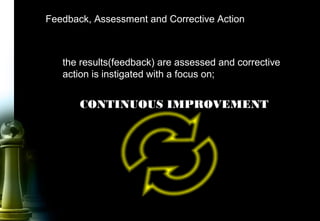
the results(feedback) are assessed and corrective
action is instigated with a focus on;
CONTINUOUS IMPROVEMENT
QS 9000
Feedback, Assessment and Corrective Action
63
Feedback, Assessment & Corrective
Action
Document a once sentence summary
64
Auditing APQP
1. How does the organisation select a cross functional
team?
2. Are cross functional teams used for APQP?
3. How does the organisation determine customer
requirements and integrate them into Phase 1 – Plan
and define the program
4. Are key dates extracted from the customer and how are
these communicated to the organisation's cross
functional team
5. Does the organisation have a defined APQP program
and is it followed
6. How is this APQP process measured
65
Auditing APQP
7. What actions are taken when milestones are not
achieved?
8. How does the organisation monitor supplier APQP
9. Examine the mechanism that the organisations has in
place to communicate information to the supplier, and
changes to these requirements
10. Does the organisation sign off the team feasibility and
commitment form?
11. Is it signed off by a cross functional team?
12. Do the team members who sign off this document
understand why the are signing the document?
13. How does the organisation transition into production
from APQP?

Apqp la

  • 1.
    Advanced Product QualityPlanning APQP ISO TS 16949:2002 Lead Auditor Course
  • 2.
    2 Course Objectives • Bythe end of the course the participant should be able to; – Audit APQP both internally and externally – Understand the need for a APQP program – Identify the 5 phases of APQP – Develop and add value to an APQP program
  • 3.
    3 The 5 Phasesof APQP 1.Plan and Define the Program 2.Product Design and Development 3.Process Design and Development 4.Product and Process Validation 5.Feedback, Assessment and Corrective Action
  • 4.
    4 An APQP overview ConceptConcept Initiation/ApprovalInitiation/Approval ProgramProgram ApprovalApprovalPrototypePrototype PilotPilot LaunchLaunch Planning Product Design and Dev. Process Design and Development Product and Process Validation Production Planning Feedback Assessment and Corrective Action Plan andPlan and DefineDefine ProgramProgram ProductProduct Design andDesign and DevelopmentDevelopment VerificationVerification ProductProduct and Processand Process ValidationValidation ProcessProcess Design andDesign and DevelopmentDevelopment VerificationVerification FeedbackFeedback Assessment andAssessment and Corrective ActionCorrective Action
  • 5.
    5 1.0 Plan andDefine Program ConceptConcept Initiation/ApprovalInitiation/Approval ProgramProgram ApprovalApproval PrototypePrototype PilotPilot LaunchLaunch Planning Feedback Assessment and Corrective Action Plan andPlan and DefineDefine ProgramProgram ProductProduct Design andDesign and DevelopmentDevelopment VerificationVerification ProductProduct and Processand Process ValidationValidation ProcessProcess Design andDesign and DevelopmentDevelopment VerificationVerification FeedbackFeedback Assessment andAssessment and Corrective ActionCorrective Action
  • 6.
    6 Phase 1 Plan anddefine the program • Form a cross functional team – The first step in planning the program is to define who will make up the cross functional team. Cross functional team does not mean one(1) person doing everything! – Typical members of a cross functional team may include: • Engineering, Production, Quality, Sales,Costing, Manufacturing, Marketing, Purchasing etc..
  • 7.
    7 Plan and definethe program • ISO TS requires that personnel within the design activity should be qualified in the following skills as appropriate – Geometric Dimensioning and tolerancing (GD&T) – Quality Function Deployment (QFD) – Design for Manufacture/Assembly (DFM/DFA) – Value Engineering (VE) – Design of Experiments (Taguchi & Classical) – Failure Mode and Effects Analysis - Design and Process
  • 8.
    8 Plan and definethe program – Finite Element Methods (FEM) – Solid Modelling – Simulation techniques – Computer Aided Design/Engineering (CAD/CAE) – Reliability Engineering plans
  • 9.
    9 Plan and definethe program • Determine customer requirements Customer requirements are typically determined by any or all of the following; – Market research – Warranty history from similar products – Supplier Quality Reports – Team Experience
  • 10.
    10 Plan and definethe program • Business plan The Business plan is a formal requirement of ISO TS. It is a strategic document which may place some constraints on the development of the proposed product. Examples of Constraints: Project timing, cost of investment in technology, machinery and human resources, quality requirements, manufacturing capabilities, government regulations
  • 11.
    11 Plan and definethe program • Benchmark data - Process & Product At this stage of the program Benchmark data should be obtained for the process and product as appropriate. Benchmark data may be used to establish the “GAP” between your current product or process and that of the “World Best”. Corrective action plans should be developed to close the “GAP” with the focus on becoming “World Best”.
  • 12.
    12 Plan and definethe program • Product and Process assumptions List all of the current product and process assumptions. Examples may be: – Material Characteristics and Performance – Reliability assessments – Machine capabilities – Management Structure
  • 13.
    13 Plan and definethe program • Product Reliability studies This area relates to identifying the frequency of repair or replacement of components over periods of time. Examples are: – Service every 30,000 miles – Replacement after 2 years – Service after 1,000,000 cycles
  • 14.
    14 Plan and definethe program • At the completion of this stage the following aspects should be defined; • Design goals • Reliability goals • Quality targets
  • 15.
    15 Plan and definethe program • Preliminary Bill of Material (BOM) • Preliminary process flow chart • Preliminary listing of special characteristics • Any governmental, environmental or safety regulations
  • 16.
    16 Example (Typical output atcompletion of phase 1 - Plan and define the program) Supplier Name: World Class Pty Ltd Part Name: Boot Carpet trim Part Number: 1234-1 Drawing date: 19 FEB ‘99 Brief description of part: The Boot carpet trim is a carpet that is vacuum formed onto a polypropylene substrate. It is then trimmed by a water jet cutter into shape, followed by an assembly operation where six (6) spacers are located.
  • 17.
    17 Example (Typical output atcompletion of phase 1 - Plan and define the program) • Design Goals – Zero Carpet folds – Acceptable color match between carpet and mating components – No peeling of carpet from polypropylene substrate • Reliability Goals – Zero customer returns for carpet wear Note: reliability goals are typically set for mechanical and/or electrical components.
  • 18.
    18 Example (Typical output atcompletion of phase 1 - Plan and define the program) • Quality Targets – PpK of all special characteristics >1.67 – Cpk of all special characteristics >1.33 – Reject rate < 0.5% for 1st 12 months < 0.35% for 2nd 12 months – Color tolerance for carpet Delta E <0.5 units
  • 19.
    19 Example (Typical output atcompletion of phase 1 - Plan and define the program) • Preliminary Bill Of Material (BOM) Name Location Name Location Vacuum Former #4 Production Fixture 1234-1 Store F23 Steel frame 1800x1200 mm Store E24 Packaging 50/crate Store F10 Poly propylene 1850x1250 Store B16 Spacers 6/unit Store A17 Carpet 1850x1250 Store B21 Mounting Fixture 1234-2 Store F24 Water Jet cutter #1 Production Labels 1/unit Store F22
  • 20.
    20 Example (Typical output atcompletion of phase 1 - Plan and define the program) • Preliminary Process Flow Chart Receive material and locate in store 1 Vacuum forming operation 2 Trim carpet to correct shape using water jet cutter 3 Assemble 6 spacers to each unit 4 Pack in stillage 5
  • 21.
    21 Example (Typical output atcompletion of phase 1 - Plan and define the program) • Preliminary Listing of Special characteristics ie KPC – Color of carpet - Delta E < 0.5 units – Hole locations +/- 1.0 mm – Hole Dimensions +/- 0.5mm • Government, Safety or Environmental regulations – Substrate of Polypropylene to be identified for recycling purposes
  • 22.
    22 Plan & Definethe program Document a once sentence summary
  • 23.
    23 2.0 Product Design& Development ConceptConcept Initiation/ApprovalInitiation/Approval ProgramProgram ApprovalApproval PrototypePrototype PilotPilot LaunchLaunch Planning Product Design and Dev. Feedback Assessment and Corrective Action Plan andPlan and DefineDefine ProgramProgram ProductProduct Design andDesign and DevelopmentDevelopment VerificationVerification ProductProduct and Processand Process ValidationValidation ProcessProcess Design andDesign and DevelopmentDevelopment VerificationVerification FeedbackFeedback Assessment andAssessment and Corrective ActionCorrective Action
  • 24.
    24 Phase 2 Product Designand Development The Product Design and Development phase begins with the generation of a Design FMEA • Design Failure Mode and Effects Analysis
  • 25.
    25 Product Design andDevelopment • ISO TS requires that design output shall be the result of a process that includes the following; – Efforts to simplify, optimise, innovate and reduce waste with methods such as; • Quality Function Deployment (QFD) • Design for Manufacture/Assembly (DFM/DFA) • Value Engineering (VE) • Design of Experiment • Tolerance studies (GD&T) • Response surface methodology
  • 26.
    26 Product Design andDevelopment • Analysis of costs/performance/risks trade offs • Use of feedback from testing, production and the field • Use of Design FMEA’s
  • 27.
    27 Product Design andDevelopment • Design verification at appropriate stages of design The purpose of the design verification is to ensure that the design output is meeting the planned design input as defined in phase 1, Plan and Define the program. Example: Phase 1: Design Input - Hole locations +/- 1.0 mm Phase 2: Design Output - Engineering Drawings stipulating the Hole locations at the tolerance of +/- 1.0 mm
  • 28.
    28 Product Design andDevelopment • Design reviews (formal documented review) Design reviews are conducted to monitor the progress of the project relative to customer requirements. The reviews are conducted by a cross functional team and the results of each review must be documented. Typically, the Design reviews might cover; Design FMEA’s, Design verification progress, reliability tests and studies, computer simulation results, benchmark data and overall progress relative to time constraints
  • 29.
    29 Product Design andDevelopment • Prototype build control plan A prototype build control plan should be developed for a product when required by the customer. This control plan will detail the results from a dimensional analysis, material and functional tests, engineering and reliability tests.
  • 30.
    30 Product Design andDevelopment • Finalisation of; – Engineering drawings including CAD data – Engineering specifications – Material specifications At this stage the cross functional team should have reviewed and approved all drawings, engineering specifications and material specifications.
  • 31.
    31 Product Design andDevelopment • New equipment, tooling and facilities During the design review the cross functional team may determine that new equipment, tooling and facilities will be required. These details must be addressed and included in the overall timing plan. Emphasis must be placed on ensuring that new equipment, tooling and facilities are completed on time.
  • 32.
    32 • Finalisation ofspecial characteristics At this stage the majority of technical information is known and as a consequence the special characteristics should be agreed upon by the cross functional team and finalised. The Control Plan should denote the finalised special characteristics. Product Design and Development
  • 33.
    33 • Any newinspection, measuring and test equipment device Based on all the information generated, in particular, the characteristics which need to be measured the cross functional team should determine whether any new inspection, measuring and test equipment is required. If the equipment is required, this should be recorded into the overall timing plan and progress towards the acquisition be monitored. Product Design and Development
  • 34.
    34 • Team Feasibilitystatement (This is a compulsory requirement of ISO TS 16949:2002 At this time the cross functional team must be satisfied that the proposed design can be manufactured to the customer’s requirements. Once satisfied, the cross functional team members must sign off the Team Feasibility Statement. Product Design and Development
  • 35.
    35 Product Design &Development Document a once sentence summary
  • 36.
    36 3.0 Process Design& Development ConceptConcept Initiation/ApprovalInitiation/Approval ProgramProgram ApprovalApproval PrototypePrototype PilotPilot LaunchLaunch Planning Product Design and Dev. Process Design and Development Feedback Assessment and Corrective Action Plan andPlan and DefineDefine ProgramProgram ProductProduct Design andDesign and DevelopmentDevelopment VerificationVerification ProductProduct and Processand Process ValidationValidation ProcessProcess Design andDesign and DevelopmentDevelopment VerificationVerification FeedbackFeedback Assessment andAssessment and Corrective ActionCorrective Action
  • 37.
    37 Phase 3 Process Designand Development The Process Design and Development phase requires the following aspects to be defined and/or documented; • Customer packaging and labelling standards Generally, the customer will provide documented packaging and labelling guidelines. These documents should be followed. When no guidelines are available, the cross functional team is responsible for developing guidelines to ensure integrity of the packaged product.
  • 38.
    38 Process Design andDevelopment • Review of the current Quality Management System to ensure its suitability for the prospective product and associated processes The cross functional team should review the manufacturing sites Quality Manual to ensure the current Quality Management System addresses all of the requirements to design and manufacture the product under consideration. Any additional controls and/or procedural changes should be used to improve the Quality Management System in operation
  • 39.
    39 Process Design andDevelopment • Finalisation of the process flow chart The finalized process flow chart is a schematic representation of the process flow. This chart is used to detect any potential bottlenecks, such as, material flow problems and manpower. This chart also serves as a starting point when conducting the Process Failure Mode and Effects Analysis.
  • 40.
    40 Process Design andDevelopment • Floor plan layout with an emphasis on minimising material travel The floor plan should be developed to determine the acceptability of inspection points, control chart locations, visual aid locations, rework area(s) and storage areas. When developing the process and subsequent floor plan an emphasis must be placed on utilising floor space for value added activities.
  • 41.
    41 Process Design andDevelopment • Completion of the Process Failure Mode and Effects Analysis (FMEA) The Process FMEA should be conducted prior to production commencing. The process FMEA is a structured and detailed study performed by a cross functional team on a process to determine how potential external and internal factors could impact a process. Once potential problems are established, preventive actions are developed to control all such problems.
  • 42.
    42 Process Design andDevelopment • Completion of the Pre-launch Control Plan The Pre-Launch control plan provides a description of the dimensional measurements and functional test that occur after prototype and prior to full production. The pre-launch control plan typically includes additional product/process controls until the production process is validated.
  • 43.
    43 Process Design andDevelopment • Measurement systems analysis plan to encompass all of the inspection measuring and test equipment designated on the control plan All inspection, measuring and test equipment utilised to measure product or process characteristics as defined in the Control plan must under go a Measurement Systems Analysis. The analysis should not be just restricted to Gauge Repeatability and Reproducibility but should also include studies on, linearity, and accuracy, as appropriate.
  • 44.
    44 Process Design andDevelopment • Process Monitoring and Operator Instructions - these shall typically include or reference as follows; – Operation Name and number keyed to process flow chart – Part Name and Number – Current Engineering level/date – Required tools, gages and other equipment – Material identification and disposition instructions – Customer and supplier designated special characteristics – SPC requirements – Relevant Engineering and manufacturing standards
  • 45.
    45 Process Design andDevelopment – Inspection and test instructions – Corrective action instructions – Revision date and approvals – Visual aids – Tool change intervals and set up instructions
  • 46.
    46 Process Design andDevelopment • Preventative maintenance The cross functional should identify key process equipment and develop an preventative maintenance system. At a minimum the system must include; – A procedure that describes planned maintenance activities – Scheduled maintenance activities – Predictive maintenance methods • Review of Manufacturers recommendations • Tool wear • Fluid Analysis • Vibration Analysis – Availability of replacement parts for key manufacturing equipment
  • 47.
    47 Process Design andDevelopment • Preliminary process capability requirements If no requirements have been specified a Ppk value greater than or equal to 1.67 should be achieved for preliminary results (less than 30 production days) • If process is unstable refer to customer
  • 48.
    48 Process Design &Development Document a once sentence summary
  • 49.
    49 4.0 Product &Process Validation ConceptConcept Initiation/ApprovalInitiation/Approval ProgramProgram ApprovalApproval PrototypePrototype PilotPilot LaunchLaunch Planning Product Design and Dev. Process Design and Development Product and Process Validation Feedback Assessment and Corrective Action Plan andPlan and DefineDefine ProgramProgram ProductProduct Design andDesign and DevelopmentDevelopment VerificationVerification ProductProduct and Processand Process ValidationValidation ProcessProcess Design andDesign and DevelopmentDevelopment VerificationVerification FeedbackFeedback Assessment andAssessment and Corrective ActionCorrective Action
  • 50.
    50 Product and ProcessValidation The Product and Process validation phase requires the following aspects to be defined and/or documented; • Production trial run as stipulated in the Control Plan - typically the results from this trial production run are used for; • Preliminary process capability studies • Measurement systems analysis (Gauge R&R) • Process review • Product validation testing (Functional fit)
  • 51.
    51 Product and ProcessValidation • Production Part Approval • Packing evaluation • Quality Planning signoff • Finalisation of Production Control Plan
  • 52.
    52 Product and ProcessValidation • Measurement Systems Evaluation Validating that all measuring devices used for product and process validation have been evaluated for Measurement error, typically Gauge Repeatability and Reproducibility studies.
  • 53.
    53 Product and ProcessValidation • Preliminary Process Capability study Ensuring that preliminary process capability studies have been conducted on all characteristics identified on the Control Plan
  • 54.
    54 Product and ProcessValidation • Production Part Approval Production Part Approval is required to validate that the product manufactured meets all customer requirements.
  • 55.
    55 Product and ProcessValidation • Production Validation Testing Production Validation testing refers to Engineering tests that validate the production process as meeting all of the customer requirements, particularly, Engineering requirements.
  • 56.
    56 Product and ProcessValidation • Packaging Evaluation Validating the packaging to ensure product is protected to the point of delivery is an integral phase of Product and Process Validation. In addition the cross functional team representatives should ensure that the type of packaging will allow the end user to handle the product in a safe and efficient manner.
  • 57.
    57 Product and ProcessValidation • Production Control Plan The production control plan describes the systems for controlling the entire process. The production control plan is a living document that must reflect the current flow of production. Any addition or deletions of process, inspection activities etc.. must be reflected in the control plan.
  • 58.
    58 Product and ProcessValidation • Quality Planning Sign-off The Quality planning sign off is typically is typically conducted by the cross functional team once the control plan accurately reflects the entire process, process instructions are satisfactory, FMEA’s are complete and Measurement System Studies have been completed. The form which is typically used for sign off is referred to as the Product Quality Planning Summary and Sign Off Report.
  • 59.
    59 Product & ProcessValidation Document a once sentence summary
  • 60.
    60 5.0 Feedback, Assessment& Corrective Action ConceptConcept Initiation/ApprovalInitiation/Approval ProgramProgram ApprovalApproval PrototypePrototype PilotPilot LaunchLaunch Planning Product Design and Dev. Process Design and Development Product and Process Validation Production Planning Feedback Assessment and Corrective Action Plan andPlan and DefineDefine ProgramProgram ProductProduct Design andDesign and DevelopmentDevelopment VerificationVerification ProductProduct and Processand Process ValidationValidation ProcessProcess Design andDesign and DevelopmentDevelopment VerificationVerification FeedbackFeedback Assessment andAssessment and Corrective ActionCorrective Action
  • 61.
    61 Feedback, Assessment andCorrective Action • Based on the output of phase 4, more specifically the; – Production trial run – Measurement Systems Analysis – Preliminary process capability study – Production part approval – Production validation testing – Packaging Evaluation – Customer concerns
  • 62.
    62 the results(feedback) areassessed and corrective action is instigated with a focus on; CONTINUOUS IMPROVEMENT QS 9000 Feedback, Assessment and Corrective Action
  • 63.
    63 Feedback, Assessment &Corrective Action Document a once sentence summary
  • 64.
    64 Auditing APQP 1. Howdoes the organisation select a cross functional team? 2. Are cross functional teams used for APQP? 3. How does the organisation determine customer requirements and integrate them into Phase 1 – Plan and define the program 4. Are key dates extracted from the customer and how are these communicated to the organisation's cross functional team 5. Does the organisation have a defined APQP program and is it followed 6. How is this APQP process measured
  • 65.
    65 Auditing APQP 7. Whatactions are taken when milestones are not achieved? 8. How does the organisation monitor supplier APQP 9. Examine the mechanism that the organisations has in place to communicate information to the supplier, and changes to these requirements 10. Does the organisation sign off the team feasibility and commitment form? 11. Is it signed off by a cross functional team? 12. Do the team members who sign off this document understand why the are signing the document? 13. How does the organisation transition into production from APQP?